
Teaching Your Baby to Connect, Ask, and Play
Start Here: 2-minute quick guide
If you only do one thing today, try this:
- Pick something your child loves right now. A snack, a toy, bubbles, a song on your phone.
- Hold it where they can see it but can't grab it. Wait.
- When they reach, point, look at you, or make any sound, give it immediately and say the word out loud ("Bubbles!" or "Rice!").
- Repeat 3 or 4 times across the day with different things they want.
That is the foundation. One moment of connection, repeated.
You are probably exhausted. You might be second-guessing yourself, wondering if you are doing enough, if you will ever break through. If you are reading this in Manila, or anywhere else in the world where professional help feels out of reach financially or geographically, you are not alone. You are doing the most important work there is.
You told us you are working on sensory support, emotional regulation, and advocacy for your child under 3 with autism, ADHD, and behavioral needs. Those 3 areas all rest on the same foundation: your child's ability to connect with you, to ask for what they need, and to share what they are experiencing. When a baby or toddler cannot communicate, frustration builds. Behaviors spike. Connection feels impossible. The good news is that communication does not require words. It starts with a look, a reach, a shared moment over something your child cares about.
Behavior analysts call this joint attention (when you and your child are both focused on the same thing at the same time, together) and functional communication (any way your child tells you what they want or need, not just talking). These 2 skills predict everything that comes later: language, play, relationships, self-regulation. Research shows that children with autism who develop joint attention and early requesting skills between 8 and 36 months have significantly better language and social outcomes years later. You are not teaching tricks. You are building the neural pathways for connection.
1. Follow your child's motivation in the moment. That is when communication has power.
Behavior analysts call this a motivating operation (what makes a reward valuable right now). If your 2 year old is reaching for rice crackers, that is your teaching moment. Hold the cracker where they can see it but not grab it. Wait 2 or 3 seconds. When they look at you, reach toward you, point, or make any sound, give the cracker immediately and say the word ("Cracker!"). You just taught them that communication is a tool. Do this 10 times a day with things they already want: milk, a favorite toy, tickles, a song. You are not forcing them to perform. You are showing them that connecting with you gets them what they need. For a child under 3, this is the single most important pattern to establish.
2. Get down at their eye level and make it easy for them to see your face.
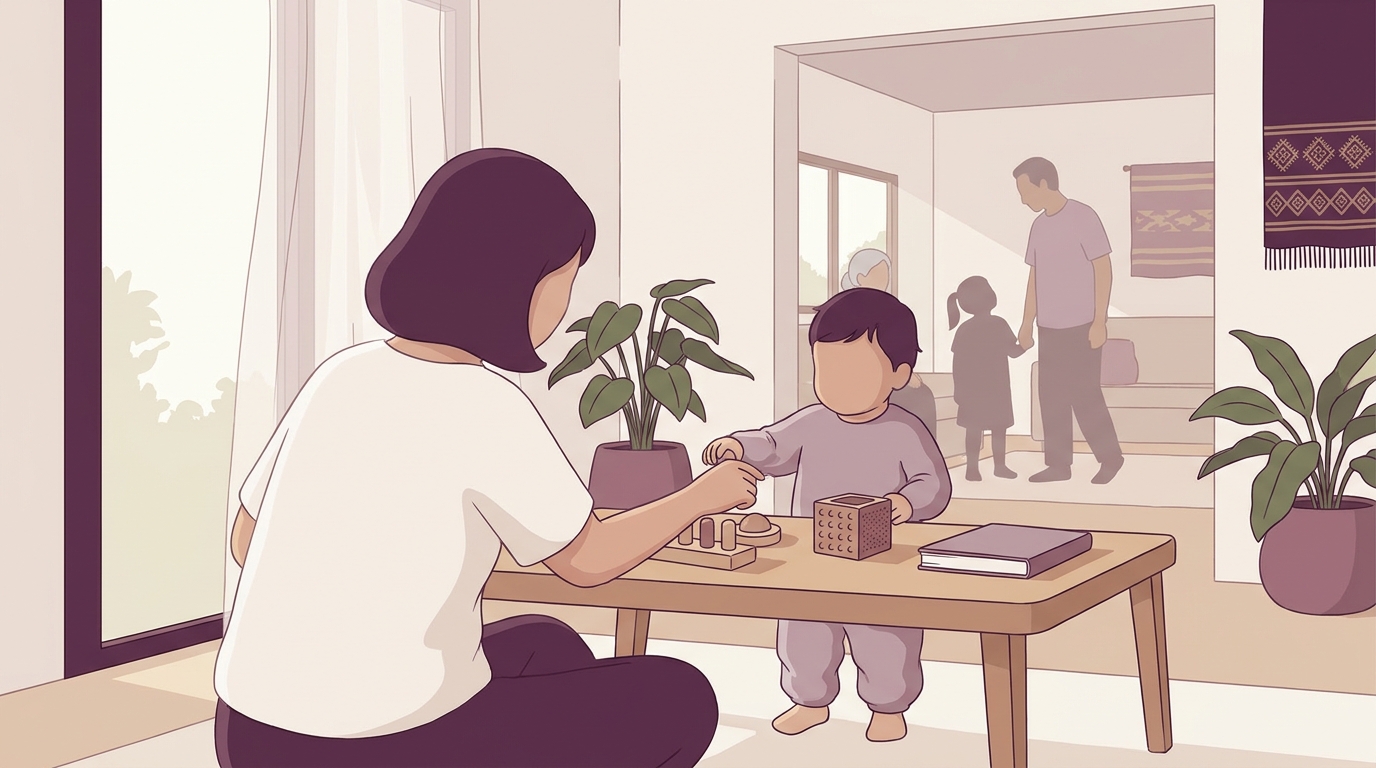
Joint attention (that shared triangle between you, your child, and the object) requires your child to know that YOU have the thing they want. If you are standing and they are on the floor, that connection is harder. Sit on the floor. Hold the item between your face and theirs. When they reach for it, pause. Wait for any sign they are looking toward you, even a quick glance. Then give it and name it. Over time, that glance becomes a look, the look becomes a reach-plus-look, and the reach-plus-look becomes a word or a sign. But it starts with you being physically present and accessible in their space.
3. Use play routines that have a natural start and stop, so you get lots of chances to practice.
Bubbles are perfect for this. Blow 1 or 2 bubbles, then stop. Your child will want more. Wait. When they look at you, reach, or make a sound, blow more and say "Bubbles!" Repeat 5 or 6 times. The same works with peek-a-boo, bouncing on your lap, or rolling a ball back and forth. These repeatable routines (behavior analysts call them play scripts) teach your child that communication is predictable and safe. They ask, you respond. Every time. For a toddler in a multi-generational home in Metro Manila, this works with grandparents, aunts, uncles, and siblings too. The more people who play the same routine, the faster your child learns that all people respond to requests.
4. If your child does not use words yet, teach them another way to ask: pointing, signing, or handing you a picture.
Functional communication does not mean vocal speech. It means any behavior that successfully gets a need met. If your child can point, you can shape that into a request. Hold a favorite snack (mango, crackers, whatever they love) and wait for them to point at it. Give it immediately. If they cannot point yet, gently guide their hand into a point, then give the snack. Do this 3 or 4 times, then try waiting to see if they point on their own before you help. If your family uses sign language or you want to try it, pick 3 simple signs (more, eat, drink) and use hand-over-hand prompting (guiding their hands to make the sign) every time they want that item. Over a week or 2, fade your help so they do more of the sign themselves. Pictures work the same way: print a photo of rice, milk, or a toy, tape it to the fridge, and every time your child wants that item, help them pick up the picture and hand it to you. Then give the item and say the word. You are building a bridge to language, not waiting for it to appear.
5-day starter plan (what to do this week):
- Day 1: Pick 3 things your child asks for most often (snack, drink, toy). Write them down. These are your teaching targets.
- Day 2: When your child wants one of those 3 things, hold it where they can see it, wait 2 seconds for any communication attempt (look, reach, sound), then give it and say the word. Do this 5 times today.
- Day 3: Add a play routine with a natural stop: bubbles, peek-a-boo, or bouncing. Do it 3 times, pausing after each round to wait for your child to ask for more (any gesture or sound counts).
- Day 4: Sit on the floor at your child's level during 2 play moments today. Notice if eye contact or reaching toward you increases when you are physically closer.
- Day 5: If your child is not using words, pick 1 sign or 1 picture for their favorite item. Use hand-over-hand prompting or picture exchange 3 times today, then give the item immediately each time.
By the end of this week, you will have created 15 to 20 moments where your child experienced the power of communication. That is how connection starts.
If you would like step-by-step video instruction that walks you through exactly how to teach communication, joint attention, and early play skills at home, the resource built for you is Journey to Independence: Parent ABA Training & Curriculum Bundle at https://store.special-learning.com/product/journey-to-independence-curriculum-level-1. It is Special Learning's structured ABA training course designed specifically for parents, with modules on requesting, play routines, sensory support, and emotional regulation. 12 months of access for $199. If you want a lower-cost entry point, the printable Journey to Independence Curriculum Level 1 is $79 at https://store.special-learning.com/product/jti-curriculum-level-1. It is a play-based ABA curriculum you download and keep, not a video course.
You can also download the free Autism Early Screening Checklist (37 developmental questions) at https://special-learning.com/for-parents/ to track what your child is doing now and what to work on next. If you want to talk through your specific situation with a behavior analyst at no cost, book a free 60-minute V-CAT consultation at the same page.
Looking for a guide built for your specific situation?
Our 2-minute survey gives you a free personalized guide grounded in Special Learning's clinical library.
Take the 2-Minute SurveyPrefer this guide in another language?
Tap to tell us which language you need. We use these requests to decide which languages we translate next.