
Getting a Nonverbal 4-Year-Old to Use an AAC Device Consistently: A Guide for SLPs Working with Preschoolers with Autism
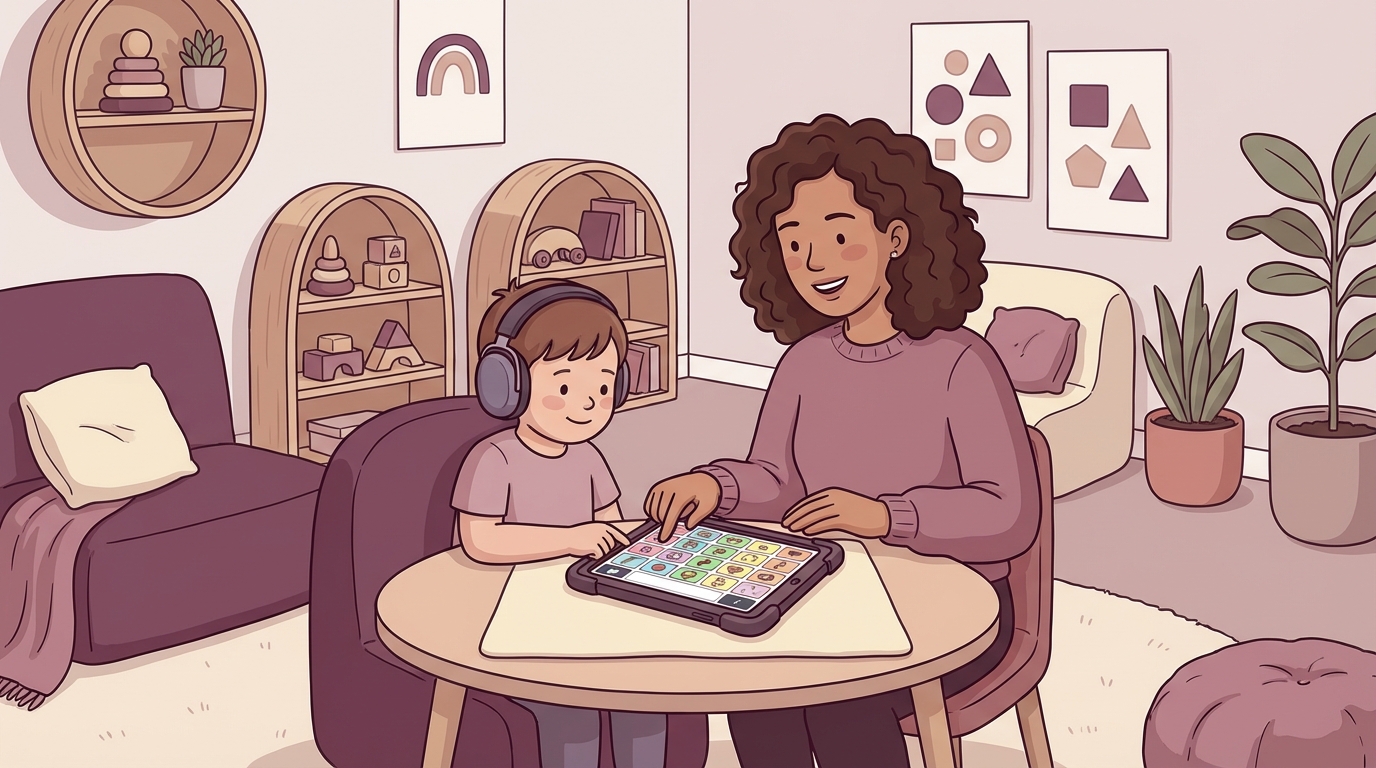
You have a 4-year-old client who has been introduced to an augmentative and alternative communication (AAC) device, but consistent use remains elusive. The device sits untouched during sessions. The child continues to lead adults by the hand, grab for items, or engage in challenging behavior when frustrated. This is one of the most common and most frustrating scenarios for SLPs working with preschoolers with autism, and the research is clear: the challenge is rarely about the child's ability to use the device. It is about whether we have systematically taught functional communication as a behavior worth repeating.
AAC devices are tools, not treatments. As noted in Special Learning's training on mand training across modalities, choosing the correct communication modality is only the first step. The real work lies in conducting a task analysis of what the child needs to do to successfully mand (request), assessing the child's current repertoire against that ideal sequence, and then designing an intervention that makes AAC-based requesting more effective than any other behavior the child currently uses to access preferred items. If grabbing, crying, or leading an adult by the hand reliably produces cookies, the AAC device will remain a decorative object.
Collaboration between speech-language pathologists and behavior analysts is particularly powerful here. SLPs bring deep expertise in augmentative communication, language development, and device programming. Behavior analysts contribute systematic prompting hierarchies, reinforcement schedules, and data systems that allow you to see whether your intervention is working week by week. As discussed in Special Learning's SLP-ABA collaboration series, the overlap between our fields is greatest when addressing functional communication. The SLP selects and programs the device. The behavior analyst (or SLP with ABA training) designs the teaching procedure. Both monitor progress together. When this collaboration works, children make gains that neither discipline could produce alone.
Consistency in AAC use is not a motivation problem. It is a learning problem. The child has not yet learned that using the device is the most efficient, most effective way to get needs met. Your job is to engineer that learning, one mand at a time, with precision and patience.
Strategy 1: Conduct a Task Analysis for the Target Mand
Before you teach anything, write out every step required for the child to successfully request a cookie (or any preferred item) using the AAC device. A complete task analysis might include: (1) the child has an establishing operation (is motivated for the item), (2) the child knows who controls access to that item, (3) the child gains that person's attention, (4) the child navigates to the correct screen or folder on the device, (5) the child selects the icon, (6) the child waits for the adult to respond. Now compare this ideal sequence to what the child currently does. Does the child approach an adult? Does the child look at the adult's face? Does the child wait after pressing the icon, or does the child grab immediately? Identify every missing step. Those gaps are your teaching targets. This task analysis process is emphasized throughout Special Learning's mand training curriculum and is the foundation of errorless teaching.
Strategy 2: Choose 1 High-Value Item and Control Access Completely
Do not expect generalization at the start. Choose 1 item the child loves (a specific snack, a specific toy, a specific video) and make that item available only when the child uses the AAC device to request it. This is not punishment. It is teaching. If the child can access the item by grabbing, the device has no function. During teaching trials, the item should be visible but out of reach. You may need to keep it in a clear container on a high shelf. The establishing operation (the child's desire for the item) is what drives the mand. Create that motivation deliberately. As noted in the mand training transcript, withholding a favorite item can be delicate, but pairing it with errorless prompting (see Strategy 4) ensures the child experiences success immediately, reducing frustration.
Strategy 3: Use a Communication Modality Assessment to Confirm AAC is the Right Fit
If the child continues to resist the device after systematic teaching, revisit whether AAC is the appropriate modality. The communication modality assessment described in Special Learning's mand training materials evaluates 25 prerequisite skills across 5 modalities: vocal words, sign language, picture exchange, low-tech AAC, and high-tech AAC. Does the child have joint attention skills? Does the child tolerate sitting for the length of time required to work through a device? Is the child able to make simple motor movements with accuracy? High-tech AAC requires scanning, selecting, and waiting. If the child does not yet attend to an adult or cannot isolate a finger to press an icon, you may need to start with a lower-tech option (a single-message device, a picture exchange card) and build up. The modality must match the child's current skill set, not your aspirations.
Strategy 4: Use Most-to-Least Prompting with Physical Guidance
Errorless learning means the child does not fail. At the beginning, you provide full physical guidance: hand-over-hand, you help the child press the icon for "cookie." The moment the icon is pressed, you deliver the cookie immediately (or a small piece of it, to allow for multiple teaching trials). Over successive trials, you fade your prompt: from hand-over-hand, to touching the child's wrist, to touching the elbow, to a gestural prompt (pointing at the device), to no prompt at all. The child should experience success on every trial. This is the most effective way to build a new skill and is a core principle from applied behavior analysis. The SLP-ABA collaboration transcript emphasizes that behavior analysts bring systematic prompting procedures to the table. Use them.
Strategy 5: Collect Data on Independent Device Use
Track the level of prompting required for each mand. Create a simple data sheet with columns for: date, item requested, prompt level (full physical, partial physical, gestural, verbal, independent), and whether the child waited after pressing the icon. Take data every session. Graph it weekly. You should see the prompt level decrease over time. If you do not see progress after 2 weeks of daily teaching (10 to 15 trials per session), your intervention needs adjustment. Perhaps the reinforcer is not strong enough. Perhaps the device navigation is too complex. Perhaps the child is not yet attending to you as the person who controls the item. Data tells you what to change. Without data, you are guessing.
Strategy 6: Program the Device for Speed and Simplicity
A 4-year-old with limited communication skills does not need 8 categories and 200 icons. At the start, 1 screen with 4 to 6 icons is enough. Program the icons for highly preferred items only: cookie, juice, iPad, play, bubbles, swing. Use real photos if possible, not generic clipart. Make the icons large (at least 2 inches square). Reduce motor planning demands. Every extra screen, every extra folder, every extra step is a barrier to success. You can add complexity later, after the child has learned that using the device works. Simplicity is not dumbing down. It is good teaching.
Strategy 7: Teach "Attention-Gaining" as a Separate Skill
Many children press the icon and then grab for the item without waiting for the adult to respond. Or they press the icon while the adult is across the room. This is a breakdown in the mand sequence. The child does not yet understand that the device is a tool for communicating with a person. Explicitly teach attention-gaining. Before mand training, run trials where the child must tap your arm, say "excuse me" (if vocal), or press an "I need help" button to get your attention, and you immediately turn and deliver praise or a small edible. Once the child reliably gains attention, then introduce the mand for the specific item. This two-step sequence (gain attention, then request) is often missing from AAC training and is a major reason devices sit unused.
Strategy 8: Collaborate with the BCBA or Educator to Ensure Consistency Across Settings
The device must be available and used the same way in the classroom, at home, and during related services. If the child can grab snacks in the classroom but must use the device during speech sessions, you are teaching the child that the device is situational, not functional. Meet with the classroom teacher or behavior analyst. Share your prompting hierarchy. Share your data sheet. Train the parent. As discussed in Special Learning's multidisciplinary collaboration series, IEP teams often develop goals in silos. The SLP works on requesting, the teacher works on compliance, the BCBA works on reducing tantrums. But if the child's tantrums are occurring because the child cannot access preferred items, and the SLP is the only person teaching the communication alternative, the intervention will fail. Alignment across the team is not optional. It is the mechanism of success.
Keep Exploring ABA
Free guides, glossaries, and ready-to-use tools for families, caregivers, and educators. Browse a growing library of practical, ready-to-use classroom tools and downloadables including visual schedules, token boards, data sheets, and communication boards. Browse Free Resources →
5-Day Starter Plan: Teaching Your 4-Year-Old Client to Use the AAC Device for 1 Request
Day 1: Conduct the Task Analysis and Choose Your Target Item
Write out every step required for your client to request "cookie" (or another high-preference item) using the AAC device. Compare that sequence to what the child currently does. Identify the missing steps. Choose 1 item the child loves and will work for. Confirm with the parent or teacher that this item can be restricted to AAC-only access for the next 2 weeks.
Day 2: Simplify the Device and Set Up the Environment
Program the AAC device with 1 screen and 4 to 6 icons for highly preferred items. Use large icons (2 inches minimum) and real photos if possible. Place the target item (cookie) in a clear container on a shelf the child can see but not reach. Have the AAC device within arm's reach of the child at all times during the session. Prepare 10 small pieces of the cookie so you can run multiple trials without satiation.
Day 3: Run 5 Errorless Teaching Trials
Sit next to the child. Show the cookie. Wait 2 seconds. If the child does not press the icon, provide full hand-over-hand guidance to press "cookie." The moment the icon is pressed, deliver 1 small piece of cookie immediately and praise ("Nice asking!"). Repeat 5 times. Record the prompt level for each trial (full physical, partial physical, gestural, independent). Do not let the child fail. Every trial ends with cookie delivery.
Day 4: Begin Fading Your Prompt
Run 5 trials again. This time, start with a lighter touch: touch the child's wrist instead of guiding the whole hand. If the child completes the press independently, immediately fade to a gestural prompt (pointing at the device) on the next trial. If the child needs more support, stay at wrist-level prompting. Record every trial. Graph your data. You should see at least 1 trial with less prompting than yesterday.
Day 5: Share Your Data and Plan with the Team
Email your task analysis, your data sheet, and your prompt fading plan to the classroom teacher, the BCBA (if there is one), and the parent. Include 1-paragraph instructions: "When [child] wants a cookie, show the cookie, wait 2 seconds, then provide [current prompt level] to press the icon. Deliver the cookie immediately after the press." Request that all adults use the same procedure. Schedule a 15-minute check-in meeting for next week to review progress and troubleshoot barriers. Consistency across settings is the difference between a device that works and a device that collects dust.
Looking for a guide built for your specific situation?
Our 2-minute survey gives you a free personalized guide grounded in Special Learning's clinical library.
Take the 2-Minute Survey