
For San Diego Unified principals, bookkeepers and special education leads · Checked November 16, 2026
How a San Diego Unified school buys autism and behavior-support training for support staff
Special Learning has no San Diego Unified contract, quote, purchase order or vendor number today. For a team of 10, the course is $990; a team of 50 is $4,950. The district’s Administrative Regulation 3300 lists “Micro-Purchases $0.00 - $10,000.00,” says that from $10,000.01 to $90,200.00 “the requisitioner must solicit at least two quotes,” and routes each requisition to an Approver, “the principal or department head,” before Strategic Sourcing and Contracts (SS&C) reviews it. Here are the steps to confirm with SS&C and your bookkeeper, the district rule behind each, and what we could not confirm, including where district documents differ.
Ask for a written quote your school can use
Each fact, with its source
01What we confirmed, and from where
| What we confirmed | Source |
|---|---|
| Vendor registration. The Bids page: “The district has an Agreement with PlanetBids to announce and process all solicitations released by the Strategic Sourcing and Contracts Department. To register, receive automatic announcements, and to download solicitations from the San Diego Unified School District, at no cost, please click on the following link: PlanetBids.” The Supplier Self-Service page: “For information on becoming a supplier or vendor with the district please contact the Strategic Sourcing & Contracts Officer at 858-522-5808.” The deck’s “New Supplier and Purchasing Information” slide: “When you are working with a new supplier or have an update to an existing supplier, enter the information using the New Supplier/Supplier Update Request Form. SS&C will process the update in PeopleSoft.” Its “Entering E-Pro Requisitions” slide: “If you have a new supplier you would like to work with, send the New Supplier link to that supplier to complete.” Its “Sourcing Best Practices” slide: “Make sure the Supplier is in PeopleSoft / New Suppliers need W9 and 590 Form / New Supplier Request.” We found no definition of “approved vendor,” no sentence on whether a vendor must be on PlanetBids before a purchase order or a card purchase, and no small-business program for supplies or services (the Business Outreach Program page describes construction-related businesses). The New Supplier form is on a staff site we did not open. | Bids page; Supplier Self-Service page; End of Year Conference deck (February 29, 2024); Business Outreach Program page |
| California forms named for new suppliers. The deck names “590 Form.” California Franchise Tax Board Form 590 (taxable year 2025) opens: “The payee completes this form and submits it to the withholding agent. The withholding agent keeps this form with their records.” Form 587 is titled “Nonresident Withholding Allocation Worksheet.” Both are withholding forms. The district’s documents do not say which form a given supplier files, and we do not say; ask SS&C. | End of Year Conference deck (February 29, 2024); FTB Form 590; FTB Form 587 |
| State bidding law. Public Contract Code 20111(a)(1) (read on california.public.law, which prints its leginfo source): “The governing board of any school district ... shall let any contracts involving an expenditure of more than fifty thousand dollars ($50,000) for any of the following: (A) The purchase of equipment, materials, or supplies to be furnished, sold, or leased to the district. (B) Services, except construction services. ...” (a)(2): “The governing board shall let the contract to the lowest responsible bidder who shall give security as the board requires, or else reject all bids.” (e) says the Superintendent of Public Instruction “shall annually adjust the dollar amounts specified in subdivision (a).” The State Superintendent’s letter of December 8, 2025: “effective January 1, 2026, the State Superintendent has determined that the inflation adjusted bid threshold will increase from $114,800 to $119,100.” We found no letter for 2027 as of November 16, 2026. (d): “This section shall not apply to professional services or advice, ...” (the sentence continues with other categories; read it in full at the link). We do not say whether (d) reaches a staff course; ask SS&C which method applies to your purchase. | Public Contract Code 20111; State Superintendent letter, December 8, 2025 (county-office copy) |
| The district’s tiers. AR 3300 (approved December 11, 2018): “The Superintendent or designee may purchase supplies, materials, apparatus, equipment, and services up to the amounts specified in section 20111 of the Public Contract Code, beyond which a competitive bidding process is required.” Its table: “a. Micro-Purchases $0.00 - $10,000.00 / b. Small Purchase Procedures $10,000.01 - $90,200.00 / c. Sealed Bids/Competitive Proposals $90,200.01 and above / d. Noncompetitive Procurement $10,000.01 and above.” Micro-purchases: “The purchaser is encouraged to solicit at least two quotes from suppliers.” “Micro-purchases may be awarded without soliciting competitive quotations if the district considers the price to be reasonable.” From $10,000.01 to $90,200.00: “For purchases within this price range, the requisitioner must solicit at least two quotes.” “Upon obtaining at least two quotes, the requisitioner must attach the quotes to the requisition.” AR 3300 gives the figure as “$90,200 for FY 2017-18, adjusted annually.” The Procurement Manual (public copy, file created October 8, 2019) table: “Up to $9,999: 1 quote / $10,000-$92,599 (adjusted annually for inflation): 2 quotes / $92,600 (adjusted annually for inflation): Formal bid/RFP.” The End of Year Conference deck (February 29, 2024): “Find 1 quote for expenses under $10,000 / Find 2 quotes for expenses over $10,000.” The three district documents differ below $10,000 (“encouraged” two quotes, one quote, one quote), and the two district bid figures ($90,200 and $92,600) differ from each other and from the State Superintendent’s $119,100 from January 1, 2026; we quote all of them and do not decide. The district’s current figures are in a staff-site manual we did not open. | AR 3300 (approved December 11, 2018); Procurement Manual (public copy, file created October 8, 2019); End of Year Conference deck (February 29, 2024) |
| How a purchase is counted and splitting. AR 3300 defines a micro-purchase as one “the aggregate amount of which does not exceed the micro-purchase threshold.” We found no sentence on whether the tiers count per order, per supplier per year or district-wide. The Procurement Manual, “Procurement Laws”: “It is important that District employees follow the procedures provided by the Strategic Sourcing and Contracts Department and refrain from illicit activities,” followed by a list that begins “Bid splitting (breaking up one large procurement into many smaller ones).” AR 3300 has no splitting sentence in the text we read. Ask SS&C how your order is counted. | AR 3300 (approved December 11, 2018); Procurement Manual (public copy, file created October 8, 2019) |
| Who approves and signs. AR 3300 II.A.5: “By annual resolution, the Board delegates the authority to purchase supplies, materials, apparatus, equipment and non-construction services in amounts equal to or less than the amount specified by section 20111 of the Public Contract Code ... to the Chief Operations Officer and Strategic Sourcing and Contracts Officer.” II.B.4.a: “The Approver is the principal or department head.” The Procurement Manual: “All new agreements, regardless of the dollar amount, must go before the Board for Education for approval or ratification” (quoted as printed), and contracts are “fully executed when signed by the supplier, the Strategic Sourcing & Contract’s Officer and the Director of Board Services.” BP 3314 (adopted July 24, 2018): “The district shall not be responsible for unauthorized purchases.” We found no sentence naming a principal’s own authority to sign a purchase order or contract, and the documents do not say how the Board-approval sentence and the delegation fit together for a small purchase. Both are quoted and we do not decide. | AR 3300 (approved December 11, 2018); Procurement Manual (public copy, file created October 8, 2019); BP 3314 |
| When a contract is needed. The deck, “Contracting Process” slide: “You Need a Contract When: Signatures are required. Terms and Conditions are presented to you. Services are for or with children on school campuses.” Among reasons a purchase order takes longer: “The REQ is for a service and a contract is needed.” We do not say whether any of these applies to a purchase of our course; our quote and invoice ask for no signature, and if your school would need to accept online terms, ask SS&C what applies. | End of Year Conference deck (February 29, 2024) |
| Exceptions to competition, quoted with no conclusion. Public Contract Code 20118.3: “The governing board of any school district may purchase supplementary textbooks, library books, educational films, audiovisual materials, test materials, workbooks, instructional computer software packages, or periodicals in any amount needed for the operation of the schools of the district without taking estimates or advertising for bids.” Public Contract Code 20118.2(b): “This section applies only to a school district’s procurement of computers, software, telecommunications equipment, microwave equipment, and other related electronic equipment and apparatus.” AR 3300 lists “d. Noncompetitive Procurement $10,000.01 and above.” The Procurement Manual: “Sole Sources allow the District to bypass the formal solicitation process, but should always be backed by formal agreement.” AP 2415 (revised June 23, 2000): “Nonbid procedures are limited by Education Code Section 39873. Permission for use of nonbid procedures must be obtained from the Procurement and Distribution Manager.” We do not say how SS&C applies any of these to a staff course; ask which method applies to your purchase. | Public Contract Code 20118.3; 20118.2; AR 3300 (approved December 11, 2018); Procurement Manual (public copy, file created October 8, 2019); AP 2415 |
| Requisitions and purchase orders. AR 3300 II.B.4.a: “The district uses the Peoplesoft e-Procurement (aka ePro) web-based ordering system to purchase goods and services. (1) District staff use the ePro to create electronic requisitions online. ... (3) When the budget has been successfully checked, the requisition is routed electronically to the Approver. The Approver is the principal or department head. (4) Strategic Sourcing and Contracts reviews the purchase requisitions and ensures compliance with bid and contract laws ... (5) A PeopleSoft purchase order or contract for services is processed after purchase requisition is approved.” “The district uses a three-way match of purchase order, receiving documents and vendor invoice before payment is made.” The deck: “Always attach a quote from the supplier you are working with to obtain the goods,” “7-14 Business Days - The time it takes to Approve a REQ and Source to a Purchase Order,” and “3 - 10 Business Days - The time it takes to Dispatch a Purchase Order.” We found no rule in the words “a purchase order before the service starts.” The nearest texts: the sole-proprietor sheet (for individuals and sole proprietors): “No services shall start until you have received a ‘Fully Executed Agreement’ from the District”; and AP 2415 C.4: “Requisitions for unauthorized materials or services already received will be canceled and returned to the originating office. Payment for such orders will be the responsibility of the management employee authorizing the purchase.” | AR 3300 (approved December 11, 2018); End of Year Conference deck (February 29, 2024); sole-proprietor sheet (file dated July 14, 2023); AP 2415 |
| Purchasing card. AR 3300 II.C: “The PCard program is meant to supplement purchasing mechanisms already in place, and is not intended as an overall replacement or as a means to circumvent established purchasing guidelines, requirements, and policies and procedures.” Cardholders: “Individuals must be district employees who have a reasonable need to routinely procure goods.” Limits: “Single Transaction Limit (including tax, freight, handling charges) $2,500 / Daily Transaction Limit $5,000 / Monthly Cycle Spending Limit $5,000.” Prohibited transactions, as listed: “g. ASB, PTA or any outside foundation purchases ... k. Leases, rentals, contracts, long-term maintenance agreements. ... m. Professional licenses. ... o. Services or labor of any kind, including repair or installation.” The regulation names no software, training or subscription. The Fiscal Control FAQ: “Do we have a list of authorized PCard vendors? No.” We make no statement on whether any listed item covers an online staff course; ask SS&C before using a card for this course. | AR 3300 (approved December 11, 2018); Fiscal Control FAQ |
| School activity funds. AP 2415 (revised June 23, 2000) C.7: “Associated Student Body (ASB) purchases of materials or equipment may be made by submitting an EFRA nonstock requisition (E.1.) to the Budget Department ... ASB purchases shall be paid from ASB funds generated by (a) a fund-raising activity specifically held for this purpose, (b) by a gift of funds to the school, or (c) by an authorized ASB budget item.” We found no sentence on whether a principal may pay an outside vendor for adult staff training from school activity funds, or by what route. The ASB manual and Board Policy 1321 were not read; your bookkeeper and SS&C confirm. | AP 2415 |
| Who pays vendors and payment terms. The Accounts Payable page: “Accounts Payable is responsible for the processing of all payments of goods and services to vendors as well as reimbursements to individuals.” PO terms, item 6: “All invoices for item(s) delivered and service(s) performed shall be mailed to San Diego Unified School Buyers, Accounts Payable Department. Accordingly, unless otherwise specified and agreed to with the Buyer’s, Seller agrees that SELLER SHALL NOT SUBMIT ANY STATEMENTS OR INVOICES TO BUYER.” The PO terms state no net days. The sole-proprietor sheet (for individuals and sole proprietors): “All invoices will be paid on net 30 terms after the Board of Education approves the Agreement and if all services have been received by the District.” The district’s software license agreement form (Rev. 3.13.25), as posted with another vendor: “District will pay all Provider invoices issued under this Agreement within thirty (30) days of the invoice date. Payment will be made by purchase order.” BP 3314: “The Superintendent or designee shall sign all warrants and shall ensure that warrants have appropriate documentary support verifying that all goods and services to be paid for have been delivered or rendered in accordance with the purchase agreement.” These are different kinds of documents; we quote them and do not say which governs your order. | Accounts Payable page; Purchase Order General Terms and Conditions (“SDUSD PO Terms 1/11/2022”); sole-proprietor sheet; software agreement form; BP 3314 |
| State payment deadline. We found no state statute setting a payment deadline for a school district’s purchase of non-construction goods or services. Two nearby texts name their scope. Government Code 927(b)-(c): “state agencies pay properly submitted, undisputed invoices ... within 45 days of receipt,” and the chapter “shall apply to all state agencies.” Public Contract Code 20104.50(b): “Any local agency which fails to make any progress payment within 30 days after receipt of an undisputed and properly submitted payment request from a contractor on a construction contract shall pay interest ...” We do not say whether either reaches your order. | Government Code 927; Public Contract Code 20104.50 |
| Data and software review, quoted only. The deck lists Information Technology among the reviewers: “The services or goods include the transmission of student and/or staff data. The goods or services include the procurement of software that will connect with existing district systems. The goods may exceed the public bidding threshold.” The district’s software license agreement form, Appendix B: “The District requires all software applications and services to undergo data privacy, security, and support review.” BP 6163.6 (Acceptable Use Policy, adopted June 25, 2024): “Users must only use approved technology and services,” and its definition of “User” includes “third-party vendors, contractors, service providers, consultants.” PO terms, item 13: “FERPA (AS APPLICABLE): If Seller will have access to student records, Seller agrees to comply with the Family Educational Rights ...” We found no public approved-apps list, no data privacy agreement template, and no approval process for professional-learning providers. We do not say whether a staff course needs this review; ask SS&C. | End of Year Conference deck (February 29, 2024); software agreement form; BP 6163.6; Purchase Order General Terms and Conditions (“SDUSD PO Terms 1/11/2022”) |
| State student-privacy law, quoted only. Education Code 49073.1(a): “A local educational agency may, pursuant to a policy adopted by its governing board ..., enter into a contract with a third party for either or both of the following purposes: (1) To provide services, including cloud-based services, for the digital storage, management, and retrieval of pupil records. (2) To provide digital educational software that authorizes a third-party provider of digital educational software to access, store, and use pupil records ...” (d)(5): “‘Pupil records’ means both of the following: (i) Any information directly related to a pupil that is maintained by the local educational agency. (ii) Any information acquired directly from the pupil through the use of instructional software or applications assigned to the pupil by a teacher or other local educational agency employee.” Business and Professions Code 22584 (SOPIPA) (a)(7): “‘Operator’ means the operator of an internet website, online service, online application, or mobile application with actual knowledge that the site, service, or application is used primarily for K–12 school purposes and was designed and marketed for K–12 school purposes.” We do not say how either applies to a course used only by staff; ask SS&C. | Education Code 49073.1; Business and Professions Code 22584 |
| Sales tax. We found no San Diego Unified sales tax certificate or number on any district page. The California Department of Tax and Fee Administration, Publication 102 (May 2024): “sales to State of California agencies and state political subdivisions—counties, cities, and special districts (such as irrigation, fire, and school districts)—are generally taxable. This holds true even if the purchase is made using federal funds.” We found no statement in a primary source on whether an online course delivered electronically is taxed when a school district buys it, and we say nothing here about whether tax applies to ours; ask SS&C and your bookkeeper. | CDTFA Publication 102; Sales and Use Tax Annotations 530.0000 |
| Salespeople, advertising and fliers. The district’s Policy Manual, D-6700 (approved March 1988): “Commercial salespersons or agents shall not be permitted to discuss business on school premises except at specifically authorized schools with special needs and requirements.” AP 9350 (revised April 22, 2005) C.3.f: “Commercial materials/advertising. Approval for display of commercial materials must be obtained in advance by the principal.” AP 9350 C.4 and the Flier Approval page instead say: “Commercial salesmen or agents shall not be permitted to discuss business on district property. Representatives of textbook publishers, school furnishing houses, and student activity suppliers may be exempted from this restriction by the division head (Procedure 4500).” We quote both versions and do not decide which controls. K-6500 (approved March 1988): “Board of Education policy restricts distribution of literature and sales on school property by persons other than students and by community organizations.” The Flier Approval page: “Flier distribution must be approved by principal or designee.” Every rule we found is written about school or district property or about fliers sent home with students. We found no process that professional-learning or edtech vendors must complete before approaching schools in a public document, and no rule on email, calls or web pages to staff; the current policy set on Simbli was not readable. This page invites no school visits and no fliers. | District Policy Manual; AP 9350; Flier Approval page |
| Team | Total | AR 3300 (2018) | Procurement Manual (2019 file) | Course price alone compared with the $2,500 card limit; the full transaction includes tax, freight and handling charges |
|---|---|---|---|---|
| 10 people | $990 | Micro-Purchases ($0.00 - $10,000.00): “encouraged to solicit at least two quotes” | Up to $9,999: 1 quote | At or under $2,500 |
| 25 people | $2,475 | Micro-Purchases ($0.00 - $10,000.00): “encouraged to solicit at least two quotes” | Up to $9,999: 1 quote | At or under $2,500 |
| 26 people | $2,574 | Micro-Purchases ($0.00 - $10,000.00): “encouraged to solicit at least two quotes” | Up to $9,999: 1 quote | Over $2,500 |
| 100 people | $9,900 | Micro-Purchases ($0.00 - $10,000.00): “encouraged to solicit at least two quotes” | Up to $9,999: 1 quote | Over $2,500 |
| 101 people | $9,999 | Micro-Purchases ($0.00 - $10,000.00): “encouraged to solicit at least two quotes” | Up to $9,999: 1 quote | Over $2,500 |
| 102 people | $10,098 | Small Purchase Procedures ($10,000.01 - $90,200.00): “the requisitioner must solicit at least two quotes” | $10,000-$92,599: 2 quotes | Over $2,500 |
| 912 people | $90,288 | Sealed Bids/Competitive Proposals ($90,200.01 and above) | $10,000-$92,599: 2 quotes | Over $2,500 |
| 936 people | $92,664 | Sealed Bids/Competitive Proposals ($90,200.01 and above) | $92,600: Formal bid/RFP | Over $2,500 |
| 1,204 people | $119,196 | Sealed Bids/Competitive Proposals ($90,200.01 and above); also above the State Superintendent’s $119,100 for 2026 | $92,600: Formal bid/RFP | Over $2,500 |

Six steps, with Strategic Sourcing and Contracts, Information Technology and your bookkeeper
02How a San Diego Unified school buys

- 1Get our written, dated quoteOur purchasing support
- 2Ask SS&C about vendor set-up and the routeSupplier Self-Service page; deck
- 3Ask about data and technology reviewDeck; software agreement form; BP 6163.6
- 4Approval, requisition and the payment routeAR 3300
- 5Confirm the order before staff startAR 3300; deck; SS&C confirms the route
- 6We invoice with your PO numberPO terms; Accounts Payable page
Diagram: a suggested order for planning. SS&C, your principal and your bookkeeper decide what applies to your school.
- Get our written, dated quote. Pick your team in the quote planner and send the request, or email contact@special-learning.com with the training you want, the number of users, the start date and a purchasing contact. Ten people at $99 each is $990; 50 people is $4,950; 100 people is $9,900. Our written quote shows the price for your order, and a quote is not a purchase order. The district’s Procurement Manual says “If it’s been more than 30 days since you have obtained your quote make a call to your vendor and check the validity of the pricing,” and our quotes are dated and valid for 30 days. The deck says “Always attach a quote from the supplier you are working with to obtain the goods.” The district’s documents give different quote counts under $10,000 (see the table), so ask SS&C how many quotes your order needs. To prepare your purchase request, edit the purchase-request memo.
- Ask SS&C about vendor set-up and the route. The Supplier Self-Service page directs questions about becoming a supplier to the Strategic Sourcing & Contracts Officer at 858-522-5808, and the End of Year Conference deck (February 29, 2024) says “New Suppliers need W9 and 590 Form.” We send our completed IRS Form W-9 within one business day of your school’s request, and we complete the district’s vendor forms on request, including the New Supplier/Supplier Update Request Form if SS&C sends us its link. The district’s documents do not say which California withholding form (590 or 587) a supplier files; we complete what SS&C asks for. We found no San Diego Unified list of required vendor documents; if SS&C sends one, its list is the district’s requirement. Start this early.
- Ask about data and technology review. The deck lists Information Technology among the reviewers when “The services or goods include the transmission of student and/or staff data.” The district’s software license agreement form says “The District requires all software applications and services to undergo data privacy, security, and support review,” and BP 6163.6 says “Users must only use approved technology and services.” Ask SS&C whether a review applies to a staff course used in a web browser, who in Information Technology handles it, and what the district needs from us for it. We complete the district’s privacy and contract paperwork on request. We do not say whether the course needs this review.
- Approval, requisition and the payment route. AR 3300 (approved December 11, 2018) has staff create the requisition in ePro, routes it to “the principal or department head” as Approver, and then SS&C reviews it; the table above shows team sizes against the district’s tiers. Ask your bookkeeper and SS&C which funding source applies. We found the card limits and prohibited lines quoted above and an old procedure on ASB purchases, but no sentence on whether a principal may pay an outside vendor for adult staff training from school activity funds or a card; ask before using either. If a contract is needed (“Signatures are required. Terms and Conditions are presented to you. Services are for or with children on school campuses.”), ask SS&C for its intake route; we do not say whether this purchase needs one. Our quote and invoice ask for no signature; if your school would need to accept online terms, ask SS&C what applies.
- Confirm the order before staff start. AR 3300 (approved December 11, 2018): “A PeopleSoft purchase order or contract for services is processed after purchase requisition is approved.” The deck gives “7-14 Business Days” to approve a requisition and source it to a purchase order and “3 - 10 Business Days” to dispatch it. Ask SS&C which ordering document your purchase requires. If the district issues a purchase order, we ask that it reference our quote number and be emailed to contact@special-learning.com. We start your staff only once your order is in place through the route SS&C directs.
- We invoice with your PO number. Our invoice references your purchase order, and access codes are issued when payment clears. Purchase Order General Terms and Conditions (“SDUSD PO Terms 1/11/2022”) item 6 says invoices for services performed “shall be mailed to San Diego Unified School Buyers, Accounts Payable Department,” and the Accounts Payable page says Accounts Payable processes payments to vendors. Ask SS&C and Accounts Payable where to send ours and what payment terms your order carries; the district’s documents give different net days (see the table). Our vendor information page has the details your office files.
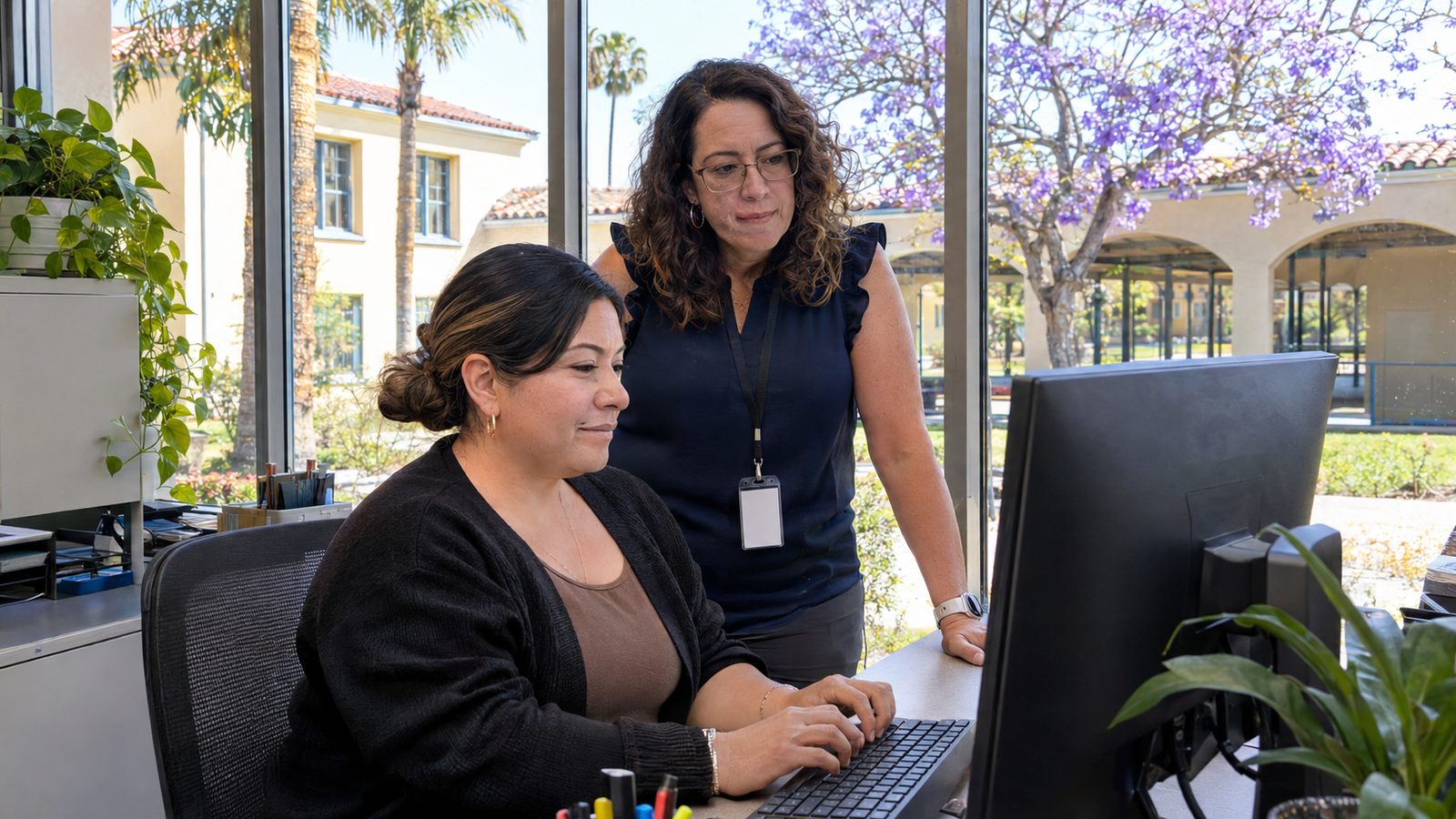
What Special Learning does
03Our part
- The quote. Written, numbered, itemized, dated and valid for 30 days, so it can be attached to your requisition.
- The forms. We send our completed IRS Form W-9 within one business day of your school’s request: write to contact@special-learning.com. We complete the district’s vendor forms on request; tell us there which form SS&C asks for.
- The invoice. Itemized, carrying your purchase order number, and sent where your purchase order directs.
- Staff-only training. No student uses it and no student data is entered; we hold staff names and work emails. We complete your district’s privacy and contract paperwork on request.

What the school is buying
04The course for your support staff

The Level 1 ABA Online Training Course for groups introduces autism and behavior-support foundations, drawn largely from work with young children in classrooms and homes, for frontline staff who support autistic students. It has nine online sessions plus a final exam, costs $99 a person for 10 or more, paid once, and each person has 12 weeks from the day they activate their own access. Completing it earns a Special Learning certificate of completion.

What we could and could not confirm
05Sources and limits of this page

- San Diego Unified documents, read November 16, 2026: the Strategic Sourcing and Contracts, Bids and Requests for Proposal, Supplier Self-Service, Accounts Payable, Fiscal Control FAQ and Business Outreach Program pages (undated); AR 3300 (approved December 11, 2018); BP 3314 (adopted July 24, 2018); Procurement Manual (public copy, file created October 8, 2019); the End of Year Conference deck (February 29, 2024); Purchase Order General Terms and Conditions (“SDUSD PO Terms 1/11/2022”); the sole-proprietor sheet (file dated July 14, 2023); the software license agreement form (Rev. 3.13.25, signature date July 10, 2025, a board document posted with another vendor); BP 6163.6 (adopted June 25, 2024); the 2022 District Policy Manual (D-6700, K-6500); AP 9350 (revised April 22, 2005); AP 2415 (revised June 23, 2000); and the Flier Approval page (guidelines as of December 1, 2015). Strategic Sourcing and Contracts: 2351 Cardinal Lane, Building M, San Diego, CA 92123, 858-522-5808. The district’s main office number, printed on the Accounts Payable page, is (619) 725-8000.
- California law and agency texts: Public Contract Code 20111, 20118.2, 20118.3 and 20104.50; Government Code 927; Education Code 49073.1; Business and Professions Code 22584; the State Superintendent’s bid-threshold letter of December 8, 2025; CDTFA Publication 102 (May 2024) and annotation 530.0260 in the Sales and Use Tax Annotations; and FTB Form 590 and Form 587 (taxable year 2025). The statutes were read on california.public.law, which prints each leginfo source, and the State Superintendent’s letter on a county office of education copy, because leginfo.legislature.ca.gov and the California Department of Education site refused our plain requests.
- Not read: the Board Policies and Administrative Regulations on Simbli, the district’s current policy host, so the 2017 and 2018 copies of AR 3300 and BP 3314 may differ from today’s (BP 1325, BP 3311, BP 3312 and BP 5125 are among the unread policies); the staff-only Contracting and Procurement Manual, the contracting-process pages and the New Supplier form; AP 2518; the ASB manual and Board Policy 1321; and the statutes and the Department of Education letter at their own addresses. We found no item naming Special Learning in a public search of the district’s board action summaries and its community agreement site; the agenda host was not readable, so that is a search result, not proof of absence.
- Old and new policy formats. The 2022 District Policy Manual says old D-6000 “has been replaced by Board Policy (BP) 3300, Expenditures and Purchases, Board Policy (BP) 3311, Bids and Board Policy (BP) 3312, Contracts.” AP 2415, revised June 23, 2000, still cites D-6000 and D-6700. We quote these references without deciding which controls today; the current policy set on Simbli was not read.
- Where documents differ, we quote both and do not decide: the quote count under $10,000 (AR 3300, Procurement Manual, deck); the bid figure ($90,200, $92,600 and the State Superintendent’s $119,100); the Procurement Manual’s Board-approval sentence against AR 3300’s delegation; the net 30 terms in the sole-proprietor sheet and the software agreement form against PO terms that state no net days; the old and new policy formats; and D-6700’s school-premises restriction and specifically-authorized-schools exception against AP 9350 and the Flier Approval page’s district-property restriction and division-head exemption.
- Limits: we found no sentence on a principal’s own signing authority, on a purchase order before service in those words, on the card and software or training, on paying a vendor from school activity funds, on a state payment deadline for this kind of purchase, on a district sales tax certificate, or on a public approval process for professional-learning vendors. We did not determine whether a staff course needs a data review or is taxed. Ask SS&C how to proceed.
Buying elsewhere? Guides for Miami-Dade, Broward County, Hillsborough County, Orange County, Palm Beach County, Duval County, Pinellas County, Brevard County, Lee County, Seminole County, Pasco County, Lake County, Marion County, St. Lucie, Collier County, St. Johns County, Leon County, Florida schools under HB 851, Los Angeles Unified, Clark County, New York City, Chicago, Gwinnett County, Fairfax County, Prosper ISD, Prince George’s County and Philadelphia, and every state on Training for Schools.
Next step: Ask for a written, dated quote for your team