
Free form for direct support professionals and their supervisors
ABC data sheet for direct support professionals
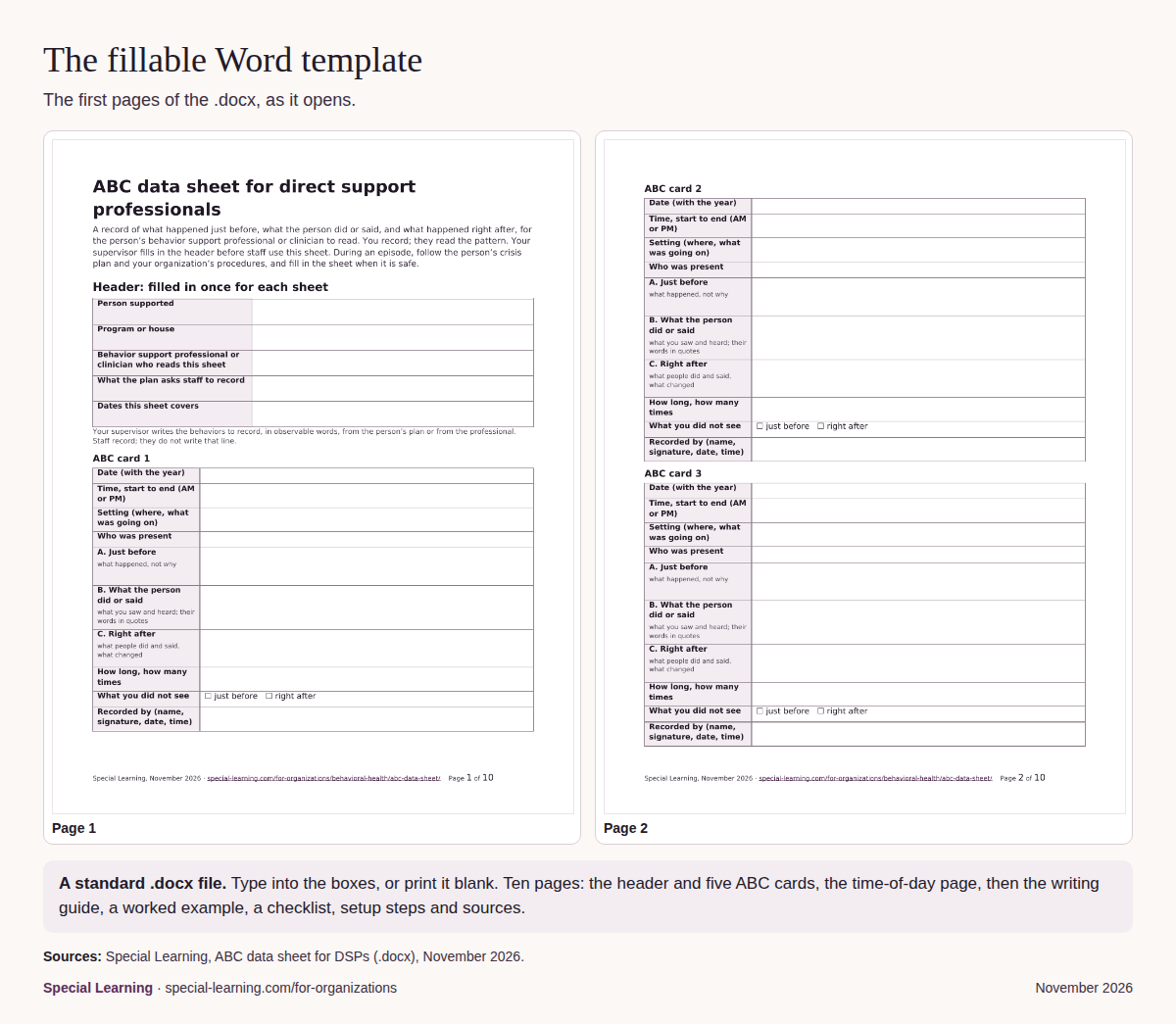
A free ABC data sheet for direct support professionals (DSPs) in group homes and day programs, as a fillable Word file and a printable PDF. You write what happened just before, what the person did or said, and what happened right after, in the words a camera could record. It comes with a guide to writing what you saw, not what you think, and a time-of-day page. DSPs record; the person’s behavior support professional or clinician reads the pattern.
Special Learning · November 15, 2026
Free download
Download the sheet
Short answer
What is an ABC data sheet, and who reads it?
Read
A form for recording what happened just before a behavior, what the person did or said, and what happened right after, in order. The DSP records what they saw and heard and signs it. The person’s behavior support professional or clinician reads the sheets together and decides what they show. The sheet does not say why something happens, and it does not tell staff what to do about it.
Published ABC forms share this shape. Vanderbilt’s TRIAD sheet asks for the “Immediate Antecedent” and the “Immediate Consequence” (Vanderbilt TRIAD, Structured ABC Data Sheet), and the Barton Lab’s observation cards ask for the date and time, the antecedent, the behavior and the consequence, and say to “Share your data with a behavior consultant, BCBA” (Vanderbilt Barton Lab, ABC Data Collection Observation Cards). The wording of our prompts, the order of the fields and the examples are ours. Which behaviors to record, in which hours, and where the sheet goes are decisions for the person’s professional, so the header leaves those lines for your supervisor to fill in with them.
Three people have three parts:
- You, the DSP: record. You write what you saw and heard, in the order it happened, as soon as it is safe, and you sign it. You tally the episode on the time-of-day page. (ICI Frontline Initiative, 2004; Washington DSHS, Module 6)
- Your supervisor or training lead: set it up. Gets the behaviors to record, the dates and where the sheet goes from the person’s behavior support professional, writes them in the header, teaches the wording, and reads sheets for wording only. This role is our design; the Barton Lab and TRIAD forms show who reads the data, not who sets it up.
- The behavior support professional or clinician: reads the pattern. Reads the sheets and the time-of-day page together and decides what they show and what, if anything, changes in the person’s plan. That part is theirs. (Touchette, MacDonald and Langer, 1985; Vanderbilt Barton Lab, ABC Data Collection Observation Cards; Vanderbilt TRIAD, Structured ABC Data Sheet)

During an episode, follow the person’s crisis plan and your organization’s procedures, and write afterward, when it is safe. NADSP lists crisis prevention and intervention as its own competency area (NADSP Competency Areas), and our free crisis plan template is the plan for each person.
Inside the sheet
One card: the fields, and where each comes from
Each episode gets one card. The sources below show what published forms and guides ask a record to hold; the Washington DSHS module teaches recording what you see (Washington DSHS, Module 6), and the ICI Frontline Initiative article covers dates, signing and the difference between fact and opinion (ICI Frontline Initiative, 2004).
| Header line | What goes there | Where it comes from |
|---|---|---|
| Person supported | Name or ID, as your organization’s policy says. | |
| Program or house | Where this sheet is kept. | |
| Behavior support professional or clinician who reads this sheet | Name, and where and how often the sheet goes to them. Your supervisor fills this in with them. | (Vanderbilt Barton Lab, ABC Data Collection Observation Cards; Vanderbilt TRIAD, Structured ABC Data Sheet) |
| What the plan asks staff to record | The behaviors to record, in observable words, copied from the person’s plan or from the professional. Your supervisor fills this in; staff do not write it. | (Bijou, Peterson and Ault, 1968; Washington DSHS, Module 6) |
| Dates this sheet covers | First and last date, with the year. | (ICI Frontline Initiative, 2004) |
| Field | What to write | Where it comes from |
|---|---|---|
| Date and time | The full date with the year, the time it started and the time it ended, each with AM or PM. | (Vanderbilt TRIAD, Structured ABC Data Sheet; Vanderbilt Barton Lab, ABC Data Collection Observation Cards; ICI Frontline Initiative, 2004) |
| Setting | Where it happened and what was going on: the room, the community place, the activity. | (Vanderbilt TRIAD, Structured ABC Data Sheet; Vanderbilt Barton Lab, ABC Data Collection Observation Cards) |
| Who was present | Who was there: you, other staff, other people who live or attend here (initials, as your policy says), visitors. | (ICI Frontline Initiative, 2004) |
| A. What happened just before | What was said or done, or what changed, in the minutes before. Write the event, not a reason. | (Vanderbilt TRIAD, Structured ABC Data Sheet; Vanderbilt Barton Lab, ABC Data Collection Observation Cards) |
| B. What the person did or said | What you saw and heard, in the order it happened, with the person’s own words in quotation marks. | (Bijou, Peterson and Ault, 1968; Vanderbilt Barton Lab, ABC Data Collection Observation Cards; Washington DSHS, Module 6) |
| C. What happened right after | What you and other people said and did, what changed, and what the person did next. | (Vanderbilt TRIAD, Structured ABC Data Sheet; Vanderbilt Barton Lab, ABC Data Collection Observation Cards) |
| How long and how many times | About how many minutes, and how many times in a row. Write “about” if you did not time it. | (Washington DSHS, Module 6) |
| What you did not see | A box to check if you did not see or hear what happened just before or right after. Do not guess. | (Vanderbilt TRIAD, Structured ABC Data Sheet) |
| Recorded by | Your name and signature, and the date and time you wrote it, with AM or PM. | (ICI Frontline Initiative, 2004) |

Worked example
Three cards for one invented person
Each line is something a camera could record, the person’s words are in quotation marks, and card 3 says plainly that the writer did not see what happened just before. The people, the staff and the program are invented. The cards follow the fields of the Vanderbilt TRIAD sheet (Vanderbilt TRIAD, Structured ABC Data Sheet) and the Barton Lab cards (Vanderbilt Barton Lab, ABC Data Collection Observation Cards), in observable words (Bijou, Peterson and Ault, 1968). The professional reads these cards; the DSP only records.
| Field | Entry |
|---|---|
| Card 1: Tuesday, March 2, 2027, 4:25 PM to 4:26 PM. Living room, after the van dropped him off at 4:05 PM. Present: J. Okafor (DSP). L. and R. were in the room. | |
| A. Just before | At 4:24 PM I started the vacuum in the hall, about 10 feet from the living room. Andre was watching TV on the couch. |
| B. What the person did or said | At 4:25 PM Andre shouted, “Too loud!” five times and hit the arm of the couch with his open hand three times. |
| C. Right after | I turned the vacuum off. Andre said, “Thank you,” and turned the TV up. L. moved to the kitchen. |
| How long, how many times | About 1 minute. One episode. |
| What you did not see | Neither box checked |
| Card 2: Thursday, March 4, 2027, 8:50 AM to 8:53 AM. Kitchen, breakfast. Present: A. Reyes (DSP). L. at the table. | |
| A. Just before | I said, “It is time to get your coat for the van.” Andre was finishing his toast. |
| B. What the person did or said | Andre said, “No coat!” in a raised voice, twice, and hit the table once with his open hand. |
| C. Right after | I stood by the door and waited. Andre stopped talking at 8:52 AM and picked up his coat at 8:53 AM. |
| How long, how many times | About 3 minutes. One episode. |
| What you did not see | Neither box checked |
| Card 3: Friday, March 5, 2027, 4:15 PM to 4:17 PM. Hallway outside the office. Present: J. Okafor (DSP). No one else in the hall. | |
| A. Just before | I was in the office and heard shouting at 4:15 PM. I did not see what happened just before. |
| B. What the person did or said | When I reached the hall, Andre was standing by the hall table. He hit the table twice with his open hand and shouted, “My phone!” |
| C. Right after | I said, “Your phone is charging in the office.” I handed it to him at 4:17 PM. He stopped shouting and took it. |
| How long, how many times | About 2 minutes. One episode. |
| What you did not see | Checked: just before |

What you saw, not what you think
Ten examples to teach with
A label or a reason tells the reader what the writer concluded. What you saw and heard lets the professional see it. Bijou, Peterson and Ault’s 1968 paper describes recording “behavioral and environmental events in observable terms” (Bijou, Peterson and Ault, 1968), and ICI’s article describes objective documentation as “just the facts” (ICI Frontline Initiative, 2004). NADSP’s Code of Ethics asks DSPs to “Use respectful and inclusive language that reflects each person’s preferences” (NADSP Code of Ethics). The pairs are ours: cover the right column and rewrite each line first.
| Part of the card | Instead of | Write |
|---|---|---|
| Time | It happened in the afternoon. | Tuesday, March 2, 2027. It started at 4:25 PM and ended at 4:26 PM. |
| Who was present | Everyone was there. | Me (J. Okafor, DSP). L. and R. were in the living room. No visitors. |
| Before | The noise triggered him. | At 4:24 PM I started the vacuum in the hall. Andre was watching TV on the couch. |
| Before | She was bored and wanted attention. | At 2:00 PM I left the room to answer the phone. Keisha was at the table with a puzzle box. |
| Behavior | Luis was aggressive. | Luis hit the table with his open hand three times and said, “No more!” Another person who lives here (D.) was next to him. The hand did not touch D. |
| Behavior | Rosa was non-compliant. | I said, “It is time to brush your teeth.” Rosa stayed on the couch and kept watching TV. I asked again two minutes later. She said, “Not yet.” |
| Behavior | Tom had a meltdown. | At 6:05 PM Tom shouted, “I want to go home!” for about four minutes. He walked from the kitchen to the hall twice and sat on the floor by the front door. |
| After | We ignored it and he calmed down. | I stood by the sink and did not speak for two minutes. Andre stopped shouting at 4:26 PM and sat on the couch. |
| After | I gave in and she settled. | I handed Keisha the tablet. She stopped shouting and sat down. I said, “Ten minutes, then dinner.” |
| Reason | He did it for attention. | Leave the reason out. Write what happened: Sam called my name five times from the doorway while I was on the phone. |

How to record
Nine rules for recording
- Record what you saw and heard, and nothing more. Bijou and colleagues list, among the ingredients of a descriptive field study, “defining and recording behavioral and environmental events in observable terms.” DSHS: information gathered is “objective, factual and given without emotions, opinions, or bias.” (Bijou, Peterson and Ault, 1968; Washington DSHS, Module 6)
- Write it as soon as it is safe to. During an episode, follow the person’s crisis plan and your organization’s procedures; NADSP lists crisis prevention and intervention as its own competency area. Then write it down “as soon as you can,” DSHS says, and ICI: documenting “immediately (or soon as possible) after it occurs is optimal.” Never write something before it happens. (Washington DSHS, Module 6; ICI Frontline Initiative, 2004; NADSP Competency Areas)
- Say what happened just before as an event, not a reason. The TRIAD sheet asks for what “happened immediately before.” “The vacuum started in the hall” is an event; “the noise bothered him” is a conclusion. (Vanderbilt TRIAD, Structured ABC Data Sheet)
- Describe the behavior so a person who was not there could picture it. The Barton Lab cards ask: “Record what the behavior looked like.” Say what the body and voice did, how many times and about how long, as DSHS describes counting “how many times a behavior occurs” and “how long a behavior lasts.” (Vanderbilt Barton Lab, ABC Data Collection Observation Cards; Washington DSHS, Module 6)
- Put the person’s own words in quotation marks. It keeps your wording out of theirs. This is our practice; the wider principle is in NADSP’s Code of Ethics: “Use respectful and inclusive language that reflects each person’s preferences.” (NADSP Code of Ethics)
- Record what happened right after, including what you and others did. The TRIAD sheet asks for what “happened immediately after.” Your own words and actions, and other people’s, are part of what happened. Leave out how you think the person felt. (Vanderbilt TRIAD, Structured ABC Data Sheet)
- If you did not see it, say so. Check the “did not see” box. The TRIAD sheet’s antecedent list includes “Unknown.” A guess written as a fact is harder to fix than a gap. (Vanderbilt TRIAD, Structured ABC Data Sheet)
- Keep opinions out. If your organization asks for yours, label it. ICI describes objective documentation as “just the facts” and says that if you include an opinion, “always indicate that this is your opinion.” Its example: “it is the DSP’s opinion that Harry was frustrated, but it isn’t a fact.” (ICI Frontline Initiative, 2004)
- Record, and send it to the person who reads the pattern. The TRIAD sheet leaves its scoring to its consultants: “Only TRIAD consultants should complete scores below.” The Barton Lab cards say to “Share your data with a behavior consultant, BCBA.” NADSP Competency Area 12 asks DSPs to be “aware of the requirements for documentation in his or her organization.” Your part is the record; keep it and send it as your organization’s policy says. (Vanderbilt TRIAD, Structured ABC Data Sheet; Vanderbilt Barton Lab, ABC Data Collection Observation Cards; NADSP Competency Areas)
Before you hand in a sheet: a ten-point check
Our wording, built on the sources in the rules above. A new DSP can run it on every sheet for the first weeks, and a supervisor can use the same list.
- Every card has the date with the year and the times with AM or PM.
- The setting and who was present are written.
- “Just before” says what happened, not why.
- The behavior is what a camera could record, with the person’s own words in quotation marks.
- “Right after” says what you and others did, and what the person did next.
- If you did not see the start or the end, you checked the box.
- Labels and reasons are out; any opinion is marked as yours.
- Each episode has a tally mark on the time-of-day page.
- You signed each card and wrote the time you wrote it.
- The sheet is kept where your policy says and goes to the professional on their schedule.

The time-of-day page
A grid for the hour each episode started
One box for each hour, and one box for 10 PM to 6 AM. Tally one mark for each episode that started in that hour. Draw a line through an hour when the person was away. Your supervisor and the professional decide who fills in which hours, so a blank box means the same thing to everyone who reads it. Touchette, MacDonald and Langer wrote that “a scatter plot can make patterns of responding identifiable” (Touchette, MacDonald and Langer, 1985). The sheet is how you record; the professional reads the pattern. The hour rows and the tally marks are ours.

For training leads
Set it up and teach it in five steps
Teach it with the same wording you use for notes: our free DSP daily notes template and DSP incident report template share the see-and-hear rule, and the DSP shift change report template carries what the next shift needs. New DSPs can start with the DSP onboarding checklist.
- Ask the person’s behavior support professional what to record. Get in writing which behaviors to record, in observable words; whether to record every episode or only some hours; who fills in which hours; and where and how often the sheet goes to them. Type it into the header of the master copy. We leave it blank on purpose: it is the professional’s decision, for each person.
- Add the person and the people who read it. In the master copy, write the person’s name or ID (as your policy says), the program, the professional’s name and where the sheet goes. Print a new sheet for each person and each period, or save a new file with the dates.
- Teach the nine rules with the ten example pairs. Read each “instead of” line aloud and have staff rewrite it as what a camera could record before you show the “write” line.
- Practice with the worked example. Run a two-minute made-up scene with two staff members. Everyone fills in a card from what they saw and heard, then compares cards: which words could a camera not record?
- Read sheets for wording, then send them on. Each week read a few sheets and ask only: could someone who was not there picture it? Where not, ask the staff member what they saw. They add a dated, signed correction to their own card, as your policy says; never change someone else’s entry. Send the sheets to the professional on the schedule they gave you, and ask what was missing or unclear.

On paper
Prefer paper? Print the PDF
The printable PDF carries five cards with write-in space, the time-of-day page, and then the guide, the examples, the worked example, the check, the setup steps and the sources, for a binder at the house. It is also in our free DSP training and HR toolkit with the other tools.

Questions
ABC data sheets: common questions
What is an ABC data sheet?
It is a form for writing down, in order, what happened just before a behavior (the antecedent), what the person did or said (the behavior), and what happened right after (the consequence). Vanderbilt’s TRIAD data sheet, for example, asks for the “Immediate Antecedent” and the “Immediate Consequence,” and Vanderbilt’s Barton Lab ABC cards ask for the date and time, the antecedent, the behavior and the consequence. Direct support professionals record; the person’s behavior support professional or clinician reads what the records show.
Who reads the ABC data sheet?
The person’s behavior support professional or clinician. The Barton Lab cards say to share your data with a behavior consultant, and the TRIAD sheet leaves its scoring to consultants. Your supervisor gets from the professional which behaviors to record and where and how often the sheet goes to them; this sheet leaves those lines for them to fill in.
What should a DSP write on an ABC card?
What you saw and heard, in the order it happened, with the person’s own words in quotation marks: the date and time with AM or PM, the setting, who was there, what happened just before, what the person did or said, what happened right after, about how long and how many times, and your signature. Leave out labels such as “angry” and reasons such as “for attention.” The page has ten pairs of examples.
What if I did not see what happened just before?
Say so. The card has a box for it, and the TRIAD sheet’s list of antecedents includes “Unknown.” A guess written as a fact is harder to correct than a gap.
What is the time-of-day page for?
It is a grid of hours and dates where you tally one mark for each episode that started in that hour. The scatter plot method was described by Touchette, MacDonald and Langer in 1985, who wrote that “a scatter plot can make patterns of responding identifiable.” You tally; the behavior support professional reads the pattern.
What do I do during an episode?
Follow the person’s crisis plan and your organization’s procedures, and fill in the sheet when it is safe; NADSP lists crisis prevention and intervention as its own competency area. Our free crisis plan template is the plan for each person. The sheet records afterward.
Did a state or university write this sheet?
No. The sheet, its prompts, the rules’ wording, the example sentences and the worked example are Special Learning’s. The fields come from the published Vanderbilt, Washington DSHS, ICI, NADSP and journal sources listed below, and the quoted lines are as published. None of those organizations has reviewed or endorsed this sheet.
Sources
Read November 15, 2026. The quoted lines are as published; the sheet, its prompts, the nine rules’ wording, the example sentences and the worked example are ours. None of these organizations has reviewed or endorsed this sheet.
- Washington State Department of Social and Health Services (DSHS), “Module 6: Data Collection & Goal Tracking,” a training module on writing down what you see (it points readers to the state’s Developmental Disabilities Administration IISP training manual). https://dshs.wa.gov/media/4735/download?inline=
- Vanderbilt Kennedy Center, TRIAD, “Structured ABC (Antecedent-Behavior-Consequence) Analysis” data sheet, 2018, adapted from B. A. Iwata (1996). https://vkc.vumc.org/assets/files/emails/TRIAD/EI/05_summer_2018/Structured-ABC-Data-Sheet.pdf
- Vanderbilt University, Barton Lab (IES grant R324A160086), “ABC’s of Behavior: Antecedents, Behavior, Consequences” and “ABC Data Collection Observation Cards,” a parent-facing guide. https://cdn.vanderbilt.edu/vu-web/lab-wpcontent/sites/96/2020/02/06141842/ABC-Data-Collection.pdf
- Sidney W. Bijou, Robert F. Peterson and Marion H. Ault, “A method to integrate descriptive and experimental field studies at the level of data and empirical concepts,” Journal of Applied Behavior Analysis, 1(2), 175–191 (1968), abstract as posted at PubMed Central. https://pmc.ncbi.nlm.nih.gov/articles/PMC1310995/
- Paul E. Touchette, Rebecca F. MacDonald and Susan N. Langer, “A scatter plot for identifying stimulus control of problem behavior,” Journal of Applied Behavior Analysis, 18(4), 343–351 (1985), abstract as posted at PubMed Central. https://pmc.ncbi.nlm.nih.gov/articles/PMC1308031/
- Traci LaLiberte, “Doing Documentation ‘Write!’,” Frontline Initiative, Volume 5, Number 4 (2004), Institute on Community Integration, University of Minnesota. https://publications.ici.umn.edu/frontline-initiative/5-4/doing-documentation-write
- National Alliance for Direct Support Professionals (NADSP), The NADSP Competency Areas, Area 10: Crisis Prevention and Intervention and Area 12: Documentation, as published on nadsp.org. https://nadsp.org/resources/competency-areas/
- National Alliance for Direct Support Professionals (NADSP), The NADSP Code of Ethics (revised 2026), tenets as published on nadsp.org. https://nadsp.org/resources/the-nadsp-code-of-ethics/