Adult social care & disability services
Looking for autism foundations for staff? Our introductory course is drawn largely from work with young children; tell us your setting so we can discuss fit.
Discuss your learning need →
For organizations beyond ABA
Your team supports people through everyday life. Find learning that speaks to the work they actually do.
For behavioral health, disability services and adult social care organizations outside applied behavior analysis (ABA). Start with a staff learning need, then explore the content before you choose.

A starting point for your setting
Looking for autism foundations for staff? Our introductory course is drawn largely from work with young children; tell us your setting so we can discuss fit.
Discuss your learning need →Bring the situation your staff want to understand. Explore the course’s content, intended audience and limits before deciding whether it fits.
Discuss your learning need →Explore introductory autism foundations for staff who support autistic children.
Explore the team course →Free tools
Templates, checklists, a calculator and guides for training and supporting direct support professionals (DSPs). Each one is free to open.
 Zip
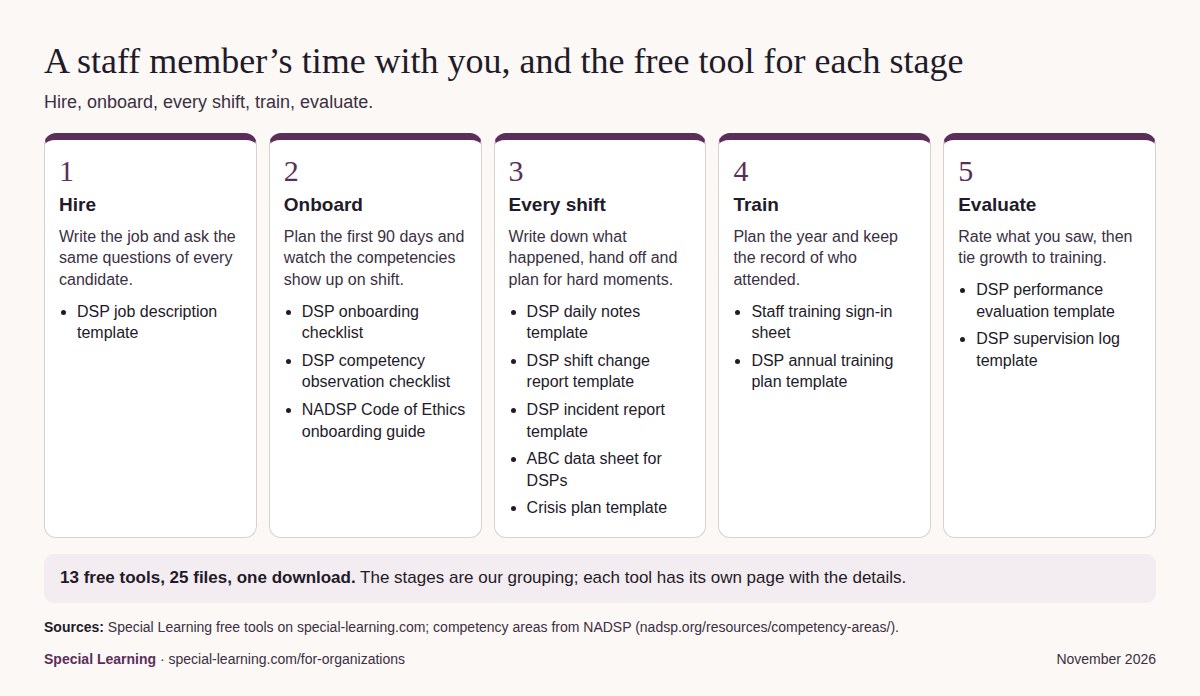
All 17 free tools below in one download: 33 files from the job description to the performance evaluation, with a one-page printable index.
 Word/PDF
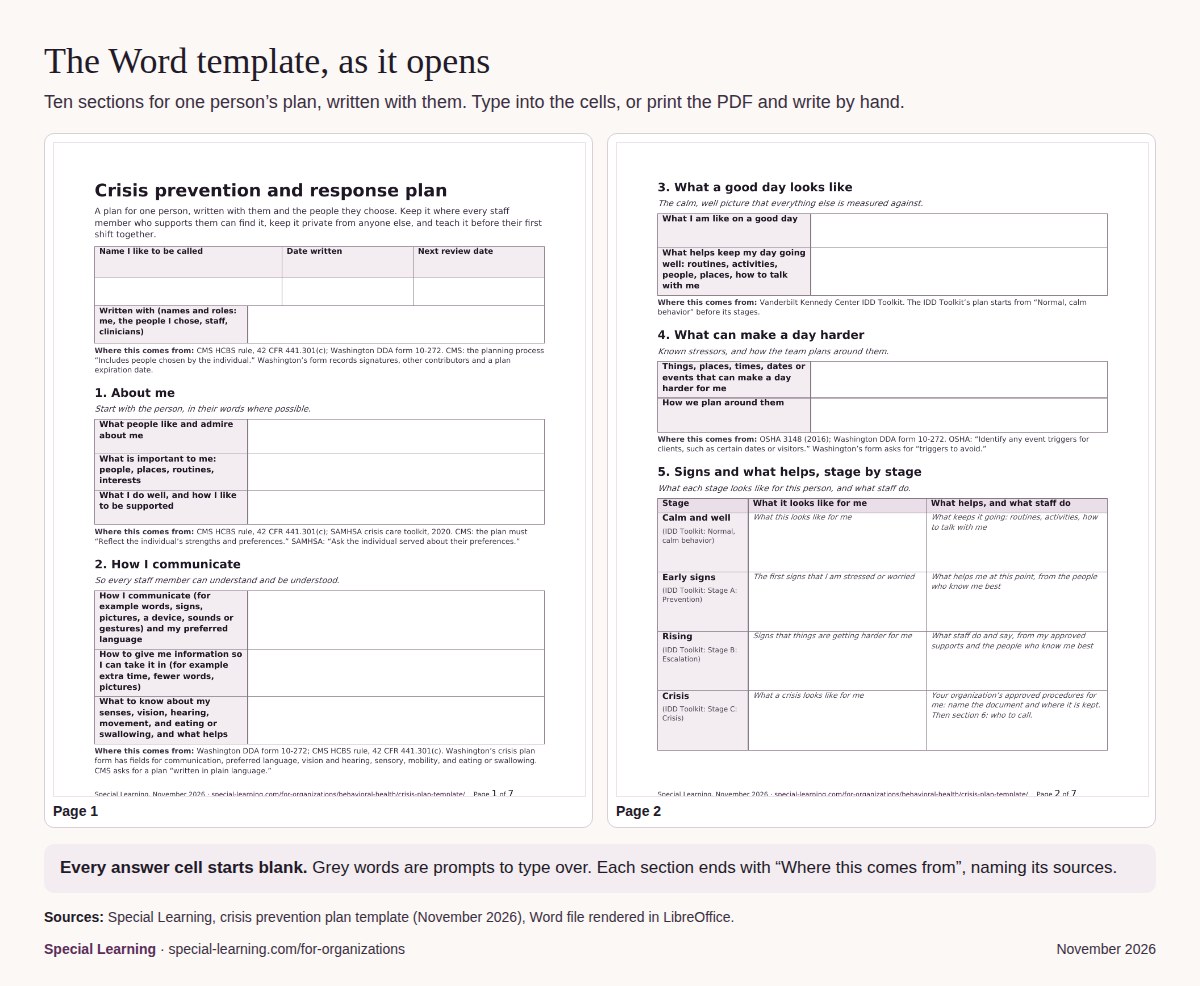
An individual crisis prevention and response plan, written with the person: stage by stage, who to call, and a debrief.
 Word/PDF
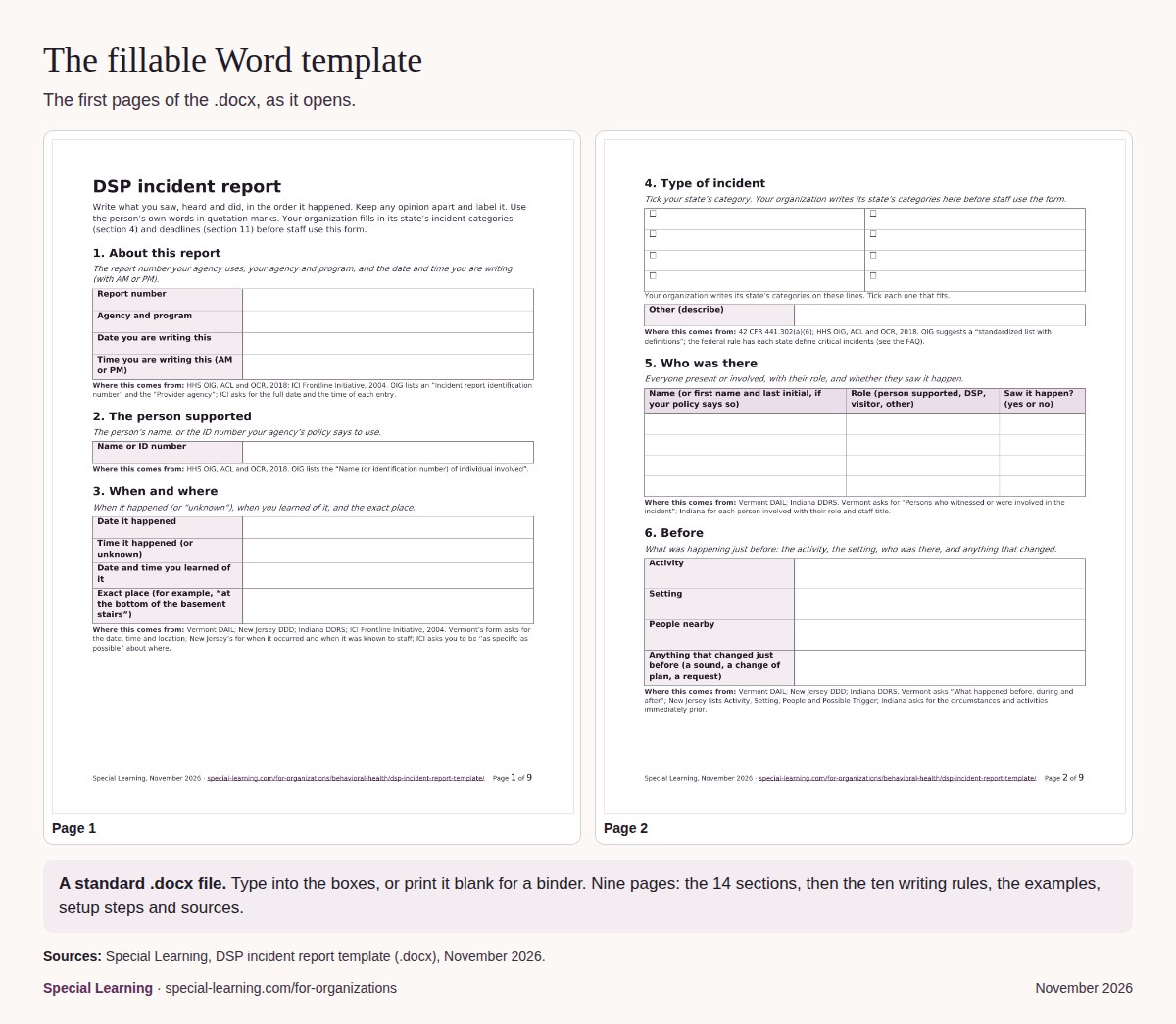
A fillable incident report form with 14 sections, plus ten rules for writing reports that stick to the facts.
 Word/PDF
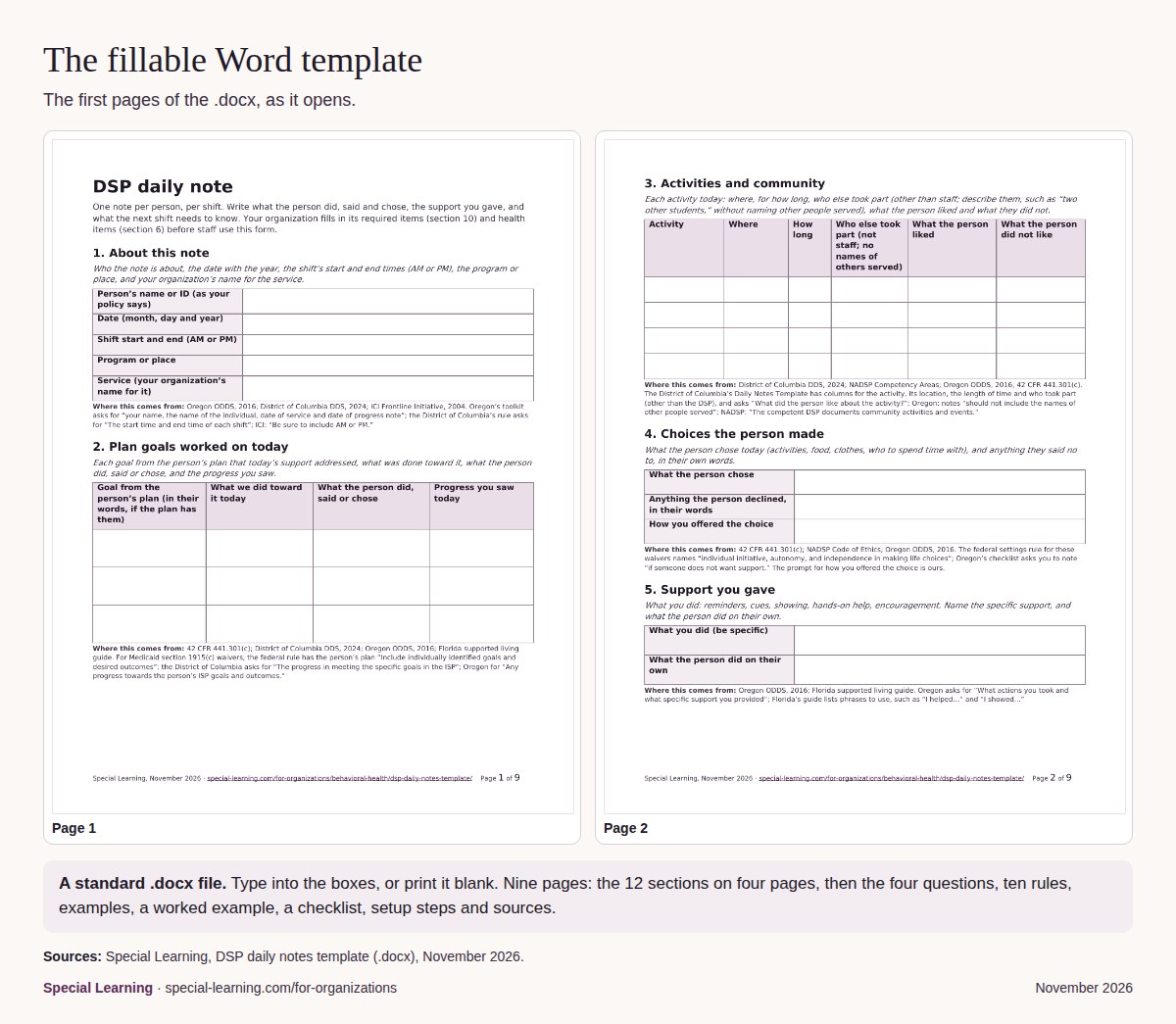
A fillable progress note form with 12 sections, a worked example, and six examples of writing facts, not opinions.
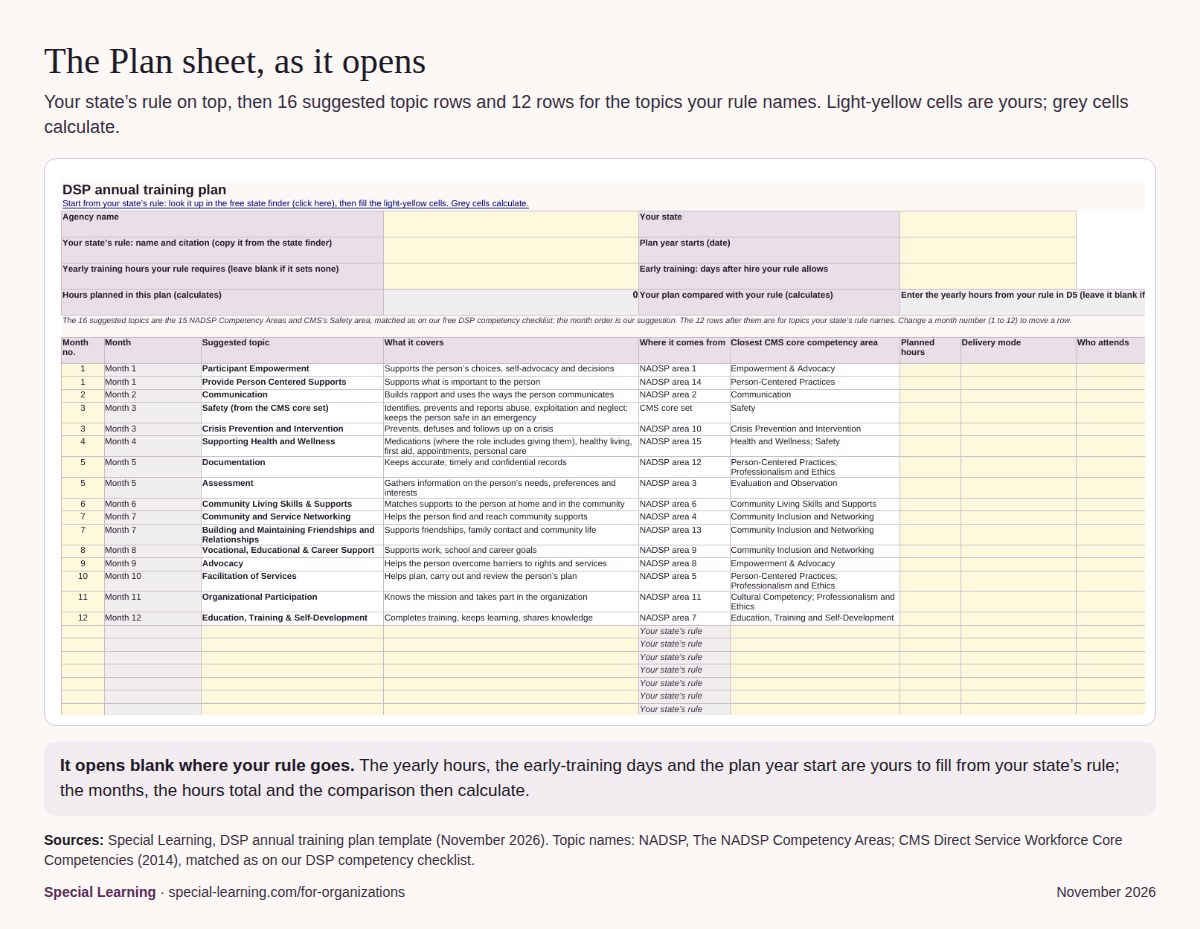 Excel/PDF
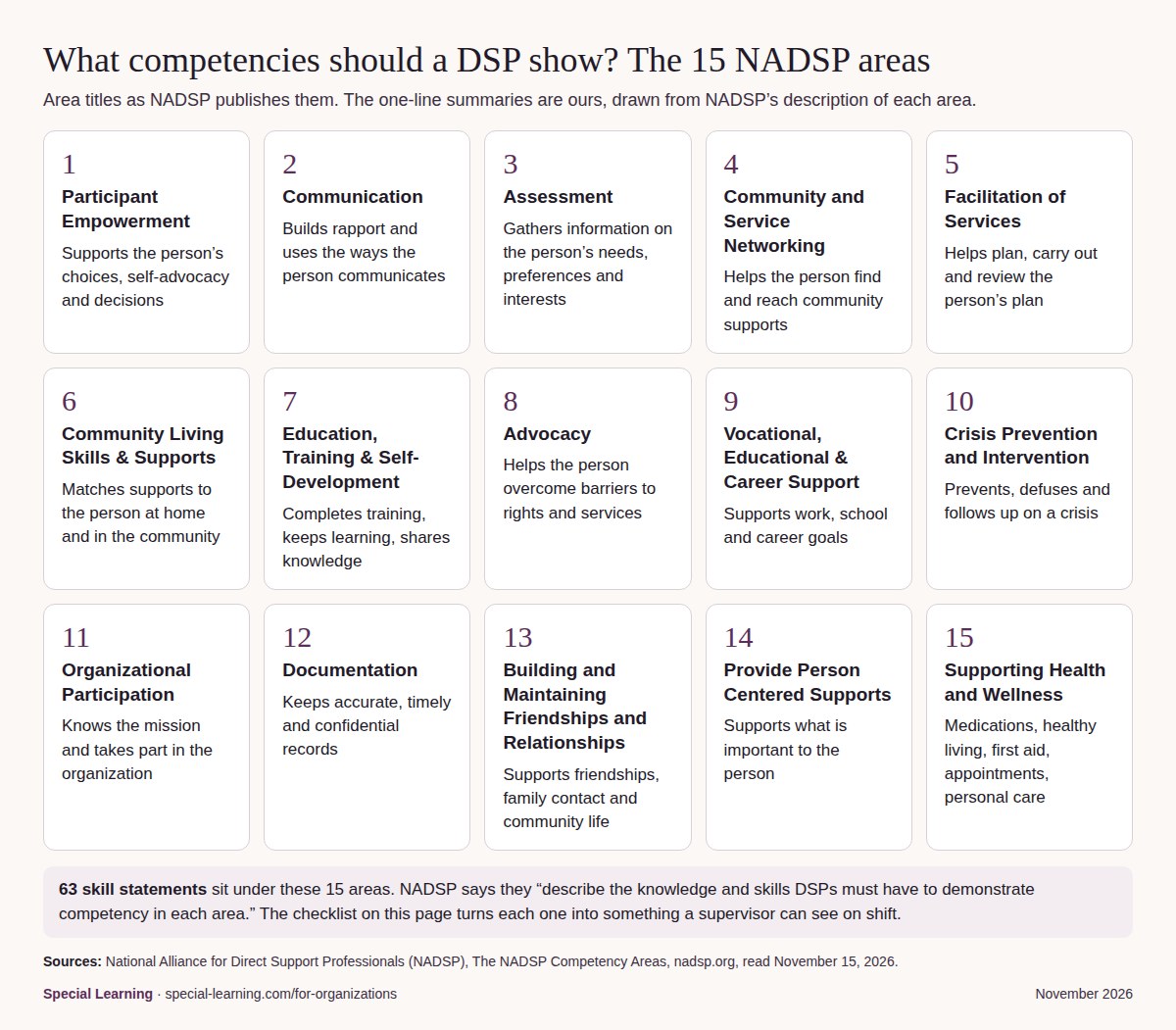
A month-by-month training plan built on the NADSP competency areas, plus a staff roster that tracks early-training due dates and yearly hours (NADSP).
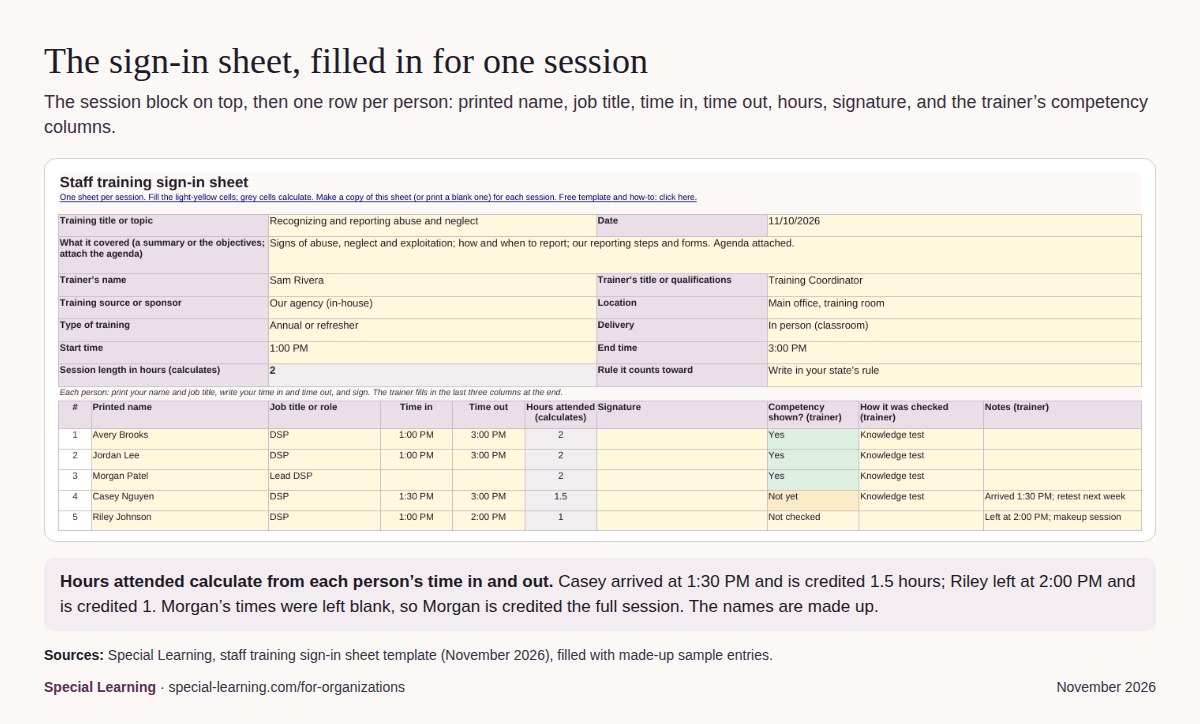 Excel/PDF
A sign-in sheet that works out each person’s hours, a training log, and a printable training record per person. Start from your state’s rule.
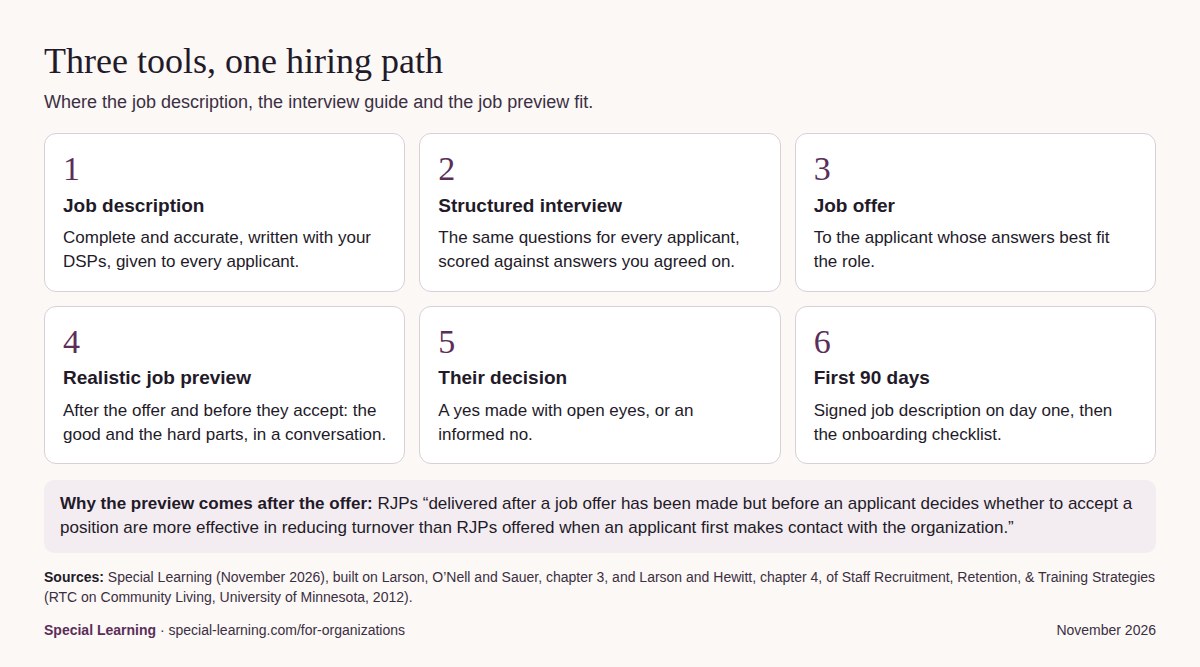 Word/PDF
Duties mapped to the NADSP competency areas, 12 structured behavioral interview questions with a scoring guide, and a realistic job preview checklist. Pay, schedule and requirements are yours to write in.
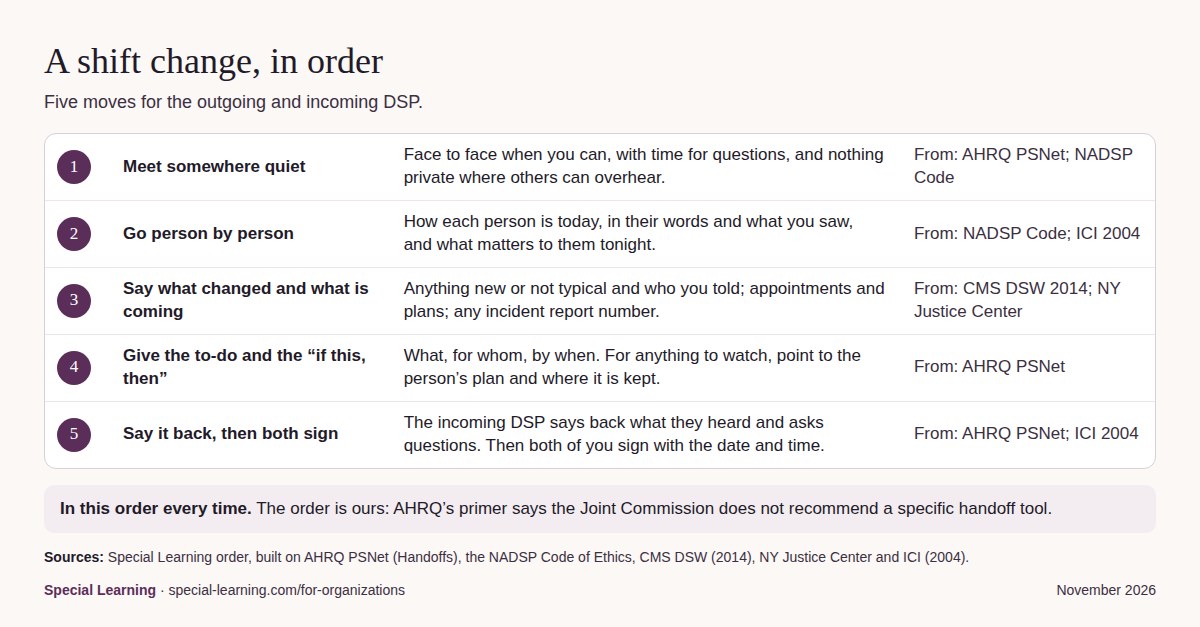 Word/PDF
A free shift handoff form for group homes: how each person is, what changed, what is coming up and what to watch for, with a worked example. Your counts and required items are yours to write in.
 Word/PDF
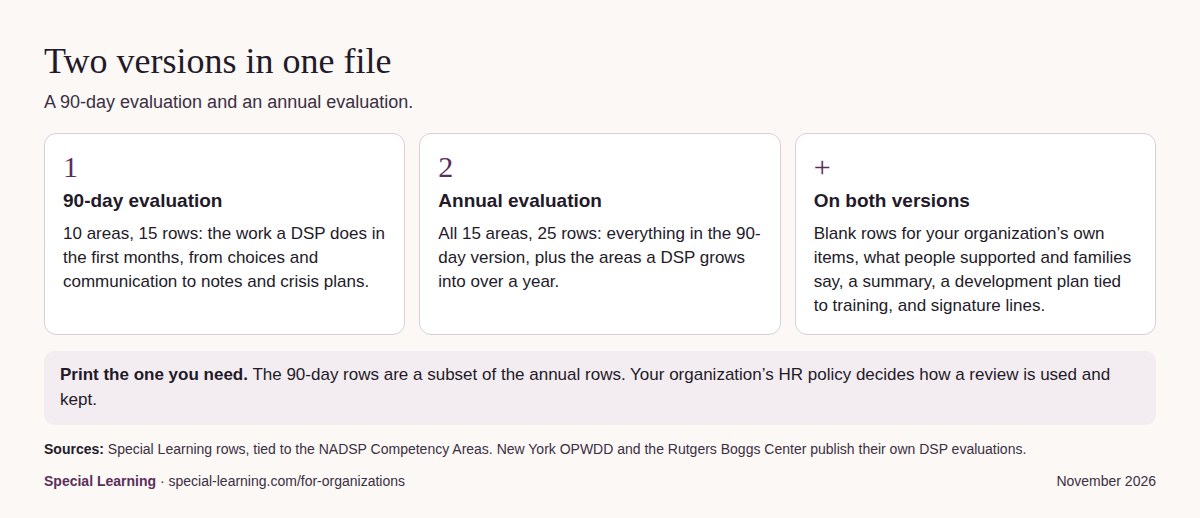
A free 90-day and annual evaluation form for direct support professionals, with rows tied to the NADSP competency areas, comment examples, a worked example and a development plan tied to training. Your own items are yours to add.
 Word/PDF
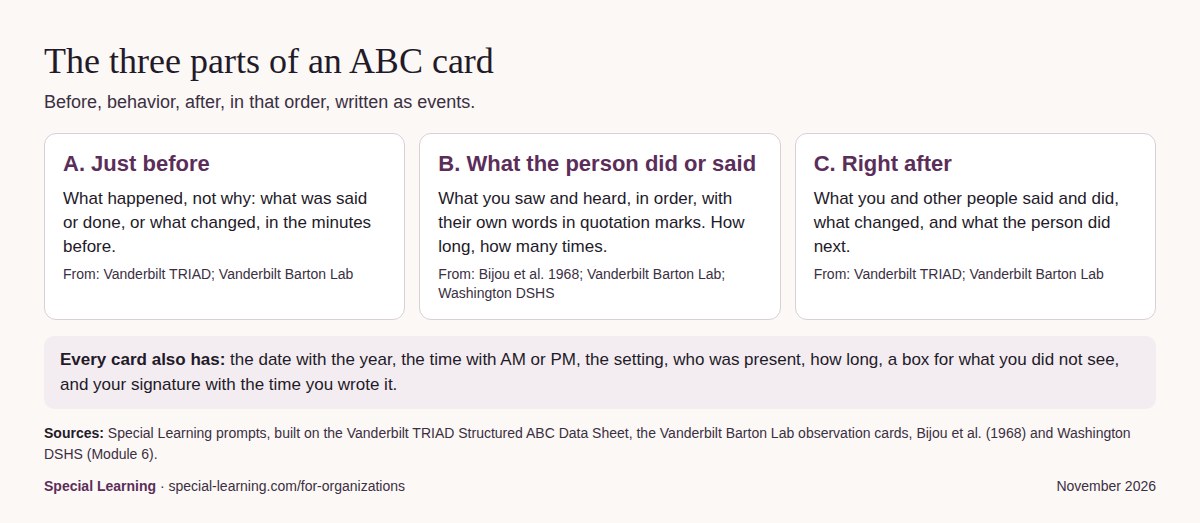
A free form for group homes and day programs: record what happened just before, what the person did or said and what happened right after, with a guide to writing what you saw. DSPs record; the behavior support professional reads the pattern.
 Word/PDF
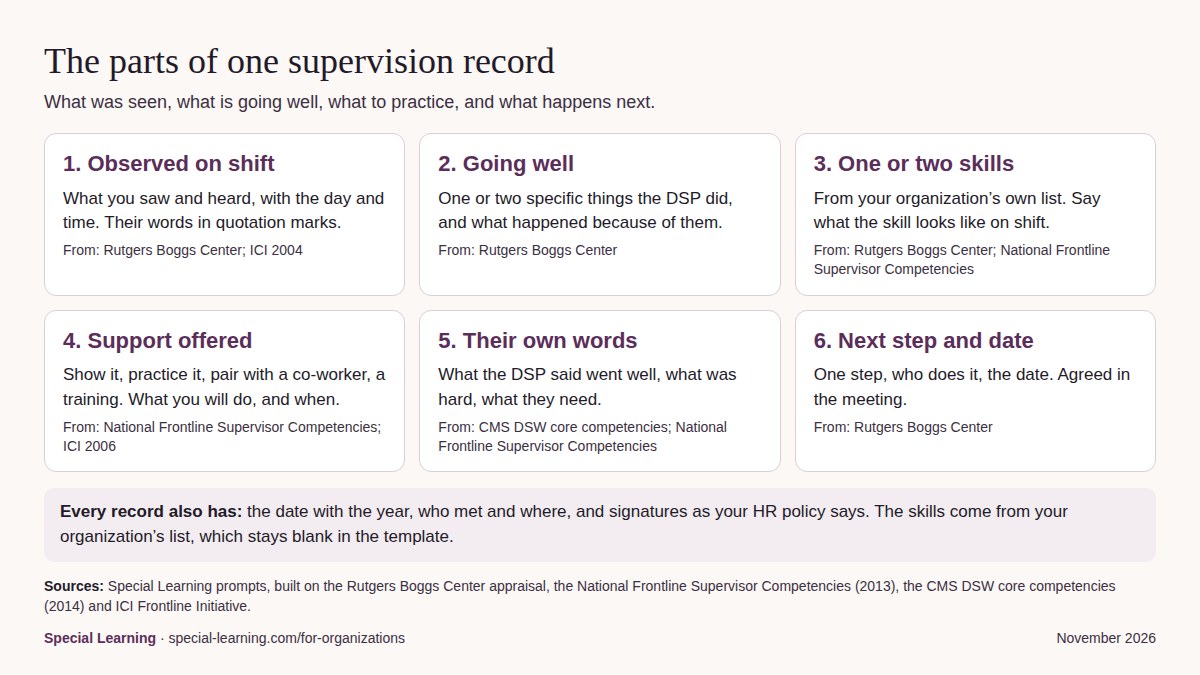
A free record for each short coaching meeting between a frontline supervisor and a DSP: what you saw on shift, what is going well, one or two skills to practice and an agreed next step with a date, with a guide to a 20-minute meeting.
 Word/PDF
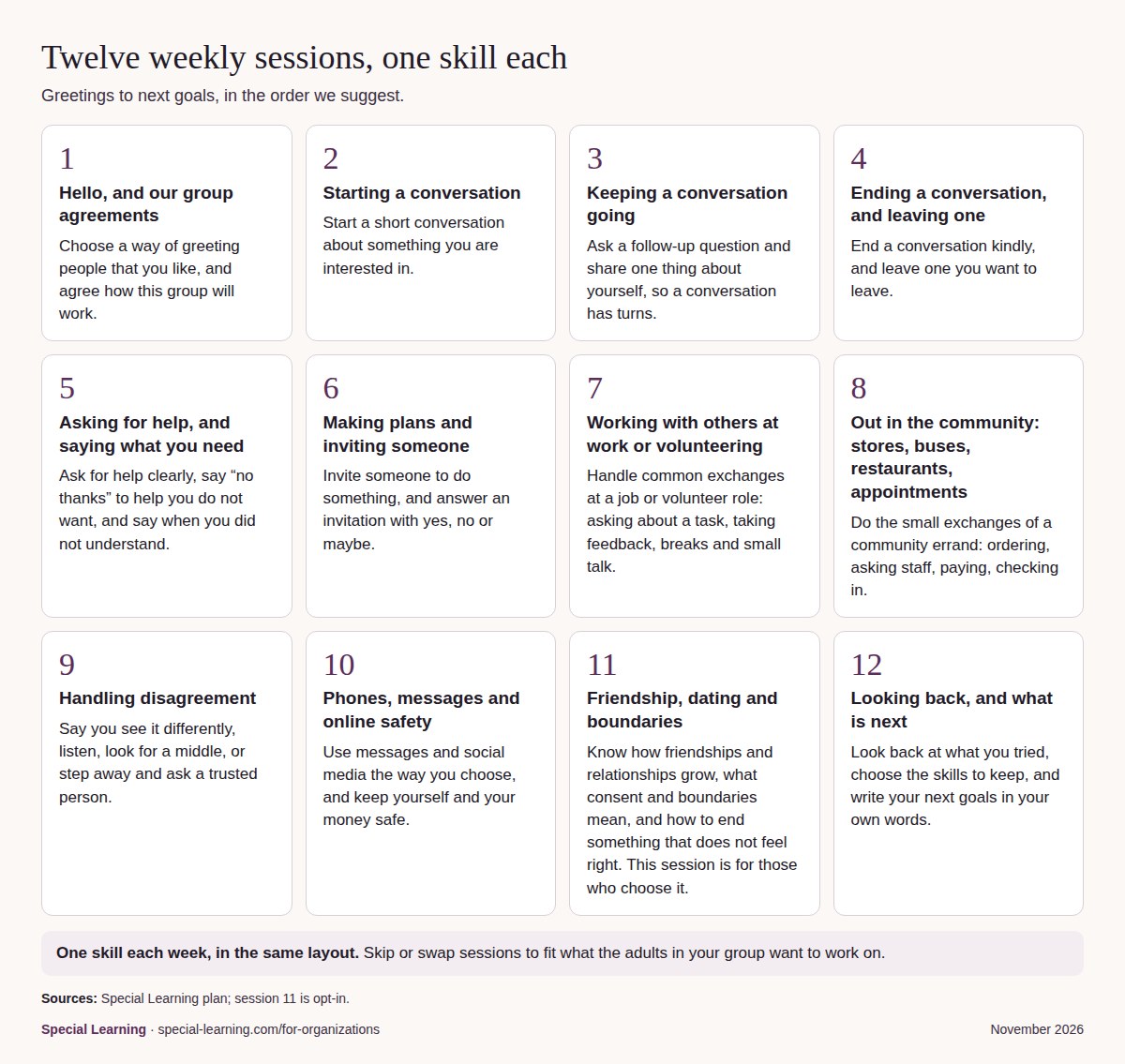
A free 12-session weekly group plan for adults with developmental disabilities: group setup, consent and choice, goals from each person's own plan, one skill a session with real-world practice, and a progress sheet.
 Word/PDF
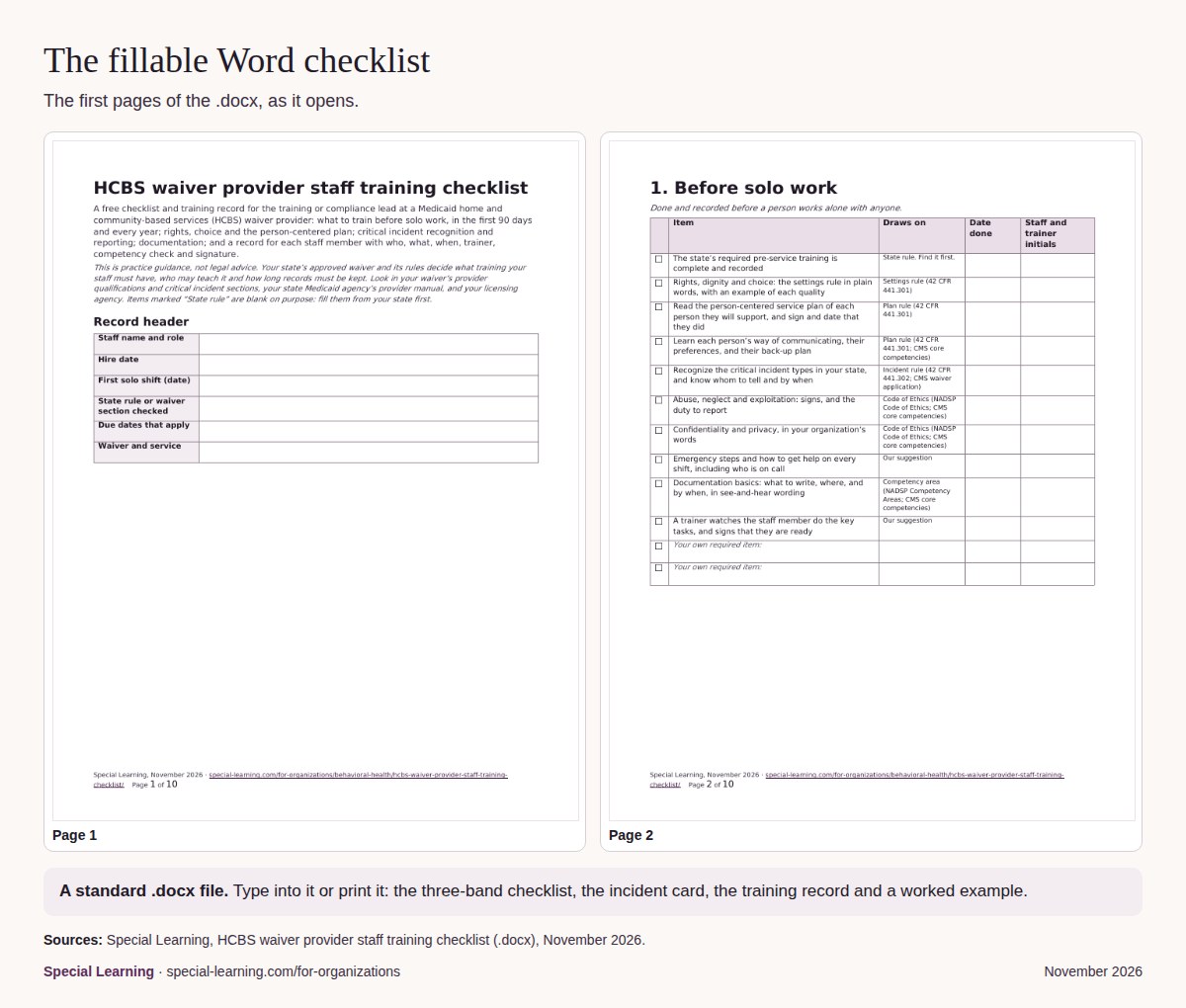
A free checklist and training record for staff at Medicaid waiver providers: what to train before solo work, in the first 90 days and every year, a critical incident card, and a signed record.
 Word/PDF
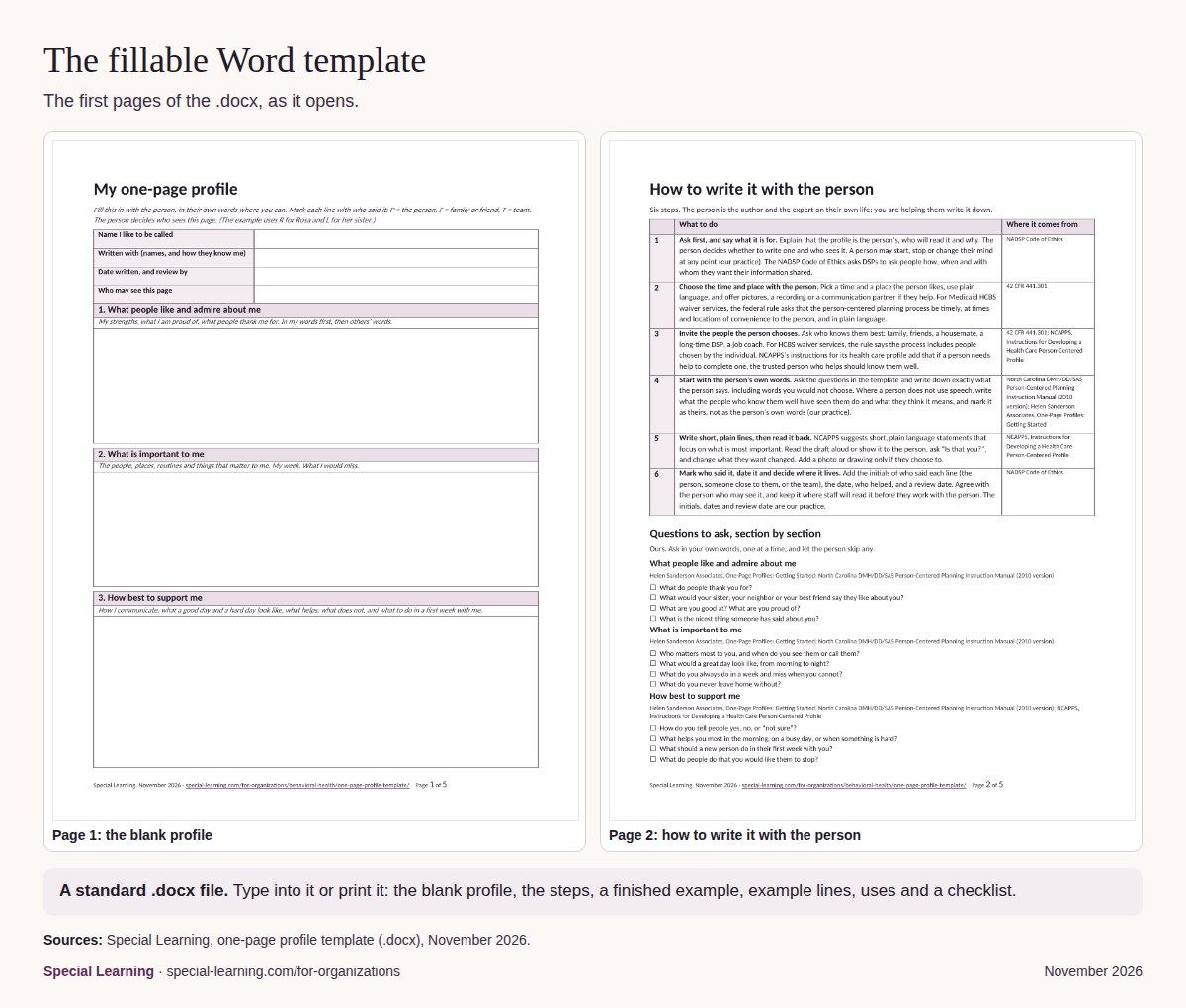
A free guide and template for writing a one-page profile with a person in their own words: the three sections, a finished example, weak and stronger lines, and uses in onboarding, at shift change and in plan updates.
 Word/PDF
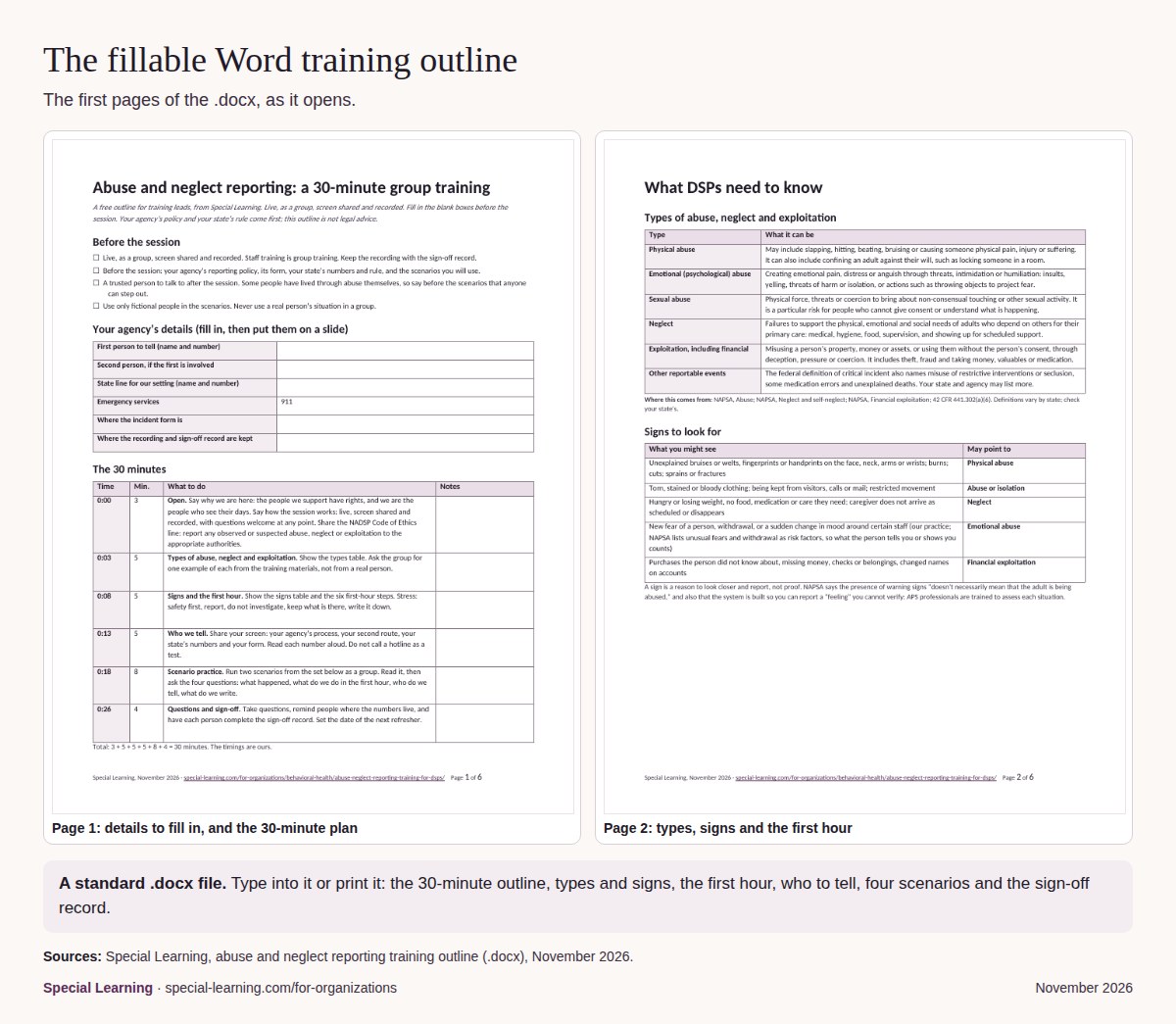
A free guide for training DSPs to recognize and report abuse, neglect and exploitation: types and signs, the first hour, who to report to, annual refreshers, a 30-minute group outline, fictional scenarios and a sign-off record.
 PDF
A printable observation checklist built on the 15 NADSP Competency Areas and the CMS core competencies, and how to use it in the first 90 days (NADSP; CMS, 2014).
 PDF
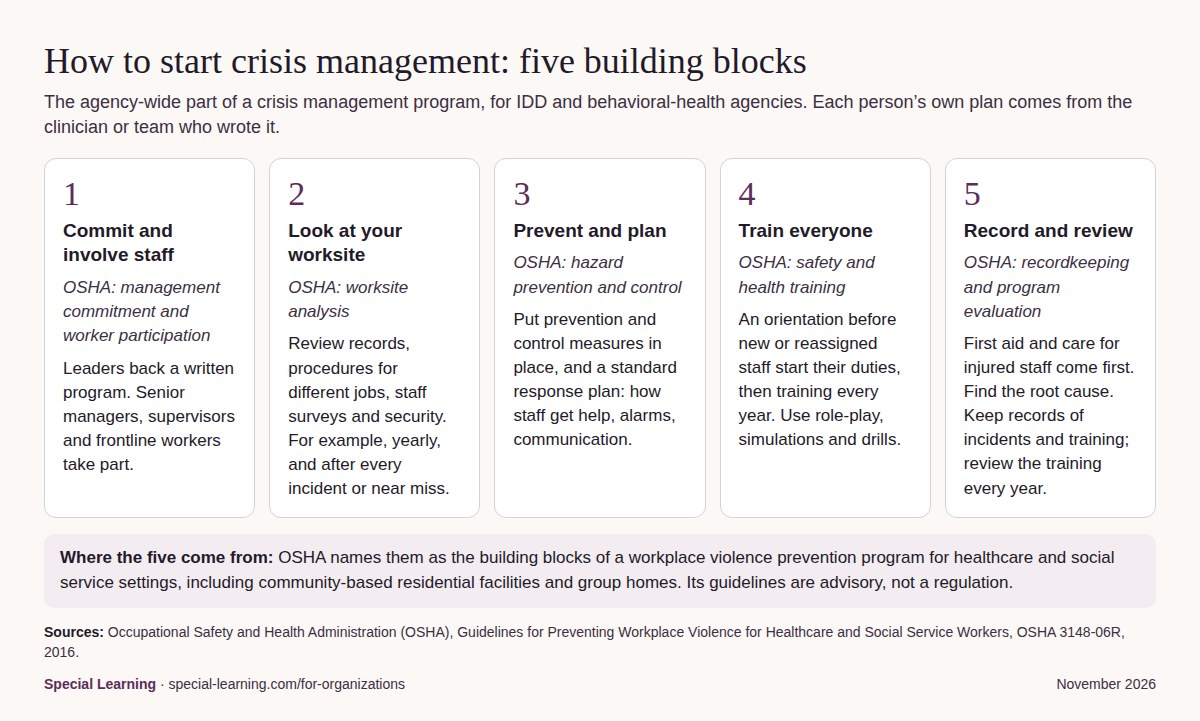
Five steps from OSHA guidance for group homes and community providers, a printable checklist, and what to train DSPs on (OSHA, 2016).
 Word/Excel/PDF
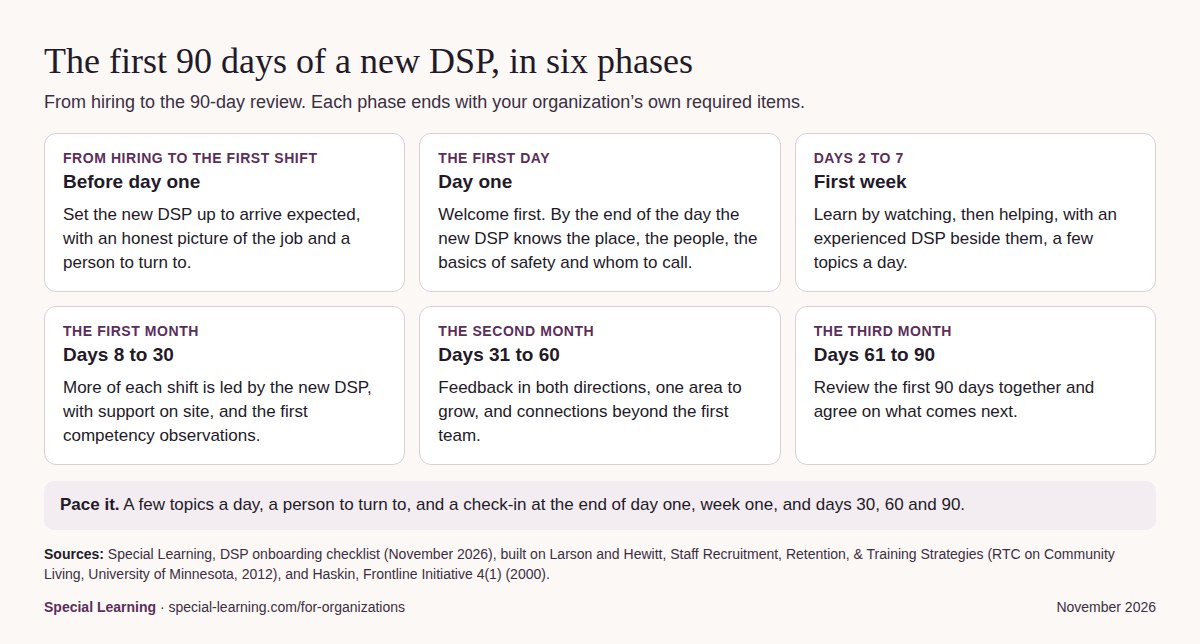
Before day one, day one, week one and days 30, 60 and 90, with mentor pairing, shadow shifts and five supervisor check-ins, plus a tracker spreadsheet. Blank rows for your own required items.
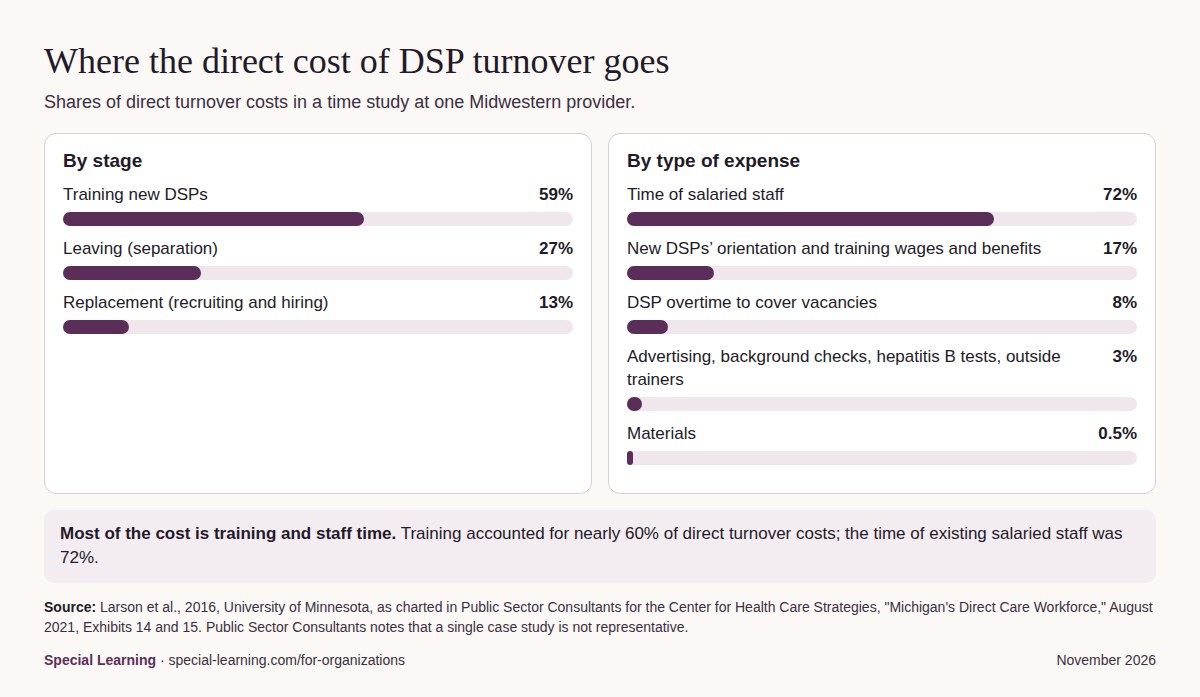
Enter your DSPs, turnover rate and cost to replace one DSP to see the yearly cost of turnover and what a small drop would save.
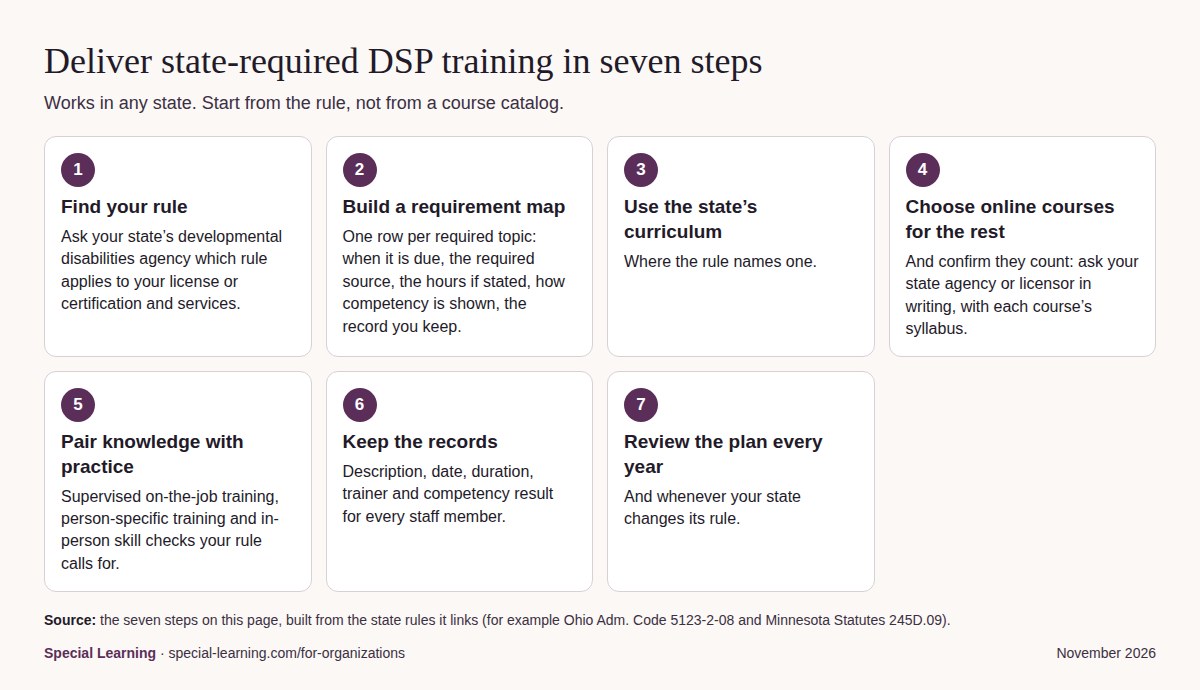
How to deliver your state’s required DSP training online: read the rule, map each topic to a source, pair online learning with observed skill checks, and keep the records.
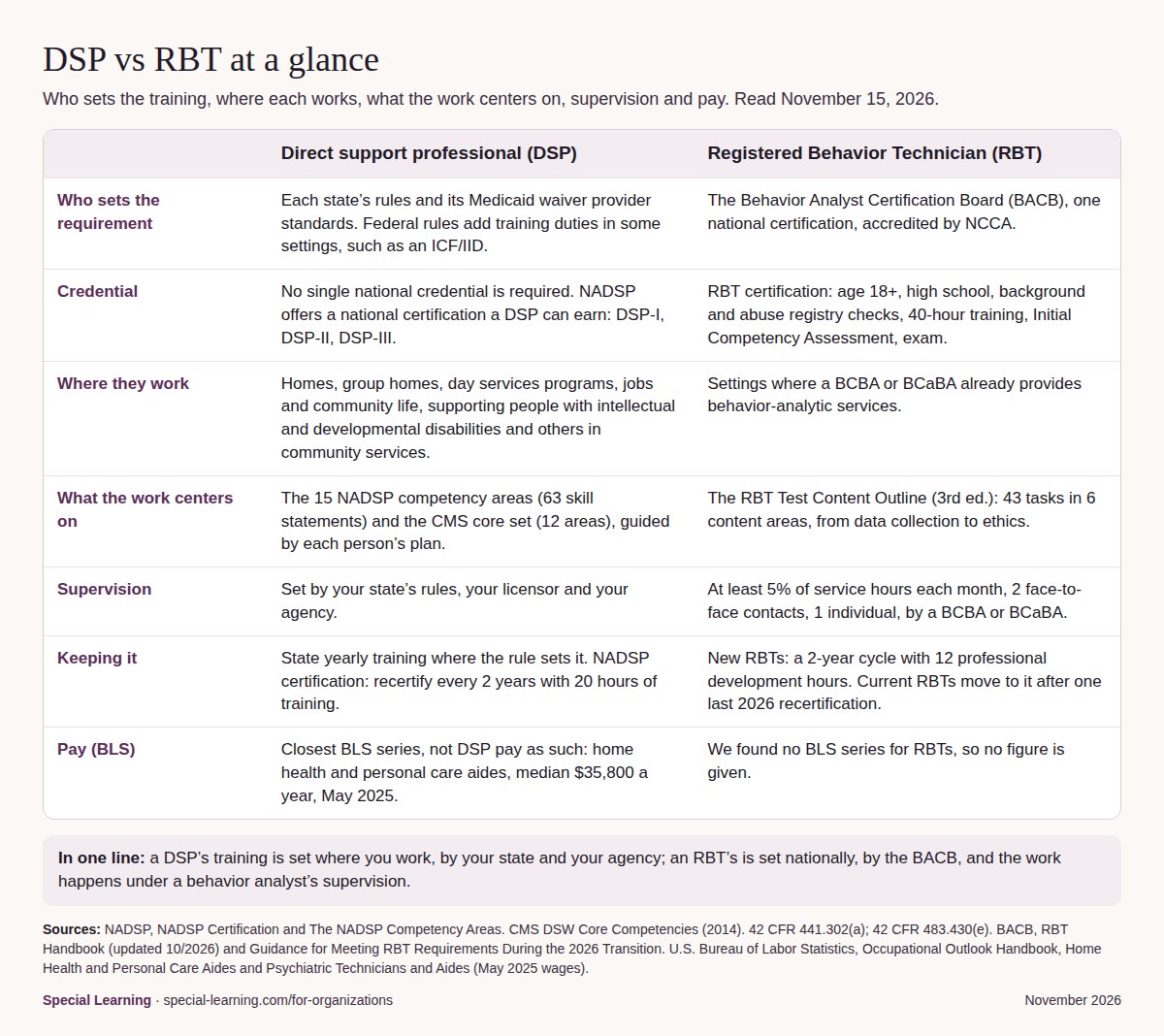
Side by side: a DSP’s training is set by each state, and an RBT is a national certification. Settings, competencies, supervision and pay.
 PDF
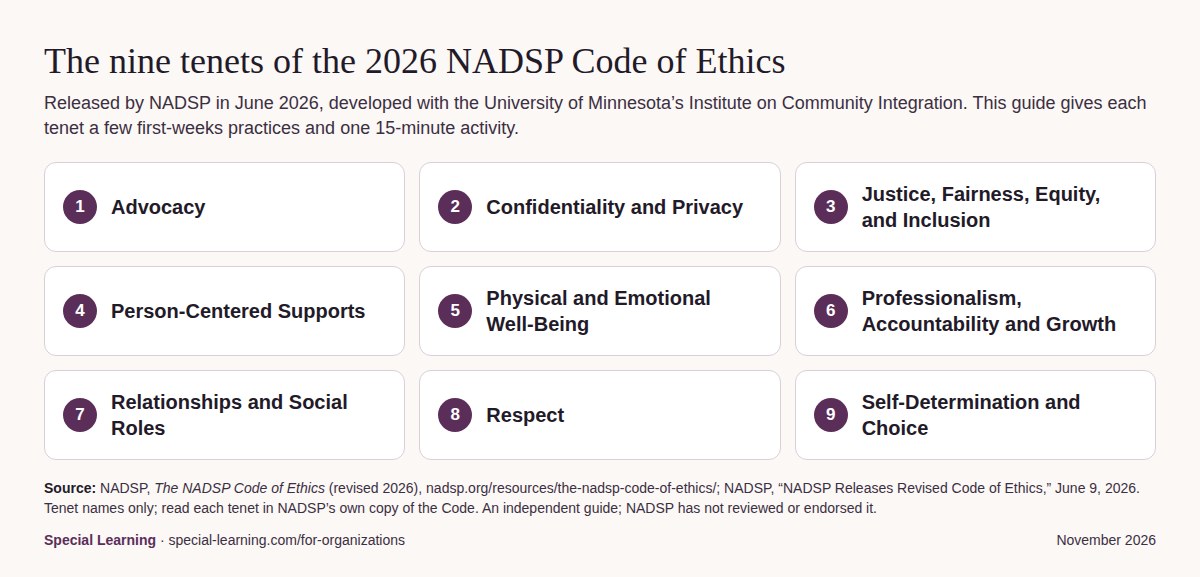
Each of the nine tenets of the revised 2026 NADSP Code of Ethics, turned into everyday practices and a 15-minute scenario for new staff who support autistic adults (The NADSP Code of Ethics).
Train a whole team
For organizations: recorded foundations of autism and behavior support for frontline staff who support autistic children, with a final exam.
Team course for groups
Foundations of autism and behavior support for frontline staff: what autism is, an overview of applied behavior analysis, methods of teaching, prompting and motivation, and building participation skills, followed by a final exam.
What to weigh: the sessions were recorded with young children in classroom and home settings, so the course fits staff who support autistic children best. Support for any one person follows that person’s own plan and the clinician who wrote it.
$99 per learner ($990 for 10 learners) · One-time purchase · Each learner has 12 weeks of access from the day they activate their code.
Free 7-day trial of the first 2 sessions, so you can watch before you buy.
Plan a team evaluation: a step-by-step kit →
See the course and start the free trial →Before you buy
Tell us your service setting, how many staff you want to train and what they find hardest. We will tell you plainly whether this course fits your team.
Tell us about your team →Checking first what your state or funder already requires? Read our guide, autism training for staff who support autistic children.
Training staff in foster care, kinship, adoption or residential child welfare? Read autism training for child welfare staff.
Training early intervention staff who visit families at home? Read autism training for early intervention staff.
Training staff at a community mental health center or CCBHC? Read autism training for community mental health staff.
For DSP trainers
Each of the nine tenets of the revised Code, turned into everyday practices and a 15-minute scenario for new staff who support autistic adults.
Open the free guide →Something to hand families
Free
If your service meets families at intake or diagnosis, you can give them this plan. Week by week, it walks a parent through watching and writing down what their child loves, making the day predictable, helping their child communicate and handling hard moments.
Free, works on a phone and available in English, Spanish, Portuguese, Hindi, French, Arabic and more. It is a starting point for families, not therapy or a care plan.
Open the free home plan →For your organization
Ask us for a link of your own to share with families, so you can see how many open the plan.
Ask for your organization’s link →From interest to a useful choice
What do staff need to understand or do differently? Tell us the service setting and the people they support.
Compare the course content, audience and limitations with that need.
Before buying for colleagues, ask about access for each learner and the terms that apply. An individual purchase is not a shared team license.
Tell us your organization, service setting and the staff learning question you’re trying to answer. Please leave out client names and private health information.
Start a conversation about a suitable learning option. You can buy the team course in the store at the price shown above, or email us first with questions.
Email our team Choose a starting point for your message →Prefer our contact page? →This page is for organizations outside ABA. The examples draw on behavior-support research and practice; evaluate their relevance to your service and your staff’s roles. If you run an ABA agency, explore the agency page.
Each learner has their own access period from activation; ask us about group size and arranging access for your team.
A training lead can tell us which staff need support and what they need to learn. Please leave out names and private health information about the people your staff support.
Opens your email app with prompts you can edit before sending. If the link does not open, write to elena.park.ai@special-learning.com.