
Free guide and downloads for provider training leads
Abuse and neglect reporting training for DSPs
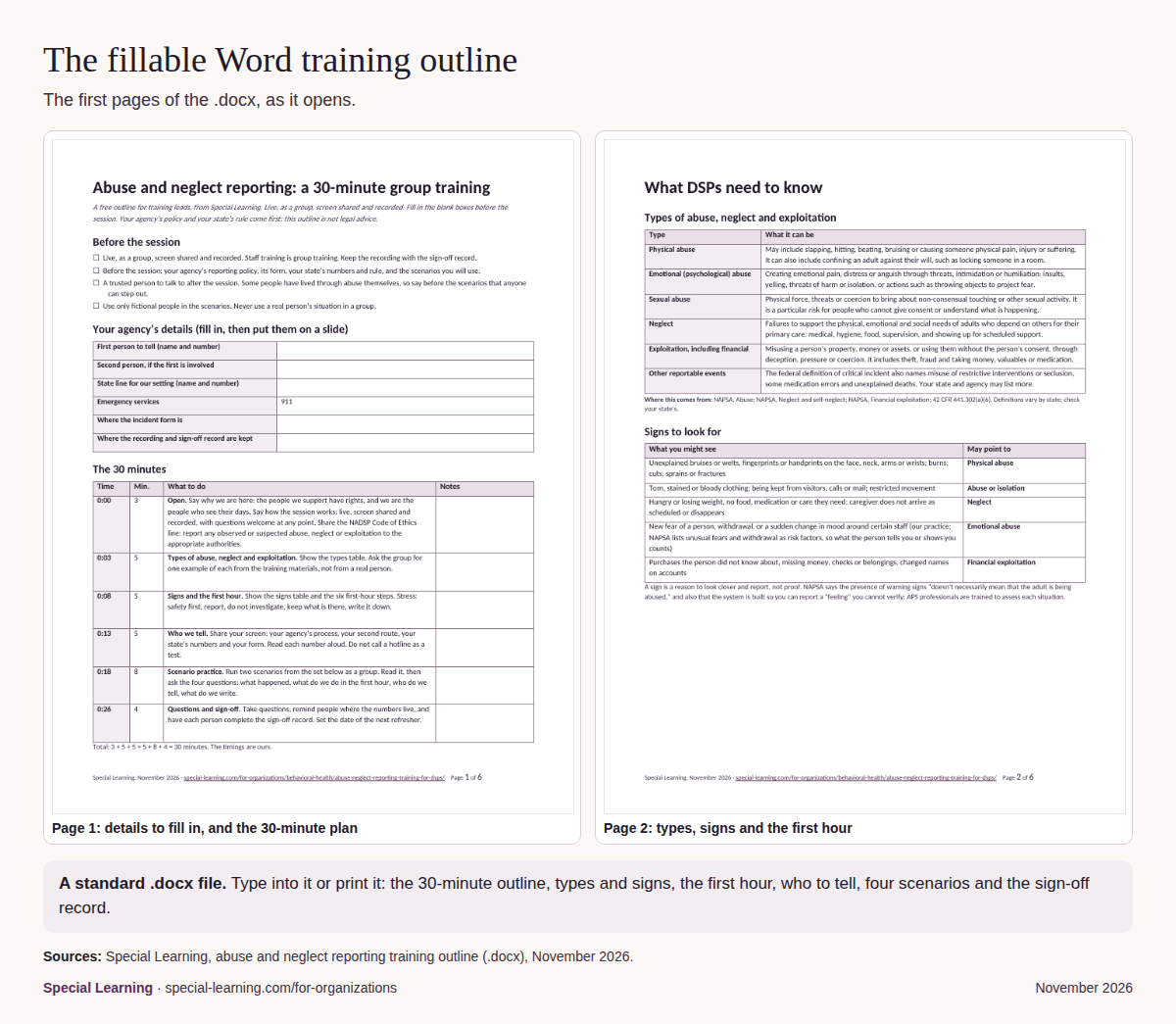
A free guide, with a 30-minute group training outline and a sign-off record in Word and PDF, for training leads at IDD and HCBS providers who train direct support professionals (DSPs) to recognize and report abuse, neglect and exploitation (ANE). What DSPs need to know, what to do in the first hour, who to report to, annual refreshers, four scenarios with fictional people, and the record that shows who was trained and when.
Special Learning · November 16, 2026
Free download
Download the training outline
Short answer
What do DSPs need to know about reporting abuse and neglect?
Read
Direct support professionals (DSPs) need to be able to recognize abuse, neglect and exploitation (ANE) of the people they support, make sure the person is safe, report what they saw or suspect right away to the people their agency and state name, and write down what they saw without investigating it themselves. Who must report, to whom and how fast is set by each state and your agency, so this page gives a 30-minute group training you can run live and a sign-off record, and sends you to your state’s own rule for the details.
Facts vary by state, so we say so plainly and do not give one national deadline. The people we support are people with rights, and the NADSP Code of Ethics asks DSPs to partner with the people they support in understanding, advocating for, protecting and exercising their human and legal rights and responsibilities (NADSP Code of Ethics). This page is practice guidance built on the sources below; it is not clinical or legal advice beyond what they say.
What the federal rule says
Medicaid HCBS requires an incident system; the State sets the details
- Critical incident has a minimum definition. For Medicaid home and community-based services (HCBS) waivers under section 1915(c), the federal rule says a State must operate an incident management system that “identifies, reports, triages, investigates, resolves, tracks, and trends critical incidents.” A critical incident includes, at a minimum, verbal, physical, sexual, psychological or emotional abuse; neglect; exploitation including financial exploitation; misuse of restrictive interventions or seclusion; certain medication errors; and an unexplained or unanticipated death. (42 CFR 441.302(a)(6))
- Providers report to the State. The State must “require providers to report to the State, within State-established timeframes and procedures,” any critical incident that happens during authorized services or because services were not delivered. The timeframes are the State’s, so they differ. (42 CFR 441.302(a)(6))
- Dates. Most of the federal incident management requirements begin for States 3 years after July 9, 2024 (July 9, 2027, our arithmetic); the information-system requirement begins 5 years after. Your state’s rules and forms may change around those dates. (42 CFR 441.302(a)(6))
- Self-directed services. The rule for self-directed personal assistance services lists “Recognizing and reporting critical events” among the support activities a State’s support system must include for participants (42 CFR 441.464(d)(2)(xiv)), and requires an incident management system that follows the same requirements (441.464(e)). (42 CFR 441.464(e))
The 2018 joint report from HHS OIG, ACL and OCR, which looked at group homes, sets out Model Practices for State incident management. They are suggestions to States, not rules. They say service providers should ensure all incidents are reported “as soon as possible after discovery,” that people who report must be free from retaliation, and that the State should ensure “appropriate training of service providers and support coordinators regarding what events, situations, and circumstances constitute reportable incidents.” (HHS OIG, ACL and OCR joint report on group homes (2018))

What DSPs need to know
The types of abuse, neglect and exploitation
NAPSA says definitions of abuse may vary from state to state, so use your state’s list (NAPSA, Abuse). These are the common types.
- Physical abuse. May include slapping, hitting, beating, bruising or causing someone physical pain, injury or suffering. It can also include confining an adult against their will, such as locking someone in a room. (NAPSA, Abuse)
- Emotional (psychological) abuse. Creating emotional pain, distress or anguish through threats, intimidation or humiliation: insults, yelling, threats of harm or isolation, or actions such as throwing objects to project fear. (NAPSA, Abuse)
- Sexual abuse. Physical force, threats or coercion to bring about non-consensual touching or other sexual activity. It is a particular risk for people who cannot give consent or understand what is happening. (NAPSA, Abuse)
- Neglect. Failures to support the physical, emotional and social needs of adults who depend on others for their primary care: medical, hygiene, food, supervision, and showing up for scheduled support. (NAPSA, Neglect and self-neglect)
- Exploitation, including financial. Misusing a person’s property, money or assets, or using them without the person’s consent, through deception, pressure or coercion. It includes theft, fraud and taking money, valuables or medication. (NAPSA, Financial exploitation)
- Other reportable events. The federal definition of critical incident also names misuse of restrictive interventions or seclusion, some medication errors and unexplained deaths. Your state and agency may list more. (42 CFR 441.302(a)(6))

Signs to look for
Teach signs as things a DSP can see and write down, not as conclusions. People communicate in many ways, and a change in behavior around certain people can be a message too (our practice).
| What you might see | May point to |
|---|---|
| Unexplained bruises or welts, fingerprints or handprints on the face, neck, arms or wrists; burns; cuts; sprains or fractures | Physical abuse (NAPSA, Abuse) |
| Torn, stained or bloody clothing; being kept from visitors, calls or mail; restricted movement | Abuse or isolation (NAPSA, Abuse; NAPSA, Neglect and self-neglect) |
| Hungry or losing weight, no food, medication or care they need; caregiver does not arrive as scheduled or disappears | Neglect (NAPSA, Neglect and self-neglect) |
| New fear of a person, withdrawal, or a sudden change in mood around certain staff (our practice; NAPSA lists unusual fears and withdrawal as risk factors, so what the person tells you or shows you counts) | Emotional abuse (NAPSA, Abuse) |
| Purchases the person did not know about, missing money, checks or belongings, changed names on accounts | Financial exploitation (NAPSA, Financial exploitation) |

A sign is a reason to look closer and report, not proof. NAPSA says the presence of warning signs “doesn’t necessarily mean that the adult is being abused,” and also that the system is built so you can report a “feeling” you cannot verify: APS professionals are trained to assess each situation. (NAPSA, Financial exploitation; NAPSA, Neglect and self-neglect)
What to do
The first hour: safety, report, do not investigate, keep, write
- Safety first. If someone is in danger or hurt, call 911 and get medical help. NAPSA says to dial 911 for a life-threatening situation. Our practice: keep the person with someone they trust, and away from anyone they may fear. Reporting may be delayed to keep people safe; New York’s Justice Center says exactly that. (NAPSA, Abuse; New York Justice Center, Reporting an Incident, example only)
- Tell your supervisor or the person your agency names, now. Follow your agency’s policy on who to call first, and who to call if that person is the one you are worried about. If your agency has no second route, use the state line directly. This step is ours.
- Report to the state, by the deadline. Mandated reporters in New York must report to the state hotline within 24 hours of discovery; other states differ. Use the number your agency and state give you, and report even if you are unsure: a mandated reporter who is not sure should still report. (New York Justice Center, Reporting an Incident, example only; New York Justice Center, Mandated Reporters, example only)
- Do not investigate. Do not question the person repeatedly, confront a coworker or family member, or search for proof. Trained investigators and APS workers do that, and a report from you can start it. (NAPSA, Adult Protective Services; HHS OIG, ACL and OCR joint report on group homes (2018))
- Preserve what is there. Do not clean, wash, delete or move things that may matter, such as clothing, messages, a damaged item or a record, unless safety or medical care requires it. Tell your supervisor what you left alone and why. Your agency and the state decide what happens next.
- Write it down the same day. Facts only: who, what, where, when, what you saw and heard, the person’s own words in quotes, what you did and who you told, with the time of each call. No guesses about why, no labels. Use your agency’s incident form; our daily notes and incident report templates can help.

Steps 2, 5 and 6, the how-to in step 4 (if the person tells you something, listen, stay calm, thank them and tell them who you will tell), and the trusted-person sentence in step 1 are our practice, not a rule. Telling your supervisor does not replace a state report where your state requires you to make it. The agency’s policy and the state’s rule decide, and they come first.
Staff who report in good faith should be free from retaliation. The joint report’s Model Practices say providers and the State should ensure that staff, people receiving services and family members are free from retaliation “because they reported incidents or allegations of abuse, neglect, exploitation, or other staff misconduct or errors.” Say so in the training, and show where your own policy says it. (HHS OIG, ACL and OCR joint report on group homes (2018))
For the writing step, see our DSP incident report template and daily notes template.
Who to report to
Your agency’s process, and your state’s line
A DSP reports through two doors: the agency’s own process, and the state’s adult protective services (APS) or developmental disabilities (DD) incident line. Which line, and how fast, is your state’s rule. Find your state’s DSP training rule and agency in our free state finder, then ask that agency for its reporting line and timeline.
| Who | When and why |
|---|---|
| 911 or local emergency services | Anyone in immediate danger, a medical emergency, or a crime in progress. (NAPSA, Abuse) |
| Your agency | Your supervisor, on-call manager or incident line, per your policy. Name a second person for when the first is involved. |
| The state’s line | Adult protective services (APS) or the state developmental disabilities (DD) or Medicaid incident line, as your state and setting require. NAPSA lists the APS number for each state; your state DD agency lists its own. (NAPSA, Adult Protective Services) |
| Family, guardian and the support coordinator | The agency tells them. The Model Practices suggest providers tell families or guardians and support coordinators as soon as possible and within 72 hours; your state sets its own timeline. (HHS OIG, ACL and OCR joint report on group homes (2018)) |

Two states, to show how different they are
Texas (example only)
Texas splits its lines by setting and urgency. The Texas Abuse Hotline site says to call 1-800-252-5400 when a situation is urgent, not to use the website for urgent or emergency situations, and that reports about clients in intermediate care facilities (ICF/IID) and state supported living centers go, since March 1, 2024, to HHS Complaint and Incident Intake (1-800-458-9858) instead. (Texas Abuse Hotline website (DFPS), example only)
New York (example only)
New York’s Justice Center runs one 24-hour hotline for the Vulnerable Persons Central Register at 1-855-373-2122. It says a direct care or support staff person at a facility or agency under its jurisdiction is a mandated reporter, that a mandated reporter must report within 24 hours of discovery, and that reporting may be delayed to keep people safe, including calling 9-1-1. (New York Justice Center, Reporting an Incident, example only; New York Justice Center, Mandated Reporters, example only)
These two are examples of how different states are. Do not copy either state’s numbers or timelines into your own training. Use your state’s rule: the state finder lists each state’s DSP training rule and agency.
Annual refreshers
How often to repeat it
We did not find a federal rule that sets how often DSPs must repeat abuse and neglect training; the sources we read leave frequency to States and contracts. (HHS OIG, ACL and OCR joint report on group homes (2018); 42 CFR 441.302(a)(6)) Check your state’s rule in the state finder and your funder’s contract. Our suggestion, to start from:
| When | What |
|---|---|
| At hire, before working alone | The full 30-minute session, plus a walk through your own form and your state’s line. |
| Every year | The 30-minute session again, with new scenarios and the current state numbers. Put the date on each person’s sign-off record. |
| After an incident review | The joint report lists “additional provider and staff training” among the corrective actions a review can lead to. Do a short session on what the review found. |
| When a rule, form or number changes | Most federal incident management requirements begin for States on July 9, 2027 (our arithmetic), so check each year that your session still matches. |

A 30-minute group training
Run it live, as a group, screen shared and recorded
Staff training is group training: everyone in the room or on the call at once, you screen sharing your own agency’s process, and the session recorded. Keep the recording with the sign-off record.
Before the session
- Live, as a group, screen shared and recorded. Staff training is group training. Keep the recording with the sign-off record.
- Before the session: your agency’s reporting policy, its form, your state’s numbers and rule, and the scenarios you will use.
- A trusted person to talk to after the session. Some people have lived through abuse themselves, so say before the scenarios that anyone can step out.
- Use only fictional people in the scenarios. Never use a real person’s situation in a group.
| Time | Length | What to do |
|---|---|---|
| 0:00 | 3 min | Open. Say why we are here: the people we support have rights, and we are the people who see their days. Say how the session works: live, screen shared and recorded, with questions welcome at any point. Share the NADSP Code of Ethics line: report any observed or suspected abuse, neglect or exploitation to the appropriate authorities. |
| 0:03 | 5 min | Types of abuse, neglect and exploitation. Show the types table. Ask the group for one example of each from the training materials, not from a real person. |
| 0:08 | 5 min | Signs and the first hour. Show the signs table and the six first-hour steps. Stress: safety first, report, do not investigate, keep what is there, write it down. |
| 0:13 | 5 min | Who we tell. Share your screen: your agency’s process, your second route, your state’s numbers and your form. Read each number aloud. Do not call a hotline as a test. |
| 0:18 | 8 min | Scenario practice. Run two scenarios from the set below as a group. Read it, then ask the four questions: what happened, what do we do in the first hour, who do we tell, what do we write. |
| 0:26 | 4 min | Questions and sign-off. Take questions, remind people where the numbers live, and have each person complete the sign-off record. Set the date of the next refresher. |

Scenario practice
Four scenarios with fictional people
Walter, Keisha, Alejandro and Nia are invented, and any resemblance to a real person is by chance. The notes under each scenario are ours, built on the sources named; your policy and your state’s rule decide what you do.
For each, ask the group:
- What happened? (Facts only.)
- What do we do in the first hour?
- Who do we tell, and by when?
- What do we write down?
Walter: Marks he does not explain
Walter, 58, is getting ready for the day. You see dark marks on his upper arm, shaped like fingers. He pulls his sleeve down and says, “It’s nothing.” Last night’s notes say he was fine.
What to notice (ours):
- Fingerprint-shaped marks are on NAPSA’s list of signs, and the person not wanting to talk about it is common.
- Do not press Walter for an answer or confront anyone. Tell him, kindly, who you will tell.
- Write what you saw and his exact words, report as your agency and state require, and tell your supervisor now.
Draws on (NAPSA, Abuse)
Keisha: A door that is locked from the outside
You hear shouting, then see a coworker turn a key in the lock of Keisha’s bedroom door from the hallway. Keisha, 34, is inside and upset. The coworker says, “She can calm down in there for a couple of hours.”
What to notice (ours):
- NAPSA names confining an adult against their will, such as locking someone in a room, as physical abuse.
- Safety first: make sure Keisha can get out and is safe, and call 911 if anyone is at risk. Do not wait for a shift to end.
- If the person you would normally tell is the coworker, use the second route or the state line. Write down exactly what you saw and heard.
Draws on (NAPSA, Abuse)
Alejandro: The card and the gas money
A coworker asks to borrow Alejandro’s bank card “just for gas” and says they will put it back. Two days later, Alejandro, 41, shows you his phone: there are purchases he does not remember.
What to notice (ours):
- NAPSA lists purchases made without the person’s knowledge or consent among the signs of financial exploitation.
- The federal definition includes exploitation “including financial exploitation.” Do not confront the coworker or ask for the card back yourself.
- Write down what Alejandro showed you and said, the dates, and report as your agency and state require.
Draws on (NAPSA, Financial exploitation; 42 CFR 441.302(a)(6))
Nia: No one came overnight
Nia, 29, is supposed to have overnight staff. Twice this week the overnight person did not arrive, and the on-call line did not answer. Each time Nia was alone from late evening until morning, and she missed an evening medication.
What to notice (ours):
- NAPSA lists a caregiver failing to arrive as scheduled as a sign of neglect, and the federal rule covers incidents that occur because services were not delivered.
- Check on Nia, get medical advice if she missed medication, and tell your supervisor and report as required.
- Write the dates, times, who was scheduled and who you tried to reach.
Draws on (NAPSA, Neglect and self-neglect; 42 CFR 441.302(a)(6))

The record
A training sign-off record
One record per session. It holds the date, trainer, format, where the recording is kept, the next refresher date, and each person’s name, role and signature. Each person confirms:
- I can name the types of abuse, neglect and exploitation.
- I know what to do in the first hour: safety first, report, do not investigate, keep what is there, write it down.
- I know who to tell at our agency, and who to tell if that person is involved.
- I know our state’s line and I know where its number is posted.
- I know where our policy says staff who report in good faith are protected from retaliation.
- I took part in the scenario practice and asked any questions I had.
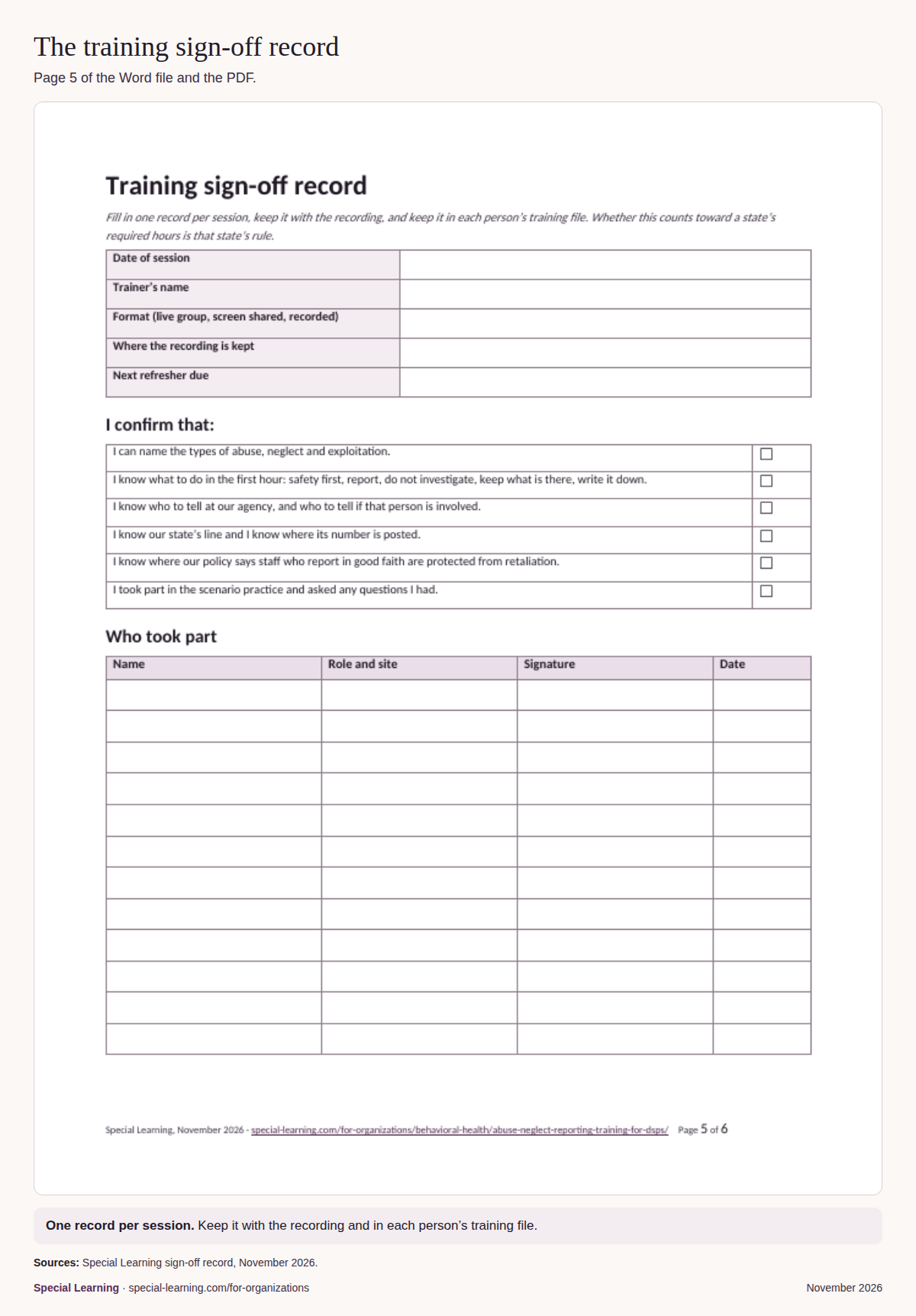
Keep it with the recording and in each person’s training file. Whether a recorded group session counts toward a state’s required hours is that state’s rule; the state finder links each state’s agency. For a roster across the year, see the staff training sign-in sheet and the DSP training and HR toolkit, and for onboarding ethics the NADSP Code of Ethics onboarding guide.
On paper
Prefer paper? Print the PDF
The printable PDF has the same six pages as the Word file, with write-in space for your agency’s numbers and the sign-off record.

Questions
Abuse and neglect reporting training: common questions
What do DSPs need to be trained on about abuse, neglect and exploitation?
How to recognize the types and signs, what to do in the first hour, who to report to and by when, and how to write down what happened. The NADSP Code of Ethics asks DSPs to teach people to understand and report abuse, neglect, exploitation or harm and to report any observed or suspected abuse, neglect or exploitation to the appropriate authorities. (NADSP Code of Ethics)
Do DSPs have to report?
It depends on the state and the setting. New York’s Justice Center says direct care and support staff at facilities and agencies under its jurisdiction are mandated reporters, and the 2018 joint report says that for suspected abuse or neglect the HCBS waiver and State regulations also require mandated reporting. Check your own state’s rule in our state finder. (New York Justice Center, Mandated Reporters, example only; HHS OIG, ACL and OCR joint report on group homes (2018))
How fast must we report?
The federal rule leaves provider timeframes to each State. In New York a mandated reporter must report within 24 hours of discovery, and the Texas hotline asks for a call when a situation is urgent. Ask your state agency, and do not copy another state’s timeline. (42 CFR 441.302(a)(6); New York Justice Center, Reporting an Incident, example only; Texas Abuse Hotline website (DFPS), example only)
Should the DSP investigate first, to be sure?
No. Make the person safe, report what you saw or suspect, and write it down. APS workers investigate, and NAPSA says that if you have a feeling you cannot verify, APS professionals are trained to assess it. New York says to report even if you are not sure it is reportable. (NAPSA, Adult Protective Services; NAPSA, Neglect and self-neglect; New York Justice Center, Mandated Reporters, example only)
Who do we report to, our agency or the state?
Both, as your policy and state say. Your agency’s process comes first for supervision and notifying the family or guardian, and the state’s adult protective services or developmental disabilities incident line receives the report. NAPSA lists the APS number for each state. (NAPSA, Adult Protective Services)
What if the person I would report to is the one involved?
Your agency’s process should name a second person, and the state line is open to everyone: New York says anyone can report, and the joint report’s Model Practices say people who report should be free from retaliation. (New York Justice Center, Mandated Reporters, example only; HHS OIG, ACL and OCR joint report on group homes (2018))
How often should DSPs repeat this training?
We did not find a federal frequency. We suggest repeating it yearly, at hire and after an incident review; your state’s rule and your contracts decide what is required. (HHS OIG, ACL and OCR joint report on group homes (2018))
Does a recorded group session count?
Whether a recorded group session counts toward a state’s required hours is the state’s rule. Use the state finder to read yours, then keep the recording and the sign-off record together.
Can we use this for a person who does not speak?
Yes, with care. Signs show up in behavior, so the first-hour steps stay the same: make the person safe, report and write down what you saw. Do not ask the person to prove it. Add the person’s own way of telling you to your agency’s materials. (New York Justice Center, Reporting an Incident, example only)
Sources
Sources read November 10 to 16, 2026 (the eCFR text is current as of November 12). The quoted lines are as published; the outline, first-hour steps beyond those cited, scenarios, refresher rhythm and sign-off record are ours. Texas and New York are examples only and are not a rule for any other state. None of these organizations has reviewed or endorsed this outline.
- Electronic Code of Federal Regulations, Title 42, section 441.302, State assurances: (a)(6), the State incident management system and its definition of critical incident; text current as of November 12, 2026. https://www.ecfr.gov/current/title-42/chapter-IV/subchapter-C/part-441/subpart-G/section-441.302
- Electronic Code of Federal Regulations, Title 42, section 441.464, State assurances for self-directed personal assistance services: (d)(2)(xiv) and (e); text current as of November 12, 2026. https://www.ecfr.gov/current/title-42/chapter-IV/subchapter-C/part-441/subpart-J/section-441.464
- U.S. Department of Health and Human Services, Office of Inspector General, with the Administration for Community Living and the Office for Civil Rights, Joint Report: Ensuring Beneficiary Health and Safety in Group Homes Through State Implementation of Comprehensive Compliance Oversight (January 2018), with Appendix A, Model Practices for State Incident Management and Investigation. https://oig.hhs.gov/reports-and-publications/featured-topics/group-homes/group-homes-joint-report.pdf
- National Adult Protective Services Association (NAPSA), “Abuse,” definitions, types and signs of physical, emotional and sexual abuse, and a checklist for when to report. https://www.napsa-now.org/abuse/
- National Adult Protective Services Association (NAPSA), “Neglect & Self-Neglect,” types, signs, and what happens after a report. https://www.napsa-now.org/neglect-and-self-neglect/
- National Adult Protective Services Association (NAPSA), “Financial Exploitation,” definition, categories and signs. https://www.napsa-now.org/financial-exploitation/
- National Adult Protective Services Association (NAPSA), “Adult Protective Services,” what APS does and its state-by-state reporting numbers at napsa-now.org/help-in-your-area/. https://www.napsa-now.org/adult-protective-services/
- National Alliance for Direct Support Professionals (NADSP), The NADSP Code of Ethics (revised 2026), the Advocacy and Physical and Emotional Well-Being tenets, as published on nadsp.org. https://nadsp.org/resources/the-nadsp-code-of-ethics/
- Texas Department of Family and Protective Services, Texas Abuse Hotline website, when to call the hotline and when to report to HHS Complaint and Incident Intake; one state’s example only. https://www.txabusehotline.org/Login/Default.aspx
- New York State Justice Center for the Protection of People with Special Needs, “Reporting an Incident,” the Vulnerable Persons Central Register hotline and the mandated reporting timeline; one state’s example only. https://www.justicecenter.ny.gov/reporting
- New York State Justice Center for the Protection of People with Special Needs, “Mandated Reporters,” who must report and what is reportable; one state’s example only. https://www.justicecenter.ny.gov/mandated-reporters