
Free form and downloads for house managers, program supervisors and QIDPs
Behavior support plan implementation checklist for DSPs
A free observation form, in Word and PDF, for watching a direct support professional carry out a person’s existing behavior support plan: mark each step as written, give feedback the same shift, and track it over time. The plan’s own author supplies the steps; the form gives them a place to be marked, counted and talked about, so the supports a person agreed to are really there.
Special Learning · November 16, 2026
Free download
Download the checklist
Short answer
What is a behavior support plan implementation checklist?
Read
A behavior support plan implementation checklist is a form an observer uses to watch a direct support professional (DSP) carry out a person’s existing plan: the plan’s own steps are listed in its author’s words, each is marked done as written, not done as written or not applicable, and the percent done as written is worked out and shared with the DSP the same shift. The form never writes the plan. The BCBA, psychologist or behavior specialist who wrote it supplies the steps, and calls to that author settle any step that cannot be done as written. How often to observe depends on your state, funder and agency, so check yours; this page gives you the form, a tracking grid across observations and a way to give feedback that helps.
We say plainly that rules vary and do not give one frequency for every program. This page is practice guidance built on the sources below; it does not replace the plan’s author, your licensing rule or your funder’s contract.
Why it matters
Why check that a plan is carried out as written
- A plan only helps if it is carried out. Researchers call the degree to which a plan is carried out as intended “treatment integrity,” and one review puts it plainly: how a person responds to a plan is “only a true measure of intervention effectiveness if the intervention is implemented as intended.” That review looked at school-based work, so read it as a principle, not a rule for your home. (Fiske (2008), Behavior Analysis in Practice)
- Steps drift without anyone noticing. Vollmer and colleagues describe “drift”: “individuals initially perform the skills as prescribed but then drift or alter their behavior from the original protocol.” They say careful monitoring plus “periodic booster training sessions may help to prevent drift from occurring.” (Vollmer, Sloman and St. Peter Pipkin (2008), Behavior Analysis in Practice)
- Training is rarely enough on its own. Parsons, Rollyson and Reid write that although completion of training is often a necessary step, “it is rarely a sufficient step.” Observation and feedback in the real routine is what carries the training onto the job. (Parsons, Rollyson and Reid (2012), Behavior Analysis in Practice)
- Staff are meant to implement each person’s plan. For ICF/IIDs, the federal rule says staff “must be able to demonstrate the skills and techniques necessary to implement the individual program plans for each client for whom they are responsible.” That rule covers ICF/IID only; yours may differ. (42 CFR 483.430(e))

What the sources say
Rules vary by state and funder: examples
- Federal, ICF/IID only: training. Staff get “initial and continuing training that enables the employee to perform his or her duties effectively, efficiently, and competently,” and must be able to demonstrate the skills to implement each client’s individual program plan (42 CFR 483.430(e)). (42 CFR 483.430(e))
- Federal, ICF/IID only: who implements. A client’s individual program plan “must be implemented by all staff who work with the client, including professional, paraprofessional and nonprofessional staff,” except for facets that only licensed personnel may implement, and the plan must be made available to all relevant staff (42 CFR 483.440(c), (d)). (42 CFR 483.440(c) and (d))
- Federal, ICF/IID only: safeguards. Interventions to manage behavior are to be used “with sufficient safeguards and supervision to ensure that the safety, welfare and civil and human rights of clients are adequately protected,” and “must be incorporated into the client’s individual program plan” (42 CFR 483.450(b)). (42 CFR 483.450(b))
- Minnesota (example, HCBS license holders). The license holder must keep evidence of staff competency, including “periodic performance evaluations … of the direct support staff person’s ability to perform the job functions based on direct observation,” and staff must be instructed on the person’s support plan “and how to implement those plans.” (Minnesota Statutes 245D.09, subdivisions 3 and 4a (example))
- Ohio (example, behavioral support strategies with restrictive measures). Each person providing services under a strategy that includes restrictive measures “shall successfully complete training in the strategy prior to serving the individual,” and such measures are to be implemented “with sufficient safeguards and supervision to ensure the health, welfare, and rights of individuals.” (Ohio Administrative Code 5123-2-06(F) (example))
- NADSP Code of Ethics (professional ethics, not a legal rule). DSPs commit to “seek guidance from supervisors, managers, or policies when unsure of the correct course of action,” and to “work with the person and their team to find alternatives and advocate for removing unnecessary restrictions and limitations in support plans.” (NADSP Code of Ethics)
These are examples of how different the sources are. None of them sets one frequency for observing DSPs, and we found no national rule that does. Use your own licensing rule, your funder’s contract and the plan author’s instructions; our state finder links each state’s DSP training rule and agency. Find your state’s DSP training rule and agency in our free state finder, then read your own licensing rule. The federal ICF/IID rules are all in 42 CFR Part 483, Subpart I, on eCFR.

The form
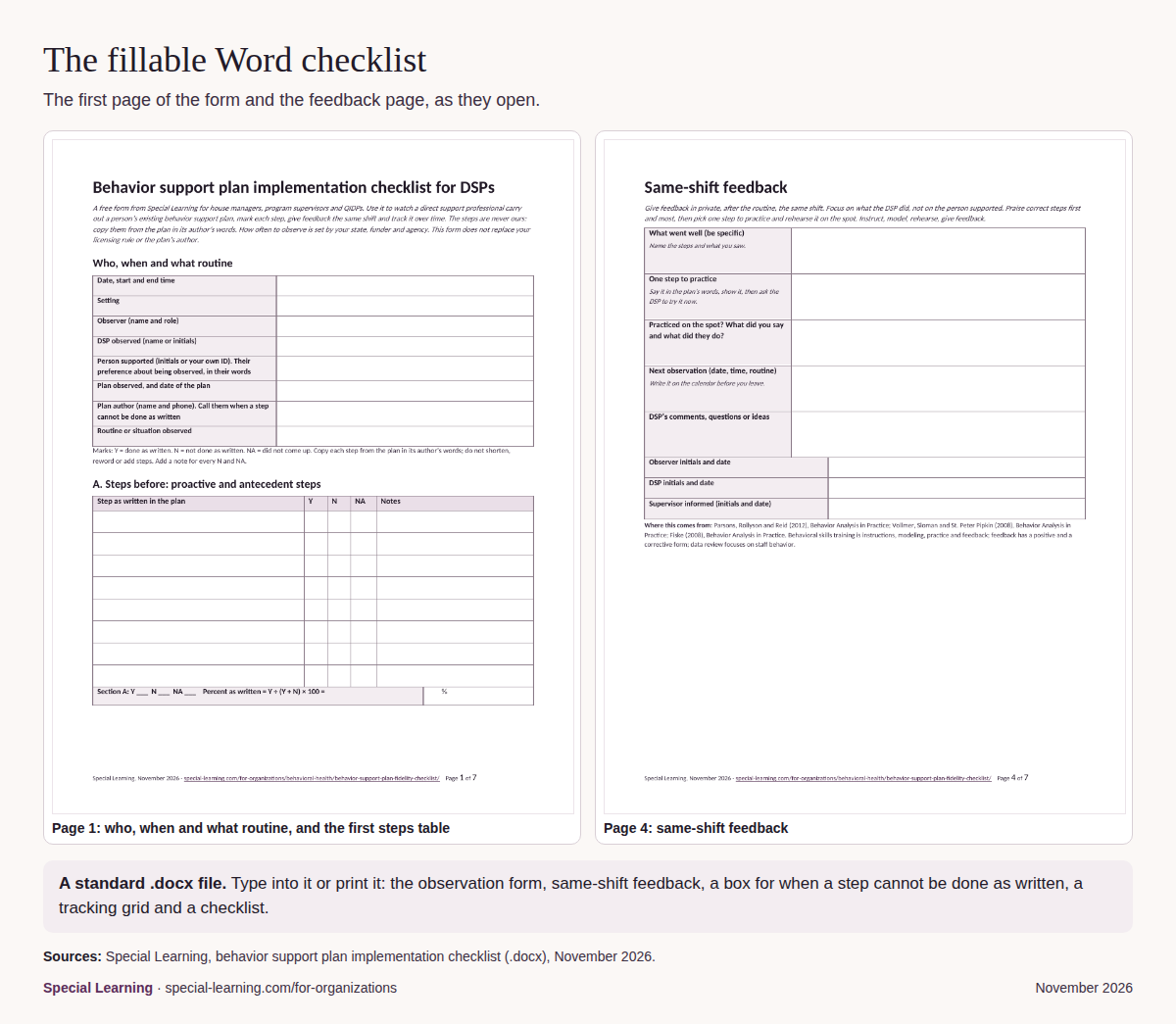
What is on the form
| Part | What it holds | Why |
|---|---|---|
| 1. Who, when and what routine | Observation date, time, setting, the observer, the DSP observed, the person supported (initials or your own ID), the plan and its date, the plan author and their phone, and the routine or situation observed. | Every mark means something only for one routine on one day, and the plan author is named before anything goes wrong (our practice). |
| 2. Steps before: proactive and antecedent | Blank rows for each step the plan lists to do before or at the start of the routine, in the plan’s words, marked Yes, No or N/A with a note. | Vollmer and colleagues note that looking at individual components may be as important as the overall figure and can allow more focused feedback. (Vollmer, Sloman and St. Peter Pipkin (2008), Behavior Analysis in Practice) |
| 3. Steps for teaching: replacement skills | Blank rows for each teaching or replacement-skill step in the plan, in the plan’s words, with the same marks. | Teaching steps are where a plan changes what a person can do; they get their own section so they are not lost. |
| 4. Steps for response | Blank rows for each step the plan gives for how to respond, in the plan’s words, with the same marks. If the situation did not come up, mark N/A. | N/A keeps the percent honest: a step you did not get to see is not counted for or against anyone (our practice). |
| 5. Data recording | Blank rows for each data step the plan asks for, such as a tally or a note at the end of the routine. | The plan’s data tell its author whether it is working; a missed data step is worth a kind, specific word (our practice). |
| 6. Percent as written | A line for each section and one overall: steps marked Yes, divided by Yes plus No, times 100. N/A steps are left out. | Vollmer and colleagues note that integrity is typically calculated as the “total percentage of opportunities for which the procedure was implemented correctly.” (Vollmer, Sloman and St. Peter Pipkin (2008), Behavior Analysis in Practice) |
| 7. Same-shift feedback | What went well, with detail; one step to practice, rehearsed on the spot; the date of the next observation; initials. | Feedback has two forms, positive and corrective, and the research behind it says to praise correct steps and correct errors explicitly. (Vollmer, Sloman and St. Peter Pipkin (2008), Behavior Analysis in Practice; Fiske (2008), Behavior Analysis in Practice) |
| 8. When a step cannot be done as written | A box with the plan author’s name and number, and a line for what you did: mark it, call the author, tell the supervisor. | A change to a plan is the plan author’s to make, with the person and their team (our practice). The NADSP Code asks DSPs to “seek guidance from supervisors, managers, or policies when unsure of the correct course of action.” (NADSP Code of Ethics) |
| 9. Tracking grid | One row per observation across weeks, with date, observer, DSP initials, the percent for each section and overall, whether feedback was given the same shift, and the next date. | Fiske’s review recommends data review that includes graphs of staff performance; a grid is the plainest version. (Fiske (2008), Behavior Analysis in Practice) |

The form’s layout, the marks and the tracking grid are ours. The steps are never ours: they come from the person’s plan, in its author’s words. For a person’s wider picture, see the one-page profile template; for the data a plan asks for, the ABC data sheet; and for a plan to follow in a crisis, the crisis plan template.
Seven steps
How to run an observation
- Before you start, get the current plan from the plan author, the person’s record or the place your agency keeps it, and copy its steps for the routine into the blank rows in the plan’s own words. Do not shorten, reword or add steps. If a step is unclear, stop and ask the plan author before you observe.
- Tell the DSP what you will do and why: you are checking that the plan is clear and works for the team, not catching anyone. Where you can, tell the person supported and ask what they would like you to know; write what they say. Follow your agency’s policy on how people are told about observations.
- Choose a routine where the plan’s steps will come up. Vollmer and colleagues suggest scheduling observations “during periods when the behavior is most likely to occur” to get more chances to see the steps.
- Watch quietly and mark each step as it happens: Yes if it was done as written, No if it was not, N/A if the situation did not come up. Add a short note for every No and N/A. Do not coach in the middle unless someone’s safety needs you to step in; if it does, follow your emergency procedures first.
- Add up each section and the overall percent. Count Yes divided by Yes plus No, times 100, and leave out N/A.
- Give feedback the same shift, in private, after the routine (see below), fill in the feedback box and put the next observation on the calendar before you leave.
- Enter the result on the tracking grid. If the same step is a No across several observations, ask the plan author whether the step is clear, possible in this setting and still right for the person.

| Section | Part | Step as written in the plan (invented) | Mark | Note |
|---|---|---|---|---|
| A | Before | Show Lee the visual schedule and say what comes next. | Yes | Lee looked at the schedule. |
| A | Before | Offer the two-choice board for the towel color. | Yes | |
| A | Before | Give a two-minute warning with the timer. | No | Timer was in the office. Dana used her voice. Call author? |
| B | Teach | Prompt the break card when Lee touches his ears. | Yes | |
| B | Teach | Praise within five seconds of using the card. | Yes | Said “nice job asking for a break.” |
| C | Respond | If Lee says “no” to the shower, wait one minute, then offer the choice again. | N/A | Did not come up. |
| D | Data | Mark the tally on the data sheet after the routine. | No | Filled in at 9:30 from memory. |
Lee, Dana and Priya are invented, and the steps are an invented illustration of what a plan’s author might write, not a clinical suggestion. Your steps come from your plan. Count the steps marked Yes and divide by Yes plus No, then multiply by 100: Yes 4, No 2, N/A 1: 4 ÷ (4 + 2) × 100 = 67%. Vollmer and colleagues describe integrity as typically calculated as “the total percentage of opportunities for which the procedure was implemented correctly,” and add that looking at each component can matter as much as the total, so the form gives a percent for each section too. (Vollmer, Sloman and St. Peter Pipkin (2008), Behavior Analysis in Practice)
Same shift
How to give feedback the same shift
Parsons, Rollyson and Reid describe behavioral skills training (BST) as “instructions, modeling, practice, and feedback until mastery is achieved.” The same four moves can be used on the job in a few minutes after an observation. (Parsons, Rollyson and Reid (2012), Behavior Analysis in Practice)
- Instruct. Say what the step is and why it matters for this person, from the plan. Use the plan’s words.
- Model. If a step was missed, show it: do it once, in the real setting, the way the plan says.
- Rehearse. Ask the DSP to try it with you, now. A short practice is enough.
- Feedback. Say exactly what was done right, then exactly what to change and how. Praise first and most.

How to say it
- Start with what went well, and be specific: “You showed the schedule before the routine started, and Lee looked at it.” Vollmer and colleagues say to seize any “opportunity for positive feedback,” and note that when monitors mostly point out errors, “the monitor can become a conditioned aversive stimulus.”
- Pick one step to practice, not every miss. Corrective feedback, per Parsons and colleagues, is “specifying what was not performed correctly” and “providing instruction about exactly how to perform” it.
- Keep the focus on what the DSP did, not on the person supported. Fiske’s review says feedback should include data review “focused on staff behavior rather than student behavior, praise for correct responding, and explicit correction for integrity errors.”
- If a miss came from a step that is unclear, for example poorly defined, Vollmer and colleagues say the implementer should not receive positive or corrective feedback about it but “should be invited to help review definitions and other sources of error.” Take it to the plan author.
- Write the next observation date on the form, and tell the DSP when it is.
| Box | What was written |
|---|---|
| What went well | You showed the schedule and offered the choice board, and Lee looked at the schedule. You praised the break card right away. |
| One step to practice | The two-minute warning. We practiced it with the timer on the hook by the door. I will ask the plan author whether voice is OK when the timer is missing. |
| Next observation | March 15, morning routine. |
How often
How often to observe
| When | What the sources say |
|---|---|
| Right after training or a plan change | Observe often at first. Fiske’s review: “Initially, frequent observations may be required following teacher training,” and “initially, daily feedback may be necessary to attain high levels of treatment integrity.” (Fiske (2008), Behavior Analysis in Practice) |
| When the percent is high and steady | Fade. The review adds that observations “can be faded if treatment integrity remains high and stable,” and that fading “to weekly and biweekly feedback may result in greater maintenance.” (Fiske (2008), Behavior Analysis in Practice) |
| Keep feedback going | The review says “performance feedback is necessary to maintain high treatment integrity levels over time.” Observation does not end when the percent reaches your target. (Fiske (2008), Behavior Analysis in Practice) |
| Watch for drift, and add a refresher | If the percent slips, go back to more frequent observation and a short refresher. Vollmer and colleagues suggest “periodic booster training sessions.” (Vollmer, Sloman and St. Peter Pipkin (2008), Behavior Analysis in Practice) |
| Check your own rule | Your state, funder or agency may set a minimum, or may say “periodic.” Minnesota’s example asks for “periodic performance evaluations” based on direct observation. This page does not set one. (Minnesota Statutes 245D.09, subdivisions 3 and 4a (example)) |

The ranges above come from school-based research and are not a rule for any home or program. Vollmer and colleagues also say monitoring should be simple, “using efficient methods such as intermittent sampling rather than continuous monitoring.” (Vollmer, Sloman and St. Peter Pipkin (2008), Behavior Analysis in Practice) For where observation fits with supervision more widely, see the DSP supervision log template and the DSP competency checklist.
When a step cannot be done
When a step cannot be done as written, call the plan’s author
- Mark it honestly. Mark No or N/A and write why in the note column, in a line: “door was locked,” “person was not in the room,” “needed a second staff and none was there.”
- Do not improvise a new step. A change to a plan is the plan author’s to make, with the person and their team. The NADSP Code of Ethics asks DSPs to “seek guidance from supervisors, managers, or policies when unsure of the correct course of action.”
- Call the plan’s author. The author’s name and phone are in the box at the top of the form. Say which step, what happened and what you saw. Ask whether the step is still right for the person and what to do next time.
- Tell your supervisor the same day. Say what you called about and what the author said. Put any change the author makes in the plan itself before the next observation.
- If anyone is in danger, follow your emergency procedures first. Then call the author. A fidelity form never replaces your emergency plan or the person’s own safety and rights.

The person at the center
The plan belongs to the person it supports
- The plan belongs to the person it supports. Their preferences, choices and rights come first, and a restrictive procedure belongs in a plan only as the person’s plan and your state allow (our practice).
- Federal ICF/IID rules say behavior interventions “must be incorporated into the client’s individual program plan” and are never to be used “for disciplinary purposes, for the convenience of staff or as a substitute for an active treatment program.” Ohio’s example asks that staff complete training in a plan with restrictive measures before serving the person. (42 CFR 483.450(b); Ohio Administrative Code 5123-2-06(F) (example))
- The NADSP Code of Ethics asks DSPs to “apply person-centered practices” and to “promote, protect, and ensure the human and legal rights, fundamental freedoms, and inherent dignity of the people I support.” A fidelity check is a way to make sure the supports the person agreed to are really there. (NADSP Code of Ethics)
- If you notice that a step seems to take away a choice the person values, or the person is unhappy with it, that is useful. Write it down and bring it to the plan author; the NADSP Code asks DSPs to “advocate for removing unnecessary restrictions and limitations in support plans” with the person and their team. (NADSP Code of Ethics)
If a check turns up a problem that involves someone’s safety, it may also belong in your incident report.
Over time
Track it across observations
One line per observation, with the percent for each section and overall. Fiske’s review recommends data review that includes “graphs of staff performance”; a grid is the plainest version, and the Word file has room for sixteen lines. (Fiske (2008), Behavior Analysis in Practice)
| Date | Observer | DSP | Routine | A | B | C | D | Overall | Feedback same shift | Next |
|---|---|---|---|---|---|---|---|---|---|---|
| Mar 12 | PL | DK | Morning | 67 | 100 | N/A | 0 | 67 | Yes | Mar 15 |
| Mar 15 | PL | DK | Morning | 100 | 100 | N/A | 100 | 100 | Yes | Mar 22 |
| Mar 22 | PL | DK | Morning | 100 | 100 | 100 | 100 | 100 | Yes | Apr 5 |
| Mar 13 | PL | CR | Evening | 33 | 50 | 0 | 100 | 38 | Yes | Mar 16 |
| Mar 16 | PL | CR | Evening | 67 | 100 | 50 | 100 | 75 | Yes | Mar 23 |
| Mar 23 | AO | CR | Evening | 100 | 100 | 100 | 100 | 100 | Yes | Apr 6 |

DK, CR, PL and AO are invented initials and the numbers are invented. Percent is Yes divided by Yes plus No, times 100, with N/A left out; “N/A” in a column means every step in that section was N/A. Your sheet, your rule and the plan’s author decide the target. If the percent slips, go back to observing more often and add a short refresher; if a step is missed across several observations, ask the plan’s author whether it is clear, possible in this setting and still right for the person.
The checklist
Around each observation
- I have the current plan, and its steps for this routine are copied into the form in the plan’s own words.
- I know who wrote the plan and have their name and number on the form.
- The DSP knows what I will do and why, and the person supported has been told in the way our agency’s policy says.
- I picked a routine where the plan’s steps will come up.
- I marked every step Yes, No or N/A, with a short note for each No and N/A.
- I worked out the percent for each section and overall, leaving out N/A.
- I gave feedback the same shift, in private: what went well, one step to practice, rehearsed on the spot.
- Any step that could not be done as written went to the plan’s author the same day, and I did not make up a replacement.
- The result is on the tracking grid and the next observation is on the calendar.

For the staff training roster across the year, see the DSP training and HR toolkit.
On paper
Prefer paper? Print the PDF
The printable PDF has the same seven pages as the Word file, with write-in space for the steps, feedback and tracking grid.

Questions
Behavior support plan implementation checklists: common questions
What is a behavior support plan fidelity checklist?
It is a form for watching how a direct support professional carries out a person’s existing behavior support plan. You list the plan’s steps in its author’s words, mark each one done as written, not done as written or not applicable, work out the percent done as written, and share it with the DSP the same shift. Researchers call this treatment integrity: “the degree to which the treatment is implemented as planned.” (Fiske (2008), Behavior Analysis in Practice)
How often should I observe a DSP carrying out a plan?
It depends on your state, funder and agency, so we do not give one number. A school-based research review says frequent observations may be needed after training and can be faded “if treatment integrity remains high and stable.” (Fiske (2008), Behavior Analysis in Practice) Minnesota’s example, for HCBS license holders, asks for “periodic performance evaluations” based on direct observation. (Minnesota Statutes 245D.09, subdivisions 3 and 4a (example)) Ask your licensing agency and the plan’s author.
How do I work out the percent of steps done as written?
Count the steps marked Yes and divide by the steps marked Yes plus No, then multiply by 100; leave N/A out. Vollmer and colleagues describe integrity as typically calculated from “the total percentage of opportunities for which the procedure was implemented correctly,” and add that looking at individual components can matter as much as the total. (Vollmer, Sloman and St. Peter Pipkin (2008), Behavior Analysis in Practice) The form works out a percent for each section and overall.
What if a step in the plan is unclear or cannot be done?
Mark it No or N/A with a note, do not make up a replacement, and call the plan’s author the same day. A change to a plan is the author’s to make, with the person and their team. The NADSP Code of Ethics asks DSPs to seek guidance when unsure of the correct course of action. (NADSP Code of Ethics)
How do I give feedback the same shift?
After the routine, in private: say what went well, be specific, pick one step to practice and rehearse it right then, and say when you will observe next. Behavioral skills training is “instructions, modeling, practice, and feedback until mastery is achieved.” (Parsons, Rollyson and Reid (2012), Behavior Analysis in Practice) Supportive feedback describes exactly what was done correctly; corrective feedback specifies what was not. (Parsons, Rollyson and Reid (2012), Behavior Analysis in Practice)
Does federal law require me to observe DSPs?
For ICF/IIDs, the federal rule says staff must be able to demonstrate the skills to implement each client’s individual program plan, and that the facility must give initial and continuing training. (42 CFR 483.430(e)) We did not find a federal rule that sets how often to observe. Home and community-based services rules differ by state and funder; Minnesota’s example is one. (Minnesota Statutes 245D.09, subdivisions 3 and 4a (example)) Check yours.
Who writes the steps on the form?
The person who wrote the plan: a BCBA, psychologist or behavior specialist. You copy the steps into the form in their words. The form never adds, changes or ranks steps.
Should the person know they are being observed?
We did not find a rule that answers this for every setting. Our practice is to tell the person in a way they understand, ask what they would like you to know, and follow your agency’s policy. The NADSP Code of Ethics asks DSPs to apply person-centered practices. (NADSP Code of Ethics)
Can I use this for a plan that has restrictive procedures?
A fidelity check does not authorize any procedure. Restrictive procedures belong in a plan only as the person’s plan and your state allow, and the people who carry them out may need specific training first; Ohio’s example requires training in the strategy “prior to serving the individual.” (Ohio Administrative Code 5123-2-06(F) (example)) Use the form to check that the plan is carried out as written, and take any concern to the plan’s author.
Is this a clinical or legal review?
No. It is a form and practice guidance built on the sources listed. The plan’s author, your licensing agency and your funder decide what your program must do.
Sources
Sources read November 16, 2026 (the eCFR text is current as of November 12). The quoted lines are as published; the form layout, marks, percent convention, tracking grid, feedback box and checklist are ours, and the steps in any plan are its author’s. Fiske’s review is of school-based research; Minnesota and Ohio are examples only and are not a rule for any other state. None of these organizations has reviewed or endorsed this form.
- Electronic Code of Federal Regulations, Title 42, section 483.430, Condition of participation: Facility staffing, (e) Standard: Staff training program, ICF/IID; text current as of November 12, 2026. https://www.ecfr.gov/current/title-42/chapter-IV/subchapter-C/part-483/subpart-I/section-483.430
- Electronic Code of Federal Regulations, Title 42, section 483.440, Condition of participation: Active treatment services, (c) Individual program plan and (d) Program implementation, ICF/IID; text current as of November 12, 2026. https://www.ecfr.gov/current/title-42/chapter-IV/subchapter-C/part-483/subpart-I/section-483.440
- Electronic Code of Federal Regulations, Title 42, section 483.450, Condition of participation: Client behavior and facility practices, (b) Standard: Management of inappropriate client behavior, ICF/IID; text current as of November 12, 2026. https://www.ecfr.gov/current/title-42/chapter-IV/subchapter-C/part-483/subpart-I/section-483.450
- Fiske, K. E. (2008). Treatment integrity of school-based behavior analytic interventions: A review of the research. Behavior Analysis in Practice, 1(2), 19-25; a review of school-based research, so its examples are teachers and classrooms. https://pmc.ncbi.nlm.nih.gov/articles/PMC2846589/
- Vollmer, T. R., Sloman, K. N., & St. Peter Pipkin, C. (2008). Practical implications of data reliability and treatment integrity monitoring. Behavior Analysis in Practice, 1(2), 4-11. https://pmc.ncbi.nlm.nih.gov/articles/PMC2846587/
- Parsons, M. B., Rollyson, J. H., & Reid, D. H. (2012). Evidence-based staff training: A guide for practitioners. Behavior Analysis in Practice, 5(2), 2-11. https://pmc.ncbi.nlm.nih.gov/articles/PMC3592486/
- National Alliance for Direct Support Professionals (NADSP), The NADSP Code of Ethics (revised 2026), as published on nadsp.org. https://nadsp.org/resources/the-nadsp-code-of-ethics/
- Minnesota Statutes, section 245D.09, Staffing standards, subdivision 3 (staff qualifications) and subdivision 4a (orientation to individual service recipient needs): home and community-based services license holders for people with disabilities; one state’s example only. https://www.revisor.mn.gov/statutes/cite/245D.09
- Ohio Administrative Code, rule 5123-2-06, Development and implementation of behavioral support strategies, (F) Implementation of behavioral support strategies with restrictive measures, as published by the State of Ohio; one state’s example only. https://codes.ohio.gov/ohio-administrative-code/rule-5123-2-06