
Free template for training leads, supervisors and program directors
Crisis prevention plan template for the people you support
A free crisis plan template, in Word and as a printable PDF, for writing one person’s crisis prevention and response plan with them and the people they choose: what a good day looks like, the early signs, what staff do at each stage, who to call, and how the team debriefs afterward. For group homes, day programs and every team of direct support professionals (DSPs).
Special Learning · November 15, 2026
Free download
Download the template
Short answer
What goes in an individual crisis plan?
Updated
The person first, then the stages, then who to call. An individual crisis prevention plan is written with the person and the people they choose. It says what helps them stay well, the signs that a day is getting harder, what staff do at each stage, who to call, and how the team learns afterward. SAMHSA’s crisis care toolkit says that during a mobile crisis intervention, staff “should engage the individual in a crisis planning process” (SAMHSA, 2020, p. 21).
For people who receive Medicaid home and community-based services, the person-centered service plan must already “Reflect risk factors and measures in place to minimize them, including individualized back-up plans and strategies when needed” (42 CFR 441.301(c)(2)(vi)). This template gives your team one place to write that down for the hardest days, in plain words every staff member can use on shift.
It is the per-person companion to your agency’s crisis program. For the program itself (policy, training, records and review), start with our free starter checklist for crisis management.
Inside the template
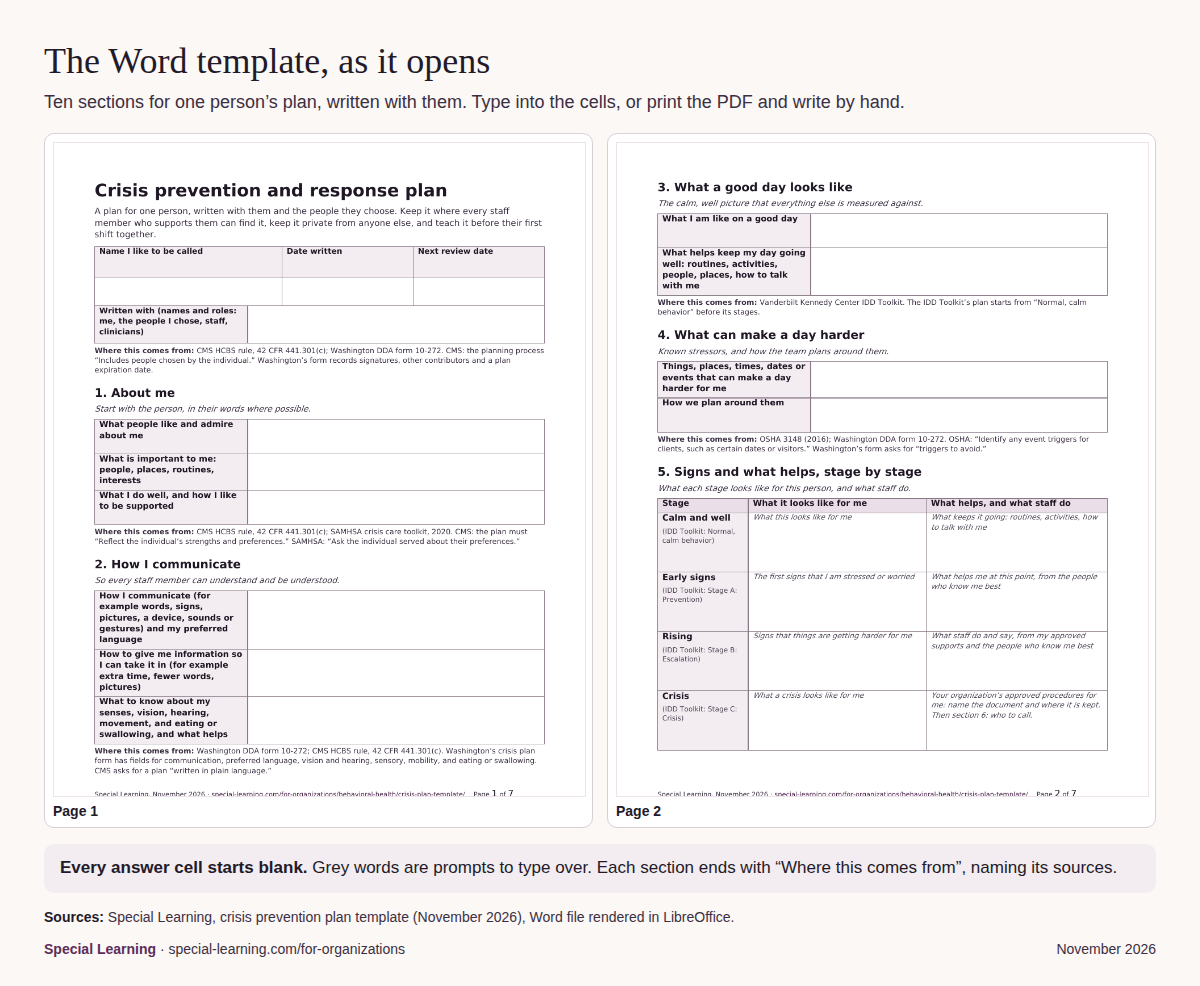
Ten sections, each from a named source
The order runs from who the person is to what the team does on a hard day and after it. Each section draws on public sources: the CMS rule for person-centered plans, SAMHSA’s crisis care toolkit, Washington State’s Cross System Crisis Plan form for people with developmental disabilities, the Vanderbilt Kennedy Center IDD Toolkit’s crisis plan, NADSP’s crisis competency area and OSHA’s guidelines for health care and social service workers. Cross-systems crisis prevention and intervention planning is also one of the services certified START programs provide for people with IDD and mental health needs (National Center for START Services).
| No. | Section | What the source says | Where it comes from |
|---|---|---|---|
| 1 | About me | CMS: the plan must “Reflect the individual’s strengths and preferences.” SAMHSA: “Ask the individual served about their preferences.” | CMS HCBS rule, 42 CFR 441.301(c); SAMHSA crisis care toolkit, 2020 |
| 2 | How I communicate | Washington’s crisis plan form has fields for communication, preferred language, vision and hearing, sensory, mobility, and eating or swallowing. CMS asks for a plan “written in plain language.” | Washington DDA form 10-272; CMS HCBS rule, 42 CFR 441.301(c) |
| 3 | What a good day looks like | The IDD Toolkit’s plan starts from “Normal, calm behavior” before its stages. | Vanderbilt Kennedy Center IDD Toolkit |
| 4 | What can make a day harder | OSHA: “Identify any event triggers for clients, such as certain dates or visitors.” Washington’s form asks for “triggers to avoid.” | OSHA 3148 (2016); Washington DDA form 10-272 |
| 5 | Signs and what helps, stage by stage | IDD Toolkit: “Describe stage-specific signs of behavior escalation and recommended responses.” SAMHSA, on crisis programs: providers “collaboratively develop de-escalation and safety plans for individuals served by the program.” | Vanderbilt Kennedy Center IDD Toolkit; NADSP Competency Area 10; SAMHSA crisis care toolkit, 2020 |
| 6 | Who to call, in order | Washington’s form lists the agency on-call number, family, legal representative, case manager, prescriber and crisis line. SAMHSA: “Text, call, or chat 988.” The IDD Toolkit’s example plan, at the crisis stage: “Call 911 and clearly state this is a behavioral health call.” | Washington DDA form 10-272; SAMHSA, 988 Lifeline; Vanderbilt Kennedy Center IDD Toolkit |
| 7 | If I need more support | SAMHSA: crisis providers “always seek to understand and implement any existing PAD” and include “natural supports and personal attendants” in planning. Washington’s form names a contact for the medication list. | SAMHSA crisis care toolkit, 2020; Washington DDA form 10-272 |
| 8 | Keeping me safe and well | CMS: the plan must “Reflect risk factors and measures in place to minimize them, including individualized back-up plans and strategies when needed.” Washington’s form lists allergies and medical conditions. | CMS HCBS rule, 42 CFR 441.301(c); Washington DDA form 10-272 |
| 9 | After a hard time: debrief and update | NADSP: the DSP continues “discussing the incident with authorized staff and participant(s), adjusting supports and the environment, and complying with regulations for reporting.” | NADSP Competency Area 10; OSHA 3148 (2016); SAMHSA crisis care toolkit, 2020; Vanderbilt Kennedy Center IDD Toolkit |
| 10 | Agreement, copies and review | CMS: the service plan is “signed by all individuals and providers responsible for its implementation” and reviewed at least every 12 months, when needs change or at the person’s request. OSHA: “Ensure workers know and follow procedures for updates to patients’ and clients’ behavior.” | CMS HCBS rule, 42 CFR 441.301(c); Washington DDA form 10-272; OSHA 3148 (2016) |

Section 5
Stage by stage: what it looks like, and what helps
Section 5 is the heart of the plan. The IDD Toolkit’s plan asks teams to “Describe stage-specific signs of behavior escalation and recommended responses,” starting from the person’s calm, usual self (IDD Toolkit). The template uses five plain stages: calm and well, early signs, rising, crisis, and after. For each, write what it looks like for this person and what helps, from the people who know them best. NADSP describes the competent DSP as one who “identifies the crisis, defuses the situation, evaluates and determines an intervention strategy and contacts necessary supports” (NADSP Area 10).
At the crisis stage the template adds no techniques of its own. It names your organization’s approved procedures for this person, where they are kept, and who to call. SAMHSA’s toolkit, writing about crisis facilities, calls restraint and seclusion “safety measures of last resort” (SAMHSA, 2020, p. 32), and CMS’s rule for home and community-based settings requires a setting that “Ensures an individual’s rights of privacy, dignity and respect, and freedom from coercion and restraint” (42 CFR 441.301(c)(4)(iii)).

Section 6
Who to call, in order
Washington State’s Developmental Disabilities Administration publishes a Cross System Crisis Plan form that gathers the residential agency’s on-call number, family, legal representative, case manager, prescriber and mental health crisis line in one place (DSHS 10-272). Section 6 follows that list and adds the clinician who wrote the person’s approved procedures, 988, where SAMHSA says people can “Text, call, or chat 988” (SAMHSA), and emergency services. The IDD Toolkit’s plan asks the team to “Identify under what circumstances the person should go to the emergency department (ED),” and its example plan, at the crisis stage, says to “Call 911 and clearly state this is a behavioral health call.”
Section 7 records the person’s own wishes if a crisis team or hospital becomes involved. SAMHSA’s toolkit says crisis providers “always seek to understand and implement any existing PAD,” a psychiatric advance directive (SAMHSA, 2020, p. 26), so the plan says whether the person has one and where it is kept.

Section 9
After a hard time: debrief, then update the plan
OSHA’s guidelines, which name group homes among community care settings, say “Appropriate and promptly rendered post-incident debriefings and counseling reduce acute psychological trauma and general stress levels among victims and witnesses” (OSHA 3148). SAMHSA’s toolkit says that after a seclusion or restraint event, staff and individuals involved “should be debriefed … to inform policies, procedures, and practices” (SAMHSA, 2020, p. 32). The template’s seven questions start with everyone’s safety and the person’s own account, and end with the change to the plan:
- Is everyone safe and cared for, staff included? (OSHA: first aid and emergency care come first; prompt debriefing for those involved)
- How is the person feeling now, and what do they want to say about it? Are they, and the people they choose, part of this debrief? (NADSP Area 10: discussing the incident with the participant)
- What happened before? Which early signs did we see, and when? (IDD Toolkit: recognize the pattern; OSHA: early recognition of warning signs)
- What helped, and what did not? (SAMHSA, after a seclusion or restraint event: debriefing informs policies, procedures and practices)
- What will we change in supports or the environment? (NADSP Area 10: adjusting supports and the environment; OSHA: find the root cause)
- Has it been reported under our policy and our state’s rules? (NADSP Area 10: complying with regulations for reporting)
- What changes go into this plan, and who tells every staff member? (IDD Toolkit: one person coordinates the debrief and updates the plan; OSHA: workers know the updates)
The questions are ours. A debrief log records what happened before, what helped, what will change and whether it was reported, and one named person coordinates the debrief and keeps the plan current, as the IDD Toolkit’s plan asks.

How to
How to use the template, in six steps
- Write it with the person. Sit down with the person and the people they choose: family, friends, a legal representative if they have one, and the staff who know them best. Use their words where you can.
- Fill it in, section by section. Start with who the person is and what a good day looks like, then the stages. At the crisis stage, write only the name and location of your organization’s approved procedures, not new techniques.
- Bring in the team. Once it is drafted, ask the clinician or behavior support professional who wrote the person’s approved procedures, and their case manager, to check sections 5 to 8. The IDD Toolkit says its plan “is best developed by an interdisciplinary team.”
- Put the numbers in order. Fill section 6 with names and phone numbers in the order staff should call, and check every number works.
- Teach it to every staff member. Walk each person who supports them through the plan before their first shift with them, and have each sign the “Staff who have read this plan” list. Keep the plan where they can find it on shift, and private from anyone else. Repeat after every update.
- Debrief and update. After any hard time, use the section 9 questions, change the plan, and tell every staff member. Review it on the date you set, when the person’s needs change, and whenever they ask.
Step 5 is where training leads come in. OSHA’s guidelines say to “Ensure workers know and follow procedures for updates to patients’ and clients’ behavior” (OSHA 3148), and the “Staff who have read this plan” list in section 10 gives you a dated record for each person who supports them.
On paper
Prefer paper? Print the PDF
The printable PDF carries the same ten sections for the binder at the house or the program, with room to write by hand, and the six steps and sources on the last page.

Free tools for training leads
- How to start crisis management: a free starter checklist for your agency’s crisis program
- DSP annual training plan template: a free spreadsheet and printable PDF
- Find your state’s DSP training rule: a free state-by-state finder for all 50 states and DC
- DSP competency observation checklist: watch a new DSP on shift and tick the NADSP competencies you see
- DSP vs RBT: what’s the difference, and what it means for your training plan
- What does DSP turnover cost your agency? A free calculator
- Bring the 2026 NADSP Code of Ethics into onboarding: a free guide with a 15-minute activity for each tenet
- Autism training for frontline staff: what to look for in a course
- Autism training for community mental health staff: what your team needs to know
- DSP incident report template: a free fill-in report and writing guide, in Word and PDF
- DSP daily notes template: a free progress note form with worked examples, in Word and PDF
- Staff training sign-in sheet template: a free sign-in sheet and per-person training record, in Excel and PDF
- DSP onboarding checklist: a free first-90-days checklist and tracker, in Word, Excel and PDF
- DSP job description template: a free job description, structured interview questions and job preview checklist, in Word and PDF
- DSP shift change report template: a free shift handoff form with a worked example, in Word and PDF
- DSP performance evaluation template: a free 90-day and annual evaluation form with a development plan, in Word and PDF
- DSP training and HR toolkit: all 11 free tools in one download, with a one-page index
- ABC data sheet for DSPs: a free form to record what happened before, during and after, with a guide to writing what you saw, in Word and PDF
- DSP supervision log template: a free record for each coaching meeting with a DSP, with a guide to a 20-minute meeting, in Word and PDF

Several of these tools are built on two public sources from the National Alliance for Direct Support Professionals: the NADSP Competency Areas and the NADSP Code of Ethics.
Questions
Crisis plans: common questions
What is a crisis prevention plan?
A written plan for one person: what helps them stay well, the early signs that a day is getting harder, what staff do at each stage, who to call, and how the team debriefs and updates the plan afterward. The IDD Toolkit’s version “describes how to recognize a pattern of escalating behaviors” and the responses that usually work for the person (Vanderbilt Kennedy Center IDD Toolkit).
Who should write the plan?
The person, with the people they choose. CMS’s rule for person-centered planning in Medicaid home and community-based services says the process “Includes people chosen by the individual” (42 CFR 441.301(c)(1)(i)), and SAMHSA’s crisis care toolkit asks providers to “Help ensure natural supports and personal attendants are also part of the planning team, such as with youth and persons with intellectual and developmental disabilities” (SAMHSA, 2020, p. 27). Add the clinician who wrote the person’s approved procedures and their case manager: the IDD Toolkit says its plan “is best developed by an interdisciplinary team.”
Does the template include restraint or de-escalation techniques?
No. It adds no techniques of its own. At the crisis stage, the plan names your organization’s approved procedures for this person, where they are kept, and who to call. Those procedures, and the training in them, come from your organization and the clinicians who know the person.
How often should a crisis plan be updated?
After any hard time, when the person’s needs change, whenever they ask, and on the review date you set. CMS’s rule asks that the person-centered service plan be reviewed “at least every 12 months, when the individual’s circumstances or needs change significantly, or at the request of the individual” (42 CFR 441.301(c)(3)(i)); you can set the crisis plan’s review date to match.
Did SAMHSA, CMS or Washington State write this template?
No. The template, its prompts, its stage names and its debrief questions are Special Learning’s. Its structure follows the public sources named in each section and listed below. None of those organizations has reviewed or endorsed it.
Does it open in Word or Google Docs?
It is a standard Word (.docx) file made of plain tables, with no macros or form fields. We checked its layout in LibreOffice. Word and Google Docs open .docx files (in Google Docs, upload it to Drive, then open it with Google Docs), but we have not tested it in them.
Sources
Read November 15, 2026. The quoted lines are as published; the template, its prompts, its stage names and its debrief questions are ours. None of these organizations has reviewed or endorsed this template.
- 42 CFR 441.301(c), Medicaid home and community-based services waivers: the person-centered planning process, the person-centered service plan, its review, and home and community-based settings. https://www.ecfr.gov/current/title-42/section-441.301
- Substance Abuse and Mental Health Services Administration (SAMHSA), National Guidelines for Behavioral Health Crisis Care: A Best Practice Toolkit, 2020. SAMHSA’s own link no longer opens; copy hosted by the U.S. Bureau of Justice Assistance: https://bja.ojp.gov/sites/g/files/xyckuh186/files/media/document/samsha-national-guidelines.pdf. SAMHSA has since published 2025 National Guidelines for a Behavioral Health Coordinated System of Crisis Care; its PDF could not be opened on November 15, 2026, so the quotes here are from the 2020 toolkit.
- Washington State Department of Social and Health Services, Developmental Disabilities Administration, Cross System Crisis Plan, DSHS 10-272 (Rev. 03/2025). https://www.dshs.wa.gov/sites/default/files/forms/pdf/10-272.pdf
- Vanderbilt Kennedy Center IDD Toolkit, Crisis Prevention and Management Plan for Adults with Intellectual and other Developmental Disabilities (IDD) at Risk of or During Behavioral Crises (content © Surrey Place, 2023, adapted for U.S. use by the Vanderbilt Kennedy Center). https://echoautism.org/wp-content/uploads/2025/06/Crisis-Prevention-and-Management-Tool.pdf
- National Alliance for Direct Support Professionals (NADSP), The NADSP Competency Areas, Area 10: Crisis Prevention and Intervention. https://nadsp.org/resources/competency-areas/
- Occupational Safety and Health Administration (OSHA), Guidelines for Preventing Workplace Violence for Healthcare and Social Service Workers, OSHA 3148-06R, 2016. https://www.osha.gov/sites/default/files/publications/osha3148.pdf
- National Center for START Services, University of New Hampshire Institute on Disability, The START Model. https://iod.unh.edu/national-center-start-services/start-model
- SAMHSA, 988 Suicide & Crisis Lifeline. https://www.samhsa.gov/mental-health/988