
Free worksheet and downloads for QIDPs, program managers, training leads and DSP supervisors
Dignity of risk worksheet for adults with IDD: a free risk-benefit conversation guide and HCBS rights modification record
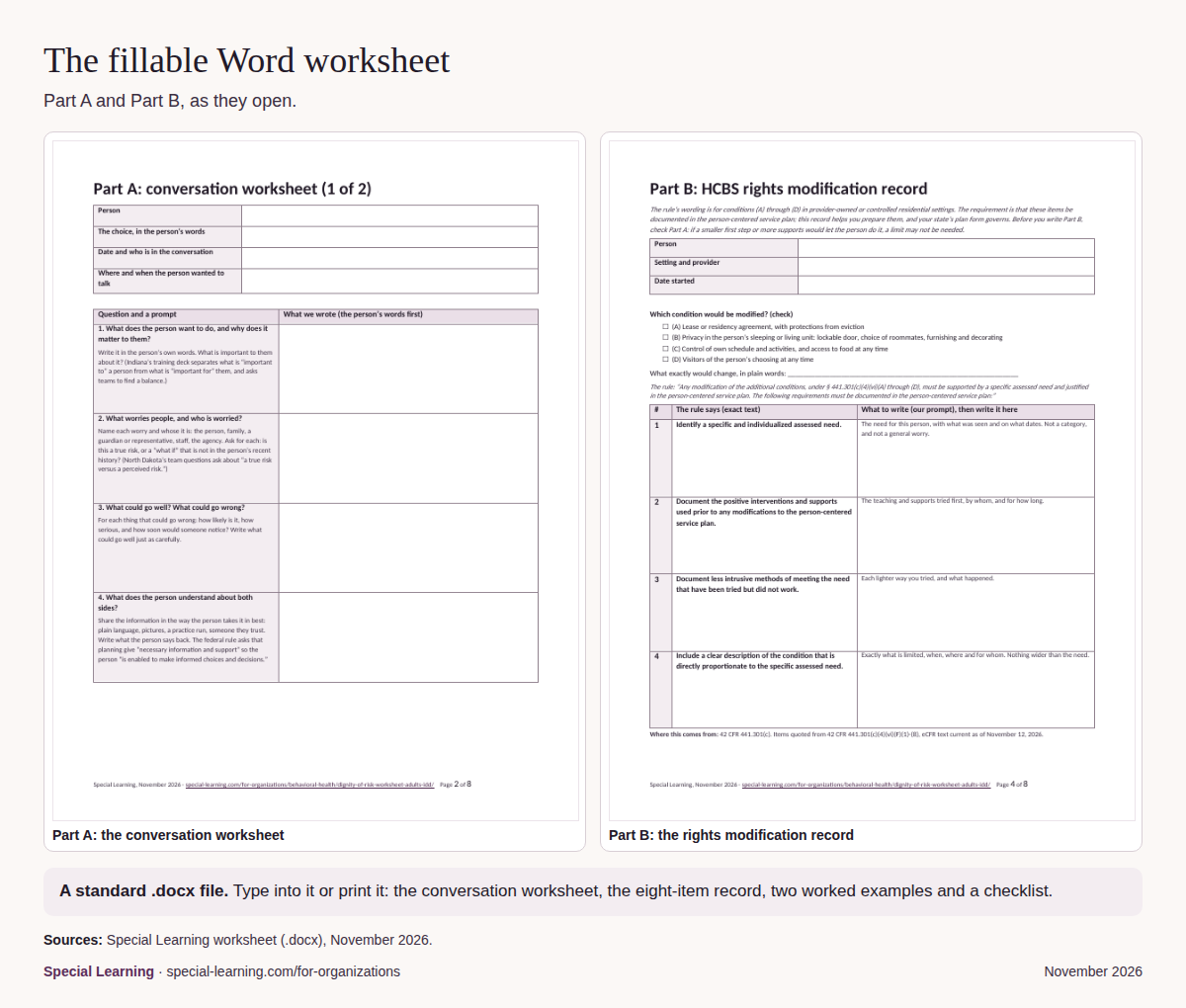
Part A is a conversation worksheet for a choice an adult wants to make that carries risk: cooking alone, taking the bus, a relationship, managing money. It starts from what the person wants, and ends in a plan and a date to look again, not a default no. Part B is a record of the eight items the federal HCBS settings rule asks to be documented before a provider modifies condition (A), (B), (C) or (D) in a provider-owned or controlled residential setting, 42 CFR 441.301(c)(4)(vi)(F)(1)-(8), quoted exactly. Two worked examples use invented people.
Special Learning · November 16, 2026
Free download
Download the worksheet and the modification record
Short answer
How do you talk through a risky choice without defaulting to no?
Read
Start with what the person wants to do and why it matters to them. Write down what could go well and what could go wrong, how likely and how serious each is, and what the person understands. Then plan what would make it safer while the person still gets to do it: practice, a back-up plan, a smaller first step and a date to look again. If the team thinks condition (A), (B), (C) or (D) in a provider-owned or controlled residential setting needs to be modified, the federal rule lists eight items that must be documented in the person-centered service plan, and Part B of the worksheet has a line for each. This page summarizes the federal rule; your state’s waiver and your planning team set what applies.
This page is a planning aid built on the sources below. It does not replace the person’s plan, your state’s forms or your planning team.
The idea
What dignity of risk means
- Where the phrase comes from. Robert Perske wrote “The Dignity of Risk and the Mentally Retarded” in 1972. The author’s abstract says he seeks to show how “appropriate and reasonable risk-taking can and should be worked into the daily living experiences” of people with intellectual disability. We read the abstract, not the article, and the 1972 title uses a term that is no longer used. (Perske (1972), Mental Retardation)
- What the field says it is. Virginia’s DBHDS writes that “the concept of dignity of risk is the right of a person to make an informed choice to engage in experiences meaningful to him/her and which are necessary for personal growth and development.” North Dakota’s toolkit says it is the right “to make informed choices and take reasonable risks to learn, grow, and have better quality of life.” (Virginia DBHDS (2025); North Dakota HHS (2024))
- It does not mean no one thinks about safety. North Dakota: “Dignity of risk does not mean there is no commitment to health and safety.” The NADSP Code asks DSPs to “respect their autonomy while ensuring safety and reducing harm” and to “partner with each person and their support network to identify risks and create safeguards.” (North Dakota HHS (2024); NADSP Code of Ethics)
- Staff have a part in it. The NADSP Code asks DSPs to “support informed decision-making, even when those decisions involve personal risk,” and to “work with the person and their team to find alternatives and advocate for removing unnecessary restrictions and limitations in support plans.” (NADSP Code of Ethics)
Overprotection is the other risk. North Dakota’s quick reference quotes Perske: “Overprotection can keep people from becoming all they could become.” We have North Dakota’s quotation of Perske, not Perske’s article. (North Dakota HHS (2024); Perske (1972), Mental Retardation) The author’s abstract is also on PubMed.

Part A
Part A: the conversation worksheet
Use these eight questions with the person, at their pace and in the way they communicate. Write the person’s words, not a summary of what the team thinks. To learn what the person likes and how they say yes and no first, see the preference and choice record and the one-page profile template.
- What does the person want to do, and why does it matter to them? Write it in the person’s own words. What is important to them about it? (Indiana’s training deck separates what is “important to” a person from what is “important for” them, and asks teams to find a balance.) (Indiana FSSA training deck)
- What worries people, and who is worried? Name each worry and whose it is: the person, family, a guardian or representative, staff, the agency. Ask for each: is this a true risk, or a “what if” that is not in the person’s recent history? (North Dakota’s team questions ask about “a true risk versus a perceived risk.”) (North Dakota HHS (2024))
- What could go well? What could go wrong? For each thing that could go wrong: how likely is it, how serious, and how soon would someone notice? Write what could go well just as carefully.
- What does the person understand about both sides? Share the information in the way the person takes it in best: plain language, pictures, a practice run, someone they trust. Write what the person says back. The federal rule asks that planning give “necessary information and support” so the person “is enabled to make informed choices and decisions.” (42 CFR 441.301(c))
- What would make it safer and still let the person do it? Practice, a route or a recipe, a phone, a buddy the person picks, a back-up plan. The federal rule asks that the plan “reflect risk factors and measures in place to minimize them, including individualized back-up plans and strategies when needed.” (42 CFR 441.301(c))
- What is a smaller first step, and for how long? A trial with support, a set place or a set time, so everyone can see how it goes. The person agrees to the first step and can ask to change it.
- Who decides, and what happens if we disagree? Start from the person’s choice. If a guardian or authorized representative has legal authority, name their role and follow your state’s rules. Write what happens if people disagree. Indiana’s deck says “facilities/leadership/staff cannot make unilateral decisions about restricting someone’s rights.” (Indiana FSSA training deck)
- When will we look again, and how will we know how it is going? Pick a date and a person who will bring it back. Decide what you will look at, including what the person says about how it is going.

What the person decides
- Go ahead as the person wants
- Go ahead with the supports on this sheet
- Try a smaller first step, then look again
- The person chooses not to, for now
- The team thinks condition (A), (B), (C) or (D) in a provider-owned or controlled home may need to be limited: go to Part B
If someone is in immediate danger, follow your emergency and reporting process first. To teach a skill that makes a choice safer, such as a route, a routine or asking for help, see our social skills teaching sheets.
Which part do I use?
| When | Use |
|---|---|
| The person wants to do something that carries risk | Part A: the conversation worksheet. A choice can end here, with a plan and a date to look again. |
| The team thinks a right in condition (A) through (D) needs to be limited in a provider-owned or controlled residential setting | Part B: the rights modification record. Write all eight items, with the person, and put them in the person-centered service plan. |
| Someone is in immediate danger | Follow your emergency and reporting process first. Use the worksheet afterward. |

Part B
Part B: the HCBS rights modification record
The federal HCBS settings rule says that, in a provider-owned or controlled residential setting, certain additional conditions must be met. (42 CFR 441.301(c)) Two of them, in the rule’s words: “Individuals have the freedom and support to control their own schedules and activities, and have access to food at any time.” and “Individuals are able to have visitors of their choosing at any time.” (42 CFR 441.301(c)) The other two are about the lease or residency agreement (A) and privacy in the sleeping or living unit (B).
The rule then says: “Any modification of the additional conditions, under § 441.301(c)(4)(vi)(A) through (D), must be supported by a specific assessed need and justified in the person-centered service plan. The following requirements must be documented in the person-centered service plan:” (42 CFR 441.301(c)) (The same section as eCFR XML, current to November 12, 2026.) These are the eight items, with a prompt of ours for what to write:
| No. | The rule says (exact text) | What to write (our prompt) |
|---|---|---|
| 1 | Identify a specific and individualized assessed need. | The need for this person, with what was seen and on what dates. Not a category, and not a general worry. |
| 2 | Document the positive interventions and supports used prior to any modifications to the person-centered service plan. | The teaching and supports tried first, by whom, and for how long. |
| 3 | Document less intrusive methods of meeting the need that have been tried but did not work. | Each lighter way you tried, and what happened. |
| 4 | Include a clear description of the condition that is directly proportionate to the specific assessed need. | Exactly what is limited, when, where and for whom. Nothing wider than the need. |
| 5 | Include regular collection and review of data to measure the ongoing effectiveness of the modification. | What you will record, who reviews it and how often. Include what the person says. |
| 6 | Include established time limits for periodic reviews to determine if the modification is still necessary or can be terminated. | The review dates, and what would end the modification. |
| 7 | Include the informed consent of the individual. | How the person was told and in what form, what the person said, and how they show agreement. |
| 8 | Include an assurance that interventions and supports will cause no harm to the individual. | Who is responsible and how you will check that the modification itself is not causing harm. |

The rule’s wording is for conditions (A) through (D) in provider-owned or controlled residential settings. The requirement is that these items be documented in the person-centered service plan; this record helps you prepare them, and your state’s plan form governs. Before you write Part B, check Part A: if a smaller first step or more supports would let the person do it, a limit may not be needed. Which conditions Part B can be used for: (42 CFR 441.301(c))
- (A) Lease or residency agreement, with protections from eviction
- (B) Privacy in the person’s sleeping or living unit: lockable door, choice of roommates, furnishing and decorating
- (C) Control of own schedule and activities, and access to food at any time
- (D) Visitors of the person’s choosing at any time
Indiana’s training deck gives an example of proportion: “it’s not okay to restrict someone’s right to go outside alone ever again simply because they fell one time.” (Indiana FSSA training deck) It is Indiana’s guidance; your state may differ. For the rest of the person’s plan, see the behavior support plan implementation checklist, the HCBS waiver provider staff training checklist and the abuse and neglect reporting training.
Worked examples
Two worked examples, with invented people
Both people are invented, and so are the details. They show the layout, not what any real person’s plan should say.
Example of Part A: Amara and the bus
Amara (invented), 29, wants to take the Route 12 bus to her job at the library by herself instead of riding the agency van.
| Question | What we wrote |
|---|---|
| 1. What does the person want to do, and why does it matter to them? | Amara: “I want to take the bus like my coworkers. I want to get there on my own and leave when I’m ready.” |
| 2. What worries people, and who is worried? | Amara’s mother worries about the downtown transfer. Staff worry about winter delays. Amara worries about missing her stop. |
| 3. What could go well? What could go wrong? | Could go well: she arrives on her own schedule and can stay after work. Could go wrong: a missed stop (likely at first, low harm), a long cold wait (moderate), a hard moment with a stranger (unlikely). |
| 4. What does the person understand about both sides? | Amara walked through the route with her photo cards and said what she would do at a missed stop: get off at the next one and call Jo. She asked about the cold, so that is on the list. |
| 5. What would make it safer and still let the person do it? | Three practice rides with a staff member sitting behind her (her choice). Phone with the route app and Jo as a favorite. Fare card with a low-balance alert. Cold-weather back-up: call the van. |
| 6. What is a smaller first step, and for how long? | Tuesdays and Thursdays only for four weeks. |
| 7. Who decides, and what happens if we disagree? | Amara decides. Her mother agreed to try. If anyone is uneasy, the team meets again, with Amara there, before anything changes. |
| 8. When will we look again, and how will we know how it is going? | Week 4, with Amara. Look at the ride log and what she says about it. |
Outcome: go ahead with the supports and a smaller first step. No right is limited, so Part B is not needed.

Example of Part B: Joel and walks after dark
Joel (invented), 41, lives in a provider-owned group home. Condition (C): control of his own schedule and activities. What would change: Joel walks to Miller Park alone any time in daylight, as he always has. After dark, a person he picks goes with him until he finishes route practice at dusk. Invented to show the layout, with invented dates, numbers and people. It is not advice for any real person’s plan.
| The rule says | What we wrote |
|---|---|
| 1. Identify a specific and individualized assessed need. | On two evenings in October (October 9 and 21) Joel lost his route home after dark and a neighbor helped him back, about 90 minutes later each time. In 14 months of daytime walks there were no such events. |
| 2. Document the positive interventions and supports used prior to any modifications to the person-centered service plan. | Route photo cards, a phone with the map app he chose, and two practice walks at dusk with Sam, his support worker. |
| 3. Document less intrusive methods of meeting the need that have been tried but did not work. | For three weeks Joel had a reminder text at sunset and shared his phone location with the house. On 4 of 9 evening walks the phone was off or dead. He did not find the reminders helpful. |
| 4. Include a clear description of the condition that is directly proportionate to the specific assessed need. | After dark only, on walks away from the house only. Joel chooses the companion (Sam, Dee or a housemate), leads the walk and picks the route. Daytime walks, visits and the door are unchanged. |
| 5. Include regular collection and review of data to measure the ongoing effectiveness of the modification. | Staff log each evening walk: companion yes or no, Joel’s note on how it went, any lost-route event. The service coordinator and Joel review the log together every month. |
| 6. Include established time limits for periodic reviews to determine if the modification is still necessary or can be terminated. | Review at 30 days, then every 60 days. Ends when Joel has done the dusk route on three walks with no help. (These numbers are invented; your state may set its own interval.) |
| 7. Include the informed consent of the individual. | Told at a plan meeting using his map. Joel said, “OK for winter, and I want it gone by spring.” He signed, with Sam as witness. His sister agreed. |
| 8. Include an assurance that interventions and supports will cause no harm to the individual. | The companion never blocks or leads. Joel can stop the modification by telling any team member, and the team meets within 5 days. The coordinator checks the log for fewer walks, which would show the limit is isolating him. |

How to use it
Eight steps, from the person’s words to a date to look again
- Start with the person’s words: what they want to do and why it matters.
- Name each worry and whose it is, and ask whether it is a true risk or a “what if.”
- Write what could go well and what could go wrong, with how likely and how serious.
- Check what the person understands, in the way they take in information best.
- Plan supports so the person can still do it: practice, a back-up plan and people the person picks.
- Pick a smaller first step and a date to look again.
- Record the person’s decision, who agreed, and give the person a copy they can use.
- If the team thinks a right in condition (A) through (D) needs limiting, write all eight items in Part B with the person.
| When | What to do |
|---|---|
| Before | Ask the person when and where they want to talk and who they want there. Bring the one-page profile and the preference and choice record if you have them. |
| During | Use Part A at the person’s pace. Write their words. Stop for a break whenever the person asks. |
| After | Give the person a copy in a form they can use. Put the date to look again on the calendar, and bring Part B to the planning team if a limit is proposed. |
| At the review | Look at what happened and at what the person says. Often the supports can fade; sometimes the plan changes. |
For the person’s day in the daily record, see the DSP daily notes template. For the NADSP Code of Ethics tenets that sit behind this, see our NADSP Code of Ethics onboarding guide.
What the sources say
What the rule, the field and four states say
| Source | What it says | How we use it |
|---|---|---|
| 42 CFR 441.301(c)(4)(vi)(F) (42 CFR 441.301(c)) | A modification of the additional conditions must be supported by a specific assessed need and justified in the person-centered service plan, with eight items documented. The conditions are for provider-owned or controlled residential settings. | Part B copies the eight items word for word. |
| Perske (1972) (Perske (1972), Mental Retardation) | The author’s abstract says it shows how “appropriate and reasonable risk-taking can and should be worked into the daily living experiences” of people with intellectual disability. | The origin of the phrase. We read the abstract only. |
| NADSP Code of Ethics (NADSP Code of Ethics) | Asks DSPs to “support informed decision-making, even when those decisions involve personal risk,” and to “respect each person’s right to make decisions, take risks, understand responsibilities, and experience the dignity of learning from the outcomes of those decisions.” | The DSP’s part in Part A. |
| North Dakota HHS toolkit (2024) (North Dakota HHS (2024)) | Team questions include “Are we putting protections in place for a true risk versus a perceived risk?” and “Are these protections important only to the system?” It says there is “no mandated threshold for acceptable levels of risk.” | Questions 2 and 3 of Part A draw on these. |
| Virginia DBHDS (2025) (Virginia DBHDS (2025)) | Defines dignity of risk and says “having a Dignity of Risk policy is a best practice.” It points providers to a Safety Restrictions Form in the state’s ISP. | Shows a state agency asking providers for a written policy. |
| Indiana FSSA training deck (Indiana FSSA training deck) | Says “the proposed restriction must be proportionate to the risk” and that “facilities/leadership/staff cannot make unilateral decisions about restricting someone’s rights.” It gives the example that “it’s not okay to restrict someone’s right to go outside alone ever again simply because they fell one time.” | Informs item 4 and question 7. This is Indiana’s guidance; your state may differ. |
| Montana SDMI HCBS 505 (Montana DPHHS, SDMI HCBS 505) | A mental health waiver policy: when a member “chooses to accept certain risks,” the member “will be required to enter into a Risk Management Agreement,” which maps mitigation “for each identified risk.” | An example of a state risk agreement. It is for a different waiver and population. |

We read the federal rule on ecfr.gov (current as of November 12, 2026), the NADSP Code on nadsp.org, the 1972 abstract, and the four state documents as published PDFs, and we quote only what they say. State policies differ and change; each state’s document is that state’s. We did not find a study that tests this worksheet, and the worksheet, the worked examples and the “what to write” prompts are our own planning aid. Nobody named here has reviewed or endorsed it.
The checklist
Before you finish
- The person’s own words are at the top of the sheet.
- Each worry is named, with whose worry it is.
- What could go well is written as carefully as what could go wrong.
- The person’s understanding was checked in a way that works for them.
- The supports let the person do it, and there is a back-up plan.
- There is a smaller first step and a date to look again.
- The person’s decision is recorded and the person has a copy.
- If a right is limited: all eight items are filled in, the person agreed, and review dates are set.
- Anyone in immediate danger goes through your emergency and reporting process first.

On paper
Prefer paper? Print the PDF
The printable PDF has the same pages as the Word file, with write-in space in Part A, Part B and the reviews table.

Questions
Dignity of risk and HCBS rights modifications: common questions
What is dignity of risk?
It is the right of a person to take reasonable risks in order to learn and grow. Virginia’s DBHDS writes that “the concept of dignity of risk is the right of a person to make an informed choice to engage in experiences meaningful to him/her and which are necessary for personal growth and development.” (Virginia DBHDS (2025)) Robert Perske used the phrase in a 1972 article, whose abstract says it shows how “appropriate and reasonable risk-taking can and should be worked into the daily living experiences” of people with intellectual disability. (Perske (1972), Mental Retardation)
Does dignity of risk mean staff stop worrying about safety?
No. North Dakota’s toolkit says “dignity of risk does not mean there is no commitment to health and safety.” (North Dakota HHS (2024)) The NADSP Code asks DSPs to “respect their autonomy while ensuring safety and reducing harm.” (NADSP Code of Ethics) The worksheet puts safety in the plan: what could go wrong, what makes it safer and a date to look again.
How do we talk about a risky choice without just saying no?
Start with what the person wants and why, then work through the worksheet together: worries and whose they are, what could go well and wrong, what the person understands, and supports that let them do it. Ask whether a worry is a true risk. North Dakota’s team questions include “Are we putting protections in place for a true risk versus a perceived risk?” (North Dakota HHS (2024)) Pick a smaller first step and a date to look again.
What are the eight items the federal HCBS settings rule requires before a provider modifies condition (A), (B), (C) or (D) in a provider-owned or controlled residential setting?
Under 42 CFR 441.301(c)(4)(vi)(F), the requirements to document in the person-centered service plan are: (1) “Identify a specific and individualized assessed need.” (2) “Document the positive interventions and supports used prior to any modifications to the person-centered service plan.” (3) “Document less intrusive methods of meeting the need that have been tried but did not work.” (4) “Include a clear description of the condition that is directly proportionate to the specific assessed need.” (5) “Include regular collection and review of data to measure the ongoing effectiveness of the modification.” (6) “Include established time limits for periodic reviews to determine if the modification is still necessary or can be terminated.” (7) “Include the informed consent of the individual.” (8) “Include an assurance that interventions and supports will cause no harm to the individual.” (42 CFR 441.301(c))
Which conditions can a modification apply to?
The rule says “any modification of the additional conditions, under § 441.301(c)(4)(vi)(A) through (D)” needs a specific assessed need and justification in the plan. (42 CFR 441.301(c)) Those conditions are in the paragraph that begins “In a provider-owned or controlled residential setting.” (42 CFR 441.301(c)) They cover the lease or residency agreement (A), privacy in the sleeping or living unit (B), the freedom and support “to control their own schedules and activities” with “access to food at any time” (C), and being “able to have visitors of their choosing at any time” (D). (42 CFR 441.301(c))
Does this apply to a day program?
The wording of the additional conditions names provider-owned or controlled residential settings. (42 CFR 441.301(c)) A day program can still use Part A to talk through a choice. Ask your state what its waiver and plan forms require for non-residential settings.
Who decides when the person has a guardian or authorized representative?
We do not give a general rule, because it depends on your state and the person’s legal status. The federal rule says the individual, “or if applicable, the individual and the individual’s authorized representative, will lead the person-centered planning process.” (42 CFR 441.301(c)) Part A asks you to name any guardian or representative role and to follow your state’s rules. Indiana’s training deck says “facilities/leadership/staff cannot make unilateral decisions about restricting someone’s rights.” (Indiana FSSA training deck)
What do state risk forms look like?
They vary. Montana’s SDMI waiver policy, for a mental health waiver, requires a Risk Management Agreement when a member chooses to accept certain risks, and the form must include the member’s capacity to make an informed decision, the risks, “risk mitigation for each identified risk” and signatures. (Montana DPHHS, SDMI HCBS 505) Virginia points providers to a Safety Restrictions Form in its ISP. (Virginia DBHDS (2025)) Use your state’s form where it requires one; this worksheet is a way to prepare.
Is a risk agreement the same as a rights modification?
Not in the sources we read. Montana’s policy describes an agreement for when a member chooses to accept a risk. (Montana DPHHS, SDMI HCBS 505) The federal rule’s eight items apply to a modification of conditions (A) through (D). (42 CFR 441.301(c)) Our reading is that a conversation that ends with the person taking on a risk is Part A, and a limit on one of those conditions is Part B. Your state and planning team decide how your forms apply.
How often must a modification be reviewed?
The rule asks for “established time limits for periodic reviews.” (42 CFR 441.301(c)) The paragraph gives no number of days. Your state may set one, so check your waiver. The 30 and 60 days in our example are invented.
Who signs the worksheet?
The rule asks that these items be in the person-centered service plan, and your state’s plan form governs. The worksheet has signature lines for the person and the team as a working record, and for item 7 it asks how the person shows agreement, because a signature is not the only way.
Sources
Sources read November 16, 2026 (the eCFR text is current as of November 12; for Perske (1972) we read the author’s abstract only). The quoted lines are as published. The worksheet questions, the “what to write” prompts, the two worked examples and the checklist are ours. 42 CFR 441.301 covers Medicaid home and community-based services waivers. This page summarizes the federal rule; your state’s waiver and your planning team set what applies. Nobody named on this page has reviewed or endorsed the worksheet.
- Electronic Code of Federal Regulations, Title 42, section 441.301, Contents of request for a waiver, paragraphs (c)(1), (c)(2) and (c)(4); text current as of November 12, 2026. It governs Medicaid home and community-based services (HCBS) waivers. https://www.ecfr.gov/current/title-42/chapter-IV/subchapter-C/part-441/subpart-G/section-441.301
- Perske, R. (1972). The dignity of risk and the mentally retarded. Mental Retardation, 10(1), 24-27 (PubMed record PMID 5059995; the author-written abstract is on the ERIC record EJ053088). The article was not opened; the 1972 title uses a term no longer used. https://eric.ed.gov/?id=EJ053088
- National Alliance for Direct Support Professionals (NADSP), The NADSP Code of Ethics (revised 2026), as published on nadsp.org (tenets Person-Centered Supports and Self-Determination and Choice). https://nadsp.org/resources/the-nadsp-code-of-ethics/
- North Dakota Health and Human Services, Developmental Disabilities: Person-Centered Approach to Risk Toolkit, Quick Reference Guide (April 2024). https://www.hhs.nd.gov/sites/default/files/documents/Developmental%20Disabilities/Person-Centered%20Approach%20to%20Risk%20Quick%20Reference.pdf
- Virginia Department of Behavioral Health and Developmental Services, About: Dignity of Risk (January 2025). https://dbhds.virginia.gov/wp-content/uploads/2025/01/About-Dignity-of-Risk-January-2025-1.pdf
- Indiana Family and Social Services Administration, Division of Disability and Rehabilitative Services, Person-Centered Service Plans & Rights Modifications (training presentation; undated). https://www.in.gov/fssa/ddars/files/PCSP-and-Rights-Modifications-Training.pdf
- Montana Department of Public Health and Human Services, Addictive and Mental Disorders Division, Severe and Disabling Mental Illness (SDMI) Home and Community Based Services Waiver Manual, policy SDMI HCBS 505, Informed Consent and Risk Management (effective July 1, 2020); a mental health waiver, not an IDD waiver. https://www.dphhs.mt.gov/assets/BHDD/WaiverManual/SDMIHCBS505RiskManagement.pdf