
Free checklist for supervisors, HR and training leads
DSP competency observation checklist
Watch a new direct support professional on shift and tick the competencies you see. Built on the 15 NADSP Competency Areas, with the CMS core competencies beside them. Print it, or tick it on screen.
Special Learning · November 15, 2026
Short answer
What competencies should a DSP show?
Updated
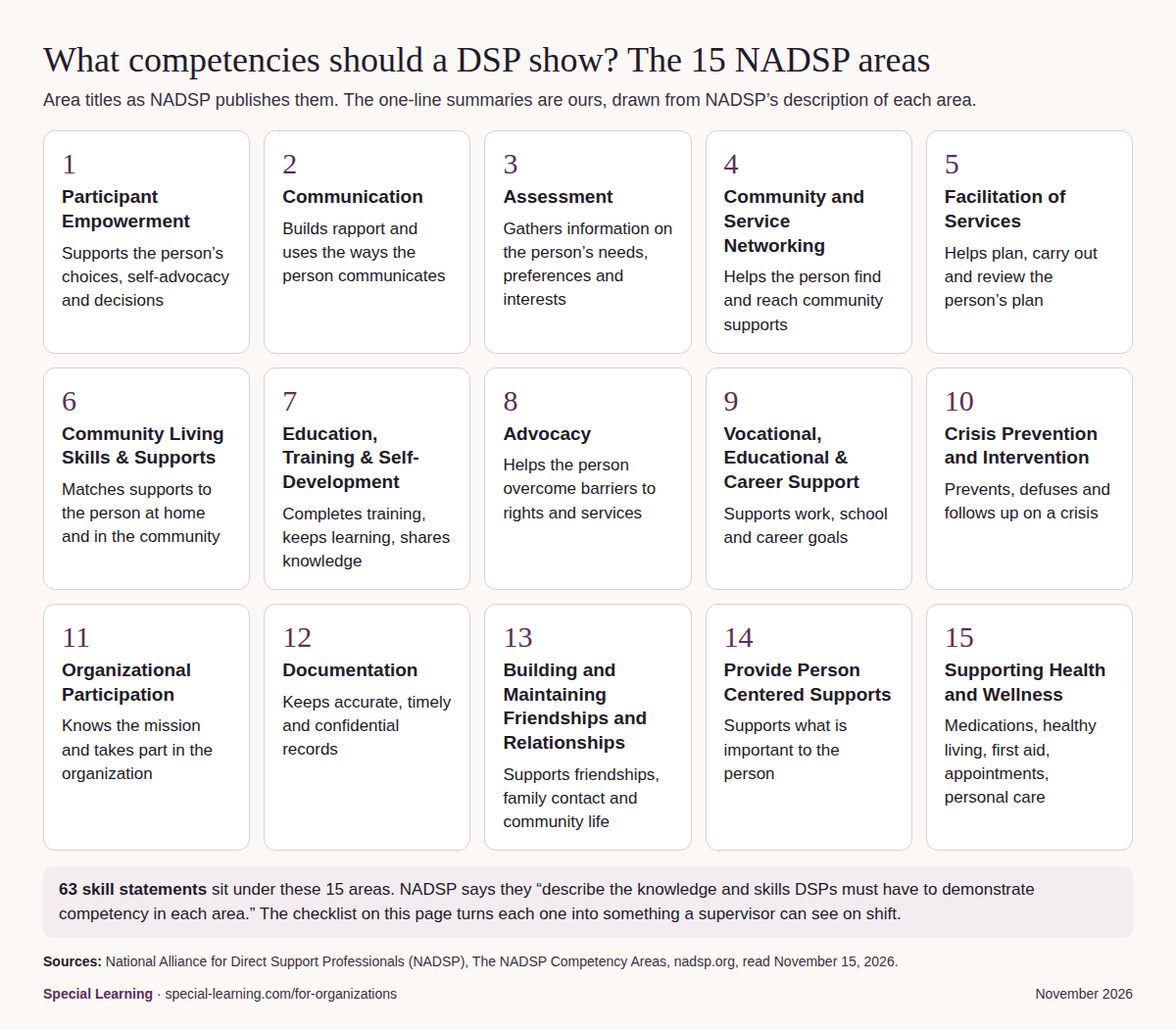
The National Alliance for Direct Support Professionals (NADSP) lists 15 competency areas, approved by its Executive Committee. Each has skill statements that “describe the knowledge and skills DSPs must have to demonstrate competency in each area” (NADSP):
- Participant Empowerment
- Communication
- Assessment
- Community and Service Networking
- Facilitation of Services
- Community Living Skills & Supports
- Education, Training & Self-Development
- Advocacy
- Vocational, Educational & Career Support
- Crisis Prevention and Intervention
- Organizational Participation
- Documentation
- Building and Maintaining Friendships and Relationships
- Provide Person Centered Supports
- Supporting Health and Wellness
The federal counterpart is the CMS Direct Service Workforce Core Competencies: 12 areas and 60 skill statements for community-based services across aging, behavioral health, intellectual and developmental disabilities, and physical disabilities. CMS’s set adds Safety, recognizing and reporting abuse, neglect and exploitation, as an area of its own (CMS, 2014). What a given job requires comes from your state’s rules, your job description and each person’s plan. The checklist below lets a supervisor record, on one shift, which of these a new DSP has shown.
How to use it
How to use the checklist in the first 90 days
CMS names “individual learning plans, coaching guidelines, performance evaluation tools” among the practical tools its core competency set can form the basis for, and says the set “may be customized in practice to reflect the specific needs of people supported” (CMS, 2014). In an intermediate care facility for individuals with intellectual disabilities (ICF/IID), training must focus on “skills and competencies,” and staff must be able to demonstrate the skills and techniques needed to carry out each person’s individual program plan (42 CFR 483.430(e)(2) and (4)). Watching a DSP on shift is one way to see that. The rhythm below is our suggestion; fit it to your state’s rules and your orientation plan.
- Before the first shift: choose the areas. Mark the areas this role uses and skip the rest. Area 9 is central where the role includes job or school supports; the medication item in area 15 applies only where the role includes giving medications. Note whose plan the DSP will follow. How a DSP supports a particular person comes from that person’s plan and the team who wrote it, not from this checklist.
- Weeks 1 to 2: observation 1. Watch one full shift. Tick only what you see, and leave the rest blank, not marked as a miss. Afterward, ask what the DSP noticed first, then share one example for each area you saw.
- By day 30: observation 2. Look first at the areas not yet seen. Pair the DSP with a coworker who shows them on shift; NADSP area 11 includes giving and accepting coworker support and taking part in supportive supervision (NADSP).
- By day 60: observation 3. The DSP picks one area to grow. CMS lists “seeks feedback from many sources” as a skill of its own (CMS, 2014), so ask a coworker and, where they wish, the person supported.
- By day 90: review together. Lay the three dated copies side by side, name the strengths, and agree on a learning plan for the next quarter. Keep the copies under your agency’s records policy.


Free checklist
The DSP competency observation checklist
One copy per shift observed. Tick each skill you see the DSP show; leave the others blank. Each numbered section is one NADSP area, with the closest CMS area named; section 16 is CMS’s Safety area. The boxes and notes work on screen; print for a paper copy. Nothing you tick or type is saved or sent.

Questions
DSP competencies: common questions
What are the NADSP Competency Areas?
A list of 15 competency areas approved by the NADSP Executive Committee, each with skill statements that “describe the knowledge and skills DSPs must have to demonstrate competency in each area” (NADSP). They span participant empowerment, communication, assessment, community networking, facilitation of services, community living, education and self-development, advocacy, vocational support, crisis prevention and intervention, organizational participation, documentation, friendships and relationships, person-centered supports, and health and wellness. NADSP’s E-Badge Academy helps DSPs “get credit for competency” by earning electronic badges. To bring NADSP’s Code of Ethics into onboarding, see our free onboarding guide.
How are the CMS Direct Service Workforce Core Competencies different?
They are a federal research set: 12 areas and 60 skill statements, developed through the National Direct Service Workforce Resource Center with CMS funding, for community-based services across aging, behavioral health, intellectual and developmental disabilities, and physical disabilities (CMS, 2014). CMS names Safety (abuse, neglect, exploitation and emergencies) and Cultural Competency as areas of their own. CMS says the set “is not intended to impose requirements” for workers entering the field; it gives guidance for initial and ongoing training, and “may be customized in practice.”
Is a competency observation required?
It depends on your setting and state. In an ICF/IID, staff “must be able to demonstrate the skills and techniques necessary to implement the individual program plans for each client for whom they are responsible” (42 CFR 483.430(e)(4)). Other settings follow their state’s rules: see the state DSP training finder. Use this checklist alongside whatever your state and licensor require.
Is anything I tick saved?
No. The boxes and notes work on screen only; nothing is saved or sent. Print the page, or choose “Save as PDF” in the print window, to keep a copy. Use a fresh copy for each observation.
Did NADSP or CMS write this checklist?
No. The checklist wording, the 90-day rhythm and the matching between the two sets are Special Learning’s, built on NADSP’s published competency areas and the CMS core competency set. Neither organization has reviewed or endorsed it. The area names and the quoted lines are theirs (NADSP) (CMS, 2014).
Sources
Read November 15, 2026. Area names and quoted lines are as published; the checklist wording, the 90-day rhythm and the matching between the two sets are ours.
- National Alliance for Direct Support Professionals (NADSP), The NADSP Competency Areas. https://nadsp.org/resources/competency-areas/
- Centers for Medicare & Medicaid Services (CMS), National Direct Service Workforce Resource Center, CMS Direct Service Workforce Core Competencies: Final Competency Set, December 2014. https://www.medicaid.gov/sites/default/files/2019-12/dsw-core-competencies-final-set-2014.pdf
- Medicaid.gov, DSW Core Competency Project. https://www.medicaid.gov/medicaid/long-term-services-supports/direct-care-workforce/dsw-core-competency-project
- 42 CFR 483.430(e), Intermediate care facilities for individuals with intellectual disabilities (ICF/IID): staff training program. https://www.ecfr.gov/current/title-42/section-483.430