
Free template for training leads and house managers
DSP daily notes template
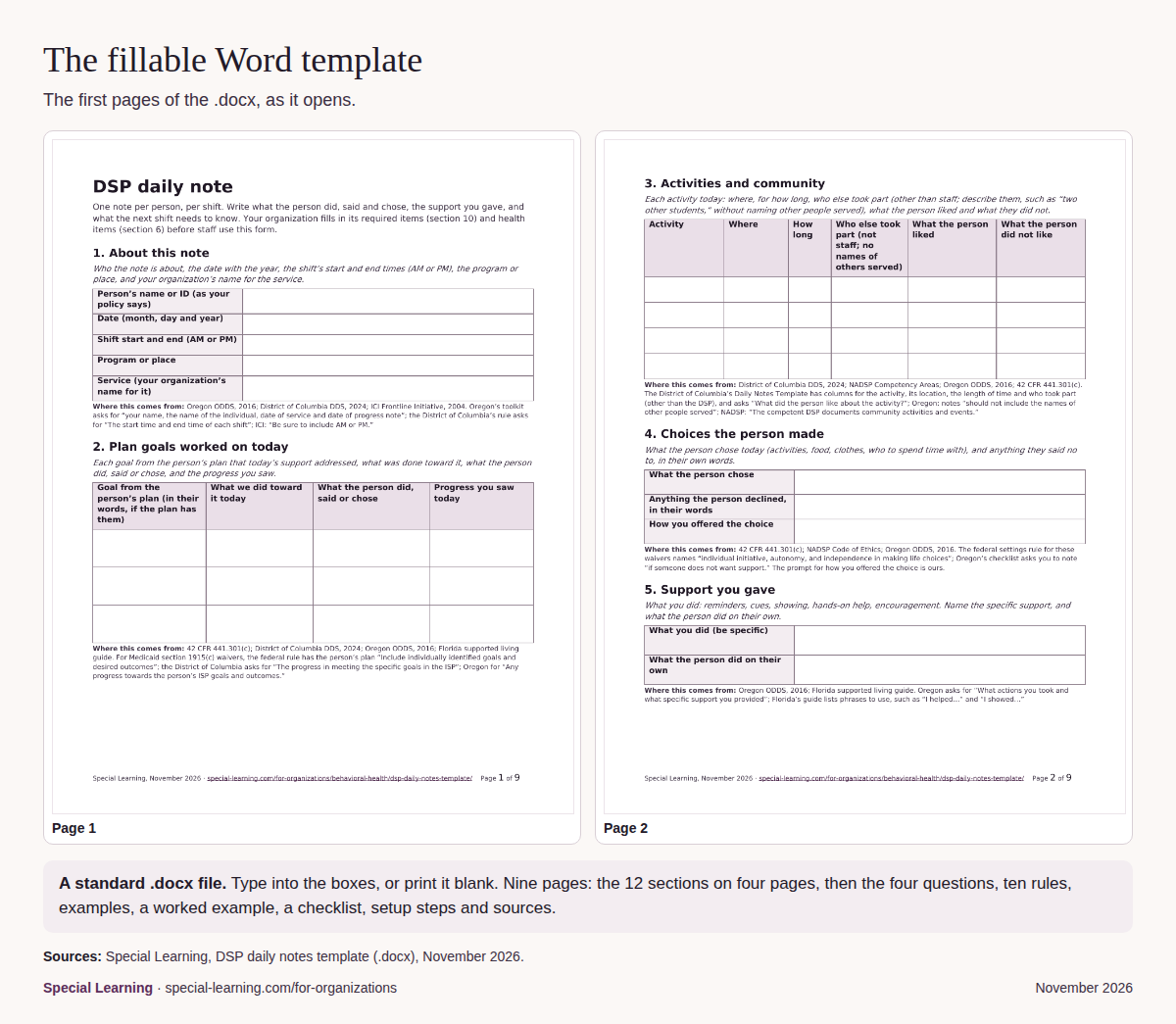
A free daily note (progress note) form for direct support professionals (DSPs) in group homes and day programs, as a fillable Word file and a printable PDF. It comes with a worked example and six examples of writing facts, not opinions: what the person did toward the goals in their plan, the choices they made, their health, their time in the community, and what helped. Your organization adds its own required items.
Special Learning · November 15, 2026
Free download
Download the template
Short answer
What should a DSP daily note include?
Read
What the person did, said and chose today, tied to the goals in their plan, and what the next shift needs to know. A useful note gives times and places, the person’s own words, the support you gave, anything new about their health, and what helped. ICI calls objective documentation “just the facts” (ICI Frontline Initiative, 2004).
A daily note answers four questions:
- Goals. What did the person do toward the goals in their plan today? (42 CFR 441.301(c); District of Columbia DDS, 2024; Oregon ODDS, 2016)
- Choices and enjoyment. What did they choose, take part in and enjoy, and what did they not like? (42 CFR 441.301(c); District of Columbia DDS, 2024)
- Health and changes. Is anything new or not typical for them today, and who did you tell? (District of Columbia DDS, 2024; Oregon ODDS, 2016)
- Next shift. What helped, and what does the next person on shift need to know or follow up? (District of Columbia DDS, 2024; ICI Frontline Initiative, 2004)
The goals come from the person’s plan. For Medicaid section 1915(c) home and community-based services waivers, the federal rule has the person-centered plan “Include individually identified goals and desired outcomes” (42 CFR 441.301(c)). That rule is about the plan, not the note: what a daily note must show is set by your state, your waiver, the service and your agency, so the template leaves those items blank for your organization to fill in.

Worked example
One evening shift, written up
Here is a filled-in note for one invented person. The grocery goal has what Luis did and how it compares with last week, and the call goal has what he did and said; what he said no to is in his words; the support names what staff did and what Luis did on his own; and the next shift knows about the morning shower and Sunday’s visit. It names no other person served, as Oregon’s toolkit asks (Oregon ODDS, 2016).
| Section | Field | Entry |
|---|---|---|
| 1 | Person | Luis R. (ID as your policy says) |
| 1 | Date and shift | Tuesday, March 2, 2027, 3:00 PM to 11:00 PM |
| 1 | Program or place | Maple Street home |
| 2 | Goal from the plan | “I want to buy my own groceries.” |
| 2 | What we did, what Luis did, progress | At the store at 4:20 PM, Luis found 6 of the 8 items on his picture list and asked a clerk where the rice was. He paid with a $20 bill and counted his change with the cashier. Last week he found 4 of 8 (Thursday’s note). |
| 2 | Goal from the plan | “I want to call my sister every week.” |
| 2 | What we did, what Luis did, progress | At 7:30 PM, Luis chose her name from his phone’s favorites and called her himself. They talked for about 20 minutes. He said, “She’s coming Sunday.” |
| 3 | Activities and community | Grocery store, 4:00 to 5:00 PM. He said hello to the cashier he knows. Luis liked “picking the bananas myself.” He did not like the long checkout line and asked to use the self-checkout next time. |
| 4 | Choices | Chose tacos for dinner from the three ideas I offered, and helped cook. Chose to watch the basketball game in the living room instead of his room. Said no to a shower tonight: “In the morning.” I wrote it in section 9 for the morning staff. |
| 5 | Support given | At the store, I held the list while he looked and pointed to the aisle signs twice. At dinner, I cut the onion; Luis browned the meat and set the table on his own. |
| 6 | Health and well-being | Nothing new or different today. He said his knee “feels better” after last week’s appointment. Walked the whole store without stopping. |
| 7 | Incidents | None this shift. |
| 8 | What helped and what did not | The picture list helped him find most items. Waiting in a long line did not go well; he walked away from the line once and came back when I said we could try the self-checkout next time. |
| 9 | For the next shift | Luis plans to shower in the morning; offer it after breakfast. His sister is visiting Sunday afternoon. Follow-up: ask the house manager about adding a self-checkout step to his grocery goal (me, by Thursday). |
| 11 | Signature | Written by J. Okafor, DSP, March 2, 2027, 10:40 PM. |

Facts, not opinions
Six examples to teach with
A label tells the reader what the writer concluded. A fact lets them see what happened, and describes the person by what they did, said and chose, not by a word that sums them up. NADSP’s Code of Ethics asks DSPs to “Use respectful and inclusive language that reflects each person’s preferences.” (NADSP Code of Ethics) These six cover goal progress, choices, health, community, what helped and the support given.
| Topic | Instead of | Write |
|---|---|---|
| Goal progress | Luis worked on his money goal. | Goal: “I want to buy my own groceries.” At the store at 4:20 PM, Luis found 6 of the 8 items on his picture list and asked a clerk where the rice was. He paid with a $20 bill and counted his change with the cashier. |
| Choices | Keisha refused to go out and was uncooperative. | At 1:00 PM, Keisha said, “Not today. I’m staying home.” She chose to stay in and painted at the kitchen table for about an hour. She said yes to asking again about the library on Thursday. |
| Health | Tom seemed sick today. | Tom ate about half of his lunch and said, “My tooth hurts,” at 12:30 PM. I told the house manager at 12:45 PM. She called his dentist, and he has an appointment on Friday at 9:00 AM. |
| Community | Mei had a good day at the community center. | From 2:00 to 3:15 PM, Mei went to the drop-in art class at the community center. She talked with two other students about their drawings and said, “I want to come back next week.” She did not like the loud hallway and put on her headphones there. |
| What helped | Andre was difficult this morning but calmed down. | At 7:10 AM, Andre said, “Too early.” I showed him his picture schedule, and he chose to shower after breakfast instead of before. He was dressed and at the van at 8:05 AM. The schedule and the choice of order helped. |
| Support given | Rosa needs total assistance with everything. | I set the shower water temperature, and Rosa washed her own face and arms. She chose the blue sweater and buttoned the top two buttons herself; I did the rest, as she asked. |

How to write it
Ten rules for writing a daily note
- Write it during or right after the shift. ICI: documenting “immediately (or soon as possible) after it occurs is optimal,” and “Never document something before it happens.” Oregon’s tip: writing soon after “helps you remember the details of the interaction.” (ICI Frontline Initiative, 2004; Oregon ODDS, 2016)
- Start from the person’s plan. Name the goal you worked on and what the person did toward it. Florida’s guide: “Documentation should reflect specifically what the person is trying to accomplish.” (Florida supported living guide; Oregon ODDS, 2016)
- Write what the person did, said and chose. Put their words in quotation marks, or describe the signs, gestures, pictures or device they used; that advice is ours. The NADSP Code asks DSPs to “Support each person’s choices, preferences, abilities, and opinions.” (NADSP Code of Ethics)
- Name the support you gave. Oregon asks for “What actions you took and what specific support you provided.” Florida’s guide suggests “I helped…”, “I assisted…”, “I showed…” and lists phrases not to use, such as “…was lazy”. (Oregon ODDS, 2016; Florida supported living guide)
- Facts first; label any opinion. Objective documentation is “just the facts.” If you add an opinion, ICI says “always indicate that this is your opinion.” Oregon’s checklist: “State the facts. Avoid personal opinions.” Where your agency’s policy allows no opinions, leave them out. (ICI Frontline Initiative, 2004; Oregon ODDS, 2016)
- Make every note about this person, today. Oregon: “Progress notes should be unique to the person served. Notes should never be copied or “cookie cutter”.” (Oregon ODDS, 2016)
- Write what is new or not typical. A change matters more than a routine day. The District of Columbia asks for “The health or behavioral events or change in status that is not typical to the person”; Oregon asks about “Any new needs that may have come up.” (District of Columbia DDS, 2024; Oregon ODDS, 2016)
- Pass on what helped. Write what worked, so the next DSP can do it too. ICI: support given “after you leave for the day may depend upon what you have written.” Amado’s article describes what one DSP knows about a person’s church, club and library, and says “Ideally, that information is documented for others”. (ICI Frontline Initiative, 2004; ICI, Amado, 2004)
- Use respectful, plain words. The NADSP Code: “Use respectful and inclusive language that reflects each person’s preferences.” Oregon: “Use respectful language. Avoid slang or abbreviations.” ICI allows abbreviations only if “approved by your organization.” (NADSP Code of Ethics; Oregon ODDS, 2016; ICI Frontline Initiative, 2004)
- Sign it, correct it the right way, keep it private. ICI: “Always sign what you have written.” For a mistake, “simply draw a line through the error and place your initials next to it.” Oregon: notes “should not include the names of other people served.” The NADSP Code: “Follow the confidentiality policies and guidelines of my employer and the state.” (ICI Frontline Initiative, 2004; Oregon ODDS, 2016; NADSP Code of Ethics)
Before you sign: a ten-point check
Our wording, built on Oregon’s Progress Note Checklist and ICI’s rules (Oregon ODDS, 2016; ICI Frontline Initiative, 2004). A new DSP can run it on every note for the first weeks, and a reviewer can use the same list.
- The date has the year, and the shift times have AM or PM.
- Each plan goal worked on today has what the person did and the progress you saw.
- The person’s own words are in quotation marks.
- Their choices, and anything they said no to, are written down.
- Your support is named: what you did, and what they did on their own.
- Anything new or not typical is written, with who you told.
- Any incident has its report number.
- The next shift knows what helped and what to follow up.
- No opinions without a label, no labels for the person, no other person’s name.
- You signed it, and any mistake has one line through it and your initials.

Inside the template
The 12 sections, and where each comes from
We built the sections from what published rules, forms and guides ask a note to record: the federal person-centered planning and settings rules for Medicaid waivers; the District of Columbia’s 2024 documentation requirements and its Daily Notes Template; Oregon’s 2016 Progress Notes Toolkit; Florida’s supported living guide; ICI’s guide for DSPs on documentation; the NADSP Competency Areas and Code of Ethics; the CMS Direct Service Workforce core competencies; and the federal Medicaid provider-agreement rule, 42 CFR 431.107(b). Each section in the Word form and the PDF names its sources. Section 7 holds only the number of any incident report; staff write the incident itself on a separate form, such as our free DSP incident report template.
| # | Section | What to write | Where it comes from |
|---|---|---|---|
| 1 | About this note | Who the note is about, the date with the year, the shift’s start and end times (AM or PM), the program or place, and your organization’s name for the service. | (Oregon ODDS, 2016; District of Columbia DDS, 2024; ICI Frontline Initiative, 2004) |
| 2 | Plan goals worked on today | Each goal from the person’s plan that today’s support addressed, what was done toward it, what the person did, said or chose, and the progress you saw. | (42 CFR 441.301(c); District of Columbia DDS, 2024; Oregon ODDS, 2016; Florida supported living guide) |
| 3 | Activities and community | Each activity today: where, for how long, who else took part (other than staff; describe them, such as “two other students,” without naming other people served), what the person liked and what they did not. | (District of Columbia DDS, 2024; NADSP Competency Areas; Oregon ODDS, 2016; 42 CFR 441.301(c)) |
| 4 | Choices the person made | What the person chose today (activities, food, clothes, who to spend time with), and anything they said no to, in their own words. | (42 CFR 441.301(c); NADSP Code of Ethics; Oregon ODDS, 2016) |
| 5 | Support you gave | What you did: reminders, cues, showing, hands-on help, encouragement. Name the specific support, and what the person did on their own. | (Oregon ODDS, 2016; Florida supported living guide) |
| 6 | Health and well-being | Anything new or not typical for this person today, what you saw or what they told you, and who you told. Your organization adds the health items its plans track. | (District of Columbia DDS, 2024; Oregon ODDS, 2016; CMS DSW Core Competencies, 2014) |
| 7 | Incidents | If anything happened that your incident rule covers, write it on your incident report, and record the report number here. | (Oregon ODDS, 2016) |
| 8 | What helped and what did not | What worked well today, and what did not go as planned. Is the plan working? Any new needs? | (District of Columbia DDS, 2024; Oregon ODDS, 2016) |
| 9 | For the next shift | What the next person on shift needs to know, and anything that needs follow-up: what, who and by when. | (District of Columbia DDS, 2024; Florida supported living guide; ICI Frontline Initiative, 2004) |
| 10 | Your organization’s required items | Blank on purpose. Your state, your waiver and your agency set what a note for each service must show. Your organization writes those items here before staff use the form. | (42 CFR 431.107(b); District of Columbia DDS, 2024; Florida supported living guide) |
| 11 | Your signature | Your name, title, signature, and the date and time you wrote the note. Sign only what you wrote. | (ICI Frontline Initiative, 2004; District of Columbia DDS, 2024) |
| 12 | Review | The house manager’s or supervisor’s name, date and comments, as your policy says. | (Oregon ODDS, 2016) |

For training leads
Set it up and teach it in five steps
- Fill in your required items first. Open your state’s rules for each service you provide, your waiver documents and your agency’s policy. Write the items a note must show into section 10, and the health items your plans track into section 6, in the Word form or on a printed master copy. We leave both blank on purpose: they differ by state, by waiver and by service. Then save it as your agency’s master copy.
- Add each person’s plan goals. In a copy of the form for each person (typed or printed), type the goals from their plan into section 2, in the person’s own words where the plan has them, so a DSP never has to look them up mid-shift. Keep that as the person’s master copy, and use a fresh copy for each shift.
- Teach the four questions and the ten rules with the example pairs. Read each “instead of” line aloud and have staff rewrite it as facts before you show the “write” line.
- Practice with the worked example. Describe Luis’s evening in a few sentences, have each new DSP write the note, then compare it with the worked example and the ten rules.
- Read notes as a reviewer. Each week, read a few notes per person and ask Florida’s bottom-line question: “Given the information collected, am I able to determine if the person is improving, losing, or maintaining skills or routines, is staying healthy and free from abuse, neglect, and exploitation?”

On paper
Prefer paper? Print the PDF
The printable PDF carries the same 12 sections with write-in space, then the four questions, the ten rules, the six example pairs, the worked example, the check, the setup steps and the sources, for a binder at the program or a new DSP’s first week.

Questions
DSP daily notes: common questions
What should a DSP daily note include?
Who the note is about, the date and shift times, the goals from the person’s plan that you worked on and what the person did toward them, activities and community time, the choices the person made, the support you gave, anything new about their health, any incident report number, what helped and what did not, what the next shift needs to know, your organization’s required items, and your signature. Those are the 12 sections of this template, each drawn from the published sources listed below (District of Columbia DDS, 2024; Oregon ODDS, 2016; Florida supported living guide). The goals themselves come from the person’s plan.
How do I write a daily note that sticks to the facts?
Write what the person did, said and chose, with times and places, and the support you gave. Put their words in quotation marks. Keep any opinion apart and label it, and describe actions rather than labels like “uncooperative.” ICI calls objective documentation “just the facts” (ICI Frontline Initiative, 2004), and Oregon’s checklist says “State the facts. Avoid personal opinions.” (Oregon ODDS, 2016)
When should a DSP write the daily note?
During the shift or right after it, while the details are fresh, and never ahead of time. ICI’s guidance is that documenting “immediately (or soon as possible) after it occurs is optimal,” and “Never document something before it happens.” (ICI Frontline Initiative, 2004) Your agency’s policy sets the deadline.
What must a daily note show for billing or my state?
That depends on your state, your waiver, the service and your agency’s policy, so this template leaves section 10 blank for your organization to fill in. Under 42 CFR 431.107(b), each provider’s agreement with the state Medicaid agency includes that it will “Keep any records necessary to disclose the extent of services the provider furnishes to beneficiaries” (42 CFR 431.107(b)). As one example, the District of Columbia’s 2024 document lists what notes must contain for its waiver services, “as set forth in each service rule” (District of Columbia DDS, 2024); that list is the District’s, not every state’s.
How is a daily note different from an incident report?
The daily note covers the whole shift: goals, activities, choices, health and what the next shift needs. When something happens that your incident rule covers, staff write it on a separate incident report and put its number in section 7 of the daily note. Our free DSP incident report template is built the same way, and our crisis plan template holds each person’s plan for preventing and handling a crisis.
Did a state or federal agency write this template?
No. The template, its section prompts, the ten rules’ wording, the example sentences and the worked example are Special Learning’s. The fields come from the published federal, state, ICI and NADSP sources listed below, and the quoted lines are as published. None of those organizations has reviewed or endorsed this template.
Sources
Read November 15, 2026. The quoted lines are as published; the template, its section prompts, the ten rules’ wording, the example sentences and the worked example are ours. None of these organizations has reviewed or endorsed this template.
- 42 CFR 441.301(c)(2) The person-centered service plan, and (c)(4) Home and community-based settings, for Medicaid section 1915(c) home and community-based services waivers, eCFR, up to date as of November 12, 2026. https://www.ecfr.gov/current/title-42/section-441.301
- 42 CFR 431.107(b), Required provider agreement (Medicaid), eCFR, up to date as of November 12, 2026. https://www.ecfr.gov/current/title-42/section-431.107
- Centers for Medicare & Medicaid Services, National Direct Service Workforce Resource Center, Direct Service Workforce Core Competencies, Final Competency Set, December 2014. https://www.medicaid.gov/sites/default/files/2019-12/dsw-core-competencies-final-set-2014.pdf
- National Alliance for Direct Support Professionals (NADSP), The NADSP Competency Areas, Area 12: Documentation and Area 13: Building and Maintaining Friendships and Relationships, as published on nadsp.org. https://nadsp.org/resources/competency-areas/
- National Alliance for Direct Support Professionals (NADSP), The NADSP Code of Ethics (revised 2026), tenets as published on nadsp.org. https://nadsp.org/resources/the-nadsp-code-of-ethics/
- Traci LaLiberte, “Doing Documentation ‘Write!’,” Frontline Initiative, Volume 5, Number 4 (2004), Institute on Community Integration, University of Minnesota. https://publications.ici.umn.edu/frontline-initiative/5-4/doing-documentation-write
- Angela Novak Amado, “Is it Paperwork? Or, is it the person?,” Frontline Initiative, Volume 5, Number 4 (2004), Institute on Community Integration, University of Minnesota. https://publications.ici.umn.edu/frontline-initiative/5-4/is-it-paperwork-or-is-it-the-person
- Oregon Department of Human Services, Office of Developmental Disabilities Services, Progress Notes Toolkit: A guide for Personal Support Workers serving people with disabilities in Oregon (December 2016). https://www.oregon.gov/odhs/providers-partners/idd/pswresources/psw-progress-notes-toolkit-en.pdf
- District of Columbia Department on Disability Services (DDS), Medicaid Waiver Services Documentation Requirements (February 2024), and its Individualized Day Supports: Daily Notes Template. https://dds.dc.gov/sites/default/files/dc/sites/dds/page_content/attachments/Medicaid%20Waiver%20Services%20Documentation%20Requirements-%20FINAL%202.16.2024.pdf Daily Notes Template: Individualized Day Supports: Daily Notes Template (PDF).
- A Guide to Supported Living in Florida, Chapter Six: Documenting Progress, produced for the Florida Developmental Disabilities Council by Program Design, Inc. (2003 to 2005), as posted by the Florida Agency for Persons with Disabilities. https://www.apd.myflorida.com/customers/supported-living/living-guide/docs/chapter6.pdf