
Free template for training leads and supervisors
DSP incident report template
A free incident report form for direct support professionals (DSPs) in group homes and day programs, as a fillable Word file and a printable PDF, with a short guide to writing reports that stick to the facts: what happened before, during and after, what the person communicated in their own words, the times, and who was notified. Your organization adds its own state’s incident categories and deadlines.
Special Learning · November 15, 2026
Free download
Download the template
Short answer
What makes a good incident report?
Read
Facts, in order, in the person’s own words. A good report says what the writer saw, heard and did, with times, before, during and after the incident. It keeps any opinion apart and labels it, and it records who was told and when. ICI calls objective documentation “just the facts” (ICI Frontline Initiative, 2004).
The rules around the report are your state’s. A 2024 federal rule for Medicaid home and community-based services (section 1915(c)) waivers, which states must follow “beginning 3 years after July 9, 2024,” that is, from July 9, 2027, requires each state to “Define critical incident to include, at a minimum” six kinds of incident, and to require providers to report them “within State-established timeframes and procedures” (42 CFR 441.302(a)(6)). So the categories and the deadlines differ by state. The template leaves both blank for your organization to fill in from its own state’s rule and its policy.
Facts, not opinions
Five examples to teach with
A label tells the reader what the writer concluded. A fact lets them see what happened, and lets the person supported be described by what they did and communicated, not by a word that sums them up. NADSP’s Code of Ethics asks DSPs to “Use respectful and inclusive language that reflects each person’s preferences.” (NADSP Code of Ethics)
| Instead of | Write |
|---|---|
| Maria was being difficult at dinner. | At 5:40 PM, Maria pushed her plate away and said, “I don’t want this.” She stood up and walked to her room. |
| James had a meltdown for no reason. | At 2:15 PM, the fire alarm test sounded in the day program hall. James covered his ears and sat on the floor for about 4 minutes. When the sound stopped, he signed “finished.” |
| Devon got aggressive with staff. | At 7:05 PM, after I said the van trip was cancelled, Devon hit my left forearm once with an open hand and said, “You promised.” I saw no mark. |
| Ana seemed fine afterward. | At 7:30 PM, Ana was on the couch watching TV. She said, “My knee hurts.” I saw a red mark about 1 inch wide on her right knee. |
| I handled it appropriately. | I stood about 6 feet away, spoke quietly and offered Priya her headphones. She took them at 2:19 PM. |

How to write it
Ten rules for writing an incident report
- Make everyone safe first, then write. New Jersey’s guide puts it in three steps: act, write, report. Write once the person and others are safe. (New Jersey DDD)
- Write it as soon as you can. ICI: documenting “immediately (or soon as possible) after it occurs is optimal.” Your state’s rule and your agency’s policy set the deadline, and your organization writes it on the form. (ICI Frontline Initiative, 2004; HHS OIG, ACL and OCR, 2018)
- Write only the facts, and label any opinion. Objective documentation is “just the facts”: what you saw, heard and did. If you add an opinion, keep it apart and say so, as ICI advises (for example, “In my opinion, …”; that wording is ours). Indiana’s instructions say it in two words: “Be objective.” (ICI Frontline Initiative, 2004; Indiana DDRS)
- Tell it in order: before, during, after. Give each part a time, with AM or PM, and name the exact place. Vermont’s form asks what happened “before, during and after.” (Vermont DAIL; ICI Frontline Initiative, 2004)
- Write what the person communicated, in their own words. Put their exact words in quotation marks. If they used signs, gestures, pictures or a device, describe what they did. Their words are a fact; your summary of them is not. (This tip is ours, built on ICI’s “just the facts.”) (ICI Frontline Initiative, 2004; NADSP Code of Ethics)
- Describe what happened, not a label. Words like “aggressive,” “noncompliant,” “meltdown” or “attention-seeking” are conclusions. Write the action you saw instead. NADSP’s Code asks DSPs to “Ensure that my own biases do not interfere with honoring and supporting people.” Describing the action you saw is one way to do that. (NADSP Code of Ethics)
- Name everyone present and their role. Indiana asks for each person involved, with their role and staff title; Vermont for everyone who witnessed or was involved. (Indiana DDRS; Vermont DAIL)
- Record every notification. Who you told, when, how, and what you said. Vermont asks “when and how notified”; New Jersey asks what was told to the guardian. (Vermont DAIL; New Jersey DDD)
- Sign it, date it, and correct it the right way. ICI: “Always sign what you have written.” Draw one line through a mistake and initial it. Never write ahead of what happened, and never sign for someone else. (ICI Frontline Initiative, 2004)
- Keep it private. Share the report only with the people your policy and your state’s rule name, including those you must notify (section 11). NADSP’s Code: “Follow the confidentiality policies and guidelines of my employer and the state.” New Jersey’s guide says incident documents “must be kept confidential.” (NADSP Code of Ethics; New Jersey DDD)

Inside the template
The 14 sections, and where each comes from
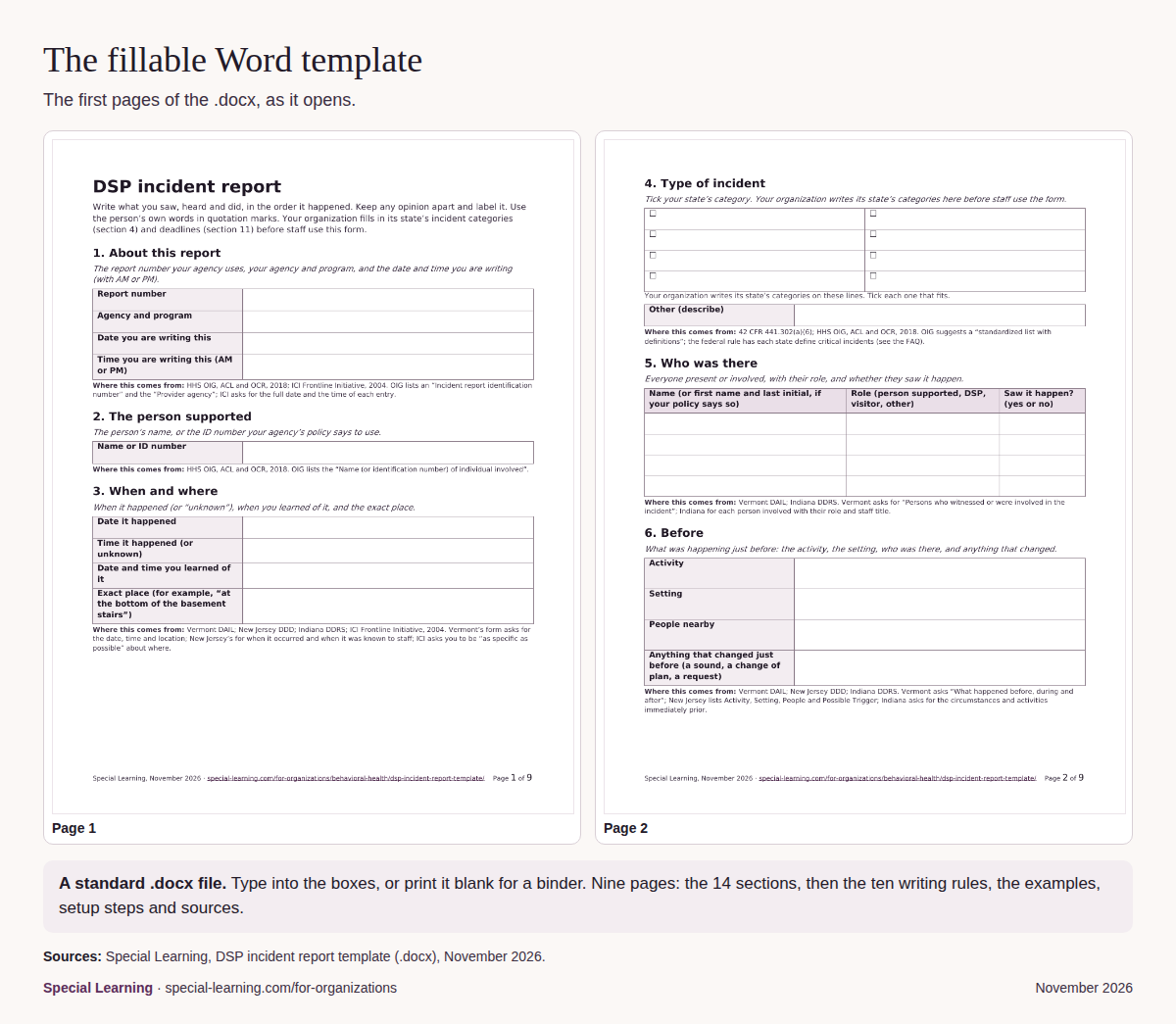
We built the sections from the fields that published incident forms and guides ask for: the model practices in a 2018 joint report by HHS’s Office of Inspector General, the Administration for Community Living and the Office for Civil Rights; Vermont’s, Indiana’s and New Jersey’s incident reporting forms and guides; and ICI’s guide for DSPs on documentation. Each section in the Word form and the PDF names its sources.
| # | Section | What to write | Where it comes from |
|---|---|---|---|
| 1 | About this report | The report number your agency uses, your agency and program, and the date and time you are writing (with AM or PM). | (HHS OIG, ACL and OCR, 2018; ICI Frontline Initiative, 2004) |
| 2 | The person supported | The person’s name, or the ID number your agency’s policy says to use. | (HHS OIG, ACL and OCR, 2018) |
| 3 | When and where | When it happened (or “unknown”), when you learned of it, and the exact place. | (Vermont DAIL; New Jersey DDD; Indiana DDRS; ICI Frontline Initiative, 2004) |
| 4 | Type of incident | Tick your state’s category. Your organization writes its state’s categories here before staff use the form. | (42 CFR 441.302(a)(6); HHS OIG, ACL and OCR, 2018) |
| 5 | Who was there | Everyone present or involved, with their role, and whether they saw it happen. | (Vermont DAIL; Indiana DDRS) |
| 6 | Before | What was happening just before: the activity, the setting, who was there, and anything that changed. | (Vermont DAIL; New Jersey DDD; Indiana DDRS) |
| 7 | During | What happened, in order, with times. What you saw and heard. What the person communicated, in their own words in quotation marks, or the signs, gestures or device they used. | (Vermont DAIL; New Jersey DDD; ICI Frontline Initiative, 2004) |
| 8 | What staff did | Each action staff took, who took it, at what time, and how the person responded. | (Vermont DAIL; New Jersey DDD) |
| 9 | Injuries and care | Any injury you saw (where on the body, size, color), the first aid or care given, and by whom. | (Indiana DDRS; New Jersey DDD; HHS OIG, ACL and OCR, 2018) |
| 10 | After | How the person is now: where, with whom, and what they are communicating. | (Vermont DAIL) |
| 11 | Who was notified | Each person or agency told: name, role, date and time, how, and what you told them. Your organization writes its own deadlines in the last column. | (Vermont DAIL; New Jersey DDD; Indiana DDRS; 42 CFR 441.302(a)(6)) |
| 12 | Follow-up planned | What is planned but not yet done, who will do it, and by when. | (Vermont DAIL; Indiana DDRS) |
| 13 | Your signature | Your name, title, signature, date, time and phone number. Sign only what you wrote. | (Vermont DAIL; ICI Frontline Initiative, 2004) |
| 14 | Supervisor review | The supervisor’s name, title, date and comments, and any follow-up they add. | (Vermont DAIL; HHS OIG, ACL and OCR, 2018) |

Who was notified
Who staff may need to tell: your organization fills in who, the order and the deadlines
Section 11 lists the roles below, each with a blank deadline column. Each state sets its own timeframes, so the template states none. Before staff use the form, write in who your organization tells, in what order and by when, from your state’s rule and your policy.
- Your supervisor or the person on call (Indiana DDRS)
- The person’s family or guardian, as your policy and the person’s wishes say (Vermont DAIL; New Jersey DDD; Indiana DDRS)
- Support coordinator or case manager (Indiana DDRS)
- Your state’s incident reporting system or office (42 CFR 441.302(a)(6); New Jersey DDD)
- Adult or child protective services, where your rule requires (Indiana DDRS)
- Emergency services or law enforcement, where needed or required (Indiana DDRS; New Jersey DDD)
- Other (named in your rule or policy)

For training leads
Set it up and teach it in five steps
- Fill in your state’s categories and deadlines first. Open your state’s incident reporting rule or guide (from your state’s developmental disabilities, behavioral health or licensing agency) and your agency’s policy. Write their incident categories in section 4 and each deadline in the last column of section 11. We leave both blank on purpose: they differ by state. Fill in sections 4 and 11 in the Word form, then print it; anything added to the PDF is handwritten on each copy.
- Add your agency’s names and numbers. Type them into the Name column of section 11 in the Word form before you print: who is on call, how to reach them, and the name of your state’s reporting system, so a new DSP never has to look it up during a shift.
- Teach the ten writing rules with the example pairs. Read each “instead of” line aloud and have staff rewrite it as facts before you show the “write” line.
- Practice on a made-up incident. Describe a short scene, have each new DSP write the report, then swap and check it against the ten rules.
- Review real reports as a supervisor. Use the supervisor review section. The 2018 joint report’s model practices have providers’ review committees “identify the facts surrounding incidents, including any contributing factors.”
On paper
Prefer paper? Print the PDF
The printable PDF carries the same 14 sections with write-in space, then the ten rules, the five example pairs, the setup steps and the sources, for a binder at the program or a new DSP’s first week.

Free tools for training leads
- Find your state’s DSP training rule: a free state-by-state finder for all 50 states and DC
- Crisis plan template: a free crisis prevention plan for group homes and day programs
- How to start crisis management: a free starter checklist
- DSP annual training plan template: a free spreadsheet and printable PDF
- DSP competency observation checklist: watch a new DSP on shift and tick the NADSP competencies you see
- Bring the 2026 NADSP Code of Ethics into onboarding: a free guide with a 15-minute activity for each tenet
- DSP vs RBT: what’s the difference, and what it means for your training plan
- What does DSP turnover cost your agency? A free calculator
- Autism training for frontline staff: what to look for in a course
- Autism training for community mental health staff: what your team needs to know
- DSP daily notes template: a free progress note form with worked examples, in Word and PDF
- Staff training sign-in sheet template: a free sign-in sheet and per-person training record, in Excel and PDF
- DSP onboarding checklist: a free first-90-days checklist and tracker, in Word, Excel and PDF
- DSP job description template: a free job description, structured interview questions and job preview checklist, in Word and PDF
- DSP shift change report template: a free shift handoff form with a worked example, in Word and PDF
- DSP performance evaluation template: a free 90-day and annual evaluation form with a development plan, in Word and PDF
- DSP training and HR toolkit: 11 free tools, one download
- ABC data sheet: a free form for recording what happened before, during and after, in Word and PDF
- DSP supervision log template: a free record for each coaching meeting with a DSP, with a guide to a 20-minute meeting, in Word and PDF
Several of these tools are built on two public sources from the National Alliance for Direct Support Professionals: the NADSP Competency Areas and the NADSP Code of Ethics.

Questions
DSP incident reports: common questions
What should a DSP incident report include?
Who the report is about, when and where it happened, the type of incident, who was there, what happened before, during and after, what staff did, any injuries and care, who was notified and when, the follow-up planned, and the writer’s and supervisor’s signatures. Those are the 14 sections of this template, each drawn from the published forms and guides listed in the sources (Vermont DAIL; Indiana DDRS; New Jersey DDD; HHS OIG, ACL and OCR, 2018).
What is a critical incident?
- Verbal, physical, sexual, psychological, or emotional abuse
- Neglect
- Exploitation including financial exploitation
- Misuse or unauthorized use of restrictive interventions or seclusion
- A medication error resulting in a telephone call to, or a consultation with, a poison control center, an emergency department visit, an urgent care visit, a hospitalization, or death
- An unexplained or unanticipated death, including but not limited to a death caused by abuse or neglect
How soon must a DSP write an incident report?
Your state’s rule and your agency’s policy set the deadlines, and they can differ by state and by type of incident. From July 9, 2027, the federal waiver rule requires states to have providers report critical incidents to the state “within State-established timeframes and procedures” (42 CFR 441.302(a)(6)). For the writing itself, ICI’s guidance is that documenting “immediately (or soon as possible) after it occurs is optimal” (ICI Frontline Initiative, 2004). The template’s deadline column starts blank so your organization can write in its own.
How do I write an incident report objectively?
Write what you saw, heard and did, in order, with times. Keep any opinion apart and label it. Put the person’s own words in quotation marks, or describe the signs, gestures or device they used. Describe actions, not labels like “aggressive” or “noncompliant.” ICI calls objective documentation “just the facts” (ICI Frontline Initiative, 2004), and Indiana’s instructions say “Be objective.” (Indiana DDRS)
Did a state or federal agency write this template?
No. The template, its section prompts, the ten rules’ wording and the example sentences are Special Learning’s. The fields come from the published federal, state and NADSP sources listed below, and the quoted lines are as published. None of those organizations has reviewed or endorsed this template.
Sources
Read November 15, 2026. The quoted lines are as published; the template, its section prompts, the ten rules’ wording and the example sentences are ours. None of these organizations has reviewed or endorsed this template.
- 42 CFR 441.302(a)(6), State assurances: incident management system (added by the 2024 HCBS Access Rule, 89 FR 40865, May 10, 2024), eCFR, up to date as of November 12, 2026. https://www.ecfr.gov/current/title-42/section-441.302
- HHS Office of Inspector General, Administration for Community Living and Office for Civil Rights, joint report, Ensuring Beneficiary Health and Safety in Group Homes Through State Implementation of Comprehensive Compliance Oversight, January 2018, Appendix A: Model Practices for State Incident Management and Investigation. https://oig.hhs.gov/reports-and-publications/featured-topics/group-homes/group-homes-joint-report.pdf
- National Alliance for Direct Support Professionals (NADSP), The NADSP Code of Ethics (revised 2026), tenets as published on nadsp.org. https://nadsp.org/resources/the-nadsp-code-of-ethics/
- Traci LaLiberte, “Doing Documentation ‘Write!’,” Frontline Initiative, Volume 5, Number 4 (2004), Institute on Community Integration, University of Minnesota. https://publications.ici.umn.edu/frontline-initiative/5-4/doing-documentation-write
- Vermont Department of Disabilities, Aging and Independent Living (DAIL), Critical Incident Reporting Guidelines and Critical Incident Reporting Form (updated May 2022). https://asd.vermont.gov/sites/asd/files/documents/DAIL_CIR_Guidelines_6_2022.pdf
- Indiana Division of Disability and Rehabilitative Services (DDRS), Policy BQIS 460 0301 008, Incident Reporting and Management, with Exhibit A (effective March 1, 2011, as posted). https://www.in.gov/fssa/ddrs/files/Incident_Reporting_and_Management.pdf
- New Jersey Division of Developmental Disabilities (DDD), Your Quick Reference Guide to Incident Reporting, and its Initial Incident Report form. https://nj.gov/humanservices/ddd/assets/documents/providers/incident-reporting-guide.pdf Form: Initial Incident Report (.docx).