
Free template for training leads, HR and supervisors
DSP job description template, interview questions and job preview checklist
A free job description template for hiring a direct support professional (DSP), with twelve duties mapped to the NADSP competency areas, a structured interview guide of twelve behavioral questions with a scoring guide, and a realistic job preview checklist. It comes as a fillable Word file and a printable PDF. Pay, schedule, requirements and every item your state or funders require are left for you to write in.
Special Learning · November 15, 2026
Free download
Download the template
Short answer
What goes in a DSP job description?
Read
What the job is really like, in duties tied to the skills it takes, with the pay, schedule and requirements written in by you. Then use it twice more: to ask every applicant the same questions, and to give the person you offer the job an honest preview before they say yes.
New Jersey’s sample DSP job description sums up the role: “A Direct Support Professional (DSP) supports individuals with developmental disabilities so that they can live as independent a life as possible” (New Jersey sample DSP job description). The research on hiring DSPs starts in the same place: “Ensure that the Job Description Is Complete and Accurate,” because “the very act of providing an accurate, up-to-date job description to all applicants is an important part of the RJP process” (Larson, O’Nell and Sauer, on the job description). New Jersey’s guidance for employers asks you to “Make sure job listings are engaging and include an accurate description of the job responsibilities and qualifications” (Jobs that Care New Jersey: information for employers).
It matters because the first months are when DSPs leave. In 2024, the weighted mean DSP turnover ratio across responding states was 37.1%; of the DSPs who left, 40.7% had been employed less than 6 months and almost two-thirds (63.7%) less than a year. Most agencies already try to set expectations: 80.4% reported offering a realistic job preview (NCI-IDD State of the Workforce, 2024).


Part 1
The job description
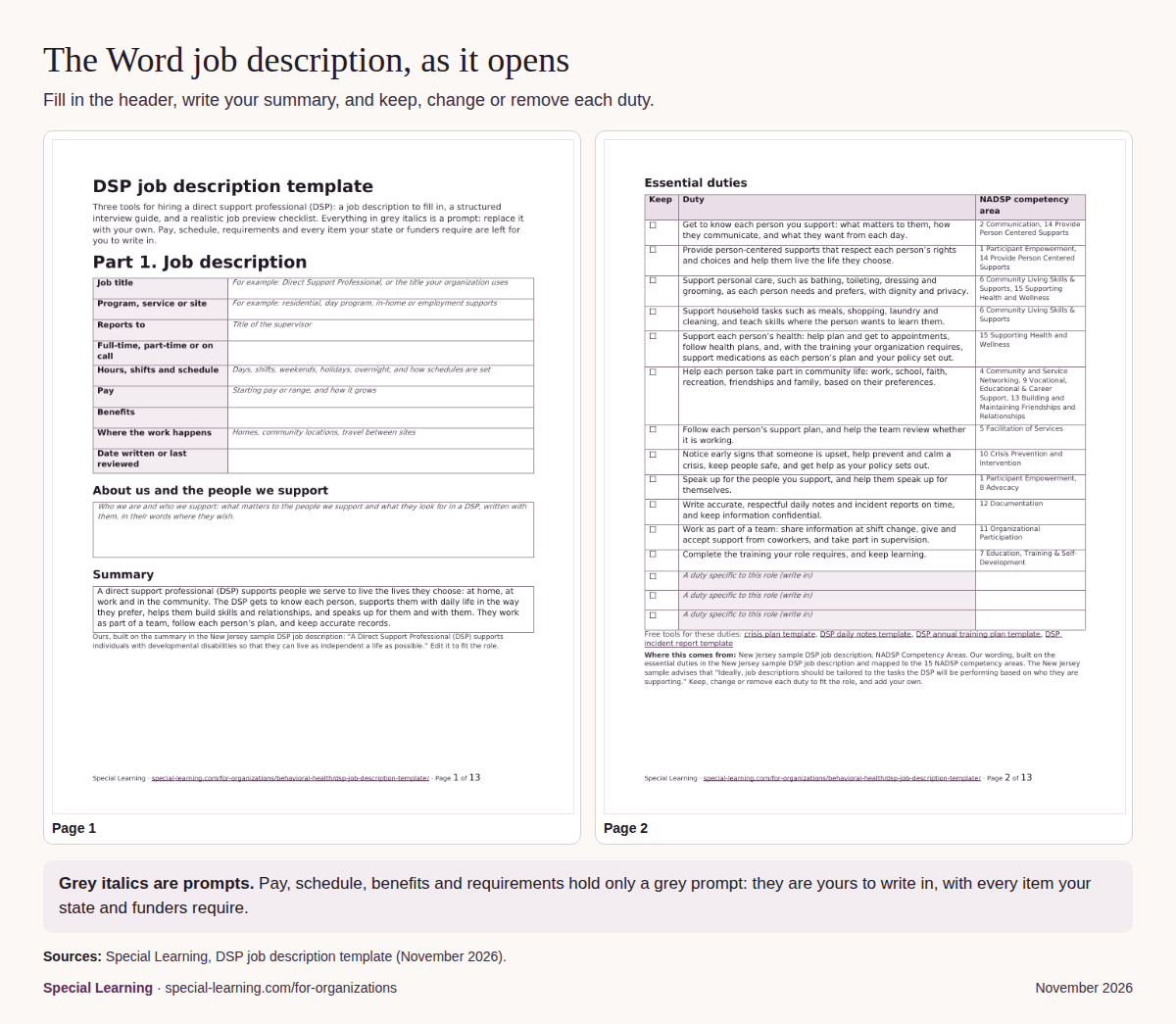
The template opens with the basics: job title, program, service or site, reports to, full-time, part-time or on call, hours, shifts and schedule, pay, benefits, where the work happens, date written or last reviewed. Grey prompts show what goes in each; pay, benefits and schedule are yours. Then a box for who you are and who you support, written with the people you support, in their words where they wish.
Essential duties
Twelve duties in our wording, built on the essential duties in New Jersey’s sample (New Jersey sample DSP job description) and each mapped to the NADSP competency areas it draws on, “a list of fifteen competency areas” for direct support (NADSP Competency Areas). Keep, change or remove each one; New Jersey’s sample advises that “Ideally, job descriptions should be tailored to the tasks the DSP will be performing based on who they are supporting.”
- Get to know each person you support: what matters to them, how they communicate, and what they want from each day. NADSP: 2 Communication, 14 Provide Person Centered Supports.
- Provide person-centered supports that respect each person’s rights and choices and help them live the life they choose. NADSP: 1 Participant Empowerment, 14 Provide Person Centered Supports.
- Support personal care, such as bathing, toileting, dressing and grooming, as each person needs and prefers, with dignity and privacy. NADSP: 6 Community Living Skills & Supports, 15 Supporting Health and Wellness.
- Support household tasks such as meals, shopping, laundry and cleaning, and teach skills where the person wants to learn them. NADSP: 6 Community Living Skills & Supports.
- Support each person’s health: help plan and get to appointments, follow health plans, and, with the training your organization requires, support medications as each person’s plan and your policy set out. NADSP: 15 Supporting Health and Wellness.
- Help each person take part in community life: work, school, faith, recreation, friendships and family, based on their preferences. NADSP: 4 Community and Service Networking, 9 Vocational, Educational & Career Support, 13 Building and Maintaining Friendships and Relationships.
- Follow each person’s support plan, and help the team review whether it is working. NADSP: 5 Facilitation of Services.
- Notice early signs that someone is upset, help prevent and calm a crisis, keep people safe, and get help as your policy sets out. Free: crisis plan template. NADSP: 10 Crisis Prevention and Intervention.
- Speak up for the people you support, and help them speak up for themselves. NADSP: 1 Participant Empowerment, 8 Advocacy.
- Write accurate, respectful daily notes and incident reports on time, and keep information confidential. Free: DSP daily notes template and DSP incident report template. NADSP: 12 Documentation.
- Work as part of a team: share information at shift change, give and accept support from coworkers, and take part in supervision. NADSP: 11 Organizational Participation.
- Complete the training your role requires, and keep learning. Free: DSP annual training plan template. NADSP: 7 Education, Training & Self-Development.
- A duty specific to this role (write in).

What we look for
- Respect. Treats each person with dignity and respects their privacy and choices.
- Reliability. Arrives on time, gives notice of a shift conflict, and follows through.
- Communication. Listens, adapts to how each person communicates, and writes clearly.
- Teamwork. Gives and accepts support from coworkers and supervisors.
- Willingness to learn. Asks for feedback and keeps learning on the job.
These are ours, built on the CMS core competencies, which list “Shows professionalism by being on time, dressing appropriately for the job, and being responsible in all work tasks” among its skill statements (CMS DSW Core Competencies, 2014), and on NADSP’s expectation that the competent DSP “provides and accepts co-worker support” (NADSP Competency Areas). Larson and Hewitt add a hiring point worth keeping in mind: “Remember that skills can be developed but that attitudes rarely change” (Larson and Hewitt, ch. 4 (RTC)).
Requirements, demands and support: yours to write in
- Requirements. Write in what your state, your funders and your organization require for this role: for example age, education, driver’s license and insurance, background checks, certifications and training to complete before or after hire.
- Physical demands. Write in what this job actually asks: lifting, standing, driving and so on.
- Work environment. Where the work happens and what a shift is like.
- Training and support we give. For example: paid orientation, a mentor, shadow shifts before working alone, and check-ins in the first 90 days.
These rows hold only a grey prompt, on purpose. What your state, your funders and your organization require differs by state, by service and by agency, so the template states none of them as general. New Jersey’s sample ends with the employee’s line “acknowledge review of this job description” and signature lines for the employee and the supervisor (New Jersey sample DSP job description); ours reads: “I have read this job description and had the chance to ask questions about it.”
Part 2
Structured interview questions for DSPs
Structured interviews predict job performance better than unstructured ones. In the research Larson and Hewitt summarize, structured interviews were rated “High (.48 to .67)” in predictive validity and unstructured interviews “Low to medium (.23 to .37)” (Larson and Hewitt, Table 4.1). Their conclusion: “Clearly, structured interviews are one of the most effective, if not the most effective, selection strategies available.” “Structured interviews use the same questions for every applicant and score responses using a standardized scoring guide” (Larson and Hewitt, ch. 4 (RTC)).

- Ask every applicant the same questions. Choose 8 to 10 questions for the role and ask them of every applicant for that position, in the same order.
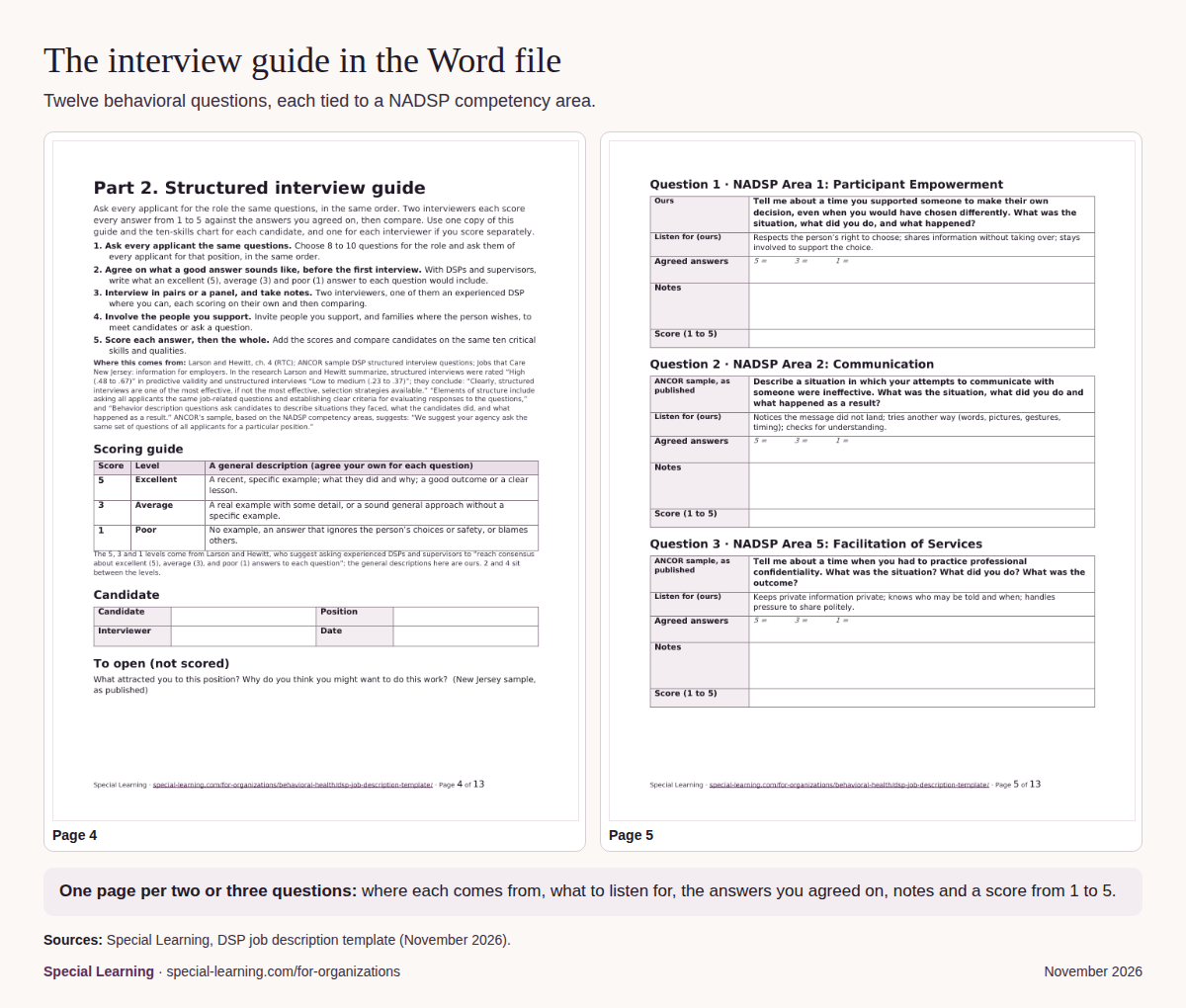
- Agree on what a good answer sounds like, before the first interview. With DSPs and supervisors, write what an excellent (5), average (3) and poor (1) answer to each question would include.
- Interview in pairs or a panel, and take notes. Two interviewers, one of them an experienced DSP where you can, each scoring on their own and then comparing.
- Involve the people you support. Invite people you support, and families where the person wishes, to meet candidates or ask a question.
- Score each answer, then the whole. Add the scores and compare candidates on the same ten critical skills and qualities.
Involving the people you support is part of it. New Jersey’s guidance says: “Involve people with disabilities using supports in the interview process to offer their perspective and ask questions” (Jobs that Care New Jersey: information for employers), and Larson and Hewitt warn: “When people receiving supports and their families are excluded from the selection process, they may not get along with the person selected or may not be confident about the person’s abilities” (Larson and Hewitt, ch. 4 (RTC)).

Twelve behavioral questions, each tied to a competency area
Open with New Jersey’s question, not scored: “What attracted you to this position? Why do you think you might want to do this work?” (New Jersey sample DSP interview questions). Then pick 8 to 10 of these for the role. Ten are quoted as published from ANCOR’s sample, whose instructions say “The questions are based on NADSP competencies” (ANCOR sample DSP structured interview questions), or New Jersey’s, “compiled from NJ providers” (New Jersey sample DSP interview questions); two are ours. Every “Listen for” line is ours, a starting point for the answers your team agrees on.

Question 1 · NADSP Area 1: Participant Empowerment
Tell me about a time you supported someone to make their own decision, even when you would have chosen differently. What was the situation, what did you do, and what happened?
Our question. Listen for (ours): Respects the person’s right to choose; shares information without taking over; stays involved to support the choice.
Question 2 · NADSP Area 2: Communication
Describe a situation in which your attempts to communicate with someone were ineffective. What was the situation, what did you do and what happened as a result?
ANCOR’s question, as published (ANCOR sample DSP structured interview questions). Listen for (ours): Notices the message did not land; tries another way (words, pictures, gestures, timing); checks for understanding.
Question 3 · NADSP Area 5: Facilitation of Services
Tell me about a time when you had to practice professional confidentiality. What was the situation? What did you do? What was the outcome?
ANCOR’s question, as published (ANCOR sample DSP structured interview questions). Listen for (ours): Keeps private information private; knows who may be told and when; handles pressure to share politely.
Question 4 · NADSP Area 14: Provide Person Centered Supports
Tell me about a time when what the person you supported wanted conflicted with what a family member/parent wanted. How did you handle that?
New Jersey’s sample question, as published (New Jersey sample DSP interview questions). Listen for (ours): Keeps the person at the center; listens to both; brings in the team or supervisor where the plan or policy calls for it.
Question 5 · NADSP Area 10: Crisis Prevention and Intervention
Describe the last time you became involved in a conflict or crisis situation. What was the situation? What did you do? How well did it work? What would you have done to prevent the situation from occurring?
ANCOR’s question, as published (ANCOR sample DSP structured interview questions). Listen for (ours): Stays calm; keeps people safe; gets help; reflects on early signs and on what would prevent it next time.
Question 6 · NADSP Area 11: Organizational Participation
Describe a situation in which you had a conflict with a co-worker. What was the issue, what did you do, what was the outcome of the conflict?
ANCOR’s question, as published (ANCOR sample DSP structured interview questions). Listen for (ours): Raises it directly and respectfully; looks for a solution; involves a supervisor when needed; no blame.
Question 7 · NADSP Area 12: Documentation
Describe a situation in which you were asked to document an event. Describe what occurred, what information was documented, and the reasons behind your documentation.
ANCOR’s question, as published (ANCOR sample DSP structured interview questions). Listen for (ours): Writes facts, not opinions; is timely and complete; understands why records matter to the person and the team.
Question 8 · NADSP Area 13: Building and Maintaining Friendships and Relationships
Tell about a time you helped a person you supported communicate with their friends and relatives.
ANCOR’s question, as published (ANCOR sample DSP structured interview questions). Listen for (ours): Values relationships; follows the person’s wishes; finds practical ways to keep in touch. Examples from work, school, volunteering or community life all count.
Question 9 · NADSP Area 15: Supporting Health and Wellness
Describe a time you helped to promote the health and wellness of a person you support.
ANCOR’s question, as published (ANCOR sample DSP structured interview questions). Listen for (ours): Supports the person’s own choices about health; notices changes and reports them; follows plans and policy.
Question 10 · NADSP Area 8: Advocacy
Describe a time when you advocated or assisted a person when they were being treated badly by another person.
ANCOR’s question, as published (ANCOR sample DSP structured interview questions). Listen for (ours): Steps in safely and respectfully; supports the person to speak up; reports as policy requires.
Question 11 · NADSP Area 7: Education, Training & Self-Development
Tell me about the last time you learned something new, at work or on your own. How did you go about it, and how did you use it?
Our question. Listen for (ours): Curious; asks for help and feedback; puts learning into practice.
Question 12 · CMS: Professionalism and Ethics
Tell me about a time when you made a mistake. How did you handle this experience?
New Jersey’s sample question, as published (New Jersey sample DSP interview questions). Listen for (ours): Owns it; tells the right person promptly; fixes what can be fixed; learns from it.
Score every answer the same way
Larson and Hewitt suggest asking experienced DSPs and supervisors to “reach consensus about excellent (5), average (3), and poor (1) answers to each question” (Larson and Hewitt, ch. 4 (RTC)). Our general descriptions, as a starting point:
- 5, Excellent. A recent, specific example; what they did and why; a good outcome or a clear lesson.
- 3, Average. A real example with some detail, or a sound general approach without a specific example.
- 1, Poor. No example, an answer that ignores the person’s choices or safety, or blames others.
They also suggest “Using a panel or at least a pair of interviewers,” and that “it may be also helpful to prepare a single-page chart listing 10 most critical job skills and qualifications on which each candidate will be scored” (Larson and Hewitt, ch. 4 (RTC)). The guide ends with that chart.
Part 3
Realistic job preview checklist
A realistic job preview (RJP) shows an applicant the good and the hard parts of the job before they decide. “One meta-analysis found that RJPs improved retention rates by 9%–17%” (Larson, O’Nell and Sauer, ch. 3 (RTC)). For residential settings, Larson advises that a preview “should address things like relationships with co-workers or supervisors, opportunities to do fun things, pay and benefits, hours and scheduling practices, and difficult or unpleasant tasks” (Larson, Frontline Initiative, 1996). Its aim: that “the recruits have made an informed decision about whether to take the job based on realistic information provided by the organization” (Larson, O’Nell and Sauer, ch. 3 (RTC)).
1. Build it
Before you post the job.
- Make sure the job description is complete and accurate, and give it to every applicant.
- Ask current DSPs, newer and experienced, what is best and hardest about the job (the six questions below).
- Ask the people you support, and their families, what they look for in a DSP.
- List what newcomers are unlikely to know or may expect differently, good and hard.
- Choose how you will share it: a visit, a meeting with DSPs, a written preview, or a video.
- Your own item (write in).
2. What to cover
The information to highlight, from Larson, O’Nell and Sauer.
- Your organization, its vision and mission.
- Hours and scheduling, pay and paid leave (write in yours).
- What the job requires before hire (write in yours).
- Typical duties, including cooking, personal care, documentation and community outings.
- What you expect at work: on time for every shift, notice for a shift conflict, respectful interactions, working without daily direct supervision.
- The interests of the people supported, shared with their permission.
- Why current DSPs love the job, in their words.
- The hard parts of the job, also in their words.
- Your own item (write in).
3. Give it
At the right time, with time for questions.
- After the job offer and before the person accepts.
- As a conversation where you can, with time for questions.
- For a site visit: ask the people who live or spend their day there first, and respect their privacy.
- Visit at a busy but routine time, such as a meal, and watch DSPs at work, not supervisors.
- Give the applicant the questions to watch for and to ask (below).
4. After it
Talk it through, and see whether it is working.
- Talk it through: what excited them, what bothered them, what confused them, and what they want to know more about.
- Respect a “no”: an applicant who decides the job is not for them has made an informed choice.
- Track how many new DSPs are still with you at 6 months.

Timing and format matter. Previews “delivered after a job offer has been made, but before an applicant decides whether to accept a position, are more effective in reducing turnover than those conducted before a job offer or after hire” (CMS DSW Promising Practices, 2006). For a site visit, the authors advise: “People receiving supports should be consulted about the structured observation before its implementation,” “Observations should be scheduled so that the observer sees other DSPs, not front-line supervisors, at work,” and “Observations should be followed by a debriefing” (Larson, O’Nell and Sauer, ch. 3 (RTC)).

Six questions for your current DSPs
Larson, O’Nell and Sauer call these “some of the most effective questions” for building a preview (Larson, O’Nell and Sauer, ch. 3 (RTC)). Ask newer and experienced DSPs; their answers, in their own words, become the preview.
- What is the best part of your job?
- What makes you want to stay at this organization or in this job?
- What could your employer do to make your job better?
- What was the hardest part of starting this job? Give specific examples.
- What specific incidents make you want to leave this organization or job?
- What would you tell a friend who was applying for your job?

For the applicant on a visit
Give the applicant these to watch for and to ask, from the Structured Observation Worksheet, “Adapted by permission from Taylor, M., Silver, J., Hewitt, A., VanGelder, M., & Hoff, D. (1997)” and Lutheran Social Service of Minnesota (Structured Observation Worksheet). Afterwards, talk it through: what excited them, what bothered them, what confused them, and what they would like to know more about.
- Watch for: What are the various job activities that DSPs do?
- Watch for: What kinds of things do the people you observed seem to like?
- Watch for: How did staff members figure out what a person wanted to eat or to do? Were choices offered?
- Ask a DSP: What do you like best about your job?
- Ask a DSP: What is the most difficult part of your job?
- Ask a DSP: What kinds of supervision do you receive?

For training leads
Set it up in five steps
- Write the job description with your DSPs. Start from the duties here, and keep, change or remove each one to fit the role. Ask DSPs who do the job now, and the people they support, what is missing. Write the summary in your own words.
- Fill in the blanks. Pay, hours and schedule, benefits, requirements, physical demands and work environment are blank on purpose: they are yours, and what your state and funders require differs by state, by service and by agency.
- Choose your interview questions and agree on good answers. Pick 8 to 10 questions, one per area that matters most for the role. Before the first interview, agree with DSPs and supervisors on what a 5, 3 and 1 answer sounds like, and list your 10 most critical skills and qualities. Ask every applicant the same questions.
- Build the job preview, and give it after the offer. Ask current DSPs the six questions, choose what to cover, and give the preview after the job offer and before the person accepts, as a conversation where you can.
- Follow through after hire. Give the new DSP their signed job description on day one, plan their first 90 days with the onboarding checklist, and count how many new DSPs are still with you at 6 months.
Then carry it into the first months: plan the new DSP’s first 90 days with our free DSP onboarding checklist, observe skills on shift with the DSP competency observation checklist, bring ethics in early with the NADSP Code of Ethics onboarding guide, and put a dollar figure on early departures with the DSP turnover cost calculator. To see whether the preview is working, the research suggests tracking “What percentage of newly hired DSPs remain with the organization (or site) at least 6 months?” (Larson, O’Nell and Sauer, ch. 3 (RTC)). For people directing their own services, the University of Minnesota’s module covers the same ground: “Topics include creating a realistic job preview, developing an accurate job description, and developing interview questions” (ICI, CMS DSW module 3).

On paper
Prefer paper? Print the PDF
The printable PDF carries the same three tools with write-in space, for an interview folder: the job description, the twelve questions with notes and score rows, the ten-skills chart, and the job preview checklist with the questions for current DSPs and for the applicant on a visit.

Questions
DSP job descriptions and interviews: common questions
What should a DSP job description include?
The basics (title, program, who the DSP reports to, hours, pay and benefits); a short summary of the role; the essential duties; the qualities you look for; your requirements, physical demands and work environment; and an acknowledgment the new DSP signs. New Jersey’s sample, “created through examples shared by New Jersey providers,” advises: “Ideally, job descriptions should be tailored to the tasks the DSP will be performing based on who they are supporting” (New Jersey sample DSP job description). A complete description also starts the job preview: “the very act of providing an accurate, up-to-date job description to all applicants is an important part of the RJP process” (Larson, O’Nell and Sauer, on the job description).
What are good interview questions for a direct support professional?
Behavioral questions, which “ask candidates to describe situations they faced, what the candidates did, and what happened as a result” (Larson and Hewitt, ch. 4 (RTC)). ANCOR publishes a set based on the NADSP competency areas, such as “Describe a situation in which you had a conflict with a co-worker. What was the issue, what did you do, what was the outcome of the conflict?” (ANCOR sample DSP structured interview questions). Ask every applicant for the role the same questions: ANCOR writes, “We suggest your agency ask the same set of questions of all applicants for a particular position” (ANCOR sample DSP structured interview questions). This template gives 12 questions, each tied to a competency area (eleven NADSP areas and one CMS area, assigned by us), each marked as ANCOR’s, New Jersey’s or ours.
What is a realistic job preview for DSPs?
An honest look at the job before the applicant decides: a realistic job preview “includes information on both the positive and the negative aspects of the job” (Larson, O’Nell and Sauer, ch. 3 (RTC)). It can be a visit, a meeting with current DSPs, a written preview or a video. “One meta-analysis found that RJPs improved retention rates by 9%–17%” (Larson, O’Nell and Sauer, ch. 3 (RTC)), and New Jersey’s guidance for employers says: “Share a Realistic Job Preview with potential candidates” (Jobs that Care New Jersey: information for employers).
When should we give the realistic job preview?
After the job offer and before the applicant accepts. Previews “delivered after a job offer has been made, but before an applicant decides whether to accept a position, are more effective in reducing turnover than those conducted before a job offer or after hire” (CMS DSW Promising Practices, 2006). A conversation where the applicant can ask questions works best: previews “that involve a verbal exchange of information (in which the applicant can ask questions about the RJP) are the most effective in reducing turnover but that written RJPs are also effective. Videotaped RJPs were much less effective in reducing turnover” (Larson, O’Nell and Sauer, ch. 3 (RTC)).
Does O*NET have a DSP occupation?
O*NET, the U.S. Department of Labor’s occupation database, has no entry named direct support professional. Two entries overlap with parts of the work; neither is a DSP occupation. 31-1122.00 Personal Care Aides: “Provide personalized assistance to individuals with disabilities or illness who require help with personal care and activities of daily living support” (O*NET 31-1122.00 Personal Care Aides). 21-1093.00 Social and Human Service Assistants: “Assist other social and human service providers in providing client services in a wide variety of fields, such as psychology, rehabilitation, or social work, including support for families” (O*NET 21-1093.00 Social and Human Service Assistants). Neither entry’s sample of reported job titles includes direct support professional; 21-1093.00 lists “Direct Support Specialist” among its example apprenticeship titles. For the skills of the role itself, the NADSP competency areas (NADSP Competency Areas) and the CMS core competencies (CMS DSW Core Competencies, 2014) are written for this work.
Did a state or federal agency write this template?
No. The duty wording, the summary, the questions marked Ours, every “Listen for” line, the scoring descriptions and the checklist wording are Special Learning’s, built on the published sources listed below, and the quoted lines and questions are as published. None of those organizations has reviewed or endorsed this template. New Jersey’s samples are New Jersey’s own examples.
Sources
Read November 15, 2026. The quoted lines and questions are as published; the duty wording, the summary, the questions marked ours, the “Listen for” lines, the scoring descriptions and the checklist wording are ours. None of these organizations has reviewed or endorsed this template. New Jersey’s samples are New Jersey’s own examples.
- New Jersey Department of Human Services, Jobs that Care New Jersey, “Sample DSP Job Description,” created through examples shared by New Jersey providers; supported by a CMS award to the New Jersey Department of Human Services. https://www.nj.gov/humanservices/jobsthatcare/employers/docs/DSPJobDescription_Sample.pdf
- New Jersey Department of Human Services, Jobs that Care New Jersey, “Sample DSP Interview Questions,” compiled from New Jersey providers; supported by a CMS award to the New Jersey Department of Human Services. https://www.nj.gov/humanservices/jobsthatcare/employers/docs/DSPJobInterviewQuestions_Sample.pdf
- New Jersey Department of Human Services, Jobs that Care New Jersey, “Information for Employers” (DSP recruitment and selection guide for employers). https://www.nj.gov/humanservices/jobsthatcare/employers/
- American Network of Community Options and Resources (ANCOR), “Sample Direct Support Professional Structured Interview Questions,” based upon the NADSP competency areas, as published at ancor.org. https://www.ancor.org/wp-content/uploads/2016/06/ancor_dsp_strucured_behavioral_interview_questions.pdf
- Sheryl A. Larson and Amy S. Hewitt, “Selection Strategies,” chapter 4 of Larson and Hewitt, Staff Recruitment, Retention, & Training Strategies for Community Human Services Organizations (Paul H. Brookes, 2005; republished 2012 by the Research and Training Center on Community Living, University of Minnesota). https://rtc.umn.edu/docs/Larson_and_Hewitt_Staff_rrt_book_U_of_MN_reprint_2012.pdf#page=103
- Sheryl A. Larson, Susan N. O’Nell and John K. Sauer, “What Is This Job All About? Using Realistic Job Previews in the Hiring Process,” chapter 3 of Larson and Hewitt, Staff Recruitment, Retention, & Training Strategies for Community Human Services Organizations (Paul H. Brookes, 2005; republished 2012 by the Research and Training Center on Community Living, University of Minnesota). https://rtc.umn.edu/docs/Larson_and_Hewitt_Staff_rrt_book_U_of_MN_reprint_2012.pdf#page=75
- University of Minnesota Research and Training Center on Community Living with The Lewin Group, CMS Direct Service Workforce Demonstration: Promising Practices in Marketing, Recruitment and Selection Interventions (Centers for Medicare & Medicaid Services, December 2006). https://rtc.umn.edu/docs/DSWPromisingPracticesFINAL.pdf
- Sheryl Larson, “Influencing Direct Support Worker Retention,” Frontline Initiative, Volume 1, Number 1 (1996), Institute on Community Integration, University of Minnesota. https://publications.ici.umn.edu/frontline-initiative/1-1/influencing-direct-support-worker-retention
- Institute on Community Integration, University of Minnesota, Recruiting, Selecting, and Retaining Direct Service Workers to Provide Self-Directed HCBS, Module #3: Selecting and Hiring the Right DSW for You. https://publications.ici.umn.edu/cms/dsw/modules/module-3-choosing-the-right-dsw-for-you
- National Core Indicators Intellectual and Developmental Disabilities (NCI-IDD), State of the Workforce in 2024 Survey Report (Human Services Research Institute and the National Association of State Directors of Developmental Disabilities Services, December 2025). https://idd.nationalcoreindicators.org/wp-content/uploads/2025/12/2024-NCI-IDD-SoTW_Final-Tagged.pdf
- National Alliance for Direct Support Professionals (NADSP), The NADSP Competency Areas, as published on nadsp.org. https://nadsp.org/resources/competency-areas/
- Centers for Medicare & Medicaid Services, National Direct Service Workforce Resource Center, Direct Service Workforce Core Competencies, Final Competency Set, December 2014. https://www.medicaid.gov/sites/default/files/2019-12/dsw-core-competencies-final-set-2014.pdf
- U.S. Department of Labor, Employment and Training Administration, O*NET OnLine, summary report for 31-1122.00 Personal Care Aides. https://www.onetonline.org/link/summary/31-1122.00
- U.S. Department of Labor, Employment and Training Administration, O*NET OnLine, summary report for 21-1093.00 Social and Human Service Assistants. https://www.onetonline.org/link/summary/21-1093.00