
Free checklist for training leads, HR and supervisors
DSP onboarding checklist: the first 90 days
A free onboarding and orientation checklist for each new direct support professional (DSP), from hiring to the 90-day review: a realistic preview of the job, a mentor, shadow shifts, competency observations and five supervisor check-ins. It comes as a fillable Word checklist, a printable PDF and a tracker spreadsheet that works out every check-in date. Your organization adds the items your state requires.
Special Learning · November 15, 2026
Free download
Download the checklist
Short answer
What should DSP onboarding include?
Read
An honest picture of the job before the new DSP says yes, a person to turn to from day one, no first shift alone, and a check-in at the end of day one, week one, and days 30, 60 and 90. The first year is when most DSPs who leave do: of the DSPs who left responding agencies in 2024, 40.7% had worked there less than 6 months, and almost two-thirds (63.7%) less than a year (NCI-IDD State of the Workforce, 2024).
Onboarding is more than the required training. “Orientation is not the same as training,” and “To fully socialize an employee to a new job can take 6–12 months” (Hewitt, Larson, O’Nell and Sauer (RTC)). The research also sets two markers worth planning for: “By the end of the first day, the employee should have a strong sense that he or she has made the right choice in taking the job,” and “By 30 days after hire, the employee should have a defined sense of commitment to the job and the organization; if not, he or she is unlikely to still be there a year after hire” (Hewitt, Larson, O’Nell and Sauer (RTC)).


The checklist
Six phases, from hiring to day 90
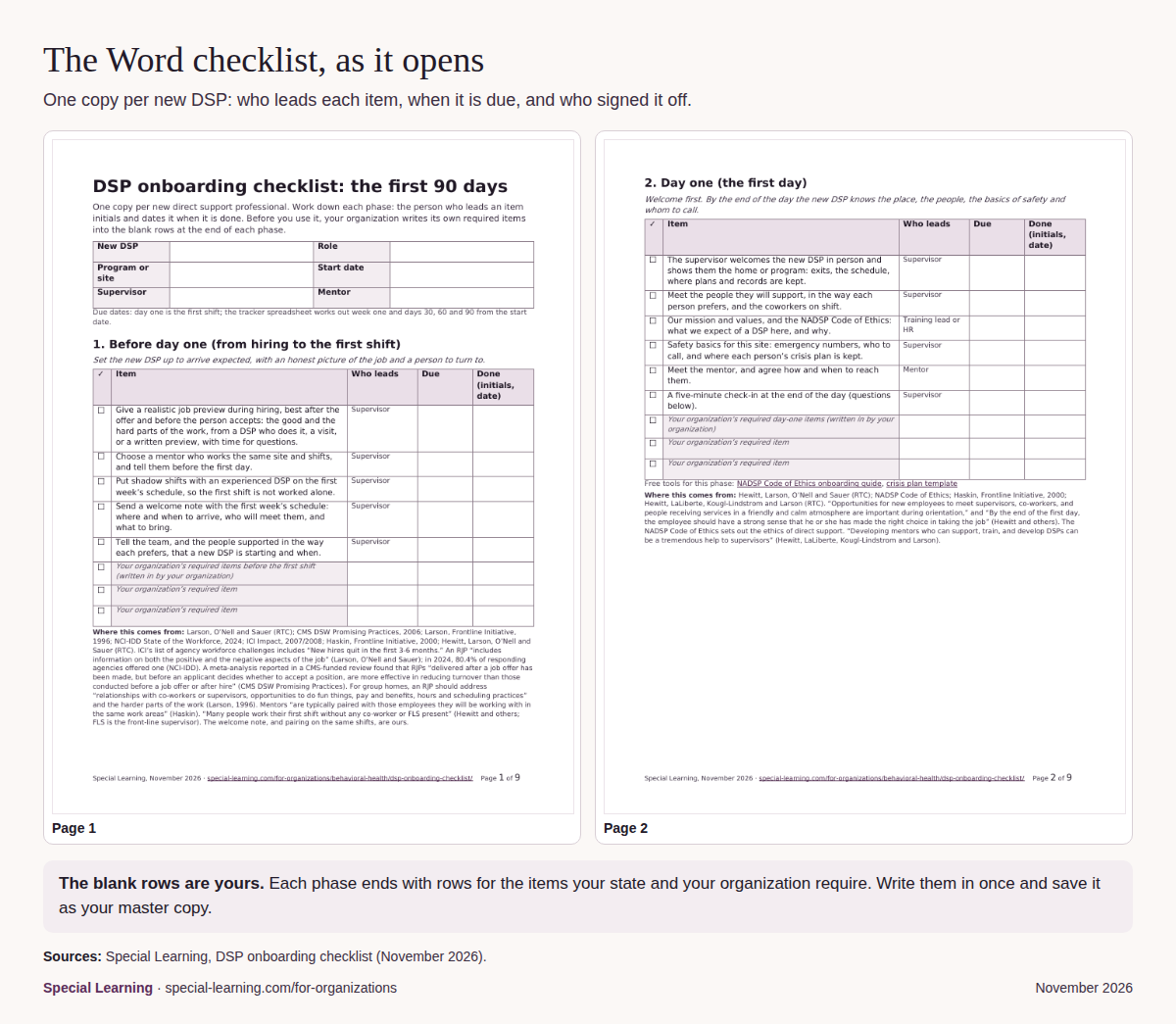
Each item names who usually leads it; change it to fit your teams. The last rows of each phase are for the items your state and your organization require, which we leave blank on purpose: they differ by state, by service and by agency. The free tools named in each phase do the detailed work.
1. From hiring to the first shift
Before day one
Set the new DSP up to arrive expected, with an honest picture of the job and a person to turn to.
- Give a realistic job preview during hiring, best after the offer and before the person accepts: the good and the hard parts of the work, from a DSP who does it, a visit, or a written preview, with time for questions. Leads: Supervisor.
- Choose a mentor who works the same site and shifts, and tell them before the first day. Leads: Supervisor.
- Put shadow shifts with an experienced DSP on the first week’s schedule, so the first shift is not worked alone. Leads: Supervisor.
- Send a welcome note with the first week’s schedule: where and when to arrive, who will meet them, and what to bring. Leads: Supervisor.
- Tell the team, and the people supported in the way each prefers, that a new DSP is starting and when. Leads: Supervisor.
- Your organization’s required items before the first shift (written in by your organization)
Where this comes from: ICI’s list of agency workforce challenges includes “New hires quit in the first 3-6 months.” An RJP “includes information on both the positive and the negative aspects of the job” (Larson, O’Nell and Sauer); in 2024, 80.4% of responding agencies offered one (NCI-IDD). A meta-analysis reported in a CMS-funded review found that RJPs “delivered after a job offer has been made, but before an applicant decides whether to accept a position, are more effective in reducing turnover than those conducted before a job offer or after hire” (CMS DSW Promising Practices). For group homes, an RJP should address “relationships with co-workers or supervisors, opportunities to do fun things, pay and benefits, hours and scheduling practices” and the harder parts of the work (Larson, 1996). Mentors “are typically paired with those employees they will be working with in the same work areas” (Haskin). “Many people work their first shift without any co-worker or FLS present” (Hewitt and others; FLS is the front-line supervisor). The welcome note, and pairing on the same shifts, are ours. (Larson, O’Nell and Sauer (RTC); CMS DSW Promising Practices, 2006; Larson, Frontline Initiative, 1996; NCI-IDD State of the Workforce, 2024; ICI Impact, 2007/2008; Haskin, Frontline Initiative, 2000; Hewitt, Larson, O’Nell and Sauer (RTC))
2. The first day
Day one
Welcome first. By the end of the day the new DSP knows the place, the people, the basics of safety and whom to call.
- The supervisor welcomes the new DSP in person and shows them the home or program: exits, the schedule, where plans and records are kept. Leads: Supervisor.
- Meet the people they will support, in the way each person prefers, and the coworkers on shift. Leads: Supervisor.
- Our mission and values, and the NADSP Code of Ethics: what we expect of a DSP here, and why. Free: NADSP Code of Ethics onboarding guide. Leads: Training lead or HR.
- Safety basics for this site: emergency numbers, who to call, and where each person’s crisis plan is kept. Free: crisis plan template. Leads: Supervisor.
- Meet the mentor, and agree how and when to reach them. Leads: Mentor.
- A five-minute check-in at the end of the day (questions below). Leads: Supervisor.
- Your organization’s required day-one items (written in by your organization)
Where this comes from: “Opportunities for new employees to meet supervisors, co-workers, and people receiving services in a friendly and calm atmosphere are important during orientation,” and “By the end of the first day, the employee should have a strong sense that he or she has made the right choice in taking the job” (Hewitt and others). The NADSP Code of Ethics sets out the ethics of direct support. “Developing mentors who can support, train, and develop DSPs can be a tremendous help to supervisors” (Hewitt, LaLiberte, Kougl-Lindstrom and Larson). (Hewitt, Larson, O’Nell and Sauer (RTC); NADSP Code of Ethics; Haskin, Frontline Initiative, 2000; Hewitt, LaLiberte, Kougl-Lindstrom and Larson (RTC))

3. Days 2 to 7
First week
Learn by watching, then helping, with an experienced DSP beside them, a few topics a day.
- Shadow shifts: watch an experienced DSP, then help, then lead parts of the routine with the DSP beside them. Leads: Coworker on shift.
- Read each person’s plan with the supervisor: what matters to them, how they communicate, and the goals in their plan. Leads: Supervisor.
- Practice the daily note and the incident report on a real shift, with the supervisor or mentor reading the first ones. Free: DSP daily notes template and DSP incident report template. Leads: Mentor.
- Pace the information: a few topics a day, not everything at once. Leads: Training lead or HR.
- Talk honestly about the hard parts of the job and how experienced coworkers handle them. Leads: Mentor.
- End-of-week check-in with the supervisor (questions below). Leads: Supervisor and new DSP.
- Any training your state or organization requires before a DSP works without a coworker present (written in by your organization)
Where this comes from: “New DSPs can understand their role by observing co-workers,” and “Pacing the information provided during orientation can also help to reduce the likelihood that a new employee will become overwhelmed” (Hewitt and others). NADSP Area 12: the DSP “is aware of the requirements for documentation in his or her organization.” In Minnesota, for example, for providers licensed under its chapter 245D, staff are instructed on each person’s plan “Before having unsupervised direct contact with a person served by the program” (Minnesota Statutes 245D.09, subd. 4a). That is Minnesota’s rule; write in your own state’s. (Hewitt, Larson, O’Nell and Sauer (RTC); Haskin, Frontline Initiative, 2000; NADSP Competency Areas; CMS DSW Core Competencies, 2014; Minnesota Statutes 245D.09)
4. The first month
Days 8 to 30
More of each shift is led by the new DSP, with support on site, and the first competency observations.
- Supervised shifts: the new DSP leads more of each shift, with a coworker or the supervisor on site. Leads: Supervisor.
- Competency observation 1 in weeks 1 to 2, and observation 2 by day 30, with the DSP competency checklist. Free: DSP competency observation checklist. Leads: Supervisor.
- A weekly mentor meeting: what went well, what was hard, one thing to try next. Leads: Mentor and new DSP.
- Agree with the supervisor when the DSP is ready to work a shift without a coworker present, under your organization’s policy and any state rule that applies. Leads: Supervisor and new DSP.
- Add the new DSP to your annual training plan. Free: DSP annual training plan template. Leads: Training lead or HR.
- Day-30 check-in with the supervisor (questions below). Leads: Supervisor and new DSP.
- Your organization’s required items by day 30 (written in by your organization)
Where this comes from: “By 30 days after hire, the employee should have a defined sense of commitment to the job and the organization” (Hewitt and others). The mentor “uses feedback forms to assess specific skills demonstrated by the new employee” (Haskin). In a randomized study, sites whose DSPs received competency-based training “experienced a significant decrease in annual turnover” (Bogenschutz, Nord and Hewitt). Bogenschutz, Nord and Hewitt tested competency-based training, not observations. The observation schedule, the weekly mentor meeting, the readiness item and the training-plan item are ours. (Hewitt, Larson, O’Nell and Sauer (RTC); NADSP Competency Areas; CMS DSW Core Competencies, 2014; Haskin, Frontline Initiative, 2000; Bogenschutz, Nord and Hewitt, 2015)
5. The second month
Days 31 to 60
Feedback in both directions, one area to grow, and connections beyond the first team.
- Competency observation 3 by day 60: the new DSP picks one area to grow. Free: DSP competency observation checklist. Leads: Supervisor.
- Ask for feedback from coworkers and, where they wish, the people supported. Leads: Supervisor.
- The new DSP gives feedback on the mentoring, too. Leads: New DSP.
- Connect the new DSP with other DSPs: a team meeting, a peer group or a DSP association. Leads: Supervisor.
- Day-60 check-in with the supervisor (questions below). Leads: Supervisor and new DSP.
- Your organization’s required items by day 60 (written in by your organization)
Where this comes from: CMS lists “Seeks feedback from many sources” as a skill; in Haskin’s program “the new employee provides an evaluation of the mentor’s instruction”; “DSPs at all phases of their employment need opportunities to network and to learn from one another” (Hewitt and others). The observation schedule is ours. (NADSP Competency Areas; CMS DSW Core Competencies, 2014; Haskin, Frontline Initiative, 2000; Hewitt, Larson, O’Nell and Sauer (RTC))
6. The third month
Days 61 to 90
Review the first 90 days together and agree on what comes next.
- 90-day review: lay the three observations side by side, name the strengths, and agree on a learning plan for the next quarter. Free: DSP competency observation checklist. Leads: Supervisor and new DSP.
- Talk about what comes next: a credential, a career path, or becoming a mentor. Leads: Supervisor.
- Close the mentor pairing, or keep it going if both wish, and thank the mentor. Leads: Supervisor.
- Record whether each new DSP is still with you at 90 days and at 6 months, to see how onboarding is working. Free: DSP turnover cost calculator. Leads: Training lead or HR.
- Day-90 check-in (questions below). Leads: Supervisor and new DSP.
- Your organization’s required items by day 90 (written in by your organization)
Where this comes from: NADSP Area 7 covers education, training and self-development; in 2024, 32.6% of responding agencies had a DSP ladder to retain workers in DSP roles (NCI-IDD). To see whether a realistic job preview is working, Larson, O’Nell and Sauer suggest tracking “What percentage of newly hired DSPs remain with the organization (or site) at least 6 months?”; the 90-day mark is ours. (NADSP Competency Areas; NCI-IDD State of the Workforce, 2024; Larson, O’Nell and Sauer (RTC))

Supervisor and new DSP
Five check-ins, and what to ask
The questions are ours, built on the research that, after peers, “supervisors were rated by new employees as the most available and most helpful sources” of information about the job, and that orientation should “Provide realistic information about job stresses” (Hewitt and others). The same chapter suggests to “Acknowledge new employees at different points (e.g., on the first day, after the first week, after the first 30 days)” and to “Plan times to check in to discuss problems or issues routinely during the first several weeks of employment” (Hewitt, Larson, O’Nell and Sauer (RTC)).
- End of day one (Supervisor, 5 minutes): How did today go? What questions do you have? Do you know who to call on your next shift, and how?
- End of week one (Supervisor, 15 minutes): What has surprised you so far? What is harder than you expected, and what has helped? Do you know each person’s plan and how they communicate? What do you need before your next shift?
- Day 30 (Supervisor, 20 minutes): Is the job what you expected from the preview? What is different? Do you feel ready to work a shift without a coworker present? What would help? How is the mentoring going?
- Day 60 (Supervisor, 20 minutes): Which competency area do you want to grow in? What feedback have you had, and what have you tried? What would make you more likely to stay with us?
- Day 90 (Supervisor, 30 minutes): What are your strengths, in your words and ours? What goes on your learning plan for the next quarter? Where would you like to be in a year?

Mentors and shadow shifts
No first shift alone
“Many people work their first shift without any co-worker or FLS present” (Hewitt, Larson, O’Nell and Sauer (RTC)) (FLS: front-line supervisor). Shadow shifts and a mentor are one way to change that. A federally funded University of Minnesota training project for front-line supervisors taught competencies that include “coordinating and participating in DSP orientation and in-service training” (McCulloh, Frontline Initiative, 2006). In one Ohio developmental center’s program, “During an orientation period, the mentor provides one-on-one specific instruction to the new employee on such areas as documentation, scheduling, community outings, implementation of procedures, and special needs of their shift,” “The new employee is exposed to all shifts so that he or she has a concise picture of the roles of each shift,” and the mentor “uses feedback forms to assess specific skills demonstrated by the new employee” (Haskin, Frontline Initiative, 2000). The research suggests to “Provide a peer or other mentor for the first 1–6 months” (Hewitt, Larson, O’Nell and Sauer (RTC)), and NADSP’s competency areas expect that the competent DSP “provides and accepts co-worker support” (NADSP Competency Areas).
Use these four steps for each routine the new DSP learns:
- Watch. The new DSP watches an experienced DSP do the routine and asks questions after.
- Help. The new DSP does parts of it, with the experienced DSP leading.
- Lead, with support. The new DSP leads it, with the experienced DSP beside them and feedback after.
- On their own. When the supervisor and the new DSP agree they are ready, under your policy and any state rule that applies.

The spreadsheet
Track every new DSP in one sheet
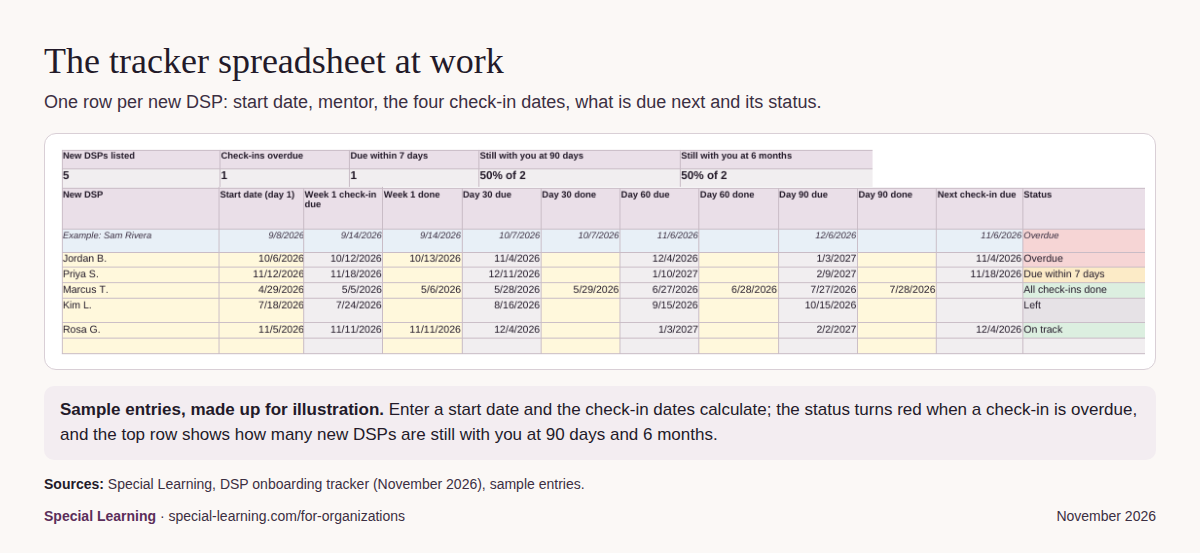
Enter a new DSP’s start date and the tracker works out the check-in dates for the end of week one and days 30, 60 and 90 (day 1 is the start date), shows the next one due once you enter the date each check-in is done, and marks it Overdue, Due within 7 days or On track. If someone leaves, enter their last day: the sheet shows whether they stayed 90 days and 6 months, and the top row shows the share of your new DSPs still with you at each mark. To see whether a realistic job preview is working, the research suggests tracking “What percentage of newly hired DSPs remain with the organization (or site) at least 6 months?” (Larson, O’Nell and Sauer (RTC)); the 90-day mark is ours. To put a dollar figure on early departures, use our free DSP turnover cost calculator.
For training leads
Set it up in five steps
- Write in your required items first. Open any state rules for each service you provide, your licensing or waiver requirements and your own policies. Write what a new DSP must complete, and by when, into the blank rows at the end of each phase: in the Word form, on the spreadsheet’s Checklist items sheet, or on a printed master copy. We leave those rows blank on purpose: they differ by state, by service and by agency. Save it as your agency’s master copy.
- Name the people. For each new DSP, write in the supervisor and a mentor who works the same site and shifts, and tell the mentor before day one. Use a fresh copy of the checklist for each new DSP.
- Set the dates. Enter each new DSP’s start date in the tracker spreadsheet. It works out the check-in dates for the end of week one and days 30, 60 and 90; enter the date each one is done and it shows what is due next. The day-one check-in is on the paper checklist.
- Sign off as you go. The person who leads each item initials and dates it when it is done. Run the five check-ins on time, even when the week is busy.
- Look at what happened. Every quarter, count how many new DSPs are still with you at 90 days and at 6 months, and ask the people who stayed and the people who left what helped. Change the checklist where it did not.
Any state rules that apply, and your own policies, decide what goes in the blank rows. As one example, Minnesota’s staffing statute for providers licensed under its chapter 245D asks for orientation “Before having unsupervised direct contact with a person served by the program” on that person’s plans (Minnesota Statutes 245D.09); that is Minnesota’s rule, not every state’s. Our free state-by-state finder links each state’s primary DSP training rule.

On paper
Prefer paper? Print the PDF
The printable PDF carries the same six phases with write-in space, the five check-ins, the shadow-to-solo steps, the setup steps and the sources, one copy per new DSP for a supervisor’s binder.

Free tools for training leads
- DSP competency observation checklist: watch a new DSP on shift and tick the NADSP competencies you see
- Bring the 2026 NADSP Code of Ethics into onboarding: a free guide with a 15-minute activity for each tenet
- DSP annual training plan template: a free spreadsheet and printable PDF
- DSP daily notes template: a free progress note form with examples, in Word and PDF
- DSP incident report template: a free fill-in report and writing guide, in Word and PDF
- Staff training sign-in sheet template: a free sign-in sheet and per-person training record, in Excel and PDF
- Crisis plan template: a free crisis prevention plan for each person you support, in Word and PDF
- Find your state’s DSP training rule: a free state-by-state finder for all 50 states and DC
- What does DSP turnover cost your agency? A free calculator
- How to start crisis management: a free starter checklist
- DSP vs RBT: what’s the difference, and what it means for your training plan
- Autism training for frontline staff: what to look for in a course
- Autism training for community mental health staff: what your team needs to know
- DSP job description template: a free job description, structured interview questions and job preview checklist, in Word and PDF
- DSP shift change report template: a free shift handoff form with a worked example, in Word and PDF
- DSP performance evaluation template: a free 90-day and annual evaluation form with a development plan, in Word and PDF
- DSP training and HR toolkit: all 11 free tools in one download, with a one-page index
- ABC data sheet for DSPs: a free form to record what happened before, during and after, with a guide to writing what you saw, in Word and PDF
- DSP supervision log template: a free record for each coaching meeting with a DSP, with a guide to a 20-minute meeting, in Word and PDF

Several of these tools are built on two public sources from the National Alliance for Direct Support Professionals: the NADSP Competency Areas and the NADSP Code of Ethics.
Questions
DSP onboarding: common questions
What should a DSP onboarding checklist include?
A realistic job preview during hiring; a mentor who works the same site and shifts; shadow shifts so no one works a first shift alone; a welcome and introductions on day one; safety basics and where each person’s plans are kept; supervised shifts and competency observations in the first month; feedback both ways in the second; a 90-day review with a learning plan; and check-ins at the end of day one, week one, and days 30, 60 and 90. Each phase also needs room for the items your state and organization require. That is how this checklist is built, on the research summarized by the University of Minnesota’s Research and Training Center on Community Living (Larson, O’Nell and Sauer (RTC); Hewitt, Larson, O’Nell and Sauer (RTC); Hewitt, LaLiberte, Kougl-Lindstrom and Larson (RTC)).
How long should DSP orientation take?
Where a state sets what training a new DSP must finish and by when, the rules differ by state and by service. The research separates the two: “Orientation is not the same as training,” and “To fully socialize an employee to a new job can take 6–12 months” (Hewitt, Larson, O’Nell and Sauer (RTC)). A short statement of good practice puts the aim of orientation plainly: “Help new employees feel welcome, a part of the agency/family, and confident in their jobs” (Frontline Initiative, 2006: workforce definition). This checklist covers the first 90 days and leaves blank rows in each phase for your required items.

Why do so many new DSPs leave in the first year?
Of the DSPs who left responding agencies in 2024, 40.7% had worked there less than 6 months, and almost two-thirds (63.7%) less than a year (NCI-IDD State of the Workforce, 2024). An earlier study of Minnesota group homes found the same pattern: “the majority quit in the first year of employment, with 41% leaving within six months of being hired and another 25% leaving between six and twelve months after hire” (Larson, Frontline Initiative, 1996). Unmet expectations are part of it: a realistic job preview “includes information on both the positive and the negative aspects of the job,” and “one meta-analysis found that RJPs improved retention rates by 9%–17%” (Larson, O’Nell and Sauer (RTC)). Timing matters: previews “delivered after a job offer has been made, but before an applicant decides whether to accept a position, are more effective in reducing turnover than those conducted before a job offer or after hire” (CMS DSW Promising Practices, 2006). Support matters too: “DSPs who were supported by their co-workers were more likely to stay than those who were not” (Hewitt, Larson, O’Nell and Sauer (RTC)).
What does a DSP mentor do?
In one Ohio program, “During an orientation period, the mentor provides one-on-one specific instruction to the new employee on such areas as documentation, scheduling, community outings, implementation of procedures, and special needs of their shift,” and mentors “are typically paired with those employees they will be working with in the same work areas” (Haskin, Frontline Initiative, 2000). The checklist pairs each new DSP with a mentor before day one and sets a weekly mentor meeting in the first month.

Where do my state’s required orientation items go?
In the blank rows at the end of each phase: in the Word checklist, on the spreadsheet’s Checklist items sheet, or on a printed master copy. We leave them blank because they differ by state, by service and by agency. As one example, Minnesota’s staffing statute for providers licensed under its chapter 245D says that “within 60 calendar days of hire, unless stated otherwise, the license holder must provide and ensure completion of orientation sufficient to create staff competency for direct support staff that combines supervised on-the-job training” with instruction in listed areas (Minnesota Statutes 245D.09). That is Minnesota’s rule, not every state’s. Our free state-by-state finder links each state’s primary DSP training rule.
Did a state or federal agency write this checklist?
No. The phase plan, the item wording, the check-in questions and the shadow-to-solo steps are Special Learning’s, built on the published sources listed below, and the quoted lines are as published. None of those organizations has reviewed or endorsed this checklist.
Sources
Read November 15, 2026. The quoted lines are as published; the phase plan, the item wording, the check-in questions and the shadow-to-solo steps are ours. None of these organizations has reviewed or endorsed this checklist.
- National Core Indicators Intellectual and Developmental Disabilities (NCI-IDD), State of the Workforce in 2024 Survey Report (Human Services Research Institute and the National Association of State Directors of Developmental Disabilities Services, December 2025). https://idd.nationalcoreindicators.org/wp-content/uploads/2025/12/2024-NCI-IDD-SoTW_Final-Tagged.pdf
- Sheryl A. Larson, Susan N. O’Nell and John K. Sauer, “What Is This Job All About? Using Realistic Job Previews in the Hiring Process,” chapter 3 of Larson and Hewitt, Staff Recruitment, Retention, & Training Strategies for Community Human Services Organizations (Paul H. Brookes, 2005; republished 2012 by the Research and Training Center on Community Living, University of Minnesota). https://rtc.umn.edu/docs/Larson_and_Hewitt_Staff_rrt_book_U_of_MN_reprint_2012.pdf#page=75
- Amy S. Hewitt, Sheryl A. Larson, Susan N. O’Nell and John K. Sauer, “Orientation, Socialization, Networking, and Professionalization,” chapter 5 of Larson and Hewitt, Staff Recruitment, Retention, & Training Strategies for Community Human Services Organizations (Paul H. Brookes, 2005; republished 2012 by the Research and Training Center on Community Living, University of Minnesota). https://rtc.umn.edu/docs/Larson_and_Hewitt_Staff_rrt_book_U_of_MN_reprint_2012.pdf#page=133
- Amy S. Hewitt, Traci L. LaLiberte, Jody Kougl-Lindstrom and Sheryl A. Larson, “Fostering Commitment and Skill Through Mentoring Programs,” chapter 8 of Larson and Hewitt, Staff Recruitment, Retention, & Training Strategies for Community Human Services Organizations (Paul H. Brookes, 2005; republished 2012 by the Research and Training Center on Community Living, University of Minnesota). https://rtc.umn.edu/docs/Larson_and_Hewitt_Staff_rrt_book_U_of_MN_reprint_2012.pdf#page=205
- Brenda Haskin, “Employee Mentoring: A Program that Paves Way for Success,” Frontline Initiative, Volume 4, Number 1 (2000), Institute on Community Integration, University of Minnesota. https://publications.ici.umn.edu/frontline-initiative/4-1/employee-mentoring-a-program-that-paves-way-for-success
- Sheryl Larson, “Influencing Direct Support Worker Retention,” Frontline Initiative, Volume 1, Number 1 (1996), Institute on Community Integration, University of Minnesota. https://publications.ici.umn.edu/frontline-initiative/1-1/influencing-direct-support-worker-retention
- “State-of-the-Art Definition: Direct Support Workforce Development,” Frontline Initiative, Volume 7, Number 1 (2006), Institute on Community Integration, University of Minnesota. https://publications.ici.umn.edu/frontline-initiative/7-1/state-of-the-art-definition-direct-support-workforce-development
- N. McCulloh, “Training Frontline Supervisors Improve Recruitment and Retention of DSPs,” Frontline Initiative, Volume 7, Number 1 (2006), Institute on Community Integration, University of Minnesota. https://publications.ici.umn.edu/frontline-initiative/7-1/training-frontline-supervisors-improve-recruitment-and-retention-of-dsps
- “Addressing DSP Workforce Challenges: Strategies for Agencies,” Impact: Feature Issue on Direct Support Workforce Development, Volume 20, Number 2 (Fall/Winter 2007/2008), Institute on Community Integration, University of Minnesota. https://publications.ici.umn.edu/impact/20-2/addressing-dsp-workforce-challenges
- University of Minnesota Research and Training Center on Community Living with The Lewin Group, CMS Direct Service Workforce Demonstration: Promising Practices in Marketing, Recruitment and Selection Interventions (Centers for Medicare & Medicaid Services, December 2006). https://rtc.umn.edu/docs/DSWPromisingPracticesFINAL.pdf
- National Alliance for Direct Support Professionals (NADSP), The NADSP Competency Areas, as published on nadsp.org. https://nadsp.org/resources/competency-areas/
- National Alliance for Direct Support Professionals (NADSP), The NADSP Code of Ethics (revised 2026), as published on nadsp.org. https://nadsp.org/resources/the-nadsp-code-of-ethics/
- Centers for Medicare & Medicaid Services, National Direct Service Workforce Resource Center, Direct Service Workforce Core Competencies, Final Competency Set, December 2014. https://www.medicaid.gov/sites/default/files/2019-12/dsw-core-competencies-final-set-2014.pdf
- Matthew Bogenschutz, Derek Nord and Amy Hewitt, “Competency-Based Training and Worker Turnover in Community Supports for People With IDD: Results From a Group Randomized Controlled Study,” Intellectual and Developmental Disabilities 53(3), 182 to 195 (2015), PMID 26107852. https://pubmed.ncbi.nlm.nih.gov/26107852/
- Minnesota Statutes 2026, section 245D.09, Staffing Standards, subdivisions 4 (Orientation to program requirements) and 4a (Orientation to individual service recipient needs), Office of the Revisor of Statutes. https://www.revisor.mn.gov/statutes/cite/245D.09