
Free template for supervisors and training leads
DSP performance evaluation template
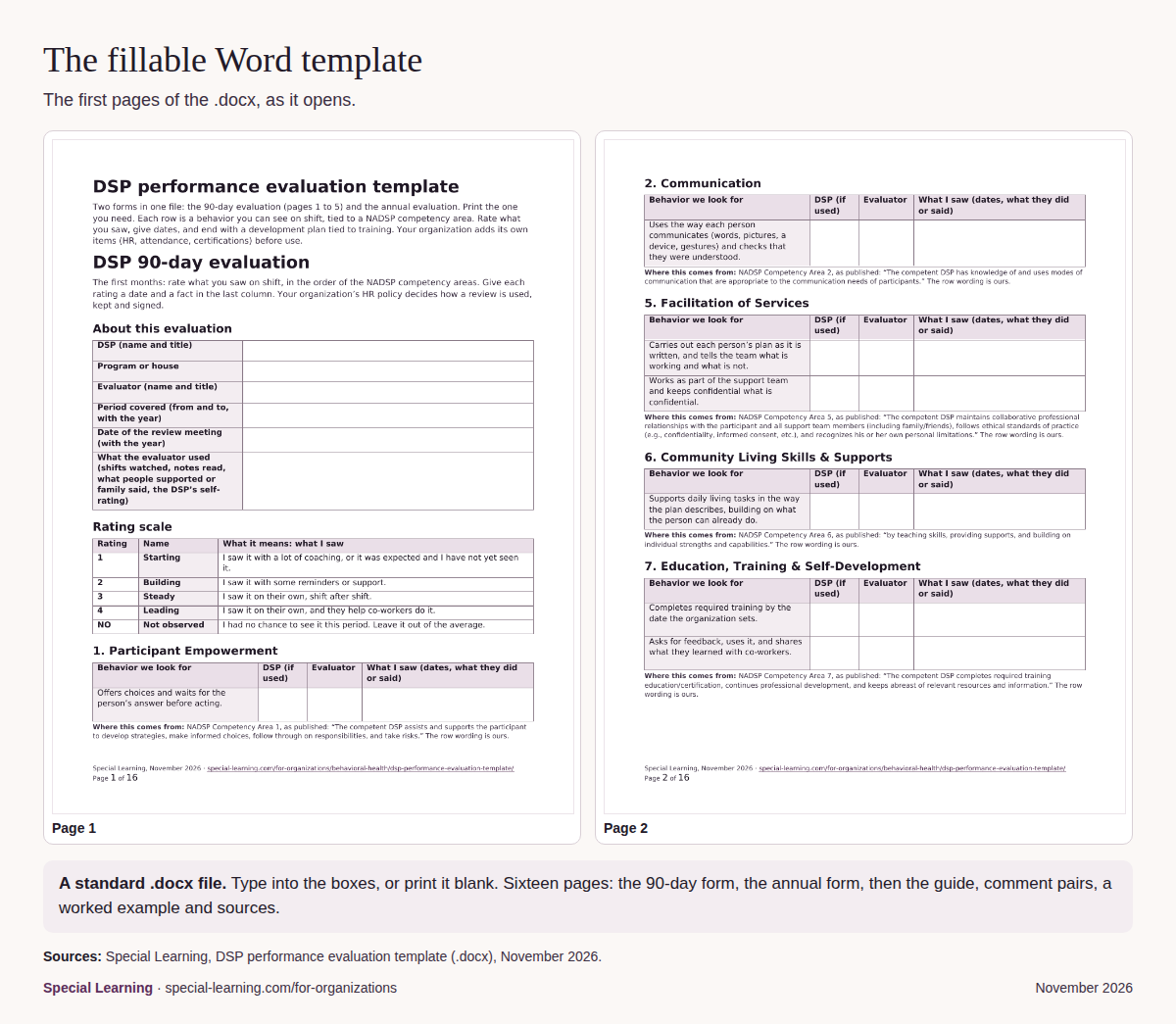
A free performance evaluation (performance review) for direct support professionals (DSPs), as a fillable Word file and a printable PDF. It has a 90-day version and an annual version, rows tied to the 15 NADSP competency areas that rate behavior you can see, eight examples of behavior-based comments, and a development plan tied to training. Your organization adds its own items.
Special Learning · November 15, 2026
Free download
Download the template
Short answer
What should a DSP performance evaluation include?
Read
Ratings of behavior you saw, with a date and a fact beside each, a strengths-first conversation, and a development plan that names the training or the person who will help. Rate the work, not the person. Let the DSP say what they think. End with a date to check in.
Why it matters: in the 2024 NCI-IDD workforce survey the weighted mean DSP turnover ratio across states was 37.1%, and 40.7% of DSPs who left had been employed less than six months (NCI-IDD State of the Workforce, 2024). Frontline Initiative describes frontline supervisors using accurate competency-based job descriptions to develop training and conduct performance appraisals (ICI Frontline Initiative, 2006), and the survey found an average of 10 DSPs to each frontline supervisor (NCI-IDD State of the Workforce, 2024), so a form should fit a supervisor’s week. Public examples exist: the Rutgers Boggs Center’s competency-based appraisal, developed with the New Jersey Division of Developmental Disabilities (Rutgers Boggs Center (New Jersey), DSP appraisal), and New York OPWDD’s initial and annual DSP evaluations (New York OPWDD, DSP Evaluation Tools). They are one state’s tools, not rules for yours. This template is ours: its rows, scale, examples and plan are Special Learning’s, built on NADSP’s competency areas (NADSP Competency Areas). What a review must hold, how it is used and who signs are set by your organization’s HR policy, so follow it.

What it rates
The 15 NADSP areas, as rows you can see
NADSP lists fifteen competency areas, each with skill statements (NADSP Competency Areas). Skill statements describe knowledge and skills; an evaluator needs something visible. Each area here has one to three rows that name what a DSP does on shift, such as “Uses the way each person communicates (words, pictures, a device, gestures) and checks that they were understood.” The 90-day version rates 15 rows in 10 areas; the annual version rates all 25. Area 11 itself describes a DSP “participating in supportive supervision, performance evaluation” (NADSP Competency Areas). Use the blank rows for your own items. Our free DSP job description template is built on the same areas, so the rows can match the duties.
| # | NADSP area | Behaviors we look for (ours) | In the 90-day version | Source |
|---|---|---|---|---|
| 1 | Participant Empowerment | Offers choices and waits for the person’s answer before acting. Helps a person speak for themselves, for example at a meeting or an appointment. | Yes (some rows) | (NADSP Competency Areas) |
| 2 | Communication | Uses the way each person communicates (words, pictures, a device, gestures) and checks that they were understood. Explains things in plain words and listens to the answer, with the person, family and co-workers. | Yes (some rows) | (NADSP Competency Areas) |
| 3 | Assessment | Shares what they notice about a person’s preferences and needs with the team, as what they saw and heard. | Annual only | (NADSP Competency Areas) |
| 4 | Community and Service Networking | Knows which community supports are in each person’s plan and helps the person get to them. | Annual only | (NADSP Competency Areas) |
| 5 | Facilitation of Services | Carries out each person’s plan as it is written, and tells the team what is working and what is not. Works as part of the support team and keeps confidential what is confidential. | Yes (all rows) | (NADSP Competency Areas) |
| 6 | Community Living Skills & Supports | Supports daily living tasks in the way the plan describes, building on what the person can already do. Supports household tasks and getting around so the person takes part. | Yes (some rows) | (NADSP Competency Areas) |
| 7 | Education, Training & Self-Development | Completes required training by the date the organization sets. Asks for feedback, uses it, and shares what they learned with co-workers. | Yes (all rows) | (NADSP Competency Areas) |
| 8 | Advocacy | Speaks up with a person, and tells the supervisor, when a barrier keeps them from a service or a choice. | Annual only | (NADSP Competency Areas) |
| 9 | Vocational, Educational & Career Support | Supports the work, school or volunteer goals in the person’s plan (for example rides, reminders, a conversation the plan calls for). | Annual only | (NADSP Competency Areas) |
| 10 | Crisis Prevention and Intervention | Knows each person’s crisis plan and follows it. Reports what happened, with times, the way the organization requires. | Yes (all rows) | (NADSP Competency Areas) |
| 11 | Organizational Participation | Follows the organization’s schedule and call-in steps, and tells the supervisor ahead when something changes. Gives and accepts co-worker support, and takes part in supervision. Brings respect for each person’s culture, religion, race, disability and gender into daily support. | Yes (some rows) | (NADSP Competency Areas) |
| 12 | Documentation | Writes notes on time, in facts and in the person’s words, with date, time and signature. | Yes (all rows) | (NADSP Competency Areas) |
| 13 | Building and Maintaining Friendships and Relationships | Helps each person plan and take part in activities, and stay in touch with the family and friends they choose. | Annual only | (NADSP Competency Areas) |
| 14 | Provide Person Centered Supports | Can say what is important to each person they support, and it shows in what they do. Changes how they support a person when the person’s wishes or needs change. | Yes (some rows) | (NADSP Competency Areas) |
| 15 | Supporting Health and Wellness | Notices changes in a person’s health or mood and tells the people the plan names, with what they saw. Follows the organization’s procedures for the health and safety tasks that are part of the job. | Yes (all rows) | (NADSP Competency Areas) |

How to rate
A four-level scale that rates what you saw
The Rutgers Boggs Center form uses four levels and a Not Applicable option (Rutgers Boggs Center (New Jersey), DSP appraisal). Ours is a different scale, written around what the evaluator saw, with a Not observed choice for rows you had no chance to see. The Boggs form says average scores can be calculated to find where a DSP may need development and where a DSP may mentor others (Rutgers Boggs Center (New Jersey), DSP appraisal); do the same with the rows you rated, and leave out Not observed.
| Rating | Name | What it means |
|---|---|---|
| 1 | Starting | I saw it with a lot of coaching, or it was expected and I have not yet seen it. |
| 2 | Building | I saw it with some reminders or support. |
| 3 | Steady | I saw it on their own, shift after shift. |
| 4 | Leading | I saw it on their own, and they help co-workers do it. |
| NO | Not observed | I had no chance to see it this period. Leave it out of the average. |

Facts, not labels
Eight behavior-based comments to teach with
A label tells the DSP what you concluded. A fact lets them see what you saw and what happens next. NADSP’s Code of Ethics asks DSPs to “Use respectful and inclusive language that reflects each person’s preferences” (NADSP Code of Ethics), and a good evaluation applies the same care to staff. The Boggs form asks supervisors to “include comments that reinforce successful use of best practices and to note areas where improvement and growth are needed” (Rutgers Boggs Center (New Jersey), DSP appraisal). These eight cover a strength, a gap and a plan.
| Topic | Instead of | Write |
|---|---|---|
| Communication | Good communicator. | On most mornings I watched Sam ask Dev which picture he wanted, wait, and then follow it. Dev pointed to his choice without prompting on February 8 and February 15. |
| Documentation | Paperwork is sloppy. | Four of the 12 notes I read this period had no time or signature. The other eight had times, the person’s words and a signature. We will review five notes together at the next supervision meeting. |
| Follow-through | Seems unmotivated. | On February 3 and February 10 I saw Sam wait in the office while Luis was at the table. When I asked, Sam said he was not sure how to support Luis at meals. We will practice with Luis’s plan on Friday. |
| Strength | Great with people. | On February 8 Keisha asked to go to the library. Sam checked her plan, called the van driver and walked in with her. Keisha said, “Thank you for listening.” |
| Reliability | Always late. | Arrived after the 3:00 PM start on 4 of 10 shifts in February (dates on the schedule). Sam said his bus times changed. We will talk about options as your HR policy allows. |
| Teamwork | Not a team player. | On February 14, when the plan changed, Sam asked questions and told the next shift. On February 20 the evening note did not mention a change to Tom’s plan. We will use the shift change report for that. |
| Dignity | The residents like him. | Three people asked for Sam by name for outings. Tom said, “He listens.” Sam used each person’s own name and asked before helping. |
| Training | Needs more training. | The crisis plan session due February 1 is not yet done. Sam will finish it by March 15, then walk me through Tom’s plan on shift. |

Worked example
One 90-day evaluation, filled in
Here is a made-up 90-day evaluation for an invented DSP at a group home. Every rating has a date and a fact; what the people supported said is in their own words; the plan names the training or helper, a date and a check-in. The structure borrows from the Rutgers Boggs Center appraisal (strengths, improvement needs, strategies) and from NADSP’s competency areas; the people and entries are made up.
| DSP | Sam Patel, DSP | ||
|---|---|---|---|
| Program | Maple Street home | ||
| Evaluator | J. Okafor, house manager | ||
| Period | December 1, 2026 to March 11, 2027 | ||
| Review meeting | March 12, 2027, in the office, 30 minutes | ||
| Used | Nine shifts watched, 12 notes read, what Luis, Keisha and Tom said, and Sam’s own ratings. | ||
| Area | Behavior | DSP | Evaluator | What I saw |
|---|---|---|---|---|
| 2 | Uses the way each person communicates (words, pictures, a device, gestures) and checks that they were understood. | 3 | 3 | Uses Keisha’s picture board every morning. Asked Luis, “Did I say that clearly?” on March 2 and again on March 9. |
| 5 | Carries out each person’s plan as it is written, and tells the team what is working and what is not. | 3 | 2 | Followed Tom’s meal plan on seven of nine shifts. On March 3 and 10 he did not tell the team that Tom stopped eating the second course. |
| 7 | Completes required training by the date the organization sets. | 2 | 2 | Eight of ten required sessions done by February 1. The crisis plan session is not yet done. |
| 10 | Knows each person’s crisis plan and follows it. | 2 | 2 | Could name the first two steps in Tom’s plan on March 4; not sure of step 3. Has not yet seen the plan for Luis. |
| 12 | Writes notes on time, in facts and in the person’s words, with date, time and signature. | 3 | 2 | Eight of 12 notes had time, the person’s words and a signature. Four had no time or signature. |
| 14 | Can say what is important to each person they support, and it shows in what they do. | 3 | 4 | Keisha asked for him by name on March 8. Tom said, “He listens.” Sam taught a new co-worker how Keisha likes her mornings. |
| Strengths I saw | Sam listens and acts on what each person tells him. He taught a new co-worker Keisha’s morning routine without being asked. | |||
| What the people supported said | Keisha: “He asks me what I want.” Tom: “He listens.” (Told to the evaluator on March 8 and March 11.) | |||
| Where to grow | Notes: time and signature on every note. Crisis plans: all of Tom’s steps and Luis’s plan. Training: finish the crisis plan session. | |||
| Growth area | What I will do | Training or support | By when | Check-in |
|---|---|---|---|---|
| 12 Documentation | Time and signature on every note. | Review five notes with J. Okafor; use the shift change report as a model. | March 31, 2027 | March 18, 2027 |
| 10 Crisis Prevention | Say all of Tom’s steps and read Luis’s plan. | Finish the crisis plan session; read plans with J. Okafor on shift. | March 15, 2027 | March 18, 2027 |
| 7 Training | Finish the one required session that is open. | The organization’s own training system (blank in the template). | March 15, 2027 | March 18, 2027 |
The DSP says in their own words what they will work on; both sign with the date. Sam’s comment: “I want to learn all of Luis’s plan. I will ask on shift.” Signed S. Patel and J. Okafor, March 12, 2027.

Development plan
Tie every growth row to training
The Boggs form says to list strategies “arrived at through collaborative conversation” in supervision (Rutgers Boggs Center (New Jersey), DSP appraisal). The CMS core competencies have the worker seek “feedback from many sources” and use it “to improve work performance and skills” (CMS DSW Core Competencies, 2014). In the template the plan has four rows: the growth area, what the DSP will do, the training or support and who provides it, and two dates. Start from what you already use: our free DSP annual training plan template, the DSP competency observation checklist and the DSP onboarding checklist for a new DSP’s first 90 days. After an incident or a change in a person’s plan, the DSP shift change report template and the NADSP Code of Ethics onboarding guide give you short activities.
| NADSP areas | What it helps with | Free tool |
|---|---|---|
| 1, 2, 14 | Person-centered support and ethics: choices, communication, what is important to each person. | Bring the 2026 NADSP Code of Ethics into onboarding: a 15-minute activity for each tenet |
| 7 | Plan and track required training for each person across the year. | DSP annual training plan template |
| 7 | Find the training rule that applies in your state before you set a due date. | Find your state’s DSP training rule |
| 2, 5, 6, 10, 15 | Watch a skill on shift with a checklist, then coach. | DSP competency observation checklist |
| 12 | Notes and handoffs: facts, times, the person’s words. | DSP daily notes template |
| 12, 15 | Handing off what changed to the next shift. | DSP shift change report template |
| 10 | Write each person’s crisis plan and record what happened. | Crisis plan template |
| 10, 12 | Writing an incident report that sticks to facts. | DSP incident report template |
| all | The first 90 days, week by week, before the first review. | DSP onboarding checklist |
| all | Keep the evaluation rows matched to the duties in the job description. | DSP job description template |
| 7 | Record who attended which session. | Staff training sign-in sheet |

How to run it
Eight rules for the review
- Rate what you saw, and what the people you support and their families say. The Rutgers Boggs Center form tells supervisors to rate the DSP “based on their observations and input from the people using supports and family as applicable.” New York’s OPWDD lists a separate evaluation for a self-advocate or family member. Write what you saw, not who you think the person is. (Rutgers Boggs Center (New Jersey), DSP appraisal; New York OPWDD, DSP Evaluation Tools)
- Date what you see as you go. A lesson on documenting concerns, written for people who direct their own services, says to keep records and to “include dates on all records.” A dated note in the weeks before the review is easier to talk about than a memory. (ICI, documenting concerns)
- Start with what is working, then name growth. The Boggs form says supervisors are “strongly encouraged to include comments that reinforce successful use of best practices and to note areas where improvement and growth are needed.” Every area in this template has room for both. (Rutgers Boggs Center (New Jersey), DSP appraisal)
- Let the DSP rate themselves first. The Boggs form has the DSP rate each skill on the left and the supervisor on the right; OPWDD also lists evaluation tools with instructions. In this template the DSP column is optional, and the conversation is the point. (Rutgers Boggs Center (New Jersey), DSP appraisal; New York OPWDD, DSP Evaluation Tools)
- Talk it through in supervision, then agree a plan. The Boggs form says to review it “during DSP supervision meetings” and to list strategies “arrived at through collaborative conversation.” NADSP’s Area 11 describes a DSP “participating in supportive supervision, performance evaluation.” (Rutgers Boggs Center (New Jersey), DSP appraisal; NADSP Competency Areas)
- Tie every growth row to training or support. A plan that says “be better at notes” gives no next step. Name the area, the behavior, the training or the person who will help, and the date. The CMS core competencies have the worker seek “feedback from many sources” and use it “to improve work performance and skills.” (CMS DSW Core Competencies, 2014) For a longer goal, NADSP offers a national certification a DSP can earn (NADSP).
- Look across the team before you plan training. The Boggs form says average scores can be calculated for one DSP “to identify where there may be the most need for further professional development” and where a DSP “may be a good mentor to other DSPs.” Applying the same average across a team is our idea. Average the rows you rated and leave out any marked Not observed. (Rutgers Boggs Center (New Jersey), DSP appraisal)
- Keep rows matched to the job. Frontline Initiative describes using “accurate competency-based DSP job descriptions to develop training and conduct performance appraisals.” Delete rows that are not part of the job and add your own in the blank rows. (ICI Frontline Initiative, 2006)

For training leads
Set it up in five steps
- Fill in your organization’s own items first. Add what your HR policy says a review must hold: forms, signatures, certification checks, attendance, and who may see it. We leave those blank on purpose, since they differ by employer and by state. Save the result as your master copy.
- Match the rows to the job. Compare the rows with your DSP job description and delete or add rows so every row is part of the work. Mark which rows belong in the 90-day version.
- Teach evaluators with the comment pairs. Give evaluators the eight pairs and the worked example. Ask each to rewrite the “instead of” line as facts before they see ours.
- Run the cycle. Evaluator keeps dated notes as they go. The DSP rates themselves, if you use that column. Meet, agree the development plan, sign, and set the check-in date.
- Read across the team. Once a quarter, look at the lowest rated areas across all evaluations and plan one training for them. Put it on your annual training plan.

On paper
Prefer paper? Print the PDF
The printable PDF carries the same two forms with write-in space, then the rules, the comment pairs, the worked example, the training table, the setup steps and the sources, for a supervisor’s binder or a new evaluator’s first review.

Questions
DSP performance evaluations: common questions
What should a DSP performance evaluation include?
The DSP’s name and role, the period covered, the evaluator, ratings of observable behavior in each competency area with a date and a fact beside each rating, what people supported and their families say if they choose to share it, strengths, where to grow, a development plan tied to training, and signature lines. This template has all of that, with rows tied to the 15 NADSP competency areas (NADSP Competency Areas). Your organization adds its own items, because HR items, attendance rules and certification checks differ by employer and by state.
How is a 90-day evaluation different from an annual one?
In this template the 90-day version has 15 rows in 10 areas, the work a DSP does in the first months, and the annual version has all 25 rows in 15 areas. OPWDD lists an initial and an annual DSP evaluation (New York OPWDD, DSP Evaluation Tools). The row choices here are ours.
Who completes it, and can the DSP rate themselves?
The supervisor completes it. The Rutgers Boggs Center’s competency-based appraisal for New Jersey has the DSP rate each skill and the frontline supervisor rate it too, then talk it through in supervision (Rutgers Boggs Center (New Jersey), DSP appraisal); OPWDD lists a separate evaluation for a self-advocate or family member (New York OPWDD, DSP Evaluation Tools). In this template the DSP column is optional. The evaluator can also record what a person supported or a family member says, in their own words, when they choose to share it.
How is it different from the competency observation checklist?
Our free DSP competency observation checklist is for watching one skill on shift and ticking it, mostly in the first weeks. This evaluation pulls what you have seen over a period into a conversation, ratings with dates, and a development plan. Use the checklist notes as evidence in the evaluation.
Can we use it for HR decisions such as pay or discipline?
That is your organization’s HR policy, not something this template decides. Follow your organization’s HR policy for how a review is used, kept and signed. This template does not give legal or HR advice.
Did a state or federal agency write this template?
No. The template, its rows, the four-level rating scale, the comment examples and the worked example are Special Learning’s. The competency areas are NADSP’s and the quoted lines are as published. The Rutgers Boggs Center and New York’s OPWDD publish their own DSP evaluations; none of the organizations listed below has reviewed or endorsed this template.
Sources
Read November 15, 2026. The quoted lines are as published; the template, its rows, the rating scale, the comment examples and the worked example are ours. None of these organizations has reviewed or endorsed this template.
- Rutgers Boggs Center, in partnership with the New Jersey Division of Developmental Disabilities, Direct Support Professional Competency Based Performance Appraisal (an optional tool for frontline supervisors; the English form is a PDF on the same page). https://boggscenter.rwjms.rutgers.edu/resources/publications/direct-support-professional-competency-based-performance-appraisal
- New York State Office for People With Developmental Disabilities (OPWDD), DSP Evaluation Tools (initial, annual, and self-advocate or family evaluations, each with instructions). The site blocks automated downloads, so this page paraphrases it and quotes nothing from it. https://opwdd.ny.gov/dsp-evaluation-tools
- National Alliance for Direct Support Professionals (NADSP), The NADSP Competency Areas (fifteen areas, each with skill statements), as published on nadsp.org. https://nadsp.org/resources/competency-areas/
- National Alliance for Direct Support Professionals (NADSP), The NADSP Code of Ethics (revised 2026), tenets as published on nadsp.org. https://nadsp.org/resources/the-nadsp-code-of-ethics/
- Centers for Medicare & Medicaid Services, National Direct Service Workforce Resource Center, Direct Service Workforce Core Competencies, Final Competency Set, December 2014. https://www.medicaid.gov/sites/default/files/2019-12/dsw-core-competencies-final-set-2014.pdf
- Nancy McCulloh, “Training Frontline Supervisors Improve Recruitment and Retention of DSPs,” Frontline Initiative, Volume 7, Number 1 (2006), Institute on Community Integration, University of Minnesota. https://publications.ici.umn.edu/frontline-initiative/7-1/training-frontline-supervisors-improve-recruitment-and-retention-of-dsps
- Institute on Community Integration, University of Minnesota, “Documenting Concerns Related to DSW Poor Performance,” Lesson 5.3 of Recruiting, Selecting, and Retaining Direct Service Workers to Provide Self-Directed HCBS (written for people who direct their own services). https://publications.ici.umn.edu/cms/dsw/modules/module-5-supporting-dsw-professionalism/lesson-3-addressing-dsw-poor-performance/documenting-concerns-related-to-dsw-poor-performance
- National Core Indicators Intellectual and Developmental Disabilities (NCI-IDD), State of the Workforce in 2024 Survey Report (Human Services Research Institute and the National Association of State Directors of Developmental Disabilities Services, December 2025). https://idd.nationalcoreindicators.org/wp-content/uploads/2025/12/2024-NCI-IDD-SoTW_Final-Tagged.pdf