
Free template for supervisors and training leads
DSP shift change report template
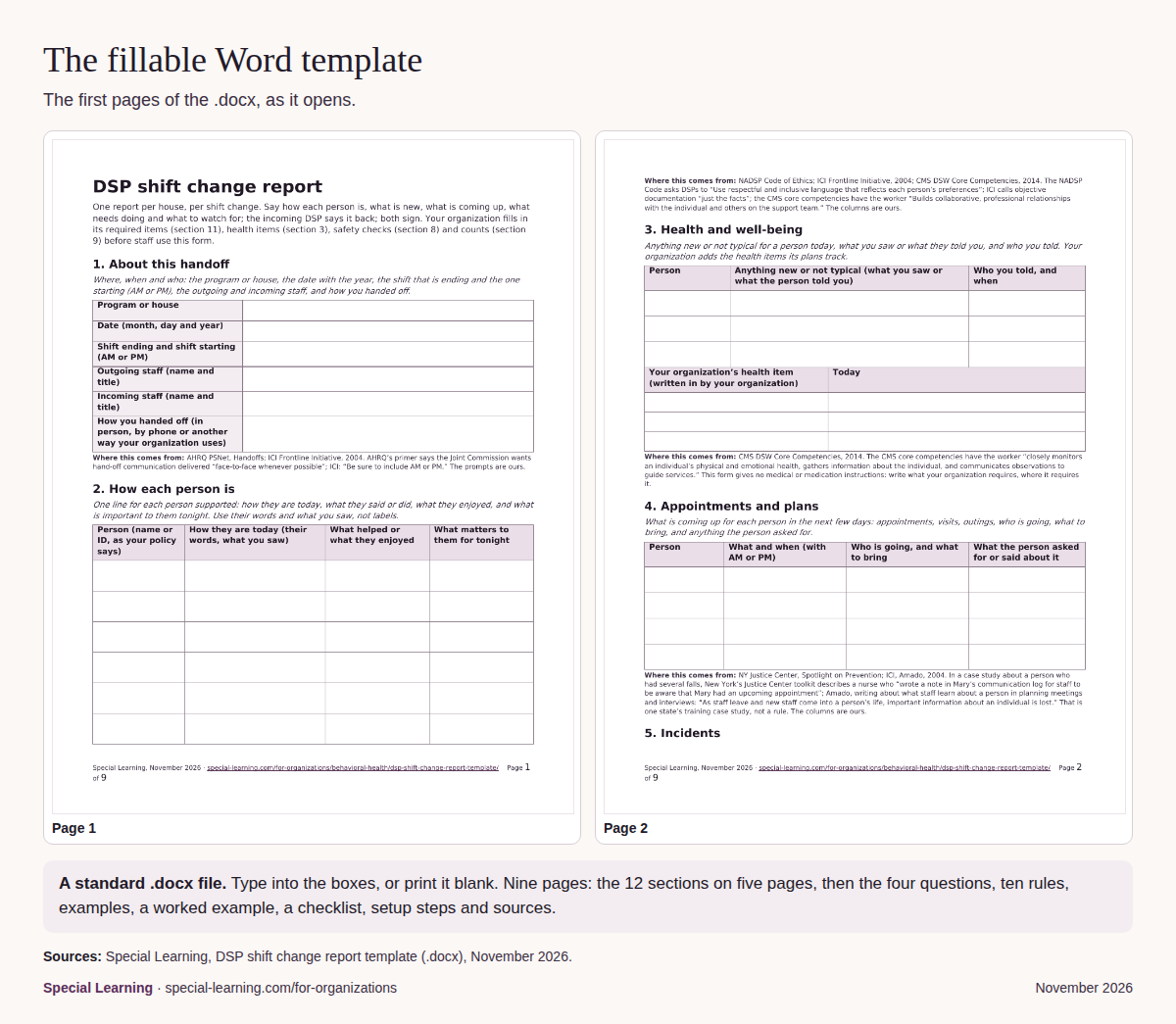
A free shift change report (shift handoff log) for direct support professionals (DSPs) in group homes and residential programs, as a fillable Word file and a printable PDF. It is what the outgoing DSP tells the incoming DSP: how each person is, what is new, what is coming up, what needs doing and what to watch for. It comes with a worked example and six examples of handing off facts, not labels. Your organization adds its own counts and required items.
Special Learning · November 15, 2026
Free download
Download the template
Short answer
What should a DSP shift change report include?
Read
How each person is, what changed, what is coming up and what to watch for, with a to-do list the incoming DSP can start from. A useful handoff gives times, the person’s own words, who was told about anything new, and a name and a time beside each thing to do. The incoming DSP says it back, and both sign.
A shift change report answers four questions:
- How is each person?. How are they today, what did they enjoy, and what matters to them tonight? (NADSP Code of Ethics; ICI Frontline Initiative, 2004)
- What changed?. Is anything new or not typical for them, and who did you tell? (CMS DSW Core Competencies, 2014)
- What is next?. What is coming up, what needs doing, who will do it, and by when? (AHRQ PSNet, Handoffs; NY Justice Center, Spotlight on Prevention)
- What if?. What should the next shift watch for, and where is the plan that says what to do? (AHRQ PSNet, Handoffs; CMS DSW Core Competencies, 2014)
Hospitals have studied structured handoffs between clinicians. AHRQ’s primer describes two tools, I-PASS and SBAR, and says the Joint Commission “does not recommend a specific handoff tool” but expects hand-off communication to be delivered “face-to-face whenever possible” (AHRQ PSNet, Handoffs). A 2025 systematic review found moderate-certainty evidence for I-PASS and low-certainty evidence for SBAR in hospital units (McCarthy et al., 2025). They are clinician tools, not a rule for group homes; for one hospital system’s experience, see PSNet’s “Implementing SBAR across a large multihospital health system.” This template borrows three ideas, an action list, an “if this, then” and having the receiver say it back; its sections, order and wording are ours. What a shift record must show, and what must be counted, is set by your state, your waiver, your service and your agency, so those items are blank for your organization to fill in.

Worked example
One evening-to-overnight handoff, written up
Here is a filled-in report for three invented people supported. Each has a line in their own words or what the DSP saw; the to-do list has a name and a time beside each item; the plan for anything to watch is pointed to, not rewritten; and the incoming DSP says it back before both sign. It leaves out sections 9 and 11, which are your organization’s. The structure borrows from the AHRQ PSNet handoffs primer and the CMS direct service workforce competencies; the people and entries are made up. For what each person did over the whole shift, staff write a daily note; see our free DSP daily notes template.
| Section | Field | Entry |
|---|---|---|
| 1 | Program, date, shifts | Maple Street home. Tuesday, March 2, 2027. Evening shift (3:00 PM to 11:00 PM) to overnight shift (11:00 PM to 7:00 AM). |
| 1 | Staff and how | Outgoing: J. Okafor, DSP. Incoming: A. Reyes, DSP. In person, in the office with the door closed, 10:50 PM. |
| 2 | Luis | Went to the store and found 6 of 8 items on his picture list. Said, “Tacos were good.” Watching the basketball game in the living room; likes to stay up for the end of it. Tonight: he wants his lamp on. |
| 2 | Keisha | Painted at the kitchen table from 6:00 to 7:15 PM and showed me her picture. Said, “I’m tired,” and went to her room at 9:30 PM. Tonight: her door stays open a little. |
| 2 | Tom | Stayed in and listened to his radio. Tonight: he likes a visit to say good night. |
| 3 | Tom | Said at 6:15 PM, “My tooth hurts,” and ate about half his dinner. I told the house manager at 6:30 PM and wrote it on his health sheet. |
| 3 | Luis, Keisha | Nothing new or not typical. |
| 4 | Tom | Dentist Friday at 9:00 AM. Needs his insurance card (in the office folder). The house manager is driving. |
| 4 | Keisha | Library trip Thursday afternoon; she asked to bring her painting to show the librarian. |
| 5 | Incidents | None this shift. |
| 6 | To do | Check in with Tom at 11:30 PM and again at 7:00 AM (A. Reyes). Put Luis’s grocery receipt in the money folder (A. Reyes, by 7:00 AM). |
| 7 | If this, then | If Tom says his tooth hurts more, tell the on-call manager as Tom’s support plan says (plan in the office binder; on-call list on the office door). |
| 8 | Household | Out of milk. The van needs fuel before Friday (told the house manager). |
| 10 | Messages | Luis’s sister called at 7:30 PM and is coming Sunday afternoon. I told Luis. The house manager asked for the schedule to be posted by Thursday. |
| 12 | Confirm and sign | A. Reyes said back: Tom check-ins at 11:30 PM and 7:00 AM, dentist Friday, tell the on-call manager if the pain increases. No other questions. Signed J. Okafor and A. Reyes, March 2, 2027, 10:55 PM. |

Facts, not labels
Six examples to teach with
A label tells the next shift what the writer concluded. A fact lets them see what happened and what to do. NADSP’s Code of Ethics asks DSPs to “Use respectful and inclusive language that reflects each person’s preferences.” (NADSP Code of Ethics) These six cover how a person is, health, what is coming up, a to-do, what helped and the house.
| Topic | Instead of | Write |
|---|---|---|
| How they are | Priya was in a bad mood. | At 5:15 PM Priya said, “I don’t want to go to work tomorrow.” She ate dinner in her room and listened to music. At 8:00 PM she came out to watch her show and said, “Better now.” |
| Health | Sam is sick. | At 5:30 PM Sam said, “My stomach hurts.” He ate about half his dinner. I told the house manager at 5:45 PM and wrote it on his health sheet. Please check in with him at 9:00 PM. |
| Coming up | Dentist tomorrow. | Rosa has a dentist appointment Thursday at 9:00 AM. She needs her insurance card and her glasses, and her sister is meeting her there. Rosa asked to wear her green sweater. |
| To do | Needs groceries. | The house is out of milk and rice. Jamal is writing the list tonight. Please take him to the store before Wednesday evening; he wants to pick the rice himself. |
| What helped | Ahmed was difficult at bedtime. | At 9:30 PM Ahmed said, “Too loud.” When I turned the hall light down and the TV off, he went to his room on his own. That worked last night too. |
| Household | House is fine. | The van’s low-fuel light came on at 6:00 PM. I wrote it on the van sheet and told the house manager. Please fill the tank before Friday’s outing. |

How to hand off
Ten rules for a shift change
- Hand off in person when you can, and leave time for questions. AHRQ’s primer says the Joint Commission expects hand-off communication to be delivered “face-to-face whenever possible,” and its standard asks for “the opportunity for discussion between the giver and receiver.” When you cannot meet, use the way your organization sets, and still leave a way to ask questions. (AHRQ PSNet, Handoffs)
- Use the same order every time. AHRQ: “Guidelines for safe handoffs focus on standardizing the process.” The Joint Commission “does not recommend a specific handoff tool”, so the order on this form is ours: people, health, plans, incidents, to-do, if-then, house, messages, confirm. (AHRQ PSNet, Handoffs)
- Start with the person, not the task list. Say how each person is and what is important to them tonight before you get to supplies and keys. The NADSP Code asks DSPs to “Apply person-centered practices, collaborating with individuals and their teams to understand what is important to and for them.” (NADSP Code of Ethics)
- Write what you saw and what they said. Put the person’s words in quotation marks. Describe actions, not labels like “difficult.” ICI calls objective documentation “just the facts,” and the NADSP Code asks for “respectful and inclusive language that reflects each person’s preferences.” (ICI Frontline Initiative, 2004; NADSP Code of Ethics)
- Say what is new or not typical, and who you told. A change matters more than a routine evening. The CMS core competencies have the worker communicate observations “to guide services.” Record health items the way your organization requires, nothing more. (CMS DSW Core Competencies, 2014)
- End with an action list: what, for whom, by when. AHRQ describes an “Action list” in the hospital I-PASS tool: “to-do items to be completed by the clinician receiving signout.” A short list with a name and a time beside each item lets the next shift start without guessing. (AHRQ PSNet, Handoffs)
- Add an “if this, then that” for anything to watch. AHRQ describes “contingency plans” in I-PASS: “directions to follow in case of changes in the patient’s status.” For a person you support, point to their crisis plan or support plan, and say where it is kept. (AHRQ PSNet, Handoffs; CMS DSW Core Competencies, 2014)
- Let the incoming DSP say it back. AHRQ lists “Synthesis by receiver: an opportunity for the receiver to ask questions and confirm the plan of care.” Ask “What will you do first?” and answer what is unclear. (AHRQ PSNet, Handoffs)
- Pick a quiet place, and keep private information private. AHRQ: effective handoffs need “an environment free of interruptions and distractions.” The NADSP Code: “Follow the confidentiality policies and guidelines of my employer and the state, taking care to prevent private information from being overheard or seen by others.” (AHRQ PSNet, Handoffs; NADSP Code of Ethics)
- Do not leave it in your head or your phone. ICI: “the support provided to the people you support after you leave for the day may depend upon what you have written.” Write it on the form your organization uses, and sign it: “Always sign what you have written.” (ICI Frontline Initiative, 2004)

Before you hand off: a ten-point check
Our wording, built on the sources in the rules above. A new DSP can run it at every shift change for the first weeks, and a reviewer can use the same list.
- The date has the year, and the shift times have AM or PM.
- Every person supported has a line, in their words or what you saw.
- Anything new or not typical is written, with who you told.
- Appointments and plans that are coming up have a time and who is going.
- Any incident has its report number.
- The to-do list has a name and a time beside each item.
- Anything to watch for points to the person’s plan.
- Your organization’s counts and safety checks are done.
- The incoming DSP said it back and asked their questions.
- You both signed, and no private information was left where others could see it.

Inside the template
The 12 sections, and where each comes from
We built the sections from public material on handoffs and on what direct support work involves: AHRQ’s PSNet primer on handoffs and a 2025 review of hospital handoff tools; New York’s Justice Center prevention toolkit, which shows a house communication log in use; the CMS Direct Service Workforce core competencies; the NADSP Competency Areas and Code of Ethics; and two ICI Frontline Initiative articles on documentation. Each section in the Word form and the PDF names its sources, or says it has none. Section 5 holds only the number of any incident report; staff write the incident itself on a separate form, such as our free DSP incident report template. Section 7 points to each person’s plan, such as one written on our free crisis plan template.
| # | Section | What to write | Where it comes from |
|---|---|---|---|
| 1 | About this handoff | Where, when and who: the program or house, the date with the year, the shift that is ending and the one starting (AM or PM), the outgoing and incoming staff, and how you handed off. | (AHRQ PSNet, Handoffs; ICI Frontline Initiative, 2004) |
| 2 | How each person is | One line for each person supported: how they are today, what they said or did, what they enjoyed, and what is important to them tonight. Use their words and what you saw, not labels. | (NADSP Code of Ethics; ICI Frontline Initiative, 2004; CMS DSW Core Competencies, 2014) |
| 3 | Health and well-being | Anything new or not typical for a person today, what you saw or what they told you, and who you told. Your organization adds the health items its plans track. | (CMS DSW Core Competencies, 2014) |
| 4 | Appointments and plans | What is coming up for each person in the next few days: appointments, visits, outings, who is going, what to bring, and anything the person asked for. | (NY Justice Center, Spotlight on Prevention; ICI, Amado, 2004) |
| 5 | Incidents | If anything happened that your incident rule covers, write it on your incident report, record the report number here, and say who was told. | (CMS DSW Core Competencies, 2014) |
| 6 | To do for the next shift | The action list: what needs doing, for whom, by when. Write it so the incoming DSP can start without asking. | (AHRQ PSNet, Handoffs) |
| 7 | If this happens, then | Anything to watch for this shift, and what the person’s plan says to do. Point to the plan (crisis plan or support plan) and where to find it; do not rewrite it here. | (AHRQ PSNet, Handoffs; CMS DSW Core Competencies, 2014) |
| 8 | Household and safety | Supplies, repairs, the vehicle, meals and anything about the house the next shift should know. Your organization adds the safety checks it requires. | |
| 9 | Counts your organization requires | Blank on purpose. If your organization requires counts at shift change, such as keys or funds, it writes each item here before staff use the form. | |
| 10 | Messages and visitors | Calls, messages from family or the team, visitors and anything promised to a person that the next shift should keep. | (NADSP Code of Ethics; NADSP Competency Areas) |
| 11 | Your organization’s required items | Blank on purpose. Your state, your waiver and your agency set what a handoff or shift record must show. Your organization writes those items here before staff use the form. | (NADSP Competency Areas) |
| 12 | Confirm and sign | The incoming DSP says back what they heard and asks questions. Then both of you sign, with the date and time. Sign only what you wrote or heard. | (AHRQ PSNet, Handoffs; ICI Frontline Initiative, 2004) |

For training leads
Set it up and teach it in five steps
New DSPs learn the handoff in their first weeks; our free DSP onboarding checklist is a 90-day plan you can add this to.
- Fill in your required items first. Open your state’s rules for each service you provide, your waiver documents and your agency’s policy. Write the items a handoff or shift record must show into section 11, the health items your plans track into section 3, the safety checks into section 8, and any counts into section 9, in the Word form or on a printed master copy. We leave them blank on purpose: they differ by state, by waiver, by service and by house. Then save it as your agency’s master copy.
- Add the people supported. In the master copy for each house, type each person’s name or ID (as your policy says) into section 2 and, as many rows as the house needs, into sections 3, 4 and 7 (add rows in the Word form), so staff never have to write the same names every shift. Print a fresh copy for each shift, or save a new file with the date.
- Teach the four questions and the ten rules with the example pairs. Read each “instead of” line aloud and have staff rewrite it as facts before you show the “write” line.
- Practice with the worked example. Pair staff up. One plays the outgoing DSP and gives the handoff from the worked example; the other writes it down, says it back, and asks one question. Then compare with the example and the ten rules.
- Read the reports as a reviewer. Each week, read a few reports and ask: could the incoming shift tell how each person is, what is coming up, what to do first and what to watch for? Where not, ask the staff what would have helped, and change the master copy.

On paper
Prefer paper? Print the PDF
The printable PDF carries the same 12 sections with write-in space, then the four questions, the ten rules, the six example pairs, the worked example, the check, the setup steps and the sources, for a binder at the house or a new DSP’s first week.

Questions
DSP shift change reports: common questions
What should a DSP shift change report include?
Where and when the handoff happened and who gave and received it, how each person supported is today, anything new or not typical for them and who was told, what is coming up, any incident report number, a to-do list with a name and a time beside each item, anything to watch for with a pointer to the person’s plan, household and safety items, messages, and a place for the incoming DSP to say it back and for both to sign. Those are the 12 sections of this template. Your organization adds its own counts, health items, safety checks and required items (AHRQ PSNet, Handoffs; CMS DSW Core Competencies, 2014; NADSP Competency Areas).
What is a shift handoff log?
It is the written record that goes with a spoken handoff: what the outgoing staff member tells the incoming one so the support carries on without a gap. Some programs call it a communication log, shift notes or a pass-down. New York’s Justice Center toolkit describes a house communication log where a nurse leaves a note about a person’s upcoming appointment (NY Justice Center, Spotlight on Prevention); that is one state’s training case study, not a rule.
Are I-PASS and SBAR for group homes?
No. They are structured handoff tools studied in hospitals, between clinicians. AHRQ’s primer describes I-PASS (illness severity, patient summary, action list, situation awareness and contingency plans, synthesis by receiver) and SBAR (situation, background, assessment, recommendation) (AHRQ PSNet, Handoffs). A 2025 systematic review of hospital handoffs found moderate-certainty evidence for I-PASS and low-certainty evidence for SBAR (McCarthy et al., 2025). We borrowed three ideas, an action list, an “if this, then” and having the receiver say it back; the form, its order and its wording are ours, and the Joint Commission “does not recommend a specific handoff tool” (AHRQ PSNet, Handoffs).
What should be counted at shift change?
That is your organization’s policy, so section 9 is blank: the organization writes in each item it requires, such as keys or funds, before staff use the form. This template gives no medical or medication instructions either; record health items the way your organization requires, and use the person’s plan and your organization’s procedures for anything else.
How is a shift change report different from daily notes or an incident report?
The shift change report is what you tell the next shift. Our free DSP daily notes template is the record of what a person did, said and chose over the whole shift, and when something happens that your incident rule covers, staff write it on a separate incident report, such as our free DSP incident report template, and put its number in section 5 of the report. Each person’s crisis plan, such as our free crisis plan template, holds the steps; section 7 points to it.
Did a state or federal agency write this template?
No. The template, its section prompts, the ten rules’ wording, the example sentences and the worked example are Special Learning’s. The fields come from the published hospital-handoff, NADSP, CMS and ICI sources listed below, and the quoted lines are as published. None of those organizations has reviewed or endorsed this template.
Sources
Read November 15, 2026. The quoted lines are as published; the template, its section prompts, the ten rules’ wording, the example sentences and the worked example are ours. None of these organizations has reviewed or endorsed this template.
- Agency for Healthcare Research and Quality (AHRQ), Patient Safety Network (PSNet), Patient Safety Primer: Handoffs and Signouts (2019), as posted at psnet.ahrq.gov. A primer on hospital handoffs between clinicians. https://psnet.ahrq.gov/primer/handoffs
- Sean McCarthy, Aneesa Motala, Emily Lawson and Paul G. Shekelle, “Use of structured handoff protocols for within-hospital unit transitions: a systematic review from Making Healthcare Safer IV,” BMJ Quality & Safety, published April 29, 2025. https://pmc.ncbi.nlm.nih.gov/articles/PMC12232517/
- New York State Justice Center for the Protection of People with Special Needs, Spotlight on Prevention: Could This Happen in Your Program? (a toolkit of case studies for agency staff training, posted June 2025). https://www.justicecenter.ny.gov/system/files/documents/2025/06/sop-cthiyp_linked-sn-1.pdf
- Centers for Medicare & Medicaid Services, National Direct Service Workforce Resource Center, Direct Service Workforce Core Competencies, Final Competency Set, December 2014. https://www.medicaid.gov/sites/default/files/2019-12/dsw-core-competencies-final-set-2014.pdf
- National Alliance for Direct Support Professionals (NADSP), The NADSP Competency Areas, Area 2: Communication and Area 12: Documentation, as published on nadsp.org. https://nadsp.org/resources/competency-areas/
- National Alliance for Direct Support Professionals (NADSP), The NADSP Code of Ethics (revised 2026), tenets as published on nadsp.org. https://nadsp.org/resources/the-nadsp-code-of-ethics/
- Traci LaLiberte, “Doing Documentation ‘Write!’,” Frontline Initiative, Volume 5, Number 4 (2004), Institute on Community Integration, University of Minnesota. https://publications.ici.umn.edu/frontline-initiative/5-4/doing-documentation-write
- Angela Novak Amado, “Is it Paperwork? Or, is it the person?,” Frontline Initiative, Volume 5, Number 4 (2004), Institute on Community Integration, University of Minnesota. https://publications.ici.umn.edu/frontline-initiative/5-4/is-it-paperwork-or-is-it-the-person