
Free form for frontline supervisors and training leads
DSP supervision log template
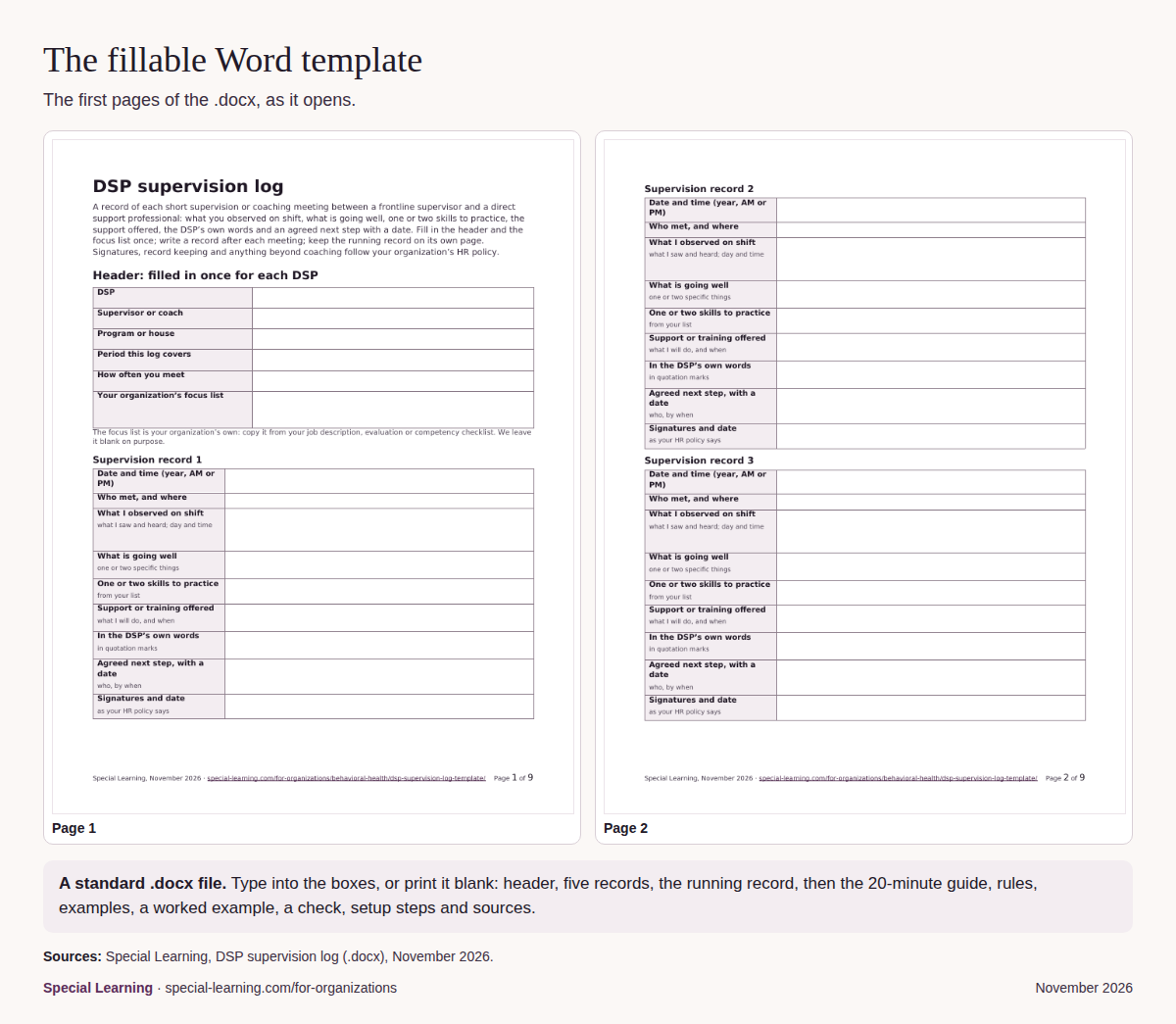
A free supervision log for frontline supervisors of direct support professionals (DSPs) in group homes, day programs and behavioral-health agencies, as a fillable Word file and a printable PDF. After each short meeting you record what you observed on shift, what is going well, one or two skills to practice, the support you offered, the DSP’s own words and an agreed next step with a date. It comes with a one-page running record, a guide to a 20-minute meeting, and worked examples written as observed behavior.
Special Learning · November 15, 2026
Free download
Download the log
Short answer
What is a DSP supervision log, and what goes in it?
Read
A short record, written right after a supervision meeting, of what the supervisor saw, what is going well, what the DSP will practice and what both agreed to do next. It is a coaching record, not an evaluation and not a disciplinary form. Your organization decides how often you meet, which skills matter, and where the records are kept.
Supervising DSPs is its own set of skills. The National Frontline Supervisor Competencies, published by the University of Minnesota’s Institute on Community Integration in 2013, include coaching and feedback, training and keeping training records in their area on staff supervision, training and development (National Frontline Supervisor Competencies, 2013). NADSP lists supportive supervision among the things a competent DSP takes part in (NADSP Competency Areas), and its curriculum page for frontline supervisors names 11 nationally validated frontline supervisor competencies (NADSP Frontline Supervisor curriculum page; ICI product page, National Frontline Supervisor Competencies). The Rutgers Boggs Center’s appraisal tool tells supervisors to review it “during DSP supervision meetings” and to note strategies “arrived at through collaborative conversation” (Rutgers Boggs Center (New Jersey), DSP appraisal). Our prompts, the order of the fields and the agenda are ours; the skill list is left for your organization to write.
Three parties have three parts:
- The DSP: brings their view. Says what is going well and what is hard, in their words, helps choose the next step, and does it by the date. Signs as your policy says. (CMS DSW Core Competencies, 2014; Rutgers Boggs Center (New Jersey), DSP appraisal)
- The supervisor: prepares, observes and offers support. Writes what they saw and heard, picks one or two skills from the organization’s list, offers coaching or training, and keeps the running record. FLS area 7 covers coaching, feedback and training records. (National Frontline Supervisor Competencies, 2013)
- The organization: decides what is expected. Sets the focus list, how often to meet, where records are kept and who may read them, and follows its own HR policy for anything beyond coaching. We leave those lines blank.

For anything beyond coaching, such as signatures, record keeping or a performance concern, follow your organization’s HR policy. Better-trained supervisors are better able to provide high quality training and support to DSPs, one ICI article notes (ICI Frontline Initiative, 2006).
Inside the log
One record: the fields, and where each comes from
Each meeting gets one record. The sources show what published tools and guides ask supervisors and records to hold: the Boggs appraisal on observation and collaborative strategies (Rutgers Boggs Center (New Jersey), DSP appraisal), the frontline supervisor competencies on coaching and feedback (National Frontline Supervisor Competencies, 2013), the CMS core competencies on seeking feedback (CMS DSW Core Competencies, 2014), and ICI on dates, signing and facts versus opinion (ICI Frontline Initiative, 2004).
| Header line | What goes there | Where it comes from |
|---|---|---|
| DSP | Name or ID, as your organization’s policy says. | |
| Supervisor or coach | The person who meets with this DSP. | |
| Program or house | Where this log is kept. | |
| Period this log covers | First and last date, with the year. | (ICI Frontline Initiative, 2004) |
| How often you meet | Your organization decides this; write it here. The log works for any schedule. | |
| Your organization’s focus list | The skills, expectations or competencies your organization has written for this job, copied from your own job description, evaluation or competency checklist. Left blank on purpose. | (Rutgers Boggs Center (New Jersey), DSP appraisal; NADSP Competency Areas) |
| Field | What to write | Where it comes from |
|---|---|---|
| Date and time | The full date with the year, the start and end times with AM or PM. A 20-minute meeting is the plan; write the real length. | (ICI Frontline Initiative, 2004) |
| Who met, and where | The DSP, the supervisor, anyone else present, and the place. | |
| What I observed on shift | What you saw and heard on shift, where and when, in words a camera could record. Put what the DSP said in quotation marks. Use initials for people supported, as your policy says. | (Rutgers Boggs Center (New Jersey), DSP appraisal; ICI Frontline Initiative, 2004) |
| What is going well | One or two specific things the DSP did, and what happened because of them. | (Rutgers Boggs Center (New Jersey), DSP appraisal) |
| One or two skills to practice | Pick one or two, from your organization’s own list, not a long list. Say what the skill looks like on shift. | (Rutgers Boggs Center (New Jersey), DSP appraisal; National Frontline Supervisor Competencies, 2013) |
| Support or training offered | What you will do to help: show it, practice it together, pair with a co-worker, a training, a resource. | (National Frontline Supervisor Competencies, 2013; ICI Frontline Initiative, 2006) |
| In the DSP’s own words | What the DSP said about what went well, what was hard, and what they need. Write their words in quotation marks. Leave it blank only if the DSP chose to say nothing. | (CMS DSW Core Competencies, 2014; National Frontline Supervisor Competencies, 2013) |
| Agreed next step, with a date | One step, who does it, and the date. Agreed in the meeting, not handed down afterward. | (Rutgers Boggs Center (New Jersey), DSP appraisal) |
| Signatures | Supervisor and DSP each sign and date, as your organization’s HR policy says. A line for any comment the DSP wants to add. | (ICI Frontline Initiative, 2004) |

The meeting
How to run a 20-minute supervision meeting
A short meeting that happens beats a long one that moves. The order below puts what is going well before the skill to practice, and ends with the DSP’s words and one agreed step. It rests on the Boggs appraisal’s call for comments that “reinforce successful use of best practices” and for strategies reached through conversation (Rutgers Boggs Center (New Jersey), DSP appraisal), on the competency to “Teach, model, and coach DSPs” (National Frontline Supervisor Competencies, 2013), and on the CMS skill statement about seeking feedback (CMS DSW Core Competencies, 2014). The minutes are our plan.
| When | What to do | Where it comes from |
|---|---|---|
| Before: 5 minutes | Get ready. Read the last record and the running record. Write down what you observed on shift since: two or three things you saw and heard, at least one that went well. Choose the one or two skills to talk about. | (Rutgers Boggs Center (New Jersey), DSP appraisal; ICI Frontline Initiative, 2004) |
| Minutes 0 to 3 | Open and look back. Ask how the shift is going. Read last time’s agreed step aloud and ask how it went. Mark it done, or note what got in the way. | (Rutgers Boggs Center (New Jersey), DSP appraisal) |
| Minutes 3 to 8 | What is going well. Say what you saw and heard that went well, with the day and time. Ask the DSP what they are proud of. The Boggs form asks supervisors for comments that “reinforce successful use of best practices.” | (Rutgers Boggs Center (New Jersey), DSP appraisal) |
| Minutes 8 to 14 | One or two skills. Describe what you saw, in observed behavior. Ask what the DSP saw. Practice or model it together for two minutes: say it, show it, try it. | (National Frontline Supervisor Competencies, 2013; CMS DSW Core Competencies, 2014) |
| Minutes 14 to 18 | Support and next step. Ask what would help. Offer the support. Agree one next step, who does it, and the date. Write it as the DSP says it. | (Rutgers Boggs Center (New Jersey), DSP appraisal; National Frontline Supervisor Competencies, 2013) |
| Minutes 18 to 20 | Their words, and close. Ask: “What do you want to add?” Write it in their words. Set the next meeting date. Both sign, as your policy says. | (CMS DSW Core Competencies, 2014; ICI Frontline Initiative, 2004) |

Worked example
Three records for one invented DSP
Each observation is something a camera could record, the DSP’s words are in quotation marks, each record has one or two skills and one dated step, and each meeting begins by reading the step from last time. The people, the staff and the program are invented. Priya’s skills come from an invented focus list; yours comes from your own.
| Field | Entry |
|---|---|
| Record 1: Tuesday, March 2, 2027, 2:00 PM to 2:20 PM. Priya N. (DSP) and A. Reyes (supervisor), in the office. | |
| What I observed on shift | At dinner on Monday, March 1, I saw Priya ask, “Do you want the blue plate or the green one?” and wait about ten seconds. Three of the five daily notes for February 22 to 26 were entered the next morning: February 22, 24 and 25. |
| What is going well | Offering a choice and waiting at dinner. K. pointed to the blue plate and ate with the group. |
| Skill to practice | Finish each person’s daily note before leaving the shift. |
| Support offered | I will sit with Priya for 10 minutes at 6:30 PM on Thursday and Friday while she writes one note, so she can ask questions. |
| In the DSP’s own words | “Late in the shift is when everyone needs me. I run out of time.” “Can I start the notes at 6:30?” |
| Agreed next step, with a date | Priya starts notes at 6:30 PM for the next two weeks. Check on March 16. |
| Signatures | A. Reyes and Priya N., March 2, 2027 |
| Record 2: Tuesday, March 16, 2027, 2:00 PM to 2:18 PM. Priya N. (DSP) and A. Reyes (supervisor), in the office. | |
| What I observed on shift | I looked at the notes for March 8 to 12: all five were in before the end of her shift at 8:00 PM. On March 11 I watched the outing at the bus stop: Priya asked R., “Which seat do you want?” and then said, “I’ll sit here when you are ready.” |
| What is going well | Notes on time all week. Choice and waiting again, at the bus stop. |
| Skill to practice | The shift change report: include what each person asked for or said that the next shift needs. |
| Support offered | I will go through one report with Priya on Wednesday, March 17, at 2:00 PM. She will read two examples from our shift change report template. |
| In the DSP’s own words | “Starting at 6:30 helped.” “I do not always know what the next shift needs to hear.” |
| Agreed next step, with a date | Priya adds one line to each person’s report about what they asked for. Check on March 30. |
| Signatures | A. Reyes and Priya N., March 16, 2027 |
| Record 3: Tuesday, March 30, 2027, 2:00 PM to 2:21 PM. Priya N. (DSP) and A. Reyes (supervisor), in the office. | |
| What I observed on shift | Reports for March 22 to 26: four of five included a line about what a person asked for. On March 24 the report said, “R. asked to call his brother at 4:00 PM.” On March 25 at dinner I saw Priya offer R. two choices for the evening routine: “Walk first or music first?” |
| What is going well | The report line is in four of five reports, and the March 24 line gave the next shift something to act on. |
| Skill to practice | Offering a choice with two or more options for the evening routine (continuing from March 2). |
| Support offered | I will pair Priya with T. for the 7:00 PM routine on April 6 so she can see how T. offers choices, then we talk for 5 minutes. |
| In the DSP’s own words | “I forgot on Friday.” “I want to see how T. does it.” |
| Agreed next step, with a date | Priya shadows T. on April 6 and brings one thing she noticed to our next meeting on April 13. |
| Signatures | A. Reyes and Priya N., March 30, 2027 |

The same weeks on the running record
One row for each meeting, so a supervisor sees at a glance what was agreed, what is due and what is done. Read it before each meeting. If your organization’s policy says so, bring it to the evaluation. The frontline supervisor’s area 7 includes “scheduling and maintaining training records.” The columns are ours. (National Frontline Supervisor Competencies, 2013)
| Date | Skill we are practicing | Support offered | Agreed next step | Due | Done on |
|---|---|---|---|---|---|
| Mar 2 | Daily notes finished before leaving | Sat with Priya at 6:30 PM, Mar 4 and 5 | Start notes at 6:30 PM for two weeks | Mar 16 | Mar 16 |
| Mar 16 | Shift change report: what each person asked for | Went through one report Mar 17, 2:00 PM | Add one line per person to the report | Mar 30 | Mar 30 |
| Mar 30 | Offering choices (evening routine) | Shadow T., Apr 6, 7:00 PM | Bring one thing noticed to Apr 13 | Apr 13 |

What you saw, not what you think
Eight examples to teach with
A label tells the reader what the writer concluded; what you saw and heard lets the DSP and the next supervisor see it. ICI describes objective documentation as “just the facts” (ICI Frontline Initiative, 2004), and the Boggs appraisal asks supervisors to rate “based on their observations” (Rutgers Boggs Center (New Jersey), DSP appraisal). The NADSP Code of Ethics asks DSPs to “Use respectful and inclusive language that reflects each person’s preferences” (NADSP Code of Ethics). The pairs are ours: cover the right column and rewrite each line first.
| Part of the record | Instead of | Write |
|---|---|---|
| Going well | Great with the residents. | At dinner on Monday, March 1, Priya asked, “Do you want the blue plate or the green one?” and waited about ten seconds before the person pointed to the blue one. |
| Going well | Gets along with everyone. | At 4:15 PM on Tuesday, March 2, Priya greeted each person by name at the door, and sat next to K. when K. asked her to. |
| Observed | Marcus has a bad attitude. | At 3:10 PM on Tuesday, March 2, Marcus stayed at the kitchen table while D. asked twice for help with a coat. He said, “I’m finishing the medication count.” |
| Observed | Poor communication. | At the 3:00 PM shift change on Thursday, March 4, the report said “J. ate fine.” It did not say that J. asked to call her sister at 4:00 PM. |
| Skill to practice | Needs to work on documentation. | Finish each person’s daily note before leaving the shift. Three of five notes last week were entered the next morning: February 22, 24 and 25. |
| Support offered | Will retrain. | I will go through the shift change report with Marcus for 15 minutes at the start of his next two shifts, March 3 and March 4, 9:00 AM. |
| DSP’s words | Marcus was defensive. | Marcus said, “Nobody told me the outing time changed.” He asked how changes get to him. |
| Next step | Improve by next time. | By Friday, March 12, Priya will lead the 7:00 AM routine while I watch, and we will meet for 20 minutes at 2:00 PM that day. |

How to write the record
Seven rules for writing it
- Write what you saw and heard, not what you think. ICI describes objective documentation as “just the facts,” and says that if you include an opinion, “always indicate that this is your opinion.” The Boggs appraisal asks the supervisor to rate “based on their observations.” (ICI Frontline Initiative, 2004; Rutgers Boggs Center (New Jersey), DSP appraisal)
- Start with what is going well. The Boggs appraisal strongly encourages supervisors “to include comments that reinforce successful use of best practices and to note areas where improvement and growth are needed.” Say what the DSP did, and when. (Rutgers Boggs Center (New Jersey), DSP appraisal)
- Keep to one or two skills. Our line. A short list is one the DSP can practice before the next meeting. Choose from your organization’s own list. The Boggs appraisal notes that average scores can be calculated “to identify where there may be the most need for further professional development”; this log uses no scores. (Rutgers Boggs Center (New Jersey), DSP appraisal)
- Offer support, not only a goal. FLS competency 5.G: “Teach, model, and coach DSPs in the most effective approaches to achieve the direct support competencies.” Write what you will do, such as show it, practice it, or pair them with a co-worker. (National Frontline Supervisor Competencies, 2013)
- Put the DSP’s words in quotation marks. The CMS core competencies include “Seeks feedback from many sources and uses to improve work performance and skills,” and FLS 7.F asks supervisors to “Observe and solicit feedback from DSPs.” The DSP’s own words are some of that feedback. (CMS DSW Core Competencies, 2014; National Frontline Supervisor Competencies, 2013)
- Agree the next step together, with a date. The Boggs form lists strategies “arrived at through collaborative conversation during the supervision meeting.” A step with a name and a date can be checked at the next meeting. (Rutgers Boggs Center (New Jersey), DSP appraisal)
- Describe people with dignity. The NADSP Code of Ethics asks DSPs to “Use respectful and inclusive language that reflects each person’s preferences.” The same care applies to how a supervisor writes about a DSP: what they did, not what they are. (NADSP Code of Ethics)
Before you file a record: a ten-point check
Our wording, built on the sources in the rules above. A new supervisor can run it on every record for the first weeks.
- The date has the year, and the times have AM or PM.
- What I observed says what I saw and heard, with the day and time.
- At least one thing that is going well is written, with what the DSP did.
- One or two skills, not a list.
- The support offered says what I will do, and when.
- The DSP’s own words are in quotation marks.
- The next step has a name and a date.
- People supported are shown as your policy says.
- We both signed, as the HR policy says, and the next meeting is set.
- The running record has a new row, and last time’s step is marked.

For training leads
Set it up and teach it in five steps
The log sits between the other tools. Where a new DSP starts with the DSP onboarding checklist, a supervisor can watch skills on shift with the DSP competency checklist, hold these meetings, and, if your policy says so, bring the running record to the DSP performance evaluation. The skills a team works on can also feed your annual training plan. The same see-and-hear wording appears in our daily notes, shift change report and ABC data sheet.

- Fill in the header and the focus list. Copy the skills and expectations from your organization’s own job description, evaluation or competency checklist into the focus list, and write how often you meet. We leave both blank on purpose: they are your organization’s decisions.
- Block 20 minutes on the calendar. A standing time that is kept is worth more than a long meeting that moves. Ask the supervisor to read the last record first.
- Teach the seven rules with the eight example pairs. Have supervisors rewrite each “instead of” line as what a camera could record before showing the “write” line.
- Run the first meeting from the worked example. Read the three records aloud, then hold a practice meeting with two supervisors playing the parts.
- Keep the running record, and carry it to the evaluation. File each record where your policy says. If your organization’s policy says so, bring the running record to the performance evaluation as one input; the skills you see can inform the competency checklist and your training plan.

On paper
Prefer paper? Print the PDF
The printable PDF carries a header, blank records with write-in space, the running record, the guide, the examples, the worked example, the check, the setup steps and the sources, for a binder in the office. It is also in our free DSP training and HR toolkit with the other tools.

Questions
DSP supervision logs: common questions
What is a DSP supervision log?
It is a record of a short meeting between a frontline supervisor and a direct support professional: what the supervisor observed on shift, what is going well, one or two skills to practice, the support offered, the DSP’s own words, and an agreed next step with a date. The Rutgers Boggs Center’s appraisal tool tells supervisors to review it “during DSP supervision meetings” and to list strategies “arrived at through collaborative conversation” (Rutgers Boggs Center (New Jersey), DSP appraisal). Our log is the page you write after each meeting, with a one-page running record across meetings.
How long should a supervision meeting take?
Our guide plans 20 minutes: a few minutes to look back, a few on what is going well, a few on one or two skills, then support, a next step and the DSP’s words. Your organization decides how often to meet and for how long; the log works for any schedule.
What should a supervisor write down?
What you saw and heard on shift, with the day and time, in words a camera could record; what is going well; one or two skills from your organization’s own list; the support you will offer; the DSP’s words in quotation marks; and one next step with a name and a date. Leave out labels such as “bad attitude.” The page has eight example pairs.
Is this a performance evaluation?
No. It records coaching conversations between evaluations. It is meant to sit beside your DSP performance evaluation template, and, if your policy allows, the running record can be brought to the evaluation as one input.
Where do the skills to practice come from?
From your organization’s own list: the job description, your evaluation or your DSP competency checklist. The log leaves the focus list blank on purpose. The NADSP competency areas and the CMS core competencies are public sets of skills an organization can draw on (NADSP Competency Areas; CMS DSW Core Competencies, 2014); the TennCare Workforce Initiative describes how competency sets are used to set performance expectations, give feedback and train (TennCare Workforce Initiative, DSP and FLS competency sets).
Does this follow a state or HR rule?
No. It is a coaching record, not an HR form. Signatures, how long records are kept, who may read them and anything about discipline follow your organization’s HR policy. It states no rule for any state.
Did a university or NADSP write this log?
No. The log, its prompts, the 20-minute agenda, the example sentences and the worked example are Special Learning’s. The fields rest on the National Frontline Supervisor Competencies (National Frontline Supervisor Competencies, 2013), the Rutgers Boggs Center appraisal (Rutgers Boggs Center (New Jersey), DSP appraisal), the NADSP competency areas and Code of Ethics, the CMS core competencies and ICI articles listed below. None of those organizations has reviewed or endorsed this log.
Sources
Read November 15, 2026. The quoted lines are as published; the log, its prompts, the rules’ wording, the agenda, the example sentences and the worked example are ours. None of these organizations has reviewed or endorsed this log.
- Lori Sedlezky, Jennifer Reinke, Sheryl Larson and Amy Hewitt, National Frontline Supervisor Competencies (April 2013), Research and Training Center on Community Living, Institute on Community Integration, University of Minnesota (competency area 7, Staff supervision, training, and development, and area 5, Promoting professional relations and teamwork), as posted by ANCOR. https://www.ancor.org/sites/default/files/national_frontline_supervisor_comp.pdf
- Institute on Community Integration, University of Minnesota, product page for National Frontline Supervisor Competencies (April 2013): a nationally validated set of 11 competency areas for frontline supervisors in the direct support workforce. https://ici.umn.edu/products/553
- Rutgers Boggs Center, in partnership with the New Jersey Division of Developmental Disabilities, Direct Support Professional Competency Based Performance Appraisal (an optional tool for frontline supervisors; the English form is a PDF on the same page). https://boggscenter.rwjms.rutgers.edu/resources/publications/direct-support-professional-competency-based-performance-appraisal
- National Alliance for Direct Support Professionals (NADSP), The NADSP Competency Areas (fifteen areas, each with skill statements), as published on nadsp.org. https://nadsp.org/resources/competency-areas/
- National Alliance for Direct Support Professionals (NADSP), The NADSP Code of Ethics (revised 2026), tenets as published on nadsp.org. https://nadsp.org/resources/the-nadsp-code-of-ethics/
- Centers for Medicare & Medicaid Services, National Direct Service Workforce Resource Center, Direct Service Workforce Core Competencies, Final Competency Set, December 2014. https://www.medicaid.gov/sites/default/files/2019-12/dsw-core-competencies-final-set-2014.pdf
- Nancy McCulloh, “Training Frontline Supervisors Improve Recruitment and Retention of DSPs,” Frontline Initiative, Volume 7, Number 1 (2006), Institute on Community Integration, University of Minnesota. https://publications.ici.umn.edu/frontline-initiative/7-1/training-frontline-supervisors-improve-recruitment-and-retention-of-dsps
- Traci LaLiberte, “Doing Documentation ‘Write!’,” Frontline Initiative, Volume 5, Number 4 (2004), Institute on Community Integration, University of Minnesota. https://publications.ici.umn.edu/frontline-initiative/5-4/doing-documentation-write
- TennCare Workforce Initiative, Institute on Community Integration, University of Minnesota, DSP & FLS Competency Sets (the page describes how competency sets are used in recruitment, selection, retention, setting performance expectations, providing feedback and training). https://tenncare.ici.umn.edu/dsp-workforce-toolkit/retention/understanding-and-using-dsp-and-fls-core-competency-sets
- National Alliance for Direct Support Professionals (NADSP), Frontline Supervisor Train-The-Trainer Curriculum, a page that names the 15 NADSP competency areas and the 11 nationally validated Frontline Supervisor competencies (this page paraphrases it and quotes nothing from it). https://nadsp.org/frontline-supervisor-curriculum/