
Free tool for executive directors, HR and training leads
DSP turnover cost calculator
See what direct support professional turnover costs your agency in a year, and what a small drop would save. Every default comes from a published source you can open.
Special Learning · November 15, 2026
Short answer
How much does DSP turnover cost?
Updated
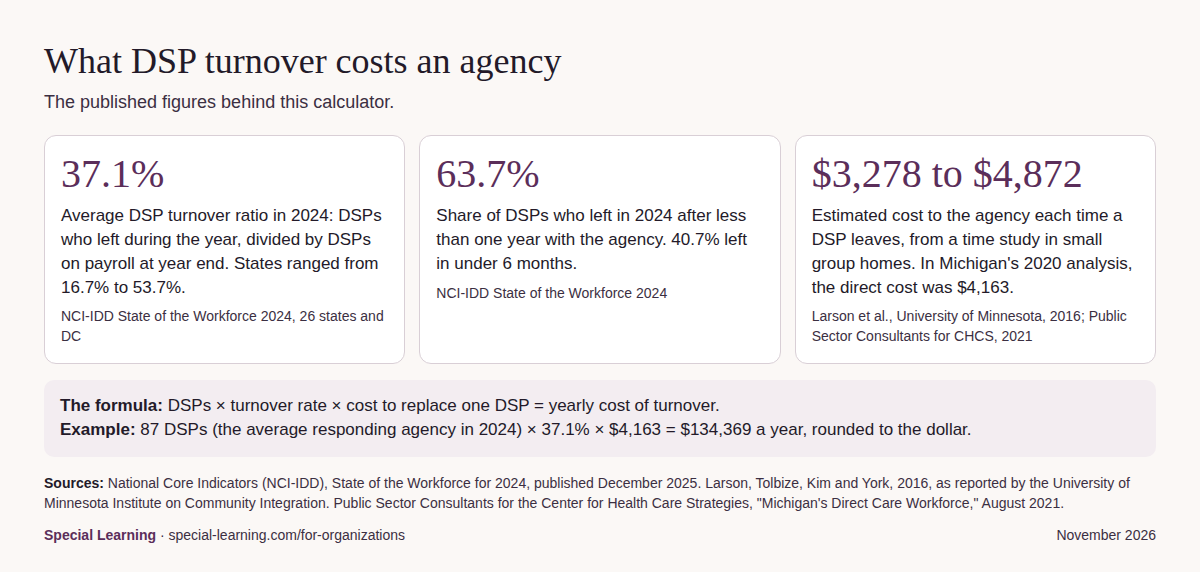
Each time a direct support professional (DSP) leaves, the agency spends an estimated $3,278 to $4,872 to replace them, according to a University of Minnesota time study in small group homes (Larson and colleagues, 2016). Michigan’s 2020 analysis put the direct cost at $4,163 per DSP who leaves (Public Sector Consultants for CHCS, 2021). In 2024, the average DSP turnover ratio reported to National Core Indicators was 37.1%, across 26 states and DC (NCI-IDD, 2024). For an agency the size of the average respondent, 87 DSPs, that is about 32 departures and $134,369 a year in direct costs.
- Where the money goes. Overtime and temporary staff while a job is open; advertising, screening, interviews and background checks; paid orientation and training; and the hours salaried staff spend on all of it. Lost productivity while a new DSP learns the job comes on top (Public Sector Consultants for CHCS, 2021). In a University of Minnesota time study at one provider, training new DSPs was 59% of the direct cost, and the time of existing salaried staff was 72% of it (Larson and colleagues, 2016, as charted by Public Sector Consultants).
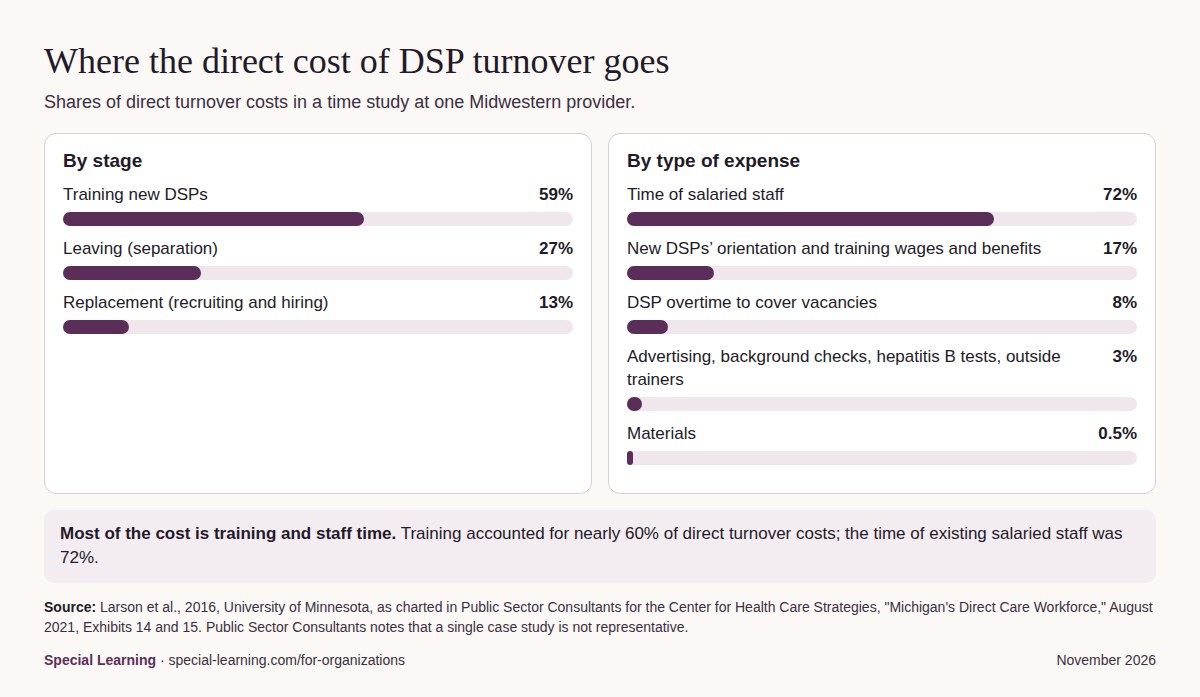
Shares of direct turnover cost at one provider, by stage and by type of expense. - Most departures come early. Of the DSPs who left in 2024, 63.7% had been with the agency for less than a year, and 40.7% for less than six months (NCI-IDD, 2024).
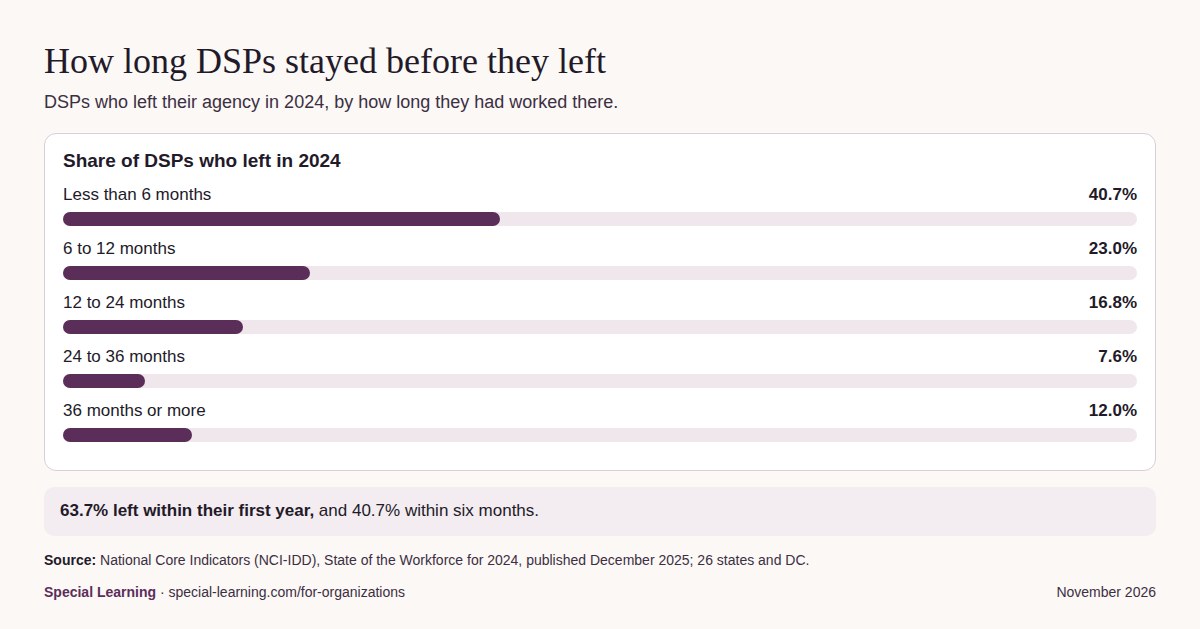
DSPs who left in 2024, by how long they had stayed. - It reaches the people supported. In 2024, 26.6% of responding agencies turned away or stopped accepting new referrals because of DSP staffing (NCI-IDD, 2024).


Calculator
Calculate your agency’s turnover cost
Change any number. The results update as you type. Nothing you enter leaves your browser.
How the calculator works
DSPs who leave in a year = DSPs × turnover rate. Yearly cost = DSPs who leave × cost to replace one DSP. The saving = DSPs × the drop in percentage points ÷ 100 × cost to replace one DSP. The course line is the number of DSPs who leave, rounded to whole people, × $99 per learner, if each replacement hire takes the course below.
Questions
DSP turnover cost: common questions
How do I calculate my DSP turnover rate?
Count every DSP who left in the last 12 months, including people who left in their first days, and divide by the number of DSPs on your payroll. National Core Indicators divides by the headcount on December 31; other methods divide by the average headcount across the year, so compare like with like (NCI-IDD, 2024). The result can be over 100%.
What goes into the cost of replacing one DSP?
Direct costs: separation, overtime and temporary staff while the job is open, advertising, screening, interviews and background checks, and paid orientation and training. Indirect costs: lost productivity while a new DSP learns the job, effects on service quality, and lost revenue (Public Sector Consultants for CHCS, 2021). In a Center for American Progress review of employee-turnover case studies, the typical cost for positions paying under $30,000 a year was about 16% of annual pay (Center for American Progress, 2012).
Why does early turnover matter so much?
Most departures come early. Of the DSPs who left in 2024, 63.7% had worked at the agency for less than a year and 40.7% for less than six months (NCI-IDD, 2024). Each departure repeats the hiring and training cost, however short the stay.
Does training reduce DSP turnover?
Research points to several factors; read it and weigh it for your agency. In a group randomized controlled study, sites that received a competency-based training intervention for DSPs had a significant decrease in annual turnover over one year compared with control sites, when multiple factors were controlled (Bogenschutz, Nord and Hewitt, 2015). A study of National Core Indicators data found higher turnover linked to lower DSP wages and to not offering health insurance, and early turnover linked to not offering paid time off or health insurance, higher vacancy rates and more part-time DSPs (Houseworth and colleagues, 2020).
How exact is the result?
It is an estimate. Published costs differ by state, year and method, so replace any default with your own figures. The calculator keeps nothing you type; it runs in your browser.
Sources
Read November 15, 2026. Figures are quoted as published; the 87-DSP average is our arithmetic (344,179 ÷ 3,936).
- National Core Indicators (NCI-IDD), State of the Workforce for 2024, Human Services Research Institute and NASDDDS, published December 2025. Turnover ratio 37.1% (range 16.7% to 53.7%); 39.7% in 2023; 344,179 DSPs at 3,936 agencies; tenure of DSPs who left. https://idd.nationalcoreindicators.org/wp-content/uploads/2025/12/2024-NCI-IDD-SoTW_Final-Tagged.pdf
- Public Sector Consultants for the Center for Health Care Strategies, Michigan’s Direct Care Workforce: Living Wage and Turnover Cost Analysis, August 2021, Exhibit 12 (2020 figures; DSP direct cost per turnover $4,163) and Exhibit 11 (direct cost categories). https://www.chcs.org/media/Michigans-Direct-Care-Workforce-Living-Wage-and-Turnover-Cost-Analysis.pdf
- Heather Boushey and Sarah Jane Glynn, “There Are Significant Business Costs to Replacing Employees,” Center for American Progress, November 16, 2012. https://www.americanprogress.org/wp-content/uploads/sites/2/2015/08/CostofTurnover0815.pdf
- Larson, Tolbize, Kim and York, Direct Support Professional Turnover Costs in Small Group Homes: A Case Study, University of Minnesota Research and Training Center on Community Living, 2016; cost range as reported by the University of Minnesota Institute on Community Integration, Workforce QuILTSS Initiative Survey 2019: Year Two Report, DSP Retention. https://publications.ici.umn.edu/tenncare/year-two-report/direct-support-professionals/dsp-retention
- Bogenschutz, Nord and Hewitt, “Competency-Based Training and Worker Turnover in Community Supports for People With IDD: Results From a Group Randomized Controlled Study,” Intellectual and Developmental Disabilities 53(3), 2015. https://pubmed.ncbi.nlm.nih.gov/26107852/
- Houseworth, Pettingell, Kramme, Tichá and Hewitt, “Predictors of Annual and Early Separations Among Direct Support Professionals: National Core Indicators Staff Stability Survey,” Intellectual and Developmental Disabilities 58(3), 2020. https://pubmed.ncbi.nlm.nih.gov/32484882/