
For training leads, HR and program directors
DSP vs RBT: what’s the difference?
A side-by-side guide for IDD and behavioral-health providers deciding what their direct support staff need: who sets each role’s training, where each works, what the work centers on, supervision and pay, and what it means for your training plan.
Special Learning · November 15, 2026
Short answer
What is the difference between a DSP and an RBT?
Updated
A DSP is a job; an RBT is a certification. A direct support professional (DSP) supports people with intellectual and developmental disabilities, and others in community services, in daily life: at home, in group homes and day programs, at work and in the community (BLS) (NADSP) (CMS, 2014). No single national credential is required. Each state’s rules set DSP training, and for Medicaid waiver services the state must assure CMS of adequate provider standards (42 CFR 441.302(a)). NADSP offers a national certification a DSP can earn (NADSP).
A Registered Behavior Technician (RBT) is a paraprofessional certified by the Behavior Analyst Certification Board (BACB). RBTs assist in delivering behavior-analytic services under the close supervision of a BCBA or BCaBA, after a 40-hour training, a competency assessment and an exam (RBT Handbook).
Compare
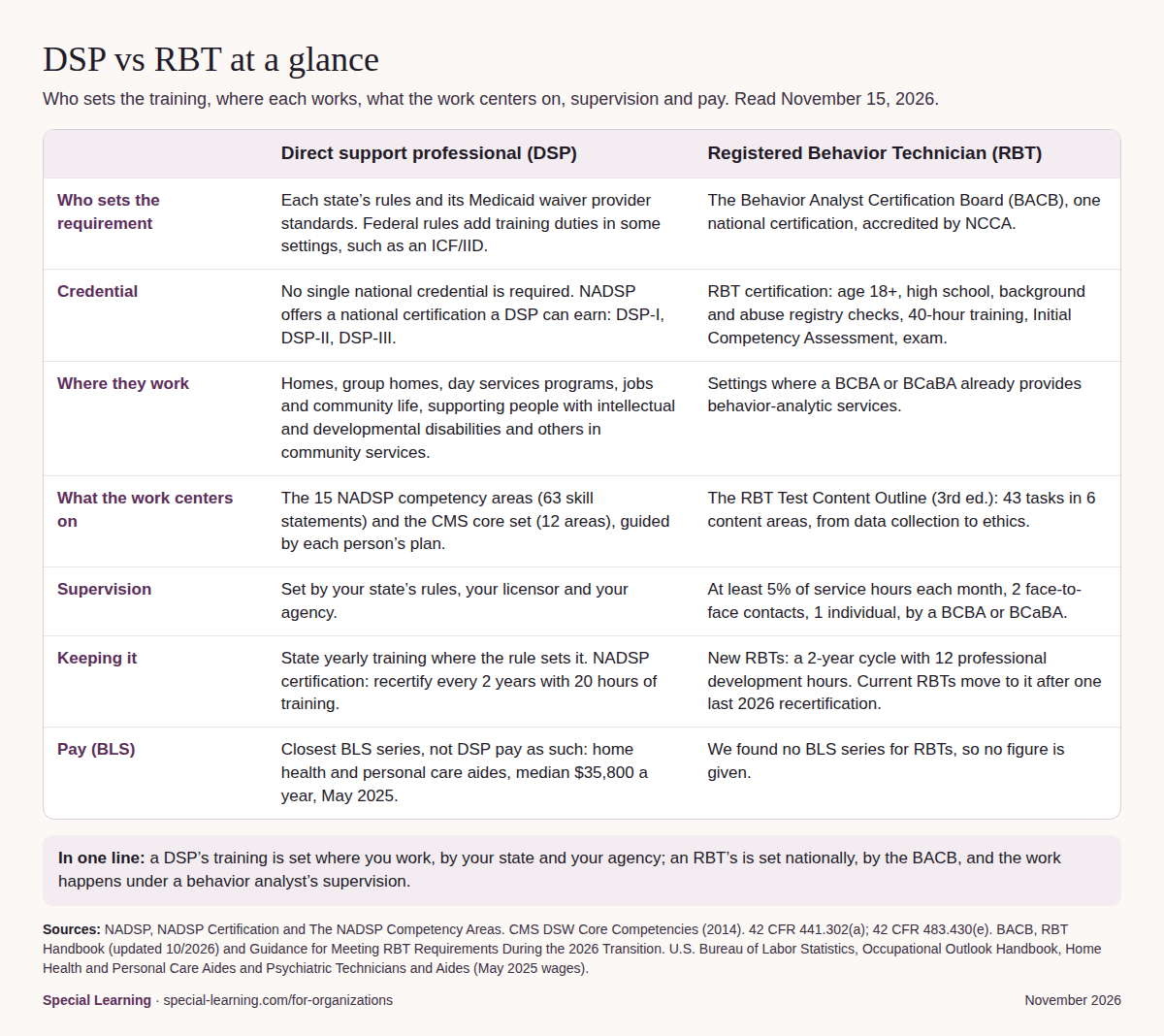
DSP vs RBT, side by side
| Topic | Direct support professional (DSP) | Registered Behavior Technician (RBT) |
|---|---|---|
| Who sets the requirement | Each state, through its rules and, for Medicaid waiver services, the provider standards it assures to CMS (42 CFR 441.302(a)). Federal rules add training duties in some settings, such as an ICF/IID (42 CFR 483.430(e)). | The Behavior Analyst Certification Board (BACB). RBT is one national certification, accredited by the National Commission for Certifying Agencies (NCCA) (RBT Handbook). |
| Credential | No single national credential is required. NADSP offers a national certification a DSP can earn: DSP-I (15 E-Badges, including a 50-hour accredited education badge), DSP-II (30) and DSP-III (50) (NADSP). | RBT certification: age 18 or older, at least a high school education, background and abuse registry checks, a 40-hour training taken over 5 to 180 days, an Initial Competency Assessment, and an exam of 75 scored questions (RBT Handbook). |
| Typical settings and people supported | The homes of the people they support, group homes and day services programs (BLS), plus jobs and community life (NADSP). People with intellectual and developmental disabilities, and others in community services across aging, behavioral health and physical disabilities (CMS, 2014). | Settings where a BCBA or BCaBA already provides behavior-analytic services; the RBT Handbook says the certification was originally designed for them (RBT Handbook). RBTs serve clients of those behavior-analytic services. |
| What the work centers on | The 15 NADSP competency areas, with 63 skill statements, from participant empowerment to health and wellness (NADSP); the CMS core set of 12 areas (CMS, 2014); and each person’s plan. | The RBT Test Content Outline (3rd ed.): 43 tasks in 6 content areas, data collection and graphing, behavior assessment, behavior acquisition, behavior reduction, documentation and reporting, and ethics (RBT Handbook). |
| Ethics code | The NADSP Code of Ethics, revised in 2026 (NADSP). DSP-I includes a Code of Ethics Commitment E-Badge (NADSP). | The RBT Ethics Code (2.0) (RBT Handbook). |
| Supervision | Set by your state’s rules, your licensor and your agency. | At least 5% of service hours each calendar month, with at least two face-to-face, real-time contacts, one of them individual, by a BCBA or BCaBA (RBT Handbook). |
| Keeping it | Yearly training where your state’s rule sets it. NADSP certification: recertify every two years with at least 20 hours of training (NADSP). | New RBTs: a 2-year cycle with 12 hours of professional development (RBT in-service guidance). Current RBTs renew one last time in 2026 under today’s rules, including a competency assessment, then move to the 2-year cycle (RBT Handbook) (2026 transition guidance). |
| Pay (BLS, May 2025) | Closest BLS series, not DSP pay as such (the Occupational Outlook Handbook has no DSP profile). Home health and personal care aides: median $35,800 a year, $17.21 an hour; $37,340 in residential intellectual and developmental disability facilities (BLS). | We found no BLS series for RBTs, so we give no figure. |
The DSP side
A DSP’s training is set where you work
There is no one DSP rule. Each state must assure CMS that its waiver has “adequate standards for all types of providers that provide services under the waiver” (42 CFR 441.302(a)(1)), and states write those standards differently. When we read the rules of all 50 states and DC on November 15, 2026, 47 plainly stated training due before or early in a DSP’s work, 15 stated yearly hours, and 24 required a state course or a curriculum the state names or approves (state finder).
Some settings add federal duties. In an intermediate care facility for individuals with intellectual disabilities (ICF/IID), training for staff who work with clients “must focus on skills and competencies directed toward clients’ developmental, behavioral, and health needs,” and staff must be able to carry out each person’s individual program plan (42 CFR 483.430(e)(2) and (4)).
What a DSP does is described by two published sets. NADSP lists 15 competency areas with 63 skill statements, from participant empowerment and communication to friendships, advocacy, and health and wellness (NADSP). The CMS Direct Service Workforce Core Competencies list 12 areas and 60 skill statements for community services across aging, behavioral health, intellectual and developmental disabilities, and physical disabilities; CMS says the set “is not intended to impose requirements” on workers entering the field (CMS, 2014).
For DSPs who want a credential, NADSP runs “a national certification program” for “Direct Support Professionals working in community human services,” in three tiers through its E-Badge Academy. DSP-I takes 15 E-Badges, including the Code of Ethics Commitment badge and a 50-hour accredited education badge; DSP-II takes 30 and DSP-III 50. Organizations can subscribe for their staff, and certified DSPs recertify every two years with at least 20 hours of training (NADSP).

The RBT side
An RBT holds one national certification
The RBT Handbook calls the RBT “a paraprofessional certified in behavior analysis.” RBTs “assist in delivering behavior-analytic services and practice under the direction and close supervision of an RBT Supervisor and/or an RBT Requirements Coordinator.” An RBT Supervisor is a BCBA or BCaBA; an RBT Requirements Coordinator is a BCBA (RBT Handbook). Under the requirements in effect since January 1, 2026 (2026 transition guidance), a new RBT:
- is at least 18, has at least a high school education, and passes a criminal background check and an abuse registry check within 180 days before paying for the application;
- completes a 40-hour training that meets the RBT 2026 40-Hour Training Requirements and Curriculum Outline, over no less than 5 and no more than 180 days. The certification board does not provide it; it “may be offered by your employer, a university, or an online training program,” and its trainers must be active BCBAs or BCaBAs who have completed an 8-hour supervision training (RBT Handbook) (2026 transition guidance);
- completes the Initial Competency Assessment after the training and no more than 90 days before applying;
- applies ($65 to the certification board) and passes the exam ($45 per appointment): 75 scored questions (plus 10 unscored) on the RBT Test Content Outline (3rd ed.), in 90 minutes (RBT Handbook);
- then works under supervision for at least 5% of service hours each calendar month, and recertifies. RBTs who renew in 2026 do so one last time under today’s rules, including a competency assessment; after that, and for new RBTs, the cycle is two years with 12 hours of professional development, which an employer’s in-service training can provide (RBT Handbook) (RBT in-service guidance).
The RBT outline centers on behavior-analytic procedures: data collection and graphing, behavior assessment, behavior acquisition, behavior reduction, documentation and reporting, and ethics. Day to day, a supervisor decides what an RBT does, which “may include conducting preference assessments, implementing discrete-trial teaching procedures, and generating session notes” (RBT Handbook). The Handbook notes that the certification “was originally designed for settings in which a BCBA® or BCaBA® is already providing behavior-analytic services.”


Pay
What public data says about pay
The U.S. Bureau of Labor Statistics’ Occupational Outlook Handbook has no profile titled direct support professional. The closest is home health and personal care aides, who BLS says work in “clients’ homes, group homes, and day services programs.” Their median annual wage was $35,800 in May 2025 ($17.21 an hour), and $37,340 in residential intellectual and developmental disability facilities, which employ 6% of them (BLS). For comparison, psychiatric aides, who work primarily in healthcare settings such as hospitals, had a median of $44,910 (BLS). We found no BLS series for RBTs, so this page gives no RBT pay figure.

For your agency
What this means for your training plan
If you employ DSPs, the RBT credential is not the starting point; your state’s rule is. Four steps we suggest:
- Start from your state’s rule. Look up what your state requires before a DSP works alone and each year, and which curriculum it names, in the state DSP training finder. Then add any federal duties for your setting, such as an ICF/IID’s.
- Map the competencies, then watch for them. Use the 15 NADSP areas, with the CMS set beside them, to plan orientation. Then observe each new DSP on shift with our free DSP competency observation checklist (printable PDF), three times in the first 90 days. For ethics, our NADSP Code of Ethics onboarding guide has a 15-minute activity for each tenet.
- Add behavior-support basics where your staff support autistic people. NADSP area 10, Crisis Prevention and Intervention, asks DSPs to prevent and defuse a crisis and to work with the team on supports (NADSP), and if you run an ICF/IID, its training must focus on clients’ developmental, behavioral and health needs (42 CFR 483.430(e)(2)). A shared foundation in how autistic people may communicate and learn, and in how teaching and support plans work, can support a DSP in carrying out the plan the person’s team wrote. How a DSP supports a particular person always comes from that person’s plan and the team who wrote it.
- Offer a path to grow. NADSP’s DSP-I, DSP-II and DSP-III recognize growing skill on the DSP path (NADSP). Where your agency already has a BCBA or BCaBA delivering behavior-analytic services, some staff may also choose the RBT path, with its own 40-hour training, assessment, exam and supervision (RBT Handbook).

Questions
DSP vs RBT: common questions
Is a DSP the same as an RBT?
No. A DSP is a role defined by where and how the person works: supporting people with intellectual and developmental disabilities and others in community services, with training set by each state’s rules and the employer. An RBT is a national certification from the Behavior Analyst Certification Board for paraprofessionals who assist in delivering behavior-analytic services under the close supervision of a BCBA or BCaBA (RBT Handbook). A DSP can also become an RBT: see the next question.
Can a DSP become an RBT?
Yes, if they meet the certification requirements: age 18 or older, at least a high school education, background and abuse registry checks, a 40-hour training that meets the RBT 2026 40-Hour Training Requirements, an Initial Competency Assessment and the exam, then ongoing supervision by a BCBA or BCaBA (RBT Handbook). The RBT Handbook says the certification “was originally designed for settings in which a BCBA® or BCaBA® is already providing behavior-analytic services,” so the path fits an agency that already has behavior analysts delivering services.
Do DSPs need a certification?
There is no single national DSP credential that every DSP must hold. Each state sets provider standards for its Medicaid waiver services (42 CFR 441.302(a)), so what a DSP needs depends on your state and setting: see the state DSP training finder. NADSP offers a national certification that a DSP can earn: DSP-I, DSP-II and DSP-III, through its E-Badge Academy (NADSP).
Who supervises a DSP, and who supervises an RBT?
An RBT practices under an RBT Supervisor (a BCBA or BCaBA) and/or an RBT Requirements Coordinator (a BCBA), with supervision for at least 5% of service hours each calendar month and at least two face-to-face, real-time contacts a month (RBT Handbook). A DSP’s supervision is set by your state’s rules, your licensor and your agency.
How much do DSPs and RBTs earn?
The U.S. Bureau of Labor Statistics’ Occupational Outlook Handbook has no profile titled direct support professional. The closest is home health and personal care aides: median $35,800 a year ($17.21 an hour) in May 2025, and $37,340 in residential intellectual and developmental disability facilities (BLS). We found no BLS series for RBTs, so we give no RBT figure.
Sources
Read November 15, 2026. Quoted lines are as published; the side-by-side layout and the training-plan steps are ours. Neither NADSP nor the Behavior Analyst Certification Board has reviewed or endorsed this page.
- Behavior Analyst Certification Board, Registered Behavior Technician Handbook, updated October 2026. Open the Handbook
- Behavior Analyst Certification Board, Guidance for Meeting RBT Requirements During the 2026 Transition, updated August 2025. Open the guidance (PDF)
- Behavior Analyst Certification Board, RBT Professional Development: In-Service Training Requirements. Open the requirements (PDF)
- National Alliance for Direct Support Professionals (NADSP), NADSP Certification. https://nadsp.org/services/certification/
- NADSP, The NADSP Competency Areas. https://nadsp.org/resources/competency-areas/
- NADSP, The NADSP Code of Ethics. https://nadsp.org/resources/the-nadsp-code-of-ethics/
- Centers for Medicare & Medicaid Services (CMS), National Direct Service Workforce Resource Center, CMS Direct Service Workforce Core Competencies: Final Competency Set, December 2014. https://www.medicaid.gov/sites/default/files/2019-12/dsw-core-competencies-final-set-2014.pdf
- 42 CFR 441.302(a), State assurances for home and community-based services waivers: health and welfare. https://www.ecfr.gov/current/title-42/section-441.302
- 42 CFR 483.430(e), Intermediate care facilities for individuals with intellectual disabilities (ICF/IID): staff training program. https://www.ecfr.gov/current/title-42/section-483.430
- U.S. Bureau of Labor Statistics (BLS), Occupational Outlook Handbook, Home Health and Personal Care Aides (May 2025 wages). https://www.bls.gov/ooh/healthcare/home-health-aides-and-personal-care-aides.htm
- BLS, Occupational Outlook Handbook, Psychiatric Technicians and Aides (May 2025 wages). https://www.bls.gov/ooh/healthcare/psychiatric-technicians-and-aides.htm
- Special Learning, state DSP training rule finder: the primary rules of all 50 states and DC, read November 15, 2026.