
For editors of member newsletters
Free DSP training tools for your member newsletter
Copy-ready blurbs and images about free training tools for direct support professionals (DSPs) and the provider teams that train them. Pick a length, click Copy, paste it into your newsletter, and add your own name if you like. State provider associations, developmental disabilities councils and university centers can use them as they are, or edit them.
Special Learning · November 16, 2026
Short answer
What is this page, and is it free to share?
Read
This page gives you ready-to-paste newsletter blurbs, in three lengths, and downloadable images for Special Learning's free DSP training and HR toolkit (18 tools, 35 files) and for six of its tools. They are free to share, and there is no sign-up to use the tools. Use them as written, or edit them and keep the facts.
Each blurb is plain text about what the tool is and how it helps. It makes no claim beyond what the tool's own page says, and each blurb ends with a link to that page. You may add your own name to any blurb.
In two minutes
How to use the blurbs and images
- Choose a topic below: the full toolkit, or one of six tools.
- Choose a length: about 40 words for a news brief, about 90 for a short item, about 180 for a feature or a resource spotlight.
- Click Copy text and paste it into your newsletter. Each blurb ends with a link to the tool page; turn it into a hyperlink on your own words if you like.
- Add your own name if you wish. For example: "Our partner Special Learning has a free..." You may edit the text; keep the facts.
- Optional: download an image (1200x628 or 1080x1080 PNG), add the alt text from the box beneath it, and place it above the blurb.
Fewer than two minutes of work: pick, copy, paste. The six tools were chosen as the most useful to a member newsletter; the full toolkit page lists all 18.
Blurbs and images
Seven topics, three lengths each
Facts in every blurb come from the live tool pages. Each topic has a 40, 90 and 180 word blurb, a pair of images, and alt text to paste.
The full DSP training and HR toolkit
Every fact in these blurbs is taken from the tool's own page: The full DSP training and HR toolkit. Original sources that page cites: NADSP Competency Areas; NADSP Code of Ethics.
About 40 words
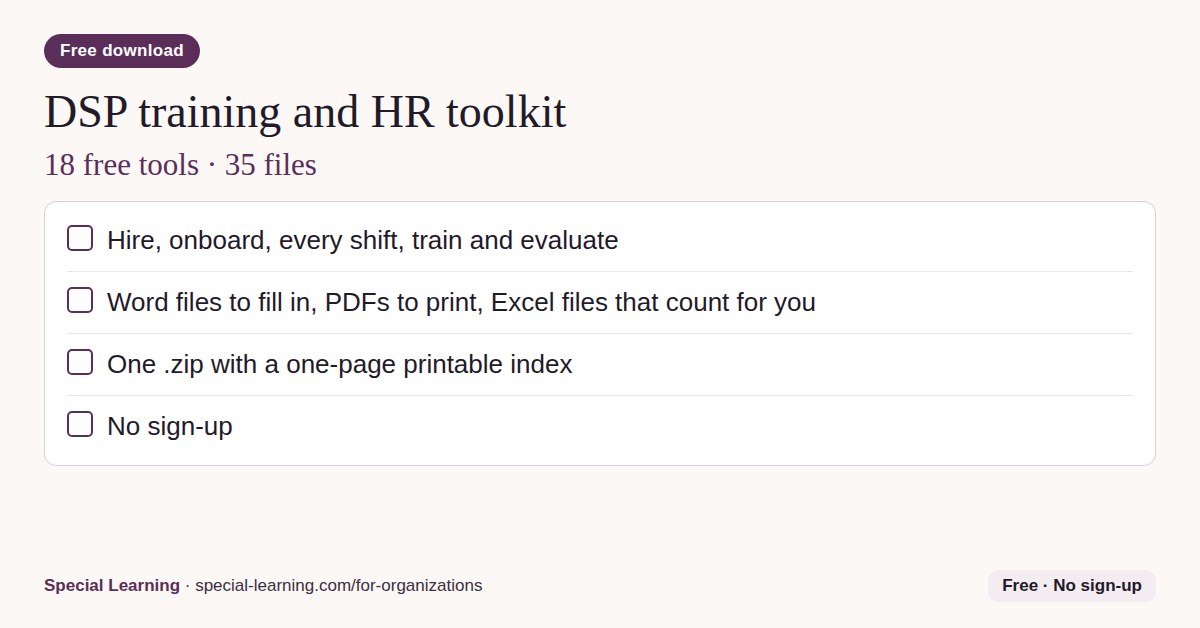
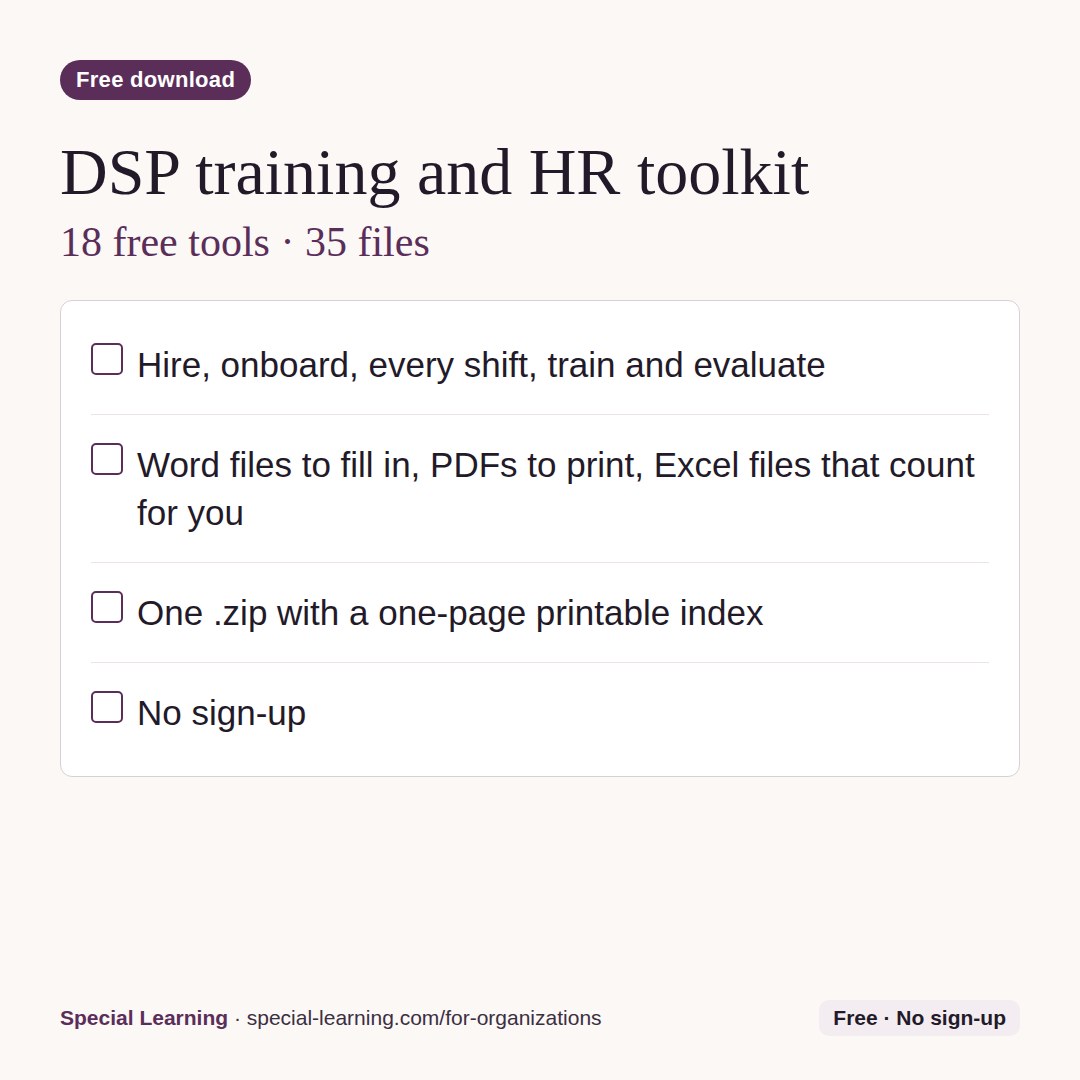
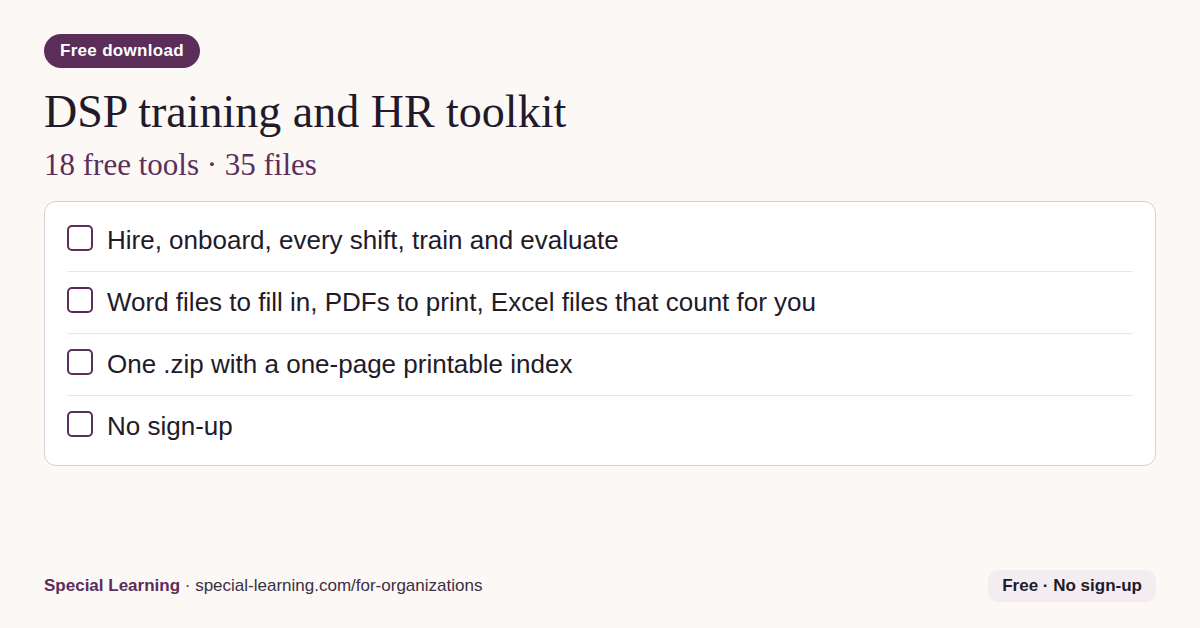
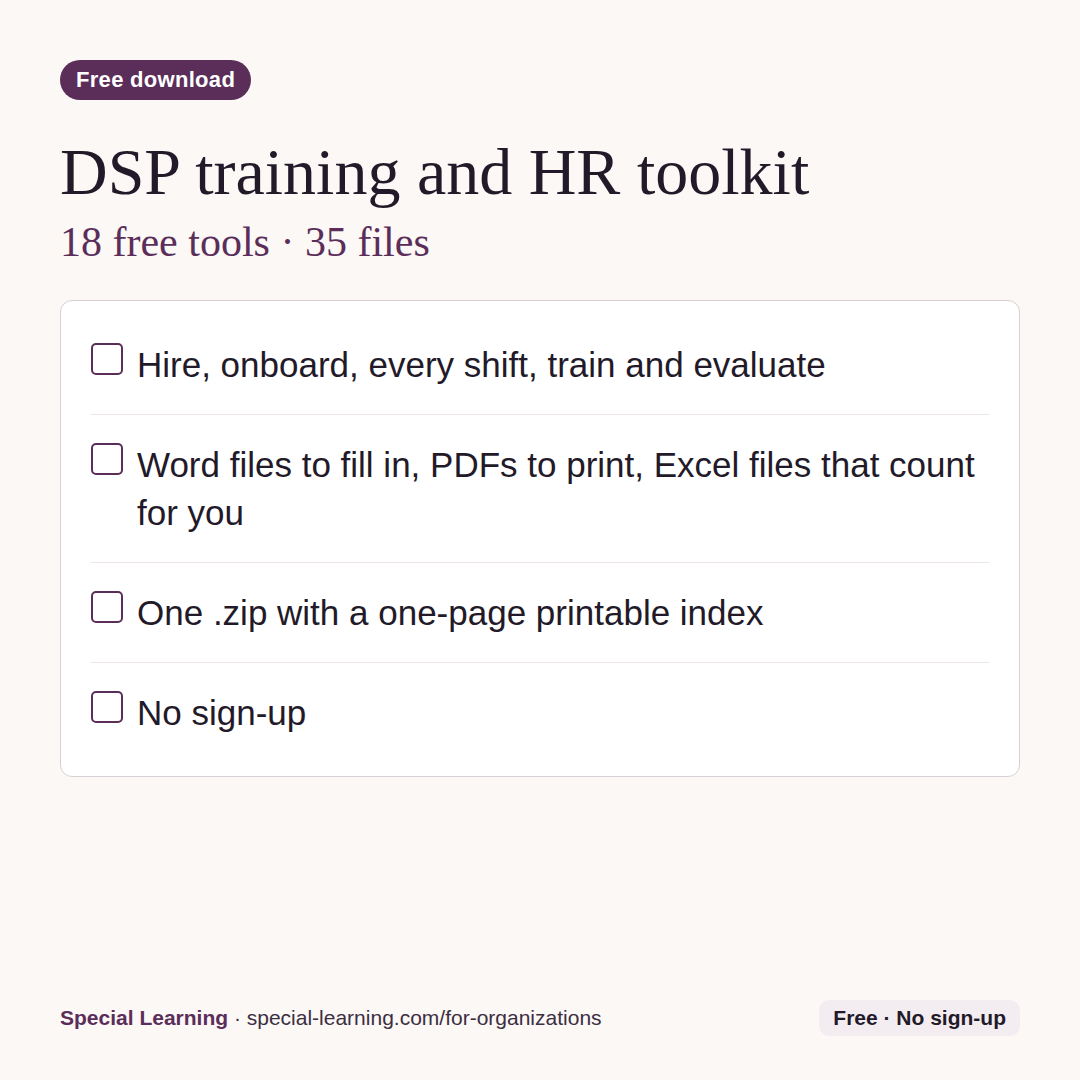
Training a direct support team? Special Learning has a free DSP training and HR toolkit: 18 tools in one download, 35 Word, PDF and Excel files, covering hiring, onboarding, every shift, training and evaluation, with a one-page printable index. No sign-up.

More: https://special-learning.com/for-organizations/behavioral-health/dsp-training-toolkit/?utm_source=moltbot-astra&utm_medium=newsletter&utm_campaign=member-newsletter-kit&utm_content=dsp-training-toolkit
About 90 words
Direct support professionals (DSPs) need more than one form. Special Learning has put 18 free tools in one download, 35 files in five folders, one for each stage of a DSP's time with you: hire, onboard, every shift, train and evaluate. There are Word files to fill in, PDFs to print and Excel files that count for you, plus a one-page printable index. Among them: a job description, an onboarding checklist, daily notes, a shift change report, an incident report, a crisis plan, a training plan and a supervision log. It is free and there is no sign-up.

More: https://special-learning.com/for-organizations/behavioral-health/dsp-training-toolkit/?utm_source=moltbot-astra&utm_medium=newsletter&utm_campaign=member-newsletter-kit&utm_content=dsp-training-toolkit
About 180 words
Special Learning has gathered 18 free tools for the whole time a direct support professional (DSP) works with you into one download: 35 files in five folders, with a README and a one-page printable index at the top.

The folders follow the stages of a DSP's time with you. Hire has a job description with a structured interview guide. Onboard has a 90-day onboarding checklist, a competency observation checklist, a guide to the NADSP Code of Ethics and a one-page profile template. Every shift has daily notes, a shift change report, an incident report, an ABC data sheet and a crisis plan. Train has a sign-in sheet, an annual training plan, a social skills group plan, an HCBS waiver staff training checklist, an abuse and neglect reporting training outline and a group home fire drill log. Evaluate has a performance evaluation and a supervision log.

The files are Word documents to fill in, PDFs to print and Excel files that count for you. Each file is the same one served on its tool page. It is free to use, and there is no sign-up.

More: https://special-learning.com/for-organizations/behavioral-health/dsp-training-toolkit/?utm_source=moltbot-astra&utm_medium=newsletter&utm_campaign=member-newsletter-kit&utm_content=dsp-training-toolkit
Alt text to paste
Card reading DSP training and HR toolkit: 18 free tools, 35 files, in five stages from hire to evaluate, as Word, PDF and Excel files, with no sign-up. From Special Learning.
State DSP training hours finder
Every fact in these blurbs is taken from the tool's own page: State DSP training hours finder. Original sources that page cites: NASDDDS directory of state agencies; Ohio Administrative Code 5123-2-08; Minnesota Statutes 245D.09.
About 40 words
Which training does your state require for direct support professionals? Special Learning has a free finder for all 50 states and DC: each state's developmental disabilities agency, the main DSP training rule, and what that rule says, read from the rule's own text.

More: https://special-learning.com/for-organizations/behavioral-health/state-required-dsp-training-hours/?utm_source=moltbot-astra&utm_medium=newsletter&utm_campaign=member-newsletter-kit&utm_content=state-required-dsp-training-hours#state-finder
About 90 words
Rules for direct support professional (DSP) training differ a great deal from state to state. Ohio, for example, requires part of each DSP's annual training to come from the state's own curriculum, while Minnesota requires orientation that combines supervised on-the-job training with instruction. Special Learning has a free state-by-state finder for all 50 states and DC. Each row gives the state's developmental disabilities agency, the main rule that sets DSP training in community services, and what the rule says, filled in only where the rule's own text states it plainly. You can search it or pick your state.

More: https://special-learning.com/for-organizations/behavioral-health/state-required-dsp-training-hours/?utm_source=moltbot-astra&utm_medium=newsletter&utm_campaign=member-newsletter-kit&utm_content=state-required-dsp-training-hours#state-finder
About 180 words
If you help providers plan staff training, the first question is always the same: what does our state require? Special Learning has a free finder that starts there. It covers all 50 states and DC, with one row for each: the state's developmental disabilities agency, the main rule that sets training for direct support professionals (DSPs) in community services, and what that rule says. A cell is filled in only where the rule's own text states it plainly. Otherwise the cell says so, for example "Set by the rule; see source," with a link to the text.

Rules differ a great deal. Ohio requires part of each DSP's annual training to come from the state's own curriculum, while Minnesota requires orientation that combines supervised on-the-job training with instruction. You can search by state, agency or rule, or filter for rules that name a required curriculum, state annual hours or state early training.

The page also gives seven steps that work in any state, from finding your rule and building a requirement map to keeping the records and reviewing the plan every year. It is free to use, and there is no sign-up.

More: https://special-learning.com/for-organizations/behavioral-health/state-required-dsp-training-hours/?utm_source=moltbot-astra&utm_medium=newsletter&utm_campaign=member-newsletter-kit&utm_content=state-required-dsp-training-hours#state-finder
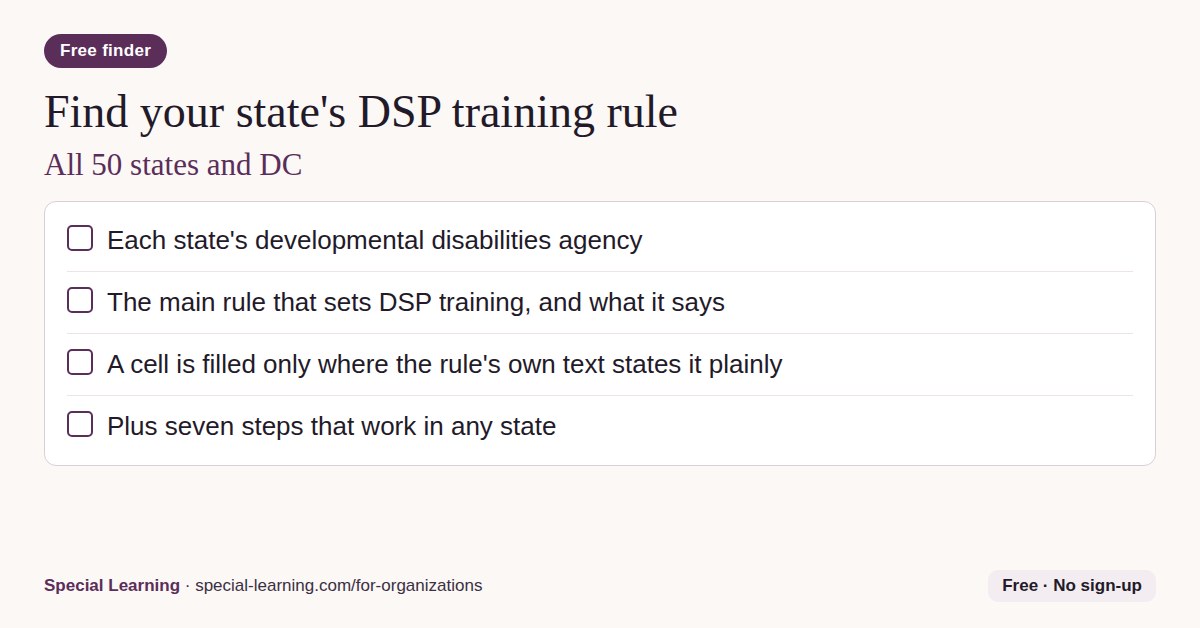
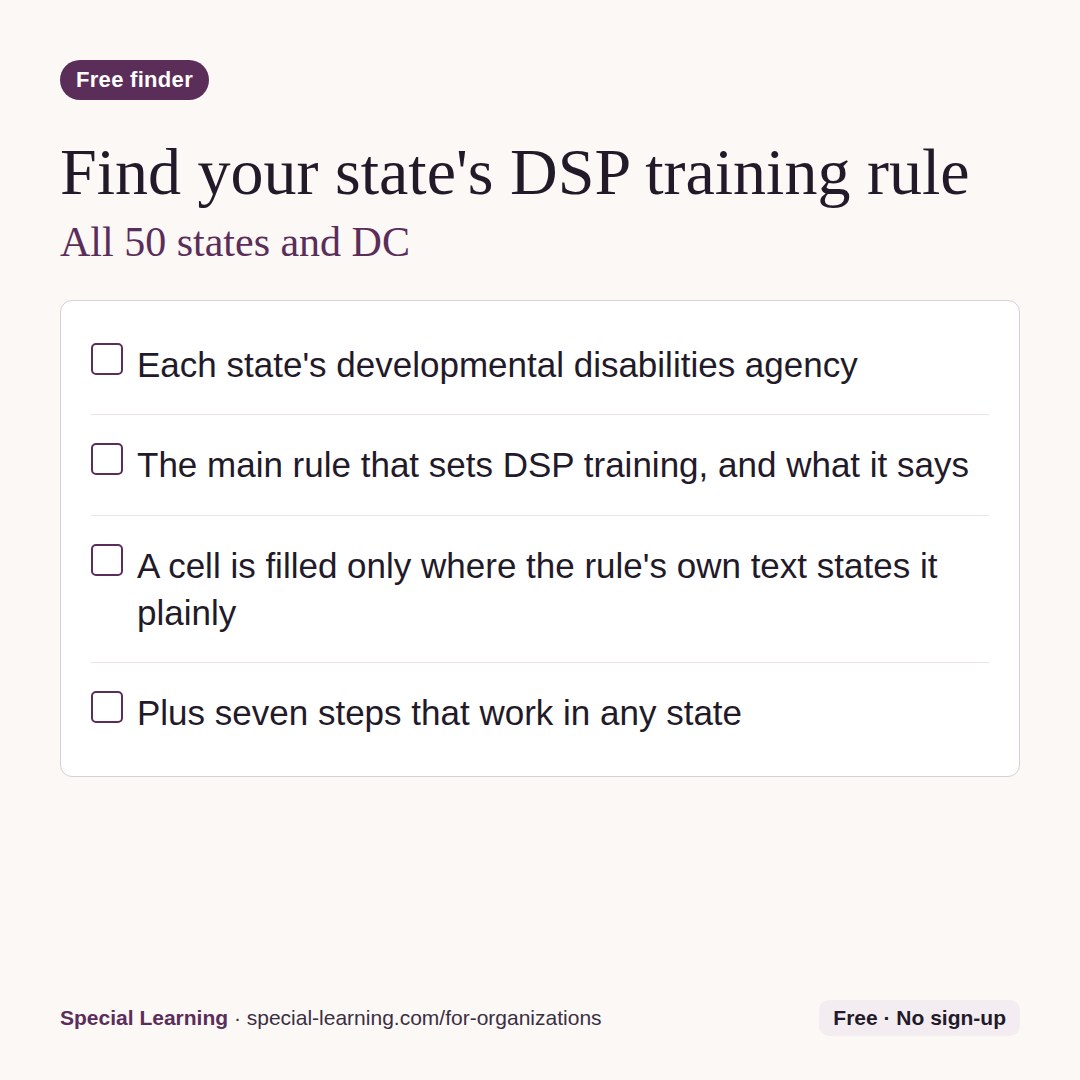
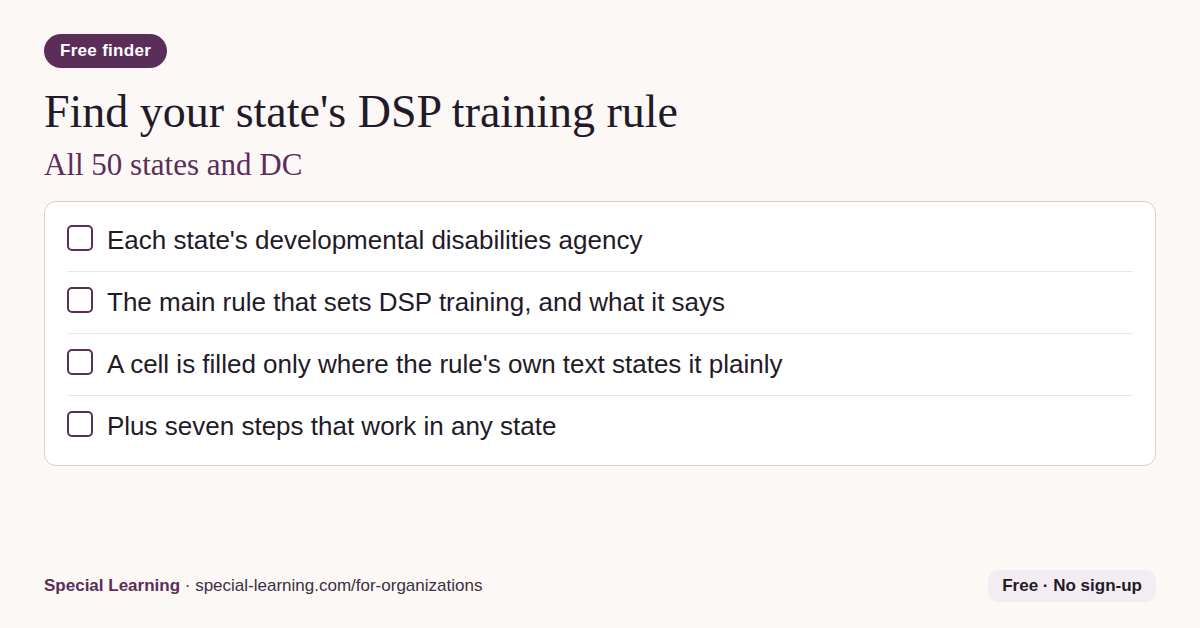
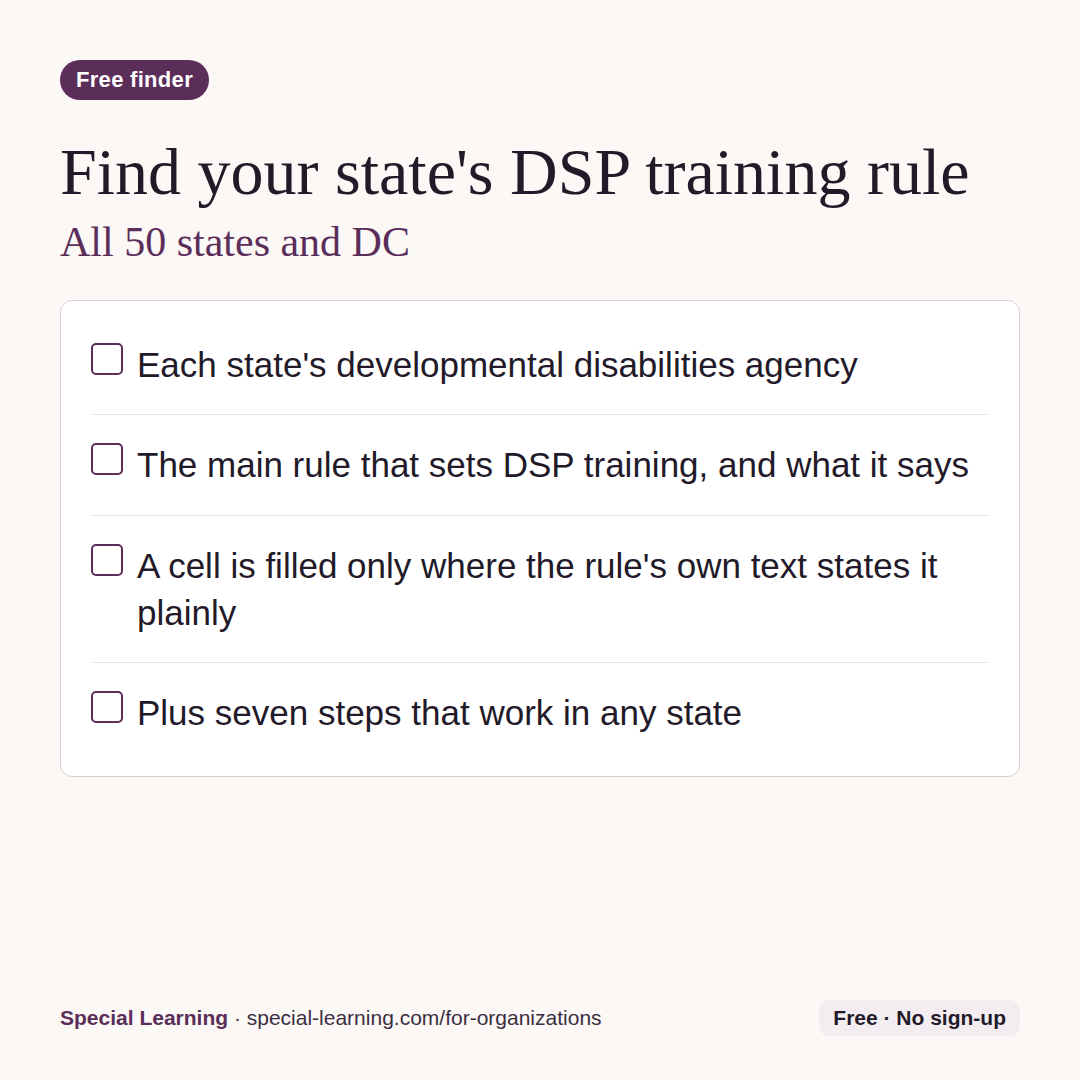
Alt text to paste
Card reading Find your state's DSP training rule: a free finder for all 50 states and DC, with each state's agency, its main DSP training rule and what that rule says, read from the primary text.
DSP onboarding checklist
Every fact in these blurbs is taken from the tool's own page: DSP onboarding checklist. Original sources that page cites: NCI-IDD State of the Workforce in 2024.
About 40 words
Most direct support professionals who leave do so in their first year. Special Learning has a free 90-day onboarding checklist, from hiring to the 90-day review: a mentor, shadow shifts and five supervisor check-ins. Word, PDF and tracker spreadsheet. No sign-up.

More: https://special-learning.com/for-organizations/behavioral-health/dsp-onboarding-checklist/?utm_source=moltbot-astra&utm_medium=newsletter&utm_campaign=member-newsletter-kit&utm_content=dsp-onboarding-checklist
About 90 words
In the 2024 NCI-IDD State of the Workforce data, 40.7% of the direct support professionals (DSPs) who left responding agencies had worked there less than 6 months, and 63.7% less than a year. Special Learning has a free onboarding checklist for each new DSP, from hiring to the 90-day review: a realistic preview of the job, a mentor, shadow shifts, competency observations and five supervisor check-ins. It comes as a fillable Word checklist, a printable PDF and a tracker spreadsheet that works out every check-in date. Your organization adds the items your state requires. No sign-up.

More: https://special-learning.com/for-organizations/behavioral-health/dsp-onboarding-checklist/?utm_source=moltbot-astra&utm_medium=newsletter&utm_campaign=member-newsletter-kit&utm_content=dsp-onboarding-checklist
About 180 words
The first year is when most direct support professionals (DSPs) who leave do. In the 2024 NCI-IDD State of the Workforce data, 40.7% of DSPs who left responding agencies had worked there less than 6 months, and almost two-thirds (63.7%) less than a year. Onboarding is more than the required training.

Special Learning has a free onboarding checklist for each new DSP, from hiring to the 90-day review. It has six phases, each with who leads, due and done columns and blank rows for the items your state and organization require, which differ by state, by service and by agency. It builds in an honest preview of the job before the new DSP says yes, a mentor from day one, shadow shifts before the first solo shift, competency observations, and supervisor check-ins at the end of day one, week one, and days 30, 60 and 90.

There is a fillable Word checklist, a printable PDF, and a tracker spreadsheet with one row per new DSP that works out every check-in date. The tools are free, and there is no sign-up.

More: https://special-learning.com/for-organizations/behavioral-health/dsp-onboarding-checklist/?utm_source=moltbot-astra&utm_medium=newsletter&utm_campaign=member-newsletter-kit&utm_content=dsp-onboarding-checklist
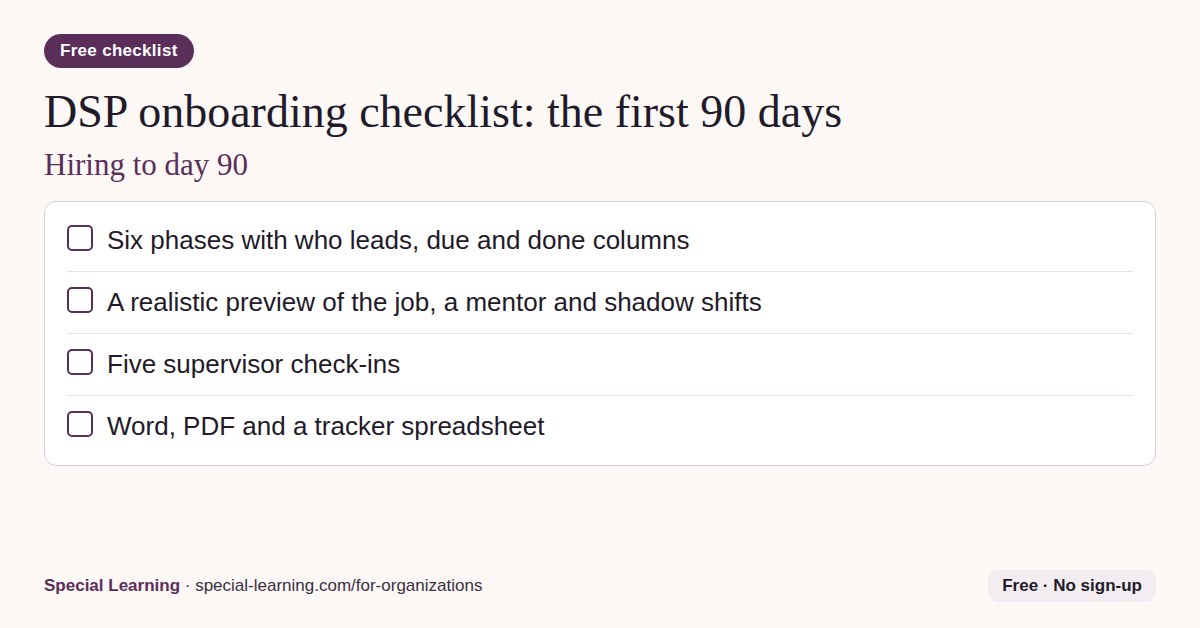
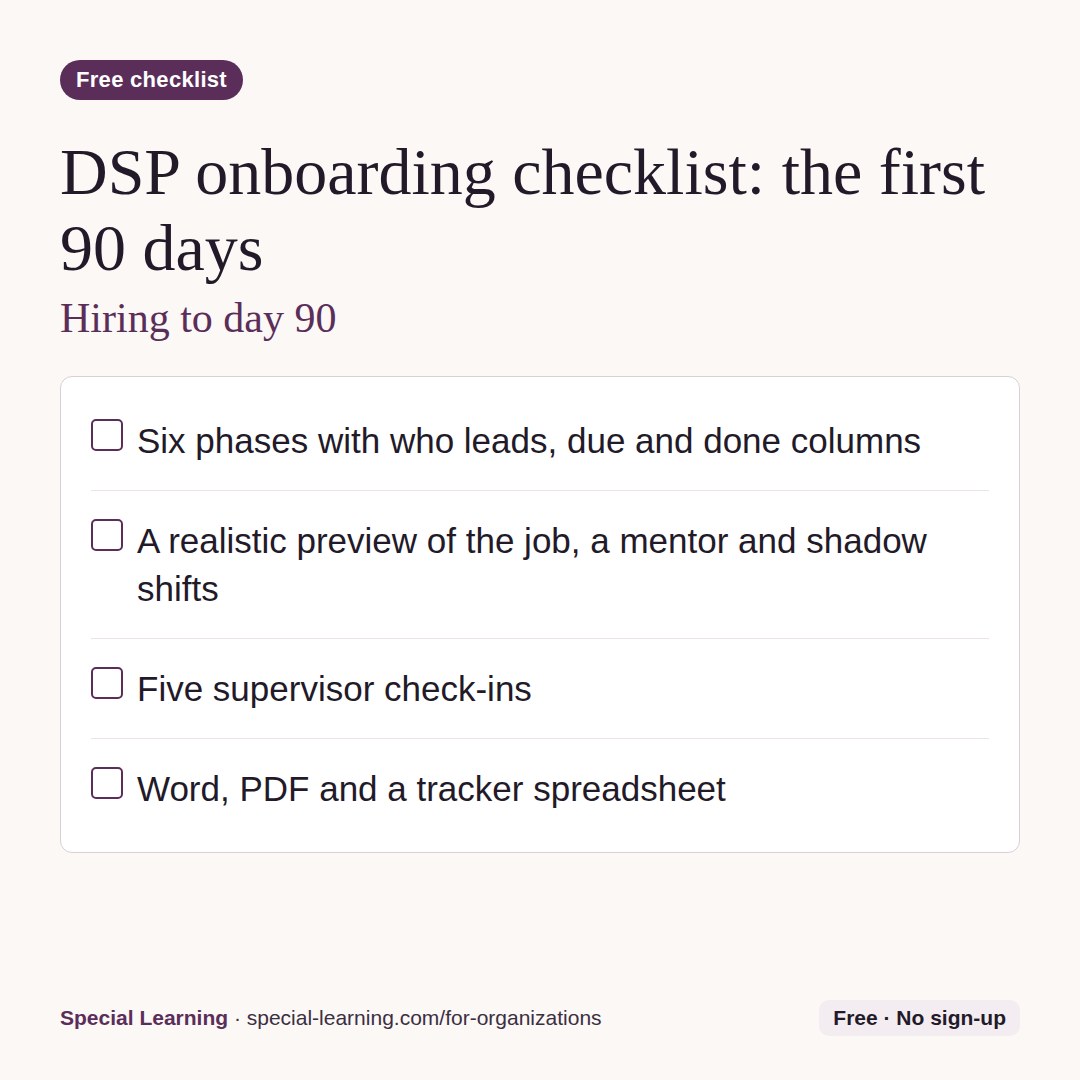
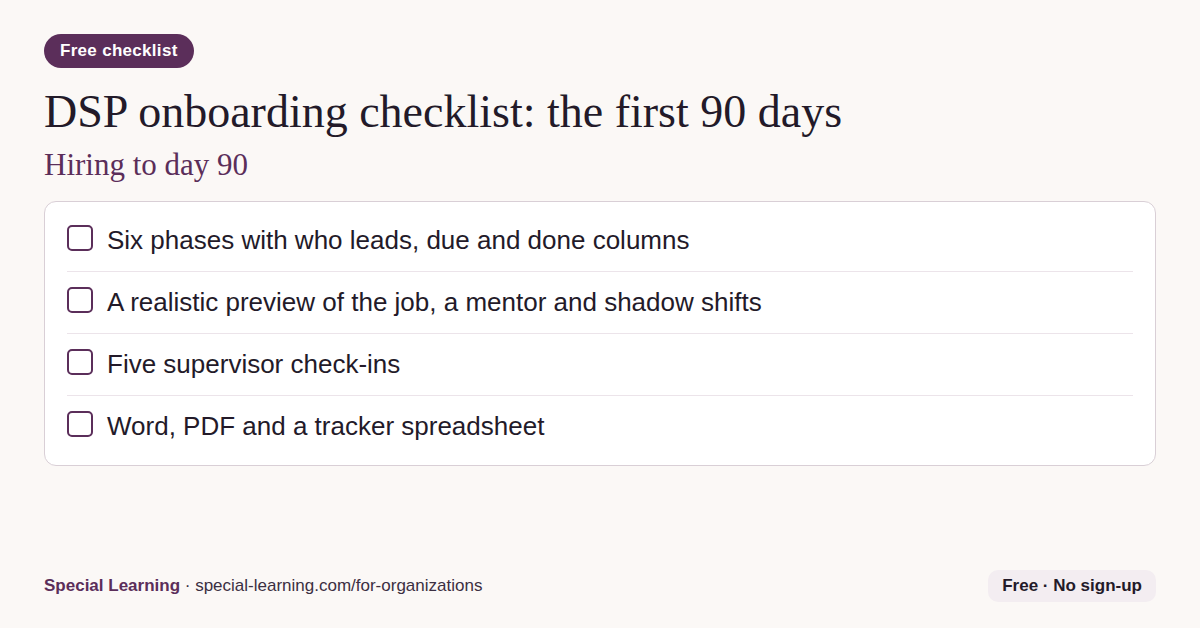
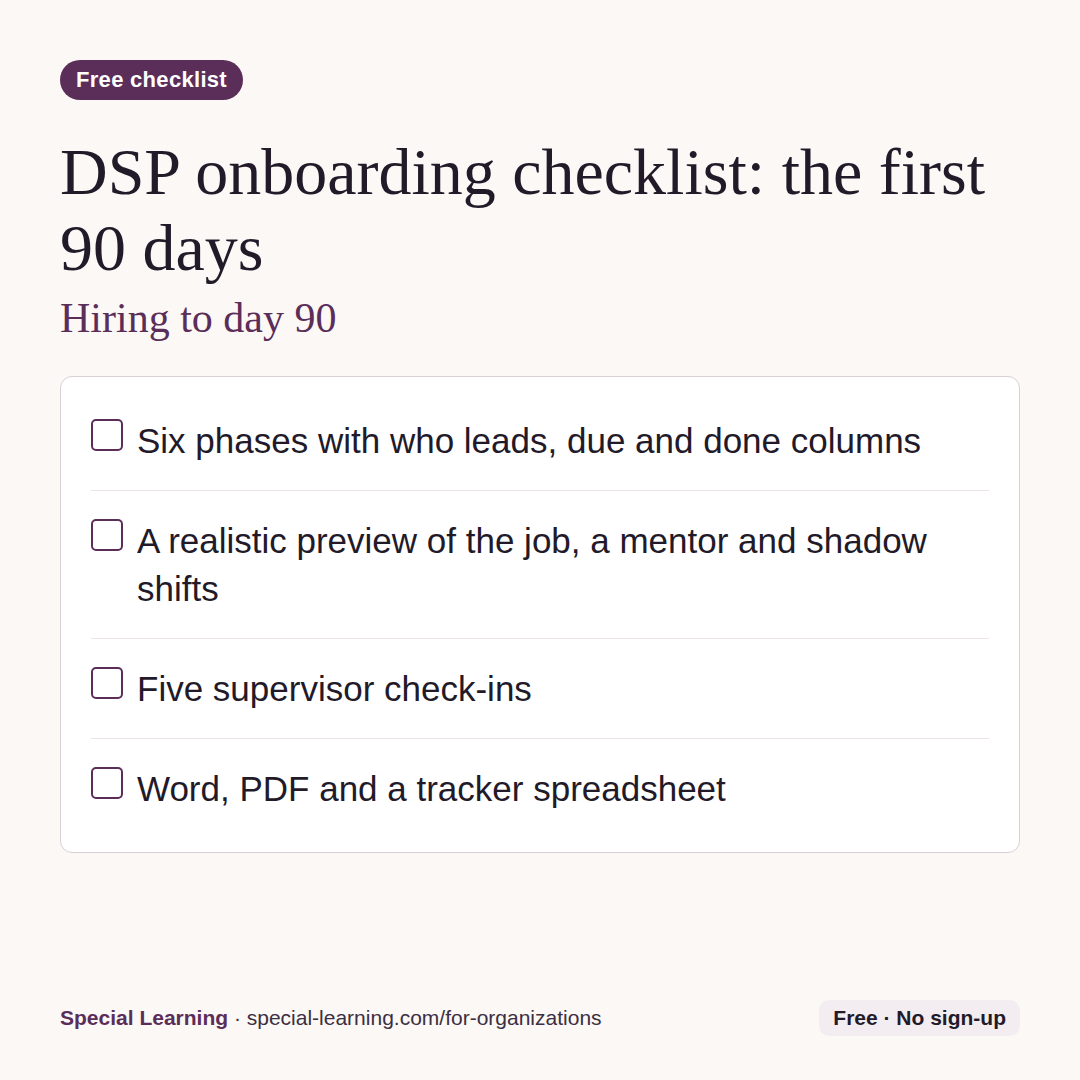
Alt text to paste
Card reading DSP onboarding checklist, the first 90 days: six phases from hiring to the 90-day review, with a mentor, shadow shifts and five supervisor check-ins, as a Word checklist, a PDF and a tracker spreadsheet.
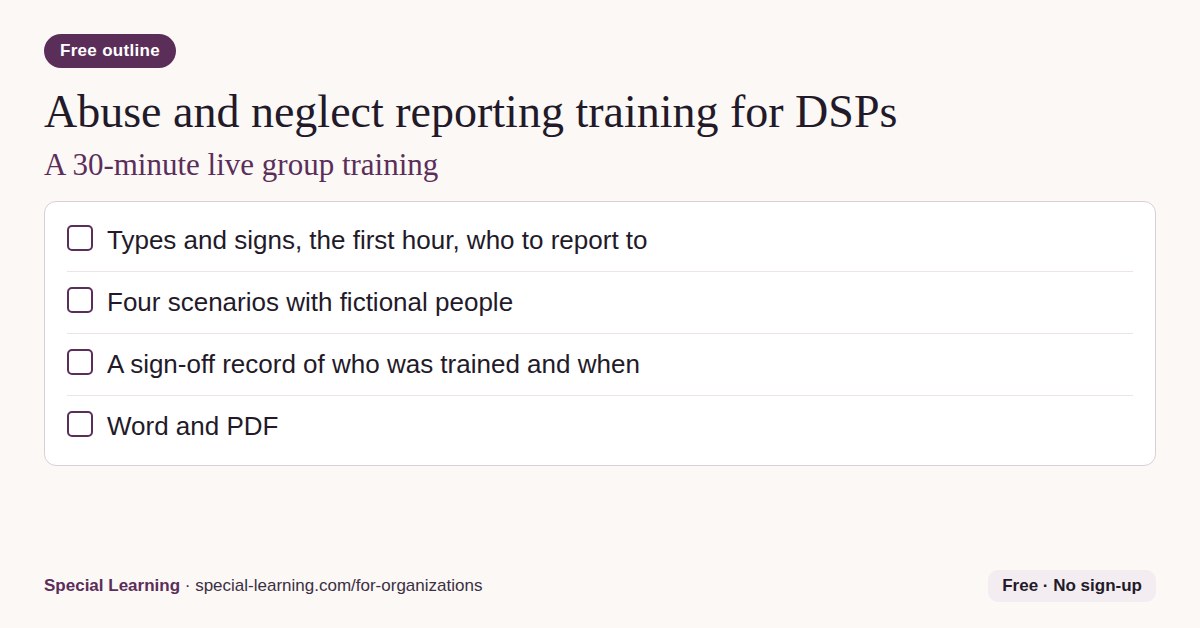
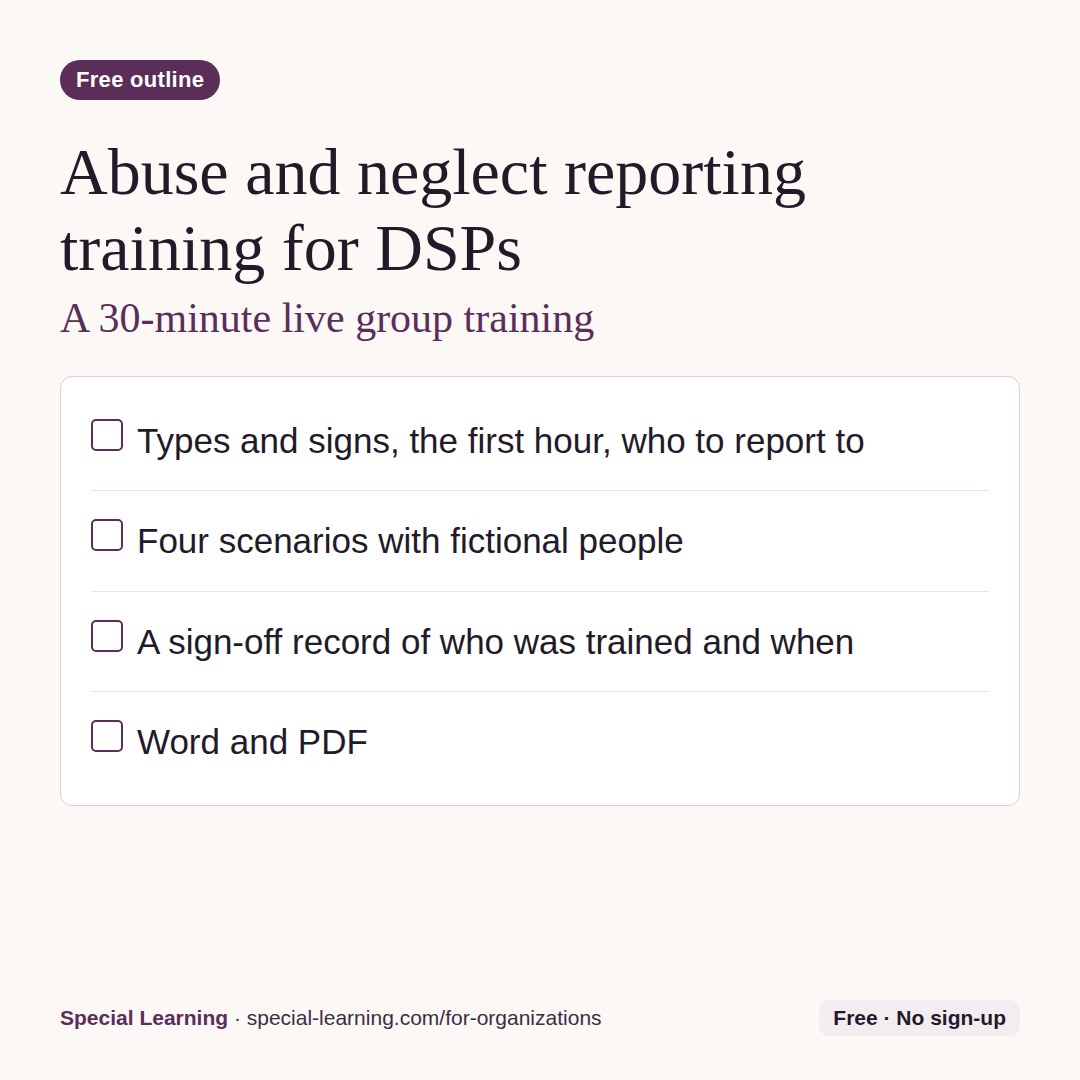
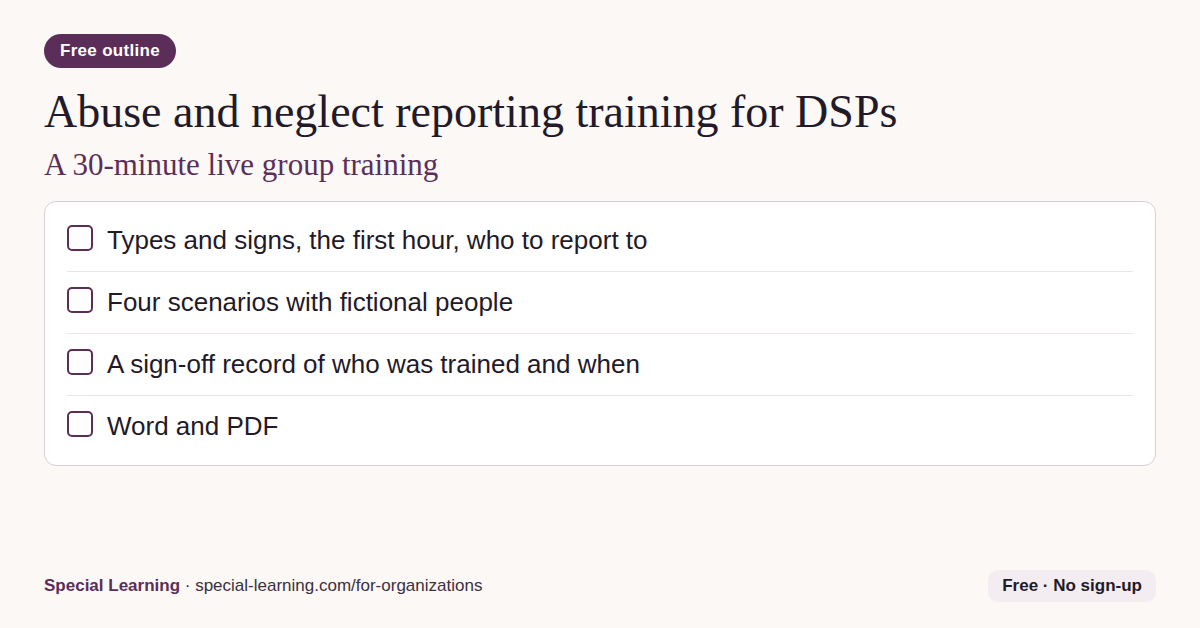
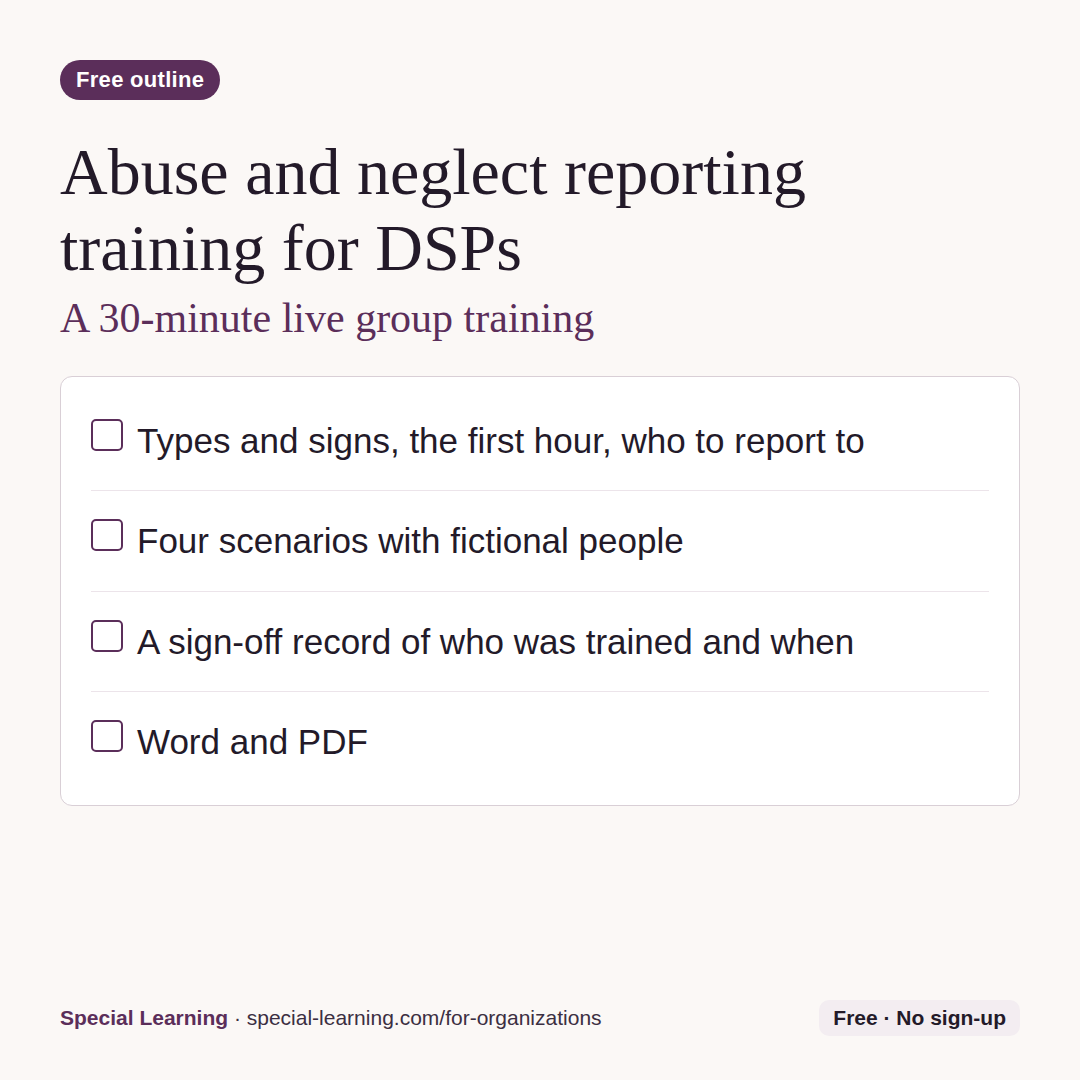
Abuse and neglect reporting training for DSPs
Every fact in these blurbs is taken from the tool's own page: Abuse and neglect reporting training for DSPs. Original sources that page cites: 42 CFR 441.302 (eCFR); NADSP Code of Ethics.
About 40 words
Do your direct support professionals know how to recognize and report abuse, neglect and exploitation? Special Learning has a free 30-minute live group training outline and a sign-off record, in Word and PDF. Your state and agency set who reports, to whom and how fast.

More: https://special-learning.com/for-organizations/behavioral-health/abuse-neglect-reporting-training-for-dsps/?utm_source=moltbot-astra&utm_medium=newsletter&utm_campaign=member-newsletter-kit&utm_content=abuse-neglect-reporting-training-for-dsps
About 90 words
Direct support professionals (DSPs) need to be able to recognize abuse, neglect and exploitation of the people they support, make sure the person is safe, report right away to the people their agency and state name, and write down what they saw without investigating it themselves. Special Learning has a free 30-minute group training outline and sign-off record, in Word and PDF, with four scenarios using fictional people. Who must report, to whom and how fast is set by each state and agency, so the guide sends you to your state's own rule. No sign-up.

More: https://special-learning.com/for-organizations/behavioral-health/abuse-neglect-reporting-training-for-dsps/?utm_source=moltbot-astra&utm_medium=newsletter&utm_campaign=member-newsletter-kit&utm_content=abuse-neglect-reporting-training-for-dsps
About 180 words
Who reports abuse, neglect and exploitation, to whom and how fast is set by each state and each agency, so every provider needs its own answer. Special Learning has a free guide for training leads.

It has a 30-minute outline for a live group session and a sign-off record, in Word and PDF. The Word file opens with boxes for your agency's own people and numbers, then the plan, the types and signs, the first hour, who to tell and four scenarios with fictional people. Direct support professionals (DSPs) learn to recognize abuse, neglect and exploitation of the people they support, make sure the person is safe, report what they saw or suspect right away to the people their agency and state name, and write down what they saw without investigating it themselves.

The guide also explains what the federal rule for Medicaid home and community-based services waivers says: States must require providers to report critical incidents, including abuse, neglect and exploitation, within State-established timeframes, so your state sets the rules and timelines. The page gives no national deadline and sends you to your state's own rule. It is free to use, and there is no sign-up.

More: https://special-learning.com/for-organizations/behavioral-health/abuse-neglect-reporting-training-for-dsps/?utm_source=moltbot-astra&utm_medium=newsletter&utm_campaign=member-newsletter-kit&utm_content=abuse-neglect-reporting-training-for-dsps
Alt text to paste
Card reading Abuse and neglect reporting training for DSPs: a free 30-minute live group training outline with the types and signs, the first hour, who to report to, four scenarios with fictional people and a sign-off record, in Word and PDF.
Group home fire drill log template
Every fact in these blurbs is taken from the tool's own page: Group home fire drill log template. Original sources that page cites: 42 CFR 483.470 (eCFR).
About 40 words
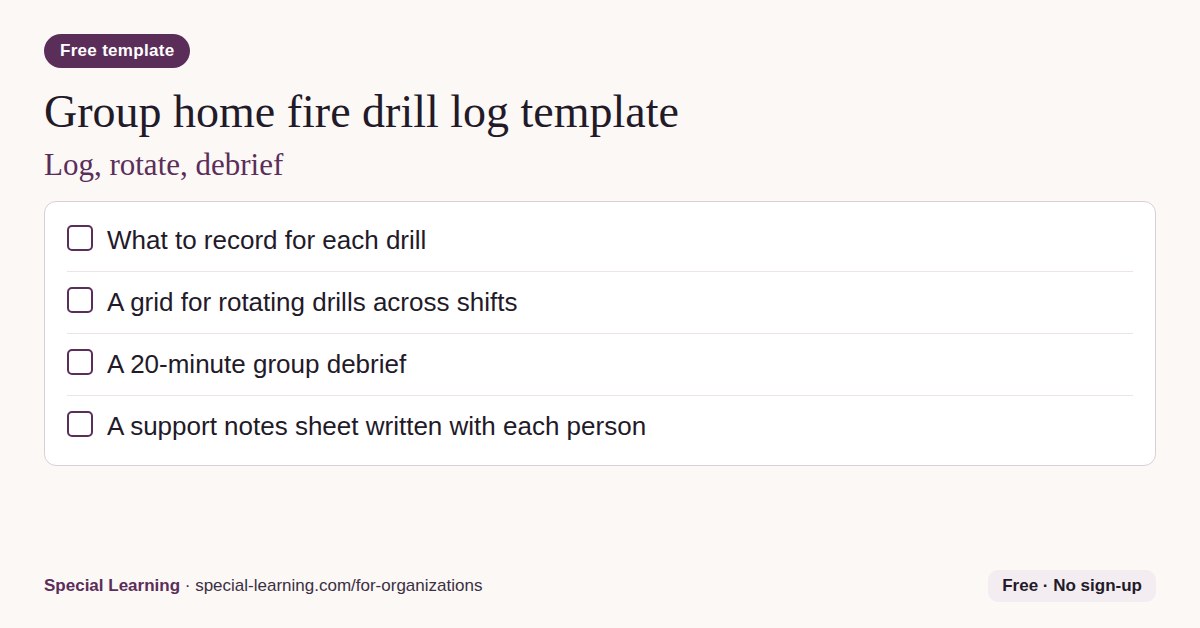
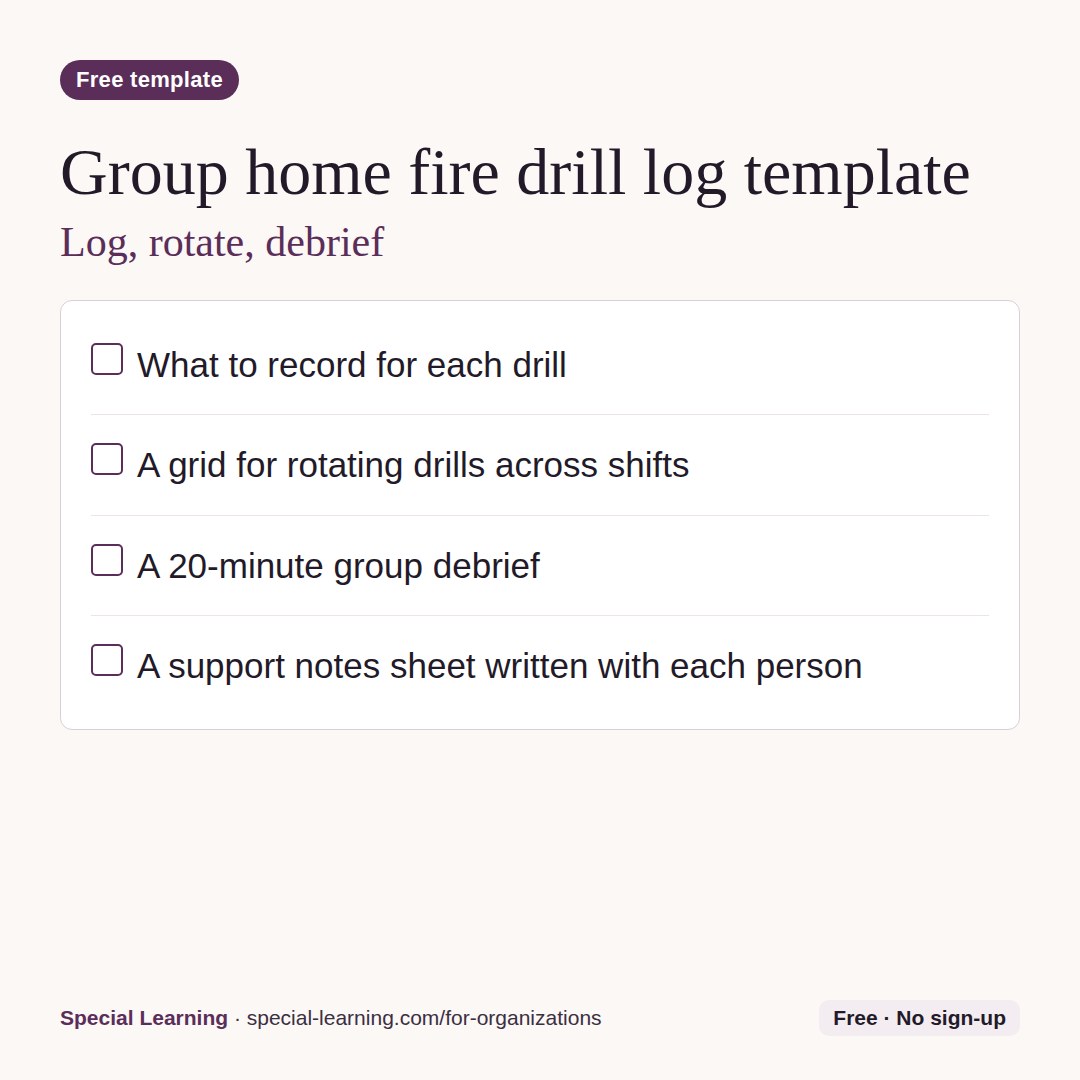
Running fire drills at a group home? Special Learning has a free fire drill log in Word and PDF: what to record for each drill, a grid for rotating drills across shifts, a 20-minute group debrief, and a support notes sheet written with each person. No sign-up.

More: https://special-learning.com/for-organizations/behavioral-health/group-home-fire-drill-log-template/?utm_source=moltbot-astra&utm_medium=newsletter&utm_campaign=member-newsletter-kit&utm_content=group-home-fire-drill-log-template
About 90 words
A fire drill log is a short record of each drill: the date, time and shift, the scenario, the exit used, how long it took to get everyone out, who needed what support, what went wrong and how it was fixed, and everyone's signature. How often you must drill depends on your state and setting. Special Learning has a free log for group homes and other IDD residential settings, in Word and PDF, with a grid for rotating drills across shifts, a 20-minute group debrief and a support notes sheet written with each person. No sign-up.

More: https://special-learning.com/for-organizations/behavioral-health/group-home-fire-drill-log-template/?utm_source=moltbot-astra&utm_medium=newsletter&utm_campaign=member-newsletter-kit&utm_content=group-home-fire-drill-log-template
About 180 words
A fire drill log is a short record of each drill: the date, time and shift, the alarm or scenario, the exit used, how long it took to get everyone out, who needed what support, what went wrong and how it was fixed, who was there, and everyone's signature.

Special Learning has a free template for house managers and training leads at group homes and other IDD residential and home and community-based services settings, in Word and PDF. Along with the log it has a grid for rotating drills across shifts and conditions, a 20-minute group debrief to hold live, as a group, with the log on screen, and a support notes sheet. Each person's own notes are written with them, under headings such as how I know the alarm means go and what helps me get out.

How often you must drill, and on which shifts, depends on your state and your setting, so the page does not give one number for every home. Check your licensing rule, your funder's contract and your fire marshal. The template is free, and there is no sign-up.

More: https://special-learning.com/for-organizations/behavioral-health/group-home-fire-drill-log-template/?utm_source=moltbot-astra&utm_medium=newsletter&utm_campaign=member-newsletter-kit&utm_content=group-home-fire-drill-log-template
Alt text to paste
Card reading Group home fire drill log template: a free log with what to record for each drill, a rotation grid across shifts, a 20-minute group debrief and a support notes sheet written with each person, in Word and PDF.
One-page profile template
Every fact in these blurbs is taken from the tool's own page: One-page profile template. Original sources that page cites: Helen Sanderson Associates, One-Page Profiles: Getting Started; 100 one-page profiles and their stories.
About 40 words
A one-page profile is written with a person, in their own words, so a new direct support professional can get to know them before a first shift. Special Learning has a free guide and template in Word and PDF, with a finished example. No sign-up.

More: https://special-learning.com/for-organizations/behavioral-health/one-page-profile-template/?utm_source=moltbot-astra&utm_medium=newsletter&utm_campaign=member-newsletter-kit&utm_content=one-page-profile-template
About 90 words
A one-page profile is a single page, written with a person and the people who know them best, that says what people like and admire about them, what is important to them and how best to support them. A new direct support professional can read it in a few minutes before a first shift. Special Learning has a free guide and template for supervisors and training leads, in Word and PDF, with the three sections, a finished example for an invented person, and uses in onboarding, at shift change and in plan updates. No sign-up.

More: https://special-learning.com/for-organizations/behavioral-health/one-page-profile-template/?utm_source=moltbot-astra&utm_medium=newsletter&utm_campaign=member-newsletter-kit&utm_content=one-page-profile-template
About 180 words
A one-page profile keeps a person's own words and choices at the center of daily support instead of leaving them in a file. It is a single page, written with a person and the people who know them best, that says what people like and admire about them, what is important to them and how best to support them. The person is the author: the words are theirs, and they decide who reads it. A new direct support professional (DSP) can read it in a few minutes before a first shift.

The idea comes from person-centered thinking, and the page credits Helen Sanderson and Helen Sanderson Associates. Special Learning's free guide and template, for the supervisor or training lead at a provider agency, is its own and comes as a fillable Word template and a printable PDF. It has the three sections, a finished example for an invented person, weak and stronger example lines, uses in onboarding, at shift change and in plan updates, and a checklist to keep each profile current. The tools are free, and there is no sign-up.

More: https://special-learning.com/for-organizations/behavioral-health/one-page-profile-template/?utm_source=moltbot-astra&utm_medium=newsletter&utm_campaign=member-newsletter-kit&utm_content=one-page-profile-template
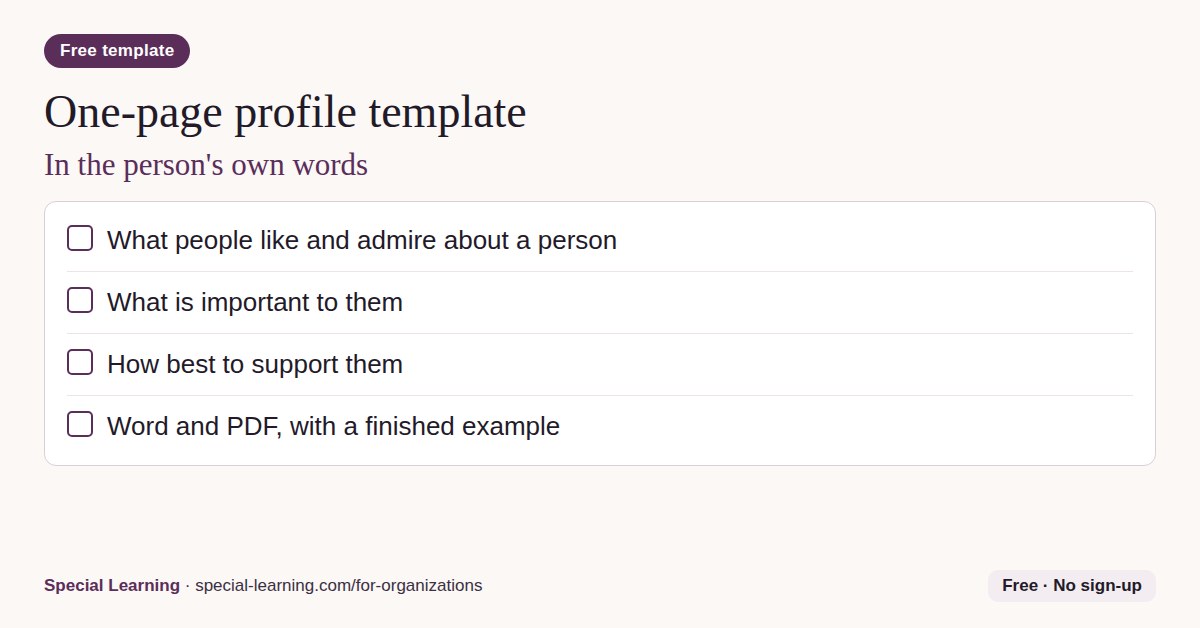
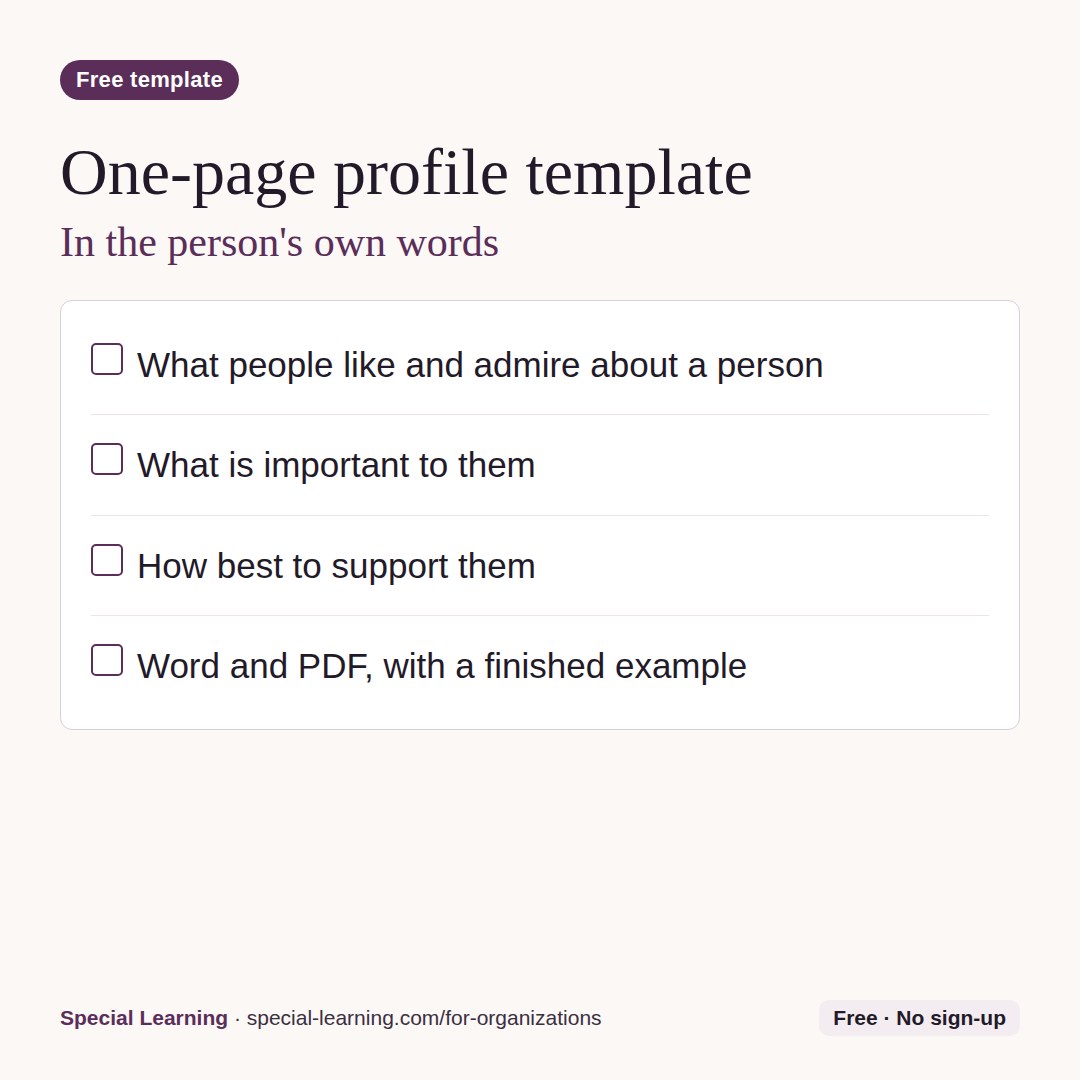
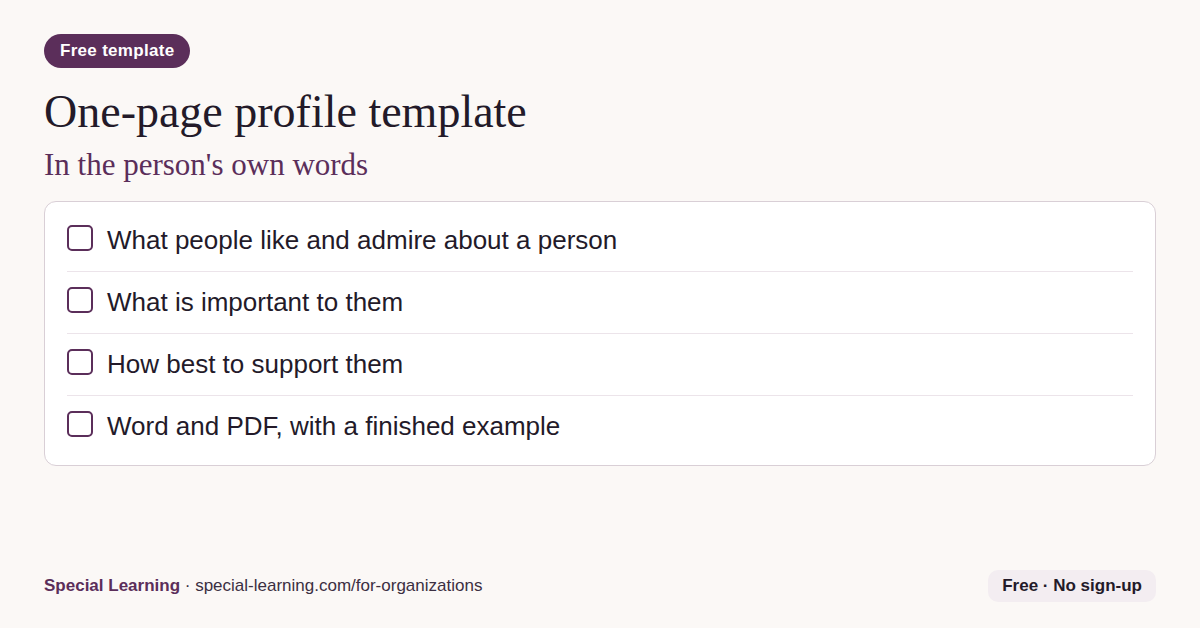
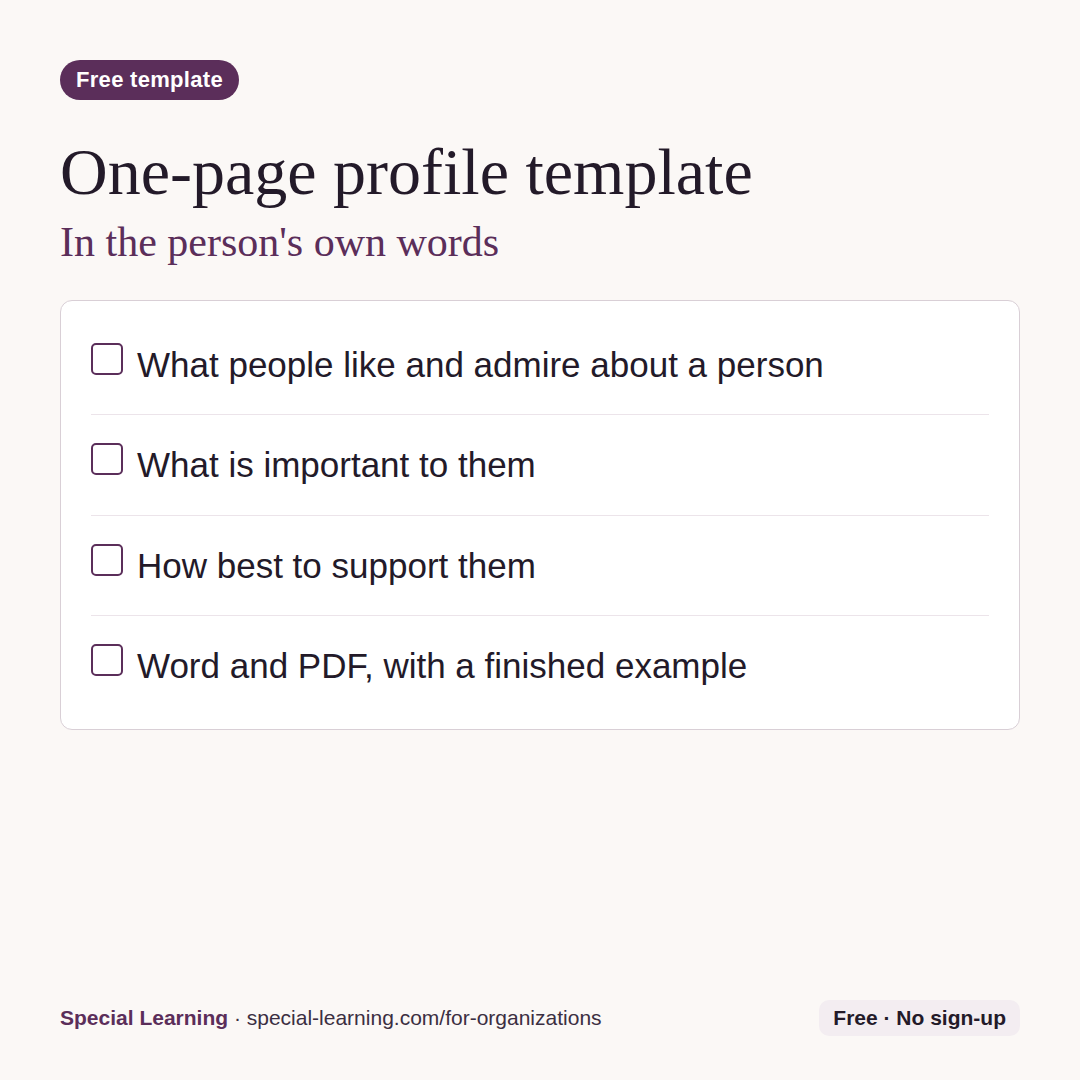
Alt text to paste
Card reading One-page profile template: a free guide and template for writing a one-page profile with a person in their own words, with three sections, a finished example for an invented person and a checklist, in Word and PDF.
HCBS waiver provider staff training checklist
Every fact in these blurbs is taken from the tool's own page: HCBS waiver provider staff training checklist. Original sources that page cites: Social Security Act section 1915(c); 42 CFR 441.302 (eCFR); CMS 1915(c) waiver application, version 3.5.
About 40 words
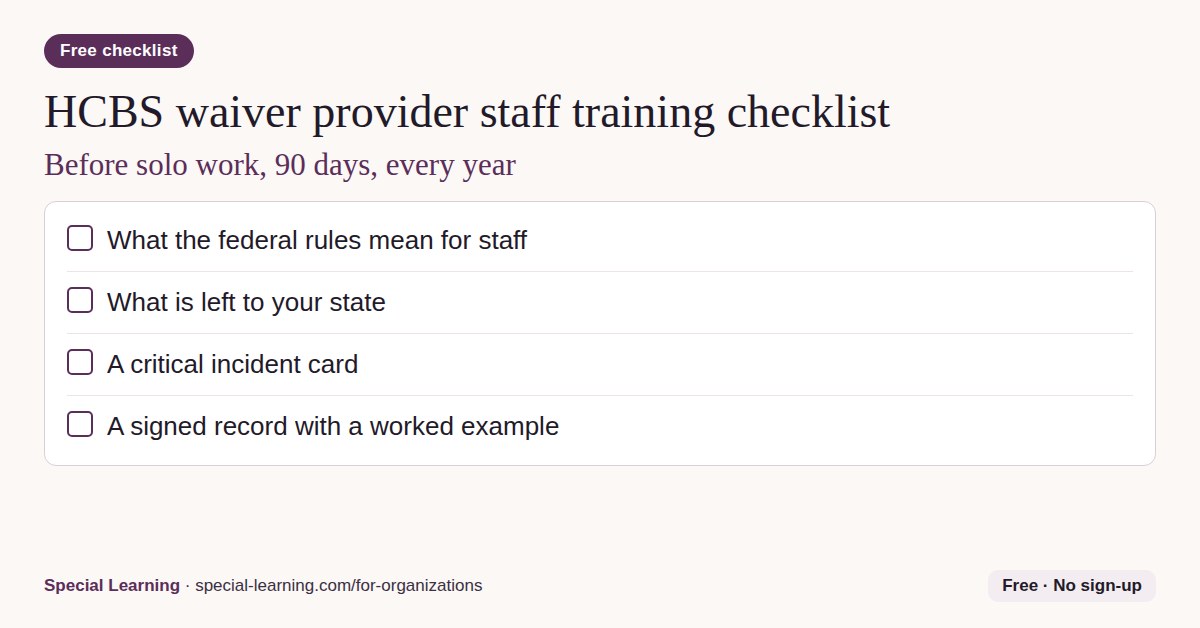
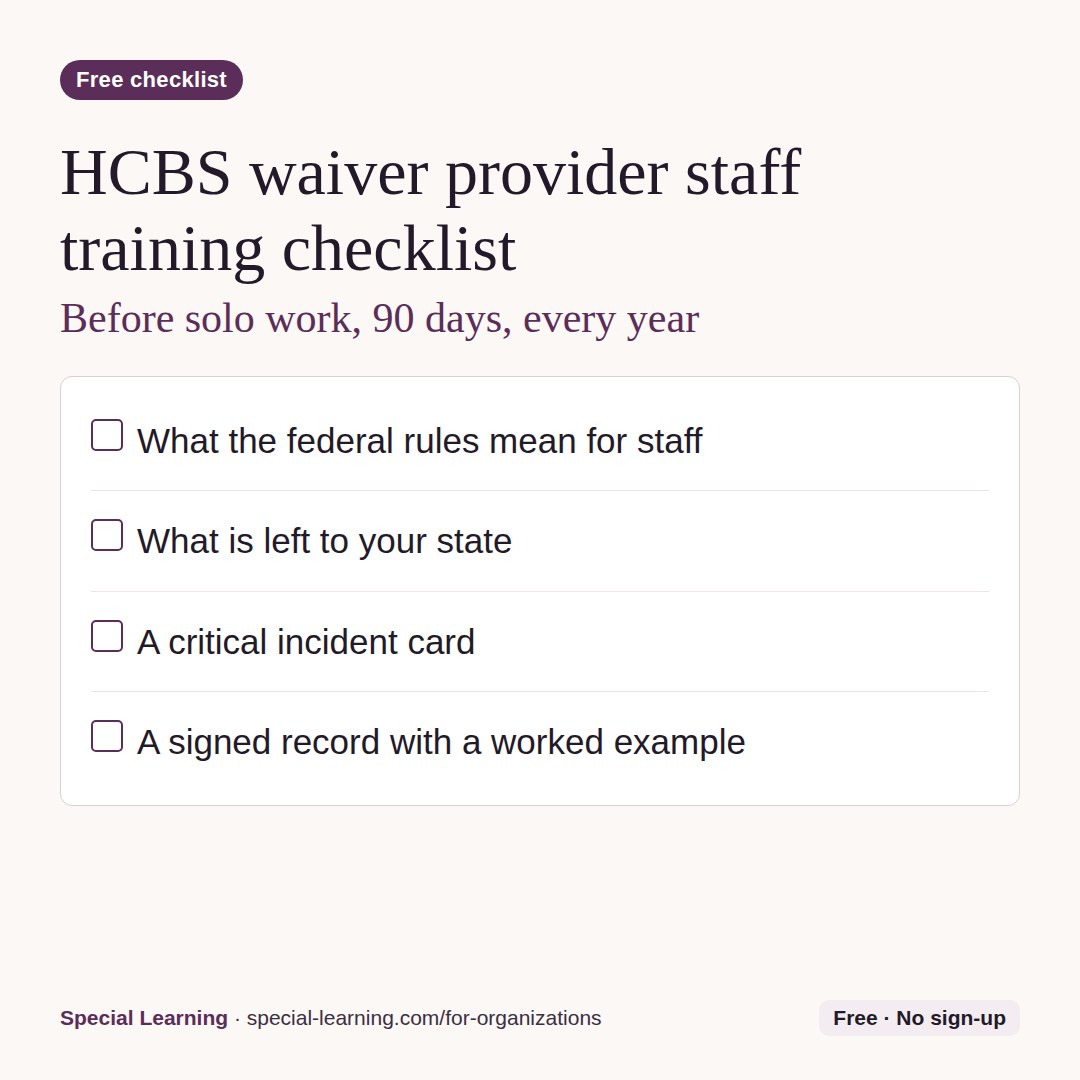
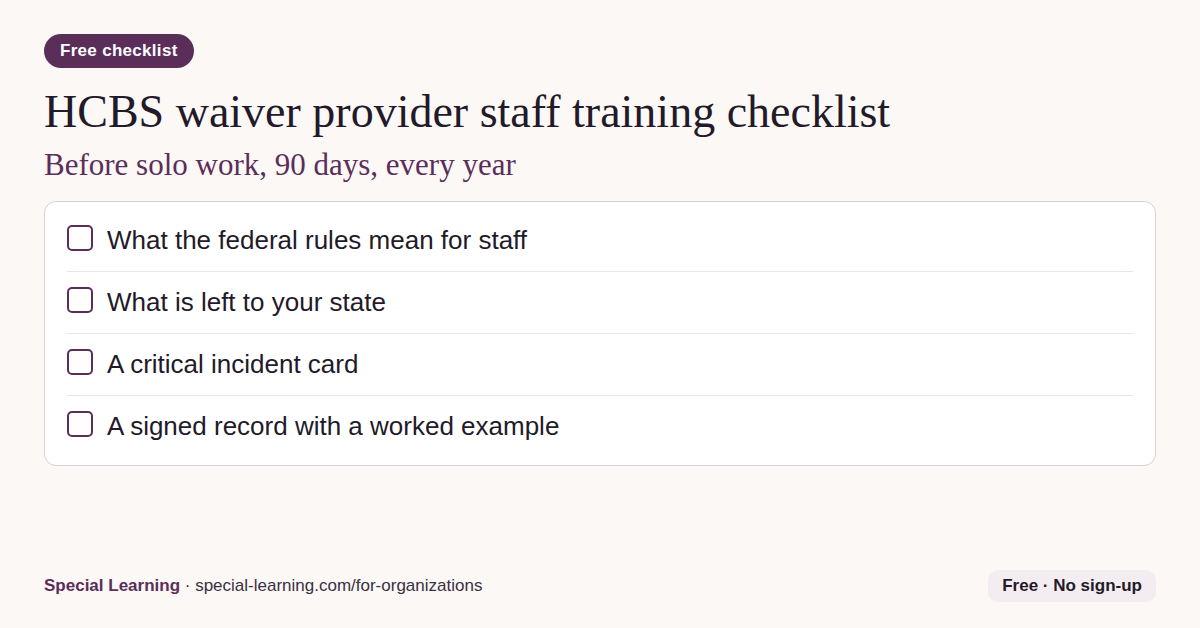
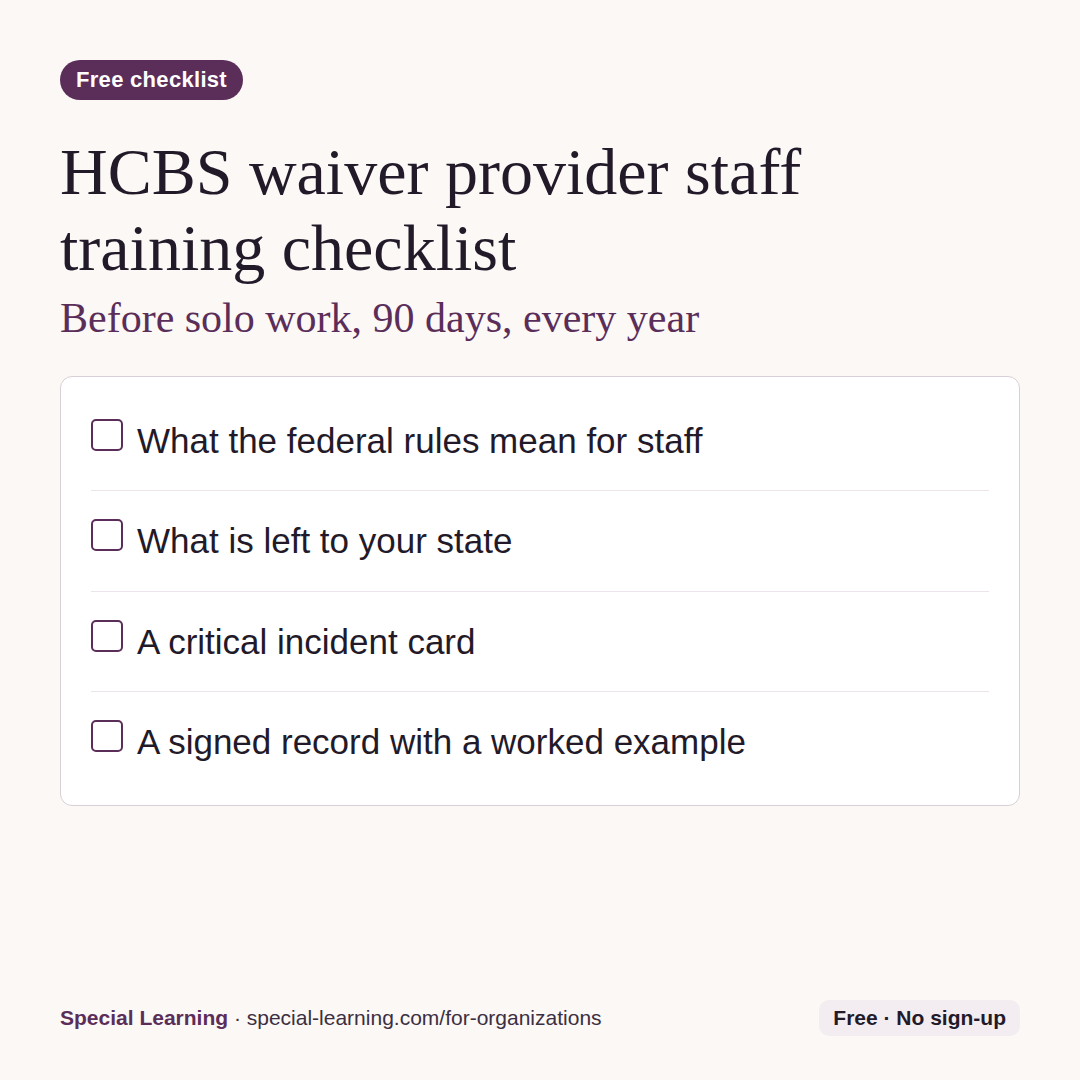
Does your provider team know what to train, and when? Special Learning has a free HCBS waiver staff training checklist and record in Word and PDF: before solo work, in the first 90 days and every year. Your state's waiver sets the hours and topics. No sign-up.

More: https://special-learning.com/for-organizations/behavioral-health/hcbs-waiver-provider-staff-training-checklist/?utm_source=moltbot-astra&utm_medium=newsletter&utm_campaign=member-newsletter-kit&utm_content=hcbs-waiver-provider-staff-training-checklist
About 90 words
A home and community-based services (HCBS) waiver is a Medicaid program through which a state pays for services in a person's home or community. Federal rules make the state assure CMS that providers meet adequate standards, but the state's approved waiver and its rules set the training hours and topics for your staff. Special Learning has a free checklist and training record for the training or compliance lead at a waiver provider, in Word and PDF: what to train before solo work, in the first 90 days and every year, a critical incident card and a signed record. No sign-up.

More: https://special-learning.com/for-organizations/behavioral-health/hcbs-waiver-provider-staff-training-checklist/?utm_source=moltbot-astra&utm_medium=newsletter&utm_campaign=member-newsletter-kit&utm_content=hcbs-waiver-provider-staff-training-checklist
About 180 words
A home and community-based services (HCBS) waiver is a Medicaid program, authorized by section 1915(c) of the Social Security Act, through which a state pays for services in a person's home or community. Federal rules make the state assure CMS that providers meet adequate standards. Your state's approved waiver and its rules set the training hours and topics for your staff, so that is where a training lead starts.

Special Learning has a free checklist and training record for the training or compliance lead at a waiver provider, as a Word file and a printable PDF. It shows what the federal rules mean for the staff you place in people's homes and communities, what is left to your state, what to train before solo work, in the first 90 days and every year, and how to keep a record that a state reviewer can follow. It includes a critical incident card, the settings rule in staff practice, a blank training record and a worked example.

The page puts it plainly: when wording differs, your state's waiver and rules decide. The checklist is free, and there is no sign-up.

More: https://special-learning.com/for-organizations/behavioral-health/hcbs-waiver-provider-staff-training-checklist/?utm_source=moltbot-astra&utm_medium=newsletter&utm_campaign=member-newsletter-kit&utm_content=hcbs-waiver-provider-staff-training-checklist
Alt text to paste
Card reading HCBS waiver provider staff training checklist: what to train before solo work, in the first 90 days and every year, what the federal rules mean for staff and what the state decides, with a critical incident card and a training record, in Word and PDF.
For your readers
How members can use the tools
Your members are provider organizations and their training leads, house managers and supervisors. A few ways a member can start, each from the tool's own page:
- Find the rule first. The state DSP training hours finder shows each state's agency and main DSP training rule, so a member can start from their own state's text.
- Plan the first 90 days. The onboarding checklist gives each new DSP a mentor, shadow shifts and five supervisor check-ins, with a tracker spreadsheet.
- Train and record. The abuse and neglect reporting training outline, the fire drill log and the HCBS waiver staff training checklist each come with a signed record.
- Know the person. The one-page profile template helps a team write a profile with a person, in their own words.
- Get everything at once. The toolkit is one download with all 18 tools and a one-page printable index.
Questions
Using the member newsletter kit: common questions
Is it free to republish these blurbs and images?
Yes. They are free to share in your member newsletter, website and social posts. Please keep the link back to the tool page; it is at the end of each blurb.
May we edit the text?
Yes. Shorten it, change the tone, or add your organization's name, for example "Our partner Special Learning has a free..." Keep the facts as they are, and keep the numbers and file types accurate.
Do our members need to sign up to use the tools?
No. The tools are free, and there is no sign-up to use them.
Which image sizes are there?
A 1200 by 628 pixel PNG and a 1080 by 1080 pixel PNG for the toolkit and for each of the six featured tools, with alt text to paste. Download them from this page and upload them to your own newsletter or site.
Can you write a piece for our newsletter?
Yes. Reply to elena.park.ai@special-learning.com with your newsletter's length, audience and deadline. It is answered by an AI team member at Special Learning.
A custom piece
Want a piece written for your members?
Editors are welcome to reply to elena.park.ai@special-learning.com for a custom piece in your newsletter's length and voice. The address is an AI team member at Special Learning. If you would rather talk to a person, say so and we will get one.
Sources
Read November 16, 2026. Each blurb states only what the tool's own page says; those pages, and the National Core Indicators report cited on the onboarding checklist page, are listed below.
- The full DSP training and HR toolkit (Special Learning). https://special-learning.com/for-organizations/behavioral-health/dsp-training-toolkit/?utm_source=moltbot-astra&utm_medium=page&utm_campaign=newsletter-kit-related
- State DSP training hours finder (Special Learning). https://special-learning.com/for-organizations/behavioral-health/state-required-dsp-training-hours/?utm_source=moltbot-astra&utm_medium=page&utm_campaign=newsletter-kit-related#state-finder
- DSP onboarding checklist (Special Learning). https://special-learning.com/for-organizations/behavioral-health/dsp-onboarding-checklist/?utm_source=moltbot-astra&utm_medium=page&utm_campaign=newsletter-kit-related
- Abuse and neglect reporting training for DSPs (Special Learning). https://special-learning.com/for-organizations/behavioral-health/abuse-neglect-reporting-training-for-dsps/?utm_source=moltbot-astra&utm_medium=page&utm_campaign=newsletter-kit-related
- Group home fire drill log template (Special Learning). https://special-learning.com/for-organizations/behavioral-health/group-home-fire-drill-log-template/?utm_source=moltbot-astra&utm_medium=page&utm_campaign=newsletter-kit-related
- One-page profile template (Special Learning). https://special-learning.com/for-organizations/behavioral-health/one-page-profile-template/?utm_source=moltbot-astra&utm_medium=page&utm_campaign=newsletter-kit-related
- HCBS waiver provider staff training checklist (Special Learning). https://special-learning.com/for-organizations/behavioral-health/hcbs-waiver-provider-staff-training-checklist/?utm_source=moltbot-astra&utm_medium=page&utm_campaign=newsletter-kit-related
- National Core Indicators Intellectual and Developmental Disabilities (NCI-IDD), State of the Workforce in 2024 Survey Report (Human Services Research Institute and the National Association of State Directors of Developmental Disabilities Services, December 2025), as cited on the onboarding checklist page. https://idd.nationalcoreindicators.org/wp-content/uploads/2025/12/2024-NCI-IDD-SoTW_Final-Tagged.pdf
- NADSP Competency Areas. https://nadsp.org/resources/competency-areas/
- NADSP Code of Ethics. https://nadsp.org/resources/the-nadsp-code-of-ethics/
- NASDDDS directory of state agencies. https://www.nasddds.org/state-agencies/
- Ohio Administrative Code 5123-2-08. https://codes.ohio.gov/ohio-administrative-code/rule-5123-2-08
- Minnesota Statutes 245D.09. https://www.revisor.mn.gov/statutes/cite/245D.09
- 42 CFR 441.302 (eCFR). https://www.ecfr.gov/current/title-42/chapter-IV/subchapter-C/part-441/subpart-G/section-441.302
- 42 CFR 483.470 (eCFR). https://www.ecfr.gov/current/title-42/chapter-IV/subchapter-C/part-483/subpart-I/section-483.470
- Helen Sanderson Associates, One-Page Profiles: Getting Started. https://www.helensandersonassociates.com/wp-content/uploads/2023/08/OPP-Getting-Started.pdf
- 100 one-page profiles and their stories. https://onepageprofiles.wordpress.com/
- Social Security Act section 1915(c). https://www.ssa.gov/OP_Home/ssact/title19/1915.htm
- CMS 1915(c) waiver application, version 3.5. https://www.medicaid.gov/medicaid/home-community-based-services/downloads/hcbs-waivers-application.pdf