
Free template and downloads for house managers and training leads
Group home fire drill log template
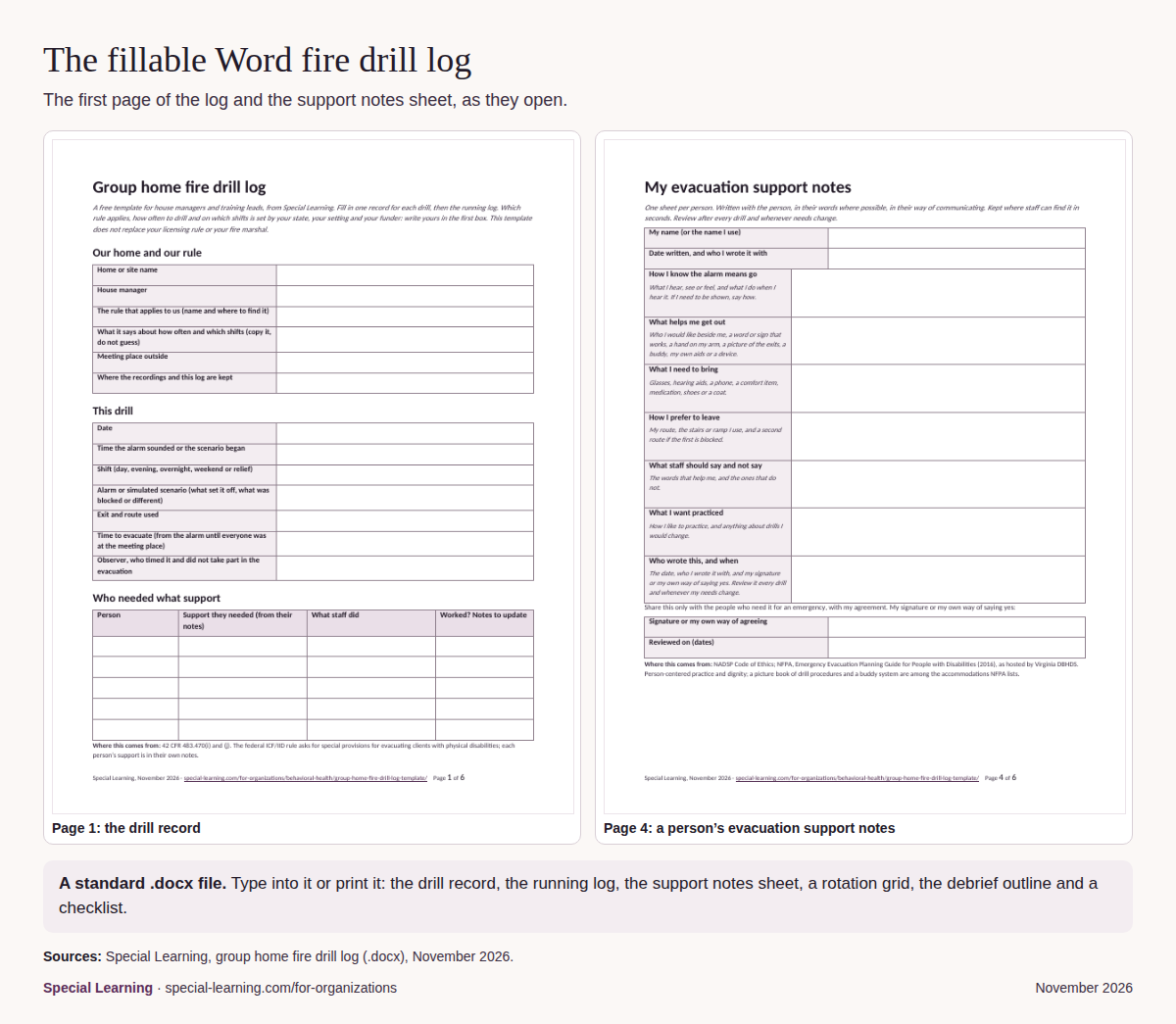
A free fire drill log, with a rotation grid, a 20-minute group debrief and an evacuation support notes sheet in Word and PDF, for house managers and training leads at group homes and other IDD residential and home and community-based services (HCBS) settings. What to record for each drill, how to rotate drills across shifts, how to debrief as a group, and how to write each person’s own evacuation support notes with them.
Special Learning · November 16, 2026
Free download
Download the fire drill log
Short answer
What goes in a group home fire drill log?
Read
A fire drill log is a short record of each drill: the date, time and shift, the alarm or scenario, the exit used, how long it took to get everyone out, who needed what support, what went wrong and how you fixed it, who was there, and everyone’s signature. How often you must drill, and on which shifts, depends on your state and your setting, so check your licensing rule; this page gives you the log, a way to rotate drills across shifts, a 20-minute group debrief and a support notes sheet written with each person.
We say plainly that rules vary and do not give one frequency for every home. This page is practice guidance built on the sources below; it does not replace your licensing rule, your funder’s contract or your fire marshal.
Why it matters
Drills are staff training
- Every shift practices. The federal rule for intermediate care facilities for individuals with intellectual disabilities (ICF/IID) says drills are held “at least quarterly for each shift of personnel and under varied conditions” to “ensure that all personnel on all shifts are trained to perform assigned tasks.” It applies to live-in and relief staff too. That rule covers ICF/IID only; yours may differ. (42 CFR 483.470(i) and (j))
- Drills test the plan, not the people. The same rule says drills evaluate “the effectiveness of emergency and disaster plans and procedures,” and that the facility must “file a report and evaluation on each evacuation drill” and “investigate all problems with evacuation drills, including accidents, and take corrective action.” A log is how you show that happened. (42 CFR 483.470(i) and (j))
- Each person has their own support plan. The rule asks facilities to “make special provisions for the evacuation of clients with physical disabilities.” NFPA’s planning guide goes further: the ability of a person with a cognitive disability to recognize and understand an alarm “and what they mean should be verified,” and if the person does not, “plans for assistance need to be developed.” So each person has their own notes, and staff learn them by drilling them. (42 CFR 483.470(i) and (j); NFPA, Emergency Evacuation Planning Guide for People with Disabilities (2016), as hosted by Virginia DBHDS)
- Training and records go together. The federal emergency preparedness rule for ICF/IIDs asks providers to “demonstrate staff knowledge of emergency procedures,” “maintain documentation of the training” and to “analyze the ICF/IID’s response to and maintain documentation of all drills.” (42 CFR 483.475(d))

What the rules say
Rules vary by state and setting: examples
- Federal, ICF/IID only. Evacuation drills at least quarterly for each shift, under varied conditions; at least one drill each year on each shift must actually evacuate clients; a report and evaluation on each; problems investigated with corrective action. Fire protection follows the Life Safety Code, including its Residential Board and Care chapter where the facility fits it (42 CFR 483.470(i), (j)). (42 CFR 483.470(i) and (j))
- NFPA 101 (2006 edition), residential board and care, as summarized in a handout. The handout lists drills “not less than six times per year on a bimonthly basis,” with “two drills conducted during the night when residents are sleeping,” announced in advance to residents when permitted, and the actual evacuation of residents to an assembly point. Which edition and chapter apply to a home is your state fire marshal’s call, so use this only to see what the code looks like. (Comparison of the 2006 Life Safety Code (NFPA 101) with the 2024 IBC/IFC)
- Minnesota (example, DD license). The emergency plan must include “procedures for conducting quarterly drills each year and recording the date of each drill,” the license holder must “maintain a log of quarterly fire drills on file in the facility,” and the plan must include “an emergency escape plan for each resident.” (Minnesota Statutes 245D.22, subdivision 5 (example))
- Oregon (example, residential care and assisted living rule, not IDD-specific). A drill “at least once every 90 calendar days, with at least one evacuation drill per year conducted during sleeping hours,” “clearly documented, signed by the caregiver conducting the drill,” and caregivers must be able to evacuate all occupants to the initial point of safety “within three minutes or less.” (Oregon Administrative Rules 411-050-0725(3) (example))
- Ohio (example, residential care facility rule, not IDD-specific). A written record and evaluation of each fire drill that includes “the date, time, staff member attendance, method of activation, effectiveness of the drill procedures, number of individuals evacuated, total time for evacuation, and the weather conditions during the evacuation.” (Ohio Administrative Code 3701-16-13(K) to (M) (example))
- Texas (example, a special care facility rule, not IDD-specific). For new residential board and care facilities, drills quarterly “with not less than two drills conducted during the night when residents are sleeping,” documented “on a form,” with “an evaluation of each drill with respect to the fire plan.” (26 Texas Administrative Code 506.83(h) (example))
These are examples of how different the rules are. Do not copy any one number into your own log. Use your own licensing rule, your funder’s contract and your fire marshal’s requirements; our state finder links each state’s DSP training rule and agency. We did not find one national frequency for every group home. Find your state’s DSP training rule and agency in our free state finder, then read your own licensing rule for drills.

The log
What to record for each drill
| Field | What to write | Why |
|---|---|---|
| Date and time | The calendar date and the clock time the alarm sounded or the scenario began. | Shows the drill happened and when; the time is how you spot a pattern across the year. |
| Shift | Day, evening, overnight, weekend or relief. Use your own names for them. | The federal ICF/IID rule counts drills for each shift, so a log without the shift cannot show coverage. (42 CFR 483.470(i) and (j)) |
| Alarm or simulated scenario | What set it off: the alarm, a coded announcement, or a named scenario, such as the main exit blocked or a person asleep. | Drills are held “under varied conditions,” so the log shows which conditions you have practiced. (42 CFR 483.470(i) and (j)) |
| Exit used | Which exit or route each person took, and the meeting place outside. | Minnesota’s emergency plan lists exits, “primary and secondary evacuation routes” and “designated assembly points outside the facility”; the log shows you used them. (Minnesota Statutes 245D.22, subdivision 5 (example)) |
| Time to evacuate | Minutes and seconds from the alarm until everyone was at the meeting place, counted by the person who observes. | Lets you compare drills over time. No federal target time is set in the rules we read; Oregon’s residential care rule, as an example, sets three minutes to the initial point of safety, and Ohio’s lists total time for evacuation. (Oregon Administrative Rules 411-050-0725(3) (example); Ohio Administrative Code 3701-16-13(K) to (M) (example)) |
| Who needed what support | For each person, the support staff gave, in the person’s own notes’ words: a verbal prompt, a hand on the arm, a device, a second staff member. | The federal rule asks for “special provisions” for the evacuation of clients with physical disabilities; each person’s notes are how staff learn what they are. (42 CFR 483.470(i) and (j)) |
| Problems found and the fix | What did not go as planned, who owns the fix, and the date it was done. | The federal rule asks facilities to “investigate all problems” and “take corrective action.” (42 CFR 483.470(i) and (j)) |
| Staff present | Every staff member on site, with their role, including live-in and relief staff. | The federal rule extends the drill requirements to live-in and relief staff. (42 CFR 483.470(i) and (j)) |
| Signatures | The staff member who led, the observer and the house manager sign and date. | Our practice. Oregon’s example requires the drill to be signed by the caregiver conducting it, and Texas’s asks for a form. (Oregon Administrative Rules 411-050-0725(3) (example); 26 Texas Administrative Code 506.83(h) (example)) |

The fields are ours as a set; each rule says what a record must cover in its own setting. Ohio’s example, for instance, lists the date, time, staff attendance, method of activation, effectiveness, number evacuated, total time and weather. Check yours. Problems that surface in a drill that involve a person’s safety may also belong in your incident report; for handing information from one shift to the next, see the shift change report template.
Across shifts
How to rotate drills across shifts
- Start from your rule. If it says drills each quarter for each shift, that is a drill count per shift; if it says something else, use that. Never use a frequency from this page.
- Write your shifts across the top and the conditions down the side, and tick each cell when you have done it. Every shift should see every condition over time, not the same easy drill each quarter.
- Pick the next drill from the empty cell with the oldest date. Do not announce the condition to staff in advance; residents may be told in advance where your rule allows it (the NFPA 101 summary says drills are “permitted to be announced to the residents in advance”).
- Cover overnight and weekend or relief shifts as deliberately as day shift. Those shifts often have fewer people on site.
- Include live-in and relief staff, and any new hire within their first weeks, in a drill they take part in, not watch.
| Condition | What to check |
|---|---|
| Main exit blocked | Use the second exit and the second route. |
| Person in bed or in the bathroom | Staff go to the person first, as each person’s notes say. |
| Alarm on, no staff at the panel | Who silences it and who calls, by name. |
| A new or relief staff member leads | The notes are enough for someone who has not met the person. |
| Bad weather or after dark | Lights, shoes, coats and the meeting place. |

NFPA’s planning guide says management should “conduct unannounced as well as announced drills and vary the drills to pose a variety of challenges along designated evacuation routes,” such as closed-off corridors, blocked doors or unconscious people. (NFPA, Emergency Evacuation Planning Guide for People with Disabilities (2016), as hosted by Virginia DBHDS) Our grid is one way to track that variety; the conditions are ours.
A short group debrief
Debrief live, as a group, screen shared and recorded
Staff training is group training: everyone from the shift in the room or on the call, you sharing the log on screen, and the session recorded. Keep the recording with the log.
- Live, as a group, screen shared and recorded. Staff training is group training. Keep the recording with the log.
- Include everyone who was on the shift, and relief or live-in staff if they were there.
- Have each person’s notes ready on the shared screen, with the person’s agreement, and no one else’s details.
| Time | Length | What to do |
|---|---|---|
| 0:00 | 2 min | Open. Say what we are doing: the drill tests the plan, not the people. No blame. Recording starts. |
| 0:02 | 5 min | Walk the log. Share your screen. The leader reads the timeline from the log: alarm, who went where, time to the meeting place. |
| 0:07 | 5 min | Each person’s support. For each person who took part, open their notes. Ask: did what we did match the notes? What worked, and what should the notes say now? |
| 0:12 | 4 min | Problems and fixes. List every problem found. Give each one an owner and a date. Do not solve it by blaming one person. |
| 0:16 | 4 min | Sign and schedule. Everyone signs the log. Pick the next drill’s shift and condition from the grid, and the date to update any notes. |

The outline and timings are ours. A drill is a chance to learn what the notes missed, so treat anything that went wrong as information about the plan.
Each person’s own plan
Evacuation support notes, written with the person
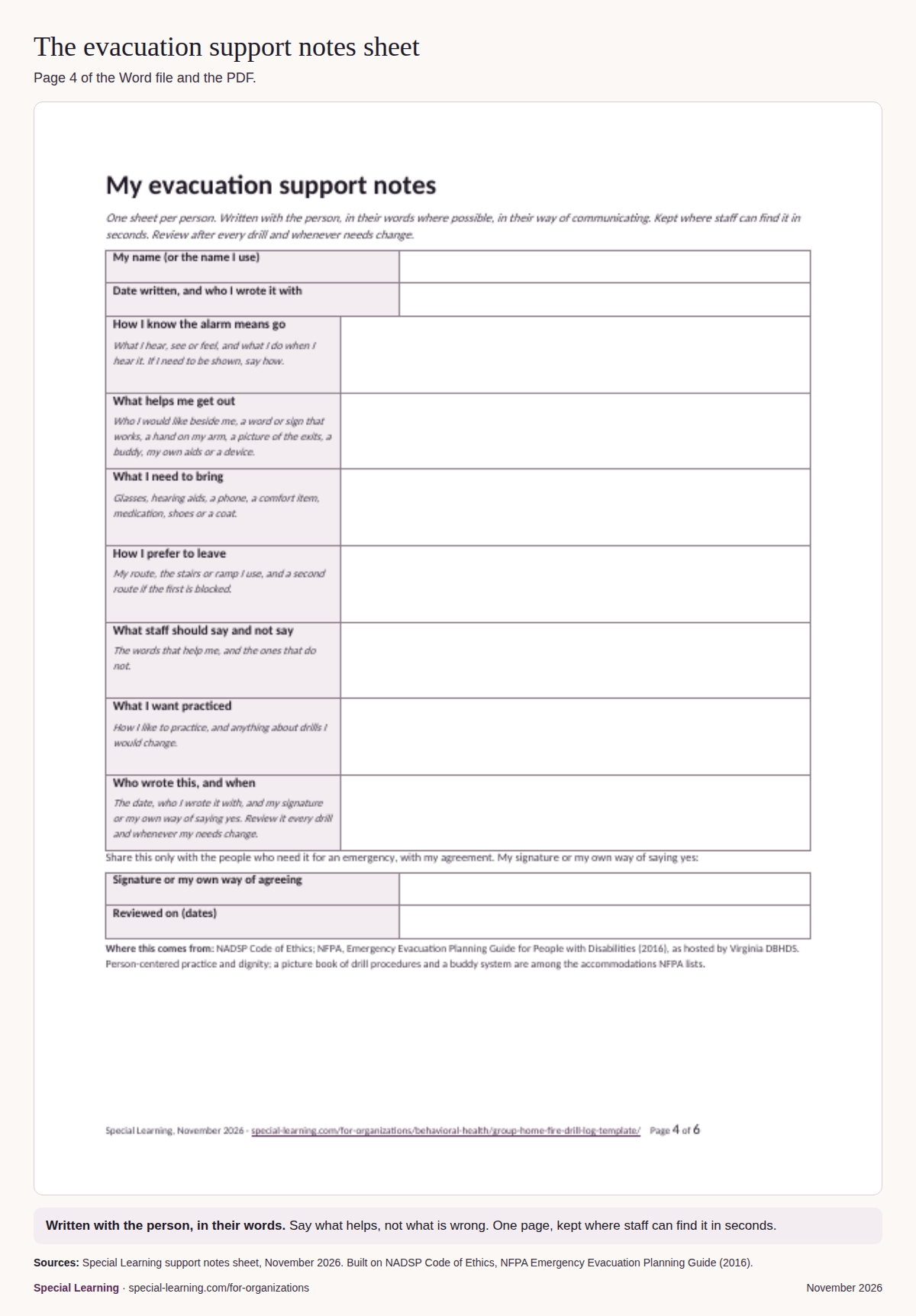
Each person has their own evacuation support notes, written with the person, in their words where possible, and kept where staff can find them in seconds. The sheet in the Word file has these headings:
| Heading | What it holds |
|---|---|
| How I know the alarm means go | What I hear, see or feel, and what I do when I hear it. If I need to be shown, say how. |
| What helps me get out | Who I would like beside me, a word or sign that works, a hand on my arm, a picture of the exits, a buddy, my own aids or a device. |
| What I need to bring | Glasses, hearing aids, a phone, a comfort item, medication, shoes or a coat. |
| How I prefer to leave | My route, the stairs or ramp I use, and a second route if the first is blocked. |
| What staff should say and not say | The words that help me, and the ones that do not. |
| What I want practiced | How I like to practice, and anything about drills I would change. |
| Who wrote this, and when | The date, who I wrote it with, and my signature or my own way of saying yes. Review it every drill and whenever my needs change. |
The NADSP Code of Ethics asks DSPs to “apply person-centered practices, collaborating with individuals and their teams to understand what is important to and for them” and to “promote, protect, and ensure the human and legal rights, fundamental freedoms, and inherent dignity of the people I support.” NFPA’s guide lists accommodations such as “providing a picture book of drill procedures” and “implementing a buddy system” for people with cognitive disabilities. (NADSP Code of Ethics; NFPA, Emergency Evacuation Planning Guide for People with Disabilities (2016), as hosted by Virginia DBHDS)
How to write them
- Write the notes with the person, not about them. Ask what they want to say and use their words, in their way of communicating.
- Say what supports help, not what is wrong. Write “likes a verbal prompt and a hand on the arm,” not a label.
- Practice the notes. If the person does not recognize or understand the alarm, the guide says plans for assistance need to be developed; a drill is how you find out.
- Keep it short, one page, and keep a current copy where staff can find it without a key or a password.
- Share it only with the people who need it for an emergency, with the person’s agreement, and keep it in the person’s record.
For the person’s wider picture, see the one-page profile template, which is written the same way.
The checklist
Before and after each drill
- I know which rule applies to our home (federal, state licensing, fire marshal, funder) and what it says about how often and on which shifts.
- Each person has current evacuation support notes, written with them, and each shift can find them in seconds.
- The next drill’s shift and condition are picked from the rotation grid.
- A staff member is named to observe and time it, and does not take part in the evacuation.
- We record the date, time, shift, scenario, exit, time to evacuate, support given, problems and fixes, staff present and signatures.
- The group debrief is live, screen shared and recorded, and held the same day where we can.
- Every problem has an owner and a date, and the fix is on the next drill’s agenda.
- Live-in and relief staff, and new hires, have taken part in a drill.
- Notes were reviewed after the drill and updated if the person’s needs changed.

For a roster of who attended trainings across the year, see the staff training sign-in sheet and the DSP training and HR toolkit.
On paper
Prefer paper? Print the PDF
The printable PDF has the same six pages as the Word file, with write-in space for each drill and each person’s notes.

Questions
Group home fire drill logs: common questions
How often do group homes have to hold fire drills?
It depends on the state, the setting and the funder, so we do not give one number. The federal rule for ICF/IIDs says drills at least quarterly for each shift, under varied conditions. (42 CFR 483.470(i) and (j)) Minnesota and Texas rules, shown as examples, say quarterly, and Oregon’s residential care rule, also an example, says at least once every 90 calendar days. (Minnesota Statutes 245D.22, subdivision 5 (example); 26 Texas Administrative Code 506.83(h) (example); Oregon Administrative Rules 411-050-0725(3) (example)) Check your own licensing rule and your fire marshal; our state finder links each state’s agency.
What should a fire drill log include?
At least the date and time, the shift, the scenario, the exit used, the time to evacuate, who needed what support, problems found and the fix, staff present and signatures. The federal ICF/IID rule asks for a report and evaluation on each drill and for problems to be investigated with corrective action. (42 CFR 483.470(i) and (j))
Why should drills cover every shift?
The federal ICF/IID rule says drills are held for each shift so that all personnel on all shifts are trained to perform assigned tasks, and it covers live-in and relief staff. (42 CFR 483.470(i) and (j)) Overnight and weekend shifts often have fewer people, so practice them on purpose.
How do I rotate drills across shifts?
Use a grid with your shifts across the top and the conditions down the side, tick each cell when done, and pick the next drill from the emptiest cell. NFPA’s guide says to vary drills to pose a variety of challenges. (NFPA, Emergency Evacuation Planning Guide for People with Disabilities (2016), as hosted by Virginia DBHDS) The grid is ours; the frequency comes from your rule.
What is an evacuation support note?
It is a short page, written with the person in their own words, on what helps them get out: how they know the alarm means go, who or what helps, what they bring, their route and how they like to practice. Minnesota’s rule, as an example, requires an emergency escape plan for each resident. (Minnesota Statutes 245D.22, subdivision 5 (example)) NFPA’s guide says that for a person who does not recognize or understand an alarm, plans for assistance need to be developed. (NFPA, Emergency Evacuation Planning Guide for People with Disabilities (2016), as hosted by Virginia DBHDS)
Can a person say no to a drill?
We did not find a rule that answers this for every setting. Texas’s example says drills “shall involve the residents, family, and staff in accordance with the emergency plan.” (26 Texas Administrative Code 506.83(h) (example)) Ask the person what would make it easier, write it in their notes, and ask your licensing agency how your rule treats a person who does not take part.
Does a recorded debrief count as training?
Whether it counts toward required training hours is your state’s rule; the state finder links each state’s agency. The recording is still the best record of what was taught and who was there. Keep it with the log.
Is this a legal or fire safety review?
No. It is a template and practice guidance built on the sources listed. Your fire marshal and licensing agency decide what your home must do.
Sources
Sources read November 16, 2026 (the eCFR text is current as of November 12). The quoted lines are as published; the log fields as a set, time to evacuate, rotation grid, debrief outline, support notes sheet and checklist are ours. Minnesota, Oregon, Ohio and Texas are examples only and are not a rule for any other state; the NFPA 101 wording comes from a handout that reproduces the 2006 edition, because NFPA 101 itself requires an account to read. None of these organizations has reviewed or endorsed this template.
- Electronic Code of Federal Regulations, Title 42, section 483.470, Condition of participation: Physical environment, (i) Evacuation drills and (j) Fire protection, ICF/IID; text current as of November 12, 2026. https://www.ecfr.gov/current/title-42/chapter-IV/subchapter-C/part-483/subpart-I/section-483.470
- Electronic Code of Federal Regulations, Title 42, section 483.475, Condition of participation: Emergency preparedness, (d) Training and testing, ICF/IID; text current as of November 12, 2026. https://www.ecfr.gov/current/title-42/chapter-IV/subchapter-C/part-483/subpart-I/section-483.475
- Handout, “2024 IBC/IFC Comparison to 2006 Life Safety Code for Residential Care Homes” (Aging Update 2026), whose left column sets out the NFPA 101 (2006 edition) residential board and care provisions on training and drills; a secondary source that reproduces the code’s wording. NFPA 101 itself is not free to read online. https://lks.memberclicks.net/assets/docs/AgingUpdate/2026AU/IFC%20-%20LSC%20Board%20%26%20Care%20Analysis.26.pdf
- National Fire Protection Association, Emergency Evacuation Planning Guide for People with Disabilities (2016), including the Personal Emergency Evacuation Planning Checklist and Chapter 6, people with cognitive disabilities; copy hosted by the Virginia Department of Behavioral Health and Developmental Services. https://dbhds.am.virginia.gov/wp-content/uploads/2023/09/H-31-Evacuation-Guide-PDF-2016-NFPA.pdf
- Minnesota Statutes, section 245D.22, Facility sanitation and health, subdivision 5, Emergencies: home and community-based services license holders for people with disabilities; one state’s example only. https://www.revisor.mn.gov/statutes/cite/245D.22
- Oregon Administrative Rules, chapter 411, division 50, rule 411-050-0725, Emergency Preparedness, (3) Evacuation drill: Oregon Department of Human Services rule for residential care and assisted living facilities, as published by OregonLaws; one state’s example only, and not an IDD-specific rule. https://oregon.public.law/rules/oar_411-050-0725
- Ohio Administrative Code, rule 3701-16-13, Building, plumbing, fire, carbon monoxide safety, and disaster preparedness standards, (K) to (M): Ohio Department of Health rule for residential care facilities, as published by Cornell Law School’s Legal Information Institute; one state’s example only, and not an IDD-specific rule. https://www.law.cornell.edu/regulations/ohio/Ohio-Admin-Code-3701-16-13
- Texas Administrative Code, Title 26, section 506.83, Fire Safety Requirements, (h) Fire drills, Health and Human Services Commission rule for special care facilities, as published by Cornell Law School’s Legal Information Institute; one state’s example only, and not an IDD-specific rule. https://www.law.cornell.edu/regulations/texas/26-Tex-Admin-Code-SS-506-83
- National Alliance for Direct Support Professionals (NADSP), The NADSP Code of Ethics (revised 2026), the Person-Centered Supports and Advocacy tenets, as published on nadsp.org. https://nadsp.org/resources/the-nadsp-code-of-ethics/