
Free checklist for training and compliance leads
HCBS waiver provider staff training checklist
A free checklist and training record for the training or compliance lead at a Medicaid home and community-based services (HCBS) waiver provider, as a Word file and a printable PDF. It shows what the federal rules mean for the staff you place in people’s homes and communities, what is left to your state, what to train before solo work, in the first 90 days and every year, and how to keep a record that a state reviewer can follow. Staff support people who choose their own goals and their own lives.
Special Learning · November 16, 2026
Free download
Download the checklist and record
Short answer
What is an HCBS waiver, and what training do its provider staff need?
Read
A home and community-based services (HCBS) waiver is a Medicaid program, authorized by section 1915(c) of the Social Security Act, through which a state pays for services in a person’s home or community, for people who would otherwise need the level of care of a hospital, nursing facility or intermediate care facility. Federal rules make the state assure CMS that providers meet adequate standards and, from July 9, 2027 (our arithmetic from the rule’s dates), that incidents are tracked, but your state’s approved waiver and its rules set the training hours and topics for your staff, so start there and keep a record that shows who learned what, when, from whom and how you checked it.
Sources: (Social Security Act section 1915(c); CMS, Home & Community-Based Services 1915(c)) for the program, (42 CFR 441.302) for provider standards and incident management, and (CMS, 1915(c) waiver application (version 3.5)) for the waiver form each state completes.

What federal rules say
Six federal rules that touch staff training
Federal text is a frame. It tells the state what to assure CMS, and the state writes the detail into its waiver. These six rules are the ones a training lead meets most often (Social Security Act section 1915(c); 42 CFR 441.301; 42 CFR 441.302).
| Rule | What the text says | What it means for your training | Source |
|---|---|---|---|
| Section 1915(c) assurance on provider standards | The state must give assurances that “necessary safeguards (including adequate standards for provider participation) have been taken to protect the health and welfare of individuals provided services under the waiver.” | The state turns this into provider standards, and those standards are where your staff qualifications and training are written down. Read your waiver’s provider qualifications first. | (Social Security Act section 1915(c); CMS, Home & Community-Based Services 1915(c)) |
| 42 CFR 441.302(a)(1) and (2) | The safeguards must include “Adequate standards for all types of providers that provide services under the waiver,” and assurance that state licensure or certification requirements are met for services or for the individuals furnishing them. | If your state licenses or certifies your service or your staff, that requirement comes with the job. Keep proof of it in the same file as the training record. | (42 CFR 441.302) |
| 42 CFR 441.301(b)(1)(i) and (c)(2) | Services are furnished under a written person-centered service plan. The plan must reflect the person’s strengths and preferences, and it must “be finalized and agreed to, with the informed consent of the individual in writing, and signed by all individuals and providers responsible for its implementation.” | Staff cannot support a plan they have not read. Before solo work, each staff member reads the plan of each person they support, and the record shows when. | (42 CFR 441.301) |
| 42 CFR 441.301(c)(4), the settings rule | Settings must have the qualities in (c)(4)(i) through (v): integration in the community, a setting the person selects, privacy, dignity, respect and freedom from coercion and restraint, individual initiative and autonomy, and choice of services and who provides them. | This is staff practice every shift. The table below turns each quality into what a staff member does and does not do. | (42 CFR 441.301) |
| 42 CFR 441.302(a)(6), incident management | From July 9, 2027 (our arithmetic from “beginning 3 years after July 9, 2024”), the state must operate “an incident management system that identifies, reports, triages, investigates, resolves, tracks, and trends critical incidents,” and must require providers to report critical incidents “within State-established timeframes and procedures.” | Every staff member must be able to recognize a critical incident and know whom to tell, and by when, in your state. The incidents section below has the details. | (42 CFR 441.302; CMS, HCBS Health and Welfare) |
| 42 CFR 441.302(k), payment adequacy | From July 9, 2030 (our arithmetic from “beginning 6 years after July 9, 2024”), the state assures that payment rates are adequate to ensure a sufficient direct care workforce. The text lists “A direct support professional” among the direct care workers. For homemaker, home health aide and personal care services, the state must ensure that providers spend 80 percent of payments on direct care worker compensation, with exceptions the rule lists, such as a state option for small providers, and “Costs of required trainings for direct care workers (such as costs for qualified trainers and training materials)” are excluded costs in that calculation. | This rule is about pay, not training hours. It matters here because required training costs are listed apart from wages, so track them separately. | (42 CFR 441.302) |

The settings rule, as what staff do
The settings rule describes the qualities of a home and community-based setting. It is about the person’s life, so it becomes training in dignity, choice and daily practice (42 CFR 441.301).
| Quality of the setting | What the text says (42 CFR 441.301) | What staff do |
|---|---|---|
| Community integration (c)(4)(i) | The setting is “integrated in and supports full access of individuals receiving Medicaid HCBS to the greater community,” including “opportunities to seek employment and work in competitive integrated settings, engage in community life, control personal resources, and receive services in the community.” | Offer and plan community outings, work and volunteer choices. Do not make a facility schedule the default for everyone. |
| Choice of setting (c)(4)(ii) | The setting is “selected by the individual from among setting options including non-disability specific settings,” with the options documented in the person-centered service plan. | Know what is in the plan about where the person chose to live and work, and pass on any wish to change. |
| Privacy, dignity, respect, freedom from coercion (c)(4)(iii) | The setting “Ensures an individual’s rights of privacy, dignity and respect, and freedom from coercion and restraint.” | Knock and wait. Ask before sharing anything private. Offer choices; never use threats or pressure. Report any restraint as your state requires. |
| Autonomy in daily life (c)(4)(iv) | The setting “Optimizes, but does not regiment, individual initiative, autonomy, and independence in making life choices,” including daily activities, the physical environment and with whom to interact. | Let the person decide the day where the plan allows. Ask before doing for someone what they can do for themselves. |
| Choice of services and providers (c)(4)(v) | The setting “Facilitates individual choice regarding services and supports, and who provides them.” | Take a request to change a support or a staff member seriously, and take it to the person’s team the same day. |
| Provider-owned residential settings (c)(4)(vi) | Extra conditions include doors “lockable by the individual, with only appropriate staff having keys,” freedom and support to control schedules and have “access to food at any time,” and visitors “of their choosing at any time.” Any modification “must be supported by a specific assessed need and justified in the person-centered service plan.” | A house rule is not a plan. Staff follow only the restrictions written in the person’s plan, and ask the team when a rule seems to limit a right. |

Critical incidents
Critical incidents: what staff must recognize and report
From July 9, 2027 (our arithmetic; see the dates below), the incident management system in 441.302(a)(6) must cover a minimum set of types, and your state may name more. Staff must know the types in your state, whom to tell and by when (42 CFR 441.302; CMS, HCBS Health and Welfare; CMS, 1915(c) waiver application (version 3.5)).
| Type | Text of the rule (42 CFR 441.302) |
|---|---|
| Abuse | Verbal, physical, sexual, psychological, or emotional abuse |
| Neglect | Neglect |
| Exploitation | Exploitation including financial exploitation |
| Restrictive interventions | Misuse or unauthorized use of restrictive interventions or seclusion |
| Medication error | A medication error resulting in a telephone call to, or a consultation with, a poison control center, an emergency department visit, an urgent care visit, a hospitalization, or death |
| Unexplained death | An unexplained or unanticipated death, including but not limited to a death caused by abuse or neglect |

Put your state’s wording, the reporting contacts and the deadline on one card that every staff member can reach on shift. The card is in the Word and PDF files. When something happens, these five steps are ours; the timelines and recipients come from your state.
- Make sure the person is safe and get help. Call emergency services first when someone is in danger.
- Report to the people your state names (often through your supervisor), within its timeframe. Your waiver’s critical incident section names the types, who reports and the timelines. Staff carry a one-page card with both.
- Write what you saw and heard. Facts, times and the person’s own words, with no guesses about why. Use the same wording as daily notes.
- Tell your supervisor, then follow up. Know who reviews it, what happens next and what your organization records.
- Debrief with care. Offer the person and the staff a chance to talk. Look for what to change.

Our DSP incident report template and daily notes template use the same see-and-hear wording.
Dates in the Medicaid Access Rule
The 2024 rule adds incident management requirements and a payment adequacy requirement that name direct care workers, with later dates for states (Federal Register, 89 FR 40542 (May 10, 2024); 42 CFR 441.302).
| Date | What happens | Source |
|---|---|---|
| May 10, 2024 | The final rule is published in the Federal Register (89 FR 40542). | (Federal Register, 89 FR 40542 (May 10, 2024)) |
| July 9, 2024 | The rule takes effect. | (Federal Register, 89 FR 40542 (May 10, 2024)) |
| July 9, 2027 | States must comply with the incident management requirements in 441.302(a)(6) “beginning 3 years after July 9, 2024,” except the electronic information system in (a)(6)(i)(B). | (42 CFR 441.302) |
| July 9, 2029 | The information system requirement applies “beginning 5 years after July 9, 2024.” | (42 CFR 441.302) |
| July 9, 2030 | The payment adequacy requirements in 441.302(k) apply “beginning 6 years after July 9, 2024.” | (42 CFR 441.302) |
The calendar dates in the left column are our arithmetic from the text. For a state that pays for HCBS through managed care, the rule ties the date to the first contract rating period on or after that point. Your state may act earlier.

What to build a checklist on
Three public frameworks for staff competencies
None of these replaces your state’s rule. Each helps you decide what a competent staff member can do and how to check it (CMS Direct Service Workforce core competencies (2014); NADSP Competency Areas; NADSP Code of Ethics).
| Framework | What it is | How to use it | Source |
|---|---|---|---|
| CMS Direct Service Workforce core competencies | 12 competency areas, from Communication to Education, Training and Self-Development, that CMS describes as guidance for “initial and ongoing DSW education and training.” | The document says the set “is not intended to impose requirements” on workers at entry, so use it to plan, not as a mandate. | (CMS Direct Service Workforce core competencies (2014)) |
| NADSP Competency Areas | 15 areas with skill statements, including Area 1 Participant Empowerment, Area 10 Crisis Prevention and Intervention, Area 12 Documentation and Area 14 Provide Person Centered Supports. | Use them as the “competency check” column of the training record. | (NADSP Competency Areas) |
| NADSP Code of Ethics | Tenets such as Person-Centered Supports, Confidentiality and Privacy, and Physical and Emotional Well-Being; the last asks staff to “Report any observed or suspected abuse, neglect, or exploitation to the appropriate authorities.” | Use the tenets for the values part of onboarding and each year’s refresher. | (NADSP Code of Ethics) |

What your state decides
Where to look in your state
Open our state-by-state DSP training finder for each state’s rule and source. Then check the waiver for your service and the provider manual.
| Where | What you find |
|---|---|
| Your approved waiver document | The waiver application each state files has a provider qualifications section (license, certificate or “Other Standard”) for each type of provider, and a critical events section (G-1) that names the incidents to report, who reports and the timelines. Ask your state Medicaid agency or the operating agency for the current waiver for your service. (CMS, 1915(c) waiver application (version 3.5)) |
| Your state’s provider rules and manuals | The state Medicaid agency and the agency that licenses or contracts with you publish the rules, provider manuals and training requirements. They set hours, topics, who may teach and by when. |
| Your managed care plan, if you have one | If your state pays for HCBS through managed care plans, ask each plan what it adds to your contract. (42 CFR 441.302) |

The checklist
What to train: before solo work, in the first 90 days and every year
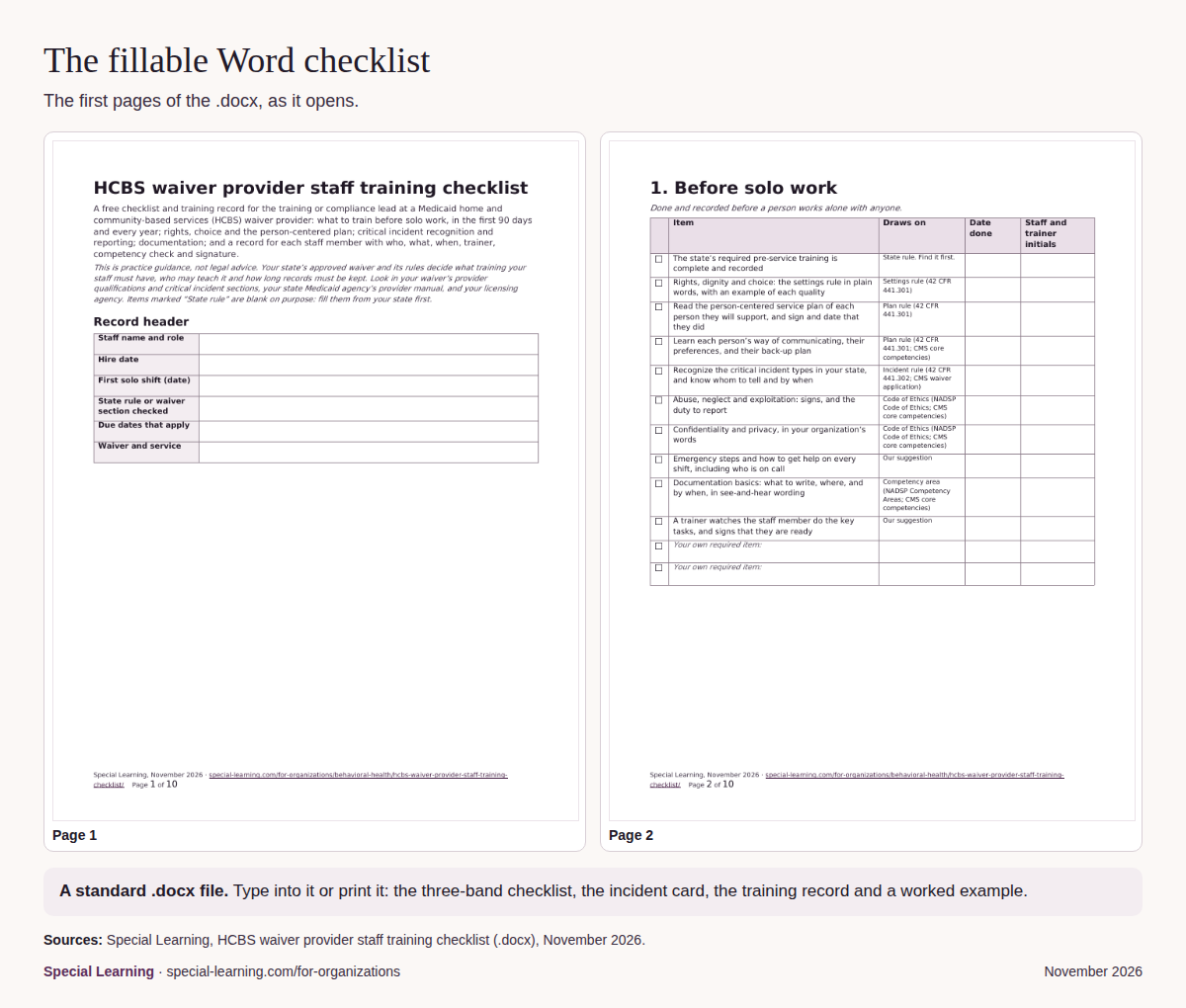
Three bands, each with a tick box and the source each item draws on. Items marked “State rule” are blank on purpose: fill them from your state first. The other items rest on the sources shown or are our suggestion. Add a line for each requirement your state adds.

1. Before solo work
Done and recorded before a person works alone with anyone.
| Item | Draws on | Source |
|---|---|---|
| The state’s required pre-service training is complete and recorded | State rule. Find it first. | Ours |
| Rights, dignity and choice: the settings rule in plain words, with an example of each quality | Settings rule | (42 CFR 441.301) |
| Read the person-centered service plan of each person they will support, and sign and date that they did | Plan rule | (42 CFR 441.301) |
| Learn each person’s way of communicating, their preferences, and their back-up plan | Plan rule | (42 CFR 441.301; CMS Direct Service Workforce core competencies (2014)) |
| Recognize the critical incident types in your state, and know whom to tell and by when | Incident rule | (42 CFR 441.302; CMS, 1915(c) waiver application (version 3.5)) |
| Abuse, neglect and exploitation: signs, and the duty to report | Code of Ethics | (NADSP Code of Ethics; CMS Direct Service Workforce core competencies (2014)) |
| Confidentiality and privacy, in your organization’s words | Code of Ethics | (NADSP Code of Ethics; CMS Direct Service Workforce core competencies (2014)) |
| Emergency steps and how to get help on every shift, including who is on call | Our suggestion | Ours |
| Documentation basics: what to write, where, and by when, in see-and-hear wording | Competency area | (NADSP Competency Areas; CMS Direct Service Workforce core competencies (2014)) |
| A trainer watches the staff member do the key tasks, and signs that they are ready | Our suggestion | Ours |

2. First 90 days
Added in the first three months, with a supervisor.
| Item | Draws on | Source |
|---|---|---|
| Shadow shifts with a trained mentor, then observed shifts with a written note | Our suggestion | Ours |
| Person-centered practices: how each plan’s goals show up in a shift | Competency area | (NADSP Competency Areas; CMS Direct Service Workforce core competencies (2014)) |
| Communication: respectful, clear, and in the way each person communicates | Competency area | (CMS Direct Service Workforce core competencies (2014)) |
| Positive behavior supports and each person’s crisis plan, as your state and clinician allow | Competency area | (CMS Direct Service Workforce core competencies (2014); NADSP Competency Areas) |
| Community inclusion: support a person to do what they chose, in the community | Settings rule | (42 CFR 441.301; CMS Direct Service Workforce core competencies (2014)) |
| Health and wellness: recognize a change and tell the right person | Competency area | (CMS Direct Service Workforce core competencies (2014); NADSP Competency Areas) |
| Any state-required topic with a later due date, marked with the date it is due | State rule. Find it first. | Ours |
| A supervisor reads three of the staff member’s notes and gives feedback | Our suggestion | Ours |
| A 90-day review: what is signed off, what is still open | Our suggestion | Ours |

3. Every year
Repeated or refreshed each year, and when a plan changes.
| Item | Draws on | Source |
|---|---|---|
| The state’s annual hours, completed and recorded by the due date | State rule. Find it first. | Ours |
| Refresh: rights, choice and the settings rule, with a new example from this year | Settings rule | (42 CFR 441.301) |
| Refresh: critical incident types, reporting, and any change to your state’s timeframes | Incident rule | (42 CFR 441.302) |
| Retrain on a person’s plan when it changes. Plans are reviewed at least every 12 months, and sooner when needs change or the person asks | Plan rule | (42 CFR 441.301) |
| Confidentiality refresher and a documentation spot-check | Competency area | (NADSP Competency Areas; NADSP Code of Ethics) |
| A performance evaluation tied to the competencies and the next year’s training plan | Our suggestion | Ours |
| A records check: every file has the proof of each required item, signed and dated | Our suggestion | Ours |

Rights, choice and the person-centered plan: five questions for the trainer
- Can the staff member name the qualities of an HCBS setting in their own words, and give an example for each?
- Have they read each person’s plan, and can they say what matters to that person?
- Do they offer a choice before they decide for someone?
- Do they know which restrictions, if any, are written in a person’s plan, and that a house rule is not one?
- Do they know whom to tell when a rule, a practice or another person limits a person’s choices?
The plan must reflect the person’s strengths and preferences and be signed by those responsible for it (42 CFR 441.301).
Documentation: what a note holds
- What happened, in what the person said and did, with the day and time.
- Who was there, and who was told, and when.
- Nothing that guesses at why. The behavior support professional reads the pattern.
- Completed in the time your state or organization sets.
- Kept where your policy says, and shared only with people who need it.
The wording is ours. It follows the NADSP documentation competency area (NADSP Competency Areas).
The record
A training record a state reviewer can follow
Made up, for teaching. Marisol T. is an invented direct support professional hired on March 1, 2027, at an invented provider. A reviewer should be able to follow one row from a requirement to a signed, dated check. The layout is ours; what the record must hold is set by your state.
| Date | Training topic or task | Length | Trainer and role | Competency check (how, result) | Staff signature | Trainer signature |
|---|---|---|---|---|---|---|
| Mon Mar 1, 2027 | Rights, dignity and choice (settings rule) | 45 min | Dana W., training coordinator | Role-play: offered two choices before a task; passed | M. Torres | D. Walker |
| Mon Mar 1, 2027 | Reading the plan of the person I will support | 30 min | Dana W., training coordinator | Told back the person’s three goals and back-up plan; passed | M. Torres | D. Walker |
| Tue Mar 2, 2027 | Critical incidents: types, whom to tell, timeline | 40 min | Sam P., program director | Scenario: abuse sign at a shower; named the call and the time limit; passed | M. Torres | S. Patel |
| Wed Mar 3, 2027 | Documentation: what you saw and heard | 30 min | Dana W., training coordinator | Rewrote three labels as facts; one needed a second try; passed | M. Torres | D. Walker |
| Fri Mar 5, 2027 | Observed shift with mentor | 4 hr | Lee K., mentor DSP | Observation checklist: ready for solo work | M. Torres | L. Kim |

What to keep for a state review
- The dated record, signed by the staff member and the trainer.
- The outline or slides, or a link to the course and its completion record.
- Who the trainer is and why they may teach it, if your state requires it.
- How you checked the skill: what was observed, by whom and the result.
- The state rule or waiver section the item relates to.
How long to keep records is set by your state and your funder. Ask your state Medicaid agency.
Before a review: an eight-point check
- You have the state’s rule for your waiver service and know where to find the next change.
- You have the waiver’s provider qualifications and critical incident sections, or the answer from your state.
- Each staff member has a record with every required item, a date and two signatures.
- Each staff member read each person’s current plan before supporting them, and again after a change.
- Every staff member can say the critical incident types and whom to tell, and by when.
- A trainer watched each key task before solo work.
- Annual items have due dates, and someone owns the list.
- Records are kept where the state or funder says, and found in minutes.

Set up the record in six steps
The record sits beside your other tools: the DSP onboarding checklist, the competency checklist, the training sign-in sheet and the NADSP Code of Ethics onboarding guide. All of them, with this checklist, are in our free DSP training and HR toolkit.
- Find your state’s rule. Open the state finder, then the waiver and the provider manual. Write each requirement, its source and its due date at the top of the record.
- Fill in the record header. Staff name, role, hire date, first solo shift and the due dates that apply.
- Run the pre-service band. Teach each item, check the skill, and have the staff member and trainer sign and date it.
- Add each person’s plan. Each person the staff member supports gets a row: plan read, date, and who explained it.
- Run the first 90 days. Shadow and observed shifts, a supervisor’s read of notes, then a 90-day review.
- Repeat each year and when a plan changes. Annual hours, refreshers and a records check, with a new row for each change.

On paper
Prefer paper? Print the PDF
The printable PDF carries the record header, the three bands, the incident card, the settings table, a blank record, a worked example, the check and the sources, for a binder in the office.

Questions
HCBS waiver provider staff training: common questions
What is an HCBS waiver?
A home and community-based services (HCBS) waiver is a Medicaid program, authorized by section 1915(c) of the Social Security Act, through which a state pays for services in a person’s home or community, for people who would otherwise need the level of care of a hospital, nursing facility or intermediate care facility. (Social Security Act section 1915(c); CMS, Home & Community-Based Services 1915(c))
What training does my state require for staff at a waiver provider?
Your state decides, and it writes the answer into your approved waiver and its provider rules. The federal text asks the state to assure adequate standards for providers (42 CFR 441.302); it does not set hours for direct support staff. Start with the state-by-state DSP training finder, then read your waiver’s provider qualifications section (CMS, 1915(c) waiver application (version 3.5)).
Do the CMS direct service workforce core competencies have to be taught?
No. The document says the set “is not intended to impose requirements” on workers at entry, and describes itself as guidance for “initial and ongoing DSW education and training” (CMS Direct Service Workforce core competencies (2014)). Use it, with the NADSP Competency Areas (NADSP Competency Areas), to plan what to teach and what to check.
What counts as a critical incident?
Your state defines the types. The federal rule names a minimum set the state’s system must cover: abuse, neglect, exploitation, misuse of restrictive interventions or seclusion, certain medication errors and unexplained or unanticipated death (42 CFR 441.302). Your waiver’s critical event section lists the types, who reports and the timelines (CMS, 1915(c) waiver application (version 3.5)).
When do the Medicaid Access Rule’s incident management rules apply to states?
The final rule was published May 10, 2024 and took effect July 9, 2024 (Federal Register, 89 FR 40542 (May 10, 2024)). The incident management requirements in 441.302(a)(6) apply “beginning 3 years after July 9, 2024,” except the electronic information system, which applies “beginning 5 years after July 9, 2024” (42 CFR 441.302). July 9, 2027 and July 9, 2029 are our arithmetic from that text, and your state may act sooner.
What is the 80 percent rule?
It is the 80 percent requirement in 441.302(k)(3): for homemaker, home health aide and personal care services, the state must ensure that providers spend 80 percent of payments on direct care worker compensation, except as the rule provides (for example, a state option for small providers), with “Costs of required trainings for direct care workers” among the excluded costs (42 CFR 441.302). The requirement applies “beginning 6 years after July 9, 2024,” which we calculate as July 9, 2030. It is about pay, not training hours, and it covers only those three services.
What should a staff training record show?
Who was trained, what, when, for how long, by whom, how you checked the skill, and the staff member’s and trainer’s signatures. The page includes a blank record and a worked example with invented names.
How often should staff be retrained?
The checklist has a yearly band, and it calls for retraining when a person’s plan changes. The rule requires a plan to be reviewed at least every 12 months and when the person’s circumstances or needs change significantly, or at their request (42 CFR 441.301). Hours and topics each year come from your state.
Sources
Read November 16, 2026. The quoted lines are as published; the checklist items, the three bands, the record and the worked record are ours. None of these organizations has reviewed or endorsed this checklist.
- Social Security Administration, Compilation of the Social Security Laws, section 1915, subsection (c): home or community-based services waivers and the state assurances. https://www.ssa.gov/OP_Home/ssact/title19/1915.htm
- Electronic Code of Federal Regulations, Title 42, section 441.301, contents of a request for a waiver: the person-centered service plan (c)(1) to (3) and the home and community-based settings qualities (c)(4); text current as of November 12, 2026. https://www.ecfr.gov/current/title-42/chapter-IV/subchapter-C/part-441/subpart-G/section-441.301
- Electronic Code of Federal Regulations, Title 42, section 441.302, state assurances: (a) health and welfare, including the incident management system in (a)(6), and (k) HCBS payment adequacy; text current as of November 12, 2026. https://www.ecfr.gov/current/title-42/chapter-IV/subchapter-C/part-441/subpart-G/section-441.302
- Centers for Medicare & Medicaid Services, “Medicaid Program; Ensuring Access to Medicaid Services,” final rule, 89 Federal Register 40542, May 10, 2024 (effective July 9, 2024), document 2024-08363. https://www.federalregister.gov/documents/2024/05/10/2024-08363/medicaid-program-ensuring-access-to-medicaid-services
- Medicaid.gov, “Home & Community-Based Services 1915(c)”: the program basics a state HCBS waiver must meet. https://www.medicaid.gov/medicaid/home-community-based-services/home-community-based-services-authorities/home-community-based-services-1915c
- Medicaid.gov, “Home & Community Based Services Health and Welfare”: states and the incident management system. https://www.medicaid.gov/medicaid/home-community-based-services/home-community-based-services-guidance-additional-resources/home-community-based-services-health-and-welfare
- Medicaid.gov, “Application for a §1915(c) HCBS Waiver,” version 3.5: the form each state completes, including Appendix C (provider qualifications) and Appendix G-1 (critical events or incidents). https://www.medicaid.gov/medicaid/home-community-based-services/downloads/hcbs-waivers-application.pdf
- Centers for Medicare & Medicaid Services, Direct Service Workforce Core Competencies, final set, December 2014 (developed through the National Direct Service Workforce Resource Center). https://www.medicaid.gov/sites/default/files/2019-12/dsw-core-competencies-final-set-2014.pdf
- National Alliance for Direct Support Professionals (NADSP), The NADSP Competency Areas, 15 areas with skill statements, as published on nadsp.org. https://nadsp.org/resources/competency-areas/
- National Alliance for Direct Support Professionals (NADSP), The NADSP Code of Ethics (revised 2026), tenets as published on nadsp.org. https://nadsp.org/resources/the-nadsp-code-of-ethics/