
Free checklist for executive directors, HR and training leads
How to start crisis management at your agency
A starter plan for group homes, day programs and community behavioral-health providers: OSHA’s five building blocks, a checklist you can print, and the source behind each item.
Special Learning · November 15, 2026
Short answer
How do you start crisis management?
Updated
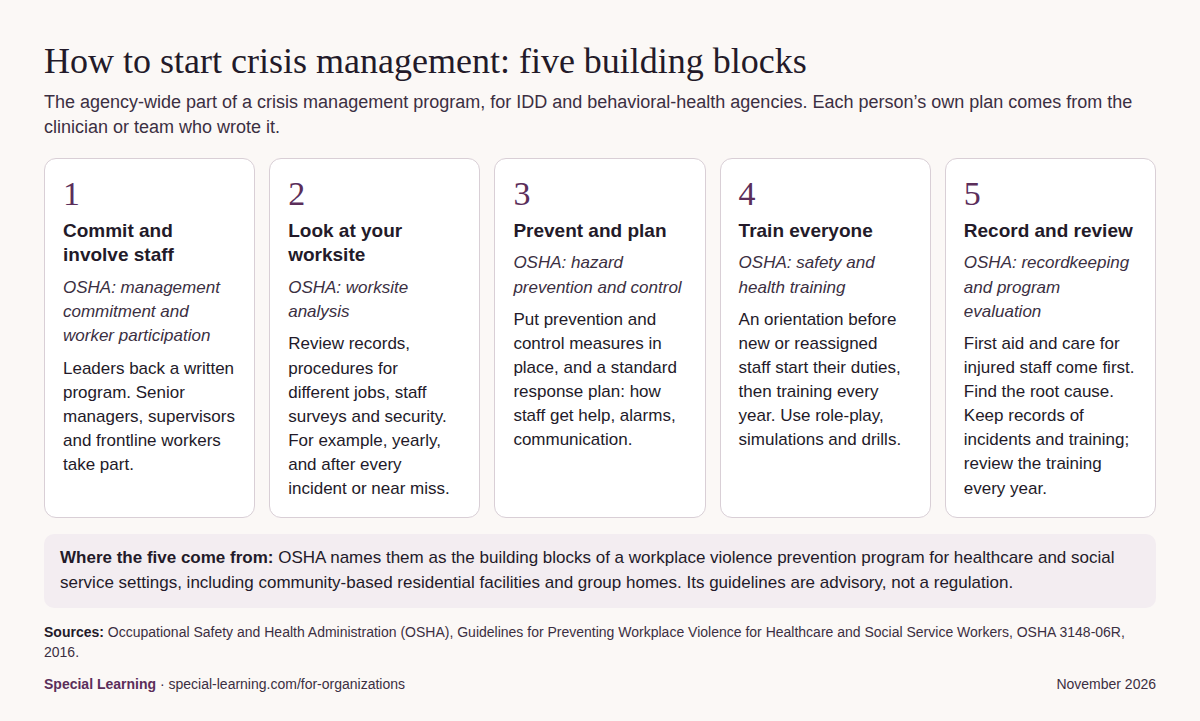
A crisis management program has two parts: an agency-wide safety program, and each person’s own plan from the clinician or team who wrote it. For the agency part, start with OSHA’s five building blocks of a violence prevention program for healthcare and social service settings, including group homes and community mental health clinics. OSHA’s guidelines are advisory, not a regulation (OSHA, 2016).
- Commit and involve staff (OSHA: management commitment and worker participation). Leaders back a written program; managers, supervisors and frontline staff take part.
- Look at your worksite (OSHA: worksite analysis). Records, procedures for different jobs, staff surveys and security.
- Prevent and plan (OSHA: hazard prevention and control). Prevention measures and a standard way for staff to get help.
- Train everyone (OSHA: safety and health training). Before staff start their duties and every year, with hands-on practice.
- Record and review (OSHA: recordkeeping and program evaluation). After every incident, and once a year.
For the people you support, each person’s own plan comes first, written by the clinician or team responsible for it. In an ICF/IID, less intrusive or more positive approaches must be tried systematically, and shown not to work, before more restrictive techniques are used (42 CFR 483.450(b)(1)(iii)). In home and community-based settings, each person has the right to “freedom from coercion and restraint” (42 CFR 441.301(c)(4)(iii)).
Why it matters
Health care and social assistance has the most injuries from violence at work
In 2021 and 2022, health care and social assistance had the highest rate of injuries from violence by another person that needed time away from work, job restriction or transfer: 14.2 a year per 10,000 full-time workers, against 2.9 across private industry. That sector had 72.8% of all such cases in private industry, 41,960 over the two years (BLS, 2024). In 2018, counting only injuries that needed days away from work, the rate per 10,000 full-time workers was 21.1 in nursing and residential care facilities and 12.4 in social assistance, against 2.1 across private industry (BLS, 2020). These figures do not say who caused an injury or why.

Free checklist
The crisis management starter checklist
Tick each item as it is in place. The boxes work on screen; print the page for a paper copy for your team meeting. Nothing you tick is saved or sent.

Questions
Starting crisis management: common questions
Is OSHA’s workplace violence guidance a law?
No. OSHA calls its guidelines “advisory in nature and informational in content”; they are not a standard or regulation and create no new legal obligations (OSHA, 2016). Employers still have to follow OSHA standards and the OSH Act’s General Duty Clause, Section 5(a)(1), and OSHA asks agencies to check their own state’s requirements. For state-required DSP training topics and hours, see the state DSP training finder.
How often should staff get crisis training?
OSHA’s guidelines say new and reassigned workers should have an orientation before they start their duties, all workers should be trained every year, and high-risk settings may need refreshers more often, “perhaps monthly or quarterly.” Training should include role-play, simulations and drills, and OSHA says de-escalation and self-defense training should include a hands-on component (OSHA, 2016). Those are taught by qualified trainers, in line with each person’s plan.
Who writes the crisis plan for a person we support?
The clinician or team responsible for that person’s plan. In an ICF/IID, the use of systematic interventions must be incorporated into the person’s individual program plan (42 CFR 483.450(b)(4)). In home and community-based settings, each person has the right to “freedom from coercion and restraint” (42 CFR 441.301(c)(4)(iii)). Staff then train on the person’s plan and follow it.
What should we track to know the program is working?
Keep records of incidents, near misses, injuries, corrective actions and training, and review them for patterns by location, job or department. At least once a year, review the training’s content, methods and frequency, using supervisor and employee interviews, testing and observation (OSHA, 2016).
Sources
Read November 15, 2026. Figures and rules are quoted as published; the checklist wording is ours.
- Occupational Safety and Health Administration, Guidelines for Preventing Workplace Violence for Healthcare and Social Service Workers, OSHA 3148-06R, 2016. https://www.osha.gov/sites/default/files/publications/osha3148.pdf
- U.S. Bureau of Labor Statistics, “Workplace Violence 2021 - 2022” fact sheet, last modified October 8, 2024. https://www.bls.gov/iif/factsheets/workplace-violence-2021-2022.htm
- U.S. Bureau of Labor Statistics, “Workplace Violence in Healthcare, 2018,” April 2020, Table 1. https://www.bls.gov/iif/factsheets/workplace-violence-healthcare-2018.htm
- National Alliance for Direct Support Professionals (NADSP), Competency Areas, area 10: Crisis Prevention and Intervention. https://nadsp.org/resources/competency-areas/
- 42 CFR 483.430(e), Intermediate care facilities for individuals with intellectual disabilities (ICF/IID): staff training program. https://www.ecfr.gov/current/title-42/section-483.430
- 42 CFR 483.450, ICF/IID: client behavior and facility practices. https://www.ecfr.gov/current/title-42/section-483.450
- 42 CFR 441.301(c)(4), Home and community-based services: settings requirements and plan modifications. https://www.ecfr.gov/current/title-42/section-441.301