
Free forms and downloads for QIDPs, program managers and human rights committee chairs
Human rights committee review packet for IDD providers: a free referral form, review checklist and decision record
Before a team limits a person’s rights or uses a restrictive intervention, some providers, and some states, send the proposal to a human rights committee. This free packet has a referral form to fill in with the person, a committee review checklist built on the text of the federal requirements (the ICF/IID committee condition at 42 CFR 483.440(f)(3), the behavior-management standards at 483.450, and the eight items of the HCBS settings rule at 441.301(c)(4)(vi)(F)), and a meeting minutes and decision record with review and end dates. One worked example uses an invented person, with her own words. Each state and agency sets its own committee rules.
Special Learning · November 16, 2026
Free download
Download the referral form, checklist and decision record
Short answer
What does a human rights committee review, and what does the packet do?
Read
A human rights committee looks at a proposed limit on a person’s rights, or a restrictive intervention, before it starts. This packet has three free forms: a referral form the QIDP or program manager fills in with the person, a committee review checklist built on the federal text, and a meeting minutes and decision record with review and end dates. For an ICF/IID, 42 CFR 483.440(f)(3) says the facility must use a specially constituted committee. For a provider-owned or controlled home under an HCBS waiver, 42 CFR 441.301(c)(4)(vi)(F) lists eight items to document in the person-centered service plan for a modification of conditions (A) to (D). This page summarizes the federal rules; your state and your agency’s policies set what applies. Each state and agency sets its own committee rules.
This page is a planning aid built on the sources below. It does not replace your state’s forms, your agency’s policies or your committee’s own process.
The federal text
What the federal rules say about committees and restrictions
| Rule | What it says (exact text in quotation marks) | How the packet uses it |
|---|---|---|
| 42 CFR 483.440(f)(3), the committee (42 CFR 483.440) | The facility must “designate and use a specially constituted committee or committees consisting of members of facility staff, parents, legal guardians, clients (as appropriate), qualified persons who have either experience or training in contemporary practices to change inappropriate client behavior, and persons with no ownership or controlling interest in the facility.” | Checklist section A checks who sits on the committee. The regulation’s own term “inappropriate behavior” is quoted as written. |
| (f)(3)(i), what it reviews (42 CFR 483.440) | The committee is to “Review, approve, and monitor individual programs designed to manage inappropriate behavior and other programs that, in the opinion of the committee, involve risks to client protection and rights.” | The referral form asks for the program and what it would limit; checklist section B. |
| (f)(3)(ii), consent (42 CFR 483.440) | The committee is to “Insure that these programs are conducted only with the written informed consent of the client, parent (if the client is a minor), or legal guardian.” | The referral form records how consent was sought; the decision record confirms it. |
| (f)(3)(iii), practices and programs (42 CFR 483.440) | The committee is to “Review, monitor and make suggestions to the facility about its practices and programs as they relate to drug usage, physical restraints, time-out rooms, application of painful or noxious stimuli, control of inappropriate behavior, protection of client rights and funds, and any other area that the committee believes need to be addressed.” | The minutes have a place for suggestions to the facility. |
| (f)(4), state variation (42 CFR 483.440) | The committee provisions “may be modified only if, in the judgment of the State survey agency, Court decrees, State law or regulations provide for equivalent client protection and consultation.” | One reason to check your state’s rule before you adopt any form. |
| 42 CFR 483.450(b)(1)(iii), less intrusive first (42 CFR 483.450) | The facility’s procedures must “Insure, prior to the use of more restrictive techniques, that the client’s record documents that programs incorporating the use of less intrusive or more positive techniques have been tried systematically and demonstrated to be ineffective.” | Referral items 7 and 8; checklist section C. |
| 483.450(b)(2), safeguards (42 CFR 483.450) | Interventions “must be employed with sufficient safeguards and supervision to ensure that the safety, welfare and civil and human rights of clients are adequately protected.” | Checklist section C. |
| 483.450(b)(3) and (b)(5), never allowed (42 CFR 483.450) | The rule lists uses that are never allowed, including that techniques “must never be used for disciplinary purposes, for the convenience of staff”. It also says “Standing or as needed programs to control inappropriate behavior are not permitted.” | Checklist section C. |
| 42 CFR 441.301(c)(4)(vi)(F), HCBS rights modifications (42 CFR 441.301(c)(4)(vi)(F)) | In a provider-owned or controlled residential setting, a modification of conditions (A) through (D) “must be supported by a specific assessed need and justified in the person-centered service plan,” and eight items must be documented in that plan. The text we read does not mention a committee. | Checklist section D carries the eight items word for word; the referral form asks for each one in our own words. Some states route such reviews through a committee; see the state examples. |
Both federal texts were read on ecfr.gov, current as of November 12, 2026. The ICF/IID text (483.440 and 483.450) applies to ICF/IID. The HCBS settings text (441.301) applies to Medicaid HCBS waivers. Which one applies to your program is a question for your state and your agency. The same sections are on eCFR as XML: 483.440, 483.450 and 441.301 (current to November 12, 2026).

Which rule applies to you?
| When | Use |
|---|---|
| Your program is an ICF/IID | The federal condition at 42 CFR 483.440(f)(3) requires a specially constituted committee, and 483.450 sets the behavior-management standards. Use all three forms. |
| Your program is a provider-owned or controlled home under an HCBS waiver, and the team may limit condition (A), (B), (C) or (D) | The eight items in 441.301(c)(4)(vi)(F) must be documented in the person-centered service plan. Your state may send the proposal to a committee. Use the referral form and checklist section D. |
| A behavior support plan includes a restrictive intervention, or any plan would limit a person’s rights | Check your state and agency policy for the review it requires. Use the referral form to prepare, and the checklist and decision record if you have a committee. |
| Someone is in immediate danger | Follow your emergency and reporting process first. Use the packet afterward. |

Part 1
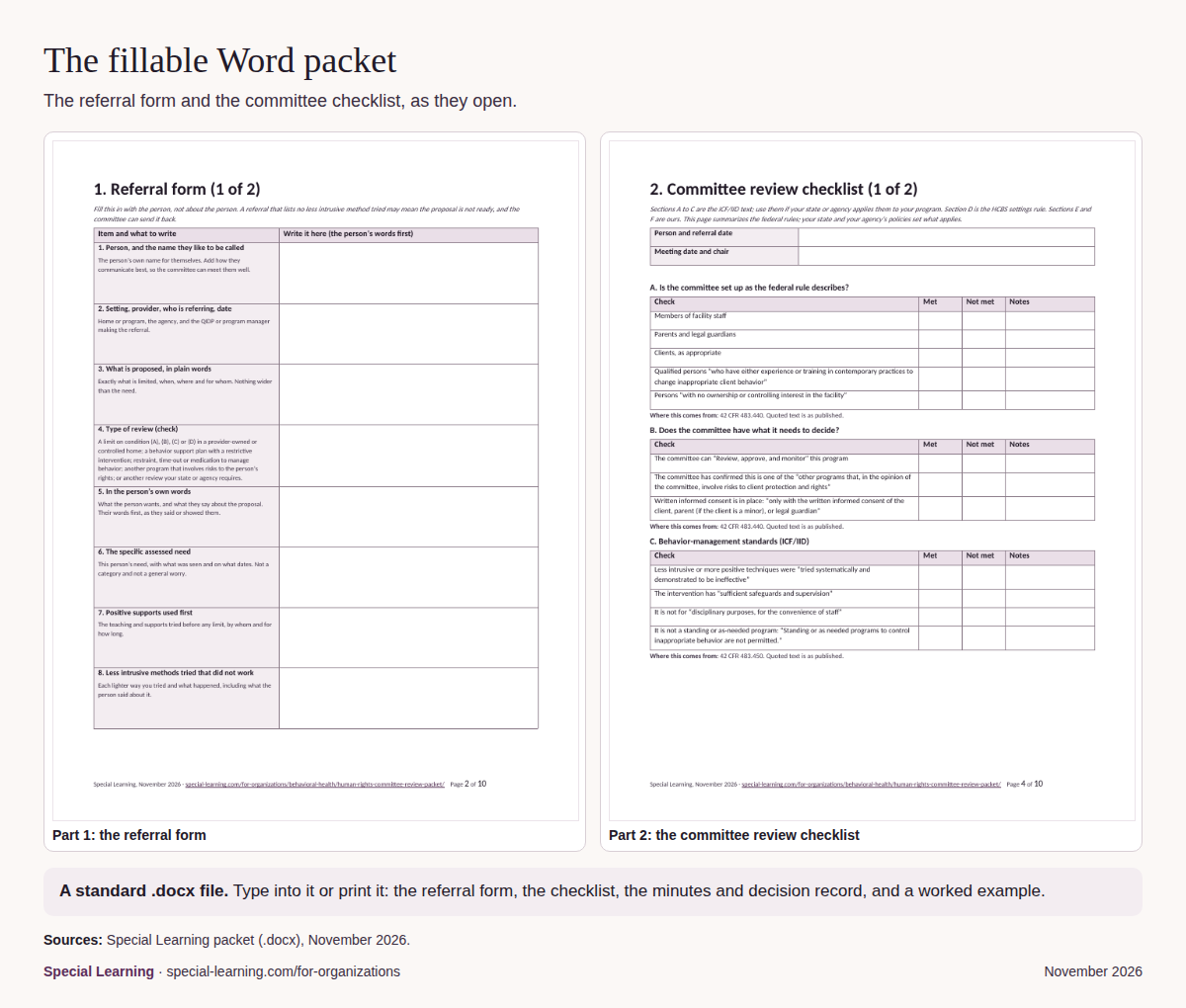
Part 1: the referral form
A QIDP or program manager fills this in with the person. Write the person’s words first. To learn what the person likes and how they say yes and no, see the preference and choice record and the one-page profile template. For a choice that carries risk but does not limit a right, see the dignity of risk worksheet. Fill this in with the person, not about the person. A referral that lists no less intrusive method tried may mean the proposal is not ready, and the committee can send it back.
| Item | What to write (our prompt) |
|---|---|
| 1. Person, and the name they like to be called | The person’s own name for themselves. Add how they communicate best, so the committee can meet them well. |
| 2. Setting, provider, who is referring, date | Home or program, the agency, and the QIDP or program manager making the referral. |
| 3. What is proposed, in plain words | Exactly what is limited, when, where and for whom. Nothing wider than the need. |
| 4. Type of review (check) | A limit on condition (A), (B), (C) or (D) in a provider-owned or controlled home; a behavior support plan with a restrictive intervention; restraint, time-out or medication to manage behavior; another program that involves risks to the person’s rights; or another review your state or agency requires. |
| 5. In the person’s own words | What the person wants, and what they say about the proposal. Their words first, as they said or showed them. |
| 6. The specific assessed need | This person’s need, with what was seen and on what dates. Not a category and not a general worry. |
| 7. Positive supports used first | The teaching and supports tried before any limit, by whom and for how long. |
| 8. Less intrusive methods tried that did not work | Each lighter way you tried and what happened, including what the person said about it. |
| 9. Why the limit is no wider than the need | What is limited, and what stays the same: the person’s choices, places, people and routines that are not part of the need. |
| 10. Data and review | What you will record, who reviews it, how often, and what the person says about how it is going. |
| 11. Review dates and end | The first review date, later review dates, and what would end the limit. Write an end date or an end condition. |
| 12. Informed consent | How the person was told and in what form, what they said, how they show agreement, and the role of a guardian or authorized representative under your state’s rules. |
| 13. No-harm check | Who is responsible for checking that the limit itself is not causing harm, and how. |
| 14. Emergency use | Is any part of this an emergency measure? If so, follow your emergency and reporting process and your state’s rules, and note it here. |
| 15. How the person will take part | Come to the meeting, send someone they choose, or share their view another way. Who they want beside them. What support they need to take part. |
| 16. Attached | The plan, assessment, data, consent record and the person’s profile or preference record if you have them. |

Part 2
Part 2: the committee review checklist
Sections A to C are the ICF/IID text; use them if your state or agency applies them to your program. Section D is the HCBS settings rule. Sections E and F are ours. This page summarizes the federal rules; your state and your agency’s policies set what applies.
A. Is the committee set up as the federal rule describes? (42 CFR 483.440)
- Members of facility staff
- Parents and legal guardians
- Clients, as appropriate
- Qualified persons “who have either experience or training in contemporary practices to change inappropriate client behavior”
- Persons “with no ownership or controlling interest in the facility”
B. Does the committee have what it needs to decide? (42 CFR 483.440)
- The committee can “Review, approve, and monitor” this program
- The committee has confirmed this is one of the “other programs that, in the opinion of the committee, involve risks to client protection and rights”
- Written informed consent is in place: “only with the written informed consent of the client, parent (if the client is a minor), or legal guardian”
C. Behavior-management standards (ICF/IID) (42 CFR 483.450)
- Less intrusive or more positive techniques were “tried systematically and demonstrated to be ineffective”
- The intervention has “sufficient safeguards and supervision”
- It is not for “disciplinary purposes, for the convenience of staff”
- It is not a standing or as-needed program: “Standing or as needed programs to control inappropriate behavior are not permitted.”
D. For a rights modification in a provider-owned or controlled home: the eight items, exact text (42 CFR 441.301(c)(4)(vi)(F))
- (1) Identify a specific and individualized assessed need.
- (2) Document the positive interventions and supports used prior to any modifications to the person-centered service plan.
- (3) Document less intrusive methods of meeting the need that have been tried but did not work.
- (4) Include a clear description of the condition that is directly proportionate to the specific assessed need.
- (5) Include regular collection and review of data to measure the ongoing effectiveness of the modification.
- (6) Include established time limits for periodic reviews to determine if the modification is still necessary or can be terminated.
- (7) Include the informed consent of the individual.
- (8) Include an assurance that interventions and supports will cause no harm to the individual.
E. The person’s voice and dignity (our additions)
- The person’s own words are in the referral and in the minutes
- The person was invited, and supported to take part in the way that works for them
- The record says what the person can still do and choose
- The limit is described in terms of the need, not of the person
- Our addition, drawing on New York’s recusal rule: members who deliver this person’s services step out for this review (check your state)
F. Decision and follow-up (our additions)
- The decision is one of: approve as proposed, approve with changes, not approved, more information needed, or withdrawn
- Conditions are written down
- A review date and an end date or end condition are set, and checked against your state’s limits
- Someone is named to bring it back, with the data and what the person says
- Dissent is recorded

The eight HCBS items, with where the referral form asks for each
The rule says: “Any modification of the additional conditions, under § 441.301(c)(4)(vi)(A) through (D), must be supported by a specific assessed need and justified in the person-centered service plan. The following requirements must be documented in the person-centered service plan:” (42 CFR 441.301(c)(4)(vi)(F))
| No. | The rule says (exact text) | On the referral form |
|---|---|---|
| 1 | Identify a specific and individualized assessed need. | Referral item 6. |
| 2 | Document the positive interventions and supports used prior to any modifications to the person-centered service plan. | Referral item 7. |
| 3 | Document less intrusive methods of meeting the need that have been tried but did not work. | Referral item 8. |
| 4 | Include a clear description of the condition that is directly proportionate to the specific assessed need. | Referral items 3 and 9. |
| 5 | Include regular collection and review of data to measure the ongoing effectiveness of the modification. | Referral item 10. |
| 6 | Include established time limits for periodic reviews to determine if the modification is still necessary or can be terminated. | Referral item 11. |
| 7 | Include the informed consent of the individual. | Referral item 12. |
| 8 | Include an assurance that interventions and supports will cause no harm to the individual. | Referral item 13. |

These eight items apply to conditions (A) through (D) in provider-owned or controlled residential settings. (42 CFR 441.301(c)(4)(vi)(F)) For the rest of the person’s plan, see the behavior support plan implementation checklist, the HCBS waiver provider staff training checklist and the crisis plan template.
Part 3
Part 3: the meeting minutes and decision record
Keep the minutes in the form your state or agency requires. Massachusetts, for example, says “Minutes of the committee meetings shall be kept.” (Massachusetts 115 CMR 3.09) The record has five outcomes: approve as proposed, approve with changes, not approved, more information needed, withdrawn by the team. Every approval gets a review date and an end date or end condition.
| Item | What to write |
|---|---|
| Meeting date, time, place, chair | Who ran the meeting. |
| Members present | Name and role. Mark members who are independent of the provider and members who step out because they support this person. |
| Quorum | Your state or agency sets it (New York, for example, requires three members present). Write how many were present and what your rule says. |
| The person | Did the person take part, and how? What did they say? Who was with them? |
| What was reviewed | The referral, with the date and the program or limit. |
| Discussion | Key questions the committee asked, what the team answered, and anything the committee noticed. |
| Decision (check one) | ☐ Approve as proposed ☐ Approve with changes ☐ Not approved ☐ More information needed ☐ Withdrawn by the team |
| Conditions | What must be true for the approval to stand: narrower wording, a supports change, a date to report back. |
| Consent confirmed | Who gave it, in what form, and the date. Written informed consent, as your state requires. |
| Data to bring back | What the committee wants to see, who brings it, and when. |
| Review date | The date the committee will look at it again. |
| End date or end condition | When the limit stops unless the committee renews it, or what would end it. |
| Suggestions to the provider | Anything about practices or programs more widely. |
| Dissent or concerns | Any member’s concern, in their words. |
| Copies to | The person, a guardian or representative, the QIDP or program manager, the record. |

Worked example
A worked example, with an invented person
Ines (invented), 44, lives in a provider-owned four-person group home. She likes to cook and to sit in the kitchen with her housemates in the evening. Condition (C): access to food at any time. The team first proposed a lock on the pantry and refrigerator from 9 PM to 6 AM. Invented to show the layout, with invented dates, numbers and people. It is not advice for any real person’s plan.
The referral
| Item | What we wrote |
|---|---|
| Person | Ines, 44, who uses spoken language and likes to talk things through with her support worker, Dee. |
| What is proposed | A lock on the pantry and refrigerator from 9 PM to 6 AM. |
| Type of review | A limit on condition (C), access to food at any time. |
| In Ines’s words | “I get hungry at night. I want to pick my snacks. I don’t want a lock on my kitchen. I know my sugar was high.” |
| Specific assessed need | On three evenings in October (October 6, 13 and 20), Ines ate a large amount of sweets after 10 PM, and her morning readings were above the range her doctor gave her. Her doctor asked the team to help plan evening snacks. |
| Positive supports used first | Ines picked a snack list with Dee, took an evening walk after dinner with a housemate, and used a picture snack plan on the refrigerator. Her doctor reviewed the snack list. |
| Less intrusive methods tried | A reminder text at 9 PM for three weeks. On 5 of 12 nights the sweets were still eaten after 10 PM. Ines said the reminders felt like being watched. |
| Why it is no wider than the need | The lock covers the whole kitchen, which is wider than the need. The committee asked whether a smaller step would do. |
| Data and review | Ines ticks her snacks on a sheet with Dee. Her morning readings go to her doctor each month. |
| Review and end | First review in 30 days. It ends when Ines and her doctor agree it is no longer needed. (These numbers are invented; your state may set its own interval.) |
| Informed consent | Told at a team meeting with pictures. Ines said no to the lock and yes to a plan with her own snacks. She makes her own decisions; no guardian. |
| No-harm check | The service coordinator checks that Ines still cooks and sits in the kitchen with her housemates, and that she is not skipping meals. |
| How Ines takes part | She comes to the committee with Dee and speaks for herself. |

The decision record
| Item | What we wrote |
|---|---|
| Meeting | November 12, 2026 (invented). Chair: a self-advocate member. Five members present; the member who supports Ines stepped out. |
| The person | Ines came with Dee. She said: “I’d rather have my own bin than a lock.” She told the committee which snacks she wants in it. |
| Discussion | The committee asked the team why a lock on the whole kitchen was needed when the concern was evening sweets. The team agreed a lock was wider than the need. A night snack bin in Ines’s room, stocked with snacks she picks, was proposed. |
| Decision | Not approved: the lock. The kitchen stays open. Ines has a night snack bin in her room with snacks of her choosing, including sweets. This does not limit a right, so no limit is recorded. |
| Conditions | The team brings the snack sheet and Ines’s readings to the committee in 30 days. If anyone proposes a limit later, it comes back as a new referral. |
| Consent confirmed | Ines agreed to the snack bin plan in her own words, with Dee as witness, on November 12. |
| Review date | December 12, 2026, with Ines present. |
| End date or condition | No limit was imposed, so there is nothing to end. The snack plan is looked at with Ines every month. |
| Dissent | One member would have preferred a pantry lock for 30 days. Recorded. |
| Copies to | Ines, Dee, the program manager, the record. |

State examples
Three states’ committee rules
| State and document | What it says | How we use it |
|---|---|---|
| Virginia, 12VAC35-115-100 (DBHDS human rights regulations) (Virginia 12VAC35-115-100) | Providers “shall not limit or restrict any individual’s freedom more than is needed to achieve a therapeutic benefit, maintain a safe and orderly environment, or intervene in an emergency.” Providers “shall obtain approval of the LHRC of any restriction imposed on an individual’s rights under this subsection or 12VAC35-115-50 that lasts longer than seven days or is imposed three or more times during a 30-day time period.” A qualified professional “regularly reviews the restriction and that the restriction is discontinued when the individual has met the criteria for removal.” | Shows a state that sets a time trigger for committee approval and requires a review and criteria for removal. “LHRC” is Virginia’s local human rights committee. |
| Massachusetts, 115 CMR 3.09 and 5.14 (DDS) (Massachusetts 115 CMR 3.09; Massachusetts 115 CMR 5.14) | “Each human rights committee shall be composed of a minimum of five members”, and “at least three of the members shall be individuals receiving services or supports provided, purchased, or arranged by the Department, or parents or guardians of, or advocates for, such individuals.” The committee “shall meet as often as necessary upon call of the chairperson, or upon request of any two members, but no less than quarterly.” “New PBSPs containing restrictive procedures shall be submitted to the program’s human rights committee”, and review of an existing plan shall occur “at least annually.” | Shows a state that sets committee size, who must be members, how often to meet and when a behavior support plan goes to the committee. Our copy is from the Cornell Legal Information Institute. |
| New York, 14 NYCRR 633.16(f) (OPWDD) (New York 14 NYCRR 633.16(f)) | Before a proposed behavior support plan is implemented, “the committee shall approve or refuse to approve, in writing” plans that limit a person’s rights or use restrictive or intrusive interventions (the rule has an exception for monitoring plans in which medication is used solely for the treatment of a co-occurring diagnosed psychiatric disorder). Plans are “approved for a time period not to exceed one year and are based on the needs of the person.” A committee “must have a minimum of four members”, and “A committee member must recuse himself/herself from reviewing a plan for a person for whom he/she is actively involved in the delivery of services.” The committee “must have a minimum of three members present to proceed with its deliberations.” | Shows a state that requires approval in writing, a maximum approval period, recusal and a quorum. Our copy is from the Cornell Legal Information Institute. |

We read three states’ published rules and quote only what they say. Other states differ, and rules change. Look up your own state’s rule for human rights committees before you adopt any form.
Virginia’s regulations also have sections on use of seclusion, restraint, and time out (12VAC35-115-110) and local human rights committee hearing and review procedures (12VAC35-115-180), which we did not summarize. Massachusetts’s committee rule is 115 CMR 3.09.
How to use it
Eight steps, from the person’s words to a date to look again
- Find out what applies: your state’s committee rule, your agency’s policy, and whether your program is an ICF/IID or an HCBS provider-owned or controlled home.
- Open the referral form with the person. Write their words first, and ask how they want to take part.
- Fill in the need, the supports and less intrusive methods tried, how narrow the limit is, and the data plan.
- Write review dates and an end date or end condition before the form goes to the committee.
- Send the referral and attachments to the chair in the time your agency sets.
- At the meeting, use the checklist section by section. Invite the person to speak first.
- Record the decision, conditions, consent and dissent in the minutes. Give the person a copy in a form they can use.
- Put the review date on the calendar, and bring the data and the person’s view back on that date.
| When | What to do |
|---|---|
| Before | Ask the person when and where they want to meet, and who they want with them. Send the referral to the chair in plain language. |
| During | The person speaks first if they want to. Committee members ask questions in plain language and give the person time. |
| After | Give the person and the team a copy of the decision. Calendar the review date. |
| At the review | Look at the data and what the person says. Sometimes the limit can be narrowed or ended; sometimes the plan changes. |
For the NADSP Code of Ethics tenets that sit behind this, see our NADSP Code of Ethics onboarding guide. For reporting concerns, see the abuse and neglect reporting training.
What the sources say
What the federal rules and three states say
| Source | What it says | How we use it |
|---|---|---|
| 42 CFR 483.440(f)(3) (42 CFR 483.440) | ICF/IID: the facility must “designate and use a specially constituted committee or committees”, with members from staff, parents, legal guardians, clients (as appropriate), qualified persons and persons with no ownership or controlling interest. | Checklist section A. |
| 42 CFR 483.450(b) (42 CFR 483.450) | ICF/IID behavior management: less intrusive techniques “tried systematically and demonstrated to be ineffective” before more restrictive ones, and “Standing or as needed programs to control inappropriate behavior are not permitted.” | Checklist section C. |
| 42 CFR 441.301(c)(4)(vi)(F) (42 CFR 441.301(c)(4)(vi)(F)) | HCBS: modification of conditions (A) to (D) in a provider-owned or controlled residential setting needs “a specific assessed need” and eight items documented in the plan. | Checklist section D and the referral form. |
| Virginia 12VAC35-115-100 (Virginia 12VAC35-115-100) | Committee approval for a restriction “that lasts longer than seven days or is imposed three or more times during a 30-day time period.” | An example of a state time trigger. |
| Massachusetts 115 CMR 3.09, 5.14 (Massachusetts 115 CMR 3.09; Massachusetts 115 CMR 5.14) | Committee of at least five members, “at least three” of them people served, family or advocates; meets “no less than quarterly”; reviews plans with restrictive procedures “at least annually.” | An example of state committee rules. |
| New York 14 NYCRR 633.16(f) (New York 14 NYCRR 633.16(f)) | Approves “in writing”; approval “not to exceed one year”; recusal; “a minimum of three members present.” | An example of written approval, a maximum period and a quorum. |
We read the federal rules on ecfr.gov (current as of November 12, 2026) and three states’ published rules, and we quote only what they say. State rules differ and change. We did not find a study that tests these forms; the referral form, the checklist wording that is not quoted, the minutes form and the worked example are our own planning aid. Nobody named here has reviewed or endorsed it.
The checklist
Before it goes to the committee
- The person’s own words are in the referral.
- The assessed need is specific to this person, with dates.
- Positive supports and less intrusive methods are written down, with what happened.
- The limit is described in plain words and is no wider than the need.
- There is a data plan, and it includes what the person says.
- Review dates and an end date or end condition are written.
- Consent is recorded, in the form your state requires.
- The person has been invited and supported to take part.
- The minutes record the decision, conditions, dissent and who brings it back.

On paper
Prefer paper? Print the PDF
The printable PDF has the same ten pages as the Word file, with write-in space in the referral form, the checklist and the minutes.

Questions
Human rights committees for IDD providers: common questions
What is a human rights committee?
It is a committee that reviews, before they start, programs or plans that limit a person’s rights or use restrictive interventions. For ICF/IID, the federal rule says the facility must “designate and use a specially constituted committee or committees” made up of staff, parents, legal guardians, clients (as appropriate), qualified persons and persons with no ownership or controlling interest in the facility. (42 CFR 483.440) Each state and agency sets its own committee rules.
Does federal law require a human rights committee?
For an ICF/IID, 42 CFR 483.440(f)(3) says the facility must use a specially constituted committee. (42 CFR 483.440) Paragraph (f)(4) says that provision “may be modified only if, in the judgment of the State survey agency, Court decrees, State law or regulations provide for equivalent client protection and consultation.” (42 CFR 483.440) The HCBS settings rule, 441.301(c)(4)(vi)(F), requires eight items to be documented in the person-centered service plan, and the text we read does not mention a committee. (42 CFR 441.301(c)(4)(vi)(F)) Some states route those reviews through one. Ask your state.
Who should sit on the committee?
For an ICF/IID, the federal rule lists facility staff, parents, legal guardians, clients (as appropriate), qualified persons and persons with no ownership or controlling interest in the facility. (42 CFR 483.440) Massachusetts requires at least five members, with at least three of them people served, family or advocates. (Massachusetts 115 CMR 3.09) New York requires at least four members, including a licensed psychologist or behavioral intervention specialist, a licensed clinician, and an additional party who may be someone advocating for a person’s rights, or a person with a developmental disability, a guardian or a family member. (New York 14 NYCRR 633.16(f)) We suggest including people with disabilities where your rules allow it.
When should a proposal go to the committee?
The federal ICF/IID rule covers “individual programs designed to manage inappropriate behavior and other programs that, in the opinion of the committee, involve risks to client protection and rights.” (42 CFR 483.440) States add their own triggers. Virginia, for example, requires committee approval of a restriction “that lasts longer than seven days or is imposed three or more times during a 30-day time period.” (Virginia 12VAC35-115-100) Ask your committee and your state what goes to it.
What are the eight items for a rights modification?
Under 42 CFR 441.301(c)(4)(vi)(F), the requirements to document in the person-centered service plan are: (1) “Identify a specific and individualized assessed need.” (2) “Document the positive interventions and supports used prior to any modifications to the person-centered service plan.” (3) “Document less intrusive methods of meeting the need that have been tried but did not work.” (4) “Include a clear description of the condition that is directly proportionate to the specific assessed need.” (5) “Include regular collection and review of data to measure the ongoing effectiveness of the modification.” (6) “Include established time limits for periodic reviews to determine if the modification is still necessary or can be terminated.” (7) “Include the informed consent of the individual.” (8) “Include an assurance that interventions and supports will cause no harm to the individual.” (42 CFR 441.301(c)(4)(vi)(F))
What can a committee decide?
That is for your state and agency. New York’s rule says the committee “shall approve or refuse to approve, in writing.” (New York 14 NYCRR 633.16(f)) Our decision record offers five outcomes: approve as proposed, approve with changes, not approved, more information needed, and withdrawn by the team. Approving with changes can mean the lightest way to meet the need, as in the worked example.
How long can an approval last, and how often is it reviewed?
It depends on your state. New York’s rule says plans are “approved for a time period not to exceed one year.” (New York 14 NYCRR 633.16(f)) Massachusetts says review of an existing plan with restrictive procedures shall occur “at least annually.” (Massachusetts 115 CMR 5.14) The HCBS rule asks for “established time limits for periodic reviews” and gives no number of days. (42 CFR 441.301(c)(4)(vi)(F)) The 30 days in our example are invented. Write a review date and an end date or end condition on every approval.
Should the person be at the meeting?
The federal ICF/IID rule names “clients (as appropriate)” as possible committee members. (42 CFR 483.440) Massachusetts requires at least three members to be people served, family or advocates. (Massachusetts 115 CMR 3.09) We recommend inviting the person, asking how they want to take part, and recording their own words. The referral form and the minutes have a place for both.
What about an emergency?
Follow your emergency and reporting process first. For an ICF/IID, the federal rule allows physical restraint “As an emergency measure, but only if absolutely necessary to protect the client or others from injury.” (42 CFR 483.450) Your state sets what happens next. Use this packet for planned programs and limits.
Does this replace our state or agency forms?
No. Use your state’s and your agency’s forms where they require one. This packet is a way to prepare, and its checklist is built on the federal text. This page summarizes the federal rules; your state and your agency’s policies set what applies.
Sources
Sources read November 16, 2026 (the federal text is current as of November 12; the Massachusetts and New York texts are from the Cornell Legal Information Institute, so check the agency’s current text). The quoted lines are as published. The referral prompts, the checklist wording that is not in quotation marks, the minutes form, the worked example and the checklist are ours. 42 CFR 483.440 and 483.450 apply to ICF/IID; 441.301 covers Medicaid home and community-based services waivers. This page summarizes the federal rules; your state and your agency’s policies set what applies. Each state and agency sets its own committee rules. Nobody named on this page has reviewed or endorsed the packet.
- Electronic Code of Federal Regulations, Title 42, section 483.440, Condition of participation: Active treatment services, paragraph (f)(3) and (f)(4); text current as of November 12, 2026. It governs intermediate care facilities for individuals with intellectual disabilities (ICF/IID). https://www.ecfr.gov/current/title-42/section-483.440
- Electronic Code of Federal Regulations, Title 42, section 483.450, Condition of participation: Client behavior and facility practices, paragraphs (b) and (d); text current as of November 12, 2026. It governs ICF/IID. https://www.ecfr.gov/current/title-42/section-483.450
- Electronic Code of Federal Regulations, Title 42, section 441.301, Contents of request for a waiver, paragraph (c)(4)(vi); text current as of November 12, 2026. It governs Medicaid home and community-based services (HCBS) waivers. https://www.ecfr.gov/current/title-42/chapter-IV/subchapter-C/part-441/subpart-G/section-441.301
- Virginia Administrative Code, 12VAC35-115-100, Restrictions on freedoms of everyday life (Department of Behavioral Health and Developmental Services human rights regulations), as published by the Virginia Law Library, read November 16, 2026. https://law.lis.virginia.gov/admincode/title12/agency35/chapter115/section100/
- Massachusetts Department of Developmental Services regulations, 115 CMR 3.09, Protection of Human Rights/Human Rights Committees, as republished by the Cornell Legal Information Institute, read November 16, 2026; the agency's own copy was not reachable from our server, so check the current text with DDS. https://www.law.cornell.edu/regulations/massachusetts/115-CMR-3-09
- Massachusetts Department of Developmental Services regulations, 115 CMR 5.14, Positive Behavior Supports, paragraph (13), as republished by the Cornell Legal Information Institute, read November 16, 2026; check the current text with DDS. https://www.law.cornell.edu/regulations/massachusetts/115-CMR-5-14
- New York Office for People With Developmental Disabilities regulations, 14 NYCRR 633.16, paragraphs (f) and (g), as republished by the Cornell Legal Information Institute, read November 16, 2026; check the current text with OPWDD. https://www.law.cornell.edu/regulations/new-york/14-NYCRR-633.16