
Free guide and template for DSP supervisors and training leads
One-page profile template
A free guide and template, in Word and as a printable PDF, for the supervisor or training lead at a provider agency. A one-page profile is written by a person with the people who know them best, and new staff read it before their first shift. Here is how to write one in the person’s own words, the three sections, good and weak lines, how to use it in onboarding, at shift change and when the plan is updated, and how to keep it current.
Special Learning · November 16, 2026
Free download
Download the template
Short answer
What is a one-page profile?
Read
A one-page profile is a single page, written with a person and the people who know them best, that says what people like and admire about them, what is important to them and how best to support them, so that someone new can get to know them quickly and learn how to support them the way they want. It matters because a new direct support professional (DSP) can read it in a few minutes before a first shift, and because it keeps the person’s own words and choices at the center of daily support instead of leaving them in a file.
The person is the author. The words in the profile are theirs, and they decide who reads it (our practice: North Carolina’s manual calls the profile a document that belongs to the person, and the NADSP Code of Ethics asks DSPs to ask people with whom they want their information shared) (North Carolina DMH/DD/SAS Person-Centered Planning Instruction Manual (2010 version); NADSP Code of Ethics).
Where it comes from
Credit where it is due
Where it comes from. The one-page profile comes from person-centered thinking. Helen Sanderson writes that she first developed the concept of a one-page profile in 2004 to help improve understanding between her daughter Laura and her teachers at school, and Helen Sanderson Associates now shares 100 profiles and their stories on a dedicated site. North Carolina’s 2010 person-centered planning manual credits “Max Neill / Gill Bailey / Helen Sanderson” and has a section on building a One Page Profile with the same kinds of headings. (One-page profiles: 100 profiles and their stories (Helen Sanderson Associates); North Carolina DMH/DD/SAS Person-Centered Planning Instruction Manual (2010 version))
The three headings. Helen Sanderson Associates’ free guide describes the three sections as what people like and admire about a person, what is important to them and how to support them. (Helen Sanderson Associates, One-Page Profiles: Getting Started)
Where to learn more. For training, the Learning Community for Person Centered Practices (TLC-PCP) lists credentialed Person Centered Thinking trainers. It did not write this page or template. (The Learning Community for Person Centered Practices (TLC-PCP))
What is ours. The template, the questions, the example profile (a made-up person), the example lines and the checklist on this page are Special Learning’s own. We did not copy anyone’s layout, wording or graphics. Their free resources are linked in the sources, and none of these organizations has reviewed or endorsed this page.

How to write one
Write it with the person, in their own words
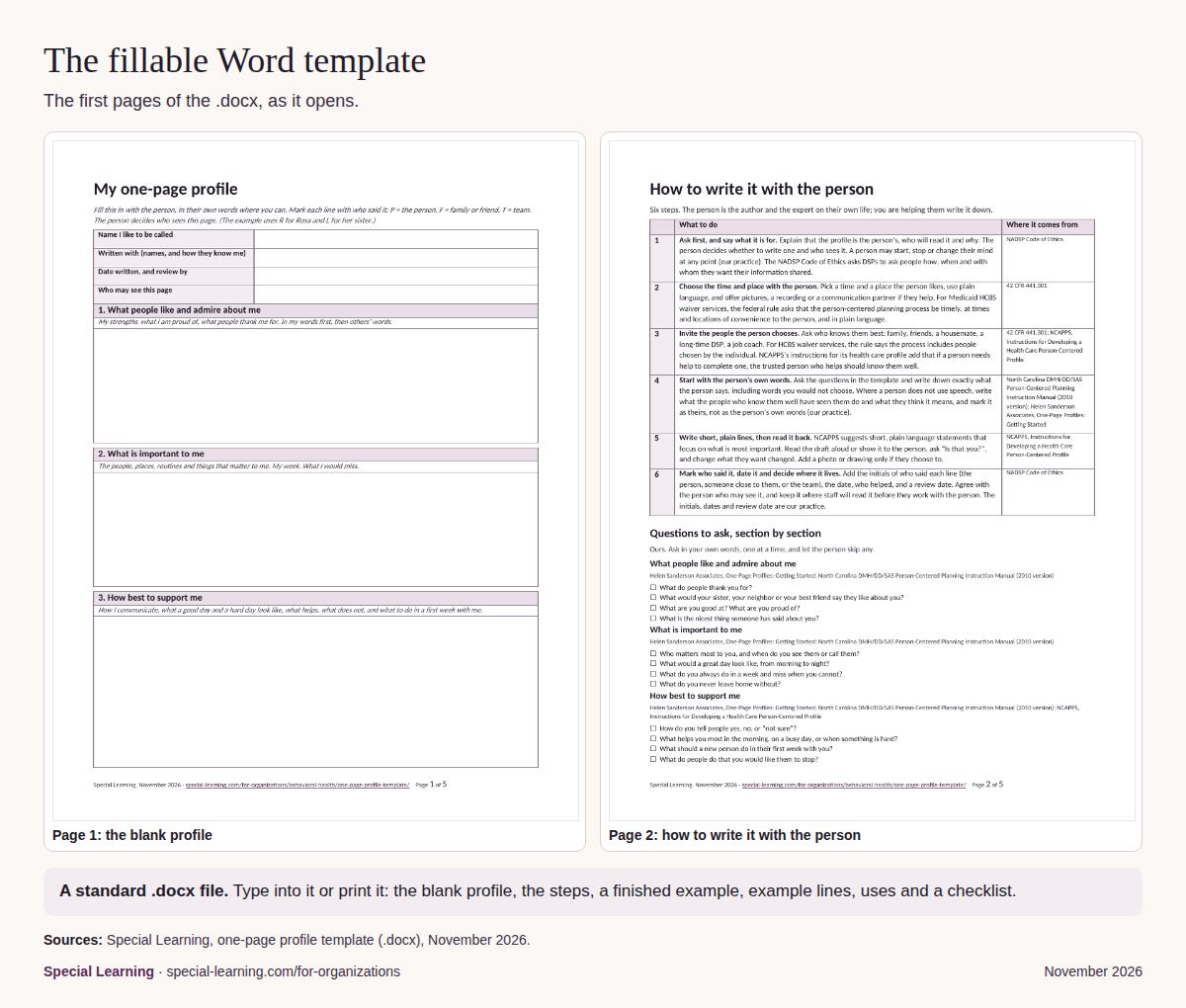
Treat the person as the expert on their own life. You are helping them write it down. Six steps:
- Ask first, and say what it is for. Explain that the profile is the person’s, who will read it and why. The person decides whether to write one and who sees it. A person may start, stop or change their mind at any point (our practice). The NADSP Code of Ethics asks DSPs to ask people how, when and with whom they want their information shared. (NADSP Code of Ethics)
- Choose the time and place with the person. Pick a time and a place the person likes, use plain language, and offer pictures, a recording or a communication partner if they help. For Medicaid HCBS waiver services, the federal rule asks that the person-centered planning process be timely, at times and locations of convenience to the person, and in plain language. (42 CFR 441.301)
- Invite the people the person chooses. Ask who knows them best: family, friends, a housemate, a long-time DSP, a job coach. For HCBS waiver services, the rule says the process includes people chosen by the individual. NCAPPS’s instructions for its health care profile add that if a person needs help to complete one, the trusted person who helps should know them well. (42 CFR 441.301; NCAPPS, Instructions for Developing a Health Care Person-Centered Profile)
- Start with the person’s own words. Ask the questions in the template and write down exactly what the person says, including words you would not choose. Where a person does not use speech, write what the people who know them well have seen them do and what they think it means, and mark it as theirs, not as the person’s own words (our practice). (North Carolina DMH/DD/SAS Person-Centered Planning Instruction Manual (2010 version); Helen Sanderson Associates, One-Page Profiles: Getting Started)
- Write short, plain lines, then read it back. NCAPPS suggests short, plain language statements that focus on what is most important. Read the draft aloud or show it to the person, ask “Is that you?”, and change what they want changed. Add a photo or drawing only if they choose to. (NCAPPS, Instructions for Developing a Health Care Person-Centered Profile)
- Mark who said it, date it and decide where it lives. Add the initials of who said each line (the person, someone close to them, or the team), the date, who helped, and a review date. Agree with the person who may see it, and keep it where staff will read it before they work with the person. The initials, dates and review date are our practice. (NADSP Code of Ethics)

The three sections
What people like and admire, what is important, how best to support
Each section has a short description and four questions. The questions are ours.

1. What people like and admire about me
The person’s gifts, skills and qualities, in the words of the person and the people who care about them. It starts the page on a positive note: North Carolina’s manual calls it “a capacity view” in a document that belongs to the person. (Helen Sanderson Associates, One-Page Profiles: Getting Started; North Carolina DMH/DD/SAS Person-Centered Planning Instruction Manual (2010 version))
Questions to ask, in your own words and one at a time:
- What do people thank you for?
- What would your sister, your neighbor or your best friend say they like about you?
- What are you good at? What are you proud of?
- What is the nicest thing someone has said about you?
2. What is important to me
The people, places, routines and things that matter to the person, as the person says or shows it. North Carolina describes these as the things the person is telling us with words and behavior that really matter to them. (Helen Sanderson Associates, One-Page Profiles: Getting Started; North Carolina DMH/DD/SAS Person-Centered Planning Instruction Manual (2010 version))
Questions to ask, in your own words and one at a time:
- Who matters most to you, and when do you see them or call them?
- What would a great day look like, from morning to night?
- What do you always do in a week and miss when you cannot?
- What do you never leave home without?
3. How best to support me
What others need to know or do to support the person well, in the person’s own terms: how they communicate, what a good day and a hard day look like, what helps, and what does not. It keeps a balance between what is important to the person and what is important for them. (Helen Sanderson Associates, One-Page Profiles: Getting Started; North Carolina DMH/DD/SAS Person-Centered Planning Instruction Manual (2010 version); NCAPPS, Instructions for Developing a Health Care Person-Centered Profile)
Questions to ask, in your own words and one at a time:
- How do you tell people yes, no, or “not sure”?
- What helps you most in the morning, on a busy day, or when something is hard?
- What should a new person do in their first week with you?
- What do people do that you would like them to stop?
A finished example
Rosa M., an invented person
Rosa is made up for teaching, and any resemblance to a real person is by chance. R = Rosa’s own words · L = her sister Lena · T = her support team.
| Name I like to be called | Rosa |
|---|---|
| Written with | Rosa; her sister Lena; Jo, a housemate; Dev, a DSP who has known her for three years |
| Who may see this page | Rosa; Lena; the team at her home |
| Date written / review by | March 3, 2027 / the next plan meeting, or sooner if anything changes |
What people like and admire about me
- I make people laugh at the breakfast table. I know all the words to old country songs. (R)
- Rosa never forgets a birthday in the house, and she makes the card by hand. (L)
- She is brave about new bus routes and learns them fast. She has shown three people how to use the library self-checkout. (T)
What is important to me
- My sister Lena calls on Sunday at 4. Please do not plan an outing that makes me miss it. (R)
- Saturday morning is the community garden. I wear my green gloves. (R)
- Coffee with two sugars first. Say good morning, then we talk about the day. (R)
- My room is mine. Knock and wait for me to say come in. (R)
How best to support me
- When I go quiet, ask “Do you want company or space?” and wait. Both answers are fine. (R)
- Show me the day on my picture schedule and let me choose between two breakfasts. (R)
- At the store I count my own change. Stand beside me, not in front of me. (R)
- Rosa finds being rushed at the door hard. Tell her ten minutes before we leave. (T)
- Please do not talk about me with others as if I am not there. (R)
- Rosa’s health information is in her plan, not on this page. Ask your supervisor before you help with anything about her health. (T)

What makes it work
- Rosa’s own words come first. The first line is in Rosa’s voice. Lines from Lena and the team are marked so no one mistakes them for Rosa’s.
- Each line can be acted on. Sunday at 4, green gloves, “knock and wait”: a new DSP can do each one on the first shift.
- A strength before a support. The page opens with what people admire, not with what staff need to manage.
- It points elsewhere for health. Health information stays in the plan and the health record, and the page says where to ask.
Good lines and weak lines
Lines a new DSP can act on
A weak line is a label, is too general to act on, or is about what staff find hard. A stronger line is in the person’s voice (“I”), or marked as someone else’s, and a new DSP can act on it tomorrow. All the people here are invented.
| Section | A weak line | A stronger line |
|---|---|---|
| Like and admire | “Friendly and sometimes non-compliant.” A label, and a judgment about staff’s wants. | I say good morning to every neighbor by name and ask about their dogs. (Theo) |
| Like and admire | “Good boy, easy to work with.” Talks about an adult as a child, and about how easy he is for staff. | Anil is a careful cook. His friends ask him to make the rice on Sundays. (his housemate, Sam) |
| Important to me | “Likes music.” Too general to act on. | I put on Dolly Parton on the kitchen speaker to start my day. Please ask before you change the song. (Imani) |
| Important to me | “Prefers routine.” Says nothing a new DSP can do. | I eat dinner at 6 with the news on. If it will be late, tell me before 5 so I can plan. (Theo) |
| How best to support me | “Becomes agitated and needs redirection.” Describes the person by what staff see at their worst, and tells the reader nothing to do. | When I start pacing, I need a quieter room and fewer words. Say “I am here” once, then wait. I will tell you when I want to talk. (Imani, with her support team) |
| How best to support me | “Needs prompting for all daily tasks.” A deficit statement, and a support-plan matter rather than a profile line. | I like to pick my own clothes the night before. Lay out two choices if I ask you to. (Anil) |

Four checks for any line
- Would the person be glad to hear it read aloud?
- Could a new DSP act on it tomorrow?
- Is it true of this person and not of everyone?
- Does it say who said it?
What stays off the profile
A profile is short and the person decides who reads it, so put clinical detail where it already belongs and point to it. Where each item goes is our suggestion; that the person decides who sees the profile follows the NADSP Code of Ethics (NADSP Code of Ethics).
- Diagnoses, medication details and health information: The health record and the plan. Point to where staff should ask.
- Crisis procedures and restrictive measures: The crisis plan and the support plan, written with the person.
- Anything the person does not want shared: Nowhere. The person decides who sees the profile.
- Staff opinions about the person’s behavior: Notes and team meetings. Describe what you saw and heard.

Using it
In onboarding, at shift change and in plan updates
In onboarding, before the first shift
- The new DSP reads the profile before working with the person, and signs and dates that they have.
- The supervisor asks two questions: “What did you learn about this person?” and “What will you do differently on your first shift because of it?”
- On the first shift, the DSP introduces themselves, then asks the person if there is anything they would like them to know or do to start well. Some people want to show or tell you themselves.
- After the first week, the DSP tells the supervisor one thing the profile did not say that they have learned. With the person’s yes, it is added.
Draws on (NADSP Competency Areas; NADSP Code of Ethics)
At shift change
- Read the top of the profile before you walk in, especially after time away.
- In the handoff, name anything that was different today for the person, using the page’s words: “Rosa went quiet at noon; we offered company or space.”
- Do not edit the profile in the middle of a shift. Write a note to bring to the person and the team, and change the page with them.
Draws on (NADSP Competency Areas)
When updating the person-centered plan
- For Medicaid HCBS waiver services, the federal rule asks that the service plan be reviewed, and revised as appropriate, at least every 12 months, when the person’s circumstances or needs change significantly, or at the person’s request. Bring the profile to the meeting so the person’s words are in the room, and update it with the person afterwards.
- The profile does not replace the plan, and the plan stays the place for services, goals, risk and clinical supports. Your state’s rules decide the plan’s form and content.
Draws on (42 CFR 441.301)

The profile and the plan
The profile supports the plan and does not replace it. The federal rule applies to Medicaid HCBS waiver services.
| One-page profile | Person-centered service plan (42 CFR 441.301) | |
|---|---|---|
| What it is | A short working summary of the person, in their words, for people who support them. | The written person-centered service plan that the federal rule requires for HCBS waiver services. |
| Who leads it | The person, with the people they choose and a facilitator who writes it down. | The person leads the planning process, with people they choose; the state’s rules set the form. |
| What it holds | What people like and admire, what is important, how best to support, in plain lines. | Services, goals, risk and clinical supports, as your state requires. |
| Who reads it first | A new DSP, before a first shift, and anyone at shift change. | The team, at planning and review meetings (ours). |
| How often it changes | Whenever something changes, and a check with the person about every 6 months (our suggestion). | At least every 12 months for HCBS waiver plans, when circumstances or needs change significantly, or at the person’s request. |

Pair it with the DSP onboarding checklist, the shift change report template, the competency checklist and the NADSP Code of Ethics onboarding guide. Where staff also need your crisis steps for a person, see the crisis plan template.
Keeping it current
A checklist to keep it current
- The person has read or heard it in the last 6 months, and said what to change.
- Every line is still true. Lines that are out of date are removed, not left in.
- Anything staff learned is added only with the person’s yes, and marked with who said it.
- It still fits on one page and a new DSP can read it in about two minutes.
- It was brought to the last plan review, and is updated after the next one and after any big change.
- The newest copy is where staff look, and old copies are taken out.
- Each new DSP has signed and dated that they read it before a first shift.
- The person decides who may see it, and your confidentiality policy is followed.

On paper
Prefer paper? Print the PDF
The printable PDF has the blank profile on page 1 with write-in space, then the steps, the finished example, the example lines, the uses, the checklist and the sources.

Questions
One-page profiles: common questions
What is a one-page profile?
A one-page profile is a single page, written with a person and the people who know them best, that says what people like and admire about them, what is important to them and how best to support them, so that someone new can get to know them quickly and learn how to support them the way they want. (Helen Sanderson Associates, One-Page Profiles: Getting Started; North Carolina DMH/DD/SAS Person-Centered Planning Instruction Manual (2010 version))
Who invented it?
It comes from person-centered thinking. Helen Sanderson writes that she first developed the concept in 2004, for her daughter Laura and her teachers, and Helen Sanderson Associates shares profiles and their stories on a dedicated site. (One-page profiles: 100 profiles and their stories (Helen Sanderson Associates)) Our template is our own. For training, the Learning Community for Person Centered Practices lists credentialed Person Centered Thinking trainers. (The Learning Community for Person Centered Practices (TLC-PCP))
Is a one-page profile the same as the person-centered service plan?
No. For Medicaid HCBS waiver services, the federal rule requires a written person-centered service plan, led by the person, with specific content and a review at least every 12 months. (42 CFR 441.301) A one-page profile is a short working summary of the person in their own words that supports that plan. Your state’s rules decide the plan’s form.
Does my state require one?
We did not find a federal rule that requires a one-page profile. Some states publish guidance on them: North Carolina’s 2010 manual includes a section on building a One Page Profile. (North Carolina DMH/DD/SAS Person-Centered Planning Instruction Manual (2010 version)) Check your state’s developmental disabilities agency and your own contracts.
Who should write it?
The person, with the people they choose, and a facilitator who writes down what is said. Where the person needs help, NCAPPS’s instructions for its health care profile say the trusted person who helps complete it should know them well. (NCAPPS, Instructions for Developing a Health Care Person-Centered Profile; 42 CFR 441.301) A DSP can help, but a profile written by staff alone, from files, is a description of the person, not their own page.
What if the person does not use speech?
Use the people who know them best, and what they have seen the person do, and mark each line as theirs, not as the person’s own words. Ask the person to react to each line in the way they communicate and change what they do not like (our practice: a yes sign, a smile or a pull away can all be answers). (NCAPPS, Instructions for Developing a Health Care Person-Centered Profile; North Carolina DMH/DD/SAS Person-Centered Planning Instruction Manual (2010 version))
What should not go on it?
Anything the person does not want shared, and clinical protocols, diagnoses, medication details and crisis procedures, which belong in the plan, the health record and the crisis plan. Point to where staff should ask. The person decides who sees the profile (the NADSP Code of Ethics asks DSPs to ask people with whom they want their information shared), and where each item goes instead is our suggestion. (NADSP Code of Ethics)
How often should we update it?
Whenever something changes, at each plan review (at least every 12 months for Medicaid HCBS waiver plans under the federal rule), and our suggestion is a check with the person every 6 months. (42 CFR 441.301)
Can we use the template with the person’s plan meeting?
Yes. Print the blank page, fill it with the person beforehand, and bring it to the meeting. Fill in the line for who said each statement so the team knows what is the person’s own.
Where can I learn more or find training?
Start with Helen Sanderson Associates’ free guide and the one-page profiles site. TLC-PCP lists credentialed Person Centered Thinking trainers. (Helen Sanderson Associates, One-Page Profiles: Getting Started; One-page profiles: 100 profiles and their stories (Helen Sanderson Associates); The Learning Community for Person Centered Practices (TLC-PCP))
Sources
Read November 16, 2026. The quoted lines are as published; the template, the questions, the example profile, the example lines and the checklist are ours. The one-page profile comes from person-centered thinking, developed by Helen Sanderson and colleagues. None of these organizations has reviewed or endorsed this template.
- Helen Sanderson Associates, “One-Page Profiles: Getting Started,” a free guide to what a one-page profile is and the questions that help people write one. https://www.helensandersonassociates.com/wp-content/uploads/2023/08/OPP-Getting-Started.pdf
- Helen Sanderson Associates, “One-page profiles | 100 one-page profiles and their stories,” including Helen Sanderson’s note on why the profiles are shared and a young man’s account of his own. https://onepageprofiles.wordpress.com/
- North Carolina Division of Mental Health, Developmental Disabilities and Substance Abuse Services, Person-Centered Planning Instruction Manual (2010 version), the section on building a “One Page Profile”. https://www.ncdhhs.gov/media/83/open
- National Center on Advancing Person-Centered Practices and Systems (NCAPPS, ACL), “Instructions for Developing a Health Care Person-Centered Profile,” a three-section profile for health care settings. https://ncapps.acl.gov/docs/COVID-19/Resources/Instructions%20for%20Health%20Care%20PC%20Profile.pdf
- National Center on Advancing Person-Centered Practices and Systems (NCAPPS, ACL), Five Competency Domains for Person-Centered Planning, Appendix B on tools such as the One-Page Description. https://ncapps.acl.gov/docs/Resources/V2%20NCAPPS%20Five%20Competency%20Domains%20for%20Person-Centered%20Planning%20(508).pdf
- The Learning Community for Person Centered Practices, home page, which lists credentialed Person Centered Thinking trainers. https://tlcpcp.com/
- Electronic Code of Federal Regulations, Title 42, section 441.301, contents of a request for a waiver: the person-centered planning process and service plan in (c)(1) to (3) and the home and community-based settings qualities in (c)(4); text current as of November 12, 2026. https://www.ecfr.gov/current/title-42/chapter-IV/subchapter-C/part-441/subpart-G/section-441.301
- National Alliance for Direct Support Professionals (NADSP), The NADSP Competency Areas, 15 areas with skill statements, including Area 14, Provide Person Centered Supports, as published on nadsp.org. https://nadsp.org/resources/competency-areas/
- National Alliance for Direct Support Professionals (NADSP), The NADSP Code of Ethics (revised 2026), tenets as published on nadsp.org. https://nadsp.org/resources/the-nadsp-code-of-ethics/