
Free sheets and downloads for DSPs, house managers and QIDPs
Teaching personal care to adults with IDD: free step-by-step teaching sheets for direct support staff
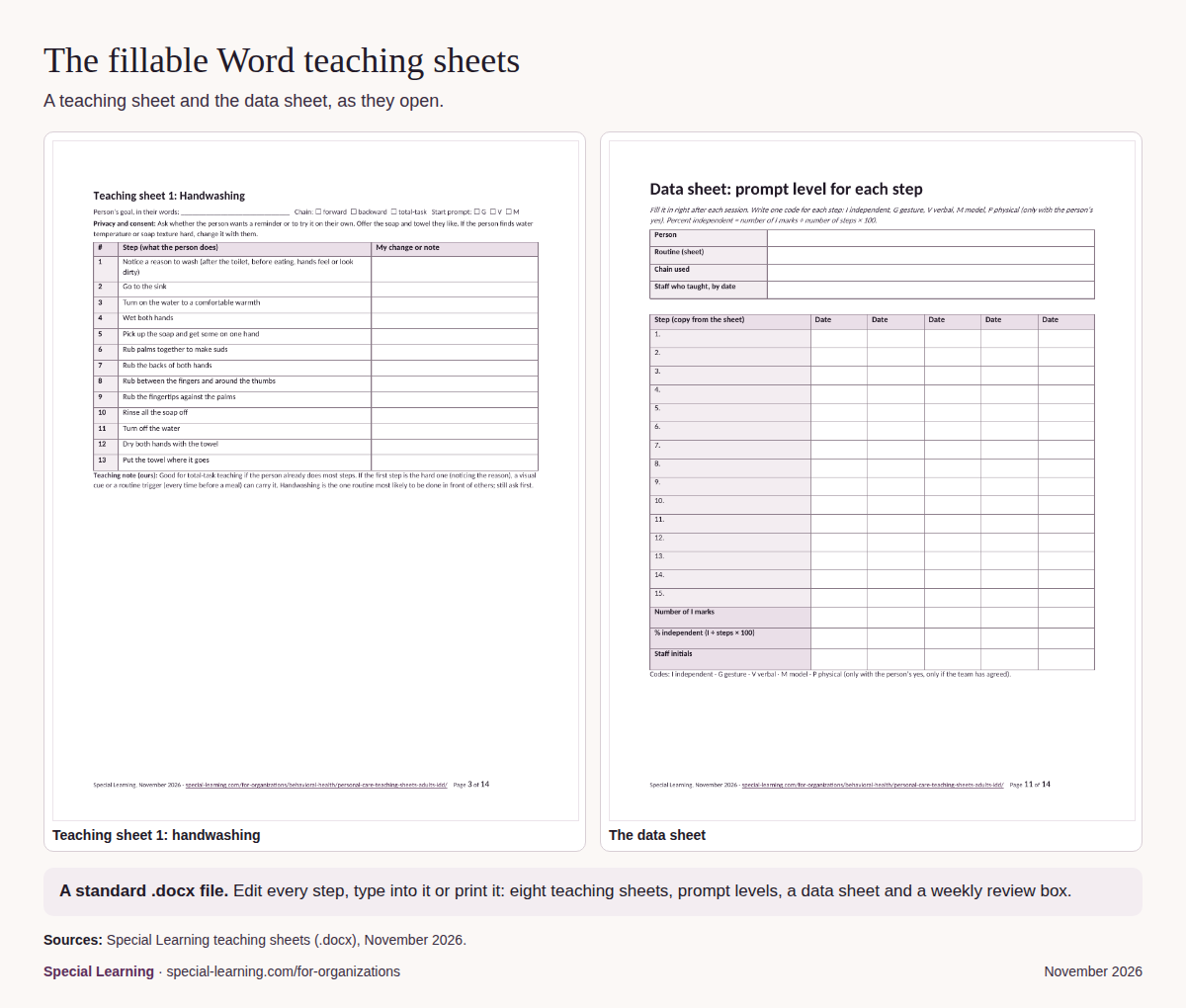
Eight editable step-by-step teaching sheets, in Word and PDF, for personal care with adults who have an intellectual or developmental disability: handwashing, toothbrushing, showering, deodorant, face shaving, menstrual care, hair brushing and dressing for the weather. Each has a privacy and consent note. Add how to teach with chaining and prompting, a one-page prompt-level data sheet and a weekly review box.
Special Learning · November 16, 2026
Free download
Download the teaching sheets
Short answer
How do you teach personal care to an adult with IDD?
Read
To teach a personal care routine to an adult with an intellectual or developmental disability, ask the person what they want to learn and when, break the routine into small steps (a task analysis), teach one part at a time with the lightest help that works, fade the help as the person learns, record each session on a data sheet, and use the results to decide what to change. Ask before you touch, keep the door closed, honor the person’s preference for who helps, and let the person lead. Teaching is for what the person wants to learn; helping is fine when the person wants help. Deciding for them is not. Below are eight ready-made teaching sheets you can edit, a one-page data sheet and a weekly review box, free in Word and PDF.
This page is practice guidance built on the sources below. It does not replace the person’s plan, the plan’s author, your licensing rule or your funder’s contract.
Why teach
Why teach, not only do for
- Independence is a stated goal of the work. The NADSP Code of Ethics asks DSPs to “ensure the rights of individuals to live as independently as possible and direct their own lives with appropriate support.” Teaching a routine so the person can do it, or do more of it, is one way to do that. (NADSP Code of Ethics)
- Privacy and dignity are rights in the settings rule. For Medicaid home and community-based settings, the federal rule says a setting “ensures an individual’s rights of privacy, dignity and respect, and freedom from coercion and restraint.” Personal care is where those words are tested every day. The rule is for HCBS waiver settings; other settings and states may have their own. (42 CFR 441.301(c)(4))
- Choice runs through the routine. The same rule says a setting “optimizes, but does not regiment, individual initiative, autonomy, and independence in making life choices, including but not limited to, daily activities, physical environment, and with whom to interact.” When to shower, which soap, who helps and whether to shave are the person’s choices. (42 CFR 441.301(c)(4))
- People keep learning. The Code asks DSPs to “support each individual’s potential for lifelong learning and growth” and to “protect each person’s privacy.” A teaching sheet used with consent does both. (NADSP Code of Ethics)
Teach when the person wants to learn the routine or do more of it. Help, with no teaching, when the person wants help today. Both are respectful. What is not respectful is deciding for the person, doing it to them without asking, or teaching a routine they do not want to learn. Offer, and a “no” stands (our practice).

Privacy and consent
Privacy and consent, every time
- Ask first, every time. Ask whether the person wants to do the routine now, and who they want to help. Tell them what you will do before you do it. A “no” or “not now” stands. Come back later.
- Ask before you touch. No hand-over-hand or physical prompt without the person’s yes, each time. If the person does not use words, agree on how they tell you yes and no, and honor it. Use a model, a picture or your own hands first.
- Door closed, person in charge. Personal care happens in private. Close the door and put a sign on it. Stay outside, within earshot if the plan calls for it, unless the person asks you in. Knock before you enter. In provider-owned or controlled residential settings the HCBS rule also says “each individual has privacy in their sleeping or living unit.” (42 CFR 441.301(c)(4))
- Same-gender support, where possible. Ask whom the person prefers for showering, menstrual care, shaving or dressing, and arrange it where you can. If you cannot, say so honestly and take it to your supervisor.
- The person leads. The person decides the pace, the products, the order and when to stop. A teaching sheet is a guide, not a script. Use adult language and adult supplies.
- Keep it private after, too. Do not talk about a person’s body or routines in front of others or in the log beyond what the plan needs. The NADSP Code says “protect each person’s privacy.” (NADSP Code of Ethics)

How to teach
Eight moves for teaching a routine
- Start with the person’s goal. Ask what the person wants to be able to do on their own, in the way they communicate. “Do you want to learn to shave yourself, or do you want me to help?” Their answer, in their words, is the goal on the sheet. Team members and the person’s clinician can add what they have seen; they do not answer for the person. (NADSP Code of Ethics)
- Use a task analysis. A task analysis writes a routine as small steps in order, each one something you can see the person do. The eight sheets below are task analyses. Edit them: add, merge or drop steps to fit this person, their products, their bathroom and their way of doing it.
- Choose how to chain the steps. Forward chaining teaches the first step and you do the rest; backward chaining has you do every step but the last, which the person finishes; total-task teaching has the person try every step each time with help as needed. In a study with children, learners acquired the skills under both forward and backward chaining but “individual children did not consistently learn more efficiently with either procedure,” and the children did not prefer one over the other. Pick with the person, watch the data, and switch if it is not working. (Slocum and Tiger (2011), Journal of Applied Behavior Analysis)
- Choose a prompt level, lightest first. Prompts are the help you give: a gesture, a spoken cue, a model, or a physical prompt. Least-to-most starts with the lightest help and adds more only if needed. Most-to-least starts with more help and fades it. In one study of two prompting orders with children, most-to-least “may prevent errors, but it sometimes slows learning.” For personal care we default to least-to-most with a pause, because it gives the person room to do it, and use more help sooner for safety steps (our practice). (Libby et al. (2008), Behavior Analysis in Practice; Gil et al. (2019), Behavior Analysis in Practice)
- Fade help as the person learns. When the person does a step with a given prompt on a few sessions in a row, try the next lighter prompt. A step the person does independently stays at independent. If a step gets harder after you fade, go back one level. Do not take over the whole routine because one step is slow (our practice).
- Let the person choose what makes it worth doing. Much of personal care has its own payoff: clean hands, a fresh mouth, warm and dry, ready for the day. Add the acknowledgment the person likes, in an adult way, and the choices they like in the routine (soap, music, timing). Never make food, visits, outings or privacy depend on a routine. For routines a person finds hard to tolerate, a clinician plans the reinforcement (our practice). (42 CFR 441.301(c)(4))
- Take data every session. After each session, write a prompt code for each step on the data sheet: I for independent, G, V, M or P for the lightest prompt you needed. Count the steps marked I and divide by the number of steps to get percent independent. A few minutes of notes, kept the same way by every DSP, is what shows whether the teaching is working.
- Review weekly, and ask the clinician when it is not working. Look at the data once a week with the person. If the person is upset or refuses again and again, if the numbers stay flat across a few weeks, or if a health issue shows up (skin, pain, bleeding), stop and take it to the supervisor and the clinician who wrote the plan. Changing the plan is their work; bringing them clear data is yours. (McHugh et al. (2025), Journal of Applied Behavior Analysis)

The research cited here was done with children and with adults, mostly in programs run by trained clinicians. We read the abstracts, not the full papers, and make no claim beyond them. The chaining, prompting and fading choices on the sheets are our practice guidance, not findings of these studies.
Chaining: forward, backward or total-task
| Way to chain | What you do | A good fit when | Watch for |
|---|---|---|---|
| Forward chaining | Teach step 1. You do the rest. | When the first steps are the hard ones; when the person likes to get going. | The person may not reach the end of the routine themselves for a while. |
| Backward chaining | You do every step but the last. The person does the last step, then the next-to-last, and so on. | When the end of the routine has a clear payoff, like fresh breath or clean hands. | The person sees the routine start with you doing it. |
| Total-task | The person tries every step each time. You prompt only where needed. | When the person already does many steps; short routines. | Long routines can feel like a lot of corrections. |

Prompt levels and their codes
| Code | Level | What you do | Note |
|---|---|---|---|
| I | Independent | The person does the step with no help. | Wait. Give the person time to start. |
| G | Gesture | You point, nod or show with a hand. | Lightest help. No words, no touch. |
| V | Verbal | You say what to do, in few words. | Name the step or ask “What’s next?” |
| M | Model | You show how, on your own hand, a model or a picture or video. | The person copies. Do not do it to them. |
| P | Physical | You guide the person’s hand or body. | Only with the person’s yes each time and, for personal care, only if the team has agreed. Fade fast. |

What the research says
What published research says
| Paper | What the abstract says | How we use it |
|---|---|---|
| Slocum and Tiger (2011) (Slocum and Tiger (2011), Journal of Applied Behavior Analysis) publisher page | Compared forward and backward chaining with children. “Learners acquired all target skills introduced under both chaining conditions, but individual children did not consistently learn more efficiently with either procedure.” The authors also say the children showed no preference between the two procedures. | Either chain can work. Try one, read the data, and switch if the person is not learning. The children in this study were not adults, so treat it as a starting point. |
| Libby et al. (2008) (Libby et al. (2008), Behavior Analysis in Practice) publisher page | Compared most-to-least and least-to-most prompting with children with autism learning play skills. “All participants learned to build the play structures when the teacher used MTL, which was associated with fewer errors than LTM.” The authors also report that “MTL may prevent errors, but it sometimes slows learning.” | A trade-off: more help up front can mean fewer errors; lighter help can be faster for some learners. Use more help sooner for safety steps. |
| Gil et al. (2019) (Gil et al. (2019), Behavior Analysis in Practice) publisher page | Used least-to-most prompting to teach young adults with intellectual disability to find and select items with a grocery list on an iPad, in a grocery store. The results “indicated that participants learned to use an initial grocery list.” | An example of least-to-most prompting with adults in a real setting. It is not a personal care study. |
| Veazey et al. (2016) (Veazey et al. (2016), Behavior Analysis in Practice) publisher page | Used chaining to teach feminine hygiene skills to two young females with autism and intellectual disability. “Both participants acquired the skill,” and the skill generalized to new stimuli with one participant. The authors begin by noting that little applied research focuses on teaching these skills. | Chaining can be used for menstrual care skills. Two participants is a very small study. |
| Kristiansen et al. (2025) (Kristiansen et al. (2025), Journal of Autism and Developmental Disorders) publisher page | A systematic review of menstrual care teaching studies: “7 single-subject design studies were identified in the previous 40 years of research.” The authors write that “the complexity and private nature of menstrual care skills can make intervention development daunting” and aim to support programming “that is both effective and respectful.” | The evidence is thin, and the topic is private. That is a reason to go slowly, put the person in charge and ask a health professional. |
| Foglia et al. (2023) (Foglia et al. (2023), Behavior Analysis in Practice) publisher page | Used a video prompting package to teach leg shaving to women with disabilities (paraplegia, Down syndrome and intellectual disability). “All participants learned to shave their legs and maintained responding two weeks post-intervention.” | Shaving can be taught with prompts. This study was about leg shaving, not face shaving; our face-shaving sheet is our own adaptation. |
| McHugh et al. (2025) (McHugh et al. (2025), Journal of Applied Behavior Analysis) publisher page | Tested synchronous reinforcement for five adults with IDD across eight health-related routines, such as toothbrushing and handwashing. It worked alone for five of the eight routines; “additional modifications were necessary for two other routines, and no effects were observed for one participant.” The authors report they trained direct-care staff to carry it out. | Staff can learn to carry out teaching for these routines. When a person finds a routine hard to tolerate, a clinician plans the next step with the team. |

We read the published abstracts of these seven papers on PubMed and quote only what they say. We did not read the full papers, so we make no claim about their details. Several of these studies were with children, and we say so.
For the person’s own likes, choices and ways of saying yes and no, start with the preference and choice record and the one-page profile template.
Eight teaching sheets
Step-by-step teaching sheets for personal care
Each sheet is a task analysis in the order most people do it. Edit it for the person: products, room, order, speed. These steps are our own practice guidance. The person leads, you ask before every touch, and the door stays closed.
Teaching sheet 1: Handwashing
Privacy and consent. Ask whether the person wants a reminder or to try it on their own. Offer the soap and towel they like. If the person finds water temperature or soap texture hard, change it with them.
- Notice a reason to wash (after the toilet, before eating, hands feel or look dirty)
- Go to the sink
- Turn on the water to a comfortable warmth
- Wet both hands
- Pick up the soap and get some on one hand
- Rub palms together to make suds
- Rub the backs of both hands
- Rub between the fingers and around the thumbs
- Rub the fingertips against the palms
- Rinse all the soap off
- Turn off the water
- Dry both hands with the towel
- Put the towel where it goes

Teaching note (ours). Good for total-task teaching if the person already does most steps. If the first step is the hard one (noticing the reason), a visual cue or a routine trigger (every time before a meal) can carry it. Handwashing is the one routine most likely to be done in front of others; still ask first.
Teaching sheet 2: Toothbrushing
Privacy and consent. Nothing goes in or near the person’s mouth or face without a yes. Demonstrate on your own toothbrush or a model, not the person’s mouth. If the person uses dentures, an electric brush or a mouth rinse, edit the steps with them and their dental professional.
- Get the toothbrush and toothpaste
- Wet the toothbrush
- Put a small amount of toothpaste on the brush
- Brush the outsides of the top teeth
- Brush the outsides of the bottom teeth
- Brush the insides of the top teeth
- Brush the insides of the bottom teeth
- Brush the chewing surfaces
- Brush the tongue (if the person wants to)
- Spit into the sink
- Rinse the mouth with water and spit
- Rinse the toothbrush
- Put the toothbrush and toothpaste away
- Wipe the mouth and the sink

Teaching note (ours). Backward chaining can work here: you set up, the person finishes with the rinse and a fresh mouth. A mirror helps. If a flavor, bristles or the sensation is the problem, change the brush or toothpaste and bring it to the clinician or dental professional if it persists.
Teaching sheet 3: Showering
Privacy and consent. Close the door; the person decides whether anyone is in the room. Same-gender support, where possible, is the person’s choice. Nothing is washed for the person unless they ask. Falls, water temperature and the need for standby help are decided with the person and the team in the plan, not by this sheet.
- Choose a time and get a towel and clean clothes
- Go to the bathroom and close the door
- Take off clothes and put them in the hamper
- Turn on the water and check the temperature with a hand
- Step into the shower (using the grab bar if there is one)
- Wet the body and hair
- Shampoo the hair
- Rinse the hair
- Wash arms, chest and underarms
- Wash private areas
- Wash legs and feet
- Rinse off all the soap
- Turn off the water
- Step out carefully onto the mat
- Dry off with the towel
- Hang up the towel

Teaching note (ours). Long routines teach well by chaining. Teach a few steps and let the person do the rest their way. Offer products the person chooses. Teach in short sessions; a shower does not need to be a lesson every time. If the person does not want to be seen, teach from outside the door with a picture list or a recording they choose.
Teaching sheet 4: Using deodorant
Privacy and consent. Teach with a model or picture first. The person puts it on themselves; you never apply it. Ask which kind they like (stick, spray, roll-on) and edit the steps to match.
- After washing, dry the underarms
- Pick up the deodorant
- Take off the cap
- Twist up a little (if it is a stick)
- Swipe it under one arm
- Swipe it under the other arm
- Twist down and put the cap back on
- Put the deodorant away
- Let it dry before getting dressed

Teaching note (ours). Short, so it chains easily. Put the deodorant where the person will see it after washing. If a smell or skin problem keeps showing up, tell the supervisor and ask about a health check.
Teaching sheet 5: Shaving the face
Privacy and consent. First ask whether the person wants to shave. Facial hair is the person’s choice. Use the kind of razor the person and their team have agreed on: edit the steps for an electric razor or a safety razor, and follow any safety rule in the plan. Teach in front of a mirror; the person holds the razor. Same-gender support, where possible.
- Get the razor, shaving cream, towel and a mirror
- Wash the face with warm water
- Put shaving cream on the cheeks, chin and upper lip (skip for an electric razor)
- Pick up the razor
- Hold the skin flat with the other hand
- Shave one cheek in short strokes
- Shave the other cheek
- Shave the upper lip and chin
- Shave under the chin and neck, gently
- Rinse the razor between strokes
- Rinse the face and pat it dry
- Check the mirror for spots that were missed
- Rinse the razor and put it away
- Wipe the sink

Teaching note (ours). Shave one side first and add steps as the person gains skill. A mirror and good light matter. If there are nicks or irritation, treat it as information about the razor or the technique and ask a nurse or the clinician about products. A study of video prompting taught leg shaving to women with disabilities; face shaving here is our own adaptation.
Teaching sheet 6: Menstrual care
Privacy and consent. This is the most private sheet. The person leads and chooses the products. Same-gender support, where possible, and the person’s preference on who helps. Close and lock the door. Never touch the person; use pictures, a model or your own words. Do not discuss it in front of others. If the person uses tampons, a cup or medicine for symptoms, a nurse or other health professional should teach that part with the person.
- Notice it is time to change (or that a period has started)
- Get a new pad (or period underwear) and a disposal bag
- Go to the bathroom and lock the door
- Wash hands
- Take down underwear and remove the used pad
- Fold the used pad in its wrapper or the bag
- Put it in the covered bin
- Wipe from front to back
- Unwrap the new pad
- Peel the backing and stick the pad to the middle of the underwear
- Pull up the underwear
- Wash hands
- Mark the calendar (if the person wants a record)
- Put the supplies away

Teaching note (ours). Teach with a picture or doll model of the steps outside the bathroom; the person practices the real steps alone. Have supplies in the person’s own room or bag. Edit for the products the person chooses. A review of the research found few studies of teaching these skills and notes the private nature of the skill; go slowly and keep it respectful. Symptoms such as pain or heavy bleeding go to a health professional.
Teaching sheet 7: Brushing or combing hair
Privacy and consent. Hair is personal and often cultural. The person’s hair type and style lead: use the tools and products they choose, such as a wide-tooth comb, a pick, a brush or a wrap. Do not touch the person’s hair or head without a yes.
- Get the brush or comb the person prefers
- Stand or sit at the mirror
- Take any hair ties or clips out
- Brush or comb the ends gently
- Work up toward the roots
- Brush or comb the sides and the back
- Part or style the hair as the person likes
- Put in hair ties, clips or a hat if wanted
- Check the mirror
- Clean the brush and put it away

Teaching note (ours). Teach the person to start at the ends and work up if the hair tangles; this works for many hair types, but the person and the people who know their hair know best. Offer a hand mirror for the back.
Teaching sheet 8: Dressing for the weather
Privacy and consent. Adults wear adult clothes of their own choosing. Offer options; do not lay out an outfit unless asked. Ask before touching clothes or the person’s body. If the person needs help with buttons or zippers, ask what kind of help they prefer.
- Check the weather (look outside, a forecast or a weather picture)
- Decide: cold, warm, rain, snow or sun
- Choose clothes that fit the weather and what the person is doing today
- Put on underwear and socks
- Put on pants or a skirt
- Put on a shirt
- Add a sweater or a jacket if needed
- Fasten buttons, zips and shoes
- Add a hat, gloves, scarf or umbrella if needed
- Look in the mirror: comfortable?

Teaching note (ours). Step 2 to 3 is the skill that matters: matching clothes to weather. Teach it with a weather picture board or a choice of two outfits. Let the person keep their style.
Data
The one-page data sheet and weekly review
The Word file and PDF have a blank one-page data sheet: the steps down the side, a column for each session and a code in every box. Percent independent is the number of I marks divided by the number of steps, times 100. Invented numbers to show the layout. Ellis went from 5 of 12 steps done independently on Monday (42 percent) to 9 of 12 on Friday (75 percent). Steps 7 to 9 are still prompted, so the team keeps teaching there. Percent independent is the number of I marks divided by the number of steps, times 100.
| Step | Mon | Tue | Wed | Thu | Fri |
|---|---|---|---|---|---|
| 1 Notice a reason to wash | V | V | G | G | I |
| 2 Go to the sink | I | I | I | I | I |
| 3 Turn on the water | I | I | I | I | I |
| 4 Wet both hands | I | I | I | I | I |
| 5 Get soap | G | I | I | I | I |
| 6 Rub palms | V | G | G | I | I |
| 7 Rub the backs of hands | M | V | V | G | G |
| 8 Between fingers and thumbs | M | M | V | V | V |
| 9 Fingertips | M | M | M | V | V |
| 10 Rinse off soap | I | I | I | I | I |
| 11 Turn off the water | I | I | I | I | I |
| 12 Dry hands | G | G | I | I | I |
| % independent | 42% | 50% | 58% | 67% | 75% |

The weekly review box
Once a week, sit with the person and fill in the review box. It asks what the person said or showed about how it is going, so their view is part of the data.
| Box | What was written |
|---|---|
| Dates and routine | Mon to Fri, handwashing before lunch |
| Percent independent this week (first day, last day) | 42 percent, then 75 percent |
| Steps now independent | 1 to 6 and 10 to 12 (9 of 12) |
| Steps still prompted, and the prompt level | 7 gesture, 8 and 9 verbal |
| What the person said or showed about how it is going | “I like the lemon soap.” Sped up on Thursday. |
| What is working | Waiting for him to start; soap he picked; the picture card by the sink |
| What to change next week (chain, prompt level, time of day, products) | Fade verbal to gesture on 8 and 9; try before dinner too |
| Ask the supervisor or clinician? (distress, refusal, flat data, a health concern) | No |
| Reviewed with the person on | Friday, at the sink |

The session, start to finish
- Ask the person what they want to learn and when, and who they want to help. Write the goal in their words.
- Pick the sheet. Edit the steps for this person: products, room, order, speed.
- Choose how to chain it (forward, backward or total-task) and the prompt levels you will use, lightest first.
- Set the room up the way the person wants it: supplies in reach, door closed, a picture list if it helps.
- Run the session. Wait before prompting. Give the lightest prompt that works. Ask before any touch.
- Fill in the data sheet right after, with one code per step.
- Once a week, do the review box with the person. Fade a prompt on any step done the same way a few sessions in a row.
- If the person is distressed, refuses again and again, the data stay flat or there is a health concern, take it to your supervisor and the clinician.
| When | What to do |
|---|---|
| Before the session | Ask the person. Set out what they need. Check the sheet for edits. |
| During | Give the lightest prompt that works. Wait. Honor a no. Stay out of the room if the person wants privacy. |
| Right after | Fill the data sheet while it is fresh, one code per step. |
| Each week | Do the weekly review box with the person. |
| When it stalls or distresses | Stop. Tell the supervisor and clinician. Bring the data. |
For the person’s routine in the daily record, see the DSP daily notes template; to check that a behavior support plan is carried out as written, the implementation checklist; for tracking staff skills, the DSP competency checklist; and for recording what happens before and after a behavior, the ABC data sheet. For ethics at orientation, see the NADSP Code of Ethics onboarding guide; for the training roster across the year, the DSP training and HR toolkit. The federal home and community-based services rules are on eCFR in 42 CFR 441.301; find your state’s DSP training rule in our free state finder, then read your own licensing rule. If something unsafe or harmful turns up, it may also belong in your incident report.
The checklist
Before you finish
- I asked the person what they want to learn and wrote it in their words.
- I edited the sheet for this person’s products, room and way of doing it.
- I asked before every touch and honored every “no” or “not now.”
- The door was closed and the person chose who helps.
- I used the lightest prompt that worked and waited before prompting.
- I filled in the data sheet right after the session.
- I faded one prompt level on a step the person has done the same way a few sessions in a row.
- I did the weekly review with the person.
- I took distress, refusal, flat data or a health concern to my supervisor and the clinician.

On paper
Prefer paper? Print the PDF
The printable PDF has the same pages as the Word file, with write-in space on the data sheet and the review box.

Questions
Teaching personal care to adults with IDD: common questions
What is a task analysis?
It is a routine written as small steps in order, each one something you can see the person do. You teach, prompt and keep data step by step. The eight sheets on this page are task analyses you can edit for the person.
Should I teach the person or just do it for them?
Ask the person. Teach when they want to learn the routine or do more of it; help when they want help today. Both are respectful. Deciding for them or doing it without asking is not. The NADSP Code asks DSPs to “ensure the rights of individuals to live as independently as possible and direct their own lives with appropriate support.” (NADSP Code of Ethics)
Which is better: forward chaining, backward chaining or total-task?
There is no single winner. In a study of children, learners acquired the skills under both forward and backward chaining but “individual children did not consistently learn more efficiently with either procedure.” (Slocum and Tiger (2011), Journal of Applied Behavior Analysis) Pick with the person, watch the data and switch if it is not working.
What is least-to-most prompting, and when should I use more help?
You start with the lightest help (a gesture), add a spoken cue, then a model, and use a physical prompt only with the person’s yes. A study of two prompting orders with children found that most-to-least prompting “may prevent errors, but it sometimes slows learning.” (Libby et al. (2008), Behavior Analysis in Practice) For personal care we default to lightest first, and use more help sooner for safety steps (our practice).
Can I use hand-over-hand in personal care?
Only with the person’s yes each time, and for personal care only if the team has agreed. Try a gesture, a verbal cue or a model first. It is the heaviest prompt, and it is touch. Fade it quickly.
How do I protect privacy when teaching showering or menstrual care?
Ask first, close the door, offer same-gender support where you can, let the person lead and stay outside the room unless asked. Use pictures or a model instead of touch. The HCBS rule says a setting “ensures an individual’s rights of privacy, dignity and respect, and freedom from coercion and restraint.” (42 CFR 441.301(c)(4)) Menstrual care in particular is private; a research review calls it complex and private and aims for programming “that is both effective and respectful.” (Kristiansen et al. (2025), Journal of Autism and Developmental Disorders)
What should I use as a reward?
Start with what the routine gives: clean hands, fresh breath, comfort. Add the acknowledgment the person likes, in an adult way, and the choices they like in the routine. Never make food, visits, outings or privacy depend on a routine. When a person finds a routine hard to tolerate, a clinician plans the reinforcement with the team; one study of adults with IDD tested a method on eight routines, including toothbrushing and handwashing, and reported that it worked alone for five of eight. (McHugh et al. (2025), Journal of Applied Behavior Analysis)
How do I measure progress?
Use the data sheet: write a prompt code (I, G, V, M or P) for each step after every session. Percent independent is the number of I marks divided by the number of steps, times 100. Look at it each week with the person. Fade a prompt on steps done the same way a few sessions in a row.
When do I ask the clinician to change the plan?
When the person is distressed or refuses again and again, when the data stay flat across a few weeks, when a step is unsafe or when you see a health concern such as skin problems, pain or bleeding. Bring the data. Changing the plan is the clinician’s work.
Can I use these sheets as written?
Edit them first. They are starting points: add steps, merge steps, change products and order to fit this person. The sheets, data sheet and review box are ours; they are practice guidance and do not replace the person’s plan, your licensing rule or your funder’s contract.
Sources
Sources read November 16, 2026 (the eCFR text is current as of November 12). The quoted lines are as published; for the seven research papers we read and quote only the published abstracts. The eight task analyses, the data sheet, the weekly review box, the privacy habits and the advice on prompting and fading are ours; the person leads. 42 CFR 441.301 covers Medicaid home and community-based services waivers; other settings and states may differ. None of these organizations has reviewed or endorsed these sheets.
- Electronic Code of Federal Regulations, Title 42, section 441.301, Contents of request for a waiver, (c)(4) home and community-based settings; text current as of November 12, 2026. It governs Medicaid home and community-based services (HCBS) waivers. https://www.ecfr.gov/current/title-42/chapter-IV/subchapter-C/part-441/subpart-G/section-441.301
- National Alliance for Direct Support Professionals (NADSP), The NADSP Code of Ethics (revised 2026), as published on nadsp.org. https://nadsp.org/resources/the-nadsp-code-of-ethics/
- Slocum, S. K., & Tiger, J. H. (2011). An assessment of the efficiency of and child preference for forward and backward chaining. Journal of Applied Behavior Analysis, 44(4), 793-805 (abstract read on PubMed, PMID 22219530); the learners were children. https://pubmed.ncbi.nlm.nih.gov/22219530/ Publisher page: https://doi.org/10.1901/jaba.2011.44-793
- Libby, M. E., Weiss, J. S., Bancroft, S., & Ahearn, W. H. (2008). A comparison of most-to-least and least-to-most prompting on the acquisition of solitary play skills. Behavior Analysis in Practice, 1(1), 37-43 (abstract read on PubMed, PMID 22477678); the learners were children with autism. https://pubmed.ncbi.nlm.nih.gov/22477678/ Publisher page: https://doi.org/10.1007/BF03391719
- Gil, V., Bennett, K. D., & Barbetta, P. M. (2019). Teaching young adults with intellectual disability grocery shopping skills in a community setting using least-to-most prompting. Behavior Analysis in Practice, 12(3), 649-653 (abstract read on PubMed, PMID 31976275). https://pubmed.ncbi.nlm.nih.gov/31976275/ Publisher page: https://doi.org/10.1007/s40617-019-00340-x
- Veazey, S. E., Valentino, A. L., Low, A. I., McElroy, A. R., & LeBlanc, L. A. (2016). Teaching feminine hygiene skills to young females with autism spectrum disorder and intellectual disability. Behavior Analysis in Practice, 9(2), 184-189 (abstract read on PubMed, PMID 27606248). https://pubmed.ncbi.nlm.nih.gov/27606248/ Publisher page: https://doi.org/10.1007/s40617-015-0065-0
- Kristiansen, S., Syed, N., Anderson, N., & Bendush, S. (2025). An analysis of teaching menstrual care skills using single-subject methodology: a systematic literature review. Journal of Autism and Developmental Disorders, 55(8), 2718-2732 (abstract read on PubMed, PMID 38782882). https://pubmed.ncbi.nlm.nih.gov/38782882/ Publisher page: https://doi.org/10.1007/s10803-024-06389-0
- Foglia, N., Sidener, T. M., Pantano, N. A., Reeve, S. A., & DeBar, R. M. (2023). Using video prompting to teach leg shaving to women with disabilities. Behavior Analysis in Practice, 16(1), 296-301 (abstract read on PubMed, PMID 37006432; the PubMed record spells the first author Folgia). https://pubmed.ncbi.nlm.nih.gov/37006432/ Publisher page: https://doi.org/10.1007/s40617-022-00693-w
- McHugh, C. L., Dozier, C. L., Kamlowsky, M. E., & Simmons, B. A. (2025). Synchronous reinforcement schedules promote tolerance of health-related routines for adults with disabilities. Journal of Applied Behavior Analysis, 58(3), 504-521 (abstract read on PubMed, PMID 40614120). https://pubmed.ncbi.nlm.nih.gov/40614120/ Publisher page: https://doi.org/10.1002/jaba.70020