
Free form and downloads for DSPs, house managers and QIDPs
What I like and what I choose: preference and choice record for adults with IDD
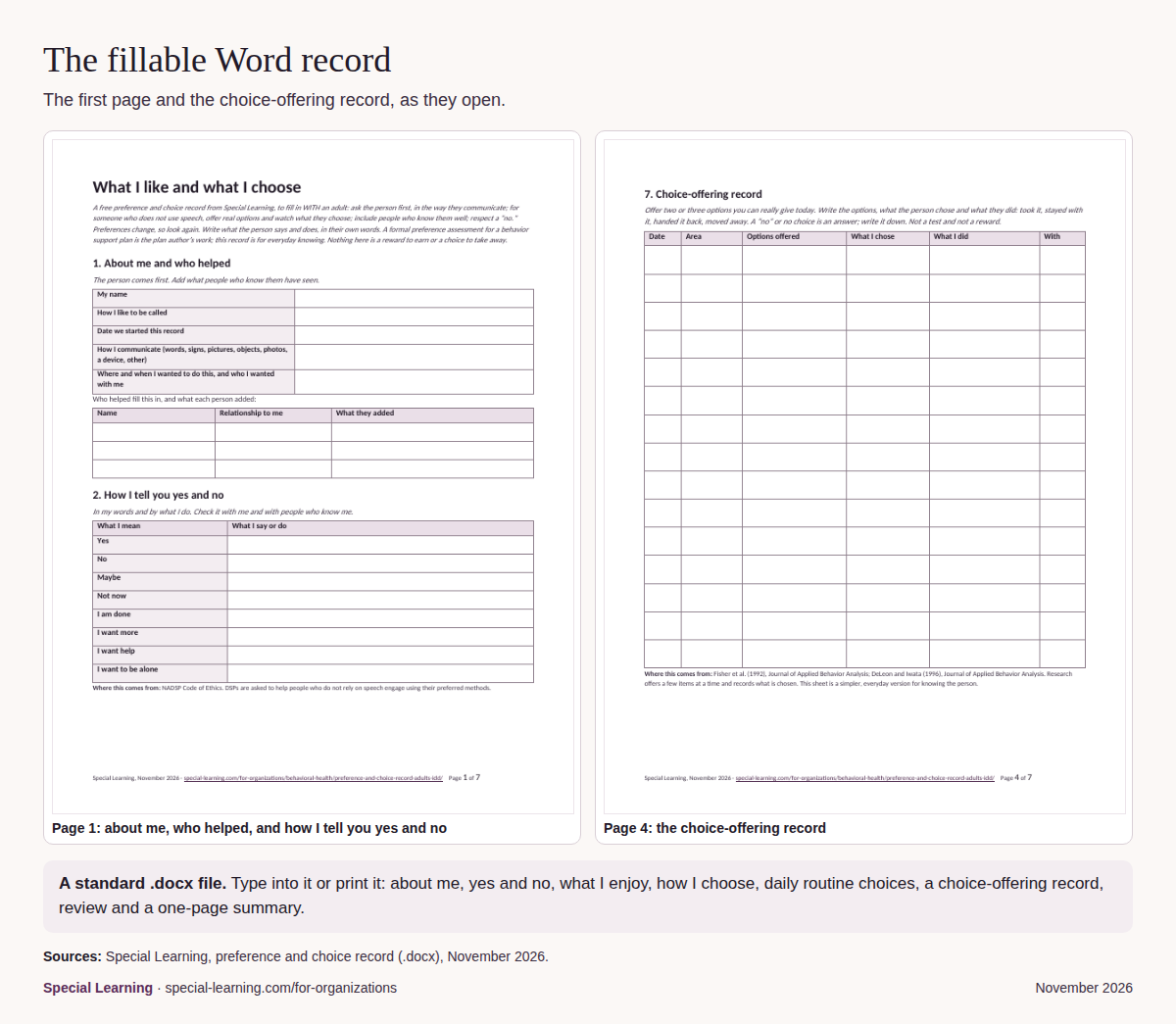
A free record, in Word and PDF, to fill in with an adult who has an intellectual or developmental disability: what the person enjoys and wants, how they say yes and no, the choices they make in a day, and a one-page summary for the front of the binder. Ask the person first, offer real choices, watch what they pick and do, and keep it current so the day reflects their own choices.
Special Learning · November 16, 2026
Free download
Download the record
Short answer
What is a preference and choice record?
Read
A preference and choice record is a form a direct support professional (DSP) fills in with an adult who has an intellectual or developmental disability, to find out and write down what the person enjoys and wants, by asking, by offering real choices and by watching what the person picks and does, and then to keep it current so the person’s day reflects their own choices. The person comes first: ask them first, in the way they communicate; for someone who does not use speech, offer real options and watch what they choose; include people who know them well; and respect a “no.” Preferences change, so check again. A formal preference assessment for a behavior plan is the plan author’s work; this form is for everyday knowing, in the person’s own words wherever possible.
This page is practice guidance built on the sources below. It does not replace the person-centered plan, the plan’s author, your licensing rule or your funder’s contract.
Why it matters
Why keep a preference and choice record
- The person’s own choices are the point. For Medicaid home and community-based settings, the federal rule says a setting “optimizes, but does not regiment, individual initiative, autonomy, and independence in making life choices, including but not limited to, daily activities, physical environment, and with whom to interact.” That rule is for HCBS waiver settings; other settings and states may have their own. (42 CFR 441.301(c)(1) to (4))
- Person-centered plans start from what is important to the person. The federal rule says the person-centered service plan reflects “what is important to the individual with regard to preferences for the delivery of such services and supports.” This record is a daily tool a DSP can bring to that process; it does not replace the plan or the planning meeting (our practice). (42 CFR 441.301(c)(1) to (4))
- The DSP code of ethics points the same way. DSPs commit to “seek guidance from the people I support about their culture, preferences, social networks, and needs” and to “support each person’s choices, preferences, abilities, and opinions.” (NADSP Code of Ethics)
- People can tell us their likes and dislikes, including when they do not use speech. The abstract of a systematic review of preference assessment research opens by stating that people with intellectual or developmental disabilities “are able to reliably express their likes and dislikes through direct preference assessment.” The NADSP Code asks DSPs to help people who do not rely on speech “engage using their preferred methods.” (Virués-Ortega et al. (2014), American Journal on Intellectual and Developmental Disabilities; NADSP Code of Ethics)

Six moves
How to find out what a person likes and wants
- Ask the person first. Ask in the way the person communicates: words, signs, pictures, objects, photos, an AAC device, a yes or no card. Ask openly (“What would you like to do Saturday?”), then with choices. Write the person’s own words in quotes. The NADSP Code asks DSPs to “seek guidance from the people I support about their culture, preferences, social networks, and needs.” (NADSP Code of Ethics)
- Include people who know them well. Family, friends, an advocate, long-time staff and the person’s own circle can add what they have seen. They help; they do not answer in the person’s place. The federal planning rule says the person-centered planning process “includes people chosen by the individual,” so ask who the person wants to help. (42 CFR 441.301(c)(1) to (4))
- Offer real choices. Offer two or three options you can really give today, the same way each time, and let the person pick. Research on preference assessment gives people a few items at a time: in one study, “clients were presented with two stimuli simultaneously and were given access only to the first stimulus approached.” Our version is simpler: offer a few real options and write down what the person picks. (Fisher et al. (1992), Journal of Applied Behavior Analysis)
- Watch what they do. Notice what the person reaches for, moves toward, stays with, hands back or turns away from. Early preference research worked by “measuring approach behaviors to differentiate preferred from nonpreferred stimuli.” Write what you saw, not what you think it means, and check it with people who know the person. (Fisher et al. (1992), Journal of Applied Behavior Analysis)
- Respect a “no”. A no, a turn of the head or a walk to the other side of the room is information. Write it down and honor it. The NADSP Code asks DSPs to “respect each person’s right to make decisions, take risks, understand responsibilities, and experience the dignity of learning from the outcomes of those decisions.” (NADSP Code of Ethics)
- Re-check, because preferences change. People change their minds, and their lives change. Set a review date with the person, and look again when something changes or the person asks. For the person-centered service plan, the federal rule has it reviewed “at least every 12 months, when the individual’s circumstances or needs change significantly, or at the request of the individual.” Your state or agency may set additional timing. This record has no set frequency of its own. (42 CFR 441.301(c)(1) to (4))

The research behind “offer a few options and watch what is chosen” is mostly about identifying items that can work as rewards for teaching, and in our practice guidance its procedures are run in set steps by trained people. Our version is different in purpose: it is for knowing the person and shaping their day, and the choices are never something to be earned or taken away.
What the research says
What published research says, and what is the plan author’s work
| Paper | What the abstract says | How we use it |
|---|---|---|
| Fisher et al. (1992) (Fisher et al. (1992), Journal of Applied Behavior Analysis) publisher page | The authors compared two ways of presenting items. In one, two items were presented at once and the person got only the first one approached; the researchers report that this “forced-choice stimulus preference assessment resulted in greater differentiation among stimuli.” They were working with clients with severe and profound disabilities, and some clients “consistently approach most or all of the stimuli on each presentation, making it difficult to differentiate among these stimuli.” | One reason to offer two at a time: it can show more than a single offer. A paired choice is a research method; here, it is just one way to offer. |
| DeLeon and Iwata (1996) (DeLeon and Iwata (1996), Journal of Applied Behavior Analysis) publisher page | The authors compared a paired-stimulus format, a multiple-stimulus format with replacement and one without replacement (MSWO). They report that “the time to administer the MSWO procedure was comparable to that required for the MSW method and less than half that required to administer the PS procedure.” The study had 7 participants and the authors call the results preliminary. | Offering several options at once, then offering the remaining ones again, can be quicker than pairs. Our version: offer three, note the pick, offer the other two. |
| Virués-Ortega et al. (2014) (Virués-Ortega et al. (2014), American Journal on Intellectual and Developmental Disabilities) publisher page | A systematic review of the literature, which says “a number of preference assessment methods are available and selecting the appropriate method is crucial to provide reliable and meaningful results.” | Choosing a formal method is the work of the person who does the assessment, such as the plan author. A DSP’s everyday record is a different, simpler job. |

We read the published abstracts of these three papers on PubMed and quote only what they say. We did not read the full papers, so we make no claim about their details. We did not cite a review of choice and preference assessment for adults that we could not open.
- Everyday record, by a DSP or supervisor, with the person. What the person enjoys, how they say yes and no, the choices they make in a day, and what to change. This is what the form is for.
- Formal preference assessment, by the plan author. Paired-choice or multiple-stimulus procedures, run in set steps with data, for a behavior support plan or a teaching program. The plan’s author or the clinical lead sets these up and trains the people who run them. If your record shows something that would help them, such as what the person picks again and again, share it.
- Safety and risk. If a choice raises a safety concern, take it to your supervisor and the team. Do not quietly stop offering it. The NADSP Code asks DSPs to “support informed decision-making, even when those decisions involve personal risk,” and to seek guidance when unsure.
For the rest of a person’s picture, see the one-page profile template, the DSP daily notes template and the behavior support plan implementation checklist.
The record
What is on the record
| Part | What it holds | Why |
|---|---|---|
| 1. About me and who helped | My name, the date, how I like to be called, how I communicate, who helped fill this in (me, family, friends, staff, an advocate) and what each one added. | The person is listed first. People who know them add to the record; they do not replace what the person says (our practice). |
| 2. How I tell you yes and no | In my words and by what I do: yes, no, maybe, not now, I am done, I want more, I want help, I want to be alone. | Reading a choice means knowing how this person says yes and no. NADSP: help people who do not rely on speech “engage using their preferred methods.” (NADSP Code of Ethics) |
| 3. Things I enjoy | Activities; food and drink; people; places; music, shows and media; and sensory things (sounds, light, textures, touch, temperature). A column for what I said and a column for what I showed. | The two columns keep the person’s words apart from what others see (our practice). |
| 4. Things I do not like | The same areas, for what I do not want or want less of, with how I show it. | A “no” is as useful to know as a “yes” (our practice). |
| 5. How I like to make choices | How many options, pictures, objects or words, how long to wait, time of day, who I want with me, and what makes it hard. | Offering well is half of choice: the HCBS rule asks that the person be “enabled to make informed choices and decisions.” (42 CFR 441.301(c)(1) to (4)) |
| 6. My daily routine choices | Waking and bedtimes, washing, meals and snacks, free time, outings, evenings and weekends, who helps and how I like support given, and what I want to change. | The HCBS rule lists “daily activities, physical environment, and with whom to interact” among life choices. (42 CFR 441.301(c)(1) to (4)) |
| 7. Choice-offering record | Date, area, the options offered, what I chose, what I did, who was with me. Fifteen rows. | The record of what the person picked and did is the core. Writing the options offered too shows what the person chose among (our practice). |
| 8. Review | The review date, who reviews with me, what changed and what we will do about it. | Preferences change, so the record has a date to look again (our practice). |
| One-page summary | A page for the front of the person’s binder: what I enjoy most, what I do not like, how I say yes and no, how I like to choose, how I like support given, my routine choices and the review date. | So a new or fill-in DSP can know the person in a minute, and the person has a page that is theirs (our practice). |

The form’s layout, the summary page and the choice-offering record are ours. What goes in them comes from the person and the people who know them, never from us. The federal home and community-based services rules are on eCFR in 42 CFR 441.301; find your state’s DSP training rule and agency in our free state finder, then read your own licensing rule.
Seven steps
How to fill it in with the person
- Pick a good time and a comfortable place, and ask the person whether they want to do this now, who they want with them, and where. In plain words, tell them why: so that their days can have more of what they like. It is fine to stop and come back.
- Fill in the first part: the person’s name and how they like to be called, how they communicate, and who helped. Then fill in how they say yes and no, from the person first, then from people who know them, then from what you have seen.
- Ask first, in the way the person communicates. Start open, then with options. Write what they say in their own words, in quotes. Fill in “things I enjoy” and “things I do not like” from what they tell you.
- Offer real choices for anything the person cannot tell you in words or is unsure about. Offer two or three things you can really give, in the same order or place, wait, and write what they chose and what they did: took it, stayed with it, handed it back, moved away. Offer the others another time.
- Do not steer and do not test. Do not say which is better, and do not use a choice as a reward or take it away. If the person turns down everything, write that, and try other options on another day.
- Ask people who know the person what they have seen. Where it differs from what the person showed you, write both. The person’s own pick is the one to follow; take any safety concern to your supervisor and the team.
- Make the one-page summary, give the person their own copy in a form they can use, put one at the front of the binder, set a review date, and then change the day: build the choices into the schedule and offer them at every shift.
An example: how Sam says yes and no

| What Sam means | What Sam says or does |
|---|---|
| Yes | Says “yeah,” reaches for it, smiles and leans in. |
| No | Says “nope,” turns his head away or pushes it back. |
| Maybe or not now | Looks at me, then at the door, and says “later.” |
| I am done | Stands up and walks to the window. |
| I want more | Taps the table twice and holds out his hand. |
| I want to be alone | Goes to his room and closes the door. |
An example: the choice-offering record

| Date | Area | Options offered | What Sam chose | What Sam did | With |
|---|---|---|---|---|---|
| Mar 4 | Saturday morning | Walk at the park, the library or baking | Walk at the park (reached for his jacket) | Stayed out the whole hour and led us to the pond | Dee |
| Mar 4 | Lunch | Soup, a sandwich or leftover pasta | Pasta | Finished it and asked for more | Dee |
| Mar 6 | Music in the van | The radio, his playlist or quiet | Quiet (put a hand over the speaker) | Relaxed; asked for his playlist ten minutes later | Rae |
| Mar 8 | Evening | TV, a puzzle or a call to his sister | None; went to his room | Had a quiet evening. Noted: “wants to be alone sometimes.” | Rae |
| Mar 11 | Haircut | The barber on Main Street or Rae cutting it at home | Said “home” | Haircut at home, sat for all of it | Rae |
| Mar 13 | Dinner | Chicken, fish or eggs | Eggs | Ate half, pushed the plate away. Offered fruit; he took it. | Dee |
Sam, Dee and Rae are invented, and the entries are an invented illustration of how the record reads, not a suggestion for any person. Your record comes from your person. After a few weeks the record might show: outdoors most weekend mornings; quiet or his own playlist in the van; time alone in the evenings; pasta and eggs more often than soup; and a wish to see his sister that has not yet been arranged (written as “wants, not yet available” and taken to the supervisor).
The front of the binder
The one-page summary
When the record has a few weeks of entries, put what you have learned on one page, in the person’s own voice, and give the person their own copy. A new or fill-in DSP can read it in a minute.

| Box | What was written |
|---|---|
| What I enjoy most | Walking outside, especially to the pond; pasta and eggs; my own playlist; my sister’s calls. |
| What I do not like | Loud radio in the van; crowded places; being rushed in the morning. |
| How I say yes and no | Yes: “yeah,” reaches, leans in. No: “nope,” turns away. I am done: I go to the window. |
| How I like to choose | Two or three options, with the real thing in my hand or in a picture. Give me time. I choose best in the morning. |
| How I like support given | Tell me what is next before it happens. Offer, do not tell. Leave me alone when I go to my room, and check in after a while. |
| My routine choices | Wake at 7 or when I wake up. Shower in the evening. Weekend mornings outside. |
| Wants, not yet available | To visit my sister every other month. |
| Reviewed with me on | April 12 (with Dee and my sister). |
Invented, written in Sam’s voice with Sam. In your binder it is the person’s own page.
The person at the center
Keeping it respectful
- Adults, always. Write in the person’s voice (“I like,” “I choose”). Use adult activities, wording and pictures. Describe what the person did and chose, not labels.
- Not earned, not withheld. Things a person likes are not rewards to earn or take away. This form never makes access to a preferred thing depend on behavior. For provider-owned or controlled residential settings, the HCBS rule says people have “the freedom and support to control their own schedules and activities, and have access to food at any time,” and any modification of those conditions “must be supported by a specific assessed need and justified in the person-centered service plan.” (42 CFR 441.301(c)(1) to (4))
- A “no” stands. Do not coax, bargain or ask again and again in the same sitting. Write the no, and offer again another day.
- Preferences you cannot give today. If a choice is not available because of cost, staffing or the setting, say so honestly, write it as “wants, not yet available,” and take it to your supervisor. It is an unmet preference to work on, not a wrong answer.
- Risk and informed choice. The NADSP Code says to respect each person’s right to make decisions and “take risks,” and to support informed decision-making. If a choice worries you, tell your supervisor and the team, and keep the person in the conversation. (NADSP Code of Ethics)
- Privacy. The record holds personal information. Keep it where your agency’s privacy policy says, and share it with the person and the people they choose.

Preferences change
Keeping it current
| When | What to do |
|---|---|
| When the person asks | If the person says they want something different, that is the review. Write it now. |
| When something changes | A move, a new housemate, a health change, a new job, a loss: look again at the whole record. |
| On the review date | Set it with the person, and use it to ask again, offer again and update the summary page. Your state or agency may set timing for the plan itself; use the record in time for it. |
| At every shift | Offer a real choice in the day, and note what the person picks. A few lines a week is better than a big form once a year. |
| Check for sameness | If the same option is chosen every time, offer something new now and then, and ask. Do not take away what the person likes. |

For where this fits with the rest of a DSP’s learning on the person’s own choices, see the NADSP Code of Ethics onboarding guide and the social skills group plan for adults; for the training roster across the year, the DSP training and HR toolkit. If a choice turns up a safety problem, it may also belong in your incident report.
The checklist
Before you finish
- I told the person what we are doing and why, and asked if they wanted to do it now.
- I asked the person first, in the way they communicate, and wrote their words in quotes.
- I wrote how they say yes, no, maybe, not now and “I am done.”
- Every choice I offered was one I could really give.
- I wrote the options offered, what the person chose and what they did.
- I honored every “no” and did not coax.
- I asked people who know the person, and wrote where they differed.
- The one-page summary is in the front of the binder and the person has their copy.
- The review date is set and the choices are built into the daily routine.

On paper
Prefer paper? Print the PDF
The printable PDF has the same pages as the Word file, with write-in space for every part.

Questions
Preference and choice records: common questions
What is a preference and choice record?
It is a form a DSP fills in with an adult with an intellectual or developmental disability to find out what the person enjoys and wants, by asking, by offering real choices and by watching what they pick and do. It has a section for how the person says yes and no, a choice-offering record, daily routine choices, a review date and a one-page summary for the front of the binder.
How do I find out what a person likes if they do not use speech?
Offer two or three real options, in the same way each time, and write what the person picks and does: reaches for, stays with, hands back or turns away from. Ask people who know the person well. The abstract of a systematic review of preference assessment research states that people with intellectual or developmental disabilities “are able to reliably express their likes and dislikes through direct preference assessment.” (Virués-Ortega et al. (2014), American Journal on Intellectual and Developmental Disabilities) The NADSP Code asks DSPs to help people who do not rely on speech engage using their preferred methods. (NADSP Code of Ethics)
Is this a preference assessment?
No. Formal preference assessments, such as the paired-choice and multiple-stimulus procedures studied in Fisher et al. (1992) and DeLeon and Iwata (1996), are the work of the plan’s author or a trained clinician, usually for a behavior support plan or a teaching program (our practice guidance). (Fisher et al. (1992), Journal of Applied Behavior Analysis) (DeLeon and Iwata (1996), Journal of Applied Behavior Analysis) This form is an everyday record that a DSP and the person can keep; it can give the plan author useful information.
What if the person says no to everything?
Write it down and honor it. Try other options on another day, ask people who know the person, and check whether the options are right: whether the person understood, whether it was a good time. Do not coax. A no is a preference too.
Can I use a preferred item as a reward?
This form does not set that up, and it never makes access to something a person likes depend on behavior. If a plan uses preferred items in another way, that is the plan author’s work with the person’s team. For provider-owned or controlled residential settings, the HCBS rule says any modification of conditions such as control of schedules and access to food “must be supported by a specific assessed need and justified in the person-centered service plan.” (42 CFR 441.301(c)(1) to (4))
How does this connect to the HCBS settings rule and the person-centered plan?
The rule says the person-centered planning process “includes people chosen by the individual” and that settings optimize “individual initiative, autonomy, and independence in making life choices.” (42 CFR 441.301(c)(1) to (4)) A preference and choice record is a daily tool that can feed the planning process. It does not replace the plan, and it is not a compliance document; your state and agency set what you must keep.
How often should we review it?
Set a date with the person, and look again whenever something changes or the person asks. The federal rule has the service plan reviewed “at least every 12 months, when the individual’s circumstances or needs change significantly, or at the request of the individual.” (42 CFR 441.301(c)(1) to (4)) We do not set one frequency for this record; your state, funder and agency may set more.
What if a person wants something we cannot offer?
Write it as “wants, not yet available,” say honestly why, and take it to your supervisor. It is an unmet preference to work on with the person and team, not a wrong answer.
Who should fill it in?
Anyone who supports the person and has time to sit with them: a DSP, house manager or QIDP. Fill it in with the person, not about them, and add what people who know them have seen.
Is this clinical or legal advice?
No. It is a form and practice guidance built on the sources listed. The plan’s author, your licensing agency and your funder decide what your program must do.
Sources
Sources read November 16, 2026 (the eCFR text is current as of November 12). The quoted lines are as published; for the three research papers we read and quote only the published abstracts. The record layout, the two-column about-me method, the choice-offering record, the one-page summary and the checklist are ours; what goes in them is the person’s. 42 CFR 441.301 covers Medicaid home and community-based services waivers; other settings and states may differ. None of these organizations has reviewed or endorsed this record.
- Electronic Code of Federal Regulations, Title 42, section 441.301, Contents of request for a waiver, (c)(1) person-centered planning process, (c)(2) person-centered service plan, (c)(3) review, (c)(4) home and community-based settings; text current as of November 12, 2026. It governs Medicaid home and community-based services (HCBS) waivers. https://www.ecfr.gov/current/title-42/chapter-IV/subchapter-C/part-441/subpart-G/section-441.301
- National Alliance for Direct Support Professionals (NADSP), The NADSP Code of Ethics (revised 2026), as published on nadsp.org. https://nadsp.org/resources/the-nadsp-code-of-ethics/
- Fisher, W., Piazza, C. C., Bowman, L. G., Hagopian, L. P., Owens, J. C., & Slevin, I. (1992). A comparison of two approaches for identifying reinforcers for persons with severe and profound disabilities. Journal of Applied Behavior Analysis, 25(2), 491-498 (abstract read on PubMed, PMID 1634435). https://pubmed.ncbi.nlm.nih.gov/1634435/ Publisher page: https://doi.org/10.1901/jaba.1992.25-491
- DeLeon, I. G., & Iwata, B. A. (1996). Evaluation of a multiple-stimulus presentation format for assessing reinforcer preferences. Journal of Applied Behavior Analysis, 29(4), 519-532 (abstract read on PubMed, PMID 8995834); 7 participants, described by the authors as preliminary. https://pubmed.ncbi.nlm.nih.gov/8995834/ Publisher page: https://doi.org/10.1901/jaba.1996.29-519
- Virués-Ortega, J., Pritchard, K., Grant, R. L., North, S., Hurtado-Parrado, C., Lee, M. S. H., Temple, B., Julio, F., & Yu, C. T. (2014). Clinical decision making and preference assessment for individuals with intellectual and developmental disabilities. American Journal on Intellectual and Developmental Disabilities, 119(2), 151-170 (abstract read on PubMed, PMID 24679351). https://pubmed.ncbi.nlm.nih.gov/24679351/ Publisher page: https://doi.org/10.1352/1944-7558-119.2.151