
Free plan for day-program directors and DSP supervisors
Social skills group plan for adults with developmental disabilities
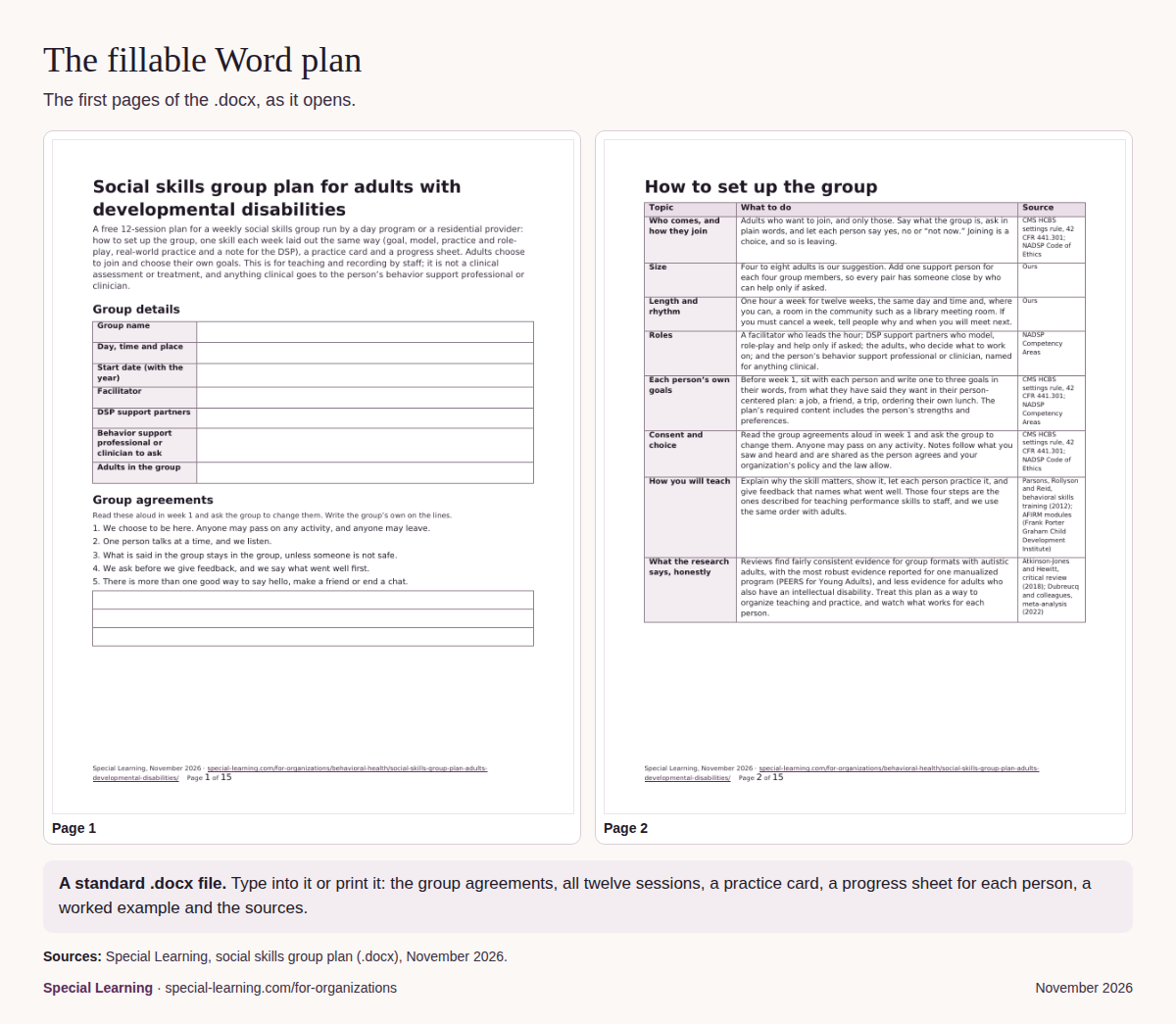
A free 12-session plan for a weekly social skills group for adults, as a Word file and a printable PDF. It shows how to set up the group (size, length, roles, consent and choice, and each person’s own goals), then gives one skill a week laid out the same way: a goal, a model, practice and role-play, real-world practice in the community and a note for the DSP. It ends with a progress sheet. Adults choose to join and choose their goals.
Special Learning · November 15, 2026
Free download
Download the plan
Short answer
How do you run a social skills group for adults with developmental disabilities?
Read
Meet once a week for an hour with four to eight adults who chose to join, for twelve weeks, and teach one skill each week: explain it, show it, practice it in role-play, then try it in a real place and talk about it the next week. Each adult starts from their own goal, in their own words. Staff teach and record what they saw and heard; the person’s behavior support professional or clinician is named for anything clinical.
The federal HCBS settings rule points the same way. It describes settings that support access to the greater community and the ability to “engage in community life,” and that facilitate “individual choice regarding services and supports, and who provides them” (CMS HCBS settings rule, 42 CFR 441.301). NADSP’s Code of Ethics speaks of “developing and maintaining relationships and social roles that matter to them” (NADSP Code of Ethics). AFIRM’s free modules teach modeling, video modeling, social narratives and social skills training as evidence-based practices for learners to age 22; this plan borrows modeling and practice and adapts them for adults who choose their own goals (AFIRM modules (Frank Porter Graham Child Development Institute)).
The research on group formats is encouraging for autistic adults and thinner for adults who also have an intellectual disability, so watch what is useful to each person (Atkinson-Jones and Hewitt, critical review (2018); Dubreucq and colleagues, meta-analysis (2022)). One review found the most robust evidence for a manualized program, PEERS for Young Adults (Atkinson-Jones and Hewitt, critical review (2018)); it is worth looking at (UCLA PEERS Clinic), and nothing from it is in this plan.
Before week 1
How to set up the group: size, length, roles, consent and choice
Most of the work happens before the first session: asking adults whether they want to come, writing their goals with them and naming who to ask about anything clinical. The suggestions below are ours; the sources show what each rests on.
| Topic | What to do | Where it comes from |
|---|---|---|
| Who comes, and how they join | Adults who want to join, and only those. Say what the group is, ask in plain words, and let each person say yes, no or “not now.” Joining is a choice, and so is leaving. | (CMS HCBS settings rule, 42 CFR 441.301; NADSP Code of Ethics) |
| Size | Four to eight adults is our suggestion. Add one support person for each four group members, so every pair has someone close by who can help only if asked. | Ours |
| Length and rhythm | One hour a week for twelve weeks, the same day and time and, where you can, a room in the community such as a library meeting room. If you must cancel a week, tell people why and when you will meet next. | Ours |
| Roles | A facilitator who leads the hour; DSP support partners who model, role-play and help only if asked; the adults, who decide what to work on; and the person’s behavior support professional or clinician, named for anything clinical. | (NADSP Competency Areas) |
| Each person’s own goals | Before week 1, sit with each person and write one to three goals in their words, from what they have said they want in their person-centered plan: a job, a friend, a trip, ordering their own lunch. The plan’s required content includes the person’s strengths and preferences. | (CMS HCBS settings rule, 42 CFR 441.301; NADSP Competency Areas) |
| Consent and choice | Read the group agreements aloud in week 1 and ask the group to change them. Anyone may pass on any activity. Notes follow what you saw and heard and are shared as the person agrees and your organization’s policy and the law allow. | (CMS HCBS settings rule, 42 CFR 441.301; NADSP Code of Ethics) |
| How you will teach | Explain why the skill matters, show it, let each person practice it, and give feedback that names what went well. Those four steps are the ones described for teaching performance skills to staff, and we use the same order with adults. | (Parsons, Rollyson and Reid, behavioral skills training (2012); AFIRM modules (Frank Porter Graham Child Development Institute)) |
| What the research says, honestly | Reviews find fairly consistent evidence for group formats with autistic adults, with the most robust evidence reported for one manualized program (PEERS for Young Adults), and less evidence for adults who also have an intellectual disability. Treat this plan as a way to organize teaching and practice, and watch what works for each person. | (Atkinson-Jones and Hewitt, critical review (2018); Dubreucq and colleagues, meta-analysis (2022)) |
Who does what
- The adults in the group. Choose to join, name their own goals, decide which practice to try in the community and what to share, and may pass or leave at any time. (CMS HCBS settings rule, 42 CFR 441.301; NADSP Competency Areas)
- The facilitator. Plans the hour, explains and models the skill, keeps time, makes sure everyone gets a turn, and gives specific feedback. (Parsons, Rollyson and Reid, behavioral skills training (2012))
- DSP support partners. Role-play, practice alongside, and help in the community only as each person asks. Write down what they saw and heard, in the person’s words. (NADSP Competency Areas; NADSP Code of Ethics)
- The behavior support professional or clinician. Named for anything clinical: a behavior support plan, a health or sexuality question, a safety concern. This plan does not assess or treat anyone.

Start from each person’s goals
Sit with each person, ask what they want, and write one to three goals in their words. If they wish to share their person-centered plan, the plan’s own content is a good place to start: the rule says it must reflect strengths and preferences (CMS HCBS settings rule, 42 CFR 441.301), and NADSP describes a DSP who supports a person to lead a self-determining life (NADSP Competency Areas). Then see which sessions fit. The example below is invented.
| In the person’s words | Sessions that fit | In staff notes |
|---|---|---|
| “I want to talk with people at my job.” | Sessions 2, 3 and 7 | Dana wants to chat with coworkers at lunch. |
| “I want to order my own food.” | Sessions 5 and 8 | Dana wants to order at a counter on his own. |
| “I want a friend to see movies with.” | Sessions 6 and 11 | Dana wants to invite someone to a movie. |
| “I get messages from people I don’t know.” | Session 10 | Dana wants to know what to do about them. |

Every week
The 60-minute session, and the five parts of every session
The hour is the same every week, so people know what to expect. Its order follows the steps described for teaching performance skills: give the reason, model the skill by role-play, have everyone practice, then give feedback that says exactly what went well (Parsons, Rollyson and Reid, behavioral skills training (2012)). Practice gets the most minutes. The AFIRM modules also teach modeling as a practice (AFIRM modules (Frank Porter Graham Child Development Institute)).
| When | What happens | Where it comes from |
|---|---|---|
| 0 to 5 min | Welcome. Greet, one word or one sentence about how the week went, read the group agreements. Anyone may pass. | Ours |
| 5 to 10 min | Look back. Volunteers tell what they tried last week and what happened. Acknowledge the trying. | Ours |
| 10 to 20 min | Why and how, then a model. Say why the skill is useful, give three steps, and show it: the facilitator and a DSP role-play it once well, and once with a different choice. | (Parsons, Rollyson and Reid, behavioral skills training (2012); AFIRM modules (Frank Porter Graham Child Development Institute)) |
| 20 to 40 min | Practice. Pairs and threes role-play with cards the adults chose. Everyone practices; the facilitator and DSP partners move around. | (Parsons, Rollyson and Reid, behavioral skills training (2012)) |
| 40 to 50 min | Feedback. Ask first if the person wants feedback. Start with what went well, in specific words, then one thing they could try. They decide. | (Parsons, Rollyson and Reid, behavioral skills training (2012)) |
| 50 to 57 min | Real-world practice. Each person picks one thing to try this week, where, and with whom, and writes or says it on the practice card. | Ours |
| 57 to 60 min | Close. One thing I will try. Thank everyone. Staff write the progress sheet afterward. | Ours |

Each of the twelve sessions below has the same five parts: a goal, a model, practice and role-play, real-world practice and a note for the DSP.

The curriculum
Twelve sessions, one skill each
Run them in order, or swap and skip to fit what the adults want to work on. Change the examples to the group’s own interests. The lines under each table say where the idea comes from; the sessions themselves are ours.

Sessions 1 to 4: greeting, starting, keeping going and ending a conversation
Session 1: Hello, and our group agreements
| Part | What to do |
|---|---|
| Goal | Choose a way of greeting people that you like, and agree how this group will work. |
| Model | The facilitator and a DSP greet each other four ways: a wave and “Hi,” “Good morning, Sam,” a handshake or fist bump, and “I’d rather not shake hands, but hello.” Then show how a greeting changes for a coworker, a neighbor and a friend. |
| Practice and role-play | In pairs, try each greeting and keep the one you like. Practice it on someone you do not know well. As a group, write the agreements: we listen, anyone can pass, what is said here stays here, we ask before giving feedback. |
| Real-world practice | Greet one person this week, at work, at the program or in a shop, the way you chose. Tell the group next week how it went. |
| A note for the DSP | Offer the choices, and never require eye contact or touch. A greeting is a choice. |
The NADSP Code of Ethics asks DSPs to “Support each person’s right to manage relationships as they choose,” which is why a greeting is a menu and not a rule. (NADSP Code of Ethics)
Session 2: Starting a conversation
| Part | What to do |
|---|---|
| Goal | Start a short conversation about something you are interested in. |
| Model | Show three openers: a comment on what is around you (“The bus is late today”), a question (“What are you working on?”), and something you noticed (“I like your jacket”). Show noticing whether the other person turns toward you. |
| Practice and role-play | Role-play in pairs using topic cards the group made. Each person picks an opener. The partner sometimes answers warmly and sometimes says “I’m busy right now,” so both are practiced. |
| Real-world practice | Start one conversation with someone you chose, for example a coworker at break. Write who, where and what you said on the practice card. |
| A note for the DSP | Let the person choose the topic and the listener. Name what you saw: “You asked a question.” |
The Code names “safe, positive, and reciprocal relationships” as what DSPs support, and an opener is where a reciprocal exchange begins. (NADSP Code of Ethics)
Session 3: Keeping a conversation going
| Part | What to do |
|---|---|
| Goal | Ask a follow-up question and share one thing about yourself, so a conversation has turns. |
| Model | Show two chats about the same topic. In one, one person talks the whole time. In the other, they ask, share, ask: “What did you do this weekend?” “I went fishing. What about you?” |
| Practice and role-play | Two-minute chats in pairs on topics people picked (food, music, sports, a show). A turn card passes back and forth. Afterward, ask what felt good and what did not. |
| Real-world practice | Have a conversation with one person that has two turns each, ask, share, ask. Note who it was and where. |
| A note for the DSP | Some people prefer short chats or messages, and that is a valid style. Notice interests that carry a conversation. |
Modeling and social skills training are among the practices AFIRM teaches, and turn-taking is the reciprocal part of the Code’s wording above. (AFIRM modules (Frank Porter Graham Child Development Institute); NADSP Code of Ethics)
Session 4: Ending a conversation, and leaving one
| Part | What to do |
|---|---|
| Goal | End a conversation kindly, and leave one you want to leave. |
| Model | Show lines for ending: “I need to get back to work. It was nice talking to you.” “I’m going to go now. See you tomorrow.” Show noticing that the other person is ready to go. Then show leaving when you want to: “I’ve got to go. Bye.” |
| Practice and role-play | Role-play a whole conversation, start to end, in three turns. Then practice a polite exit with a coworker, a neighbor and a person who keeps talking. |
| Real-world practice | Use a goodbye line at the end of one conversation this week. If you want to leave a conversation, try the exit. |
| A note for the DSP | Make sure the person has a way to leave any conversation, including one with you. Leaving is a skill and a right. |
The Code also asks DSPs to help people identify strategies “to use when they want to end a relationship”; ending a chat is the smallest version of that. (NADSP Code of Ethics)

Sessions 5 to 8: asking for help, making plans, work and the community
Session 5: Asking for help, and saying what you need
| Part | What to do |
|---|---|
| Goal | Ask for help clearly, say “no thanks” to help you do not want, and say when you did not understand. |
| Model | Show three steps: get the person’s attention, say what you need, say thank you. Lines: “Excuse me, can you show me where the batteries are?” “I didn’t catch that. Can you say it again?” “No thanks, I’d like to try it myself.” |
| Practice and role-play | Situation cards (can’t find an aisle, a machine is not working, an instruction is unclear). Pairs role-play, and the helper sometimes says “One moment.” |
| Real-world practice | Ask one question for help in a store, at work or on the bus. Write down what you said. |
| A note for the DSP | Wait before stepping in. Help with words only if the person asks. This is self-advocacy in practice. |
NADSP Area 1 describes a DSP who “enhances the ability of the participant to lead a self-determining life”; asking for help in your own words is a part of that. (NADSP Competency Areas)
Session 6: Making plans and inviting someone
| Part | What to do |
|---|---|
| Goal | Invite someone to do something, and answer an invitation with yes, no or maybe. |
| Model | Show inviting (“Want to get coffee Saturday at 2?”), accepting, declining kindly (“Thanks for asking, I can’t Saturday”), and suggesting another time (“How about Sunday?”). Say what, where and when, and how you will confirm, by text or call. |
| Practice and role-play | Role-play invitations to activities the group picked: a movie, a game, a walk. Practice saying no to an invitation and hearing no from someone. |
| Real-world practice | Invite one person to do one small thing, or plan an outing together as a group. The group chooses the place. |
| A note for the DSP | Help with rides, money and times only if asked. Hearing “no” is part of friendship. |
NADSP Area 13 reads “Support the participant in the development of friendships and other relationships.” (NADSP Competency Areas)
Session 7: Working with others at work or volunteering
| Part | What to do |
|---|---|
| Goal | Handle common exchanges at a job or volunteer role: asking about a task, taking feedback, breaks and small talk. |
| Model | Show asking a supervisor to repeat directions, “Is this how you want it done?”, answering feedback with “Thanks, I’ll do it that way,” and a short chat at a break. |
| Practice and role-play | Role-play scenes from the group’s own jobs and volunteer roles. For anyone not yet working, use a role they would like to try. Someone plays the supervisor. |
| Real-world practice | Use one of the skills at work, at a volunteer role or at the program, and tell the group how it went. |
| A note for the DSP | Connect it to the person’s job goals in their plan. Ask the person, and the employer or job coach, before practicing at the workplace. |
The HCBS settings rule describes settings that support “opportunities to seek employment and work in competitive integrated settings.” (CMS HCBS settings rule, 42 CFR 441.301)
Session 8: Out in the community: stores, buses, restaurants, appointments
| Part | What to do |
|---|---|
| Goal | Do the small exchanges of a community errand: ordering, asking staff, paying, checking in. |
| Model | Show ordering at a counter, asking a store employee a question, answering “Do you want a bag?” and “Anything else?”, and checking in at a front desk. |
| Practice and role-play | Set up the room as a café and a front desk. Take turns as customers and staff. Practice answers to questions you did not expect. |
| Real-world practice | A group outing, or an errand each person picks. Each person does one thing on their own list and reports back. |
| A note for the DSP | Let the person lead and stand back. Time in real places is part of community life under the HCBS settings rule. |
The same rule lists the ability to “engage in community life” among the qualities of a home and community-based setting. (CMS HCBS settings rule, 42 CFR 441.301)

Sessions 9 to 12: disagreement, online safety, friendship and what is next
Session 9: Handling disagreement
| Part | What to do |
|---|---|
| Goal | Say you see it differently, listen, look for a middle, or step away and ask a trusted person. |
| Model | Show “I see it differently,” “Can we find something that works for both of us?” and “I need a break. Can we talk later?” Show telling a trusted person when someone pressures you or you feel unsafe. |
| Practice and role-play | Role-play small disagreements the group picks: which movie, who sits where, a shared kitchen, a schedule. Practice taking a break and asking a trusted person. |
| Real-world practice | Notice one small disagreement this week and try one skill. Or tell the group about one you would like to practice. |
| A note for the DSP | If anyone is hurt or threatened, follow your organization’s safety policy; that is never practice. Anything about a person’s behavior support plan goes to their behavior support professional. |
This session is ours; its practice follows the instructions, modeling, rehearsal and feedback steps in the staff-training literature. (Parsons, Rollyson and Reid, behavioral skills training (2012))
Session 10: Phones, messages and online safety
| Part | What to do |
|---|---|
| Goal | Use messages and social media the way you choose, and keep yourself and your money safe. |
| Model | Show a friendly message to a friend. Show what to keep private: passwords, your address, bank details, photos you would not want shared. Show a message that asks for money, and the line “I’ll check with someone I trust.” |
| Practice and role-play | Sort invented messages into “reply,” “ask someone first” and “block and report.” Write a message and a reply. Practice saying no to a request for money. |
| Real-world practice | Check one privacy setting with someone you trust, and send a message to a friend. |
| A note for the DSP | Support the person’s privacy and choices, and read nothing unless asked. Follow the person’s own plan and your organization’s policy. |
The FTC’s advice on romance scams: “Never send money or gifts to a sweetheart you haven’t met in person.” (Federal Trade Commission, romance scams)
Session 11: Friendship, dating and boundaries
| Part | What to do |
|---|---|
| Goal | Know how friendships and relationships grow, what consent and boundaries mean, and how to end something that does not feel right. This session is for those who choose it. |
| Model | Show how both people show interest, asking “Do you want to?”, accepting a “no,” saying “I’m not comfortable with that,” and ending a friendship or relationship kindly. Use plain words and the group’s agreements. |
| Practice and role-play | Scenario cards: a friend who asks for too much of your time, someone you would like to know better, someone who says no. Role-play asking, hearing no and setting a limit. Anyone may pass. |
| Real-world practice | No assignment. Anyone who wants to may bring a question to a person they trust, or look into a community group. |
| A note for the DSP | Opt-in only, and private. Follow your organization’s policy and the person’s plan. Send health and sexuality questions to the person’s clinician or health provider, and keep your own beliefs out of it. |
The Code asks DSPs to “Ensure individuals can make informed choices about expressing their sexuality and gender identity” and to “Separate my personal beliefs about relationships” from those of the people they support. (NADSP Code of Ethics)
Session 12: Looking back, and what is next
| Part | What to do |
|---|---|
| Goal | Look back at what you tried, choose the skills to keep, and write your next goals in your own words. |
| Model | The facilitator shares a short invented look-back and fills in a blank “My goals, in my words” page, out loud. |
| Practice and role-play | Each person tells one thing they did that worked. The group gives specific compliments. Each person writes or says one to three next goals. The group decides whether to meet again and what to change. |
| Real-world practice | Pick one practice for next month and add it to the next person-centered plan meeting, if the person wants. |
| A note for the DSP | Finish the progress sheet. Bring the person’s own words to their next plan meeting only if they want to. |
The HCBS rule says the person-centered plan must “Reflect the individual’s strengths and preferences,” so the next goals are the person’s to write. (CMS HCBS settings rule, 42 CFR 441.301)

Beyond the room
Real-world practice: four steps, all by choice
Skills learned in a room only matter if they travel. The HCBS settings rule describes settings that support access to community life to the same degree as people who do not receive services (CMS HCBS settings rule, 42 CFR 441.301), and NADSP asks DSPs to help plan community activities and events (NADSP Competency Areas). Each person moves up these steps when they choose to, with a practice card they write themselves.

Recording
A progress sheet: their words first, then what staff saw
The sheet has one row for each session: the person’s goal in their words, what they tried, what staff saw and heard, and the person’s next step. It records teaching and practice, and it is not an assessment. Write what a camera could record, with the day and time, and put the person’s words in quotation marks. The NADSP Code asks DSPs to support each person’s choices, preferences, abilities and opinions (NADSP Code of Ethics).
| Session and date | My goal for this skill (my words) | What I tried, where, with whom | What staff saw and heard | My next step |
|---|---|---|---|---|
| 2. Tue March 9, 2027 | “Talk to people at lunch.” | Asked Lee at the break room table, “What are you working on?” | Dana used an opener from the cards at 12:10 PM. Lee answered and asked him back. Dana said, “That went okay.” | Ask Lee a follow-up question on Thursday. |
| 5. Tue March 30, 2027 | “Order my own food.” | Asked the café worker for a straw, then napkins. | Dana asked for the straw after a card in his pocket and for the napkins with no card. He said “No thanks” when offered help carrying the tray. | Order a drink and a sandwich on Friday. |
| 6. Tue April 6, 2027 | “A friend to see movies with.” | Invited Mo to a Saturday 2:00 PM movie. Mo said, “Can’t this week.” | Dana said, “How about next Saturday?” Mo said yes. Dana wrote the time on his phone. | Text Mo the theater name by Thursday. |

Write what you saw, not a label
A label says what the writer concluded and can follow a person for years; what you saw and heard shows their effort and their choices. Cover the right column and rewrite each line first.
| Part | Instead of | Write |
|---|---|---|
| Goal | “Needs social skills.” | Dana said he wants to chat with coworkers at lunch. |
| A pass | “Refused to participate.” | At 10:20 AM Dana said, “I’ll pass on this one,” and watched from his chair. He joined the next role-play. |
| A skill | “Poor eye contact.” | Dana greeted his partner with a wave and “Hi, Lee,” the greeting he chose in session 1, and Lee said hi back. |
| Help | “Needs prompting for everything.” | Dana asked the café worker for a straw after a reminder card, and asked for napkins with no card. |
| A choice | “Refused the outing.” | Dana said, “Not today, Thursday?” and the group agreed on Thursday at 1:00 PM. |
| Words | “Inappropriate comments.” | Dana said, “Nice jacket,” to Lee, and Lee said thanks. Next time he will ask Lee a question too. |

For training leads
Set up the group in six steps
The group sits beside your other training and records. The NADSP Code of Ethics onboarding guide and the DSP onboarding checklist prepare new DSPs to be support partners, the DSP supervision log gives supervisors a place to coach facilitators, and the daily notes template and ABC data sheet use the same see-and-hear wording as the progress sheet.

- Talk with the adults. Ask who wants to join and what they want from it. Write one to three goals in their words, and check them against the person-centered plan.
- Choose the room, the day and the people. Pick a weekly one-hour slot, four to eight adults, a facilitator and one support partner for every four. Name the clinician or behavior support professional to ask.
- Read the plan and the practice cards. Read all twelve sessions. Make the topic cards with the group, using what they care about.
- Run week 1. Greetings and the group agreements. Pass out the practice card. Staff set up each person’s progress sheet folder.
- Run weeks 2 to 12. Use the same hour each time. After each session, staff fill in one row of each person’s progress sheet from what they saw and heard.
- Look back in week 12. Each person chooses what to keep and writes their next goals. Bring their words to the next plan meeting if they want.

On paper
Prefer paper? Print the PDF
The printable PDF carries the group details, agreements, set-up, a goals page, the twelve sessions, a practice card, the progress sheet, the worked example, the check and the sources, for a binder in the office. It is also one of the 14 tools in our free DSP training and HR toolkit, a single download with a one-page index.

Go deeper: for staff who want recorded sessions on this topic, Transition Survival 103, Part 1 covers social skills teens and adults need for work, starting with the job interview, and Part 2 covers handling change, trying new things and making hard decisions. Each is $39.
Questions
Social skills groups for adults: common questions
What is a social skills group for adults with developmental disabilities?
It is a regular small group, here one hour a week for twelve weeks, where adults who chose to join practice everyday social skills such as greeting people, starting and ending a conversation, asking for help, handling a disagreement and staying safe online. Each session in this plan has a goal, a model, practice and role-play, real-world practice and a note for the DSP.
How many people should be in the group, and for how long?
We suggest four to eight adults, one hour a week for twelve weeks, with one support partner for every four adults. That is our suggestion, not a rule. Your organization decides the size, the length and the schedule.
Do adults have to join?
No. The plan starts with each person saying yes, no or “not now.” Anyone may pass on any activity or leave. The federal HCBS settings rule describes settings that facilitate “individual choice regarding services and supports, and who provides them” and that optimize individual initiative and autonomy, including “with whom to interact” (CMS HCBS settings rule, 42 CFR 441.301).
Where do the goals come from?
From each person, in their own words, and from their person-centered plan if they wish to share it. The rule says the plan must “Reflect the individual’s strengths and preferences” (CMS HCBS settings rule, 42 CFR 441.301), and NADSP’s first competency area is about supporting a person to lead a self-determining life (NADSP Competency Areas). The page shows how an invented adult’s goals point to sessions.
Is this PEERS, or another published curriculum?
No. PEERS for Young Adults is a manualized, evidence-based UCLA program, and it is worth looking at (UCLA PEERS Clinic). This plan is Special Learning’s own, built from public sources, and does not use any content from PEERS. UCLA has not reviewed or endorsed it.
Does a social skills group work?
The research is honest about its limits. A critical review found fairly consistent evidence that group formats can increase social interaction and social knowledge for autistic adults, with less evidence for adults who also have an intellectual disability (Atkinson-Jones and Hewitt, critical review (2018)). A meta-analysis found large effects on one measure but warned that the evidence is of moderate quality and effects could be inflated (Dubreucq and colleagues, meta-analysis (2022)). Treat the plan as an organized way to teach and practice, and watch what is useful to each person.
Can DSPs run this, or does it need a clinician?
A DSP supervisor, a trainer or a DSP can facilitate the teaching and practice as your organization allows. The plan is for teaching and recording, not assessment or treatment. Anything about a behavior support plan, health, sexuality or safety goes to the person’s behavior support professional or clinician, who the plan asks you to name in the group details.
What about people who do not like eye contact, or who prefer to write or type?
Offer more than one right way. Greetings, openers and goodbyes in the plan are menus: a wave, a nod, a text, a card. The aim is what the person wants to do, not a single style. The facilitator never requires eye contact or touch.
How do we record progress?
With the progress sheet: the person’s own goal in their words, what they tried, and what staff saw and heard, with the day and time. Our daily notes template, ABC data sheet and supervision log use the same see-and-hear wording.
Does this meet a state or funder requirement?
It states no requirement for any state or funder. Group content, records and consent follow your organization’s policies and each person’s plan.
Sources
Read November 15, 2026. The quoted lines are as published; the sessions, the layout, the agenda, the examples and the progress sheet are ours. None of these organizations has reviewed or endorsed this plan.
- Electronic Code of Federal Regulations, Title 42, section 441.301(c): the person-centered service plan and the qualities of home and community-based settings (c)(4)(i) through (v). https://www.ecfr.gov/current/title-42/chapter-IV/subchapter-C/part-441/subpart-G/section-441.301
- National Alliance for Direct Support Professionals (NADSP), The NADSP Code of Ethics (revised 2026), tenets Person-Centered Supports and Relationships and Social Roles, as published on nadsp.org. https://nadsp.org/resources/the-nadsp-code-of-ethics/
- National Alliance for Direct Support Professionals (NADSP), The NADSP Competency Areas, including Area 1 Participant Empowerment and Area 13 Building and Maintaining Friendships and Relationships, as published on nadsp.org. https://nadsp.org/resources/competency-areas/
- K. Atkinson-Jones and O. Hewitt, “Do group interventions help people with autism spectrum disorder to develop better relationships with others? A critical review of the literature,” British Journal of Learning Disabilities 47(2), 77-90 (abstract, University of Oxford Research Archive). https://ora.ox.ac.uk/objects/uuid:3646a22b-70e1-4e93-828f-3f76d7450213
- J. Dubreucq, F. Haesebaert, J. Plasse, M. Dubreucq and N. Franck, “A Systematic Review and Meta-analysis of Social Skills Training for Adults with Autism Spectrum Disorder,” Journal of Autism and Developmental Disorders 52(4), 1598-1609 (abstract, PubMed). https://pubmed.ncbi.nlm.nih.gov/33963965/
- AFIRM (Autism Focused Intervention Resources and Modules), Frank Porter Graham Child Development Institute, University of North Carolina at Chapel Hill: 28 evidence-based practice modules, including Modeling, Video Modeling, Social Narratives and Social Skills Training, written for learners from birth to 22 years. https://afirm.fpg.unc.edu/modules/
- M. B. Parsons, J. H. Rollyson and D. H. Reid, “Evidence-Based Staff Training: A Guide for Practitioners,” Behavior Analysis in Practice 5(2), 2-11 (2012), on the instructions, modeling, rehearsal and feedback steps of behavioral skills training for staff. https://pmc.ncbi.nlm.nih.gov/articles/PMC3592486
- UCLA PEERS Clinic, Semel Institute: a manualized, evidence-based social skills program (PEERS for Young Adults and others); named here as an option to look at, and nothing of its content is used in this plan. https://www.semel.ucla.edu/peers
- Federal Trade Commission, “What To Know About Romance Scams,” consumer.ftc.gov. https://consumer.ftc.gov/articles/romance-scams