
Free sheets and downloads for day programs, DSPs, house managers and QIDPs
Teaching social skills to adults with IDD: free teaching sheets for day programs and direct support staff
Eight editable teaching sheets, in Word and PDF, for social skills the person chooses to learn: greeting and introducing yourself, starting and ending a conversation, asking for help at work or in a store, saying no and setting a boundary, handling a disagreement, making plans with a friend, phone and text etiquette, and break-room conversation. Each has steps, a role-play script, a real-world practice plan and a note on the person’s choice. Add how to teach with behavioral skills training, a one-page practice data sheet and a monthly review box.
Special Learning · November 16, 2026
Free download
Download the teaching sheets
Short answer
How do you teach social skills to an adult with IDD?
Read
Start with what the person wants to do in their own life, such as talking with a coworker, asking for help in a store or making plans with a friend. Write the skill as a few clear steps, teach it with behavioral skills training (explain, show, rehearse, give feedback), then practice in the real place with the lightest help that works. Let the person choose what makes it worth doing, practice with different people and places, and record each session so the person and the team can see what is working. These are skills a person chooses, not manners imposed on them. People socialize in different ways, including autistic ways, and a quiet, direct or different style is not something to fix. Below are eight ready-made teaching sheets you can edit, each with steps, a role-play script, a real-world practice plan and a note on the person’s choice, plus a one-page practice data sheet and a monthly review box, free in Word and PDF.
This page is practice guidance built on the sources below. It does not replace the person’s plan, the plan’s author, your licensing rule or your funder’s contract.
Why teach
Why teach social skills: community life and the relationships the person wants
- Community life is a stated expectation. For Medicaid home and community-based settings, the federal rule says a setting supports access to the greater community, “including opportunities to seek employment and work in competitive integrated settings, engage in community life, control personal resources, and receive services in the community.” Work, stores, buses and neighbors are where social skills get used. The rule is for HCBS waiver settings; other settings and states may have their own. (42 CFR 441.301(c)(4))
- The relationships are the person’s. The NADSP Code of Ethics asks DSPs to “support each person’s right to manage relationships as they choose” and to “support individuals in building and maintaining safe, positive, and reciprocal relationships.” A teaching sheet is a way to help the person do what they already want to do. (NADSP Code of Ethics)
- Who to spend time with is a choice. The same federal rule says a setting “optimizes, but does not regiment, individual initiative, autonomy, and independence in making life choices, including but not limited to, daily activities, physical environment, and with whom to interact.” Which skills to learn, and with whom to use them, are the person’s to decide. (42 CFR 441.301(c)(4))
- Choice and self-determination run through everything. The Code asks DSPs to “educate and support individuals to make choices and practice self-determination in all areas of life.” We read that as including the choice to say no to a skill, to a conversation or to a person (our practice). (NADSP Code of Ethics)
Teach when the person wants to learn the skill or do more of it. Be a companion, with no teaching, when the person wants company or help today. Both are respectful. What is not respectful is deciding for the person which friends they should have, correcting how they naturally talk, or teaching a skill they did not choose. Offer, and a “no” stands (our practice).

The person’s choice
Whose skills are they? The person’s
- Pick the skill with the person. Ask what they want to do in their own life: “What would you like to be able to say or do at work, in the store, with friends?” Their answer, in their words, is the goal on the sheet. Team members and the person’s clinician can add what they have seen; they do not answer for the person.
- Different is not wrong. People socialize in many ways. Some prefer a wave to a handshake, a text to a call, a short chat to a long one, or quiet over company. Autistic ways of socializing are ways of socializing. Teach options (“here are three ways to say hello”) so the person can choose the one that feels like them, rather than one “right” way. Eye contact, small talk and smiling are options, not requirements.
- Teach the skill, not the mask. The aim is for the person to get what they want, whether that is help, a friend or a good day at work, on their own terms. It is not for the person to hide who they are. One review of how staff talk with people with intellectual disabilities names a dilemma worth keeping in mind: “Adapting Communication versus Downplaying Difference” (a dilemma for staff communication, not a finding about masking). (Chinn et al. (2026), Journal of Applied Research in Intellectual Disabilities)
- Relationships, including dating, belong to the person. The Code asks DSPs to “separate my personal beliefs about relationships, including sexual relationships, from those of the people I support.” Teach the skill the person asks about, respect their pace and privacy, and take questions about sexual health to a qualified health educator or the person’s team. (NADSP Code of Ethics)
- Safety is part of skill, and so is no. Teaching how to say no and set a boundary matters at least as much as teaching how to say yes. A “no” from the person is honored in practice, not only on the sheet. Any concern about abuse, neglect or exploitation goes to your reporting process right away.

How to teach
Eight moves for teaching a social skill
- Start with the person’s goal. Ask what the person wants to be able to do on their own, in the way they communicate: say hello to a neighbor, ask a coworker to lunch, call a friend. The skill, the place and the people are theirs to choose. Say it in their words at the top of the sheet.
- Write the skill as a few clear steps. Break the skill into steps you can see and hear, in the order they happen. The eight sheets below are examples. Edit them: add, merge or drop steps, and write in more than one acceptable way to do each step so the person can pick.
- Teach with behavioral skills training. Behavioral skills training has four parts: instructions, a model, a rehearsal and feedback. In one study with six adults with autism, the training “was delivered in small group instruction and included (i) instructions about having a conversation, (ii) modeling a conversation, (iii) practicing a conversation, and (iv) feedback on performance during each session.” It “was effective for increasing appropriate conversation interactions for all six participants, and maintenance was evident 4 weeks post intervention.” The same approach has been described for training staff. (Ryan et al. (2019), Journal of Intellectual Disabilities; Parsons, Rollyson and Reid (2012), Behavior Analysis in Practice)
- Role-play first, then practice in the real place. Rehearse with a practice partner so the first try is low-pressure, then take the same steps to the break room, the store or the bus stop, with the helper standing back. In a pilot with adults with autism and intellectual disabilities preparing for employment, the authors report “evidence of maintenance and generalization” for a social skills program with video modeling. Role-play alone is not the goal; using the skill in real life is. (Walsh et al. (2018), Journal of Autism and Developmental Disorders)
- Add video models or social narratives if the person wants them. A short video of a coworker doing the skill, or a short story written with the person about what happens and what they can choose, can help some people. Make them with the person, with adult actors and settings. In the pilot above video modeling was one part of a larger program, so its effect on its own is not known from that abstract; we cite no study of social narratives with adults here, so we offer them as an option, not a finding (our practice). (Walsh et al. (2018), Journal of Autism and Developmental Disorders)
- Prompt lightly, privately, and fade. A prompt is the help you give. Start with the lightest that works, and wait before you give it: a private signal agreed beforehand, a quiet question, or a model before the person tries. Never correct the person in front of other people. In a study in a real grocery store, young adults with intellectual disability learned a skill with least-to-most prompting, the lightest help first. When the person does a step the same way a few sessions in a row, try the next lighter prompt (our practice). (Gil et al. (2019), Behavior Analysis in Practice)
- Let the person choose what makes it worth doing. Good social skills pay off in their own way: the help arrives, the plan with a friend is made, the break is pleasant. Add the acknowledgment the person likes, in an adult way. Never make food, outings, visits or privacy depend on practicing. A person who says “not today” is telling you something; honor it (our practice).
- Take data every session, and review monthly. After each practice, write a prompt code for each step and mark whether it was a role-play (R) or the real setting (W). Once a month, sit with the person and look at it together. Plan practice with new people and in new places so the skill does not stay in one room.

The research cited here is with adults, mostly with autism and often with intellectual disability, and some of it is about staff training. We read the abstracts, not the full papers, and make no claim beyond them. The teaching sheets and the prompting and fading choices are our practice guidance, not findings of these studies.
Behavioral skills training: instruct, model, rehearse, feedback
| Part | What you do | Respect note |
|---|---|---|
| Instruct | Say what the skill is, why it is useful to the person and what the steps are. Keep it short. Ask: “Is this something you want?” | The person’s reason comes first, not ours. |
| Model | Show it: you, a coworker or a short video does the steps while the person watches. Show more than one way. | Use adult scenes and settings the person goes to. |
| Rehearse | The person tries the steps in a role-play with a practice partner. Run it more than once, and change the person or the situation a little each time. | The person can say “stop” or pick a different script at any time. |
| Feedback | Say what went well first and be specific. Offer one thing to try next time. Ask how it felt and what the person wants to change. | Respect the person’s style. Feedback is about getting what they want, not about acting “normal.” |

Prompt levels and their codes
| Code | Level | What you do | Note |
|---|---|---|---|
| I | Independent | The person does the step with no help. | Wait. Give the person time to start. |
| G | Gesture | A private signal the person picked, such as a touch of the lanyard. | No words and no one else can tell. |
| V | Verbal | A quiet question or a few words: “What might you say?” | Before the step if you can, not in front of others. |
| M | Model | You or a video show the step, or a card shows it. | The person tries it. Do not do it for them. |
No physical prompts for social skills. Wait first; give the lightest prompt that works, privately; and fade it when the person does the step the same way a few sessions in a row (our practice).

What the research says
What published research says
| Paper | What the abstract says | How we use it |
|---|---|---|
| Ryan et al. (2019) (Ryan et al. (2019), Journal of Intellectual Disabilities) publisher page | Evaluated a behavioral skills training package for conversation with six adults with autism (the title also names intellectual disability). “The BST package was delivered in small group instruction and included (i) instructions about having a conversation, (ii) modeling a conversation, (iii) practicing a conversation, and (iv) feedback on performance during each session.” The authors report that “maintenance was evident 4 weeks post intervention.” | The four parts of BST can teach conversation to adults. It was six people; read your own data and adjust. |
| Walsh et al. (2018) (Walsh et al. (2018), Journal of Autism and Developmental Disorders) publisher page | A pilot of a social skills curriculum with video modeling for adults with autism spectrum disorder and intellectual disabilities preparing for employment. “Results showed significant increases in target social skills and a significant decrease in problem behaviors following intervention. Evidence of maintenance and generalization were also demonstrated.” | Teaching social skills for work, with video, can help, and practice should be checked in more than one setting. It was a pilot, and the curriculum and video were combined. |
| Rose et al. (2021) (Rose et al. (2021), Behavior Modification) publisher page | A weekly PEERS social skills group for 10 college students with intellectual and developmental disabilities aged 18 to 26. “Results showed increased social skill knowledge, friendship quality, and conversational skills from pretest to posttest intervention.” | A group format for young adults in a college program. The abstract reports change from pretest to posttest, so we use it as an example, not proof. |
| Parsons, Rollyson and Reid (2012) (Parsons, Rollyson and Reid (2012), Behavior Analysis in Practice) | A guide to training human service staff with behavioral skills training, with “a specific means of conducting a behavioral skills training session with a group of staff followed by on-the-job training requirements.” This paper is about training staff, not people receiving support. | The paper describes training human service staff with behavioral skills training plus on-the-job training; we suggest it as one way to prepare staff to use these sheets (our practice). |
| Gil et al. (2019) (Gil et al. (2019), Behavior Analysis in Practice) publisher page | Used least-to-most prompting to teach young adults with intellectual disability to use a grocery list on an iPad. “Sessions were conducted entirely in a community grocery store.” The results “indicated that participants learned to use an initial grocery list.” | An example of lightest-first prompting with adults in a real setting. It is not a social skills study. |
| Dubreucq et al. (2022) (Dubreucq et al. (2022), Journal of Autism and Developmental Disorders) publisher page | A systematic review and meta-analysis of group-based social skills training for adults with autism spectrum disorder: 18 studies, five randomized trials in the meta-analysis. “These results should be interpreted with caution due to the moderate quality of the existing evidence.” | Group training can help some adults with autism; the evidence is of moderate quality. It was about autism, not specifically intellectual disability. |
| Atkinson-Jones and Hewitt (2018) (Atkinson-Jones and Hewitt (2018), British Journal of Learning Disabilities) | A critical review of group interventions for adults with autism. “There was less evidence supporting the effectiveness of group social skills interventions for adults with ASD and intellectual disability, and more research is needed in this area.” | The evidence for adults who also have an intellectual disability is thinner. Keep your own data and keep the person’s goals first. |
| Chinn et al. (2026) (Chinn et al. (2026), Journal of Applied Research in Intellectual Disabilities) publisher page | A review of 65 conversation analysis studies of how practitioners talk with people with intellectual disabilities. The authors name two dilemmas, including “Adapting Communication versus Downplaying Difference.” | The review names this as a dilemma staff face when they talk with people with intellectual disabilities; it does not tell staff how to resolve it. |

We read the published abstracts of these eight papers (the Atkinson-Jones and Hewitt abstract in the Oxford University Research Archive record) and quote only what they say. We did not read the full papers, so we make no claim about their details. We found no study of these eight specific sheets; they are our practice guidance. The studies are with adults, with autism more often than with intellectual disability alone, and we say so.
For the person’s own likes, choices and ways of saying yes and no, start with the preference and choice record and the one-page profile template. To teach social skills in a group, see our social skills group plan.
Eight teaching sheets
Teaching sheets for social skills, with role-play scripts and practice plans
Each sheet has steps, a role-play script and a real-world practice plan. Edit it for the person: words, places, people and more than one way to do each step. These sheets are our own practice guidance. The person picks the skill and leads, and a “no” stands.
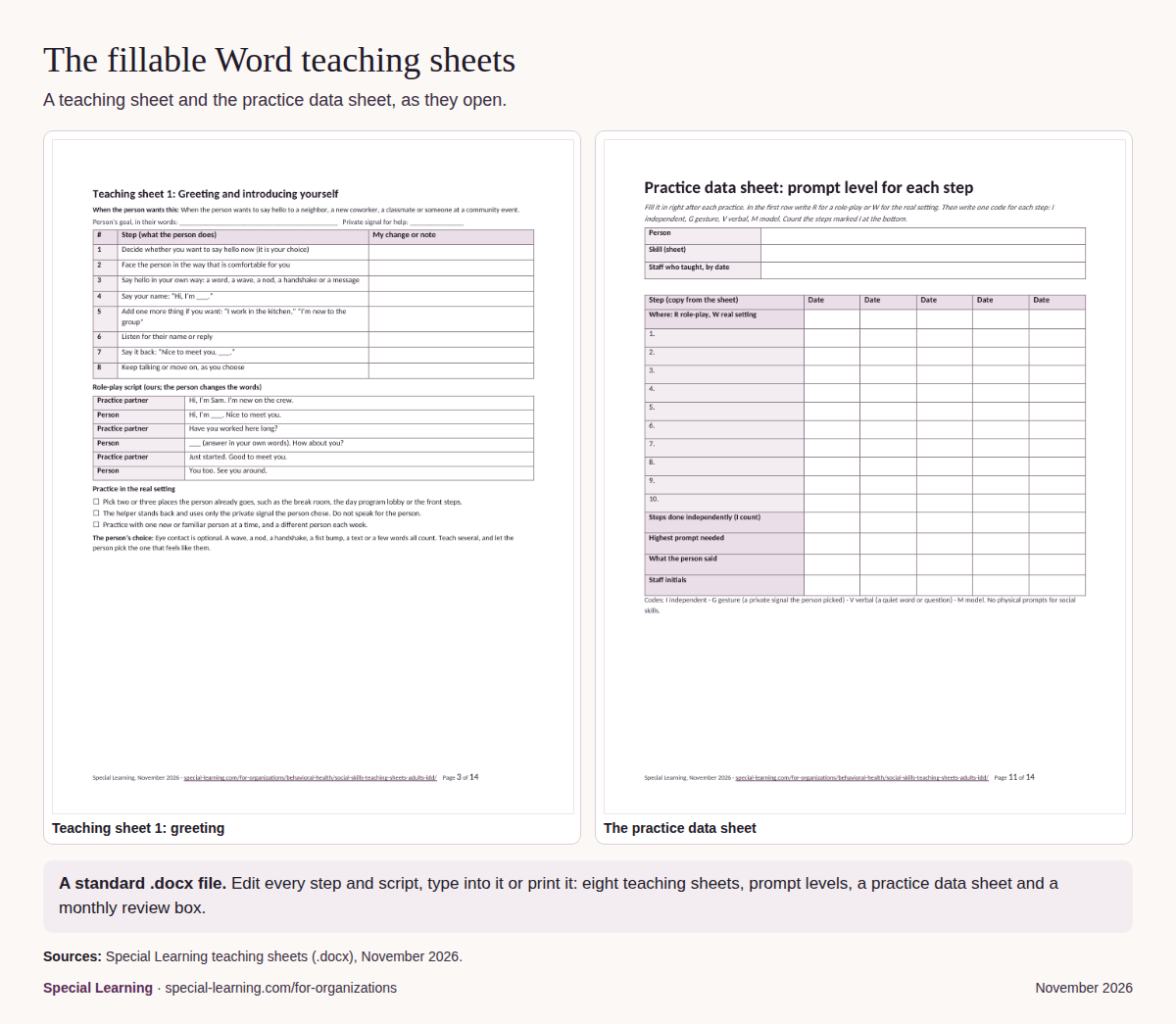
Teaching sheet 1: Greeting and introducing yourself
When the person wants this. When the person wants to say hello to a neighbor, a new coworker, a classmate or someone at a community event.
Steps (edit them with the person).
- Decide whether you want to say hello now (it is your choice)
- Face the person in the way that is comfortable for you
- Say hello in your own way: a word, a wave, a nod, a handshake or a message
- Say your name: “Hi, I’m ___.”
- Add one more thing if you want: “I work in the kitchen,” “I’m new to the group”
- Listen for their name or reply
- Say it back: “Nice to meet you, ___.”
- Keep talking or move on, as you choose

Role-play script (ours; the person changes the words).
- Practice partner: Hi, I’m Sam. I’m new on the crew.
- Person: Hi, I’m ___. Nice to meet you.
- Practice partner: Have you worked here long?
- Person: ___ (answer in your own words). How about you?
- Practice partner: Just started. Good to meet you.
- Person: You too. See you around.
Practice in the real setting.
- Pick two or three places the person already goes, such as the break room, the day program lobby or the front steps.
- The helper stands back and uses only the private signal the person chose. Do not speak for the person.
- Practice with one new or familiar person at a time, and with different people over time.
The person’s choice. Eye contact is optional. A wave, a nod, a handshake, a fist bump, a text or a few words all count. Teach several, and let the person pick the one that feels like them.
Teaching sheet 2: Starting and ending a conversation
When the person wants this. When the person wants to chat with a coworker, housemate, friend or someone they meet at a community event.
Steps (edit them with the person).
- Choose someone and a good moment (they are not busy)
- Say hello
- Start with a question or a comment: “How was your weekend?” “Did you see the game?”
- Listen to the answer
- Answer a question or add something about yourself
- Ask a follow-up question or share something that fits
- Notice if they are ready to end (looking away, checking a phone, moving off)
- End it: “I’ve got to go. Good talking to you.”
- Say goodbye

Role-play script (ours; the person changes the words).
- Person: Hi, ___. How was your weekend?
- Practice partner: Good. I went fishing. You?
- Person: ___ (say one thing about your weekend).
- Practice partner: Nice. Do you like fishing?
- Person: ___ (your own answer). What did you catch?
- Practice partner: I should get back to work.
- Person: Okay. Good talking to you.
Practice in the real setting.
- Practice a short chat of a few turns in a real place such as the break room, bus stop or lobby; longer is not better.
- After the chat, ask the person how it felt and what they would do differently, if anything.
- Try with different people and at different times of day.
The person’s choice. Some people like short chats, some like long ones, some prefer text, and talking about a favorite topic is a good way to connect. The person may end any conversation at any time.
Teaching sheet 3: Asking for help at work or in a store
When the person wants this. When the person wants to find something, check how to do a task, or ask a worker, manager or coworker for help.
Steps (edit them with the person).
- Notice that you need help
- Decide who to ask (a worker with a name tag, a manager, a coworker or a card you carry)
- Wait until they are free, or say “Excuse me”
- Say what you need: “Can you help me find ___?” “I’m not sure how to ___.”
- Listen to the answer
- If you do not understand, ask again: “Can you say that again?” “Can you show me?”
- Say thank you
- If it did not work, ask someone else or tell the person who supports you

Role-play script (ours; the person changes the words).
- Person: Excuse me. Can you help me find the rice?
- Practice partner: Sure. Aisle 6, on the left.
- Person: Aisle 6. Can you show me?
- Practice partner: I can walk you there.
- Person: Thank you.
Practice in the real setting.
- Role-play in the program first, then a real store, bus station or workplace task the person picked.
- The helper waits outside the aisle or across the room and uses a private signal only if the person wants one.
- Try different stores and different workers. Count the real tries on the data sheet.
The person’s choice. Asking for help is a skill independent adults use every day. The person may use words, a card, a note on their phone or an agreed message through a support person, and chooses the way that works for them.
Teaching sheet 4: Saying no and setting a boundary
When the person wants this. When the person wants to turn down a request, an invitation, a pressure to spend money, touch they do not want or a conversation they do not want to have.
Steps (edit them with the person).
- Notice how you feel and remember that it is your choice
- Decide your answer: yes, no, not now or maybe later
- Say it clearly: “No, thank you.” “I don’t want to.” “I’m not comfortable with that.”
- Keep it short; you do not have to give a long reason
- Say it again if you need to
- Move away or leave if they keep pushing
- Tell a person you trust (your support person, your supervisor) if you feel unsafe or pressured
- Remember you can change your mind later

Role-play script (ours; the person changes the words).
- Practice partner: Come on, lend me twenty dollars.
- Person: No, thank you.
- Practice partner: Just this once. Everybody does.
- Person: I said no. I’m going to go now.
- Practice partner: Fine.
- Person: (walks away, then tells a trusted person)
Practice in the real setting.
- Role-play several different situations the person has told you about or might face: money, a request for a favor, a conversation they want to leave.
- Practice real, low-stakes noes in daily life, such as turning down an offer of a second helping or an invitation to a show.
- Staff honor the person’s no in daily life too, and say so.
The person’s choice. This sheet is about the person’s rights, not about teaching them to comply. Any concern about abuse, neglect or exploitation goes to your reporting process right away, and the person is never blamed for saying no.
Teaching sheet 5: Handling a disagreement calmly
When the person wants this. When the person wants to disagree with a coworker, housemate or friend without it turning into an argument.
Steps (edit them with the person).
- Notice how your body feels (tight, hot, fast)
- Pause: take a breath, or a short break
- Say what you think: “I see it differently.”
- Listen to the other person’s view
- Look for something you can both do: “Could we ___?”
- Choose: agree, agree to disagree, or ask someone to help
- If you need a break, say so: “I need a few minutes.”
- Come back to it, or let it go

Role-play script (ours; the person changes the words).
- Practice partner: I wanted the table by the window.
- Person: I see it differently. I was here first.
- Practice partner: That is not fair.
- Person: I hear you. Could we switch tomorrow?
- Practice partner: Okay, tomorrow is mine.
- Person: Deal.
Practice in the real setting.
- Practice with small, real disagreements about things the person cares about, such as music, seats, chores or plans.
- Teach the break line (“I need a few minutes”) and honor it every time.
- If a disagreement is about safety or a workplace rule, the person takes it to a supervisor.
The person’s choice. Disagreeing is allowed. The goal is to be heard, not to give in. A break is always an option, and the person does not have to agree to be polite.
Teaching sheet 6: Making plans with a friend
When the person wants this. When the person wants to invite a friend to do something, or answer an invitation. The same steps work for asking someone on a date.
Steps (edit them with the person).
- Think of what you would like to do and who you would like to ask
- Pick how to reach them: in person, a call or a text
- Ask: “Do you want to ___ on ___?”
- Offer a day and a time, or two options
- Listen to their answer; if it is no, that is okay: “Maybe another time”
- Agree on the place, the time, how to get there and what it will cost
- Check the ride or the bus and your money
- Remind them the day before, if you want
- Go, enjoy it, and say thanks afterward

Role-play script (ours; the person changes the words).
- Person: Hi, ___. Do you want to get coffee on Saturday?
- Practice partner: Maybe. What time?
- Person: How about 2 o’clock at the corner cafe?
- Practice partner: Sorry, I can’t Saturday.
- Person: No problem. Maybe another time.
- Practice partner: Yes! Let’s try next week.
Practice in the real setting.
- Role-play, then send or say the real invitation. Let the person pick who to invite.
- Plan the how with the person: transportation, money, and a plan for the meeting that the person agrees to, following the person’s plan and your policy.
- Staff do not choose friends or read messages without the person’s permission.
The person’s choice. Whom to invite is the person’s choice. The same steps can be used to ask someone on a date. The person decides who, whether and when, and a “no” from the other person is answered kindly. Questions about sex and relationships go to a qualified health educator or the person’s team.
Teaching sheet 7: Phone and text etiquette
When the person wants this. When the person wants to call or text a friend, a family member, an employer or a service.
Steps (edit them with the person).
- Check that it is a good time (not at work, not late at night)
- Start: “Hi, it’s ___.”
- Say why you are calling or texting
- Wait for the answer and give them time
- Keep texts short and clear
- Do not send many messages in a row if there is no answer yet
- Share personal information and photos only with people you trust
- End: “Talk later. Bye.”

Role-play script (ours; the person changes the words).
- Person: Hi, it’s ___. Is this a good time?
- Practice partner: Yes, go ahead.
- Person: I’m calling about Saturday. Are you still coming?
- Practice partner: Yes. What time?
- Person: Two o’clock. See you then. Bye.
Practice in the real setting.
- Practice on the person’s own phone, with the person in charge of the screen.
- Try a real call or text now and then, to someone the person chose.
- Practice what to do when a call or message is unwelcome: do not answer, block the number, tell a trusted person, following the person’s plan and your policy.
The person’s choice. The person decides whether to call or text, and many prefer text. Voice-to-text, emoji and a short script are fine. Staff do not read the person’s messages unless asked.
Teaching sheet 8: Workplace break-room conversation
When the person wants this. When the person works or volunteers and wants to be comfortable at breaks and lunch with coworkers.
Steps (edit them with the person).
- Decide if you want to chat or have a quiet break (both are okay)
- Say hello when you come in
- Listen first, then add to the conversation when it fits
- Pick topics that work at work: the weekend, food, weather, sports, shows
- Take turns talking and listening
- Keep private things private if you want to (such as health, or other people’s business); whether to share your own pay is your choice
- Notice when people are busy or the break is ending
- End: “Back to work. See you later.”

Role-play script (ours; the person changes the words).
- Practice partner: Did you see the game last night?
- Person: No. Who won?
- Practice partner: We did, in overtime.
- Person: Nice. I watched a show about trains.
- Practice partner: I like trains too.
- Person: Break is almost over. See you later.
Practice in the real setting.
- Practice at the real break time, with the job coach or helper out of sight of coworkers unless the person asks otherwise.
- Bring a topic card with two things to say if the person wants one.
- Check in privately after the break: what worked, and what the person wants to try next.
The person’s choice. The break is the person’s own time. Some people want to chat and some want quiet, and being quiet at lunch is not a problem. The helper never talks about the person’s support in front of coworkers.
Data
The one-page practice data sheet and monthly review
The Word file and PDF have a blank one-page practice data sheet: the steps down the side, a column for each practice, a row for role-play (R) or real setting (W), and a code in every box. Invented numbers to show the layout. Dana did 2 of 7 steps on her own on Monday’s role-play, 4 of 7 on Tuesday, and 2 and 3 of 7 in the store on Wednesday and Friday. In this example the real store needs more help than the role-play, so the team keeps practicing in the store, with the same steps, instead of moving on. Steps 2, 3, 4 and 6 are still prompted. The count is how many steps are marked I.
| Step | Mon | Tue | Wed | Thu | Fri |
|---|---|---|---|---|---|
| Where: R role-play, W real setting | R | R | W | R | W |
| 1 Notice you need help | I | I | I | I | I |
| 2 Decide who to ask | G | I | V | I | G |
| 3 Wait, or say excuse me | V | G | V | G | V |
| 4 Say what you need | M | V | M | G | V |
| 5 Listen to the answer | I | I | I | I | I |
| 6 Ask again if unsure | M | V | M | V | M |
| 7 Say thank you | G | I | G | I | I |
| Steps done independently (I count) | 2 of 7 | 4 of 7 | 2 of 7 | 4 of 7 | 3 of 7 |
| What Dana said | OK | Good | Hard | Good | OK |

The monthly review box
Once a month, sit with the person and fill in the review box. It asks what the person said about how it is going and what they want next, so their view is part of the data.
| Box | What was written |
|---|---|
| Month and skills practiced | November, asking for help in a store |
| Role-play sessions and real-setting sessions (how many of each) | 6 role-plays, 5 real store visits |
| Steps now independent in the real setting | 1, 5 and 7 (3 of 7) |
| Steps still prompted, and the prompt level | 2 gesture; 3 and 4 verbal; 6 model |
| New people or places tried this month (generalization) | Two new stores, one new worker |
| What the person said about how it is going, and what they want next | “The pharmacy is the hardest.” She wants to practice there next. |
| What is working | Card with the sentence; walking in first; helper waiting by the door |
| What to change next month (steps, prompt level, place, people) | Fade verbal to gesture on 3 and 4; add the pharmacy |
| Ask the supervisor or clinician? (distress, refusal, flat data, a safety concern) | No |
| Reviewed with the person on | Friday, at the program, with Dana choosing the next skill |

The session, start to finish
- Ask the person which social skill they want to learn and where they would use it. Write the goal in their words.
- Pick the sheet. Edit the steps with the person: places, people, words, and more than one way to do each step.
- Agree on a private signal for help, and on how the person says stop.
- Teach in a role-play with behavioral skills training: instruct, model, rehearse and give feedback. Run it more than once.
- Go to the real place with the person. Stand back and wait before you prompt. Give the lightest prompt that works, privately.
- Fill in the data sheet right after, marking role-play (R) or real setting (W) and a code for each step.
- Practice with different people and in different places, and fade a prompt on any step done the same way a few sessions in a row.
- Once a month, do the review box with the person, and take distress, refusal, flat data or a safety concern to your supervisor and the clinician.
| When | What to do |
|---|---|
| Before the session | Ask the person. Pick the sheet, edit the steps with them, and agree on the private signal. |
| Role-play | Instruct, model, rehearse, feedback. Run it a few times, with different partners if you can. |
| Real setting | Go to the real place. Stand back. Give the lightest prompt that works, privately. Honor a no. |
| Right after | Fill the data sheet while it is fresh: R or W, and a code for each step. |
| Each month | Do the monthly review with the person and decide the next skill together. |
For the person’s day in the daily record, see the DSP daily notes template; to teach a self-care routine step by step, our personal care teaching sheets; for tracking staff skills, the DSP competency checklist; and for recording what happens before and after a behavior, the ABC data sheet. To check that a behavior support plan is carried out as written, see the implementation checklist. For ethics at orientation, see the NADSP Code of Ethics onboarding guide; for the training roster across the year, the DSP training and HR toolkit. If you are worried about abuse, neglect or exploitation, see abuse and neglect reporting training for DSPs and follow your own reporting process. The federal home and community-based services rules are on eCFR in 42 CFR 441.301; find your state’s DSP training rule in our free state finder, then read your own licensing rule. If something unsafe or harmful turns up, it may also belong in your incident report.
The checklist
Before you finish
- I asked the person which skill they want, and wrote it in their words.
- I edited the sheet for this person, their places and the people in their life.
- We agreed on a private signal and on what happens if the person says “stop.”
- I taught with instruction, a model, a rehearsal and feedback.
- I practiced in the real setting, not only in role-play.
- I gave the lightest prompt that worked, and never corrected the person in front of others.
- I filled in the data sheet right after, marking role-play (R) or real setting (W).
- I planned practice with new people and in new places.
- I did the monthly review with the person and honored their choices.

On paper
Prefer paper? Print the PDF
The printable PDF has the same pages as the Word file, with write-in space on the data sheet and the review box.

Questions
Teaching social skills to adults with IDD: common questions
What are social skills, and who decides which ones to teach?
They are what a person does and says with other people to get what they want, such as saying hello, asking for help, making plans or saying no. The person decides which ones to learn. The NADSP Code asks DSPs to “support each person’s right to manage relationships as they choose.” (NADSP Code of Ethics) Ask what they want to do in their life, and write the goal in their words.
What is behavioral skills training?
A four-part way to teach a skill: instructions, a model, a rehearsal and feedback. In one study with six adults with autism, it was “delivered in small group instruction and included (i) instructions about having a conversation, (ii) modeling a conversation, (iii) practicing a conversation, and (iv) feedback on performance during each session,” and “maintenance was evident 4 weeks post intervention.” (Ryan et al. (2019), Journal of Intellectual Disabilities)
Why practice in the real setting and not only in role-play?
Role-play is a low-pressure first try, but the goal is using the skill where the person lives and works. A pilot with adults with autism and intellectual disabilities preparing for employment reported that “evidence of maintenance and generalization were also demonstrated,” (Walsh et al. (2018), Journal of Autism and Developmental Disorders) and our data sheet marks role-play (R) and real setting (W) so you can see whether the skill is showing up in real life.
Do video models and social narratives work for adults?
Video modeling was one part of a larger program in the employment pilot, so its effect alone is not known from that abstract. (Walsh et al. (2018), Journal of Autism and Developmental Disorders) We cite no study of social narratives with adults here. Both are options to try with the person: make them together, with adult settings, and keep what helps.
How do we teach social skills without trying to make the person “act typical”?
Teach options, not one right way, and let the person choose. People socialize in different ways, including autistic ways. One review of how staff communicate with people with intellectual disabilities names a dilemma for staff communication, “Adapting Communication versus Downplaying Difference” (not a finding about masking). (Chinn et al. (2026), Journal of Applied Research in Intellectual Disabilities) The aim is for the person to get what they want on their own terms, not to hide who they are.
Do adults have to make eye contact and make small talk?
No. Eye contact, small talk and smiling are options. A wave, a nod, a short message or a few words all count as greeting someone. Teach several ways and let the person pick (our practice).
Can we teach dating and relationship skills?
Yes, if the person wants to learn them. The skills (asking someone out, hearing no kindly, planning a meeting with the person) are in the sheets on making plans and saying no. The NADSP Code asks DSPs to “separate my personal beliefs about relationships, including sexual relationships, from those of the people I support.” (NADSP Code of Ethics) Questions about sex and sexual health go to a qualified health educator or the person’s team, following the person’s plan and your policy.
How do we prompt without embarrassing the person in public?
Agree on a private signal beforehand, stand back, and wait before you prompt. Prompt before a step rather than correcting during it, and talk about how it went afterward and in private (our practice). A study in a real grocery store taught young adults with intellectual disability with least-to-most prompting, the lightest help first. (Gil et al. (2019), Behavior Analysis in Practice)
How often should we practice, and for how long?
We did not find research that gives one number, so we do not give one. Short, regular practice that the person agrees to, in both role-play and real settings, is our practice. Look at the data each month with the person and adjust. The monthly review and the “few sessions in a row” rule for fading prompts are our own defaults, not research findings.
Is there research on social skills groups for adults with IDD?
Some. A weekly PEERS group for 10 college students with intellectual and developmental disabilities reported increases in social skill knowledge, friendship quality and conversational skills. (Rose et al. (2021), Behavior Modification) A review of group interventions for adults with autism found that there was “less evidence supporting the effectiveness of group social skills interventions for adults with ASD and intellectual disability, and more research is needed in this area.” (Atkinson-Jones and Hewitt (2018), British Journal of Learning Disabilities) Keep your own data. Our group plan page is a starting point for groups.
Sources
Sources read November 16, 2026 (the eCFR text is current as of November 12). The quoted lines are as published; for the research papers we read and quote only the published abstracts. The eight teaching sheets, role-play scripts, practice plans, the prompt codes, the practice data sheet, the monthly review box and the advice on prompting and fading are ours; the person leads. 42 CFR 441.301 covers Medicaid home and community-based services waivers; other settings and states may differ. None of these organizations has reviewed or endorsed these sheets.
- Electronic Code of Federal Regulations, Title 42, section 441.301, Contents of request for a waiver, (c)(4) home and community-based settings; text current as of November 12, 2026. It governs Medicaid home and community-based services (HCBS) waivers. https://www.ecfr.gov/current/title-42/chapter-IV/subchapter-C/part-441/subpart-G/section-441.301
- National Alliance for Direct Support Professionals (NADSP), The NADSP Code of Ethics (revised 2026), as published on nadsp.org. https://nadsp.org/resources/the-nadsp-code-of-ethics/
- Ryan, G., Brady, S., Holloway, J., & Lydon, H. (2019). Increasing appropriate conversation skills using a behavioral skills training package for adults with intellectual disability and autism spectrum disorder. Journal of Intellectual Disabilities, 23(4), 567-580 (abstract read on PubMed, PMID 29291670). https://pubmed.ncbi.nlm.nih.gov/29291670/ Publisher page: https://doi.org/10.1177/1744629517750744
- Walsh, E., Holloway, J., & Lydon, H. (2018). An evaluation of a social skills intervention for adults with autism spectrum disorder and intellectual disabilities preparing for employment in Ireland: a pilot study. Journal of Autism and Developmental Disorders, 48(5), 1727-1741 (abstract read on PubMed, PMID 29224188). https://pubmed.ncbi.nlm.nih.gov/29224188/ Publisher page: https://doi.org/10.1007/s10803-017-3441-5
- Rose, A. J., Kelley, K. R., & Raxter, A. (2021). Effects of PEERS social skills training on young adults with intellectual and developmental disabilities during college. Behavior Modification, 45(2), 297-323 (abstract read on PubMed, PMID 33423534). https://pubmed.ncbi.nlm.nih.gov/33423534/ Publisher page: https://doi.org/10.1177/0145445520987146
- Parsons, M. B., Rollyson, J. H., & Reid, D. H. (2012). Evidence-based staff training: a guide for practitioners. Behavior Analysis in Practice, 5(2), 2-11 (abstract read on PubMed, PMID 23730462); about training staff, not people receiving support. https://pubmed.ncbi.nlm.nih.gov/23730462/
- Gil, V., Bennett, K. D., & Barbetta, P. M. (2019). Teaching young adults with intellectual disability grocery shopping skills in a community setting using least-to-most prompting. Behavior Analysis in Practice, 12(3), 649-653 (abstract read on PubMed, PMID 31976275). https://pubmed.ncbi.nlm.nih.gov/31976275/ Publisher page: https://doi.org/10.1007/s40617-019-00340-x
- Dubreucq, J., Haesebaert, F., Plasse, J., Dubreucq, M., & Franck, N. (2022). A systematic review and meta-analysis of social skills training for adults with autism spectrum disorder. Journal of Autism and Developmental Disorders, 52(4), 1598-1609 (abstract read on PubMed, PMID 33963965). https://pubmed.ncbi.nlm.nih.gov/33963965/ Publisher page: https://doi.org/10.1007/s10803-021-05058-w
- Atkinson-Jones, K., & Hewitt, O. (2018). Do group interventions help people with autism spectrum disorder to develop better relationships with others? A critical review of the literature. British Journal of Learning Disabilities, 47(2), 77-90 (abstract read in the Oxford University Research Archive record). https://ora.ox.ac.uk/objects/uuid:3646a22b-70e1-4e93-828f-3f76d7450213
- Chinn, D., Bruun, A., Worrall, D., Buell, S., & La, J. (2026). Communicative dilemmas for practitioners in service encounters with people with intellectual disabilities: insights from a systematic review of conversation analytic research. Journal of Applied Research in Intellectual Disabilities, 39(3), e70239 (abstract read on PubMed, PMID 42212545). https://pubmed.ncbi.nlm.nih.gov/42212545/ Publisher page: https://doi.org/10.1111/jar.70239