
A free guide and worksheet for provider staff and the adults they support
Supported decision-making agreement guide: state statutes, the DSP role and a free planning worksheet
Many adults with intellectual and developmental disabilities want to make their own decisions and want trusted people to help. Supported decision-making puts that help in writing, in the states that have a statute for it. This guide explains what SDM is and how it differs from guardianship and power of attorney, links the statute for 19 states and the District of Columbia, describes what a direct support professional does when a person has an agreement, and gives a printable worksheet the person can fill in with the people they choose. The statute linked for each state sets that state’s requirements.
Special Learning · November 16, 2026
Free download
Download the agreement-planning worksheet
Short answer
What is a supported decision-making agreement?
Read
Supported decision-making (SDM) is a way for an adult to keep making their own decisions while trusted people they choose help them understand, think through and communicate those decisions. In a growing number of states, a written supported decision-making agreement names those supporters and what each will do. This free guide explains how SDM differs from guardianship and from a power of attorney, links the statute text for 19 states and the District of Columbia, sets out what a direct support professional (DSP) does and does not do when a person has an agreement, and gives a printable worksheet for planning one. The statute linked for each state sets that state’s requirements. Where a state sets a form, use that state’s official form.
The idea
What supported decision-making is
| Point | Exact text (in quotation marks) | How the guide uses it |
|---|---|---|
| What SDM is (ACL, Alternatives to Guardianship) | “Supported decision-making or SDM is an alternative to guardianship where individuals retain their right to make decisions for themselves, with the support of trusted individuals they choose.” | The person stays the decision-maker. Supporters help; they do not decide. |
| What it keeps in the person’s hands (ACL, Alternatives to Guardianship) | “SDM keeps decision-making control in the hands of the individual by providing customized assistance in specific ways and in specific situations that are useful to the individual.” | The worksheet asks, area by area, what kind of help the person wants. |
| It can be formal or informal (ACL, Alternatives to Guardianship) | “SDM can be formalized through legal documentation, kept as an informal agreement between the decision-maker and their supporters, or a combination of the two.” | A written agreement is one way to do it. Many people use SDM with no document at all. |
| What a written agreement does (ACL, Alternatives to Guardianship) | “A formal SDM agreement clarifies expectations for both parties by describing responsibilities.” | It also tells the people around the person, such as service coordinators and doctors, that a relationship exists. In the ACL’s words, it “protects their privacy by defining what information a supporter can and cannot access.” |

How it differs from guardianship and from a power of attorney
| Supported decision-making | Guardianship | Power of attorney | |
|---|---|---|---|
| Who decides | The person. Supporters help the person understand, weigh and communicate. | A guardian, appointed by a court, makes decisions on behalf of the person in the areas the court sets. | The person’s chosen agent decides within what the document authorizes. |
| How it starts | The person chooses supporters. Where a state has an agreement statute, the person signs a written agreement the way that statute describes. | A court process in which a court finds the person incapacitated under state law. | The person signs a legal document that names an agent. |
| Where it comes from | Informal arrangements, or in some states a statute for SDM agreements. | State guardianship law. | State power of attorney law. |
| What the person keeps | Their right to make decisions for themselves. | Varies by state and by what the court orders. | The person chooses what the document covers and when it applies. |

| Topic | Exact text | Source |
|---|---|---|
| Guardianship (ACL, Alternatives to Guardianship) | “a legal process in which a state court finds a person incapacitated pursuant to state law and appoints someone else to make decisions on behalf of that person” | Administration for Community Living |
| Guardianship as a last resort (ACL, Alternatives to Guardianship) | “State laws generally only allow guardianship as a last resort and require the consideration of less restrictive alternatives.” | Administration for Community Living |
| Power of attorney (ACL, Alternatives to Guardianship) | “an adult authorizes a person to perform a specific task on their behalf through the execution of a legal document” | Administration for Community Living |
The first column is SDM as the ACL describes it. The guardianship and power of attorney wording follows the ACL’s page quoted above. Some state statutes address how an SDM agreement relates to a power of attorney. Florida’s statute is built on a power of attorney, and its text is quoted in the state tables. (ACL, Alternatives to Guardianship) For more on the Administration for Community Living’s view, see its Supported Decision Making Program page. (ACL, Supported Decision Making Program)
State by state
Which states have an SDM agreement statute, and what each says
We read the statute text for 20 jurisdictions (19 states and the District of Columbia) on each legislature’s or official code site, and saved each copy. The tables below quote each statute on three things: what it says an agreement is or lets the adult do, how an agreement is signed or made, and what a supporter may or may not do. The statute linked for each state sets that state’s requirements. Where a state sets a form, use that state’s official form.

| State and statute | What the statute says an agreement is, or what it lets the adult do | How it is signed or made | Form |
|---|---|---|---|
| Alabama (Ala. Code § 26-1B-1 et seq. (Colby Act; Act 2023-134, SB55)) | “A written agreement detailing decision-making supports and accommodations that an adult chooses to receive from one or more supporters.” | “Be in writing, dated, and signed by the adult in the presence of a notary public.” | The statute text sets out a format a document may follow. |
| Arizona (A.R.S. 14-5721 to 14-5722) | ““Supported decision-making agreement” means an agreement between an adult and a supporter that is entered into pursuant to this article.” | “A supported decision-making agreement must be signed by the adult and the supporter in the presence of two or more subscribing witnesses, who must be at least eighteen years of age, or a notary public, and the signature process is subject to the following requirements:” | The statute text sets out a form. |
| California (Cal. Welf. & Inst. Code, div. 11.5) | ““Supported decisionmaking agreement” means a voluntary, written agreement, written in plain language accessible to the adult with a disability and in conformance with Section 21005.” | “A supported decisionmaking agreement shall be signed by the adult with a disability and each supporter, in the presence of two or more attesting and disinterested witnesses who are at least 18 years of age, or a notary public.” | No form in the statute text we read. |
| Colorado (C.R.S. 15-14-801 to 806 (Title 15, Article 14, Part 8)) | ““Supported decision-making agreement” or “agreement” means a voluntary agreement entered into pursuant to this part 8 between an adult with a disability and one or more members of the adult with a disability's supportive community.” | “must be signed voluntarily, without coercion or undue influence, by the adult with a disability and each member of the supportive community in the presence of two or more attesting and disinterested witnesses who are eighteen years of age or older, or a notary public.” | No form in the statute text we read. |
| Delaware (16 Del. C. ch. 94A) | ““Supported decision-making agreement” or “the agreement” means an agreement between a principal and a supporter entered into under this chapter.” | “Each party to the agreement signed the agreement in the presence of 2 adult witnesses.” | Official form or guidance (state or court page). |
| District of Columbia (D.C. Code ch. 21B, tit. 7) | “"Supported decision-making agreement" means an agreement between a supported person and a supporter entered into pursuant to this chapter.” | “A supported decision-making agreement must be signed by the adult with a disability and the supporter in the presence of 2 adult witnesses or a notary public.” | The statute text sets out a form. Official form or guidance (state or court page). |
| Florida (Fla. Stat. § 709.2209) | “means an agreement in which the power of attorney grants an agent the authority to receive information and to communicate on behalf of the principal without granting the agent the authority to bind or act on behalf of the principal on any subject matter.” | No text on this in the section we read. | The section is a power-of-attorney provision. |
| Hawaii (Haw. Rev. Stat. ch. 349F (L. 2025, c. 284 / HB 320)) | “"Supported decision-making agreement" or "agreement" means a voluntary agreement entered into pursuant to this chapter between a qualified adult and one or more members of the supportive community.” | “signed voluntarily, without coercion or undue influence, by the qualified adult and each member of the supportive community in the presence of two or more attesting and disinterested witnesses who are eighteen years of age or older, or a notary public.” | No form in the statute text we read. |
| Illinois (755 ILCS 9 (Supported Decision-Making Agreement Act)) | “"Supported decision-making agreement" means an agreement between a principal and a supporter under this Act.” | “A principal and his or her supporter entering into a supported decision-making agreement shall sign and date the agreement in the presence of 2 or more subscribing witnesses who are at least 18 years of age.” | The statute text sets out a form. |
| Louisiana (La. R.S. 13:4261.101 to 13:4261.302 (Chapter 24-A, Supported Decisionmaking Agreement Act, "Dustin Gary Act")) | ““Supported decisionmaking agreement” is an agreement between an adult and a supporter entered into under this Chapter.” | “A supported decisionmaking agreement shall be in the form of an authentic act, dated, and signed by the adult or by the adult's guardian if the adult lacks capacity under Civil Code Article 1918.” | No form in the statute text we read. |
| Maryland (Md. Code, Est. & Trusts, Title 18) | ““Supported decision–making agreement” means an arrangement between an adult and a supporter or supporters that describes:” | “Be signed by the adult and the supporter or supporters, with each signature witnessed by two adults who are not: (i) A supporter for the adult; or (ii) An employee or agent of a supporter named in the supported decision–making agreement” | No form in the statute text we read. |
| Nevada (NRS ch. 162C) | “Supported decision-making agreement means an agreement between a principal and one or more supporters that is entered into pursuant to this chapter.” | “Be signed by each party to the agreement in the presence of at least two adult witnesses” | Official form or guidance (state or court page). |
| New Mexico (N.M. Stat. Ann. ch. 24, art. 7D (Supported Decision-Making Act); Laws 2025, SB 535, Secs. 9-22) | “A decision-maker may voluntarily, without undue influence or coercion, enter into a supported decision-making agreement with one or more supporters under which the decision-maker authorizes the supporter to do any or all of the following:” | “Each party to a supported decision-making agreement shall sign the agreement in the presence of at least two adult witnesses whose signatures shall be acknowledged by a notary public.” | No form in the statute text we read. |
| New York (N.Y. Mental Hygiene Law art. 82 (added by L. 2022, ch. 481; S.7107-B / A.8586-B)) | “An adult may enter into a supported decision-making agreement at any time if the adult enters into the agreement voluntarily.” | “be executed or endorsed by the decision-maker in the presence of at least two adult witnesses who are not also designated as supporters, or with the attestation of a notary public.” | No form in the statute text we read. |
| North Dakota (N.D.C.C. ch. 30.1-36) | “"Supported decisionmaking agreement" means a written, signed, dated, and witnessed understanding between a named individual and a trusted adult who agrees to provide assistance for decisionmaking to maximize the named individual's ability to make informed, voluntary choices” | “A notary public or two qualified witnesses must verify in writing the signatures to a supported decisionmaking agreement.” | No form in the statute text we read. |
| Rhode Island (R.I. Gen. Laws ch. 42-66.13) | ““Supported decision-making agreement” or “the agreement” means an agreement between a principal and a supporter entered into under this chapter.” | “Each party to the agreement signed the agreement in the presence of two (2) adult witnesses, or before a notary public.” | The statute text sets out a form. |
| Texas (Tex. Est. Code ch. 1357) | “"Supported decision-making agreement" is an agreement between an adult with a disability and a supporter entered into under this chapter.” | “A supported decision-making agreement must be signed voluntarily, without coercion or undue influence, by the adult with a disability and the supporter in the presence of two or more subscribing witnesses or a notary public.” | The statute text sets out a form. |
| Utah (Utah Code Title 75, ch. 5, part 7) | “"Supported decision-making agreement" means an agreement between a principal and at least one supporter, subject to the requirements described in Section 75-5-704.” | “(e) include the ink or electronic signature of: (i) the individual seeking to enter into the supported decision-making agreement; (ii) each supporter; (iii) a guardian, conservator, or qualifying person, if required under Subsection (2); and (iv) (A) two witnesses; or (B) a notary public;” | No form in the statute text we read. |
| Virginia (Va. Code § 37.2-314.3) | ““Supported decision-making agreement” means an agreement between a principal and a supporter that sets out the specific terms of support to be provided by the supporter” | No text on this in the section we read. | The section defines terms and directs a state education program. |
| Washington (RCW ch. 11.130, Article 7 (supported decision-making agreements)) | “An adult with a disability may voluntarily, without undue influence or coercion, enter into a supported decision-making agreement with a supporter under which the adult with a disability authorizes the supporter to do any or all of the following:” | “A supported decision-making agreement must be in writing, dated, and signed voluntarily, without coercion or undue influence, by the adult with a disability and the supporter in the presence of two or more subscribing witnesses or a notary public.” | The statute text sets out a form. |

What each statute says about supporters
| State and statute | What it says about supporters |
|---|---|
| Alabama (Ala. Code § 26-1B-1 et seq. (Colby Act; Act 2023-134, SB55)) | “A supporter shall not do any of the following: (1) Exert undue influence upon the adult. (2) Receive a fee or compensation for services performed in the role of supporter.” |
| Arizona (A.R.S. 14-5721 to 14-5722) | “A supporter is not a surrogate decision-maker for the adult and does not have the authority to sign legal documents on behalf of the adult or bind the adult to a legal agreement.” |
| California (Cal. Welf. & Inst. Code, div. 11.5) | “A supporter shall not coerce an adult with a disability.” |
| Colorado (C.R.S. 15-14-801 to 806 (Title 15, Article 14, Part 8)) | “A member of the supportive community shall not be entitled to compensation or other consideration, in cash or in kind, for assistance provided to the adult with a disability for the purposes of a supportive decision-making agreement.” |
| Delaware (16 Del. C. ch. 94A) | “A supporter is prohibited from doing any of the following: (1) Exerting undue influence upon, or making decisions on behalf of, the principal.” |
| District of Columbia (D.C. Code ch. 21B, tit. 7) | “A supporter acting pursuant to a supported decision-making agreement may exercise only the authority expressly granted to the supporter in the supported decision-making agreement.” |
| Florida (Fla. Stat. § 709.2209) | “A supported decisionmaking agreement may only include the authority to:(a) Obtain information on behalf of the principal, including, but not limited to, protected health information under the Health Insurance Portability and Accountability Act of 1996, 42 U.S.C. s. 1320d, as amended; educational records under the Family Educational Rights and Privacy Act of 1974, 20 U.S.C. s. 1232g; or information protected under 42 U.S.C. s. 290dd-2 or 42 C.F.R. part 2. (b) Assist the principal in communicating with third parties, including conveying the principal’s communications, decisions, and directions to third parties on behalf of the principal.” |
| Hawaii (Haw. Rev. Stat. ch. 349F (L. 2025, c. 284 / HB 320)) | “A member of the supportive community shall not be entitled to compensation or other consideration, in cash or in kind, for assistance provided to the qualified adult for the purposes of a supported decision-making agreement.” |
| Illinois (755 ILCS 9 (Supported Decision-Making Agreement Act)) | “A supporter is prohibited from: (1) Exerting undue influence upon, or making decisions on behalf of, the principal.” |
| Louisiana (La. R.S. 13:4261.101 to 13:4261.302 (Chapter 24-A, Supported Decisionmaking Agreement Act, "Dustin Gary Act")) | “A supporter shall do all of the following: (1) Support the will and preference of the adult and not the supporter's opinion of the adult's best interests.” |
| Maryland (Md. Code, Est. & Trusts, Title 18) | “A supporter may not: (1) Make decisions on behalf of the adult; (2) Exert undue influence on the adult; (3) Coerce the adult;” |
| Nevada (NRS ch. 162C) | “A supporter is prohibited from doing any of the following: (a) Exerting undue influence upon, or making decisions on behalf of, the principal.” |
| New Mexico (N.M. Stat. Ann. ch. 24, art. 7D (Supported Decision-Making Act); Laws 2025, SB 535, Secs. 9-22) | “In the absence of an applicable power of attorney a supporter is prohibited from: (1) making decisions on behalf of the decision-maker;” |
| New York (N.Y. Mental Hygiene Law art. 82 (added by L. 2022, ch. 481; S.7107-B / A.8586-B)) | “A supporter shall not be considered a surrogate or substitute decision maker for the decision-maker and shall not have the authority to sign legal documents on behalf of the decision-maker or bind the decision-maker to a legal agreement, but may, if such authority is expressly granted in the supported decision-making agreement, provide co-signature together with the decision-maker acknowledging the receipt of statements of rights and responsibilities” |
| North Dakota (N.D.C.C. ch. 30.1-36) | “A supported decisionmaking agreement does not give a supporter the ability to act as a surrogate decisionmaker.” |
| Rhode Island (R.I. Gen. Laws ch. 42-66.13) | “A supporter shall act with the care, competence, and diligence ordinarily exercised by individuals in similar circumstances, with due regard either to the possession of, or lack of, special skills or expertise.” |
| Texas (Tex. Est. Code ch. 1357) | “A supporter is only authorized to assist the adult with a disability in accessing, collecting, or obtaining information that is relevant to a decision authorized under the supported decision-making agreement.” |
| Utah (Utah Code Title 75, ch. 5, part 7) | “A supporter may not: (a) coerce, exploit, exert undue influence on, or make decisions on behalf of the principal; (b) sign for the principal or provide an electronic signature of the principal to a third party;” |
| Virginia (Va. Code § 37.2-314.3) | ““Supporter” means a person who has entered into a supported decision-making agreement with a principal.” |
| Washington (RCW ch. 11.130, Article 7 (supported decision-making agreements)) | “A supporter may exercise the authority granted to the supporter in the supported decision-making agreement.” |
Laws change, and states keep passing them. We quote only the text we saved on November 16, 2026. A state not listed here may also have a law; look on your legislature’s site. We could not retrieve the official text for Alaska, Indiana, New Hampshire or Wisconsin on November 16, 2026, so we say nothing about them.
The DSP’s part
What a DSP does, and does not do, when a person has an agreement
The person and the people they chose make the agreement. A DSP’s part is to know it exists, follow what the person wants, and support the person to use it. For the ethics behind this, see our NADSP Code of Ethics onboarding guide, and for how a choice that carries risk is planned, the dignity of risk worksheet.
What a DSP does
| Point | What it means |
|---|---|
| Treat the person as the decision-maker. | The NADSP Code asks DSPs to “Support informed decision-making, even when those decisions involve personal risk, and educate team members about this right when appropriate.” (NADSP Code of Ethics) |
| Know what the agreement is, and is not. | The Code asks DSPs to “Understand and respect the differences between emancipation, supported decision-making plans, and formal legal representation.” Read the agreement itself and the statute linked for your state. (NADSP Code of Ethics) |
| Ask the person who may see what. | The Code asks DSPs to “Ask individuals how, when, and with whom they want their information shared.” An agreement can say what information a supporter can and cannot access; follow what the person’s agreement says. (NADSP Code of Ethics; ACL, Alternatives to Guardianship) |
| Give information the way the person asked. | If the worksheet says the person likes pictures, a slower pace or a quiet room, offer information that way, and give time. This is the support the agreement describes. |
| Put the person’s words in the plan. | Write what the person said, and which supporter, if any, they asked for. Keep the agreement where the person says it should be kept, and bring it to a meeting if the person wants it there. |
| Help the person use the agreement. | If the person asks, remind them of a date, contact a supporter they named, or help them find the page of their agreement. The person chooses when to use it. |
| Bring concerns to your agency. | If you think someone is pressuring the person, or a supporter is deciding for them, follow your agency’s reporting process and tell your supervisor. Our abuse and neglect reporting training for DSPs covers reporting. |

What a DSP does not do
| Point | What it means |
|---|---|
| Decide for the person. | An SDM agreement keeps the decision with the person. A DSP’s role is to support, as the person directs. |
| Sign for the person, or complete a form on their behalf. | The statute linked for each state says who signs and who witnesses. Use that state’s form where it sets one. |
| Assume you are a supporter. | A supporter is someone the person chose and named in the agreement. Your state’s statute may address whether someone paid to support the person may serve as a supporter: Delaware, Illinois, Rhode Island and Washington disqualify a person who directly provides paid support services unless the person is an immediate family member, Maryland’s statute bars an employee or agent of a supporter from witnessing the signatures, Alabama, Arizona, Colorado, Hawaii and Illinois bar supporter compensation, Utah requires that the supporter not be paid to provide support unless the person receives caregiver compensation through its Division of Services for People with Disabilities or the supporter is a sibling who cares for the person, and New York refers to the regulations for an employee of a provider. Read the statute linked for your state. |
| Treat an agreement as a guardianship. | The two are different. A guardian is appointed by a court. A supporter is chosen by the person. (ACL, Alternatives to Guardianship) |
| Share the person’s information beyond what they agreed to. | Follow the person’s answers on the worksheet and the agreement’s terms, and your agency’s privacy policy. |

A DSP’s role is set by the person’s plan, your agency and your state. Ask your supervisor how your agency handles agreements, and where the plan says how the person wants to be supported, follow that. To learn what the person likes and how they say yes and no, see the preference and choice record and the one-page profile template. For reporting a concern, see the abuse and neglect reporting training. If a decision could limit the person’s rights, see the human rights committee review packet.
The worksheet
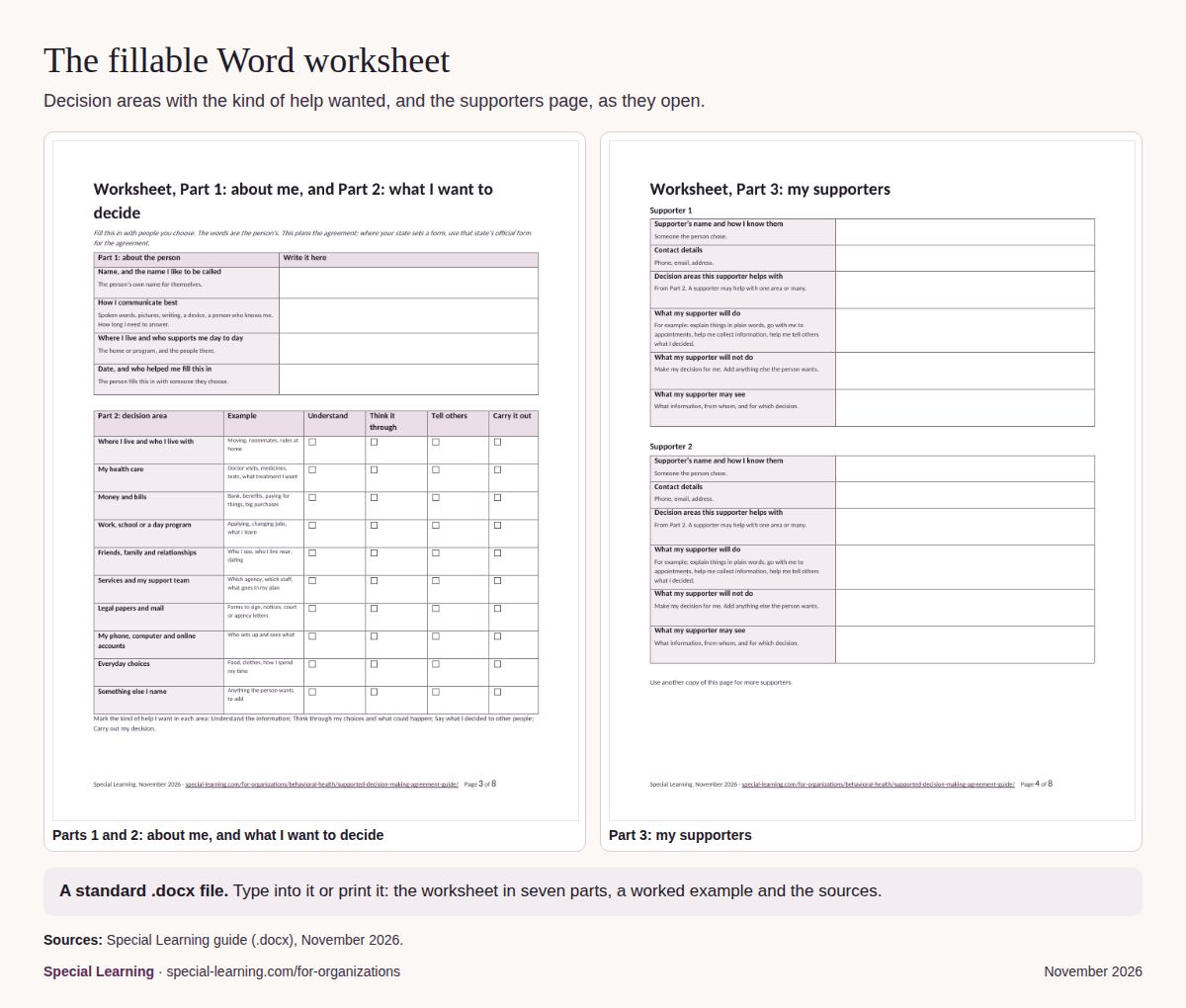
The agreement-planning worksheet, in seven parts
The person fills this in with people they choose. The words are the person’s. It plans the agreement; it is not the agreement itself. Where your state sets a form, use that state’s official form for the agreement, and use the worksheet to prepare it.
| Item | What to write |
|---|---|
| Name, and the name I like to be called | The person’s own name for themselves. |
| How I communicate best | Spoken words, pictures, writing, a device, a person who knows me. How long I need to answer. |
| Where I live and who supports me day to day | The home or program, and the people there. |
| Date, and who helped me fill this in | The person fills this in with someone they choose. |
| Decision area | Examples |
|---|---|
| Where I live and who I live with | Moving, roommates, rules at home |
| My health care | Doctor visits, medicines, tests, what treatment I want |
| Money and bills | Bank, benefits, paying for things, big purchases |
| Work, school or a day program | Applying, changing jobs, what I learn |
| Friends, family and relationships | Who I see, who I live near, dating |
| Services and my support team | Which agency, which staff, what goes in my plan |
| Legal papers and mail | Forms to sign, notices, court or agency letters |
| My phone, computer and online accounts | Who sets up and sees what |
| Everyday choices | Food, clothes, how I spend my time |
| Something else I name | Anything the person wants to add |
For each area, the person marks the kind of help they want:
- Understand the information
- Think through my choices and what could happen
- Say what I decided to other people
- Carry out my decision

| Item | What to write |
|---|---|
| Supporter’s name and how I know them | Someone the person chose. |
| Contact details | Phone, email, address. |
| Decision areas this supporter helps with | From Part 2. A supporter may help with one area or many. |
| What my supporter will do | For example: explain things in plain words, go with me to appointments, help me collect information, help me tell others what I decided. |
| What my supporter will not do | Make my decision for me. Add anything else the person wants. |
| What my supporter may see | What information, from whom, and for which decision. |

| Item | What to write |
|---|---|
| How I want information given | Plain words, pictures, a written list, a person I know present, a recording. |
| When and where I like to talk about decisions | Time of day, place, how much time. |
| If I say no or I am not sure | What my supporters do. For example: wait, ask me again another day, show me another way. |
| If my supporter and I disagree | Who else I want to talk with. The decision stays mine. |
| If I need a decision made quickly | Who I want called, and how I want my wishes shared. |

Part 5: what supporters may see
Write, for each supporter, what information they may see, from whom, and for which decision. The ACL says a written agreement “protects their privacy by defining what information a supporter can and cannot access.” (ACL, Alternatives to Guardianship)
| Item | What to write |
|---|---|
| How long this lasts, and when we look at it again | A date to review it with my supporters. |
| How I change it | Add, remove or change a supporter or a decision area, and how to put it in writing. |
| How I end it | The person can say they want to end it. Write who to tell and how, and what your state’s statute says about ending an agreement. |
| If a supporter cannot continue | Who I want to ask next, and who tells the people who have a copy. |
| Who gets a copy | The person, each supporter, and others the person names, such as a doctor or my support team. |

| Item | What to write |
|---|---|
| Signatures | Sign the way your state’s statute says. Many statutes name who signs, how many witnesses or whether a notary is needed; see the state table. Where a state sets a form, use that state’s official form. |
| My state’s statute and form | Write the statute and the form name or web address here. |
Worked example
A worked example, with an invented person
Dana (invented), 29, lives in a supported apartment with two roommates. She uses spoken language and likes to think out loud with someone she trusts. She works part time at a garden center. Dana wants help with two kinds of decisions: her health care and a possible job change. Invented to show the layout, with invented people and details. It is not a plan for any real person.
| Item | What we wrote |
|---|---|
| Name | Dana |
| How I communicate best | I talk it through out loud. I need a day to think before I decide something big. |
| Decision areas | My health care. Work: whether to change jobs. |
| Help I want | Health care: understand the information, and have someone with me at appointments. Work: think through my choices. |
| Supporter 1 | My sister Lena. Health care. She will explain things in plain words, come to appointments if I ask, and help me write down my questions. |
| Supporter 2 | Jo, my friend from the garden center. Work. Jo will talk through the choices with me and wait while I decide. |
| What my supporters will not do | Decide for me, or sign for me. |
| If I say no or I am not sure | Wait. Ask me again after a day. Show me a list or a picture. |
| What my supporters may see | Lena: my appointment notes. Jo: the job posting and my schedule. Nothing about my money. |
| Review | We look at it again in six months, on a date I put on my phone. I can change or end it any time by telling Lena and Jo, and my support team. |
| How my staff help | They know the agreement exists and where my copy is. They offer information in a list, and give me a day. They do not decide for me. |

How to use it
Eight steps, from your state’s statute to a date to look again
- Find your state in the state tables and open its statute. Read what it says an agreement is, how it is signed and what a supporter may do.
- Check whether your state sets an official form. If it does, use that form for the agreement. Use the worksheet to plan it.
- Start with the person: how they communicate best, and what they want to decide for themselves.
- Choose the decision areas in Part 2, and what kind of help the person wants in each.
- The person names their supporters and says what each will and will not do.
- Write how the person wants to be supported, and what happens if they say no or disagree.
- Decide who may see what, a review date, how to change or end the agreement, and who gets a copy.
- Sign the way your state’s statute says, using its form if it sets one. Keep copies where the person says.

| When | What to do |
|---|---|
| Before | Ask the person who they trust, and what they want help with. Offer the worksheet in a form they can use. |
| During | The person talks first. Supporters ask what the person wants and wait for the answer. |
| After | Give the person and each supporter a copy. Put the review date on a calendar the person uses. |
| At the review | Ask the person what is working and what to change. Add or remove supporters if they ask. |
What the sources say
What the ACL, NADSP and the statutes say
| Source | What it says | How we use it |
|---|---|---|
| ACL, Alternatives to Guardianship (ACL, Alternatives to Guardianship) | SDM is “an alternative to guardianship where individuals retain their right to make decisions for themselves”; guardianship is “a legal process in which a state court finds a person incapacitated pursuant to state law”. | The comparison table and the first section. |
| ACL, Alternatives to Guardianship (ACL, Alternatives to Guardianship) | SDM keeps “decision-making control in the hands of the individual”. | The worksheet is built around the person’s own wants. |
| NADSP Code of Ethics (NADSP Code of Ethics) | DSPs “Understand and respect the differences between emancipation, supported decision-making plans, and formal legal representation.” | The DSP role section. |
We read the ACL pages, the NADSP Code of Ethics and the statute text for 20 jurisdictions on official legislature and code sites, and we quote only what they say. We did not find a study that tests this worksheet; the worksheet prompts, the DSP-role wording that is not quoted and the worked example are our own planning aid. Nobody named here has reviewed or endorsed it.
The checklist
Before the agreement is signed
- The person chose their supporters, in their own words.
- Each supporter and decision area is named.
- The person has said what kind of help they want in each area.
- The agreement says what each supporter will not do.
- It says who may see what information.
- There is a review date, and a way to change or end it.
- It is signed the way the state’s statute says, on the state’s form where one is set.
- The person and each supporter have a copy.
- Staff who support the person know the agreement exists, where it is, and what their role is.

On paper
Prefer paper? Print the PDF
The printable PDF has the same pages as the Word file, with write-in space in every part of the worksheet.

Questions
Supported decision-making agreements: common questions
What is supported decision-making?
The ACL describes it as “an alternative to guardianship where individuals retain their right to make decisions for themselves, with the support of trusted individuals they choose.” (ACL, Alternatives to Guardianship) A written supported decision-making agreement is one way to set it down. The statute linked for each state sets that state’s requirements.
How is supported decision-making different from guardianship?
The ACL describes guardianship as “a legal process in which a state court finds a person incapacitated pursuant to state law and appoints someone else to make decisions on behalf of that person.” (ACL, Alternatives to Guardianship) With SDM the person keeps their right to decide, and chooses their supporters.
How is an SDM agreement different from a power of attorney?
The ACL describes a power of attorney as a legal document in which “an adult authorizes a person to perform a specific task on their behalf”. (ACL, Alternatives to Guardianship) An SDM supporter helps the person decide. States differ, so read your state’s statute.
Which states have an SDM agreement law?
We read 19 states and the District of Columbia from their legislatures’ or official code sites; they are listed with a link to the statute text in the state tables. Laws change and states keep passing them, so look on your own legislature’s site.
Does my state have an official form?
Some statutes set out a form in the statute itself, and some states publish one. The state tables say which statutes include a form. Where a state sets a form, use that state’s official form.
Can a DSP be a supporter?
It depends on the statute for your state. Delaware, Illinois, Rhode Island and Washington disqualify a person who directly provides paid support services unless the person is an immediate family member, and Alabama, Arizona, Colorado, Hawaii and Illinois bar supporter compensation; Utah requires that the supporter not be paid to provide support unless the person receives caregiver compensation through its Division of Services for People with Disabilities or the supporter is a sibling who cares for the person. The supporter column in the state tables quotes what each statute says about supporters. A supporter is someone the person chose and named in the agreement.
What does a DSP do when a person has an agreement?
The NADSP Code asks DSPs to “Support informed decision-making, even when those decisions involve personal risk, and educate team members about this right when appropriate.” (NADSP Code of Ethics) A DSP learns what the agreement says, follows the person’s wishes about who may see what, offers information the way the person asked and writes the person’s words in the plan. A DSP does not decide for the person.
Can the person change or end the agreement?
The worksheet has a place to write how. Statutes say how an agreement ends; the state tables quote what each says about how it is made, and the statute linked for your state sets the rules for ending it.
Do we have to use the worksheet?
No. It is a free planning aid. Where your state sets a form, use that state’s form for the agreement itself. The statute linked for each state sets that state’s requirements.
Sources
Sources read November 16, 2026. The quoted lines are as published. The worksheet prompts, the DSP-role wording that is not in quotation marks, the worked example and the checklist are ours. The statute linked for each state sets that state’s requirements. Where a state sets a form, use that state’s official form. Nobody named on this page has reviewed or endorsed the guide.
- Administration for Community Living (U.S. Department of Health and Human Services), Alternatives to Guardianship, acl.gov, read November 16, 2026. https://acl.gov/programs/empowering-advocacy/alternatives-guardianship
- Administration for Community Living (U.S. Department of Health and Human Services), Supported Decision Making Program, acl.gov, read November 16, 2026. https://acl.gov/programs/consumer-control/supported-decision-making-program
- National Alliance for Direct Support Professionals (NADSP), The NADSP Code of Ethics (revised 2026), as published on nadsp.org (tenets Justice, Fairness, Equity, and Inclusion; Confidentiality and Privacy; Person-Centered Supports; Self-Determination and Choice). https://nadsp.org/the-nadsp-code-of-ethics/
- Alabama Ala. Code § 26-1B-1 et seq. (Colby Act; Act 2023-134, SB55), §§ 26-1B-1 to 26-1B-10 (enrolled bill Sections 1-10), as published at www.legislature.state.al.us, read November 16, 2026. https://www.legislature.state.al.us/pdf/SearchableInstruments/2023RS/SB55-enr.pdf
- Arizona A.R.S. 14-5721 to 14-5722, §§ 14-5721 to 14-5722, as published at www.azleg.gov, read November 16, 2026. https://www.azleg.gov/ars/14/05722.htm
- California Cal. Welf. & Inst. Code, div. 11.5, §§ 21000 to 21008, as published at leginfo.legislature.ca.gov, read November 16, 2026. https://leginfo.legislature.ca.gov/faces/codes_displayText.xhtml?lawCode=WIC&division=11.5.&title=&part=&chapter=&article=
- Colorado C.R.S. 15-14-801 to 806 (Title 15, Article 14, Part 8), §§ 15-14-801 to 15-14-806, as published at leg.colorado.gov, read November 16, 2026. https://leg.colorado.gov/sites/default/files/images/olls/crs2024-title-15.pdf
- Delaware 16 Del. C. ch. 94A, §§ 9401A to 9410A, as published at delcode.delaware.gov, read November 16, 2026. https://delcode.delaware.gov/title16/c094A/index.html
- District of Columbia D.C. Code ch. 21B, tit. 7, §§ 7-2131 to 7-2134, as published at code.dccouncil.gov, read November 16, 2026. https://code.dccouncil.gov/us/dc/council/code/sections/7-2132
- Florida Fla. Stat. § 709.2209, § 709.2209, as published at www.leg.state.fl.us, read November 16, 2026. http://www.leg.state.fl.us/statutes/index.cfm?App_mode=Display_Statute&URL=0700-0799/0709/Sections/0709.2209.html
- Hawaii Haw. Rev. Stat. ch. 349F (L. 2025, c. 284 / HB 320), §§ 349F-1 to 349F-5, as published at data.capitol.hawaii.gov, read November 16, 2026. https://data.capitol.hawaii.gov/hrscurrent/Vol07_Ch0346-0398/HRS0349F/HRS_0349F-.htm
- Illinois 755 ILCS 9 (Supported Decision-Making Agreement Act), 755 ILCS 9/1 to 9/105 (as posted), as published at www.ilga.gov, read November 16, 2026. https://www.ilga.gov/Legislation/ILCS/Articles?ActID=4215&ChapterID=60
- Louisiana La. R.S. 13:4261.101 to 13:4261.302 (Chapter 24-A, Supported Decisionmaking Agreement Act, "Dustin Gary Act"), R.S. 13:4261.101 to 4261.302, as published at legis.la.gov, read November 16, 2026. https://legis.la.gov/legis/Law.aspx?d=1187154
- Maryland Md. Code, Est. & Trusts, Title 18, §§ 18-101 to 18-109, as published at mgaleg.maryland.gov, read November 16, 2026. https://mgaleg.maryland.gov/mgawebsite/Laws/StatuteText?article=get§ion=18-101&enactments=false
- Nevada NRS ch. 162C, NRS 162C.010 to 162C.330, as published at www.leg.state.nv.us, read November 16, 2026. https://www.leg.state.nv.us/nrs/nrs-162c.html
- New Mexico N.M. Stat. Ann. ch. 24, art. 7D (Supported Decision-Making Act); Laws 2025, SB 535, Secs. 9-22, Secs. 9 to 22 of SB 535 (codified as §§ 24-7D-1 et seq.), as published at www.nmlegis.gov, read November 16, 2026. https://www.nmlegis.gov/Sessions/25%20Regular/final/SB0535.pdf
- New York N.Y. Mental Hygiene Law art. 82 (added by L. 2022, ch. 481; S.7107-B / A.8586-B), §§ 82.01 to 82.15, as published at legislation.nysenate.gov, read November 16, 2026. https://legislation.nysenate.gov/pdf/bills/2021/S7107B
- North Dakota N.D.C.C. ch. 30.1-36, §§ 30.1-36-01 to 30.1-36-08, as published at ndlegis.gov, read November 16, 2026. https://ndlegis.gov/cencode/t30-1c36.pdf
- Rhode Island R.I. Gen. Laws ch. 42-66.13, §§ 42-66.13-1 to 42-66.13-10, as published at webserver.rilegislature.gov, read November 16, 2026. https://webserver.rilegislature.gov/Statutes/TITLE42/42-66.13/INDEX.htm
- Texas Tex. Est. Code ch. 1357, §§ 1357.001 to 1357.102, as published at statutes.capitol.texas.gov, read November 16, 2026. https://statutes.capitol.texas.gov/Docs/ES/htm/ES.1357.htm
- Utah Utah Code Title 75, ch. 5, part 7, §§ 75-5-701 to 75-5-709, as published at le.utah.gov, read November 16, 2026. https://le.utah.gov/xcode/Title75/Chapter5/75-5-P7.html
- Virginia Va. Code § 37.2-314.3, § 37.2-314.3, as published at law.lis.virginia.gov, read November 16, 2026. https://law.lis.virginia.gov/vacode/title37.2/chapter3/section37.2-314.3/
- Washington RCW ch. 11.130, Article 7 (supported decision-making agreements), RCW 11.130.700 to 11.130.755, as published at app.leg.wa.gov, read November 16, 2026. https://app.leg.wa.gov/RCW/default.aspx?cite=11.130&full=true