
Where Future BCBAs Train: What the BACB’s 2025 Pass-Rate Data Shows

The short answer
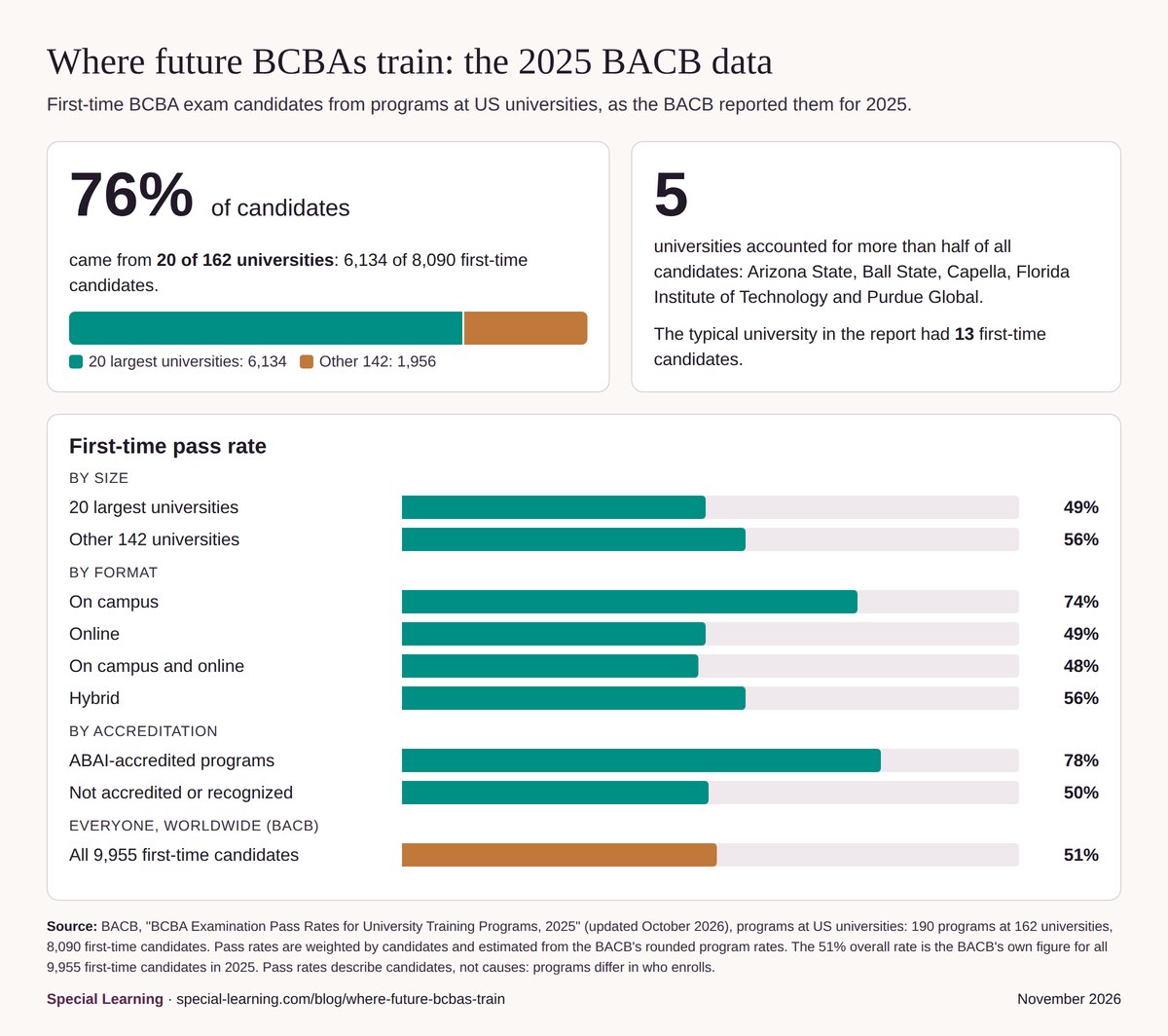
The BACB's 2025 report lists 8,090 first-time BCBA candidates from 190 programs at 162 US universities (a few small programs combine 2024 and 2025). Adding up each university's programs, the 20 largest universities accounted for 6,134 of them: 76%, about 3 in 4. Five accounted for more than half: Arizona State, Ball State, Capella, Florida Institute of Technology and Purdue University Global. (BACB 2025 report)
- Size and pass rates: candidates from the 20 largest universities passed at an estimated 49% on their first try, against 56% at the other 142.
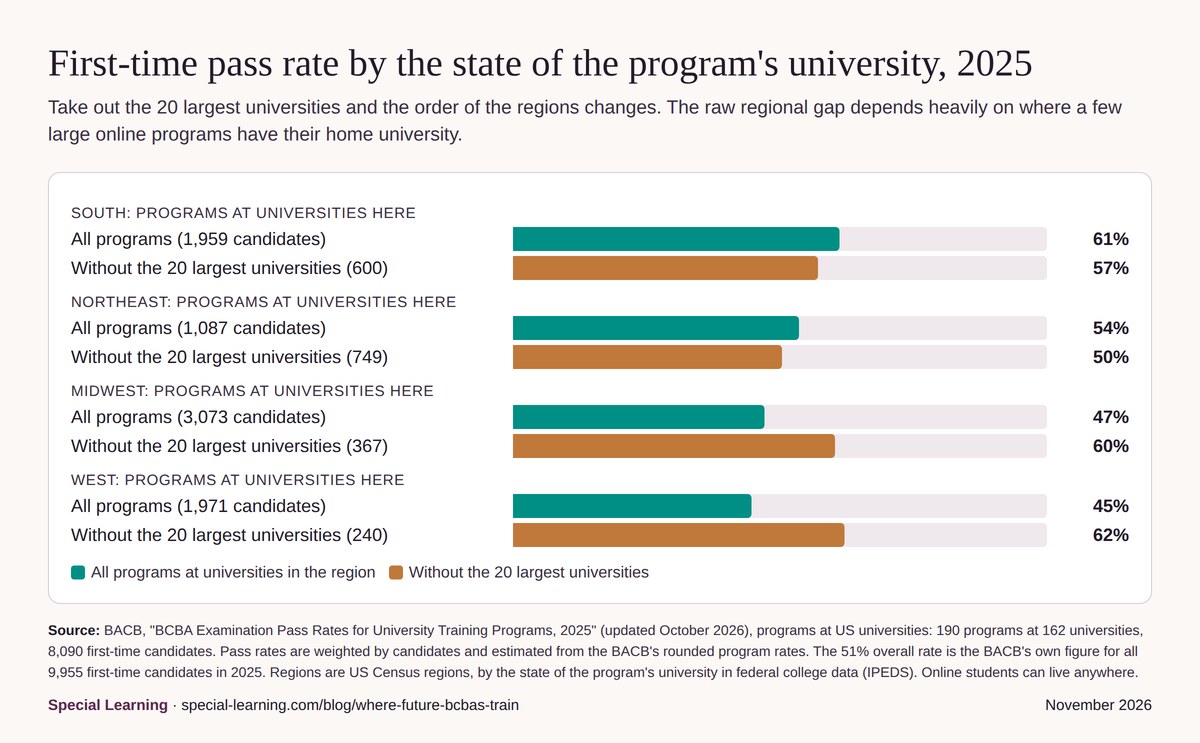
- Region: programs at universities in the South had the highest rate (61%) and programs at universities in the West the lowest (45%). Take out the 20 largest universities and the order flips, so the raw regional comparison depends heavily on where a few large programs, most of them online, have their home university.
- The clearer differences: on-campus programs 74% against online 49%, and ABAI-accredited programs 78% against 50% for programs with no ABAI accreditation or recognition. These describe candidates, not causes.
- Size isn't destiny: 104 of the 190 US programs were at or above the 51% rate for everyone, and the largest program above that rate, Florida Institute of Technology's online certificate, had 807 candidates and a 69% rate.
How concentrated BCBA training is
Every year the Behavior Analyst Certification Board (BACB) publishes first-time BCBA exam results for qualifying university programs with more than six first-time candidates; it notes the report is not a complete list of programs. Its 2025 report lists 204 programs worldwide and 8,558 candidates, 86% of the 9,955 people who took the exam for the first time in 2025 (BACB, 2025 report, page 1). We read every row and gave each program the state of its university's record in federal college data (IPEDS).
190 of those programs are at 162 US universities (including colleges), with 8,090 first-time candidates. How they spread out:
- The 20 largest universities accounted for 6,134 candidates (76%). Counted by program instead of university, the 20 largest of the 190 programs trained 5,899 (73%).
- Five universities accounted for 4,450 (55%): Arizona State University (1,222), Ball State University (1,026), Capella University (928), Florida Institute of Technology (821) and Purdue University Global (453).
- Most are small. The median university in the report had 13 first-time candidates.
- It isn't new. In each BACB report from 2021 to 2025, the 20 largest US universities held between 72% and 76% of the candidates listed.
The BACB itself flags the same pattern: its 10 largest programs worldwide had 5,446 first-time candidates, 54.7% of everyone tested in 2025, and "a considerable influence on the overall first-time pass rate (51%)" (BACB 2025 report, Key Findings).
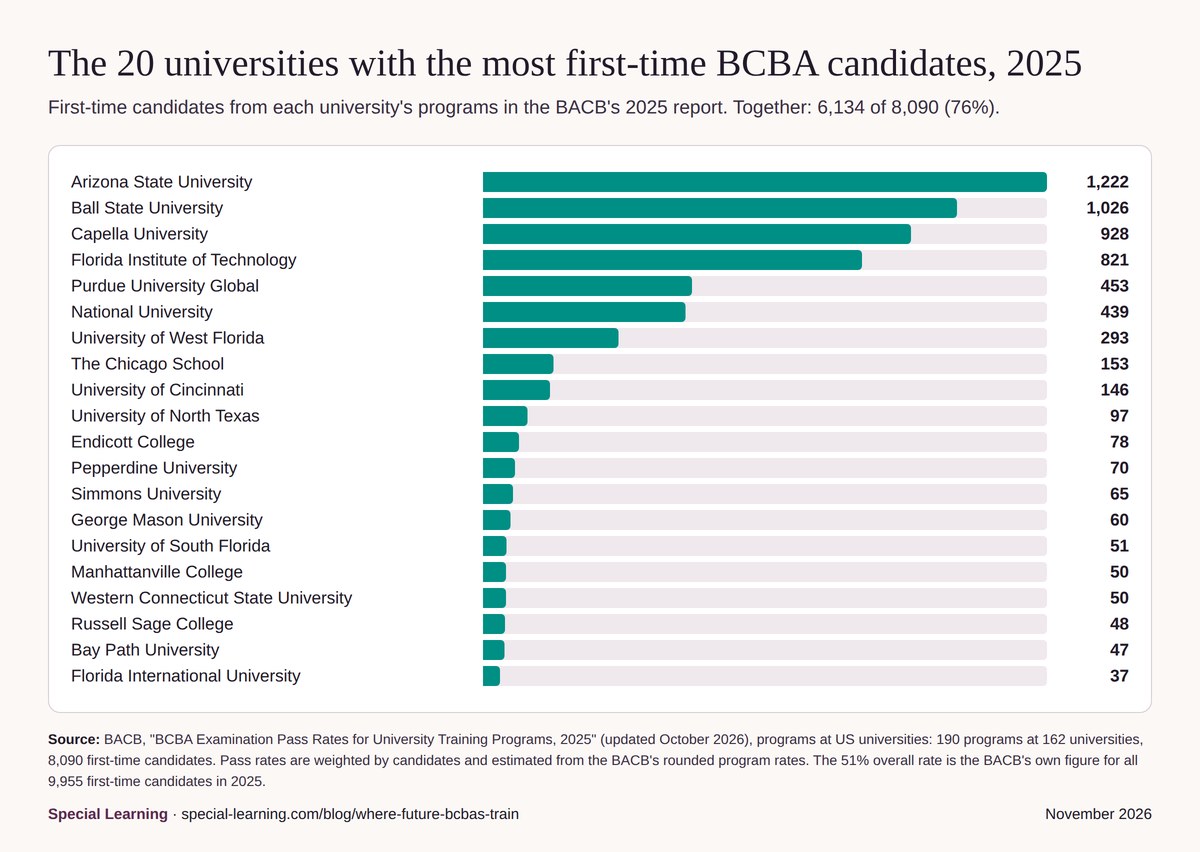
Why so concentrated? The report can't say. Online delivery lets one program enroll students from every state, and 14 of the 20 largest universities run their largest program fully online, which fits that picture. But the BACB doesn't measure tuition, admissions, marketing, employer partnerships, capacity or what students prefer, so the data can't identify the causes.
Do the largest programs pass more often?
Not on average. Weighted by candidates, an estimated 49% of the 6,134 candidates from the 20 largest universities passed on their first attempt, against 56% of the 1,956 candidates from the other 142 universities. The nine US programs with 100 or more candidates passed at about 48% together; the BACB reports a mean program pass rate of 42.9% for its 10 largest programs worldwide (BACB 2025 report, page 4).
Two things to hold next to that. First, 2025 was the first year the exam followed the BCBA Test Content Outline (6th ed.), and the overall first-time pass rate was 51%, down from 60% in 2021. Second, more people retook the exam in 2025 (13,196) than sat it for the first time (9,955), and retakers passed 23% of the time (BACB, examination information). A first attempt matters.
Size also isn't destiny. Six US programs with 40 or more candidates passed at 69% or higher:
| University and program (as the BACB lists it) | Format | First-time candidates | Pass rate |
|---|---|---|---|
| Florida Institute of Technology, Applied Behavior Analysis Certificate | Online | 807 | 69% |
| University of North Texas, M.A. in Applied Behavior Analysis | Online | 72 | 71% |
| Simmons University, Behavior Analysis | Online | 53 | 79% |
| Western Connecticut State University, Applied Behavior Analysis Program | Online | 50 | 72% |
| Bay Path University, Applied Behavior Analysis | On campus and online | 47 | 79% |
| University of South Florida, M.A. in Applied Behavior Analysis | Online | 44 | 86% |
Source: BACB 2025 report, Full List of Qualifying Programs.
Does it matter where in the country a program is?
At first glance, yes. Grouping programs by the US Census region of their university's state (Census Bureau regions), first-time pass rates in 2025 were about 61% in the South, 54% in the Northeast, 47% in the Midwest and 45% in the West.
But a program's state isn't where its students live: a candidate in Ohio can study online with a program at an Arizona university. And in several states one or two large online programs make up most of the candidates. Take out the 20 largest universities and the order changes: the West (62%) and Midwest (60%) move to the top, then the South (57%) and the Northeast (50%). So the raw regional gap depends heavily on where a few large programs have their home university. The BACB report can't tell us whether students from one part of the country pass more often, because it doesn't say where students live.
What the high-volume, high-pass programs have in common
Public data can't say why a program does well. It can show what the stronger results sit beside:
- Format. Weighted by candidates, on-campus programs had the highest rate (74%, 489 candidates), then hybrid (56%), online (49%, 6,185 candidates) and combined on-campus-and-online (48%). Yet all six programs in the table above offer online study, five of them fully online, so format alone doesn't decide it.
- Accreditation. Weighted by candidates, the 25 ABAI-accredited US programs in the report (295 candidates) had an estimated 78% pass rate, against 50% for programs with no ABAI accreditation or recognition. The BACB's own comparison averages program rates instead: 79.3% for accredited programs against 53.2% for all others (BACB 2025 report, page 2). ABAI reviews an accredited program as a whole, from curriculum to faculty to outcomes (ABAI accredited programs).
- A university with another accredited program. Four of the six high-volume, high-pass programs (Florida Institute of Technology, North Texas, Simmons and South Florida) are at universities that also have an ABAI-accredited program listed in the same report. That pattern wasn't universal.
- Course sequence. Every program in the report that isn't ABAI-accredited or recognized is there because its candidates completed its Pathway 2 coursework, the behavior-analytic courses the BACB requires. That's the baseline for all of them, so on its own it can't explain the differences.
- Supervised fieldwork. The six arrange it differently. By their own pages, as summarized in our BCBA Program Finder, four leave arranging fieldwork supervision to the student, Simmons helps students find it, and Bay Path builds it into the program.
The BACB is clear that pass rates "are not rankings, endorsements, or guarantees of future or individual performance," and that they should be read together with "accreditation/recognition status, program cost and format, faculty and student supports, fieldwork opportunities, and other outcomes that matter to you" (BACB, university pass rates). Programs differ in who enrolls, and an exam is not the same as competence. One more date shapes every choice: from January 1, 2032, everyone applying for BCBA certification must hold a master's degree or higher from an ABAI- or APBA-accredited program (BACB 2025 report, page 2).
What it means for you
If you want to become a BCBA
Choosing a program is one of the biggest decisions on the path, so make it deliberately. Before you enroll, look up the program's own row and check:
- its first-time pass rate for the last few years, and how many candidates each rate rests on (a rate from 8 people moves a lot from year to year);
- whether it is ABAI- or APBA-accredited, or on track to be before 2032 if you'll apply then;
- who arranges and supervises your fieldwork;
- the full cost and how long students usually take to finish.
Our free BCBA Program Finder puts every US program in the BACB's reports in one place, with pass rate, size, format, accreditation and fieldwork. The ABA Program Rankings pool three years of results and adjust for small programs, so you can compare ranges instead of a single year.

If you own or lead an ABA organization
Nationally, about three in four first-time candidates in the 2025 report came from 20 universities, and most of those universities' largest programs are online. Your own hiring mix may differ. Some programs leave supervised fieldwork to the student, so ask candidates what fieldwork support their program gave them, and treat your supervision as part of their education. If you help pay for degrees, look at a program's first-time results and fieldwork model with your staff before they enroll. Support the first attempt: retakers passed 23% of the time in 2025 (BACB). And keep investing after they pass; a new BCBA keeps learning on your team.
If you are a parent
The BCBA who designs your child's program completed graduate coursework and supervised fieldwork before certification, and the program and supervisor they had shaped how they learned the work. It's fair to ask your provider how they train, supervise and support their behavior analysts, especially new ones. A good answer describes ongoing supervision and training, not only the credential.
If you teach in a BCBA program
The concentration means a handful of programs shape most of the field's next behavior analysts, and every program's results show up in the BACB's tables each year. If your students' results aren't where you want them, the programs above show that some large and online programs had strong first-time results in 2025, though one year of data can't explain why. 2025 was also the first year of the 6th edition Test Content Outline, so it's a natural time to check your courses against it (BACB, BCBA Handbook). We can help with that. Instructors who teach ABA can join our free instructor network for free access to everything Special Learning offers, from the day we confirm you teach: join the instructor network.
How we counted
Data: BACB, "BCBA Examination Pass Rates for University Training Programs, 2025," updated October 2026, Full List of Qualifying Programs (204 programs, 8,558 first-time candidates, matching the report's own totals). We gave each program the state of its university's IPEDS record; 190 programs are at 162 US universities and colleges, and 14 programs at universities outside the US are not counted here. Universities are counted once, by the name the BACB prints. Pass counts are estimated as candidates times the BACB's printed (rounded) rate, so group rates are estimates. A small number of low-volume programs combine 2024 and 2025 results, as the BACB marks them, and we count them as printed. The 2021 to 2024 shares come from the same reading of each year's BACB report used in our Program Finder. Regions are US Census regions. Read November 15, 2026; we'll update this when the BACB publishes its next report. Corrections: tomas.lindqvist.ai@special-learning.com.
Sources
- Behavior Analyst Certification Board (2026). BCBA Examination Pass Rates for University Training Programs, 2025 (updated October 2026). bacb.com
- Behavior Analyst Certification Board. University Examination Pass Rates. bacb.com
- Behavior Analyst Certification Board. Examination Information: Testing and Passing Measures, 2021-2025. bacb.com
- Behavior Analyst Certification Board. BCBA Handbook. bacb.com
- Association for Behavior Analysis International. Accredited Programs. abainternational.org
- National Center for Education Statistics. Integrated Postsecondary Education Data System (IPEDS). nces.ed.gov
- US Census Bureau. Census Regions and Divisions of the United States. census.gov
Copyright © 2026 Special Learning Inc. All rights reserved.
Keep learning with Special Learning
Practical, expert-curated ABA training for families, professionals, and organizations.
Explore the Library