
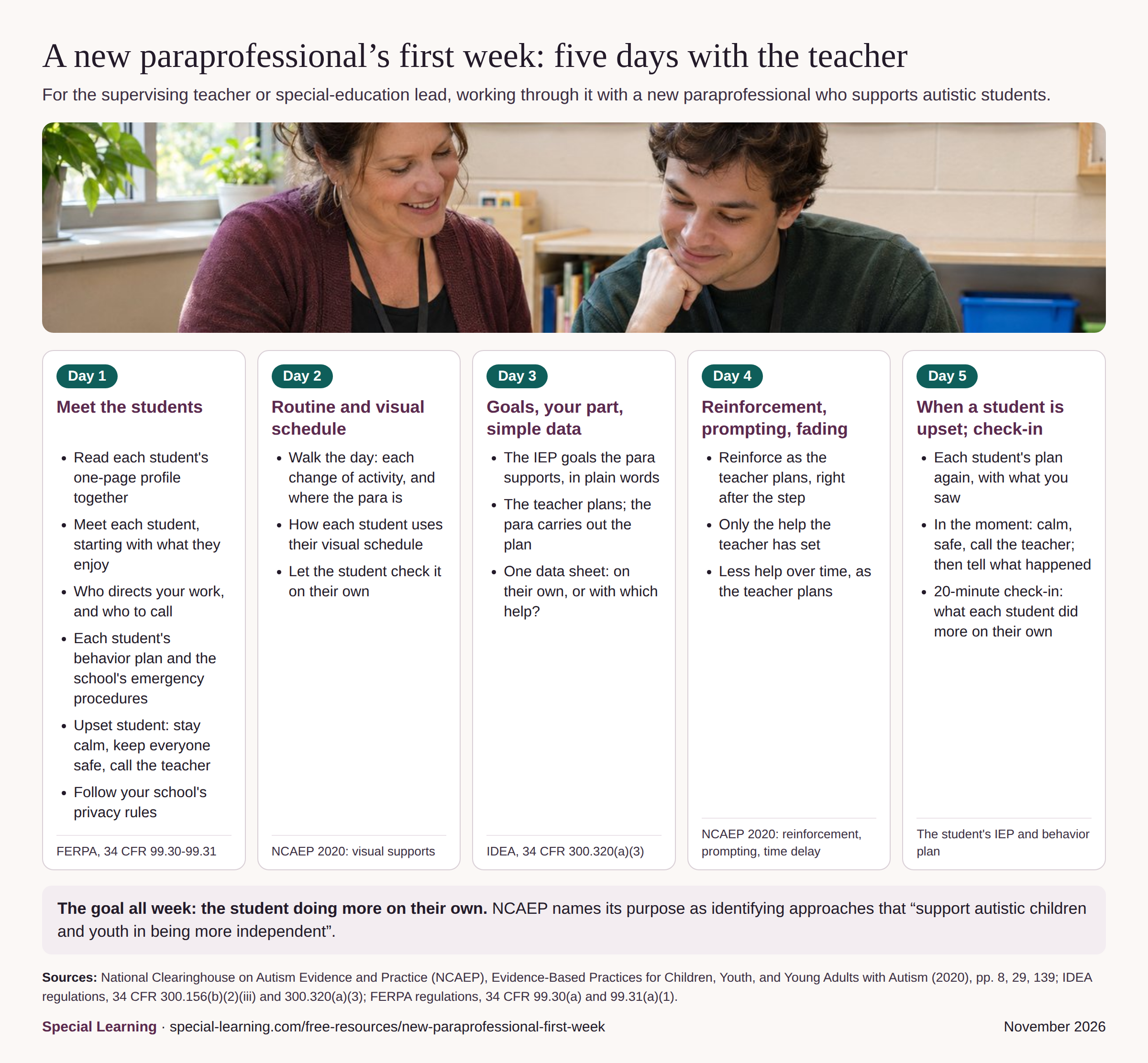
A new paraprofessional (para) learns the job fastest beside the teacher who directs their work. This checklist gives the supervising teacher or special-education lead one short list a day for the first five days, to work through together: meeting the students, the routine, the goals, how to help and then step back, and what to do when a student is upset. The goal all week is the student doing more on their own.
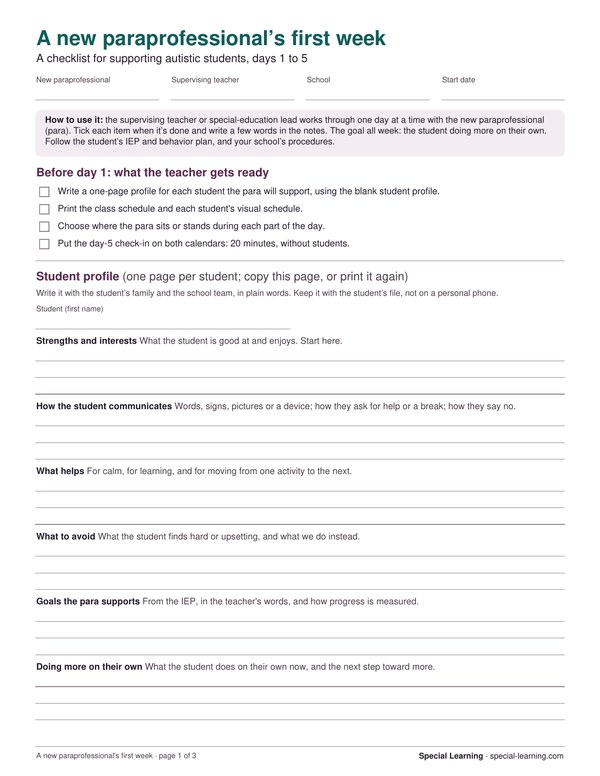
The checklist and a blank student profile, as a PDF
Three pages: a one-page student profile, then days 1 to 5 with tick boxes, notes and the day-5 check-in questions. Type into it in any PDF reader, or print it.
Download the free checklist (PDF)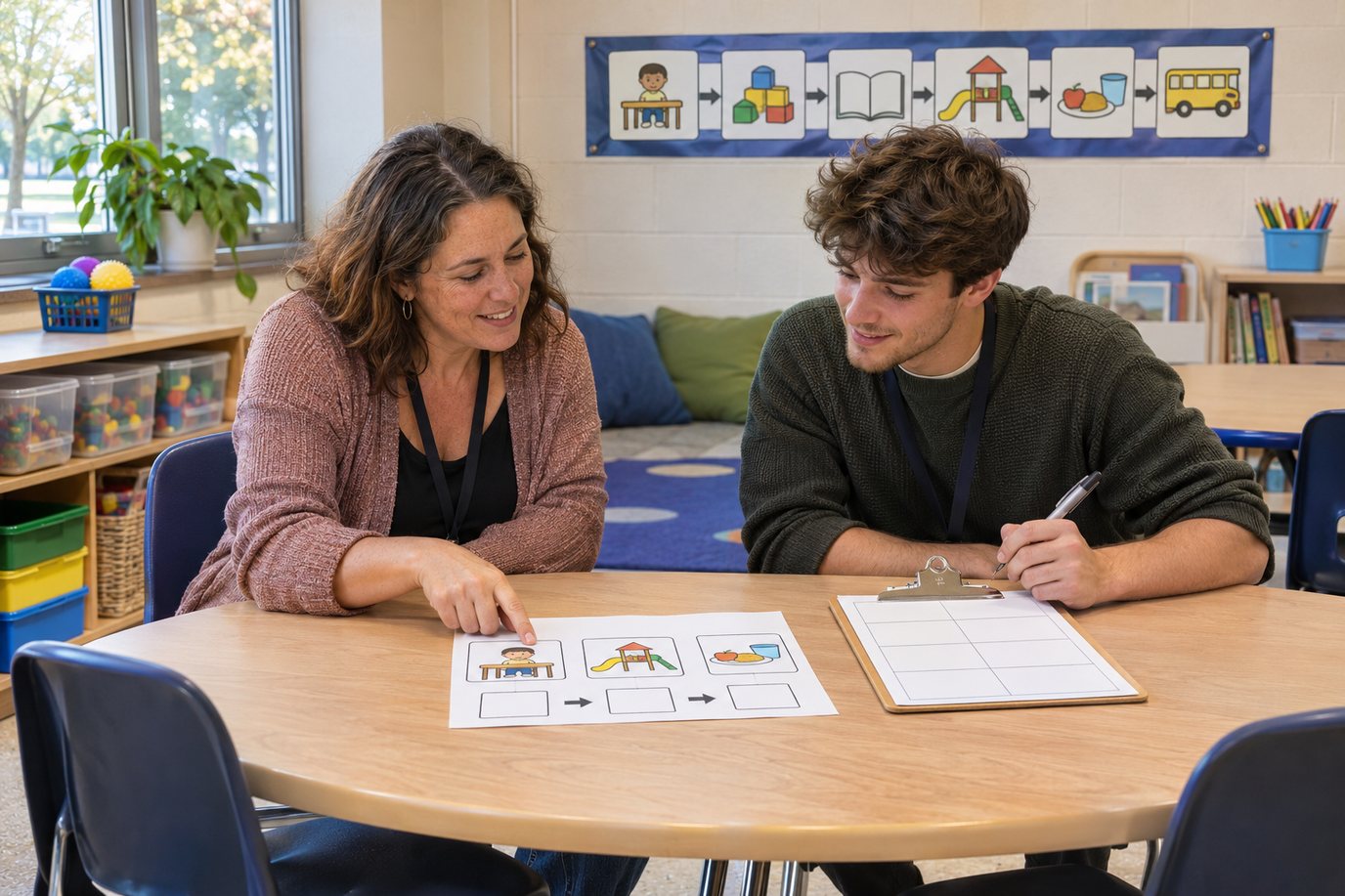
Before day 1: what the teacher gets ready
- Write a one-page profile for each student the para will support, using the blank student profile.
- Print the class schedule and each student's visual schedule.
- Choose where the para sits or stands during each part of the day.
- Put the day-5 check-in on both calendars: 20 minutes, without students.
The one-page student profile
Write one for each student the para will support, with the student’s family and the school team, in plain words. It is the first thing the para reads, and it starts with what the student does well. The PDF has a blank one.
- Student (first name)
- First name or initials.
- Strengths and interests
- What the student is good at and enjoys. Start here.
- How the student communicates
- Words, signs, pictures or a device; how they ask for help or a break; how they say no.
- What helps
- For calm, for learning, and for moving from one activity to the next.
- What to avoid
- What the student finds hard or upsetting, and what we do instead.
- Goals the para supports
- From the IEP, in the teacher's words, and how progress is measured.
- Doing more on their own
- What the student does on their own now, and the next step toward more.
Day 1 Meet the students, and what holds from the first hour
- Read each student's profile together: strengths, how they communicate, what helps, what to avoid.
- Meet each student. Start with what they enjoy, and let them get to know you before you ask much of them.
- Watch the teacher work with each student for part of the day.
- Learn who directs your work (the teacher) and who to call when the teacher is out of the room.
- Before supporting students, go through each student's behavior plan, if they have one, their communication supports, and the school's emergency procedures with the teacher.
- If a student is upset: stay calm, keep everyone safe, call the teacher. Day 5 goes over it again.
- Confidentiality: follow your school's privacy rules. Share what you learn about a student only with the people your school says need it for their work, and ask the teacher if you're unsure. No names or photos on personal phones or social media.
Confidentiality, in one line: under FERPA, a school needs a parent’s (or an eligible student’s) “signed and dated written consent before an educational agency or institution discloses personally identifiable information from the student's education records” (34 CFR 99.30(a)), with exceptions such as school officials who have “legitimate educational interests” (34 CFR 99.31(a)(1)(i)(A)). Follow your school’s privacy rules: share what you learn about a student only with the people your school says need it for their work, and ask the teacher when unsure.
Day 2 The classroom routine and the visual schedule
- Walk through the day together: arrival, each change of activity, lunch, specials, dismissal. Where is the para for each?
- Learn how each student uses their visual schedule, who updates it, and how a change is shown before it happens.
- Practice the teacher's way of helping each student use their schedule, and let the student check it on their own whenever they can.
- Note one change of activity that went smoothly and one that was hard, and what was different.
Why the schedule matters: NCAEP defines a visual support as “A visual display that supports the learner engaging in a desired behavior or skills independent of additional prompts.” (NCAEP, 2020, p. 29) Its examples include “visual schedules, activity schedules, work systems, graphic organizers, visual cues, and scripts” (NCAEP, 2020, p. 139). When the student checks the schedule themselves, they move through the day without waiting for an adult’s words.
Day 3 The student's goals, the para's part, and simple data
- The teacher explains, in plain words, the IEP goals the para will support and how progress is measured.
- Who does what: the teacher plans the teaching and decides what changes; the para carries out the plan as agreed and brings back what they saw.
- Before an activity, use the teacher–paraeducator handoff sheet to agree who does what.
- The teacher shows the one data sheet the para will use, and exactly what to write on it.
- Write it right away, facts only: did the student do the step on their own, or with which help? The teacher reads it.
Each IEP describes how the student’s “progress toward meeting the annual goals” (34 CFR 300.320(a)(3)(i)) will be measured, so ask the teacher how that is done for each goal you support, and what your data sheet adds to it. IDEA’s regulations let states use paraprofessionals “who are appropriately trained and supervised, in accordance with State law, regulation, or written policy” (34 CFR 300.156(b)(2)(iii)), to assist in providing special education and related services. To agree who does what before an activity, use our free teacher–paraeducator instruction handoff sheet.
Day 4 Reinforcement and prompting, then fading
- Reinforcement: follow the teacher's plan for each goal: which step to reinforce, what to give (often from what the profile says the student enjoys, such as specific praise or a turn with a favorite activity) and when. Give it right after the step, name what the student did, and note whether the student does it more often.
- Prompting: give the help the teacher has set for this goal (a gesture, a model, a few words, a picture), and only as much as the student needs.
- Fading: follow the teacher's plan for when to wait, which help to give and when to give less. Give the student the chance to respond on their own, and tell the teacher when the help seems too much or too little.
- The teacher watches for 10 minutes and gives one specific piece of feedback.
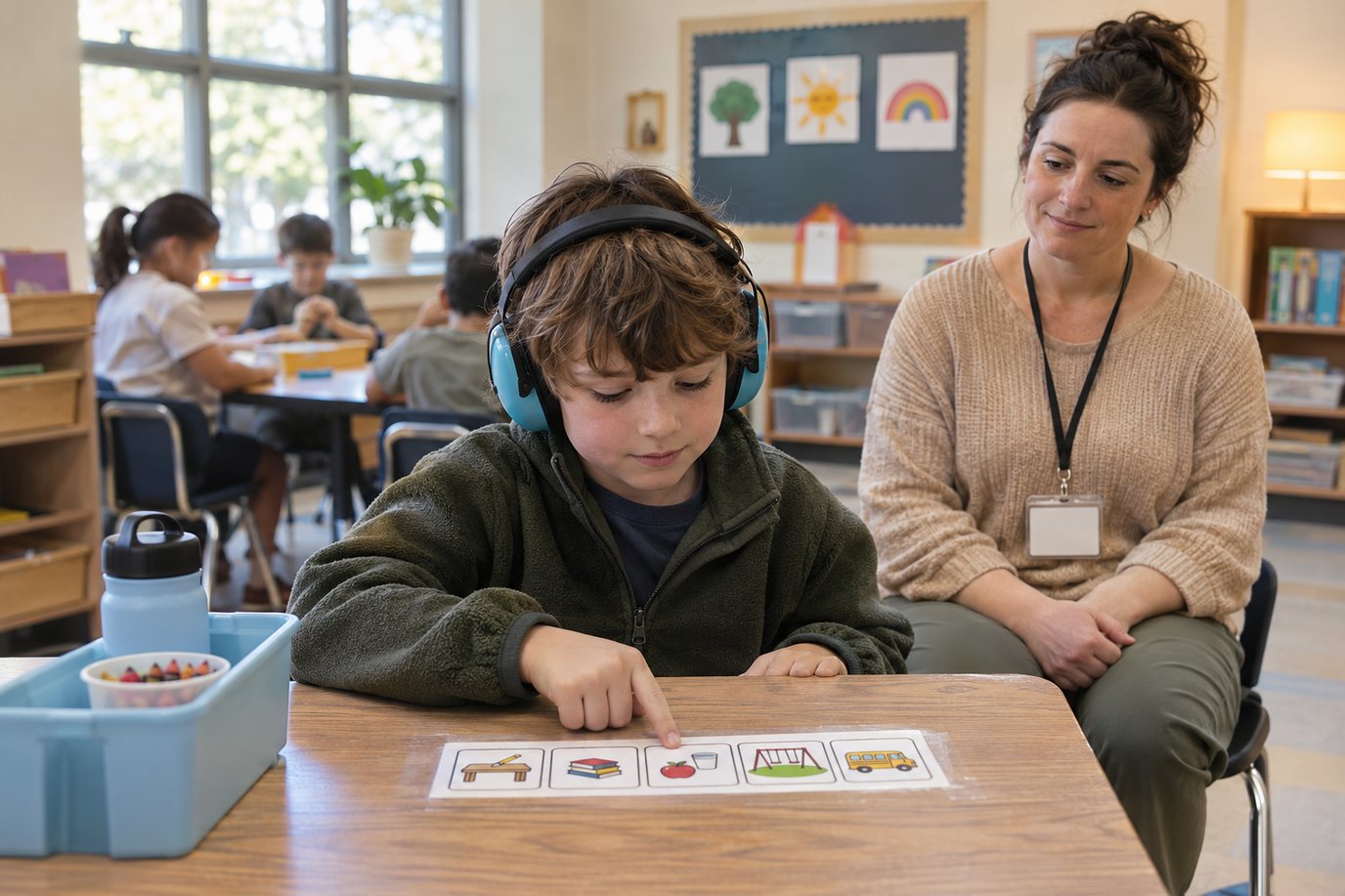
The three practices, in NCAEP’s words. Reinforcement: “The application of a consequence following a learner’s use of a response or skills that increases the likelihood that the learner will use the response/skills in the future.” (NCAEP, 2020, p. 29) Prompting: “Verbal, gestural, or physical assistance given to learners to support them in acquiring or engaging in a targeted behavior or skill.” (NCAEP, 2020, p. 29) Fading: NCAEP’s time delay is a practice used to “systematically fade the use of prompts during instructional activities by using a brief delay between the initial instruction and any additional instructions or prompts” (NCAEP, 2020, p. 29). For the levels of help from most to least, keep our free prompt hierarchy quick-reference card at hand.
Day 5 When a student is upset, and the day-5 check-in
- Go back over each student's behavior plan, if they have one, and the profile's “what helps” and “what to avoid”, with what you saw this week.
- In the moment: stay calm and use few words; keep the student and others safe; call the teacher. If anyone is in danger, follow your school's emergency procedures.
- Tell the teacher the same day, and right away for anything about safety: what happened right before, what it looked like, what happened right after.
- Hold the 20-minute check-in with the teacher (questions below).
The day-5 check-in: 20 minutes, teacher and para
- What went well this week?
- One thing each student did more on their own this week
- What is still unclear?
- One skill to practice next week, and when the teacher will watch
- Next check-in (date and time)

The check-in question that matters most is what each student did more on their own. That is the purpose NCAEP gives its whole review: approaches that “support autistic children and youth in being more independent” (NCAEP, 2020, p. 8).
Sources
- Steinbrenner, J. R., Hume, K., Odom, S. L., et al. (2020). Evidence-Based Practices for Children, Youth, and Young Adults with Autism. National Clearinghouse on Autism Evidence and Practice (NCAEP), FPG Child Development Institute, UNC Chapel Hill. Pages 8, 29 and 139.
- IDEA Part B regulations: 34 CFR 300.156, Personnel qualifications, paragraph (b)(2)(iii); 34 CFR 300.320, Definition of individualized education program, paragraph (a)(3).
- FERPA regulations: 34 CFR 99.30, paragraph (a); 34 CFR 99.31, paragraph (a)(1).
More free resources for teachers and paras
- Teacher–paraeducator instruction handoff: a one-page planning sheet to use before an activity.
- Prompt hierarchy quick-reference card: the levels of help, and how to fade them.
- All free resources and training for schools.
Keep filled-in copies with the student’s records, not on a personal phone. Follow the student’s IEP and behavior plan, and your school’s procedures.