
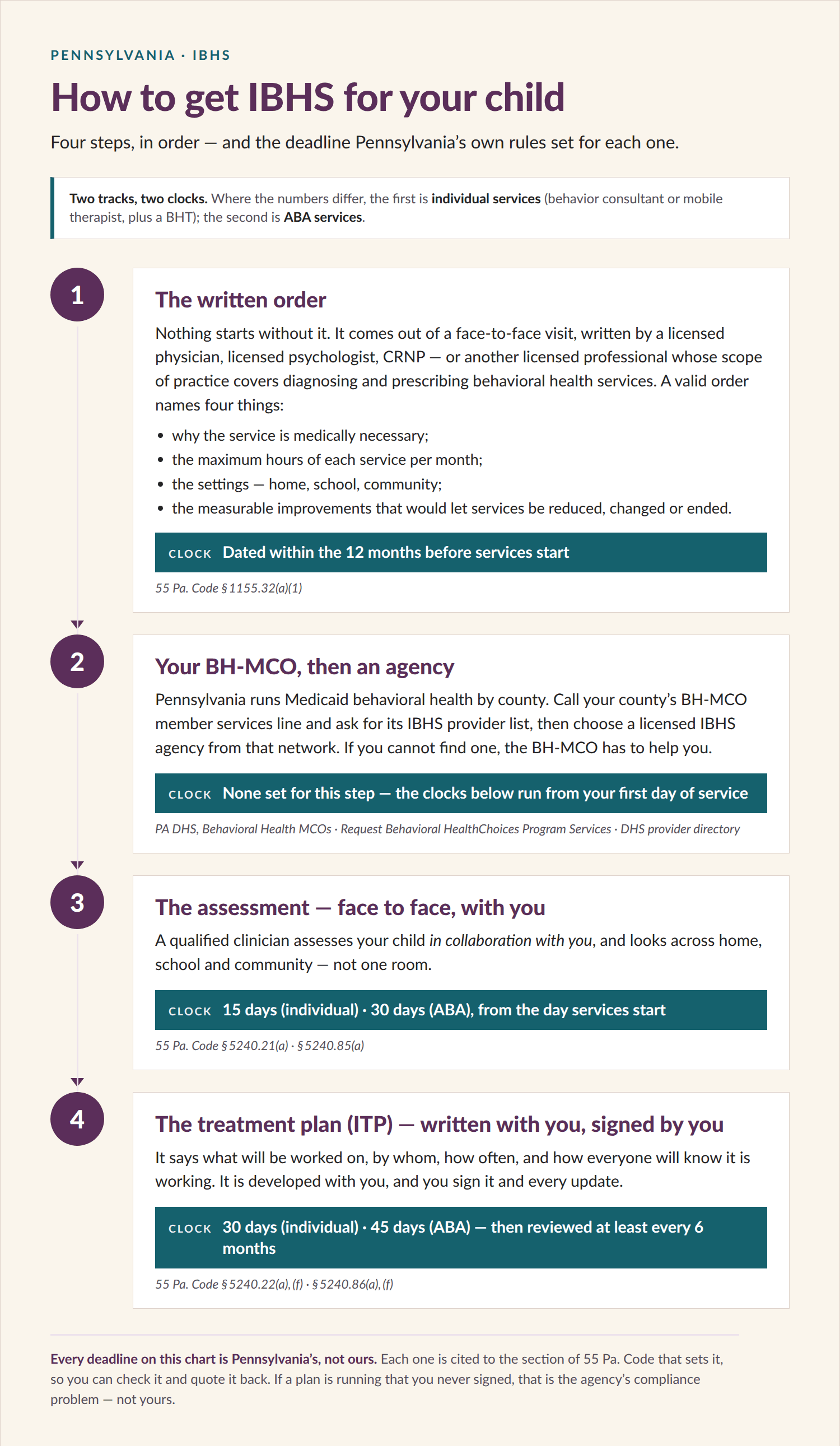
How to get IBHS for your child
Four steps, in order — and the deadline Pennsylvania’s own rules set for each one.
The written order
Nothing starts without it. It comes out of a face-to-face visit, written by a licensed physician, licensed psychologist, CRNP — or another licensed professional whose scope of practice covers diagnosing and prescribing behavioral health services. A valid order names four things:
- why the service is medically necessary;
- the maximum hours of each service per month;
- the settings — home, school, community;
- the measurable improvements that would let services be reduced, changed or ended.
Your BH‑MCO, then an agency
Pennsylvania runs Medicaid behavioral health by county. Call your county’s BH‑MCO member services line and ask for its IBHS provider list, then choose a licensed IBHS agency from that network. If you cannot find one, the BH‑MCO has to help you.
The assessment — face to face, with you
A qualified clinician assesses your child in collaboration with you, and looks across home, school and community — not one room.
The treatment plan (ITP) — written with you, signed by you
It says what will be worked on, by whom, how often, and how everyone will know it is working. It is developed with you, and you sign it and every update.
Every deadline on this chart is Pennsylvania’s, not ours. Each one is cited to the section of 55 Pa. Code that sets it, so you can check it and quote it back. If a plan is running that you never signed, that is the agency’s compliance problem — not yours.
The school assigned my son an RBT. I'm not allowed to speak to them directly, and any request to meet the supervising BCBA gets refused. What should I do?A question this page exists to answer. It is written by Special Learning’s clinical team, not quoted from a family — we do not publish anything that could identify a child.
Your child is getting IBHS in Pennsylvania. Who are these people, and what are they qualified to do?
Intensive Behavioral Health Services is the Pennsylvania program your child's ABA, behavioral or mental-health support is probably delivered under. Most of what's written about it is written for agencies. This page is for you.
You'll meet people with several different titles, and they aren't interchangeable. Knowing which is which is the difference between "someone came today" and knowing what should have happened.
Who's who
| Title | What they generally do |
|---|---|
| BHT Behavioral Health Technician |
The person most often working directly with your child, session to session. Works under supervision. |
| BC Behavior Consultant |
Designs and oversees the plan, and directs the people delivering it. |
| MT Mobile Therapist |
Provides therapy directly, often in your home or community. |
| Clinical director / supervisor | Carries clinical responsibility above the individual worker. |
Some of these people also hold national ABA credentials — BCBA, BCaBA or RBT. Those are a separate system from the Pennsylvania role titles, run by a certifying board rather than the state. A person can hold one, both, or neither, and the two answer different questions. If someone tells you a worker is "certified," it's worth asking certified as what, by whom. Our guide to checking a practitioner's credentials shows how to verify the national ones yourself on a public registry.
Pennsylvania sets training requirements for these staff
The Commonwealth's rules for IBHS live in 55 Pa. Code Chapter 5240. They set out what training staff must have — including an initial training requirement before working independently with children, and ongoing annual training after that.
What we're not going to do is tell you your child's worker has met them. We don't have that information, and neither does any website. Those records belong to the agency employing the person, and the agency is who you ask. The regulation is public, so you can read it yourself and ask specific questions rather than general ones.
The questions that get you a real answer
Vague questions get vague answers. These are specific enough that an agency meeting its obligations can answer them easily, and an agency that can't is telling you something:
- What is my child's worker's role — BHT, BC, MT — and what training does that role require?
- Who supervises them, and how often does that supervisor observe an actual session with my child?
- May I meet the supervisor?
- May I speak with the person working with my child?
- What is my child working on right now, and how will I know whether it's working?
- What happens when I disagree with something in the plan?
- Who do I contact when this person is away, and what happens if they leave?
About being told you can't speak to the worker
This is the situation families write to us about most, so we'll address it directly rather than leave it in a list.
You don't need to prove anything or make an accusation to ask for the supervisor's name and a meeting. Both are ordinary requests. Put them in writing — email is fine — and keep the reply, because a written record is worth far more later than a remembered conversation.
If you can't get answers from the agency, Pennsylvania services are overseen: agencies are licensed, and there are county and Commonwealth routes for concerns about a provider. Your child's county behavioral health office is the practical place to start asking who oversees your specific provider.
One thing worth knowing about training claims
Training a worker completes is measured against Pennsylvania's requirements for that role. A course can cover the topics the state names, but no course by itself settles whether a person is qualified for a role — that judgement belongs to the agency and its licensing oversight, not to whoever sold the training. If you're ever told a worker is qualified "because they did an online course," the useful follow-up is which requirement that course was meant to address, and who signed off that it did.
If you're the one being trained
If you work in IBHS rather than receive it, our staff and agency guide to PA IBHS training requirements covers the regulation in detail, including which citation governs which requirement.
More on credentials
Written by Special Learning’s clinical team for families receiving IBHS in Pennsylvania. General information about how the roles and requirements are structured — not legal advice, not a statement of any individual worker’s or agency’s compliance, and not a substitute for 55 Pa. Code Chapter 5240 itself, which is public and is the authority. Requirements change; check the current regulation and ask your agency and county office.