$39.00
Webcast
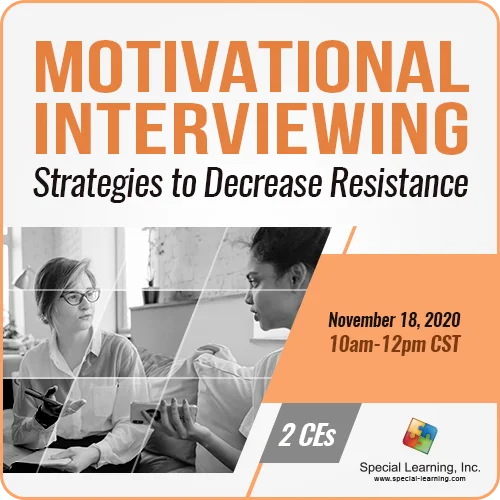
Motivational Interviewing: Decrease Resistance & Increase Buy-in
BACB · 2 CE · Learning
$39.00
How to earn credit
- Complete the 1 required lesson.
- Pass the knowledge check (12 questions) with a score of 80% or higher. You can retake it as many times as you need.
- Complete the course evaluation.
- Your certificate is issued when you finish. Download it any time from My certificates.
Overview
Description: As clinicians or educators, how many of you have experienced barriers that get in the way of helping clients or students make progress because of resistance from other members of the treatment (or educational) team? Whether the resistance is from parents, peers, professionals, or any other stakeholders, the end result is the same -- the ability to make progress is diminished.
Motivational Interviewing is an evidence-based intervention that has demonstrated substantial success in training teachers and caregivers on behavior modification techniques for children with developmental disabilities, changing addictive behaviors in substance users, and medication adherence in patients, among others. In short, motivational interviewing uses change-talk strategies to increase cooperation and decrease resistance.
Presenter: Dr. Monica Gilbert, Psy.D., BCBA-D, LMHC
LEARNING OBJECTIVES:
- Describe the Transtheoretical Model (stages of change) and how it is used alongside Motivational Interviewing
- Describe the key components of Motivational Interviewing (MI) and the context in which MI strategies can be used to remove barriers to effective communication.
- List situations in which MI strategies can be used to resolve conflict and increase buy-in.
- Describe 5 strategies to resolve communication breakdowns using MI strategies.
- Effectively describe the difference between “change talk” and “counterchange talk.”
- Describe how MI strategies can be used in real situations and the resulting benefits.
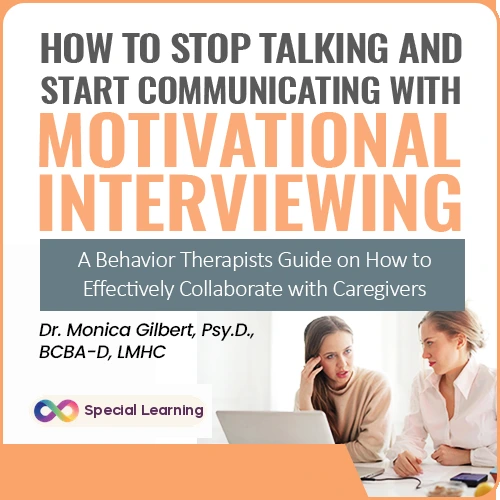
NOTE: Dr. Glibert's book, How to Stop Talking and Start Communicating with Motivational Interviewing: A Behavior Therapist Guide on How to Effectively Collaborate with Caregivers (paperback) is also available for purchase.
TIMELINE: This course, on its own has a license for active use for 30 days unless it is purchased as part of a bundle/library.
MANDATORY DISCLAIMER: The Behavior Analyst Certification Board (“BACB”) does not sponsor, approve, or endorse Special Learning, the materials, information, or sessions identified herein.
NOTE: CEs claimed on any training completed can only be claimed once. If you repeat training you’ve already claimed CEs on, you won’t be able to claim the CEs again. Please ensure you have not already completed and claimed the CEs for the training module before purchase. Want unlimited training? Get All Access training HERE. See our main page! For cancellations and refunds, please see our return policy.
Learning objectives
Motivational Interviewing: Strategies to Decrease Resistance and Increase Buy-in
- Describe the Transtheoretical Model (stages of change) and how it is used alongside Motivational Interviewing
- Describe the key components of Motivational Interviewing (MI) and the context in which MI strategies can be used to remove barriers to effective communication.
- List situations in which MI strategies can be used to resolve conflict and increase buy-in.
- Describe 5 strategies to resolve communication breakdowns using MI strategies.
- Effectively describe the difference between “change talk” and “counter change talk.”
- Describe how MI strategies can be used in real situations and the resulting benefits.
What’s inside
1 section · 2 items
Course content
- Motivational Interviewing: Strategies to Decrease Resistance and Increase Buy-in · video
- Motivational Interviewing: Strategies to Decrease Resistance and Increase Buy-in · knowledge check
Credit designation
BACB
- Credit: 2 CE (Learning)
- Provider: CEUs offered by a BACB ACE Provider (OP-14-2437)