
Error correction
Error correction is a short set of steps, written into a learner's plan, for the moment after a wrong answer or no answer. Plans differ in the steps: some repeat the trial, and others show the right answer and then give the learner another chance to respond.[1] Its purpose is to make it clear to the learner what is right, so that the last thing they said or did is the right answer, and reinforcement follows it.[1][2]
Everyone has been on the other side of this. You meet a new coworker and say her name wrong. She doesn't say "no." She says her name, and you say it back. Later that morning you use it by yourself and get it right.[1]

- Parents: when your child gets something wrong, the answer helps more than "no." Next step: try showing or saying the right answer once, in an even voice, and then give your child another turn.
- Teachers and paraprofessionals: the same steps work for a student at a desk as for a child at a table. Next step: watch Errorless Teaching and Prompting, our training for teachers, therapists and parents teaching new skills, with video examples.
- Behavior technicians: plans correct errors in different ways, and your supervisor reads your data as if every error was corrected the way the plan says. Next step: before your next block, read the error-correction line on each client's card, and ask your supervisor if it isn't there.
One error correction, step by step
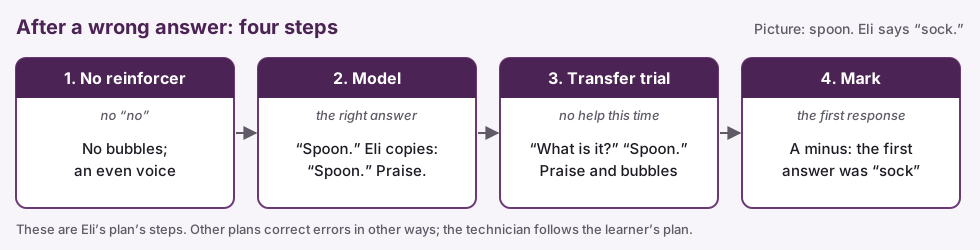
In our technician lessons, Eli is learning to name pictures. His supervisor changed his plan this week, so "spoon" gets the question alone, with no help. Eli says "sock."[1]

| Step | What his technician does | Why |
|---|---|---|
| 1. No reinforcer, no "no" | No bubbles; her voice stays even | For some learners a sharp "no" stings, and they stop trying; for others a big reaction is interesting, and errors come more often |
| 2. Model | Says "Spoon." Eli says "Spoon." She says, "That's spoon." | The model tells him the answer |
| 3. Transfer trial | Card down, card up: "What is it?" with no help. "Spoon" on his own earns praise and bubbles | His last response is independent, and the reinforcer follows it |
| 4. Mark | Marks a minus: the trial is marked by his first response | What came after it was teaching |
If he is wrong a second time, his plan has her model the word once more, praise the copy and go on, with no third question. No response within five seconds starts the same steps as a wrong answer.[1]
Two near misses
Two habits can look like Eli's error correction. Either one could be written into another learner's plan; for Eli they're misses, because each differs from what his plan says:[1]
- Asking again with no model. "What is it? Try again. What is it?" Some plans repeat the trial; Eli's plan calls for a model first. A learner who didn't know the answer the first time now guesses.
- The full reinforcer for a copied answer. If copying the adult earns the same as answering alone, the learner has less reason to answer alone.
Our Errorless Teaching and Prompting training describes the same choice: some learners do well with "try again" and a second chance, and for others the adult asks them to try again and prompts right away.[2] The plan says which.
Plans differ
Other plans correct errors in other ways. When Owen, who is seven, claps for "Stomp," his technician models stomping, Owen copies, and they go on, with no transfer trial. When Grace, who is twenty-seven, picks up the spatula for the whisk in her training kitchen, her technician points to the whisk, asks about one other tool, and then comes back to it.[1]
Studies that compared error-correction procedures with the same learners found that the procedure that worked best differed from one learner to the next, which is one reason the plan names the steps.[3][4]
Error-correction procedures vary. Some plans repeat the trial, and others model the correct response and then give the learner another chance to respond. The adult follows the learner's plan and, if it is unclear, asks the supervisor. When Eli touches the cat instead of the dog, his plan calls for a model and then the question again: the adult points to the dog and says, "This is the dog," then asks, "Where's the dog?"[1]
When errors keep coming
Error correction is not meant to be used all the time. The goal of teaching is for the learner to earn reinforcement for correct answers, not to be corrected. When a learner makes many errors after prompts have been faded, our training asks the team to look at why: whether the skill was really mastered, whether prompts were faded too fast, or whether the learner has come to depend on prompts.[2] Recording helps here: writing where the errors were ("all three errors on spoon") shows what a percentage can't.[1]
What error correction does not do by itself
It doesn't replace good teaching: if errors keep coming, the team goes back and teaches at whatever level of help the learner needs.[2] And it doesn't make a corrected trial a correct one: on Eli's sheet, a trial corrected to "spoon" is still a minus, because marking it a plus would make his supervisor think the word is nearly learned.[1]
Common questions
Why not just say "no"? For some learners it stings and they stop trying; for others the reaction is interesting. The model already tells the learner the answer.[1]
Should a corrected answer get the same reward? In Eli's plan, no: bubbles are saved for the answer he gives on his own, and the copied answer gets praise.[1]
Who decides how errors are corrected? The learner's supervisor, in the plan. A technician follows the plan's steps and asks if the plan doesn't say.[1]
Related strategies
Discrete trial training · Prompting · Discrimination training · Errorless learning
Learn it with Special Learning
- Training: Errorless Teaching and Prompting, with Michele LaMarche, BCBA: errorless teaching and prompting, and how to fade prompts so a learner becomes independent, with video examples. For teachers, therapists and parents teaching new skills.
- Course: Intro to ABA: Level 1 teaches the basic methods of ABA for parents, caregivers, teachers and paraprofessionals. A free 7-day trial covers the first 2 sessions, with no payment card.
Sources
- Special Learning. RBT 3.0, Lesson E-05, "Discrete-trial teaching 2: wrong answers, pacing and recording a block" (forthcoming).
- Special Learning. Errorless Teaching and Prompting, webcast, Michele LaMarche.
- McGhan, A. C., & Lerman, D. C. (2013). An assessment of error-correction procedures for learners with autism. Journal of Applied Behavior Analysis, 46(3), 626-639. doi:10.1002/jaba.65
- Carroll, R. A., Owsiany, J., & Cheatham, J. M. (2018). Using an abbreviated assessment to identify effective error-correction procedures for individual learners during discrete-trial instruction. Journal of Applied Behavior Analysis, 51(3), 482-501. doi:10.1002/jaba.460