
Discrete trial training (DTT)
Discrete trial training (DTT) is a way of teaching a skill in short, separate practice turns. Each turn, called a trial, has a clear start and a clear end: an instruction, the learner's response, a planned consequence and a short pause before the next instruction. The National Clearinghouse on Autism Evidence and Practice (NCAEP) lists it among 28 evidence-based practices for children, youth and young adults with autism, from birth to age 22. The studies behind it measured outcomes such as communication, social skills, play, cognitive, academic and adaptive skills.[1]
"Discrete" means separate. Because each trial stands on its own, a teacher can give many chances to practice in a few minutes, and can count exactly how the learner did on each one.
- Parents: you may see DTT in your child's sessions, or be shown how to run a few trials at home. Next step: try Intro to ABA: Level 1 free for 7 days.
- Teachers and paraprofessionals: if a student's plan includes DTT, the five parts below are what to run and what to record. Next step: share our free DTT article with the student's team.
- Behavior technicians: you run DTT the way the learner's plan writes it. Next step: bring the marking rule below to your next supervision and check it against your learner's data sheet.
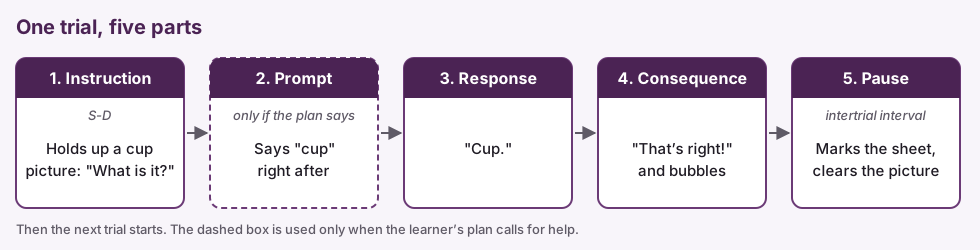
The five parts of a trial
| Part | What it is | Example |
|---|---|---|
| Instruction (S-D, discriminative stimulus) | The signal that a response can be reinforced now. It can be spoken or not. | Holding up a picture of a cup and asking "What is it?" |
| Prompt (only if the plan calls for one) | Help added to the instruction so the right response is more likely. | Saying "cup" right after the question, so the learner can copy it |
| Response | What the learner does. | "Cup." |
| Consequence | What comes right after the response. When it makes the response more likely next time, it is a reinforcer. | "That's right!" and a turn with bubbles |
| Intertrial interval | A pause of a few seconds before the next instruction. | The adult marks the data sheet and clears the picture |

Our own curriculum has taught these same five parts since about 2011, and our technician lessons teach them today.[2][3]
Doing each part well
- Get ready before the trial. Materials in order, the data sheet within reach, the reinforcer where you can reach it and the learner can't. Start when the learner is ready, as their plan describes it.
- Give the instruction once, then wait. Use the plan's words in a normal voice and stop talking. Repeating the question is extra help the plan didn't ask for and the data won't show. Many plans allow three to five seconds.
- Prompt only as the plan says. Give the kind of help the plan names, at the moment it names.
- Reinforce first, record second. When the learner answers correctly on their own, the example plan starts the reinforcer within about two seconds, before anything is written down. Late reinforcement can strengthen whatever the learner is doing when it arrives. Plans differ on what follows a prompted response; follow the learner's plan.
- Name what they did. "Cup! That's right." is clearer than "Good job."
- After a wrong response or none, follow the plan's error-correction steps in an even voice.
- Keep the pause short. A few seconds lets the learner enjoy the reinforcer and you record. A long gap loses attention.
- Mark every trial, using the recording system in the learner's plan. Whatever the marks, keep a correct response on the learner's own apart from a correct response after a prompt (one example sheet uses +, P and −). Merging them makes a skill look learned before it is.[3]

How DTT moves a skill along
DTT moves a target from easy to hard discrimination.[4] It starts with massed trials: the same target several times in a row, with prompts faded step by step until the learner responds on their own. The goal is random rotation: the target mixed at random with mastered items, which is full discrimination. When possible, a learner goes straight from massed trials to random rotation.
Two in-between steps are used only when a learner has difficulty:
- Distractor trials. The target with other items present, which the learner already knows or has never seen.
- Expanded trials. The target asked again after longer and longer gaps filled with other tasks, to build memory over time.
Where DTT fits
DTT is structured and adult-led: the adult picks the item and the moment.[3] Because every trial is separate and counted, it suits skills that need a lot of practice, and it shows clearly whether teaching is working.[3] It is one method among several. In our Level 1 teaching-methods session, the presenter uses it beside natural environment teaching, which builds on what the learner wants in the moment, and chooses for each learner and skill.[4] A technician runs DTT as the learner's plan says.[3] Designing and evaluating trial-based procedures is part of a behavior analyst's job.[5]
What DTT does not do by itself
A skill taught in trials at one table, with the same materials and the same adult, may not show up anywhere else: until it is checked, all anyone knows is that the learner responds in that arrangement.[6] So the learner's plan lists the new people, places and materials to teach with and to check without help, and many teams pair DTT with teaching in the natural environment so the skill is used where it is needed.[6][4]
Common questions
Is DTT the same as ABA? No. DTT is one teaching method used in ABA, and NCAEP lists it as its own practice; our Level 1 session teaches it beside natural environment teaching and incidental teaching, chosen for each learner and skill.[1][4]
How long is a trial? A few seconds: the instruction, a response within the few seconds the plan allows, the consequence and a short pause. How many trials make a session, and how long it runs, is in the learner's plan.[3]
Who runs DTT? Parents, teachers and technicians can all learn to run trials, and a technician runs them as the learner's plan says.[3][4] Designing and evaluating trial-based procedures is part of a behavior analyst's job.[5]
Related strategies
Prompting · Error correction · Discrimination training · Natural environment teaching · Generalization
Learn it with Special Learning
- Free article: Discrete Trial Training (DTT): Steps, Example and Research, covering where DTT came from and what research found about its limits.
- Course: Intro to ABA: Level 1 teaches the basic methods of ABA for parents, caregivers, teachers and paraprofessionals. A free 7-day trial covers the first 2 sessions, with no payment card.
Sources
- Steinbrenner, J. R., Hume, K., Odom, S. L., et al. (2020). Evidence-Based Practices for Children, Youth, and Young Adults with Autism. National Clearinghouse on Autism Evidence and Practice, FPG Child Development Institute, University of North Carolina. Table 3.1 and the DTT fact sheet. Report (PDF)
- Smith, T. (2001). Discrete trial training in the treatment of autism. Focus on Autism and Other Developmental Disabilities, 16(2), 86-92. doi:10.1177/108835760101600204
- Special Learning. RBT 3.0, Lesson E-04, "Discrete-trial teaching 1" (forthcoming).
- Special Learning. Intro to ABA: Level 1, "Teaching Methods" session, Michele LaMarche.
- Behavior Analyst Certification Board (2024). BCBA Test Content Outline (6th ed.), item G.13.
- Special Learning. RBT 3.0, Lesson E-14, "Generalization: new people, places and materials" (forthcoming).