
Discrimination training
Discrimination training is teaching a learner, on purpose, when a response pays off and when it doesn't. The adult reinforces a response when one signal is there, and doesn't reinforce it when another signal is there.[1] When the learner then responds one way to the first signal and another way to the second, that is discrimination. In this field the word has nothing to do with treating people unfairly.[1]
Everyone learns discriminations this way. You pull the door of a coffee shop with its lights on, and it opens. You pull the door of a dark shop, and nothing happens. After a morning or two you stop pulling on the doors of dark shops. Nobody scolded you; the door just didn't open.[1]
- Parents: a "point to the duck" game at home is discrimination training. Next step: between turns, change where the pictures sit, and keep your eyes on your child, not on the right picture.
- Teachers and paraprofessionals: "Line up" is a signal your class has learned; a light over an open checkout lane is one too. Next step: try Intro to ABA: Level 1, built for teachers and paraprofessionals among others, free for 7 days.
- Behavior technicians: a row of right answers can hide a learner who is touching one place. Next step: in every pause, mark where the target was and where the learner touched, if the plan's sheet has those columns.
The signals, and their names
| Signal | What it tells the learner | At the coffee shop | At Eli's table, "Touch spoon" |
|---|---|---|---|
| S-D (discriminative stimulus) | This response can be reinforced right now | Lights on | The spoon picture |
| S-delta | This response won't be reinforced right now (extinction) | Lights off | The cup and the sock |
An S-delta doesn't mean wrong, and it doesn't mean something bad is coming. Reinforcing the response with one and not the other is called differential reinforcement.[1] A third signal, written S-D-p, tells the learner a response will be punished, such as a police car by the road.[1]
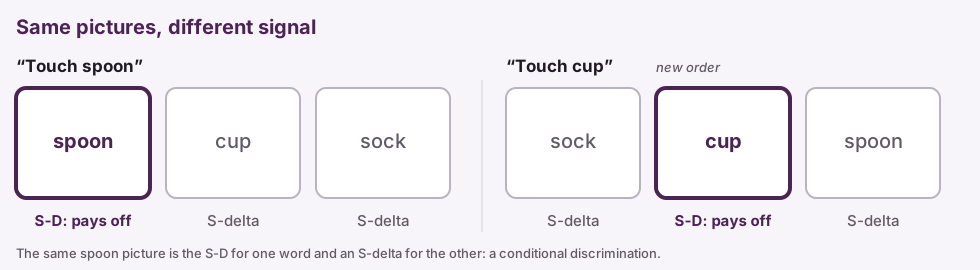
Simple and conditional. The shop door is a simple discrimination: the lights alone decide. At Eli's table, his plan later mixes in "Touch cup," and then the cup is the S-D and the spoon is an S-delta. The same picture can be either one, depending on the word, so Eli has to listen as well as look. That is a conditional discrimination. When he touches the spoon for "spoon" and the cup for "cup," his answer is under stimulus control.[1]
Running an array
The things set out for the learner to choose from are called the array. A learner can be right without knowing the word, by answering to an extra clue: where the picture sits, or where the adult glanced. Responding to the wrong feature is called faulty stimulus control. In our technician lessons, the adult takes the extra clues away:[1]
- A new order every trial. In the pause, pick up all the cards and lay them down again, with the target never in the same place twice in a row.
- Eyes on the learner, hands still. Give the instruction once. Most of us look at the right answer without knowing it, and children follow a look. A glance the learner can follow is a prompt the plan didn't call for.
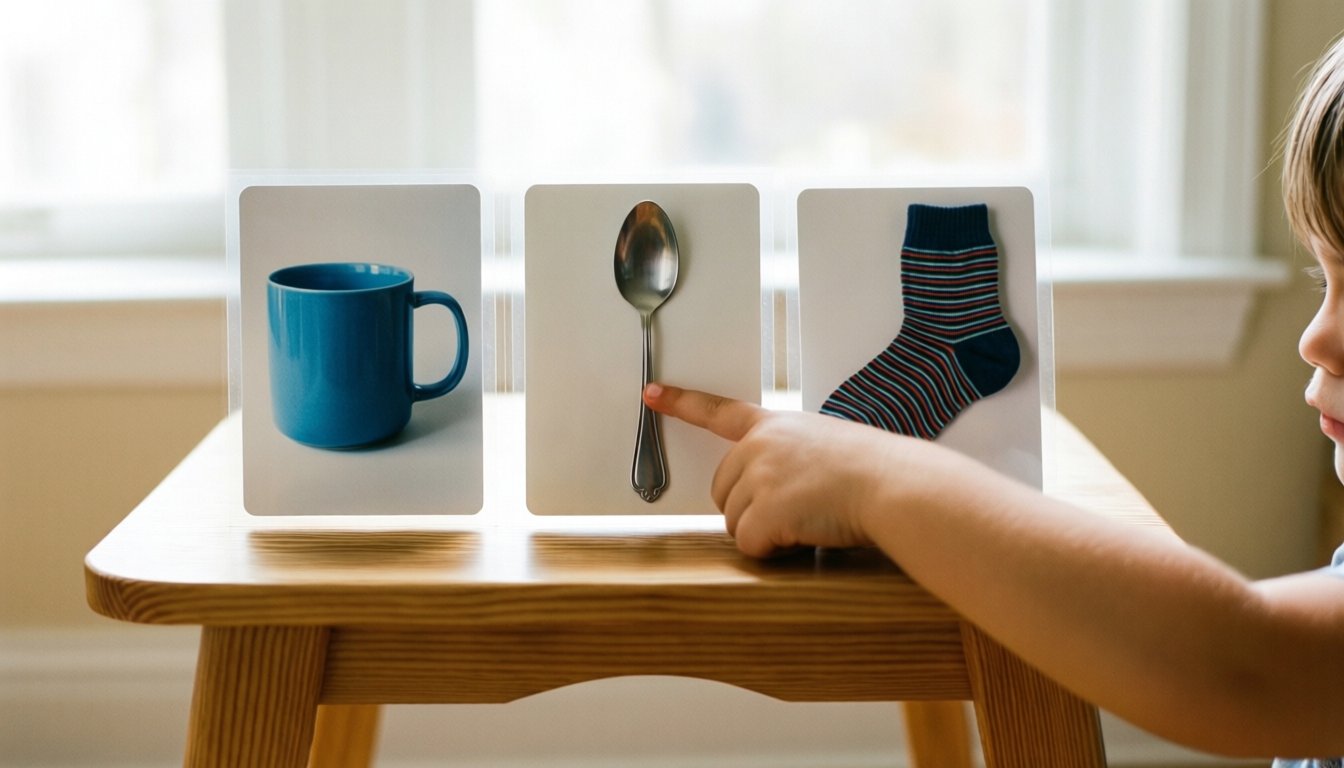
- Only the right pick pays off. In Eli's plan, the spoon earns praise and bubbles within two seconds; the cup or the sock earns none, then the plan's error correction. Holding the bubbles back isn't a penalty. It's the dark shop's door again.
- Wait, without repeating. Eli's plan gives him five seconds; plans commonly allow three to five, then score no response like an incorrect one. Repeating the instruction teaches that the first one can wait.

Published recommendations for teaching receptive language set out the same safeguards, including changing where the target sits and keeping the adult from giving the answer with a look.[3]
Our own curriculum for parents taught the same step in 2011, with picture folders: ask the child to "point to the duck," reward a correct point, and repeat with each picture or stay with one until prompts are removed and the child identifies it on their own.[2]
Showing instead of naming. Some programs hold up a picture and the learner touches its match on the table. That is matching-to-sample: what the adult holds up is the sample, and the pictures on the table are the comparisons.[1]
Teaching a concept
One picture isn't the whole idea of a spoon. A concept is taught with several examples (metal, wooden and plastic spoons) and with non-examples that share other features. A fork, with the same metal and handle and no bowl, teaches more beside the spoons than a sock does, because the bowl is the feature every spoon has. Touching every kind of spoon is generalization; passing over the fork is discrimination. A concept takes both.[1]
What the data sheet shows
Eli's sheet has two extra columns: where the spoon was, and where he touched. On Thursday he was right on 8 of 10 trials, and his hand went where the spoon went. On Friday he was right on 7 of 10, which looks nearly as good, but he touched the middle on all ten trials, and the spoon was in the middle on seven. Going to one place, whatever the word, is called a position bias.[1] Responding to position or another feature nobody planned is a long-described problem in teaching learners with autism, and changing where things sit is one standard safeguard.[4]
What discrimination training does not do by itself
Reinforcing every pick because the learner is trying is still reinforcement, but not differential reinforcement: with no difference in what pays off, there is no difference to learn.[1] And a row of right answers doesn't show by itself what the learner is answering to; the order of the array and the place columns do.[1]
Common questions
Does "discrimination" here mean treating someone unfairly? No. In applied behavior analysis it means doing one thing when one signal is there and another when it isn't.[1]
Why change where the pictures sit? So the place can't give the answer. A learner who scores nine of ten all week may be touching whichever card went down last.[1]
Is an S-delta a punishment? No. It only signals that this response won't be reinforced right now; nothing is taken away.[1]
Related strategies
Discrete trial training · Error correction · Prompting · Generalization · Differential reinforcement
Learn it with Special Learning
- Course: Intro to ABA: Level 1 teaches the basic methods of ABA for parents, caregivers, teachers and paraprofessionals. A free 7-day trial covers the first 2 sessions, with no payment card.
Sources
- Special Learning. RBT 3.0, Lesson E-12, "Discrimination training: teaching when a response pays off" (forthcoming).
- Special Learning. How to Teach series, Animals instruction booklet (2011), "Receptive Identification With the Animal File Folder."
- Grow, L., & LeBlanc, L. (2013). Teaching receptive language skills: Recommendations for instructors. Behavior Analysis in Practice, 6(1), 56-75. doi:10.1007/BF03391791
- Green, G. (2001). Behavior analytic instruction for learners with autism: Advances in stimulus control technology. Focus on Autism and Other Developmental Disabilities, 16(2), 72-85. doi:10.1177/108835760101600203