
Prompting
Prompting is "verbal, gestural, or physical assistance given to learners to support them in acquiring or engaging in a targeted behavior or skill," in the words of the National Clearinghouse on Autism Evidence and Practice, which lists it among its evidence-based practices for children, youth, and young adults with autism.[1] A prompt is anything added to the instruction, before the person responds or while they're responding, that makes the right response more likely.[2]
Why add help at all? Because nobody can praise a zipper that never goes up. A prompt gets the right response to happen, so the learner finishes the step and earns what follows. Being stuck teaches nothing.[2]
- Parents: the help you already give at home has names and an order. Next step: download our free Prompt Hierarchy Chart, a printable card of the prompt levels with an example of each.
- Teachers and paraprofessionals: a point, a look or a hint in class is a prompt too, and some are given without meaning to. Next step: read our free article, Prompting in ABA: Definition, 6 Prompt Types and How to Fade Them.
- Behavior technicians: a prompt you didn't plan can make a learner look independent when they aren't. Next step: when you give the instruction, look at the person and keep your hands still, and mark the help you actually gave.
Five kinds of help you add
In our technician lessons, Zoe is learning to zip her coat. Her technician, Luis, says, "Zip your coat," and she gets stuck. Here are five kinds of help he could add:[2]
| Prompt | At Zoe's zipper |
|---|---|
| Verbal | "Pull it up." |
| Gesture (gestural) | He points to the zipper pull: no words, no touch |
| Model | He zips his own jacket where she can see it, for her to copy |
| Partial physical | A light lift at her elbow, then he lets go; the rest of the movement is hers |
| Full physical (hand over hand) | His hands over hers, and they pull the zipper to the top together |
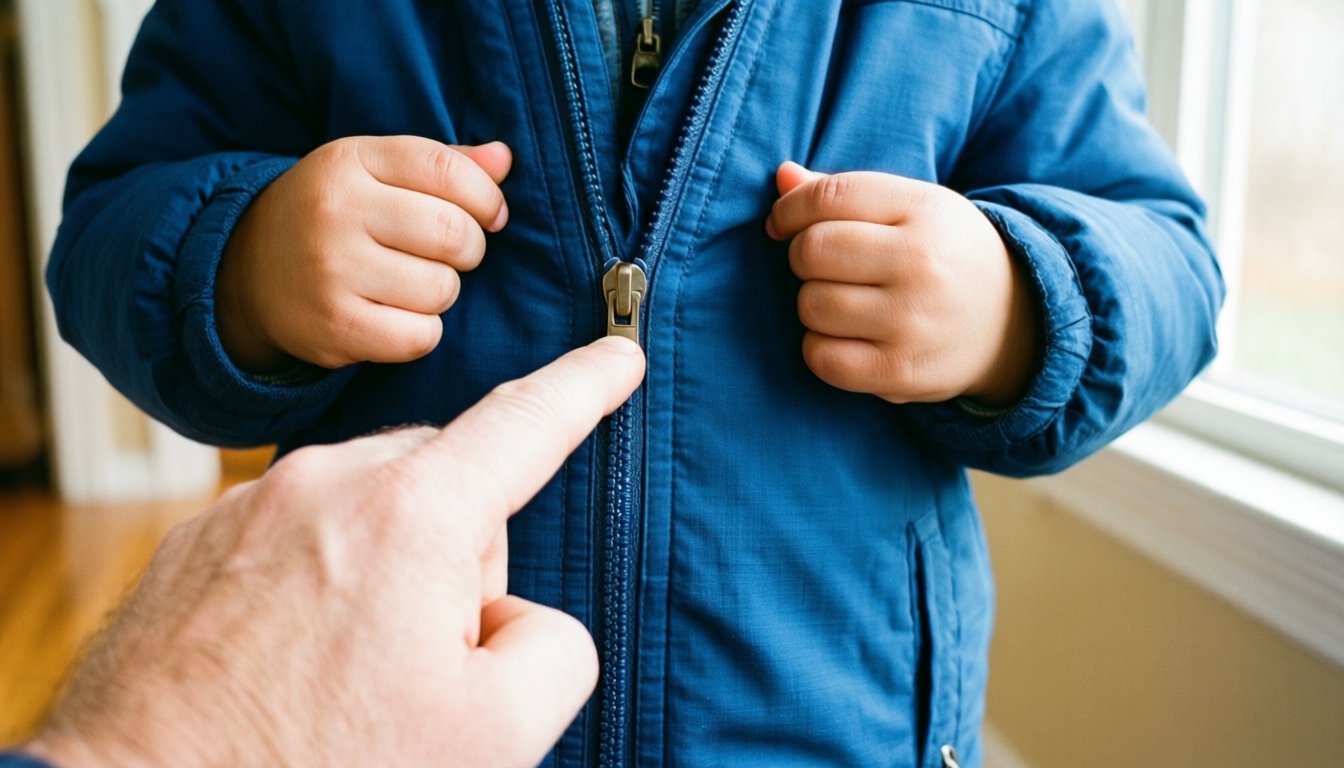
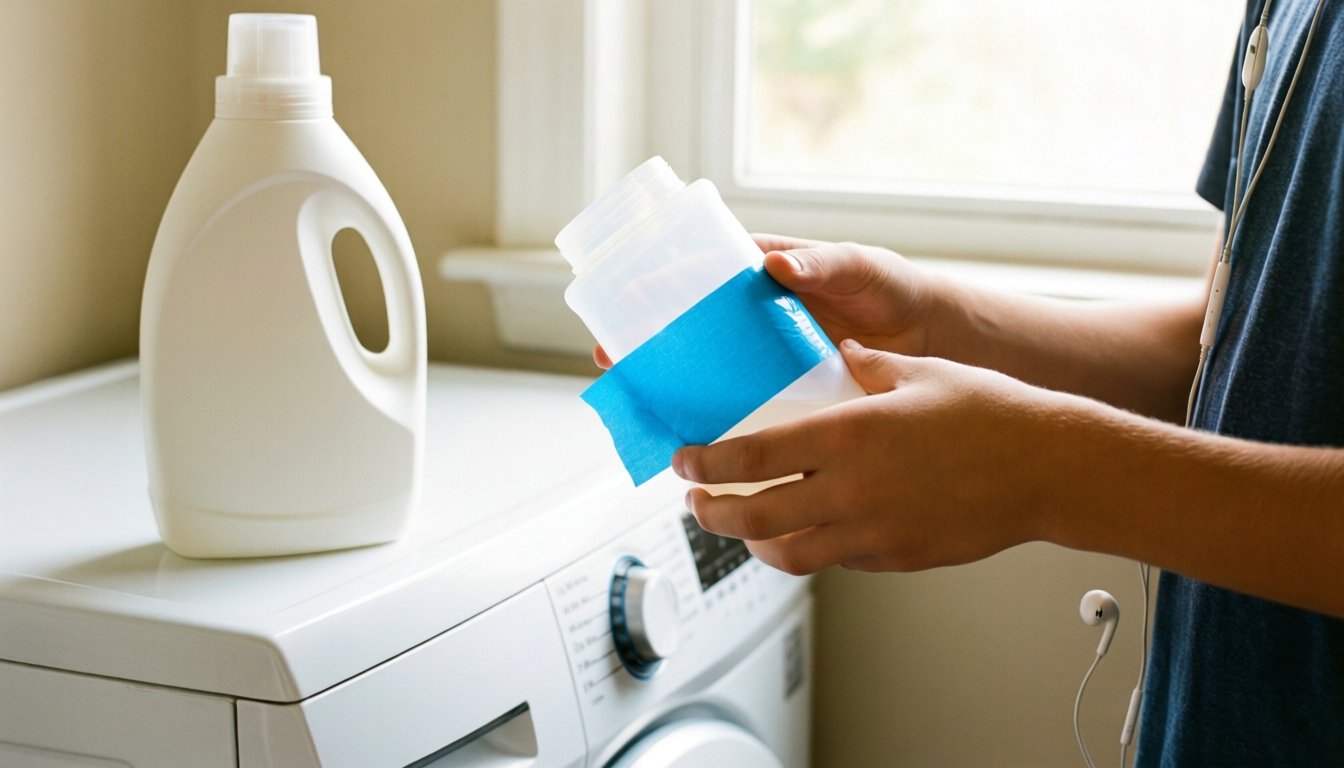
All five are things the adult says or does, so they are called response prompts. Help built into the materials is a stimulus prompt: a picture card placed closer to the learner (a position prompt), or a strip of tape at the fill line of a detergent cap (a redundancy prompt). To tell them apart, picture the adult stepping out of the room: if the help is still on the table, it is a stimulus prompt.[2][3] Our Errorless Teaching and Prompting training adds visual and textual prompts, such as a written word beside a picture for a learner who reads, a rule card or a checklist.[4]
The prompt hierarchy
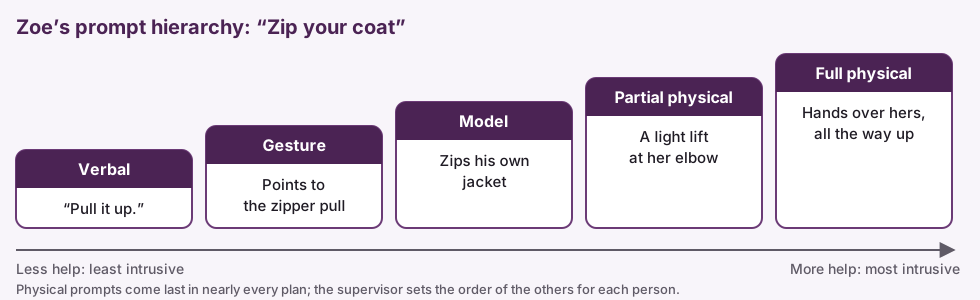
The five don't do the same amount of the work. When Luis says "Pull it up," Zoe does all the zipping; when his hands are over hers, he does most of it. The more of the work a prompt does, the more intrusive it is. A plan lists its prompts in order, from least to most, and that list is called a prompt hierarchy.[2] Physical prompts come last in nearly every hierarchy; the others can trade places for one person, because a model only helps someone who copies what they see, and words only help someone who understands them. So the supervisor chooses the prompt, and the technician gives the one chosen.[2]
Giving a prompt well
- The plan's prompt, at the plan's moment. Zoe's plan reads: say "Zip your coat" once, wait five seconds, and if she hasn't started, ask, then guide her hands. Prompting at two seconds because she looks stuck takes away three seconds in which she might have done it alone.[2]
- Ask before you touch. A physical prompt puts hands on another person, so the adult checks first, every time: "Can I help your hands?" If the answer is no, or the learner pulls away, the hands come off.[2]
- Hold back when they start on their own. On Tuesday, Zoe starts pulling at three seconds. Luis keeps his hands back and lets her finish her first zipper done alone.[2]
- Watch for help you didn't mean to give. Luis says, "Get your coat," and his eyes go to the hook. Was Zoe answering his words or his eyes? One technician's student scored ten of ten on colors all week; once she stopped looking at the right card as she asked, he got four.[2]
- Mark the help you gave. I for on her own, then V, G, M, PP or FP. The letter tells the supervisor how much help was needed.[2]
Fading prompts
A prompt is meant to come off. Removing it a little at a time, on purpose, is prompt fading, and it moves the skill from the prompt to what should set it off in daily life: dry hands and a towel, not the adult's hands.[5] Our lessons teach three ways a plan can do it:[4][5]
- Most-to-least. Start with the most help, so the first try is right, and step down by the plan's rule. This keeps mistakes rare when a skill is new.
- Least-to-most. Give the learner the first try with no help, then add help one step at a time until the step gets done. This suits a skill that's partly there. Our Errorless Teaching and Prompting training recommends starting with the least intrusive prompt possible, and moving to most-to-least when a learner is already known to need more help.
- Time delay. Give the same prompt later: first right along with the question ("What is it? Sock."), then after a few seconds' wait. What's delayed is the prompt, not the question.
A research review of prompt-fading procedures, including most-to-least, least-to-most and time delay, compares how effective and how efficient each has been in published studies.[6]
Errorless teaching is designed to prevent or keep down errors while a learner acquires a skill: it starts with a prompt that reliably brings the correct response, then fades the help. Most-to-least prompting works this way, and a time delay that starts with the prompt given right away, or stimulus fading, can also keep errors down.[5]
What prompting does not do by itself
A prompt that never comes off teaches the learner to wait for it: that is prompt dependence, and it comes from how the prompts were given, and for how long, not from the person.[5] And a prompt the adult didn't plan or record makes the data sheet say the learner did it alone when they didn't.[2]
Common questions
Which prompt should I use? The one the learner's plan names. Physical prompts come last in nearly every hierarchy, and the supervisor chooses the order of the others for that person.[2]
Is pointing a prompt? Yes. A point or a look toward the right item is a gesture prompt, and a look can prompt without the adult meaning it to.[2] Textbooks that sort stimulus prompts into kinds may call a gesture that draws attention to the right item a movement prompt. The learner's plan says how to give it and how to record it.[2][3]
Doesn't "errorless" mean the learner never tries alone? No. Help at the start is half of errorless teaching; fading the help is the other half, and it is what makes the skill the learner's own.[5]
Related strategies
Discrete trial training · Error correction · Discrimination training · Natural environment teaching · Generalization · Time delay
Learn it with Special Learning
- Free: the Prompt Hierarchy Chart and the article Prompting in ABA.
- Training: Errorless Teaching and Prompting, with Michele LaMarche, BCBA: errorless teaching and prompting, and how to fade prompts so a learner becomes independent, with video examples. For teachers, therapists and parents teaching new skills.
- Course: Intro to ABA: Level 1 teaches the basic methods of ABA for parents, caregivers, teachers and paraprofessionals. A free 7-day trial covers the first 2 sessions, with no payment card.
Sources
- Steinbrenner, J. R., Hume, K., Odom, S. L., et al. (2020). Evidence-based practices for children, youth, and young adults with autism. National Clearinghouse on Autism Evidence and Practice Review Team, University of North Carolina at Chapel Hill.
- Special Learning. RBT 3.0, Lesson E-09, "Response prompts: the help you add" (forthcoming).
- Special Learning. RBT 3.0, Lesson E-10, "Stimulus prompts and stimulus fading" (forthcoming).
- Special Learning. Errorless Teaching and Prompting, webcast, Michele LaMarche.
- Special Learning. RBT 3.0, Lesson E-11, "Fading prompts: most-to-least, least-to-most, time delay and errorless teaching" (forthcoming).
- Cengher, M., Budd, A., Farrell, N., & Fienup, D. M. (2018). A review of prompt-fading procedures: Implications for effective and efficient skill acquisition. Journal of Developmental and Physical Disabilities, 30, 155-173. doi:10.1007/s10882-017-9575-8