
Natural environment teaching (NET)
Natural environment teaching (NET) is teaching the skills in a learner's plan during their everyday places and activities, starting from what the learner wants right then.[2] The National Clearinghouse on Autism Evidence and Practice lists it within naturalistic intervention: "a collection of techniques and strategies that are embedded in typical activities and/or routines in which the learner participates to naturally promote, support, and encourage target skills/behaviors."[1] It is also written natural environment training.
"Naturalistic" doesn't mean unplanned. The adult knows the plan's targets, plans many teaching opportunities ahead of time and catches moments that may last two seconds. That makes it harder to do well than teaching at a table, not easier.[2][3]
- Parents: home is where NET is easiest, because a child moves from room to room and shows what they want.[3] Next step: ask your child's team which skill in the plan could be taught during one routine at home, such as snack or bath time.
- Teachers and paraprofessionals: recess, snack and the classroom give the same moments. Next step: read our free article, Incidental Teaching in ABA: What It Is and How It Works.
- Behavior technicians: before play starts, set the plan's items where the learner can see them and you can reach them. Next step: in your next session, count the opportunities you taught on, and those that went by.
One opportunity, step by step
In our technician lesson, Lena, who is three, is at a water table with Luis, her technician. Her plan names the skill: asking for things with a word.[2]
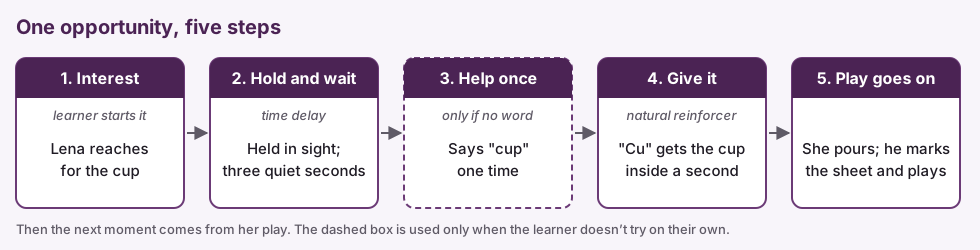
| Step | What happens | Lena's plan |
|---|---|---|
| Interest | The learner shows they want something: reaches, points, or looks at it and then at the adult | She reaches for the cup |
| Hold and wait | The adult holds the item where the learner can see it, and waits, saying nothing | Three seconds |
| Help once, if needed | If no word comes, the adult gives the prompt the plan names, once | Luis says "cup," one time, in his normal voice |
| Give what was asked for | Any attempt the plan counts gets the item itself, right away | "Cu" counts; the cup is in her hand inside a second |
| Play goes on | The learner plays with it before anything new is set up | At least twenty seconds of pouring |
The item she gets is the thing she asked for, not a sticker or a treat picked ahead of time. That is called a natural reinforcer, and it is how she finds out what the word is for.[2] If she doesn't try after the prompt, her plan has Luis say the word once more as he hands her the cup; other plans have the adult set the item down and wait for the next moment. The adult follows the learner's plan on this.[2]
Doing it well
Two mistakes are common, and NET sits between them:[2]
- Handing it over at the first reach. It is kind, and it means the learner never needs the word.
- Turning play into a drill. "Say cup. Say cup." Asked once, the word helps the learner get the cup. Asked five times, the cup becomes work, and the learner may walk away.
Play stays play. Lena's plan asks for at least five opportunities in five minutes, not thirty; in between, Luis plays too. If she pushes a toy away or turns her back, he follows her to what she chose.[2] Our Level 1 course puts it the same way: NET is supposed to look more like play than work, and it still has structure, because the adult knows which goals in the plan they are teaching.[3]

Captured and contrived moments
Both kinds of opportunity start with what the learner wants. When the want comes by itself, the adult has captured an opportunity: Lena reaches for the cup during play, and Luis uses that interest to teach her to ask for it. When the adult sets things up ahead of time so the want will come, they have contrived one. Either way, the adult follows the learner's plan for prompting and for honoring the request.[2] Our lessons name several ways a plan can contrive an opportunity:[2][3][4]
- Keep favorite items in a clear tub with the lid on, or on a shelf, in sight and out of reach.
- Give a little at a time, such as a small pour, so there is a reason to ask for more.
- Leave out a piece the activity needs, such as the measuring cups on a high shelf before a baking shift.
- Pause a routine partway, such as a swing held still.
- Use what the setting already offers: getting ready for a meal in the kitchen gives chances to find silverware, set the table and ask for a drink.

Each works because the learner wants something now and can get it by asking. None of them takes anything out of the learner's hands: taking a cup away so the learner must ask for it back would teach that playing near the adult costs them things.[2]
Incidental teaching and NET
When the learner makes the first move and the adult teaches from it, prompting a little more than the learner gave (for a reach, a word), it is called incidental teaching. NET is the wider name. Both promote generalization, and many plans use the words loosely. What defines incidental teaching is that the learner starts it.[2] It was described in a 1975 study of language teaching in a preschool.[5] A 2015 review of naturalistic developmental behavioral interventions describes the same core features across these approaches: teaching inside everyday activities, following the child's lead and using natural reinforcers.[6]
NET works for every age. Jamal, who is nine, raises his hand when he is stuck in class, and his technician is at his desk right away: help is what he asked for. Grace, who is twenty-seven, asks a coworker for the measuring cups in her training kitchen.[2] Our older curriculum used the same idea with shapes: when a child is looking at a book, point to the sun and ask, "What shape is the sun?"[4]
Counting it
At a table, a session has a fixed number of trials. In play, the adult counts as many opportunities as the play gave. On Monday, Lena had five opportunities and asked on her own on two of them: 40 percent independent. Her supervisor saw seven moments when Lena wanted something; the two that went by stay out of her percentage, because she never got the wait or the model.[2]
What NET does not do by itself
NET doesn't replace practice at a table: discrete trial training gives many more practice turns, while NET helps a word learned at a table carry over to the places and people that need it, so most plans use both.[2][4] Motivation also changes from minute to minute, so NET depends on an adult who watches closely and knows the plan's targets by heart.[2][3]
Common questions
Is NET the same as letting a child play? No. The play is the learner's, and the teaching is planned: the adult knows the plan's targets and how to teach each one when the moment comes.[2][3]
Is NET only for young children? No. Our lessons show it with a nine-year-old asking for help in class and a twenty-seven-year-old asking for what she needs at work.[2]
What if the child doesn't want anything? The adult can contrive a moment, using what they know the learner enjoys, as the plan lists.[2][3]
Related strategies
Discrete trial training · Generalization · Prompting · Incidental teaching · Motivating operations
Learn it with Special Learning
- Free article: Incidental Teaching in ABA: What It Is and How It Works.
- Course: Intro to ABA: Level 1 teaches the basic methods of ABA, natural environment training among them, for parents, caregivers, teachers and paraprofessionals. A free 7-day trial covers the first 2 sessions, with no payment card.
Sources
- Steinbrenner, J. R., Hume, K., Odom, S. L., et al. (2020). Evidence-based practices for children, youth, and young adults with autism. National Clearinghouse on Autism Evidence and Practice Review Team, University of North Carolina at Chapel Hill.
- Special Learning. RBT 3.0, Lesson E-06, "Naturalistic teaching: incidental teaching and natural environment teaching" (forthcoming).
- Special Learning. Intro to ABA: Level 1, "Teaching Methods" session, Michele LaMarche.
- Special Learning. ABA Teaching Guide, curriculum guide for parents and teachers (about 2011 to 2014), "Natural Environment Teaching."
- Hart, B., & Risley, T. R. (1975). Incidental teaching of language in the preschool. Journal of Applied Behavior Analysis, 8(4), 411-420. doi:10.1901/jaba.1975.8-411
- Schreibman, L., Dawson, G., Stahmer, A. C., Landa, R., et al. (2015). Naturalistic developmental behavioral interventions: Empirically validated treatments for autism spectrum disorder. Journal of Autism and Developmental Disorders, 45(8), 2411-2428. doi:10.1007/s10803-015-2407-8