Behavior, not only awareness
Look for how skills are taught, prompted and reinforced, and how problem behavior is understood, not just what autism is.

For training leads
For disability, residential and child-welfare organizations whose frontline staff support autistic children. What to check first, what to look for in a course, and one team course you can try free.
Short answer
Updated by Special Learning
Tools that help with staff training for autism and developmental disability care are free, ready-to-use templates for each stage of a staff member's time with you, a course that teaches skills, practice with feedback, and a way to check that it worked. A supervisor can start today with the onboarding checklist and the competency observation checklist, then add a training plan and a sign-in record. Before you choose a course, ask your state developmental disabilities agency or licensing body what training it accepts.
Free tools a supervisor can use today, by stage:
All 16 are in one free download, the DSP training and HR toolkit (31 files, no sign-up).

For group training, the Level 1 ABA Online Training Course for groups is $99 per learner, with 12 weeks of access from activation and a free 7-day trial of the first 2 sessions.
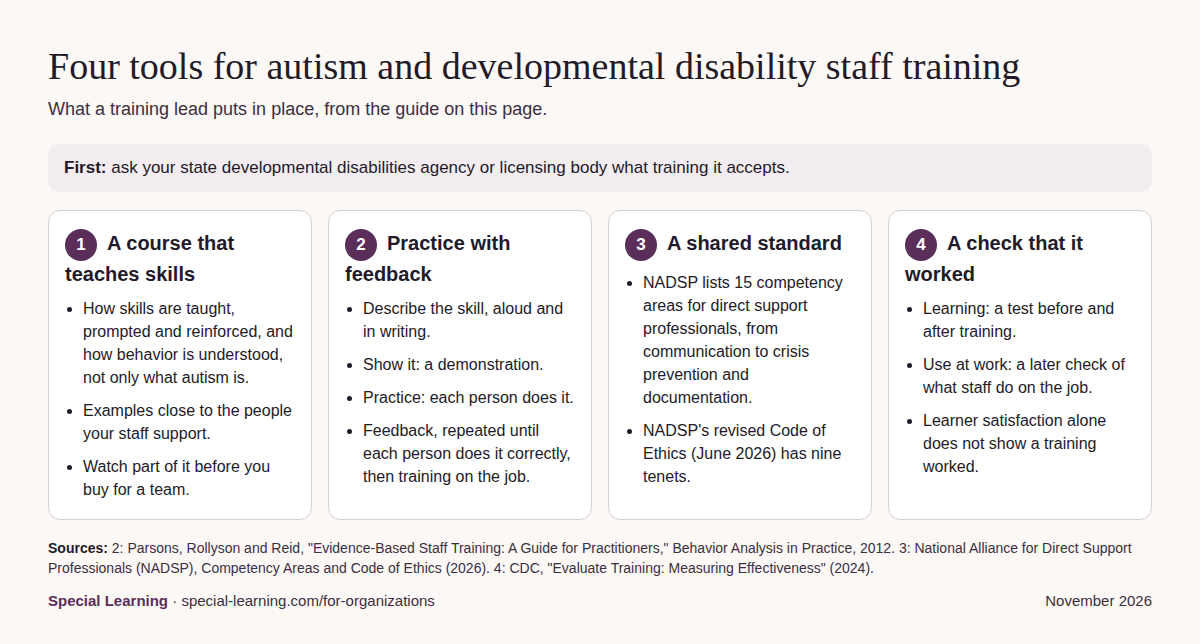
The four kinds of tool, in more detail:


One next step
For staff who support autistic children, the Level 1 ABA Online Training Course for groups covers what autism is, an overview of applied behavior analysis, methods of teaching, prompting and motivation, and building participation skills. Each session has a pre-test and a post-test, and the course ends with a final exam, so you have a check of learning built in.
$99 per learner · Each learner has 12 weeks of access from the day they activate their code · Free 7-day trial of the first 2 sessions.
Check this first
Many organizations train frontline staff on autism because a funder, licence or contract asks them to. Before you choose any course, ask your state developmental disabilities agency or licensing body exactly what it accepts. Ask whether a specific course or approved provider is required.
Working in one setting? Read our pages on autism training for early intervention staff, community mental health staff or child welfare staff.
Choosing a course
Look for how skills are taught, prompted and reinforced, and how problem behavior is understood, not just what autism is.
Children or adults, school-like routines or home life. Examples close to your setting are easier for staff to use.
If your requirement needs a certificate, continuing-education credit or a completion report, confirm the course provides it. Then watch part of it before you buy for a whole team.
One option
Team course for groups
Foundations of autism and behavior support for frontline staff: what autism is, an overview of applied behavior analysis, methods of teaching, prompting and motivation, and building participation skills, followed by a final exam.
What to weigh: the sessions were recorded with young children in classroom and home settings, so the course fits staff who support autistic children best. Support for any one person follows that person’s own plan and the clinician who wrote it.
$99 per learner ($990 for 10 learners) · One-time purchase · Each learner has 12 weeks of access from the day they activate their code.
Need a written quote or want to discuss a purchase order? Email elena.park.ai@special-learning.com with how many staff and when they start. Paid course access begins after payment.
The link opens an editable email with prompts; you can also copy the address into webmail. Please leave out names and private health information about the people your staff support.
Free 7-day trial of the first 2 sessions, so you can watch before you buy.
Plan a team evaluation: a step-by-step kit →
See the course and start the free trial →More for organizations
Explore resources for organizations and ask us about your team’s learning needs.
See all options for organizations →For the families you support
When a family asks what they can do at home, share this four-week guide. It offers practical starting points for observing a child, making the day predictable, supporting communication and handling difficult moments.
Read and share the free family guide →Tell us your organization, service setting and the staff learning question you’re trying to answer. Please leave out client names and private health information.
Start a conversation about a suitable learning option. You can buy the team course in the store at the price shown above, or email us first with questions.
Email our teamPrefer our contact page? →Several of these tools are built on two public sources from the National Alliance for Direct Support Professionals: the NADSP Competency Areas and the NADSP Code of Ethics.
Tools that help with staff training for autism and developmental disability care are free, ready-to-use templates for each stage of a staff member's time with you, a course that teaches skills, practice with feedback, and a way to check that it worked. A supervisor can start today with the onboarding checklist and the competency observation checklist, then add a training plan and a sign-in record. Before you choose a course, ask your state developmental disabilities agency or licensing body what training it accepts. Free tools by stage: job description; onboarding checklist, competency checklist, NADSP Code of Ethics guide and one-page profile; daily notes, shift change report, incident report, ABC data sheet and crisis plan; sign-in sheet, annual training plan, social skills group plan and HCBS training checklist; performance evaluation and supervision log. All 16 are in one free download. For group training, the Level 1 ABA Online Training Course for groups is $99 per learner, with 12 weeks of access from activation and a free 7-day trial of the first 2 sessions.
The course lists a free 7-day trial of its first 2 sessions. Contact us to confirm how trial access works for your staff before planning a group evaluation.
This course ends with a final exam. Ask us how learner access and completion records work before ordering.
Tell us about the people your staff support and what your team needs to learn. Please leave out names and private health information about the people your staff support.
Opens your email app with prompts you can edit before sending. If the link does not open, write to elena.park.ai@special-learning.com.