
For special-education directors, principals and business officers · Checked November 15, 2026
Paying for staff autism training: which funds, and how a district buys it
Three federal funds can support autism and behavior training for paraprofessionals and teachers when the cost fits the fund's rules and the district's approved plan or application: IDEA Part B, Title II, Part A and Title I, Part A. Your district's federal-programs office decides whether a cost is allowable and which fund pays. The purchase then follows the district's documented procedures, which typically run: a needs assessment, the allowable-cost check, vendor set-up with a W-9, a purchase order, and an invoice that quotes the PO.
Request a quote for your staff
The short answer
01The federal funds that can pay for staff training
Each fund can support professional development for its own purpose and its own students. The citation in each row links to the federal text we read on November 15, 2026 (eCFR current as of November 12, 2026).
| Fund | What the federal text allows for staff training | Whose learning it supports | Where it is written |
|---|---|---|---|
| IDEA Part B (the district's subgrant) | Pays the excess costs of special education and related services. The district must ensure that all personnel needed to carry out Part B are appropriately and adequately prepared. | Students with disabilities | 34 CFR 300.207; 300.202 |
| IDEA Part B, early intervening services (CEIS) | Up to 15 percent of the district's Part B amount, less any amount reduced under 34 CFR 300.205, may fund coordinated early intervening services, including professional development for teachers and other school staff to deliver scientifically based academic and behavioral interventions. | Students in kindergarten through grade 12, especially K-3, not currently identified as needing special education, who need more academic and behavioral support | 34 CFR 300.226 |
| ESEA Title II, Part A | Local programs and activities listed in Section 2103, including programs that increase teachers' ability to teach children with disabilities, and professional growth for paraprofessionals. The activities are described in the district's application to the state. | All students, including children with disabilities | ESEA 2103; 2102(b) |
| ESEA Title I, Part A | Professional development for teachers, paraprofessionals and other school personnel in schoolwide programs, and for staff who work with eligible children in targeted assistance programs. | Students in Title I schools and programs | ESEA 1114(b)(7); 1115(b)(2)(D) |
At a private school? Read how equitable services from your public district can include training for private school teachers, and how to ask.
Individuals with Disabilities Education Act
02IDEA Part B: training special-education staff, and early intervening services

Can IDEA Part B pay for autism training for special-education staff?
It can, when the district finds the training is an allowable excess cost of special education. The Part B money a district receives must be used only to pay the excess costs of providing special education and related services to children with disabilities (34 CFR 300.202), and the district must make sure its staff are ready for that work:
"The LEA must ensure that all personnel necessary to carry out Part B of the Act are appropriately and adequately prepared, subject to the requirements of § 300.156 (related to personnel qualifications) and section 2102(b) of the ESEA."
34 CFR 300.207, Personnel development (eCFR, read November 15, 2026)
State guides spell out the details. New Jersey's Department of Education says "the cost of training special education staff on any topic is an allowed cost that can be charged to the IDEA grant." Its guide also says: "Unless the training is only provided to special education staff, 100 percent of the training cannot be charged to the IDEA grant" (New Jersey DOE, IDEA Allowable Uses Resource Guide, February 2024). Check your own state's guide.
Can early intervening services (CEIS) pay for staff training?
For the students and activities CEIS covers, yes. A district may use no more than 15 percent of the Part B amount it receives for the fiscal year, less any amount reduced under 34 CFR 300.205, for coordinated early intervening services for students in kindergarten through grade 12, with a particular emphasis on kindergarten through grade three, "who are not currently identified as needing special education or related services, but who need additional academic and behavioral support to succeed in a general education environment." The activities can include:
"Professional development (which may be provided by entities other than LEAs) for teachers and other school staff to enable such personnel to deliver scientifically based academic and behavioral interventions..."
34 CFR 300.226(a) and (b)(1) (eCFR, read November 15, 2026)
A district that uses CEIS reports to its state each year how many children received early intervening services, and how many of them later received special education and related services under Part B during the preceding two-year period (300.226(d)).
Elementary and Secondary Education Act
03Title II, Part A: professional development in the district's plan

Can Title II, Part A pay for autism and behavior training?
It can, when the activity is one the law lists and it is in the district's plan. Section 2103 says a district may carry out its activities "through a grant or contract with a for-profit or nonprofit entity," and the list of activities includes:
"developing programs and activities that increase the ability of teachers to effectively teach children with disabilities, including children with significant cognitive disabilities, and English learners, which may include the use of multi-tier systems of support and positive behavioral intervention and supports..."
The same list names "teacher, paraprofessional, principal, or other school leader advancement and professional growth" (2103(b)(3)(B)(iii)), and the activities must "address the learning needs of all students, including children with disabilities" (2103(b)(2)).
What does the plan have to show?
A district applies to its state for Title II, Part A, describing the activities it will carry out and how they align with state academic standards, after consulting teachers, principals, paraprofessionals, parents and others (ESEA Section 2102(b), 20 U.S.C. 6612). New York, for example, tells districts to list the identified needs in the Title II-A section of the Consolidated Application (NYSED, Title II-A allowability guidance, updated May 14, 2026).
Title II, Part A uses the law's definition of professional development: activities that are "sustained (not stand-alone, 1-day, or short term workshops), intensive, collaborative, job-embedded, data-driven, and classroom-focused" (ESEA Section 8101(42), 20 U.S.C. 7801). The district's application describes the activities and how they align with challenging State academic standards; any activity counted as professional development has to fit that definition, and Section 2103 asks the district to develop, implement and evaluate its programs and activities.
Elementary and Secondary Education Act
04Title I, Part A: professional development for paraprofessionals

Can Title I pay for paraprofessional training?
Yes, in Title I programs. A schoolwide program's strategies may include:
"professional development and other activities for teachers, paraprofessionals, and other school personnel to improve instruction and use of data from academic assessments..."
The same section lists "implementation of a schoolwide tiered model to prevent and address problem behavior, and early intervening services, coordinated with similar activities and services carried out under the Individuals with Disabilities Education Act" (1114(b)(7)(A)(iii)(III)). A targeted assistance program provides professional development to "teachers, principals, other school leaders, paraprofessionals, and, if appropriate, specialized instructional support personnel, and other school personnel who work with eligible children" (ESEA Section 1115(b)(2)(D), 20 U.S.C. 6315).
States add their own conditions. Colorado allows "paraprofessional participation in professional development if the professional development is evidence-based, aligned with the school's comprehensive needs assessment and meets the purpose of Title I, Part A" (Colorado Department of Education, ESEA Paraprofessional Guidance, updated fall 2025).
Dated sources only
05Federal funding for the 2026-27 school year
Congress funded these programs for 2026-27 in the Consolidated Appropriations Act, 2026 (Public Law 119-75), signed February 3, 2026. In the Education for the Disadvantaged account (which funds Title I) and the Special Education account (which funds IDEA), the act made stated amounts available on July 1, 2026 and further amounts on October 1, 2026, "for academic year 2026-2027." It sets $2,190,080,000 for Title II, Part A, and Section 312 tells the Secretary of Education to award formula grants to states "on the date such funds become available for obligation."
States then pass the money to districts. Virginia's Department of Education, for example, reported on August 13, 2026 that its IDEA Section 611 awards were made available on July 1, with the rest available for awards on October 1, and that 43.04 percent of Title I, Part A allocations were available from July 1 and the remaining 56.96 percent from October 1 (Virginia DOE bulletin, August 13, 2026).
We found no ed.gov notice that 2026-27 allocations were delayed or withheld. Your state education agency's allocation notice gives your district's own amounts and dates.
For the business office
06How a district buys training with federal funds
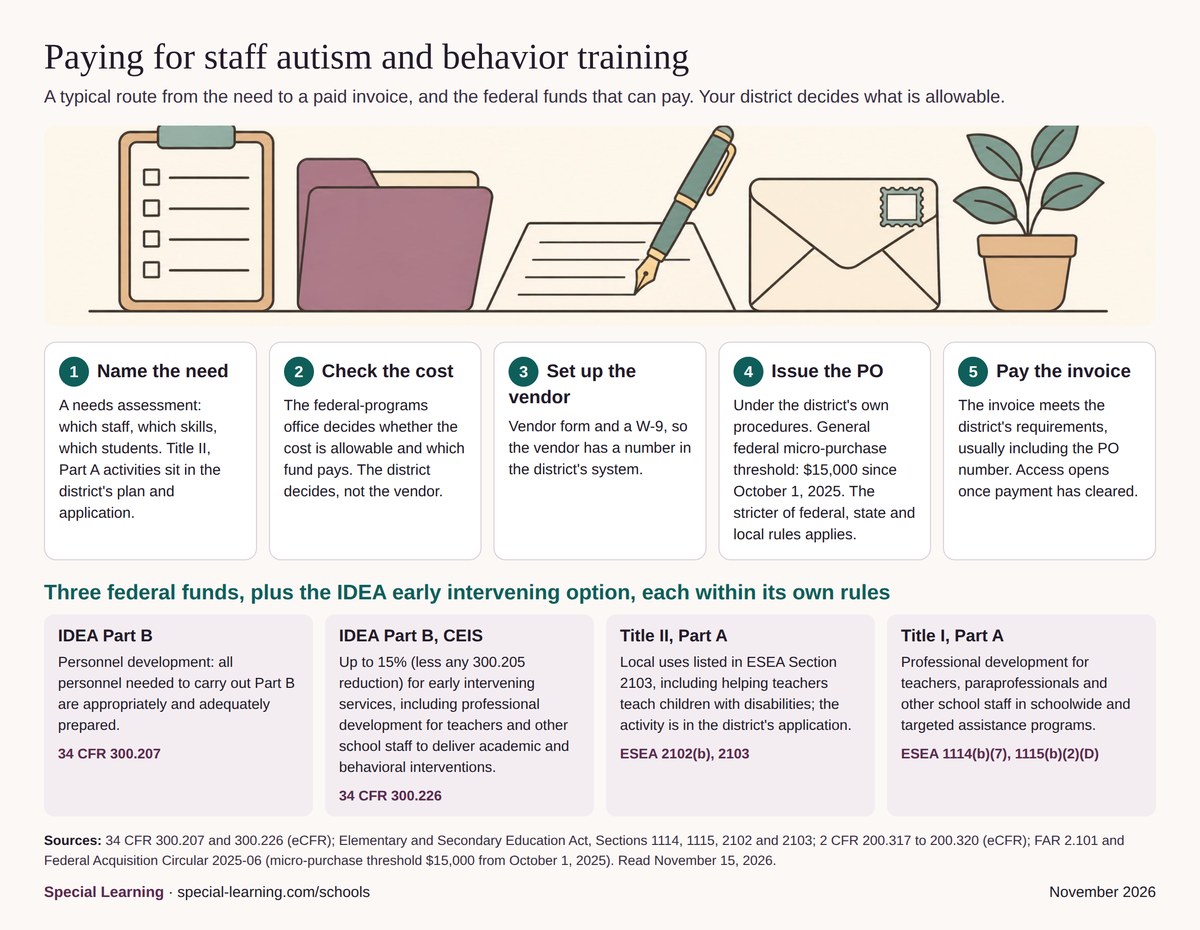
- Name the need. A needs assessment says which staff need which skills, for which students. For Title II, Part A, the activity has to be in the district's plan and application to the state.
- Check that the cost is allowable. Bring the course outline and quote to your federal-programs or grants office. It decides whether the cost is allowable and reasonable, and which fund and budget line it is charged to.
- Set up the vendor. Complete the vendor set-up your district's procedures require, often a vendor form and a signed W-9. Kenosha Unified, for example, requires a properly signed W-9 before any payment to a new vendor (KUSD Accounts Payable).
- Issue the purchase order under the district's own written procurement procedures.
- Pay the invoice. The vendor sends an invoice that meets the district's requirements, and the district pays against the PO. Kenosha Unified, for example, lists the "Purchase Order number issued by the District" among what an invoice must show.
Purchase thresholds
- General federal micro-purchase threshold: $15,000, raised from $10,000 effective October 1, 2025 (FAR 2.101; Federal Acquisition Circular 2025-06, 90 FR 41872). The grant rules generally tie the threshold for purchases with federal award money to the FAR figure (2 CFR 200.1). A district may self-certify a threshold up to $50,000 each year under 2 CFR 200.320(a)(1)(iv), and state law or district policy may set a lower one.
- General FAR simplified acquisition threshold: $350,000; FAR 2.101 lists exceptions.
- At or under the micro-purchase threshold, a purchase "may be awarded without soliciting competitive price or rate quotations if the recipient or subrecipient considers the price reasonable," and the district keeps documents to support that (2 CFR 200.320(a)(1)).
- The stricter rule applies. The district must use its own documented procurement procedures, consistent with state and local law (2 CFR 200.318(a)), and its micro-purchase threshold "must be authorized or not prohibited under State, local, or tribal laws or regulations" (200.320(a)(1)(iii)). The Texas Education Agency told districts that a $10,000 threshold still in local policy "remains the most restrictive and must be followed" until the policy is updated (TEA, Federal Grant Threshold Changes, September 25, 2025).
For scale: a group of 30 people in our Level 1 course for groups is $2,970. Whether a purchase is a micro-purchase in your district depends on your district's own threshold.
From Special Learning
07Our training, and how a school buys it
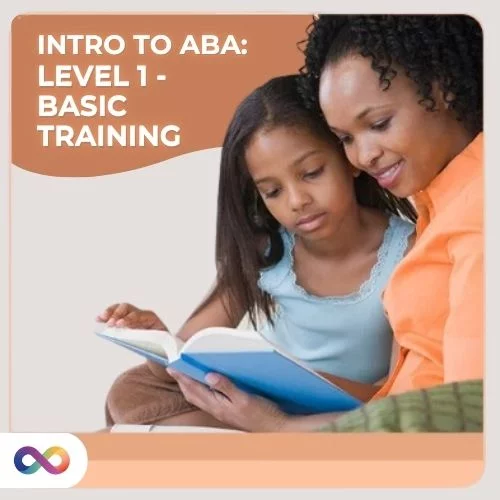
Intro to ABA: Level 1 is a course on the methods and techniques of ABA, built for the people who work with students every day: paraprofessionals, aides, teachers and behavior technicians. It has nine online sessions followed by a final exam and introduces ABA methods for daily practice, for staff whose work is helping students do more on their own. Completing this course earns a Special Learning certificate of completion.
| Who is buying | Price | How to buy and pay |
|---|---|---|
| One person | $199, paid once | Intro to ABA: Level 1 in our store |
| A group of 10 or more | $99 a person, paid once: $990 for 10 people, $2,970 for 30 | Request a quote. Pay by purchase order, or by a signed quote with an invoice. Access is activated once payment has cleared. |
- Tell us how many people and when they should start.
- We send a written quote your office can approve, or raise a purchase order against.
- We invoice against your PO or signed quote. We can provide a W-9 on request.
- Each person in the group gets their own access once payment has cleared, with 12 weeks from the day they activate it.
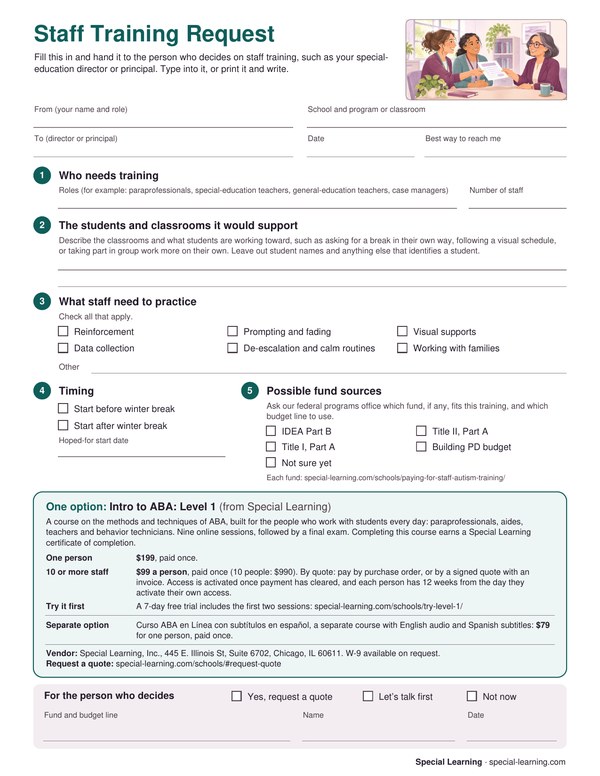
Not the one who approves it? Download the free Staff Training Request (PDF): one fillable page a teacher, paraprofessional or case manager fills in and hands to their special-education director or principal, with who needs training, the students it would support, the skills to practice, the timing, possible fund sources, and one option with its prices and vendor details.
Want to see it first? The 7-day free trial includes the first two sessions, with no payment card. For the cost of a whole team, see what paraprofessional behavior training costs, and for the questions to settle before you buy, the school buyer's worksheet.
Questions
08Questions directors and business offices ask
Can IDEA Part B funds pay for autism training for paraprofessionals?
Part B funds must be used only for the excess costs of providing special education and related services, and the district must ensure that personnel needed to carry out Part B are appropriately and adequately prepared (34 CFR 300.202 and 300.207). New Jersey's guide says training special-education staff "on any topic is an allowed cost," and that 100 percent cannot be charged to IDEA unless the training is provided only to special-education staff. Your district decides whether, and how much of, the cost is allowable.
Can CEIS money pay for behavior training?
No more than 15 percent of the IDEA Part B amount a district receives for the fiscal year, less any amount reduced under 34 CFR 300.205, can fund coordinated early intervening services, including professional development for teachers and other school staff to deliver scientifically based academic and behavioral interventions, for K-12 students not currently identified as needing special education (34 CFR 300.226).
Can Title II, Part A pay for an online course for teachers and paraprofessionals?
Section 2103 lets a district contract with a for-profit or nonprofit entity for listed activities, including programs that help teachers teach children with disabilities, when the activity is in the district's application to the state (ESEA 2103). The law defines professional development as sustained, intensive, collaborative, job-embedded, data-driven and classroom-focused, so describe how the course fits a larger plan.
Can Title I pay for paraprofessional professional development?
Yes, in schoolwide and targeted assistance programs: the law names professional development for teachers, paraprofessionals and other school personnel (ESEA 1114(b)(7)(A)(iii)(IV), 1115(b)(2)(D)).
What is the federal micro-purchase threshold for school districts?
Generally $15,000 since October 1, 2025, up from $10,000 (FAR 2.101, tied to grants by 2 CFR 200.1). A district may self-certify a threshold up to $50,000 each year (2 CFR 200.320(a)(1)(iv)), and if state law or district policy sets a lower figure, the lower one applies.
Who decides whether a training cost is allowable?
The district, through its federal-programs or grants office, under each fund's rules and its approved plan or application (2 CFR 200.318 sets the district's own procurement procedures). A vendor cannot decide it for you.