
For heads of school, division heads, learning support directors and business officers at independent, Catholic and other faith-based schools · Checked November 15, 2026
Autism training for private school teachers and aides: how to pay for it, including the federal share your public district holds
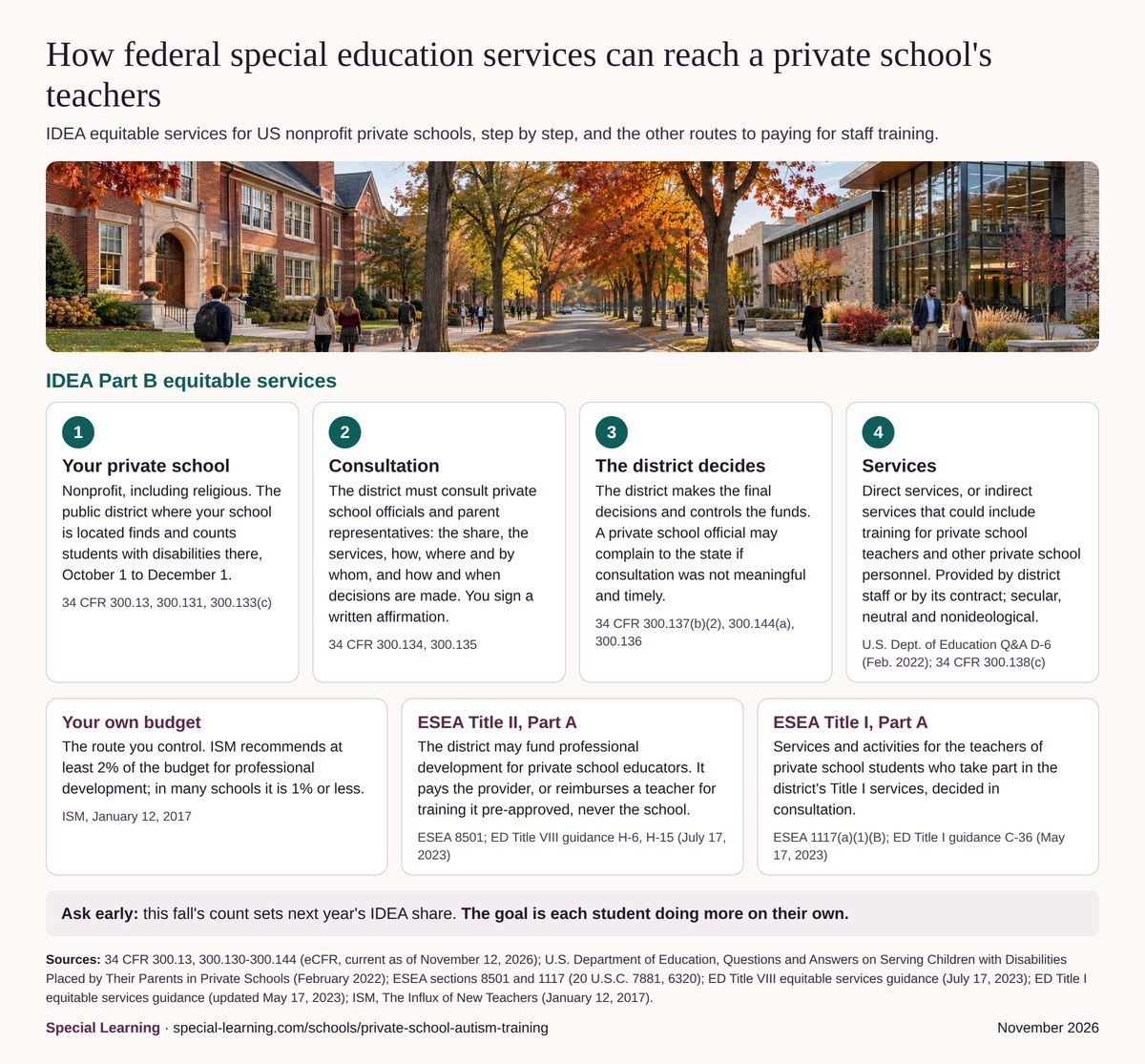
Your school's own professional development budget is the route you control. There is a second route. The public school district where your school is located must spend a proportionate share of its federal IDEA special education money on equitable services for students with disabilities whose parents placed them in nonprofit private schools, and it must consult private school officials first. The U.S. Department of Education says those services could include "training for private school teachers and other private school personnel." The district makes the final decision and controls the money, so the way in is to ask during consultation, early in the school year. Under the Elementary and Secondary Education Act, the district can also use Title II, Part A money for professional development for private school educators, paying the provider directly, and Title I includes the teachers of private school students in its Title I services.
How to ask your districtOr try our training first: the first two sessions of Level 1, free for 7 days

The short answer
01Four ways a private school's staff training gets paid for
Your own budget is the route you control. The three federal routes are services the public district provides to your students and staff; the district decides what they are, after consulting you, and the money never passes to your school.
| Route | Who holds the money and decides | What it can cover for staff | Where it is written |
|---|---|---|---|
| Your school's professional development budget | Your school | Whatever your school decides. ISM recommends "at least 2% of the budget" for professional development. | ISM, January 12, 2017 |
| IDEA Part B equitable services | The public district where your school is located, after consulting you | Services for students with disabilities whose parents placed them at your school. These could include "training for private school teachers and other private school personnel." | 34 CFR 300.133, 300.134; U.S. Department of Education Q&A D-6, February 2022 |
| ESEA Title II, Part A equitable services | The public district, after consulting you. It pays the provider, or reimburses a teacher for training it pre-approved. | "professional development activities for educators to address the specific needs of private school children" | ESEA 8501; Title VIII guidance H-6 and H-15, July 17, 2023 |
| ESEA Title I, Part A equitable services | The public district, after consulting you | Services and activities for the teachers of private school students who take part in the district's Title I services | ESEA 1117(a)(1)(B); Title I guidance C-36, May 17, 2023 |
The route you control
02Your school's professional development budget
Training bought with your school's own funds comes from its operating budget, through the school's own purchasing process. Independent School Management (ISM), which advises private schools, puts a number on it:
"ISM research indicates private-independent schools are underfunding professional development—in many schools, the percent of the budget spent is 1% or less. We recommend that at least 2% of the budget be allocated." ISM, The Influx of New Teachers, January 12, 2017
At 2%, a school with a $5 million operating budget would set aside $100,000 a year for professional development. Training ten teachers and aides in Level 1 comes to $990. The federal routes below don't replace this budget: Title II, Part A services "must supplement the professional development those teachers would otherwise receive from their private school" (Title VIII guidance, H-11).
Individuals with Disabilities Education Act · eCFR, read November 15, 2026
03IDEA equitable services: the share your public district must spend
Which schools, and which district
The rules cover children with disabilities "enrolled by their parents in private, including religious, schools" (34 CFR 300.130) that are nonprofit (300.13 and 300.36). The district responsible is "the LEA where the private school is located" (U.S. Department of Education, Questions and Answers on Serving Children with Disabilities Placed by Their Parents in Private Schools, February 2022, C-2), not the district where each student lives.
How much, and when
Each district "must spend" a share of its IDEA subgrant in proportion to the number of parentally placed private school children with disabilities in its area (34 CFR 300.133(a)). It counts them "on any date between October 1 and December 1, inclusive, of each year," and the count sets what it must spend "in the next subsequent fiscal year" (300.133(c)).
The district must consult you first
"To ensure timely and meaningful consultation, an LEA, or, if appropriate, an SEA, must consult with private school representatives and representatives of parents of parentally-placed private school children with disabilities during the design and development of special education and related services for the children..." 34 CFR 300.134
Consultation covers how the share was calculated and "how, where, and by whom" services will be provided, including "how and when those decisions will be made" (300.134(b) and (d)). The district then obtains "a written affirmation signed by the representatives of participating private schools" (300.135). "Consultation must be an ongoing process, not solely an annual meeting" (Q&A, B-1).
Can the share pay for training your teachers and aides?

It can, if the district decides so after consulting you:
"IDEA does not require an LEA to spend the proportionate share only for direct services. ... an LEA could determine, after timely and meaningful consultation, that it will provide its population of parentally-placed private school children with disabilities with indirect services. ... These services could include consultative services, equipment, or materials for eligible parentally-placed children with disabilities or training for private school teachers and other private school personnel." Q&A, D-6, February 2022
- The district decides. "The LEA must make the final decisions with respect to the services to be provided" (300.137(b)(2)).
- The district delivers and pays. Services come "by employees of a public agency" or "through contract by the public agency" with an outside organization (300.138(c)(1)), and the public agency "must control and administer the funds" (300.144(a)). If the district chooses outside training for your staff, it arranges and pays for it.
- It must be secular. Services "including materials and equipment, must be secular, neutral, and nonideological" (300.138(c)(2)).
Elementary and Secondary Education Act
04Title II, Part A and Title I: equitable services for private school teachers
Title II, Part A: professional development for private school educators
A district receiving covered federal funds must, after "timely and meaningful consultation with appropriate private school officials," "provide to those children and their teachers or other educational personnel, on an equitable basis, special educational services or other benefits that address their needs under the program" (ESEA 8501(a)(1), 20 U.S.C. 7881). Title II, Part A is one of those programs (8501(b)(1)).
"An LEA may use Title II, Part A funds to provide professional development activities for educators to address the specific needs of private school children." U.S. Department of Education, Title VIII equitable services guidance, H-6, July 17, 2023
- Who takes part. "Generally, only private school teachers, principals, and other school leaders ... are eligible," though "other educational personnel, including paraprofessionals, may also receive equitable services consistent with specific allowable uses of Title II, Part A funds" (H-2).
- What counts. Training must be "sustained (not stand-alone, 1-day, or short-term workshops), intensive, collaborative, job-embedded, data driven, and classroom focused" (H-8).
- Who pays whom. "An LEA may pay the provider directly or reimburse an individual private school teacher or other staff for professional development that the LEA has pre-approved after timely and meaningful consultation." It may not pay the private school (H-15).
Title I, Part A: for the teachers of students in Title I services
Title I requires the district to "ensure that teachers and families of the children participate, on an equitable basis, in services and activities" (ESEA 1117(a)(1)(B), 20 U.S.C. 6320). The district works out in consultation "the needs of private school instructional staff who teach Title I participating private school students" (Title I equitable services guidance, C-36, updated May 17, 2023). So it reaches the teachers of participating students, not a whole staff.
Timing under ESEA
Consultation "shall occur before the agency, consortium, or entity makes any decision that affects the opportunities of eligible private school children, teachers, and other educational personnel to participate" (8501(c)(3)). A district "must annually contact officials of private schools located in the attendance or service area of the LEA" (Title VIII guidance, A-2), and a school that "does not respond to an LEA’s request to consult in the given timeframe" loses that year’s services (A-19). Each state has an ombudsman who monitors and enforces these rules (ombudsman directory). ESEA equitable services are for nonprofit schools: "Children and educators at for-profit private schools are therefore not eligible to receive equitable services" (C-5).
A plan for this school year
05How to ask your district for training, and when
- Find your contacts. For IDEA and Title II, Part A, call the public district where your school is located: the special education office for IDEA, the federal programs office for Title II. For Title I, ask which district provides services to your participating students. Ask who runs private school consultation and when the next meeting is. If the district has not contacted you this year, the Department says to "ask to speak with the individual(s) responsible for administering the program," and your state ombudsman can help if no one answers.
- Write down the need. How many teachers and aides work with students with disabilities, what they need to practice, and what you want students to do more on their own. A teacher who wants the training can fill in our one-page Staff Training Request and hand it to you.
- Ask for training by name. At consultation, ask that part of the IDEA share go to training for your teachers and other staff (Q&A D-6), and ask "how and when those decisions will be made" (34 CFR 300.134(d)(3)). Under Title II, Part A, ask for professional development for your teachers on supporting students with disabilities, and answer the district’s request to consult by its deadline (Title VIII guidance, A-19).
- Ask in the fall, and ask the schedule. The count taken between October 1 and December 1 sets the IDEA share the district must spend in the next fiscal year (34 CFR 300.133(c)), and consultation runs through the school year (Q&A B-2). Ask when the district decides next year's services.
- Train a first group now. Your own budget can start a group of teachers and aides this term, beginning with the free trial.
Catholic and other faith-based schools
06Where Catholic schools find professional development

Catholic schools often look first to their diocesan or archdiocesan schools office. In a Spring 2026 survey of 224 Catholic school leaders and 51 diocesan-level leaders, "diocesan offices report that they provide professional learning opportunities on a variety of topics to advance inclusive practices" (National Catholic Partnership on Disability, Inclusion in Catholic Schools: A Report from the Field, Spring 2026). In October 2025, for example, the Diocese of Peoria's Office of Catholic Schools brought over 100 teachers and administrators from all 41 of its schools to a conference on "Supporting Students with Disabilities in Catholic Schools" (The Catholic Post, October 9, 2025).
The National Catholic Educational Association (NCEA) is the national gathering point. It describes its work as "leadership development for superintendents, presidents, principals, pastors, and governing bodies; professional development for teachers; and serving as the voice for Catholic school education" (NCEA, About us), and its next convention, NCEA 2027, "Bridge Builders," runs March 30 to April 1, 2027, in Indianapolis (NCEA Convention & Expo). NCEA counts 5,829 Catholic schools with 1,674,907 students in 2025-26, and "Students with special needs make up 10 percent of total enrollment—167,002 students" (NCEA, March 24, 2026).
The federal routes above apply to religious schools too: the IDEA rules name "private, including religious, schools," and the services must be "secular, neutral, and nonideological" (34 CFR 300.130 and 300.138(c)(2)).
Toward each student doing more on their own
07What teachers and aides practice
Staff use these methods every day in class: noticing and reinforcing what a student does well, giving just enough help and then fading it, visual supports such as picture schedules, a calm routine when a student is overwhelmed, and a simple record of each step a student does on their own. The Education Endowment Foundation's guidance on teaching assistants puts the aim plainly: "Remove scaffolds over time to promote independent learning" (EEF, Deployment of Teaching Assistants, third edition, March 26, 2025). For the detail, by role:
- Autism training for paraprofessionals and aides: what each Level 1 session covers.
- ABA training online for special-education teachers: for the teachers who plan the supports.
From the course records, November 15, 2026
08Options and prices
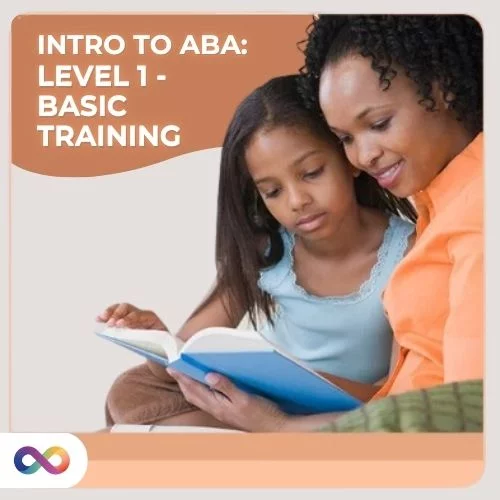
Intro to ABA: Level 1 is a course on the methods and techniques of ABA, built for the people who work with the child every day: parents and caregivers, teachers, paraprofessionals and behavior technicians. Its nine online sessions, which play on a phone or a computer, run from what autism is to prompting, classroom participation and understanding behavior. A final exam follows, and each session has a short pre-test and post-test.
- One person: $199, paid once, with 11 weeks to complete the course after activating.
- A school training 10 or more: $99 a person, paid once, 12 weeks from the day each person activates. Ten staff come to $990. How a school buys.
- The 7-day free trial: the first two sessions, with no payment card (start the trial).
- For staff who prefer Spanish: Curso ABA en Línea con subtítulos en español, a separate course with English audio and Spanish subtitles, $79 for one person, paid once.
Completing this course earns a Special Learning certificate of completion.
Start the 7-day free trialFor a school training 10 or more
09How a private school buys for its staff
A school training 10 or more pays $99 a person, by quote: ten staff come to $990, and thirty come to $2,970. Each person has 12 weeks from the day they activate their own access, so staff who join later start their 12 weeks when they begin.
- Ask for a quote. Tell us your school and how many staff. The form lists "Private or independent school" as an organization type.
- Tell us what your business office needs, such as a quote on letterhead or a vendor form. A W-9 is available on request.
- Pay the invoice. We send the school an invoice from Special Learning, Inc., and access opens once it is paid.
Planning in more detail? Plan your team and see the cost.
Questions
10Questions private school leaders ask
Does our school have to be nonprofit for these federal services?
Yes. IDEA defines an elementary or secondary school as "a nonprofit institutional day or residential school" (34 CFR 300.13, 300.36). The Department of Education says the same of ESEA services: "Children and educators at for-profit private schools are therefore not eligible to receive equitable services" (Title VIII guidance, C-5).
Can the district give our school the money to buy training ourselves?
The IDEA rules point the other way: the public agency "must control and administer the funds" (34 CFR 300.144(a)), and services are provided by public employees or "through contract by the public agency" (300.138(c)(1)). If the district agrees to training for your staff, it arranges and pays for the training itself.
What if we disagree with the district's decision?
If the district disagrees with your views on the provision or types of services, consultation must cover how it "will provide to the private school officials a written explanation of the reasons why the LEA chose not to provide services directly or through a contract" (34 CFR 300.134(e)). A private school official may also complain to the state education agency that the district "did not engage in consultation that was meaningful and timely" or "did not give due consideration to the views of the private school official" (300.136).
What does the guidance say about online professional development?
The Department says Title II, Part A funds "may be used to purchase a subscription to an online video database to provide professional development to private school educators so long as the content is secular, neutral, and nonideological" (Title VIII guidance, H-12), and the training must meet the law's definition of professional development (H-8). Whether it funds a particular course is the district's decision after consultation, so bring the training you have in mind to consultation. The district pays the provider directly or reimburses a teacher for training it pre-approved (H-15).
How long do staff have to finish Level 1?
One person buying alone has 11 weeks after activating. When a school buys for 10 or more, each person has 12 weeks from the day they activate their own access, so staff can start on different days.
Is there a certificate?
Completing this course earns a Special Learning certificate of completion.
Your next step
Watch the first two sessions of Level 1 free for 7 days, then decide with your team. Starting it asks for no payment card.
Try the first two sessions freeMore for schools: training for schools, paying for staff autism training in a public district, autism training for paraprofessionals, ABA training online for special-education teachers, shadow teacher training and international schools.