
For special education leads, principals and school board coordinators in Canada
Autism training for educational assistants: what Ontario and other provinces expect, how boards pay, and a way to start this term
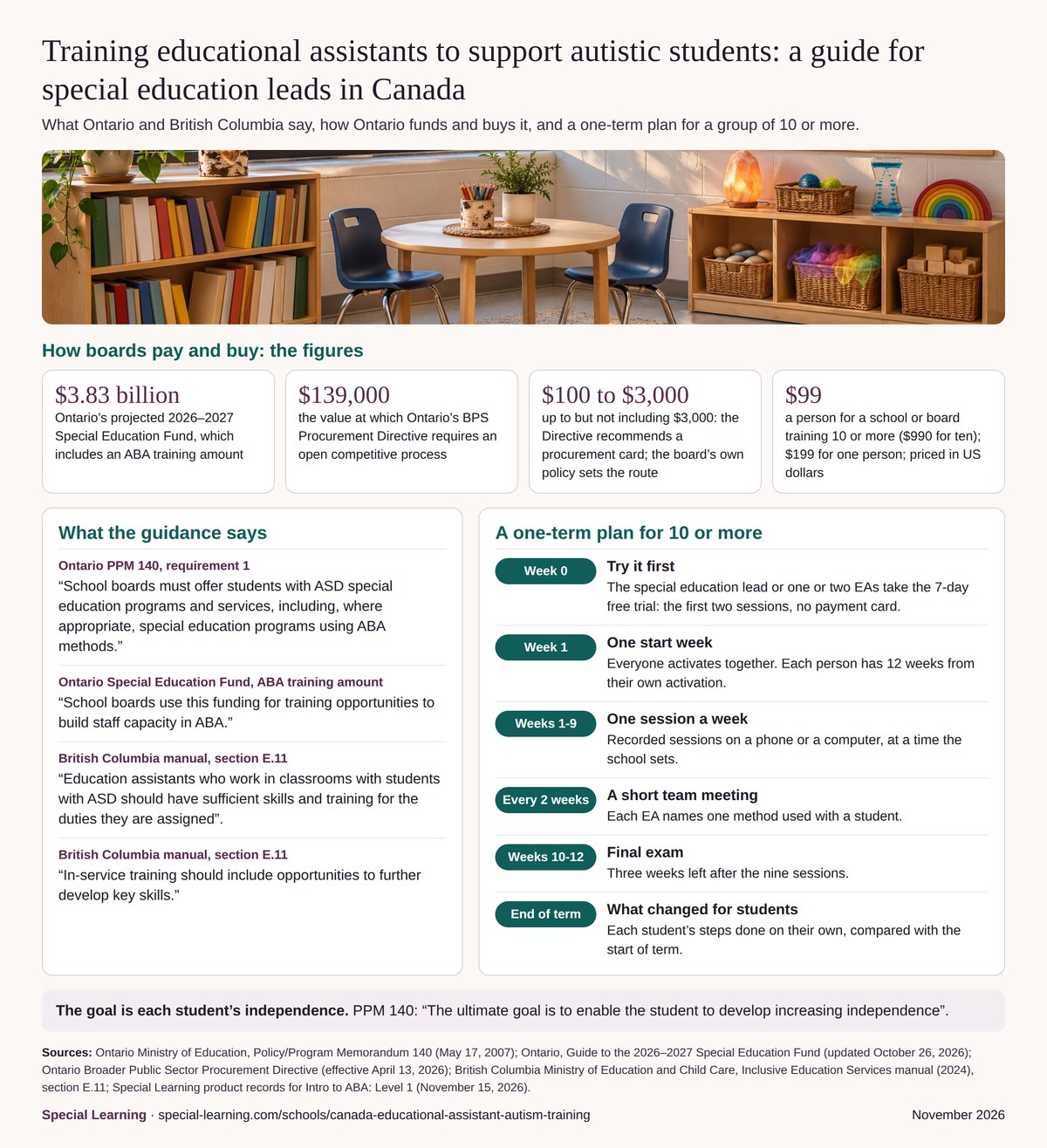
Ontario’s Policy/Program Memorandum 140 requires principals “to ensure that ABA methods are incorporated into the IEPs of students with ASD, where appropriate”, and the Ministry’s Special Education Fund includes an amount boards use “for training opportunities to build staff capacity in ABA”. Special Learning’s Intro to ABA: Level 1 trains educational assistants (EAs) and teachers online: nine recorded sessions on the methods of applied behaviour analysis (ABA), then a final exam, watched on a phone or a computer in each person’s own time. It is $199 for one person, priced in US dollars. A school or board training 10 or more pays $99 a person, by quote, with an invoice from Special Learning, Inc. Anyone can try the first two sessions free for 7 days, with no payment card.
Start the 7-day free trial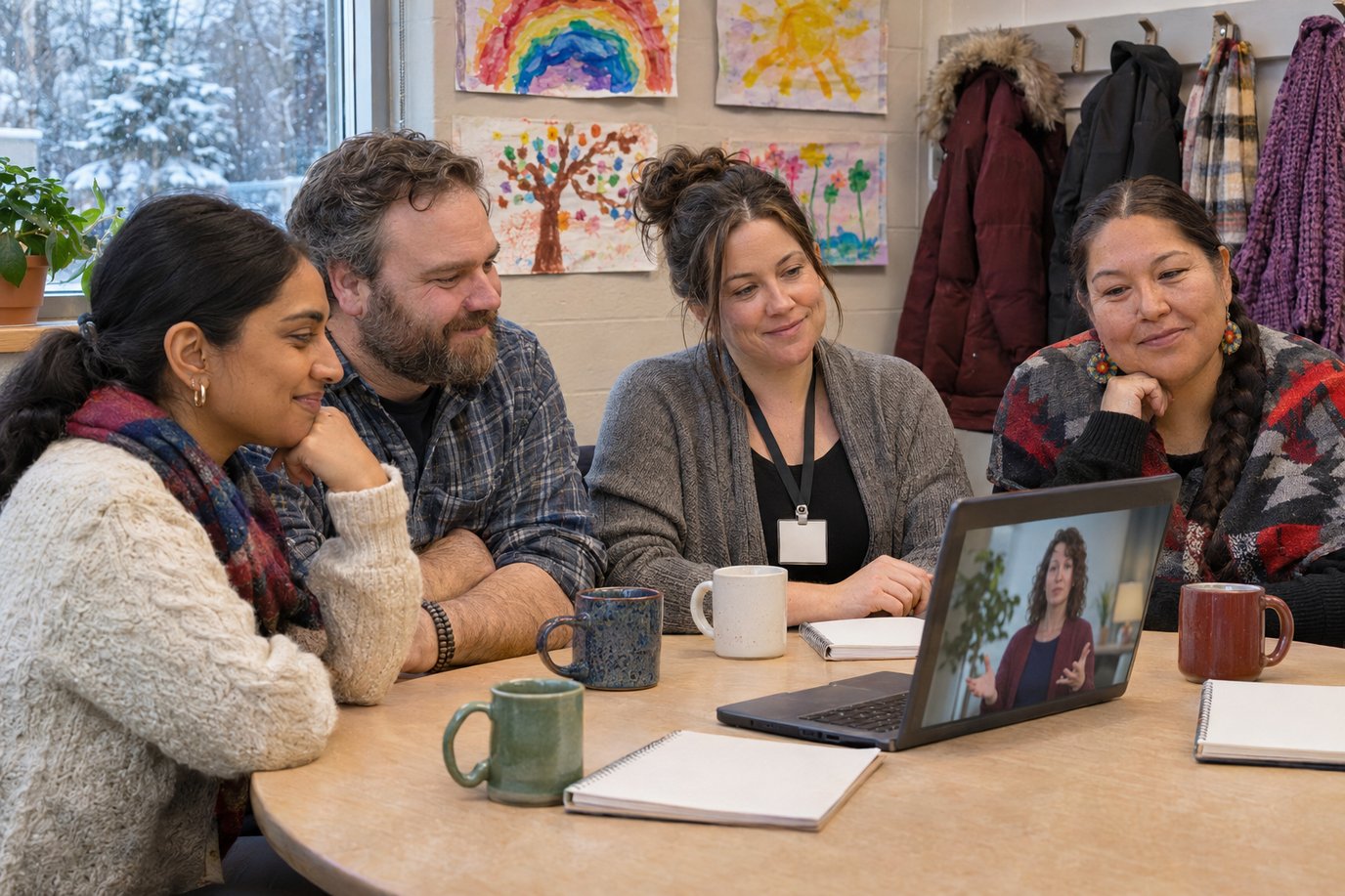
Ontario’s own words, read November 15, 2026
01What PPM 140 asks of Ontario school boards
Policy/Program Memorandum 140, “Incorporating methods of applied behaviour analysis (ABA) into programs for students with autism spectrum disorders (ASD)”, was issued on May 17, 2007 and is “Effective: Until revoked or modified”. Its purpose is “to provide direction to school boards to support their use of applied behaviour analysis (ABA) as an effective instructional approach in the education of many students with autism spectrum disorders (ASD).” Among the school board personnel it names for the IEP process are “teachers’ assistants” and “resource teachers”. What it asks, in its own words:
| Part | PPM 140’s words | For a lead planning EA training |
|---|---|---|
| Requirement 1 | “School boards must offer students with ASD special education programs and services, including, where appropriate, special education programs using ABA methods.” | ABA methods are part of what the board offers. |
| IEPs | “Principals are required to ensure that ABA methods are incorporated into the IEPs of students with ASD, where appropriate.” | The staff who carry out the IEP use those methods every day. |
| Data | “Educators must measure an individual student’s progress in the above areas by collecting and analysing data on an ongoing basis.” | Educators collect and analyse progress data on an ongoing basis and use it to adjust the student’s program. |
| Principles | “positive reinforcement must be utilized”; “transfer, or generalization, of skills should be emphasized.” | Reinforcement and carrying a skill into new settings are named. |
| The goal | “The ultimate goal is to enable the student to develop increasing independence”. | Independence is the measure. |
| Requirement 2 | “School board staff must plan for the transition between various activities and settings involving students with ASD.” | EAs often support those transitions through the day. |
PPM 140 directs school boards to offer ABA-based programs where appropriate, incorporate ABA methods into IEPs where appropriate, and plan transitions. It says “School boards should develop a plan to implement the policy in this memorandum, and should consult with their Special Education Advisory Committee (SEAC) regarding the implementation.”
Source: Ontario Ministry of Education, Policy/Program Memorandum 140 (page updated September 3, 2025).
Is it still current? The Ministry’s list of policy and program memoranda, updated November 9, 2026, includes PPM 140 among its current memoranda, and it is not among the revoked ones. The Special Education in Ontario, Kindergarten to Grade 12: Policy and Resource Guide is still the 2017 edition; the Ministry’s page notes that it “was published in 2017 and contains terminology and references that may be outdated and may not reflect current ministry policies. It remains available while it is undergoing a review to streamline information and improve usability.”
Staff development in the board’s plan. That guide’s Standard for staff development says “The board must outline its plans for the professional development of its special education personnel”, and the plan describes, among other things, “courses, in-service training, and other types of professional development activities offered by the board” and “details of the board’s budget allocation dedicated to the staff development plan in the area of special education”. It describes the educational assistant as the person who “monitors and records the student’s achievements and progress relative to the expectations described in the IEP, under the direction and supervision of the teacher”.
Sources: Education in Ontario: policy and program direction; Special Education in Ontario, Kindergarten to Grade 12 (PDF), Part B, Staff Development, and Part E, roles of the in-school team.
Ministry documents
02What British Columbia and Manitoba say about training EAs
British Columbia. The Ministry of Education and Child Care’s manual, in its autism section (E.11), says: “Education assistants who work in classrooms with students with ASD should have sufficient skills and training for the duties they are assigned, including:”
- “observing and gathering data about behaviour;”
- “shaping appropriate behaviour using behavioural techniques;”
- “stimulating communication;”
- “developing skills for independent living; and”
- “facilitating peer interaction and relationships.”
It adds: “In-service training should include opportunities to further develop key skills.” (Inclusive Education Services: A Manual of Policies, Procedures and Guidelines, 2024 (PDF), section E.11, page 78.)
Manitoba. “In Manitoba, school divisions are responsible for establishing”, among other things, “orientation and training requirements”, “the provision of training opportunities” and “financial allocations for training” for educational assistants (Educational Assistants in Manitoba Schools, 2024 (PDF)). The training decision sits with the division.
Other provinces and territories. Policies differ by province and territory; your ministry’s documents and your board’s or division’s own plan set what EAs are trained in.
Educational assistants and paraprofessionals
03What EAs most need to practise, and a one-term plan
An educational assistant in Canada does the work a US school calls a paraprofessional. Ontario’s guide and Manitoba say “educational assistant”, British Columbia says “education assistant”, and PPM 140 says “teachers’ assistants”. So our page on autism training for paraprofessionals describes the same people and the same course.
What EAs most need to practise with an autistic student, and where each comes from in Level 1:
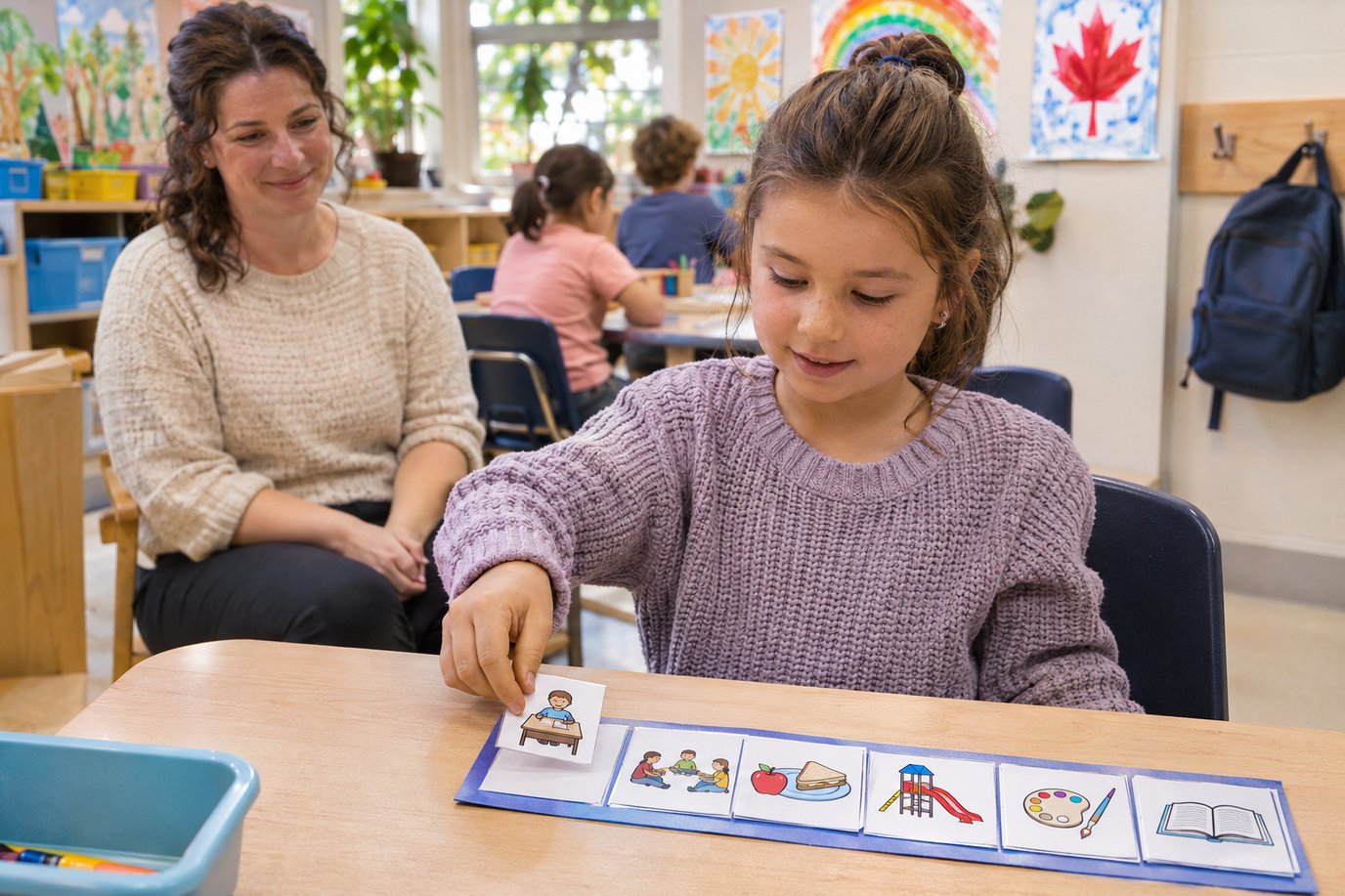
- Giving a prompt, then fading it, so the student does the step on their own: the session on errorless teaching and prompting.
- Reinforcing and motivating, the “positive reinforcement” PPM 140 names: the session on active student responding, increasing the learner’s motivation and self-monitoring.
- Beginner classroom participation skills, so the student takes part in the lesson: the sessions on teaching methods in application and classroom participation.
- Observing behaviour before responding to it, BC’s “observing and gathering data about behaviour”: the session on decreasing problem behaviour with a functional behaviour assessment.
- Recording progress simply: each step marked as done on their own or with a named prompt, the kind of record AFIRM’s data sheets keep (AFIRM, UNC Chapel Hill, Prompting brief packet).
A one-term plan for a group of 10 or more. Week 0: the special education lead or one or two EAs take the free trial. Week 1: everyone activates in the same week; each person has 12 weeks from their own activation. Weeks 1 to 9: one session a week, in each person’s own time. Every two weeks: a short meeting where each EA names one method they used with a student. Weeks 10 to 12: the final exam. Then compare each student’s record of steps done on their own with the start of term.
Funding, in the Ministry’s words
04How Ontario funds training for EAs in ABA
Ontario funds school boards through core education funding, which “has 6 funds, including the Special Education Fund”. “School boards must use all of the Special Education Fund exclusively for special education programs, services and/or equipment.” The projected 2026–2027 Special Education Fund is approximately $3.83 billion. “School boards have flexibility to use education funding to support their special education policies, programs, and services.” Which line carries a training cost is the board’s decision; two are named in the Ministry’s guide:
- The per pupil allocation. “This funding is primarily intended for staffing costs, such as” teachers, educational assistants, professional and para-professional staff, and “professional development and learning materials”.
- Behaviour expertise, in the complex supports allocation. “We fund school boards to hire board-level professionals with Applied Behaviour Analysis (ABA) expertise, including Registered Behaviour Analysts, to support educators working with autistic students and to support the implementation of ABA instructional methods for students, where appropriate.” Its ABA training amount: “School boards use this funding for training opportunities to build staff capacity in ABA.” The board’s ABA expertise professionals support educators “in providing and coordinating ABA coaching, training and resources”, so your board’s ABA team is a good first call.
Ten EAs on Level 1 come to $990, in US dollars.
Source: Ontario, Guide to the 2026–2027 Special Education Fund (published May 13, 2026, updated October 26, 2026).
When the board or school pays
05How a board or school buys
In Ontario, every school board is a designated broader public sector organization under the Broader Public Sector Procurement Directive, effective April 13, 2026. It says “Organizations must conduct an open competitive procurement process where the estimated value of procurement of goods or services is $139,000 or more.” For goods and non-consulting services below that threshold, its table recommends a procurement card (from $100 up to but not including $3,000), a purchase order (from $3,000 up to but not including $10,000) and invitational competitive procurement with at least three suppliers invited (from $10,000 up to but not including $139,000). Everywhere, a board’s or school’s own purchasing policy sets the route; your business office can confirm the procurement category and the route that applies.

- Try it first. The special education lead, or one or two EAs, take the 7-day free trial: the first two sessions, with no payment card (start the trial).
- Ask for a quote. Tell us your school or board, how many staff and that you are in Canada; the form lists Canada as a country. In the notes, say what your business office needs, such as a quote on letterhead, a supplier form or a PO number, and we reply with what we can provide.
- Pay. We send the board or school an invoice from Special Learning, Inc. in US dollars, paid by bank wire. Or pay by card in our store. Access opens once payment clears.
Planning in more detail? Plan your team and see the cost.
From the course records, November 15, 2026
06Options and prices
Intro to ABA: Level 1 is a course on the methods and techniques of ABA, built for the people who work with the child every day: parents and caregivers, teachers, paraprofessionals and behaviour technicians. Its nine online sessions run from what autism is to prompting, classroom participation and understanding behaviour (topics covered). A final exam follows, and each session has a short pre-test and post-test.
- One person: $199, paid once, with 11 weeks to complete the course. Canada has no separate country price, so the price is in US dollars (country pricing).
- A school or board training 10 or more: $99 a person, paid once, with 12 weeks from the day each person activates. Ten staff come to $990, by quote, with an invoice from Special Learning, Inc. How a board buys.
- The 7-day free trial: the first two sessions, with no payment card (start the trial).
Completing this course earns a Special Learning certificate of completion.
Buy Level 1 for one personQuestions
07Questions special education leads ask
Is an educational assistant the same as a paraprofessional?
Yes, for this course. Ontario and Manitoba say educational assistant, British Columbia says education assistant, and US schools say paraprofessional; the course is the same (paraprofessional training).
How much does Level 1 cost for a school in Canada?
One person pays $199, paid once. A school or board training 10 or more pays $99 a person, paid once, so ten staff come to $990, by quote, with an invoice from Special Learning, Inc. Prices are in US dollars; Canada is not one of the countries with a separate country price (country pricing).
Can we pay in Canadian dollars, or get the paperwork our business office needs?
Our prices are in US dollars. In the notes of the quote form, tell us what your business office needs and we reply with what we can provide.
Can we try the course before we buy for the team?
Yes. The 7-day free trial covers the first two sessions, and starting it asks for your email, a password and your role, with no payment card (start the trial).
What do EAs learn in Level 1?
Nine online sessions: what autism is and an overview of ABA, methods of teaching, errorless teaching and prompting, active student responding, teaching methods in application, beginner classroom participation skills, and a first session on decreasing problem behaviour with a functional behaviour assessment. The examples are drawn largely from work with young children in classrooms and homes. A final exam follows, and each session has a short pre-test and post-test.
How long does each person have?
When the school or board buys for 10 or more, each person has 12 weeks from the day they activate their own access, so staff who join later start their 12 weeks when they begin. One person buying alone has 11 weeks to complete the course.
Do staff receive a certificate?
Completing this course earns a Special Learning certificate of completion.
Is PPM 140 still in effect?
PPM 140 is dated May 17, 2007 and reads “Effective: Until revoked or modified”. The Ministry’s list of memoranda, updated November 9, 2026, includes it among the current memoranda (Education in Ontario: policy and program direction).
Is there a version for Spanish-speaking staff?
Yes, a separate course with English audio and Spanish subtitles on screen: nine recorded sessions and a final exam, $79, paid once, with a 7-day free trial of two sessions (Curso de ABA con subtítulos en español).
Your next step
Watch the first two sessions of Level 1 free for 7 days, then decide with your EAs. Starting it asks for no payment card.
Try the first two sessions freeMore for schools: training for schools, autism training for paraprofessionals, ABA training online for special education teachers, training for international schools and teaching assistant training for UK schools. For ABA practitioners and certification in Canada: our Canada guide.