
For heads of learning support, inclusion coordinators and heads of international schools
Autism training for an international school's support team: online, across time zones, toward each student's independence
An international school can train its learning support assistants and teachers to support autistic students online, without anyone traveling: recorded sessions each person watches in their own hours, a free trial first, one cohort start date with 12 weeks from each person's own activation when the school buys for 10 or more, and a measure of what changed for students. Special Learning's Intro to ABA: Level 1 is nine online sessions on the methods of applied behavior analysis (ABA), then a final exam. It is $199 for one person. A school training 10 or more pays $99 a person, by quote, with an invoice from Special Learning, Inc. Anyone can try the first two sessions free for 7 days.
Start the 7-day free trialTraining 10 or more staff? $99 a person: request a quote for your school
The sector in figures, with dates
01What international schools look like today
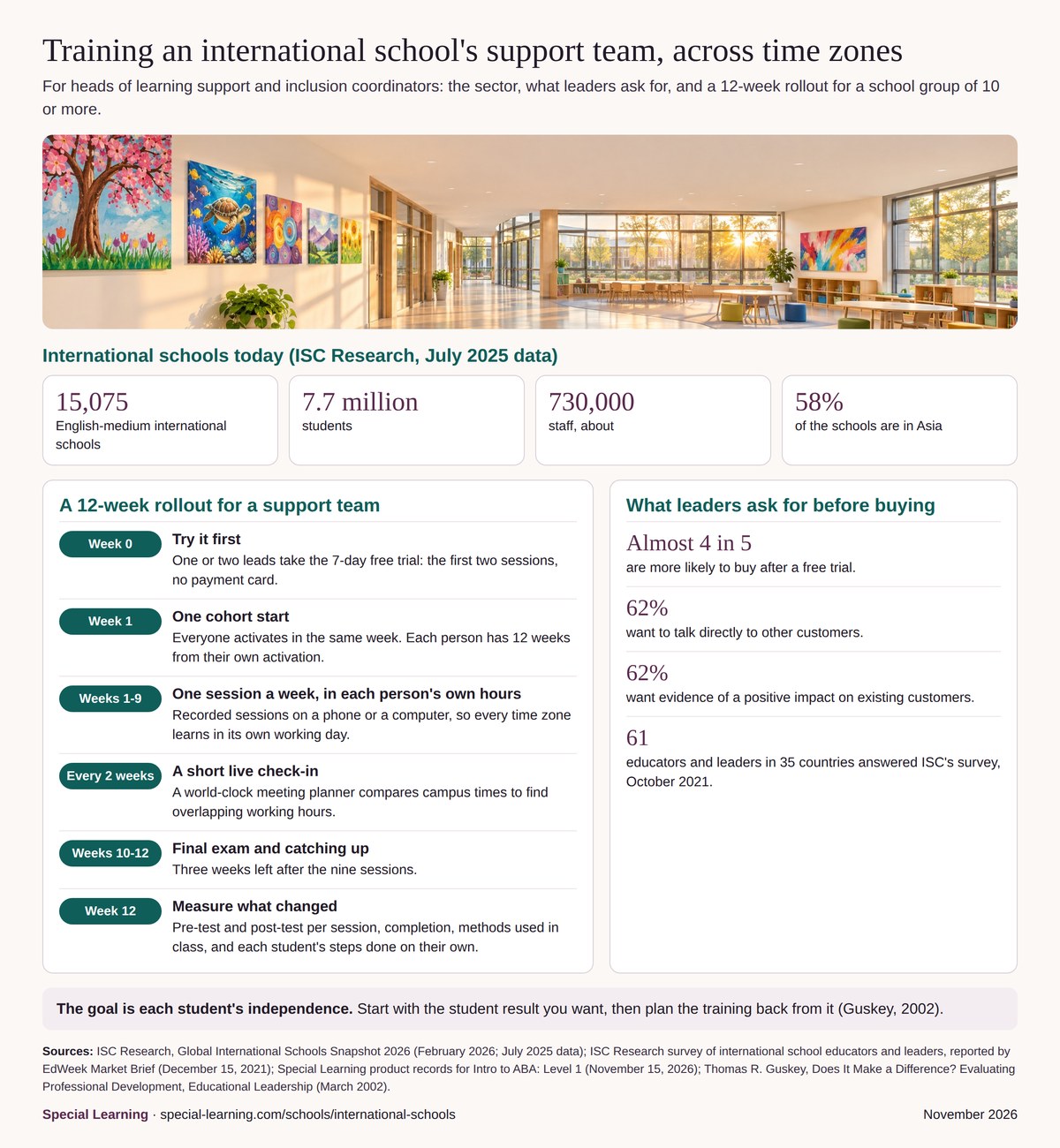
ISC Research counts 15,075 English-medium international schools worldwide, teaching 7.7 million students, with about 730,000 staff and $69.3 billion in annual fee income, from its July 2025 data (ISC Research, Global International Schools Snapshot 2026, February 2026; the school count and fee income also in Tes, September 9, 2025).
| Region | Share of international schools |
|---|---|
| Asia | 58% |
| Americas | 15% |
| Europe | 14% |
| Africa | 12% |
| Oceania | 2% |
The five countries with the most international schools are China (1,117), India (991), the UAE (898), Pakistan (701) and Indonesia (465). From July 2020 to July 2025, ISC counts 8% more schools, 15% more students and 15% more staff, and a 34% increase in the number of schools that are accredited; 38% of international schools are part of a school group (ISC Research, 2026). When a school belongs to a group, one training plan can have to work for campuses in more than one country.
Many international schools meet through associations: COBIS says it has "350 Member schools" (COBIS, About us), EARCOS's site counts 244 member schools in East Asia (EARCOS), and CIS reports "more than 1,635 schools and universities" in 120 countries (CIS, About CIS), each read November 15, 2026.
Each body's own words, read November 15, 2026
02What accreditation and inspection standards ask about learners with additional needs

Accreditation bodies and regulators ask international schools to meet the needs of every learner, and several name staff professional learning as part of it. Here is what each published text says, in its own words.
| Body | What its published text says | Source and date |
|---|---|---|
| COBIS (Council of British International Schools) | Standard 7A: "The curriculum meets the needs of all students." Among the evidence COBIS looks for: "An inclusive educational approach where the needs of all learners are met through the use of adaptive teaching" (5A) and "A CPL programme to support the sharing and development of effective and inclusive approaches to learning" (7C). COBIS uses AEN for "Additional educational needs" and CPL for continuous professional learning. | COBIS Accreditation and Compliance Standards, revised Autumn 2026, for visits from January 2027 (the Patron's Accreditation and Compliance scheme) |
| CIS (Council of International Schools) | "Inclusion is no longer a secondary aspiration; it is a central pillar of international education." Schools working toward CIS accreditation "might choose to focus on inclusive curriculum design, universal design for learning, or professional development in neurodiversity awareness, using specific CIS standards as their guide." | Mary Powell, CIS Associate Director of School Support and Evaluation, CIS Perspectives blog, October 23, 2025. We could not find CIS's current standards posted publicly on cois.org, so this row quotes CIS's own published description, not standards text |
| British Schools Overseas (UK Department for Education) | Paragraph 2(1)(b)(i): the curriculum policy and plans "take into account the ages, aptitudes and needs of all pupils, including those pupils with special educational needs". | Standards for British Schools Overseas, Department for Education, August 2023 |
| Dubai, UAE (KHDA) | Paragraph 4.11: learning support assistants "will be required to complete the relevant training and development programme appropriate to their role within a time bound period." | Dubai Inclusive Education Policy Framework, KHDA, 2017, approved with KHDA's Directives and Guidelines by Administrative Resolution No. (15) of 2026, March 11, 2026 |
| Abu Dhabi, UAE (ADEK) | Inclusion Assistants "work under the direction of a teacher", and schools "provide guidance for Inclusion Assistants and any interested Individual Assistants in their professional development." | ADEK School Policy on Inclusion, version 1.2, September 2024 (copy archived November 7, 2025) |
Each school decides how its own training plan answers these texts, and its accreditation or inspection team is the place to ask how they apply. For more on Dubai, Abu Dhabi and England's rules for support staff, see what the policies say about shadow teachers and learning support assistants.
A plan a head of learning support can run
03How to train a support team online, across time zones
What do international school leaders want before they buy? In October 2021, ISC Research surveyed 61 educators and leaders from international private schools in 35 countries. Almost four in five said they are more likely to buy from an education company after a free trial. 62% want to talk directly to other customers using the product, and the same share want to see evidence that it has a positive impact on existing customers (EdWeek Market Brief, David Saleh Rauf, December 15, 2021). The plan below, for a school training 10 or more, starts with a trial and ends with evidence.
- Try it first. The head of learning support, or one or two assistants, take the 7-day free trial: the first two sessions, with no payment card (start the trial). You see the teaching before anyone spends a budget line.
- Name the people and the student goals. List the assistants and teachers who work with autistic students, and for each student one or two goals toward doing more on their own, such as the steps of a routine done without help. The Education Endowment Foundation's guidance on teaching assistants says: "Remove scaffolds over time to promote independent learning" (EEF, Deployment of Teaching Assistants, third edition, March 26, 2025).
- Set one cohort start. Everyone activates their access in the same week, so the team moves through the course together. When the school buys for 10 or more, each person has 12 weeks from the day they activate (one person buying alone has 11 weeks to complete the course). One session a week finishes the nine sessions with three weeks left for the final exam and catching up.
- Let each time zone learn in its own hours. The sessions are recorded and play on a phone or a computer, so an assistant in Dubai and a teacher in Singapore each watch when their own day allows. The only thing to schedule is a short live check-in, every two weeks, to talk through what staff tried with students. Use a world-clock meeting planner, such as timeanddate.com's Meeting Planner, to compare campus times and find the hours where working days overlap.
- Measure what changed. Decide before you start what will count as impact, and collect it as you go (next section).
Start from the students
04Evidence of impact a governing board can read
Thomas Guskey's model of professional development evaluation names five levels: "Participants' Reactions", "Participants' Learning", "Organization Support and Change", "Participants' Use of New Knowledge and Skills" and "Student Learning Outcomes". His advice: "be sure to start with the desired result—improved student outcomes" (Guskey, Does It Make a Difference? Evaluating Professional Development, Educational Leadership, March 1, 2002). For a support team, that can look like this:
- Learning: each Level 1 session has a short pre-test and post-test, so each person sees what they knew going in and what they took away.
- Completion: how many of the cohort completed the nine sessions and the final exam in their 12 weeks.
- Use in class: in the fortnightly check-in, each assistant names one method they used with a student, such as a visual schedule or fading a prompt.
- Students: for each student goal, a simple record of each step done on their own or with a named prompt, the kind AFIRM's data sheets keep (AFIRM, UNC Chapel Hill, Prompting brief packet), taken at the start and again at week 12.
Completing this course earns a Special Learning certificate of completion.
From the course records, November 15, 2026
05Options and prices
Intro to ABA: Level 1 is a course on the methods and techniques of ABA, built for the people who work with the child every day: parents and caregivers, teachers, paraprofessionals and behavior technicians. Its nine online sessions run from what autism is to prompting, classroom participation and understanding behavior (topics covered). A final exam follows.
- One person: $199, paid once, with 11 weeks to complete the course. In 17 countries, Level 1 costs less when a person buys it for themselves, and the store shows that price automatically when they shop from there (country pricing by country).
- A school training 10 or more: $99 a person, paid once, 12 weeks from the day each person activates. Ten staff come to $990. How a school buys.
- The 7-day free trial: the first two sessions, with no payment card (start the trial).
Spanish subtitles
For Spanish-speaking assistants and teachers. Curso de ABA con subtítulos en español: nueve sesiones grabadas, un examen final y una prueba gratuita de siete días.
This is a separate course: nine recorded sessions and a final exam, with English audio and Spanish subtitles on screen. $79, paid once. The 7-day free trial covers two sessions.
Start the free trial with Spanish subtitlesWhen the school pays
06For an international school training 10 or more

A school that buys Level 1 for 10 or more people pays $99 a person, paid once. Each person has 12 weeks from the day they activate their own access, so staff who join later start their 12 weeks when they begin.
- Ask for a quote. Tell us your school, your country and how many staff. The form lists "International school" as an organization type and takes any country.
- Tell us what your finance office needs. In the notes, say which currency you would like to pay in and what paperwork your school needs, such as a quote on letterhead, a vendor form or tax details. Our prices are in US dollars; we reply with what we can provide.
- Pay the invoice. We send the school an invoice from Special Learning, Inc., and access opens once it is paid.
Planning in more detail? Plan your team and see the cost, or read what each session covers.
Questions
07Questions international school leaders ask
Can staff in different countries and time zones take the course together?
Yes. The sessions are recorded and play on a phone or a computer, so each person watches in their own hours. Set one cohort start week so the team moves together. For a school group of 10 or more, each person has 12 weeks from the day they activate; one person buying alone has 11 weeks. For a short live check-in, use a world-clock meeting planner to find the hours where campus working days overlap.
How much does Intro to ABA: Level 1 cost for an international school?
One person pays $199, paid once. A school training 10 or more pays $99 a person, paid once, so ten staff come to $990, by quote, with an invoice from Special Learning, Inc. In 17 countries, a person buying for themselves sees a lower price in the store (country pricing).
Can we pay in our own currency, or get the paperwork our finance office needs?
Our prices are in US dollars. In the notes of the quote form, tell us which currency you would like to pay in and what paperwork your school needs, such as a quote on letterhead, a vendor form or tax details, and we reply with what we can provide.
Can we try the course before we buy for the team?
Yes. The 7-day free trial covers the first two sessions, and starting it asks for your email, a password and your role, with no payment card (start the trial).
What do learning support assistants learn in Level 1?
Nine online sessions: what autism is and an overview of ABA, methods of teaching, errorless teaching and prompting, active student responding, beginner classroom participation skills, and a first session on understanding behavior through a functional behavior assessment. The examples are drawn largely from work with young children in classrooms and homes. A final exam follows, and each session has a short pre-test and post-test.
Do staff receive a certificate?
Completing this course earns a Special Learning certificate of completion.
What do COBIS and CIS say about learners with additional needs?
COBIS's standards, revised Autumn 2026, open Standard 7A with "The curriculum meets the needs of all students" and list "A CPL programme to support the sharing and development of effective and inclusive approaches to learning" among the evidence it looks for (COBIS Accreditation and Compliance Standards). CIS writes that "Inclusion is no longer a secondary aspiration; it is a central pillar of international education" (CIS Perspectives blog, October 23, 2025).
Is there a version for Spanish-speaking staff?
Yes, a separate course with English audio and Spanish subtitles on screen: nine recorded sessions and a final exam, $79, paid once, with a 7-day free trial of two sessions (Curso de ABA con subtítulos en español).
Your next step
Watch the first two sessions of Level 1 free for 7 days, then decide with your team. Starting it asks for no payment card.
Try the first two sessions freeMore for schools: training for schools, shadow teacher and learning support assistant training, autism training for paraprofessionals and ABA training online for special-education teachers. Country guides: the UAE, Saudi Arabia, India, Singapore, the UK and all countries.
A school in England training teaching assistants? See autism training for teaching assistants in UK schools.
A school or school board in Canada training educational assistants? See autism training for educational assistants in Canadian schools.