
For SENCOs, headteachers and academy trust SEND leads in England
Autism training for teaching assistants: what the SEND Code expects, how schools pay, and a way to start this term
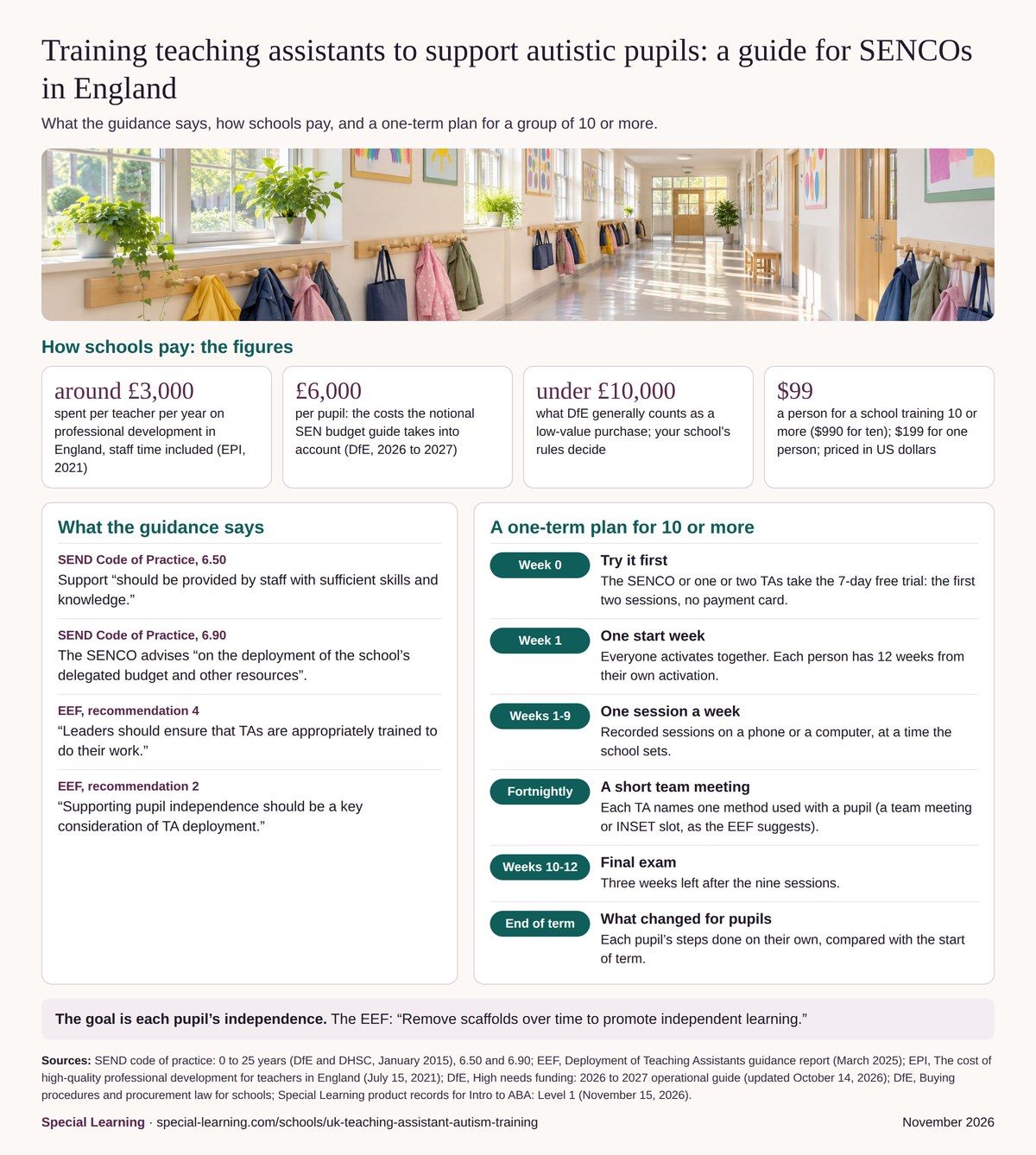
The SEND Code of Practice asks that support for pupils with SEN be “provided by staff with sufficient skills and knowledge” (paragraph 6.50), and names “advising on the deployment of the school’s delegated budget and other resources” among a SENCO’s key responsibilities (6.90). Special Learning’s Intro to ABA: Level 1 trains teaching assistants online: nine recorded sessions on the methods of applied behaviour analysis (ABA), then a final exam, watched on a phone or a computer in each person’s own time. It is $199 for one person, priced in US dollars. A school training 10 or more pays $99 a person, by quote, with an invoice from Special Learning, Inc. Anyone can try the first two sessions free for 7 days, with no payment card.
Start the 7-day free trialTraining 10 or more teaching assistants? $99 a person: request a quote

The Code’s own words, read November 15, 2026
01What the SEND Code of Practice says about the staff who support pupils with SEN
The SEND code of practice: 0 to 25 years is statutory guidance from the Department for Education and the Department of Health and Social Care, in force since April 1, 2015; GOV.UK marks it “Applies to England”. “Governing bodies of maintained mainstream schools and the proprietors of mainstream academy schools (including free schools) must ensure that there is a qualified teacher designated as SENCO for the school” (6.84). These are the paragraphs that bear on training teaching assistants, quoted from the Code:
| Paragraph | The Code’s words | For a SENCO planning training |
|---|---|---|
| 6.4 | “The quality of teaching for pupils with SEN, and the progress made by pupils, should be a core part of the school’s performance management arrangements and its approach to professional development for all teaching and support staff.” | Support staff are named in the school’s professional development. |
| 6.49 | “All teachers and support staff who work with the pupil should be made aware of their needs, the outcomes sought, the support provided and any teaching strategies or approaches that are required.” | A teaching assistant knows each pupil’s outcomes and the strategies in use. |
| 6.50 | “The support and intervention provided should be selected to meet the outcomes identified for the pupil, based on reliable evidence of effectiveness, and should be provided by staff with sufficient skills and knowledge.” | The skills of the person giving support are part of the support. |
| 6.52 | The class or subject teacher “should work closely with any teaching assistants or specialist staff involved, to plan and assess the impact of support and interventions and how they can be linked to classroom teaching.” | Teacher and teaching assistant plan and review together. |
| 6.90 | Among the SENCO’s key responsibilities: “advising on the deployment of the school’s delegated budget and other resources to meet pupils’ needs effectively”. | The SENCO advises where budget and support staff go. |
| Annex 2 | “Early years providers, schools and colleges are responsible for deciding what external support to seek and for setting their own priorities for the continuous professional development of their staff.” | The school chooses its own training and providers. |
Source: SEND code of practice: 0 to 25 years, January 2015 (PDF), paragraphs 6.4, 6.49, 6.50, 6.52, 6.84 and 6.90, and Annex 2.

The Equality Act 2010. Section 85(6) applies to schools in England, Wales and Scotland: “A duty to make reasonable adjustments applies to the responsible body of such a school” (Equality Act 2010, section 85). The Code explains in 6.9 that these duties “are anticipatory – they require thought to be given in advance to what disabled children and young people might require and what adjustments might need to be made to prevent that disadvantage.”
Education Endowment Foundation, 2025
02What the EEF says about preparing and training teaching assistants
The Education Endowment Foundation’s Deployment of Teaching Assistants guidance report, updated in 2025 from “a new review of the evidence”, is written for “headteachers and other members of the senior leadership team (SLT) in both primary and secondary schools, as well as trust leaders in multi academy trusts”, and says SENCOs “should find the report a valuable resource”. Its fourth recommendation is “Prepare and train staff around effective TA deployment”:
- “Provide clarity on the role of the TA for all in the school.”
- “Enable TAs to be effective in their role and teachers to work effectively with TAs, through effective professional development.”
- “Develop ongoing coordination and communication so that teachers and TAs are prepared for their day-to-day roles.”
On training itself, the report says: “Leaders should ensure that TAs are appropriately trained to do their work.” And: “If a specific strategy, such as scaffolding, is being used, TAs should be trained to fully understand the principles of the approach and the techniques required to apply it.” For the time it takes, it suggests space for teachers and TAs to collaborate “could be part of an INSET day, team meetings, or – if feasible - during PPA time.”
The goal it sets is the pupil’s independence. Its second recommendation says: “Supporting pupil independence should be a key consideration of TA deployment.” Two of its practices: “Remove scaffolds over time to promote independent learning, with teachers supporting TAs to make those judgements” and “Ensure pupils have the opportunity to attempt tasks independently before intervening appropriately when they can’t proceed.”
Source: EEF, Deployment of Teaching Assistants, guidance report (PDF), launched March 26, 2025: Summary of recommendations and Recommendation 4.
Teaching assistants and paraprofessionals
03What teaching assistants most need to practise, and a one-term plan
A teaching assistant in England does the work a US school calls a paraprofessional: the EEF uses “teaching assistant” “to cover equivalent classroom- and pupil-based paraprofessional roles, such as ‘learning support assistant’ and ‘classroom assistant’” (EEF, 2025). So our page on autism training for paraprofessionals describes the same people and the same course.
What teaching assistants most need to practise with an autistic pupil, and where each comes from:
- Giving a prompt, then fading it, so the pupil does the step on their own: Level 1’s session on errorless teaching and prompting.
- Waiting first: letting the pupil attempt the task before stepping in, the EEF practice quoted above.
- Keeping the pupil actively responding during a lesson: Level 1’s session on active student responding, motivation and self-monitoring.
- Beginner classroom participation skills, so the pupil takes part in the lesson: Level 1’s sessions on teaching methods in application.
- Understanding behaviour before responding to it: Level 1’s first session on functional behaviour assessment.
- Recording progress simply: each step marked as done on their own or with a named prompt, the kind of record AFIRM’s data sheets keep (AFIRM, UNC Chapel Hill, Prompting brief packet).
A one-term plan for a group of 10 or more. Week 0: the SENCO or one or two teaching assistants take the free trial. Week 1: everyone activates in the same week; each person has 12 weeks from their own activation. Weeks 1 to 9: one session a week, in each person’s own time. Every fortnight: a short meeting where each teaching assistant names one method they used with a pupil (a team meeting or INSET slot, as the EEF suggests). Weeks 10 to 12: the final exam. Then compare each pupil’s record of steps done on their own with the start of term.
Funding, in the Department for Education’s words
04How a school in England pays for teaching assistant training
Which budget carries the cost is the school’s decision; your finance lead can say which one fits. These three sources describe what schools spend on professional development and how SEND funding is set.
- The school’s CPD budget. The Education Policy Institute found that “on average, schools in England spend around £3,000 per teacher per year on professional development”, counting staff time as well as the training itself (EPI, The cost of high-quality professional development for teachers in England, July 15, 2021). Ten teaching assistants on Level 1 come to $990.
- The notional SEN budget. The Code: “Schools have an amount identified within their overall budget, called the notional SEN budget. This is not a ring-fenced amount, and it is for the school to provide high quality appropriate support from the whole of its budget.” (6.96). The Department for Education’s operational guide for 2026 to 2027 says of it: “This is an indicative amount that schools may use as a guide for how much they might need to spend on supporting their pupils with SEND.” Local authorities should review how they calculate it, as a guide to what schools might need to spend on additional support for pupils with SEND, “taking into account costs up to £6,000 per pupil.”
- High-needs top-up funding. The same guide defines it as “The funding required over and above the core funding, allocated by local authorities to schools and colleges from their high needs budget, to enable a pupil or student with high needs (normally when an EHC plan is in place) to participate in education and training.” It is set for an individual pupil, so ask your local authority whether the agreed provision and funding for that pupil can cover training the staff who support them.
Sources: DfE, High needs funding: 2026 to 2027 operational guide (updated October 14, 2026), sections 5.2 and 9.2; SEND code of practice, 6.96.
When the school pays
05How a school buys: quotes and procurement
DfE’s guidance Buying procedures and procurement law for schools starts with: “Follow your school’s procurement rules.” Those rules set the value bands; DfE says it “generally” counts low value as “under £10,000” and medium as “£10,000 to £40,000”, and where a school cannot get what it needs through a framework agreement and the purchase is low to medium value, its route is to “Get quotes from at least 3 suppliers” (Route 3). A written quote from us is one you can file beside the others.

- Try it first. The SENCO, or one or two teaching assistants, take the 7-day free trial: the first two sessions, with no payment card (start the trial).
- Ask for a quote. Tell us your school, how many staff and that you are in the United Kingdom. In the notes, say what your finance office needs, such as a quote on letterhead or a supplier form, and we reply with what we can provide.
- Pay. We send the school an invoice from Special Learning, Inc. in US dollars, paid by bank wire. Or pay by card in our store. Access opens once payment clears.
Planning in more detail? Plan your team and see the cost.
From the course records, November 15, 2026
06Options and prices
Intro to ABA: Level 1 is a course on the methods and techniques of ABA, built for the people who work with the child every day: parents and caregivers, teachers, paraprofessionals and behaviour technicians. Its nine online sessions run from what autism is to prompting, classroom participation and understanding behaviour (topics covered). A final exam follows, and each session has a short pre-test and post-test.
- One person: $199, paid once, with 11 weeks to complete the course. The UK has no separate country price, so the price is in US dollars.
- A school training 10 or more: $99 a person, paid once, with 12 weeks from the day each person activates. Ten staff come to $990, by quote, with an invoice from Special Learning, Inc. How a school buys.
- The 7-day free trial: the first two sessions, with no payment card (start the trial).
Completing this course earns a Special Learning certificate of completion.
Buy Level 1 for one personQuestions
07Questions SENCOs and heads ask
Is a teaching assistant the same as a paraprofessional?
Yes, for this course. The EEF uses “teaching assistant” “to cover equivalent classroom- and pupil-based paraprofessional roles, such as ‘learning support assistant’ and ‘classroom assistant’” (EEF, Deployment of Teaching Assistants, 2025). US schools say paraprofessional; the course is the same (paraprofessional training).
How much does Level 1 cost for a school in the UK?
One person pays $199, paid once. A school training 10 or more pays $99 a person, paid once, so ten staff come to $990, by quote, with an invoice from Special Learning, Inc. Prices are in US dollars; the UK is not one of the countries with a separate country price (country pricing).
Can we pay in pounds, or get the paperwork our finance office needs?
Our prices are in US dollars. In the notes of the quote form, tell us what your finance office needs and we reply with what we can provide.
Can we try the course before we buy for the team?
Yes. The 7-day free trial covers the first two sessions, and starting it asks for your email, a password and your role, with no payment card (start the trial).
What do teaching assistants learn in Level 1?
Nine online sessions: what autism is and an overview of ABA, methods of teaching, errorless teaching and prompting, active student responding, beginner classroom participation skills, and a first session on understanding behaviour through a functional behaviour assessment. The examples are drawn largely from work with young children in classrooms and homes. A final exam follows, and each session has a short pre-test and post-test.
How long does each person have?
When the school buys for 10 or more, each person has 12 weeks from the day they activate their own access, so staff who join later start their 12 weeks when they begin. One person buying alone has 11 weeks to complete the course.
Do staff receive a certificate?
Completing this course earns a Special Learning certificate of completion.
When can staff watch the sessions?
The sessions are recorded and play on a phone or a computer, so the school can set the time, such as a regular slot each week. The EEF suggests time for teachers and TAs to collaborate “could be part of an INSET day, team meetings, or – if feasible - during PPA time.” (EEF, Recommendation 4)
Your next step
Watch the first two sessions of Level 1 free for 7 days, then decide with your teaching assistants. Starting it asks for no payment card.
Try the first two sessions freeMore for schools: training for schools, autism training for paraprofessionals, training for international schools and shadow teacher and learning support assistant training. For families in the UK: our UK guide.