
For schools and families in the UAE, Saudi Arabia, India, the Philippines, Singapore, the UK and international schools
Shadow teacher training: what the role needs, and how support fades toward independence
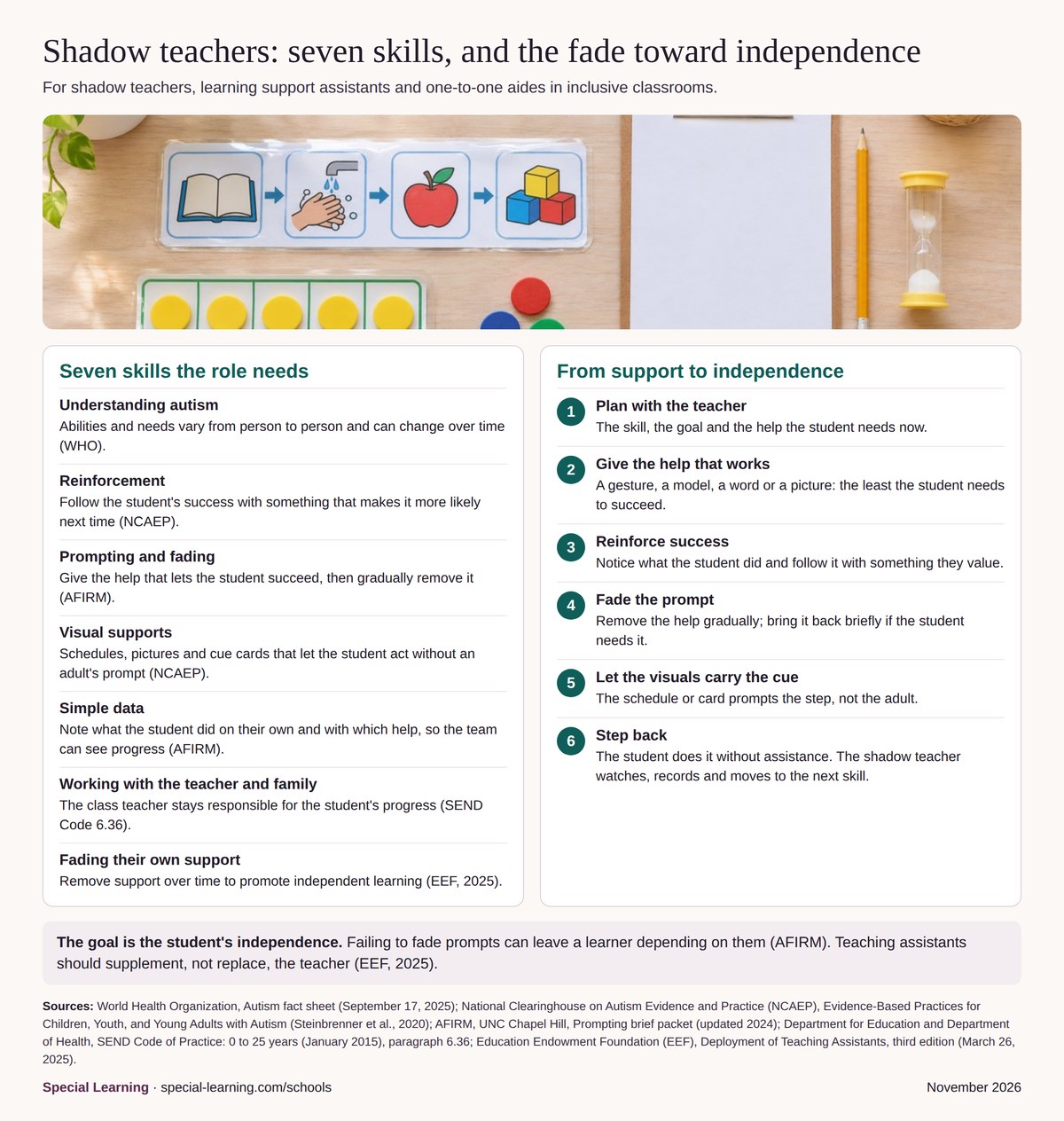
A shadow teacher is an adult who gives one student individual support in an inclusive school, often an autistic student, working with the class teacher. Titles and duties differ by country: Dubai's policy says learning support assistant, Abu Dhabi separates school-appointed Inclusion Assistants from parent-funded Individual Assistants, and England's SEND Code says teaching assistant. The job is to help the student take part in the same lessons and routines as classmates, and to step back as the student does more on their own. The role draws on seven skills: understanding autism, reinforcement, prompting and fading, visual supports, simple data, working with the teacher and the family, and fading the shadow teacher's own support. Training ranges from the school's own induction and coaching, to free online modules, to a short course on ABA methods such as Special Learning's Intro to ABA: Level 1 ($199, with a 7-day free trial of the first two sessions).
Start the free trial or buy the courseTraining 10 or more staff? $99 a person: request a quote for your school

The short answer, then the detail
01What a shadow teacher does
The name changes with the country, and official texts use their own terms. Dubai's framework says shadow teachers "will be renamed 'learning support assistants'" (KHDA, 2017, paragraph 4.11). Abu Dhabi uses two names: Inclusion Assistants, appointed by the school, who "work under the direction of a teacher", and Individual Assistants, "formerly known as 'Shadow Teachers'", who are parent-funded, give one-to-one support for non-teaching needs and enter the classroom "only upon request by the teacher" (ADEK School Policy on Inclusion, version 1.2, September 2024). England's SEND Code uses the term "teaching assistants". How much teaching the role includes depends on where you work and what the school agrees. The duties can include:
- helps the student follow the lesson the class teacher planned, breaking a task into smaller steps when it helps;
- gives the least help that lets the student succeed, then less as the student gains the skill;
- uses the student's visual supports, such as a picture schedule, a first-then card or a choice board;
- notices what the student does well and reinforces it;
- supports communication in the student's own way: speech, sign, pictures or a device;
- keeps short notes the teacher and the team use to see progress;
- shares what they see with the class teacher and, in the way the school agrees, with the family.
The class teacher stays in charge of the student's learning. England's SEND Code of Practice says it plainly: "Teachers are responsible and accountable for the progress and development of the pupils in their class, including where pupils access support from teaching assistants or specialist staff" (SEND Code of Practice, paragraph 6.36, January 2015).
The Education Endowment Foundation's guidance on deploying teaching assistants puts it the same way: "TAs should supplement – not replace – the teacher" (EEF, Deployment of Teaching Assistants, third edition, March 26, 2025).
From the research and official guidance, read November 15, 2026
02The seven skills the role needs
1. Understanding autism
"The abilities and needs of autistic people vary and can evolve over time," says the World Health Organization, which estimates that about 1 in 127 people worldwide were autistic in 2021 (WHO autism fact sheet, September 17, 2025). A shadow teacher learns this student: how they communicate, what they enjoy, what helps them feel calm and what they are working on.
2. Reinforcement
Reinforcement is "the application of a consequence following a learner's use of a response or skills that increases the likelihood that the learner will use the response/skills in the future" (NCAEP, Evidence-Based Practices for Children, Youth, and Young Adults with Autism, 2020). In class that can be specific praise, a turn with a favorite activity or a token toward a choice.
3. Prompting and fading
A prompt is help: a gesture, a model, a spoken word, a picture or, when needed, a guiding hand. AFIRM's prompting guide describes giving a prompt that ensures the learner does the skill correctly, then gradually removing it as the learner begins to use the skill, and warns: "Failure to appropriately fade prompts can cause the learner to become prompt dependent" (AFIRM, UNC Chapel Hill, Prompting brief packet, updated 2024).
4. Visual supports
NCAEP defines a visual support as "a visual display that supports the learner engaging in a desired behavior or skills independent of additional prompts" (NCAEP, 2020). A picture schedule, a first-then card or a cue card lets the student move through the day without waiting for an adult's words.
5. Simple data
A simple record can show whether the student did each step on their own or with a named prompt. AFIRM's data sheets record each step as done independently or with a named prompt, so the team can see the help shrinking (AFIRM Prompting brief packet).
6. Working with the teacher and the family
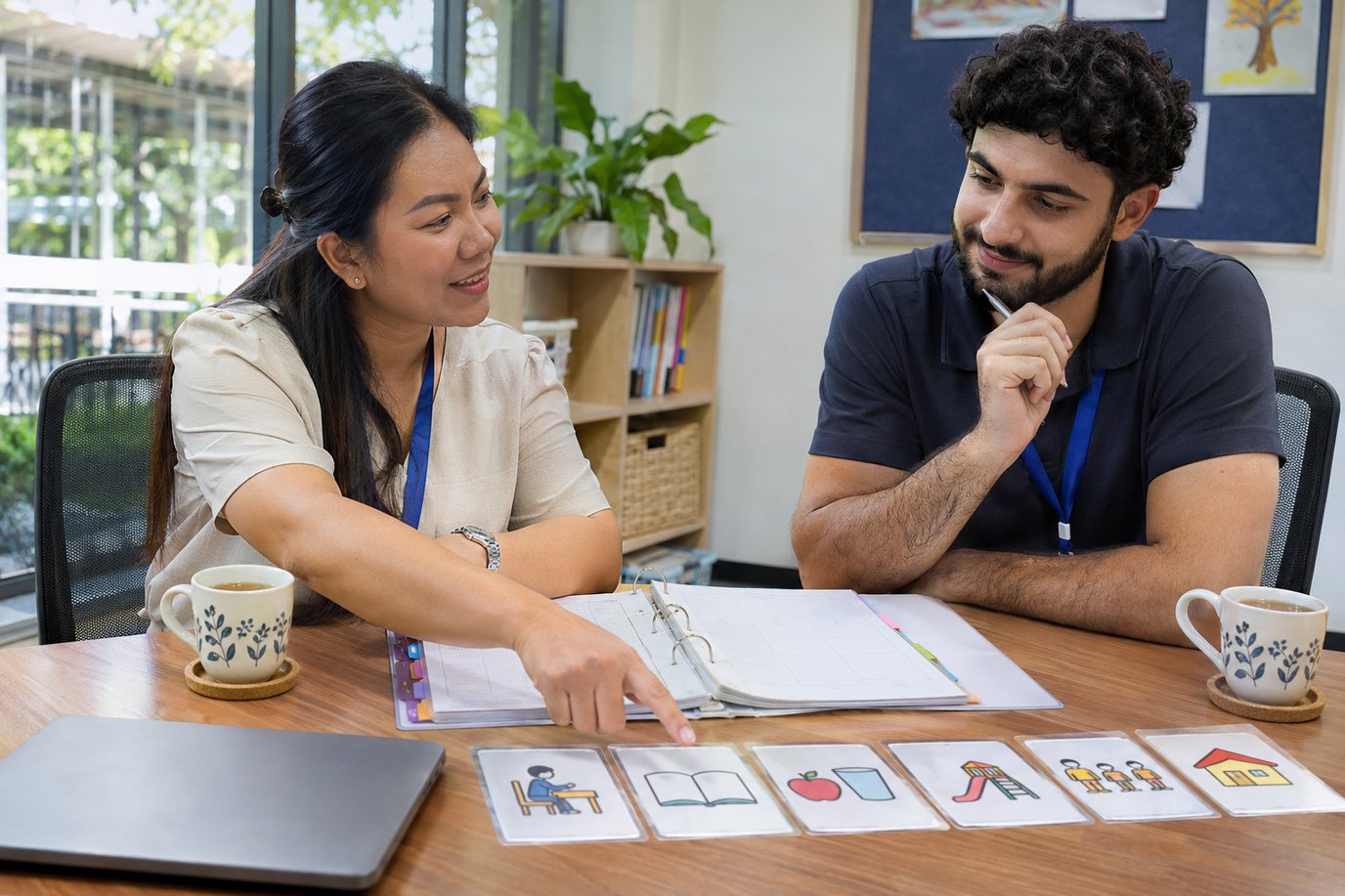
The teacher plans and the shadow teacher carries the plan into the moment. England's SEND Code asks the class teacher to "work closely with any teaching assistants or specialist staff involved, to plan and assess the impact of support" (paragraph 6.52). Families know their child best; a short, regular exchange, in the way the school agrees, keeps home and school using the same words and the same supports.
7. Fading their own support
The best measure of a shadow teacher is how much the student can do without them. The EEF's second recommendation is "Deploy TAs to scaffold learning and to develop pupils’ independence". It says: "Remove scaffolds over time to promote independent learning" and "Ensure pupils have the opportunity to attempt tasks independently before intervening appropriately when they can’t proceed" (EEF, 2025). It warns that some support practices "not only inhibit progress but foster dependence". In practice: let the student try first, remove help over time, and note the moments the student managed alone.
Each regulator's own words, with dates, read November 15, 2026
03What the policies say about support staff
Rules for support staff differ by country, and in the UAE by emirate. Here is what each official text says, in its own words. Where a text sets a requirement, it is quoted exactly.
| Where | What the official text says | Source and date |
|---|---|---|
| Dubai, UAE (KHDA) | Paragraph 4.11: "Ensure that 'shadow teachers' will be renamed 'learning support assistants'. They will be accountable to the revised job description and will be required to complete the relevant training and development programme appropriate to their role within a time bound period." Paragraph 4.12: when learning support assistants "are employed by the parents", the school implements a memorandum of understanding that includes "professional induction, monitoring and training requirements, line management procedures, the code of conduct" and "levels of accountability". | Dubai Inclusive Education Policy Framework, KHDA, 2017. Approved, with KHDA's Directives and Guidelines for Inclusive Education for private schools, by Administrative Resolution No. (15) of 2026, March 11, 2026 |
| Abu Dhabi, UAE (ADEK) | "Formerly known as 'Shadow Teachers', Individual Assistants are parent-funded staff who provide 1:1 support for students with additional learning needs for any logistical, safety-related, behavioral, medical, and/or social and emotional need. In these cases, the student requires 1:1 support for at least 50% of their school day." Schools must "provide evidence and a justification" when asking parents to engage one, and the Individual Assistant "is authorized to enter the classroom to provide support to the concerned student only upon request by the teacher." Schools also appoint Inclusion Assistants, who "work under the direction of a teacher", and "provide guidance for Inclusion Assistants and any interested Individual Assistants in their professional development." | ADEK School Policy on Inclusion, version 1.2, September 2024; effective from October 3, 2023, compliance from academic year 2025/26 (copy archived November 7, 2025; check adek.gov.ae for any later update) |
| India | Section 16(iv): educational institutions "provide necessary support individualised or otherwise in environments that maximise academic and social development consistent with the goal of full inclusion." Section 17(d): government and local authorities are "to train professionals and staff to support inclusive education at all levels of school education." The National Education Policy 2020 (paragraph 6.14) adds that "the awareness and knowledge of how to teach children with specific disabilities (including learning disabilities) will be an integral part of all teacher education programmes." | Rights of Persons with Disabilities Act, 2016, Gazette of India, December 28, 2016; National Education Policy 2020, Ministry of Human Resource Development (now Ministry of Education), paragraphs 6.11 to 6.14 |
| England, UK | Paragraph 6.36: "Teachers are responsible and accountable for the progress and development of the pupils in their class, including where pupils access support from teaching assistants or specialist staff." Paragraph 6.50: support "should be provided by staff with sufficient skills and knowledge." The EEF's guidance adds five recommendations, including "Deploy TAs to scaffold learning and to develop pupils’ independence". | SEND Code of Practice: 0 to 25 years, Department for Education and Department of Health, January 2015; EEF, Deployment of Teaching Assistants, third edition, March 26, 2025 |
In Saudi Arabia, the Philippines, Singapore and international schools elsewhere, the school's inclusion lead or learning support department is the place to ask which rules apply to a shadow teacher; this page quotes only texts we opened and read on November 15, 2026.
From free to structured
04Training options for shadow teachers
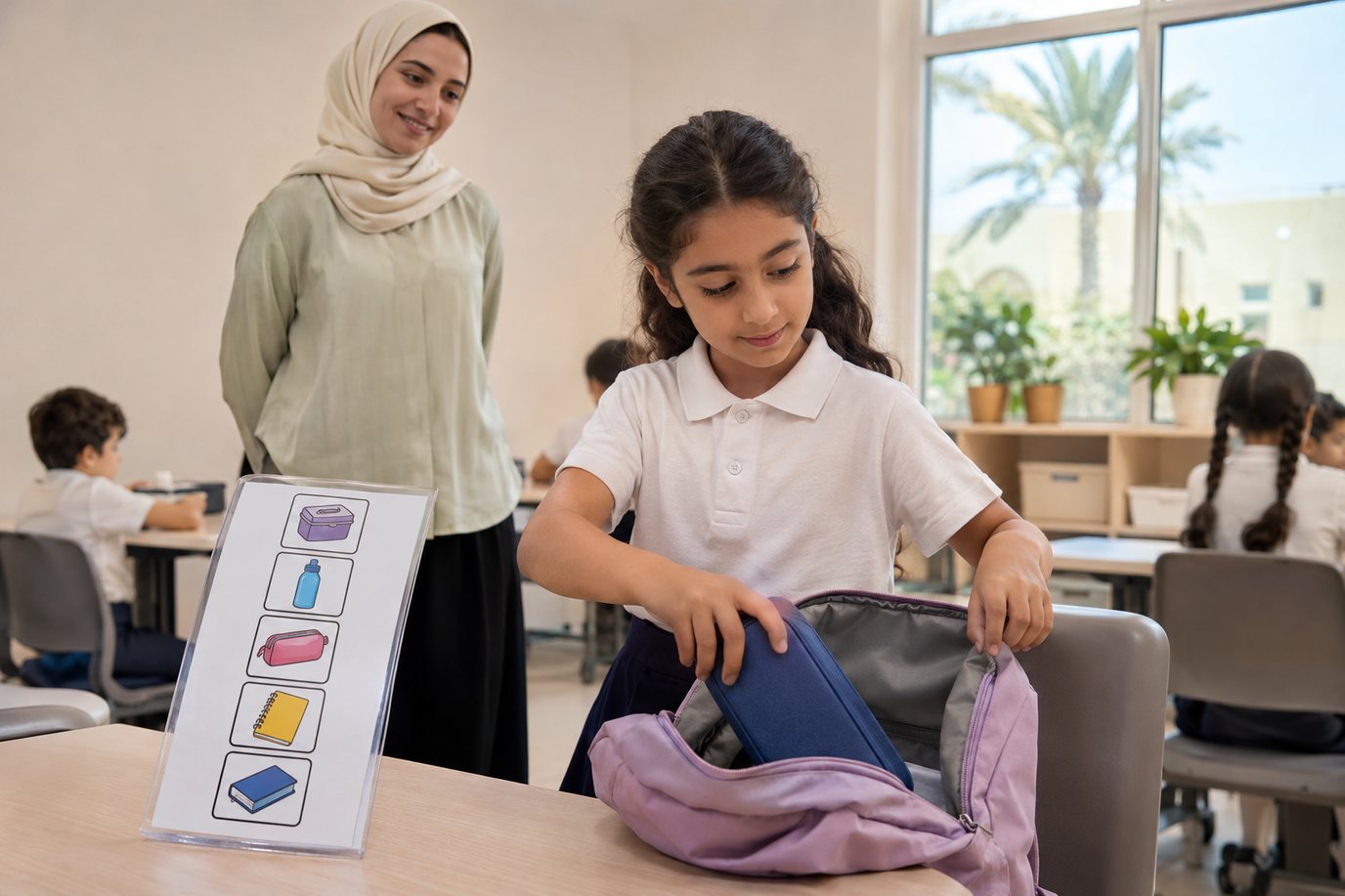
- The school's own induction and coaching. The class teacher or the inclusion lead shows the shadow teacher the student's plan, the supports in use and how the class runs, then watches and gives feedback. EEF recommendation 4 is "Prepare and train staff around effective TA deployment" (EEF, 2025).
- Free online modules. AFIRM, from the University of North Carolina at Chapel Hill, publishes free modules on evidence-based practices for autistic learners, including prompting, reinforcement and visual supports (AFIRM modules).
- A short course on ABA methods. A structured course, such as Special Learning's Intro to ABA: Level 1, takes a shadow teacher through these methods in order, with a pre-test and post-test for each session.
- Ongoing guidance from a qualified professional. Where the student has a behavior analyst, a psychologist or a therapist, the shadow teacher follows that professional's plan and asks them when something changes.
The course
05Intro to ABA: Level 1, for a shadow teacher
Intro to ABA: Level 1 is a course on the methods and techniques of ABA, built for the people who work with the child every day: parents and caregivers, teachers, paraprofessionals and behavior technicians. Its nine online sessions, drawn largely from work with young children in classrooms and homes, include:
- what autism is, and an overview of ABA
- methods of teaching, and errorless teaching and prompting
- active student responding, to raise a learner's motivation
- two sessions on beginner classroom participation skills
- a first session on understanding behavior through a functional behavior assessment
A final exam follows the nine sessions. You watch the sessions online on a phone or a computer, and you have 11 weeks to complete the course. Each session has a short pre-test and post-test, and the course comes with downloadable materials, listed beside its sessions.
Completing this course earns a Special Learning certificate of completion.
$199, paid once. In India and the Philippines, the store shows $70 when you shop from there (country pricing). The 7-day free trial covers the first two sessions; starting it asks for your email, a password and your role, with no payment card.
Level 1 is built for parents and caregivers too, so a family and its shadow teacher can learn the same methods.
Start the free trial or buy the courseSpanish subtitles
For Spanish-speaking educators, paraprofessionals, parents and caregivers. Curso de ABA con subtítulos en español: nueve sesiones grabadas, un examen final y una prueba gratuita de siete días.
This is a separate course. Nine recorded sessions and a final exam, about 13.8 hours of video, with English audio and Spanish subtitles on screen. The sessions cover what autism is, an overview of applied behavior analysis, teaching methods, errorless teaching and prompting, active student responding, a first look at assessing problem behavior, and helping beginners take part in class.
$79, paid once. The 7-day free trial covers two sessions.
Start the free trial with Spanish subtitlesWhen the school pays
06For a school training 10 or more

When a school buys Level 1 for a group of 10 or more, it is $99 a person, paid once, and every person has 12 weeks from the day they activate their access. Ten staff come to $990. Shadow teachers, teaching assistants and class teachers then share the same words and methods.
Tell us your school, your country and how many staff, and we reply with a quote. The form takes international schools and schools in any country.
Request a quote for your schoolPlanning in more detail? Plan your team and see the cost, or read what each session covers.
Leading learning support at an international school? How to train an international school's support team online, across time zones.
Questions
07Questions schools and families ask

What is a shadow teacher?
A shadow teacher is an adult who gives one student individual support in an inclusive school, often an autistic student, working with the class teacher. Titles and duties differ by country and by the policy in force. The aim is for the student to take part in the same lessons and routines as classmates, with support that fades as the student does more on their own.
Is a shadow teacher the same as a learning support assistant?
Not always; the terms depend on the policy in force. Dubai's 2017 framework says shadow teachers "will be renamed 'learning support assistants'" (KHDA Dubai Inclusive Education Policy Framework, 2017, paragraph 4.11). Abu Dhabi calls parent-funded one-to-one staff Individual Assistants, "formerly known as 'Shadow Teachers'" (ADEK School Policy on Inclusion, version 1.2, September 2024). England's SEND Code uses the term "teaching assistants".
Who pays for a shadow teacher in the UAE?
In Abu Dhabi, an Individual Assistant is "parent-funded" and "not part of the school's standard inclusive provision" (ADEK School Policy on Inclusion, version 1.2, September 2024, section 3.1). In Dubai, when parents employ a learning support assistant, the school sets out the terms in a memorandum of understanding that covers induction, monitoring and training requirements (KHDA Dubai Inclusive Education Policy Framework, 2017, paragraph 4.12).
What training does a shadow teacher need?
Dubai's framework says learning support assistants "will be required to complete the relevant training and development programme appropriate to their role within a time bound period" (KHDA Dubai Inclusive Education Policy Framework, 2017, paragraph 4.11); the school's memorandum of understanding sets the training requirements. Elsewhere, ask the school's inclusion lead or learning support department which rules apply. Useful training covers understanding autism, reinforcement, prompting and fading, visual supports, simple data and working with the teacher and family.
How does a shadow teacher help a student become independent?
By giving the least help that works and removing it step by step. The EEF says: "Remove scaffolds over time to promote independent learning" (EEF, 2025), and AFIRM warns that failing to fade prompts can leave a learner prompt dependent (AFIRM Prompting brief packet).
How much does Intro to ABA: Level 1 cost for a shadow teacher outside the US?
$199, paid once, with a 7-day free trial of the first two sessions. In India and the Philippines, the store shows $70 when you shop from there (country pricing). A school training 10 or more pays $99 a person (request a quote).
Your next step
Watch the first two sessions of Level 1 free for 7 days. Starting it asks for no payment card.
Try the first two sessions freeMore for schools: training for schools, ABA training online for special-education teachers and autism training for paraprofessionals. Country guides: the UAE, Saudi Arabia, India, the Philippines, Singapore and the UK.