
Before you plan or buy staff training, you need two numbers: how many staff want it, and in what. Most schools don’t have them. This free survey gets them in about a week. Staff answer eight questions in under five minutes, without their names, and a two-page tally sheet turns the answers into the headcount, the roles and the top three needs. The result helps you plan whatever training you choose.

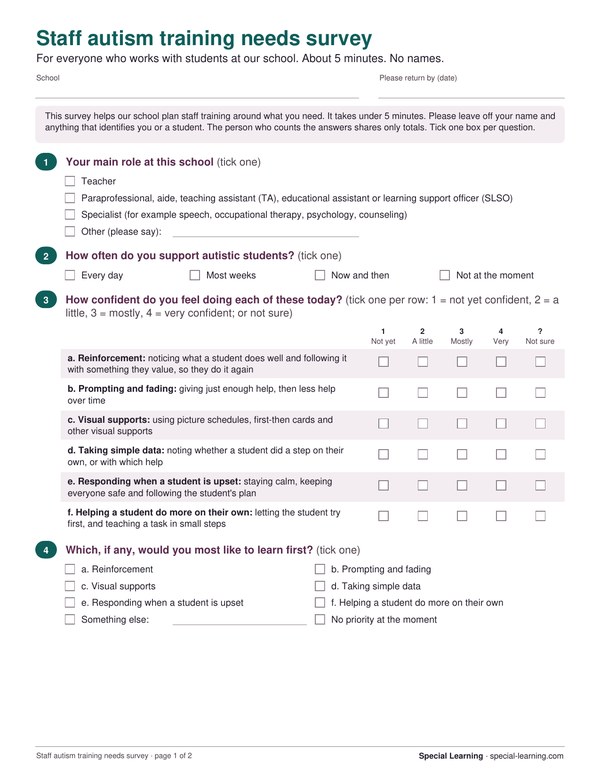
The staff survey (2 pages)
Eight questions with tick boxes. Staff can type into it in any PDF reader and save it, or you can print copies to hand out.
Download the survey (PDF)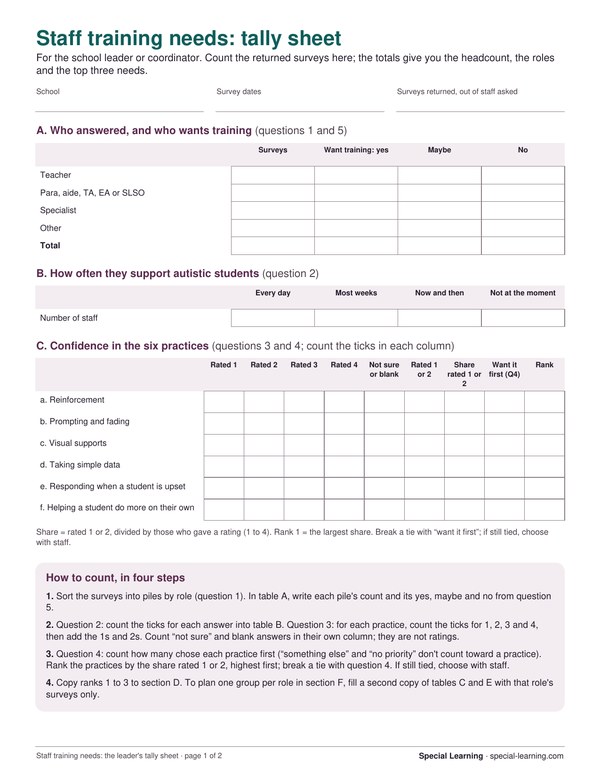
The leader's tally sheet (2 pages)
Tables for the counts by role, the six practices ranked, the top three needs, a plan by role and the 12-week re-survey.
Download the tally sheet (PDF)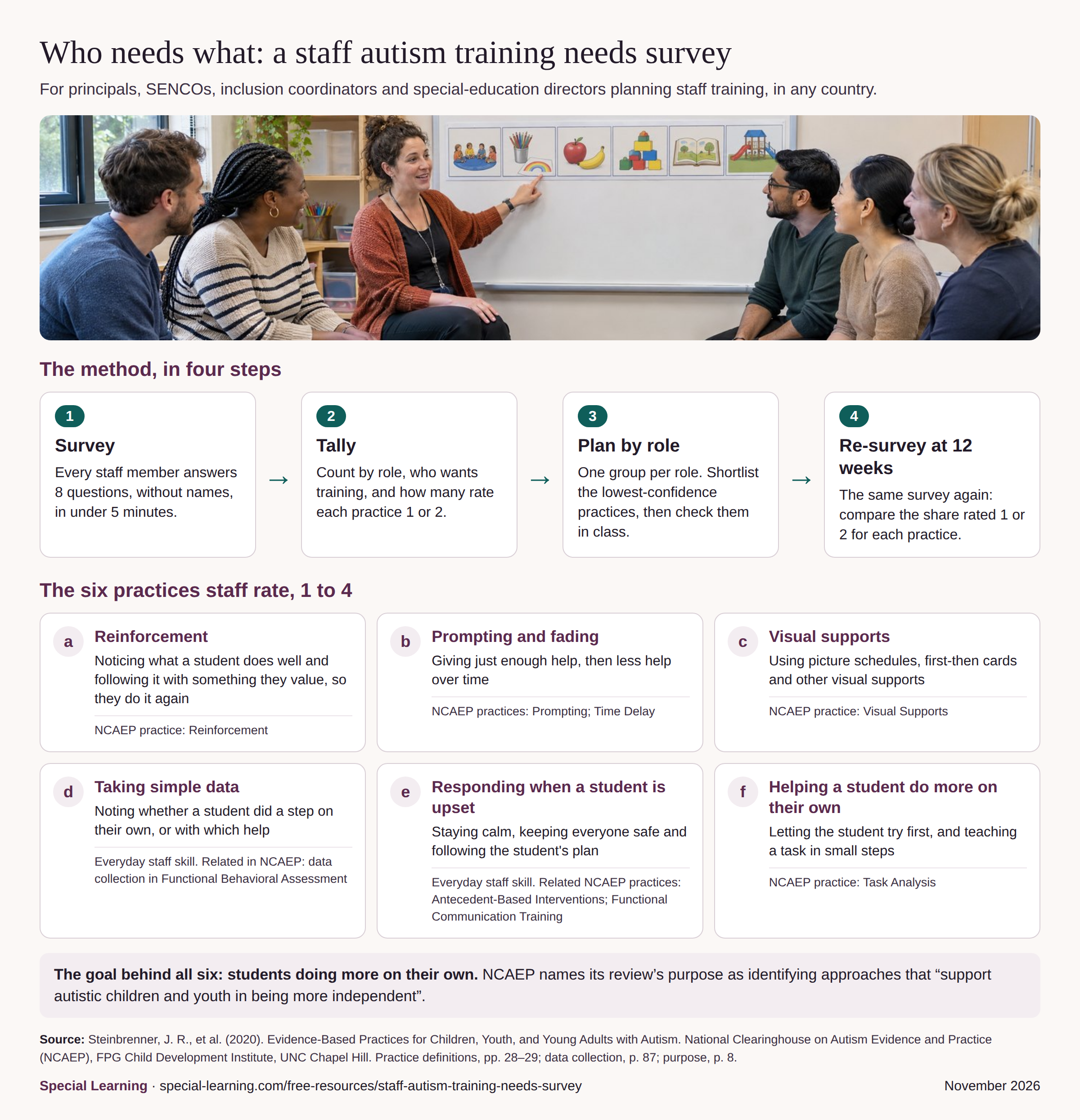
The survey: eight questions, under five minutes
For everyone who works with students: teachers, paraprofessionals and teaching assistants, specialists and anyone else. Hand it out at a staff meeting or share the PDF, and give a return date a week away. Ask staff to leave off their names and anything that identifies them or a student, and tell them how answers will be collected and shared, so they can answer candidly. A collection box for paper copies keeps returns private; a PDF sent back by email shows who sent it.
- Your main role at this school Teacher; paraprofessional, aide, teaching assistant (TA), educational assistant or learning support officer (SLSO); specialist; or other.
- How often do you support autistic students? Every day, most weeks, now and then, or not at the moment.
- How confident do you feel doing each of these today? Each of the six practices below, rated 1 (not yet confident), 2 (a little), 3 (mostly) or 4 (very confident), or “not sure” for a practice they can’t judge.
- Which, if any, would you most like to learn first? One of the six, something else, or no priority at the moment.
- Would you like training in these practices this school year? Yes, maybe or no. The yes answers are your headcount.
- Which format suits you? Self-paced online, a live group session (in person or online), or either.
- How much time could you give to training in a usual week? Under 30 minutes, 30 to 59 minutes, 1 to 2 hours, or more than 2 hours.
- Anything else that would help us plan your training? Optional, in their own words.
The six practices staff rate, and the research behind them
Question 3 asks about six everyday practices for supporting autistic students. Four of them are practices named in NCAEP’s 2020 review of evidence-based practices (Steinbrenner et al., 2020), the same review our guide to shadow teacher training cites. Taking simple data and responding when a student is upset are everyday staff skills, each related to practices in the review. The survey describes each in plain classroom words, so a new aide and an experienced teacher can both answer.
a Reinforcement
Noticing what a student does well and following it with something they value, so they do it again.
NCAEP defines reinforcement as “The application of a consequence following a learner’s use of a response or skills that increases the likelihood that the learner will use the response/skills in the future.” (NCAEP, 2020, p. 29) In class that can be specific praise, a turn with a favorite activity or a token toward a choice.
NCAEP practice: Reinforcement (R). To learn more: AFIRM Reinforcement brief packet (UNC Chapel Hill).
b Prompting and fading
Giving just enough help, then less help over time.
NCAEP defines prompting as “Verbal, gestural, or physical assistance given to learners to support them in acquiring or engaging in a targeted behavior or skill.” (NCAEP, 2020, p. 29) Fading the help matters as much as giving it: NCAEP’s time delay is a practice used to “systematically fade the use of prompts during instructional activities by using a brief delay between the initial instruction and any additional instructions or prompts” (NCAEP, 2020, p. 29).
NCAEP practices: Prompting (PP) and Time Delay (TD). To learn more: AFIRM Prompting brief packet; AFIRM Time Delay brief packet (UNC Chapel Hill).
c Visual supports
Using picture schedules, first-then cards and other visual supports.
NCAEP defines a visual support as “A visual display that supports the learner engaging in a desired behavior or skills independent of additional prompts.” (NCAEP, 2020, p. 29) A picture schedule lets a student move through the day without waiting for an adult’s words.
NCAEP practice: Visual Supports (VS). To learn more: AFIRM Visual Supports brief packet (UNC Chapel Hill).
d Taking simple data
Noting whether a student did a step on their own, or with which help.
This is an everyday staff skill rather than one of NCAEP’s named practices. A simple record of whether the student did each step on their own, or with which help, shows the team whether the help is shrinking. NCAEP discusses data collection as part of functional behavioral assessment, which uses it for a different purpose, understanding what a behavior does for the student: “Data collection is an important part of the FBA process.” (NCAEP, 2020, p. 87)
An everyday staff skill. Related in NCAEP: data collection within Functional Behavioral Assessment (FBA).
e Responding when a student is upset
Staying calm, keeping everyone safe and following the student's plan.
Staying calm, keeping everyone safe and following the student’s own plan and the school’s procedures is everyday school practice. Two related NCAEP practices work before and around those moments. Antecedent-based interventions are the “Arrangement of events or circumstances that precede an activity or demand” (NCAEP, 2020, p. 28), which can make a hard moment less likely. Functional communication training is a set of practices that “replace a challenging behavior that has a communication function with more appropriate and effective communication behaviors or skills” (NCAEP, 2020, p. 28), such as a way to ask for a break.
An everyday staff skill. Related NCAEP practices: Antecedent-Based Interventions (ABI) and Functional Communication Training (FCT). To learn more: AFIRM Antecedent-Based Interventions module; AFIRM Functional Communication Training brief packet (UNC Chapel Hill).
f Helping a student do more on their own
Letting the student try first, and teaching a task in small steps.
The purpose of NCAEP’s whole review is to identify approaches that “support autistic children and youth in being more independent” (NCAEP, 2020, p. 8). One of its practices, task analysis, is a process in which an activity or behavior is “divided into small, manageable steps in order to assess and teach the skill” (NCAEP, 2020, p. 29), so a student can learn a task one step at a time and do more of it alone.
NCAEP practice: Task Analysis (TA); and the review's purpose, independence. To learn more: AFIRM Task Analysis brief packet (UNC Chapel Hill).
The tally: the headcount, the roles and the top three needs
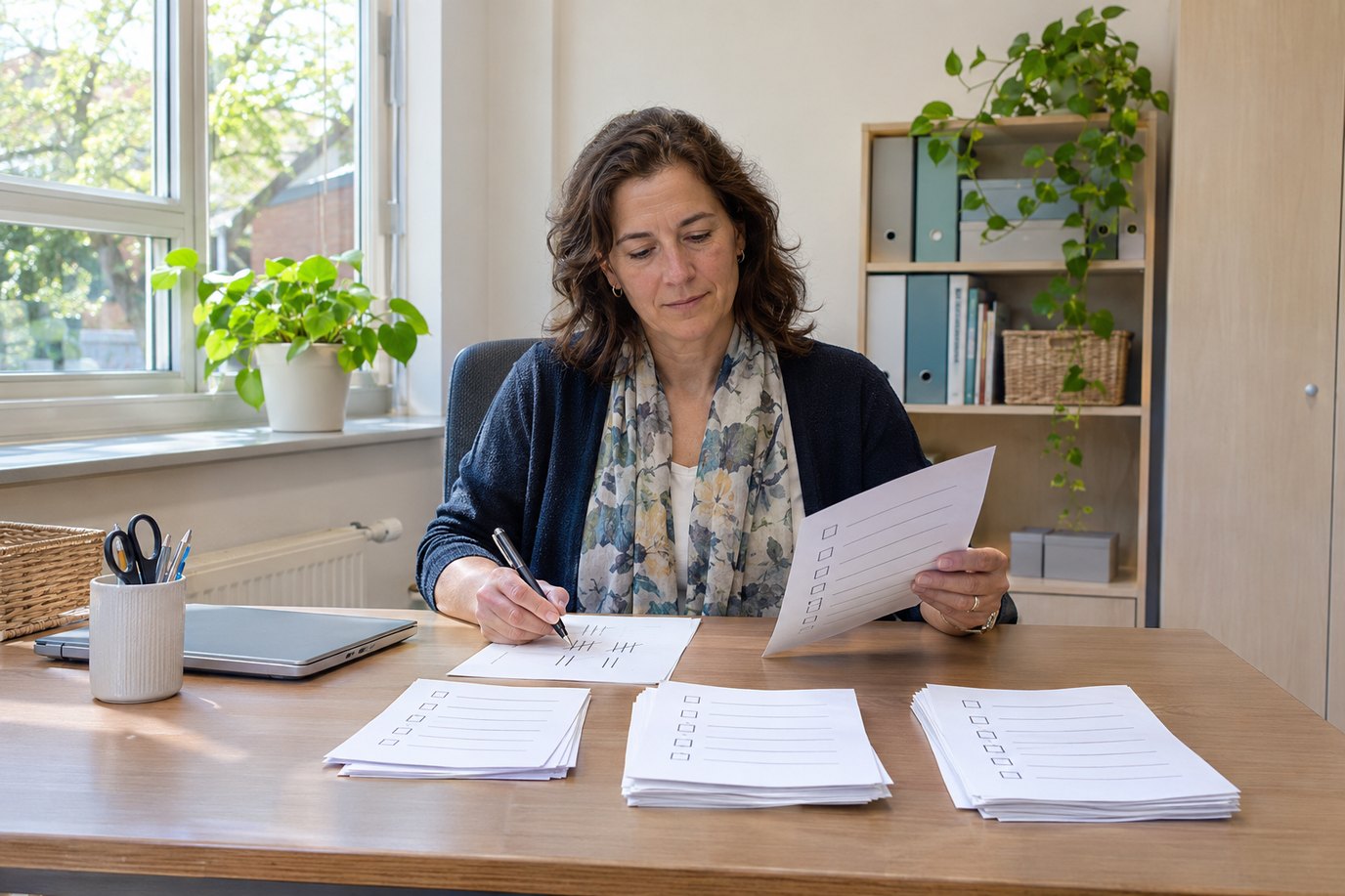
One person, usually the coordinator, counts the returned surveys on the tally sheet, or types the counts into the calculator below.
- Sort the surveys into piles by role (question 1). In table A, write each pile's count and its yes, maybe and no from question 5.
- Question 2: count the ticks for each answer into table B. Question 3: for each practice, count the ticks for 1, 2, 3 and 4, then add the 1s and 2s. Count “not sure” and blank answers in their own column; they are not ratings.
- Question 4: count how many chose each practice first (“something else” and “no priority” don't count toward a practice). Rank the practices by the share rated 1 or 2, highest first; break a tie with question 4. If still tied, choose with staff.
- Copy ranks 1 to 3 to section D. To plan one group per role in section F, fill a second copy of tables C and E with that role's surveys only.
Tally calculator
Type your counts from the surveys. It adds them up and ranks the six practices as you type. It runs in your browser only: nothing you type is sent or saved.
| Role | Surveys | Want training: yes | Maybe |
|---|---|---|---|
| Teacher | |||
| Para, aide, TA, EA or SLSO | |||
| Specialist | |||
| Other |
| Practice | Gave a rating (1 to 4) | Rated 1 or 2 | Want it first |
|---|---|---|---|
| a. Reinforcement | |||
| b. Prompting and fading | |||
| c. Visual supports | |||
| d. Taking simple data | |||
| e. Responding when a student is upset | |||
| f. Helping a student do more on their own |
Your results appear here as you type.
How to use the results
Practical advice from planning school training, for turning the tally into a plan staff will finish:
- Plan in groups by role. A teacher who plans a student's support and a para or teaching assistant who carries it out need different practice. Tally each role's surveys on its own copy of the sheet, and plan one group per role where the numbers allow. Pair a teacher with the aide they work beside for practice in class.
- Shortlist from the lowest-confidence practices, then check. The practices the largest share of staff rated 1 or 2 make the shortlist; question 4 (what staff want to learn first) helps choose between close ones. Check the shortlist against what you see in classrooms and what students' plans call for before you choose where to start. Three practices are enough for one term.
- Match the format and time staff can give. Questions 6 and 7 tell you whether self-paced online, a live group or both will be used, and how much time a week to plan for. A plan that fits the time people have is one they finish.
- Count the yes answers as your headcount. Treat the maybes as people to talk to, and confirm who will take part before you book or buy anything.
- Tell staff what you found. Share the headcount and the top three needs in a staff meeting or one email, and what happens next. People answer the next survey when they see the last one used.
- Re-survey after 12 weeks. Hand out the same survey again. For each practice, compare the share of answers rated 1 or 2 (out of those who gave a rating), and note how many answered and from which roles. A lower share suggests staff feel more confident; use what you see in classrooms and talk with staff to decide what comes next.
- Protect people's privacy. Collect paper copies in a box rather than by hand. A PDF returned by email shows who sent it, so offer the box as well. If a role has fewer than five answers, report it with another group, and leave out any comment that could identify someone.
Sources
- Steinbrenner, J. R., Hume, K., Odom, S. L., Morin, K. L., Nowell, S. W., Tomaszewski, B., Szendrey, S., McIntyre, N. S., Yücesoy-Özkan, S., & Savage, M. N. (2020). Evidence-Based Practices for Children, Youth, and Young Adults with Autism. The University of North Carolina at Chapel Hill, Frank Porter Graham Child Development Institute, National Clearinghouse on Autism Evidence and Practice Review Team. Read the report (PDF). Pages 8 (purpose), 28 and 29 (practice definitions) and 87 (functional behavioral assessment).
- AFIRM (Autism Focused Intervention Resources and Modules), Frank Porter Graham Child Development Institute, UNC Chapel Hill: AFIRM Reinforcement brief packet; AFIRM Prompting brief packet; AFIRM Time Delay brief packet; AFIRM Visual Supports brief packet; AFIRM Antecedent-Based Interventions module; AFIRM Functional Communication Training brief packet; AFIRM Task Analysis brief packet; and AFIRM for Paraeducators.
More free resources for school teams
- A new paraprofessional’s first week: a day-by-day checklist for the supervising teacher and the new para.
- Teacher–paraeducator instruction handoff: a one-page planning sheet to use before an activity.
- Prompt hierarchy quick-reference card: the levels of help, and how to fade them.
- All free resources and training for schools.