
For principals, learning support leaders and business managers in Australian schools
Autism training for teacher aides and SLSOs: what the Disability Standards ask, how teachers’ PD works, and a way to start this term
Since August 1, 2026, the Disability Standards for Education 2005 open their participation part with a statement of rights: students with disability have “the right to reasonable adjustments, where necessary, to ensure they are able to participate in education and training, on the same basis as students without disabilities”. Teacher aides, school learning support officers (SLSOs) and education support staff are often the adults who carry out those adjustments in the classroom. Special Learning’s Intro to ABA: Level 1 trains them, and teachers, online: nine recorded sessions on the methods of applied behaviour analysis (ABA), then a final exam, watched on a phone or a computer in each person’s own time. It is $199 for one person, priced in US dollars. A school training 10 or more pays $99 a person, by quote. Anyone can try the first two sessions free for 7 days, with no payment card.
Start the 7-day free trial
The law’s own words, read November 15, 2026
01What the Disability Standards for Education ask of schools
The Disability Standards for Education 2005 are made under the Disability Discrimination Act 1992 and apply to education providers, including schools. The current compilation, dated August 1, 2026, includes the Disability Standards for Education Amendment Standards 2025, registered on November 17, 2025, which added a statement of rights to each of Parts 4 to 8. What the Standards ask, in their own words:
| Section | The Standards’ words | For a learning support leader |
|---|---|---|
| Section 5.1A, statement of rights | Students with disabilities have “the right to participate in the courses or programs, and to use services and facilities, provided by an educational institution, on the same basis as students without disabilities, including the right to reasonable adjustments, where necessary”. | Participation on the same basis is the measure, and adjustments are how a school gets there. |
| Section 5.2(2) | The provider must “consult the student, or an associate of the student”, decide “whether an adjustment is necessary”, and, if a reasonable adjustment can be identified, “make a reasonable adjustment for the student in accordance with Part 3.” | Consult, decide, adjust: the steps a learning support team plans around. |
| Section 5.2(3) | “The provider must repeat the process set out in subsection (2) as necessary to allow for the changing needs of the student over time.” | Adjustments are reviewed as the student grows. |
| Section 3.3 | An adjustment is “a measure or action (or a group of measures or actions) taken by an education provider that has the effect of assisting a student with a disability” and “includes an aid, a facility, or a service that the student requires because of the disability”. | Support from a trained adult in the room is one kind of measure or service. |
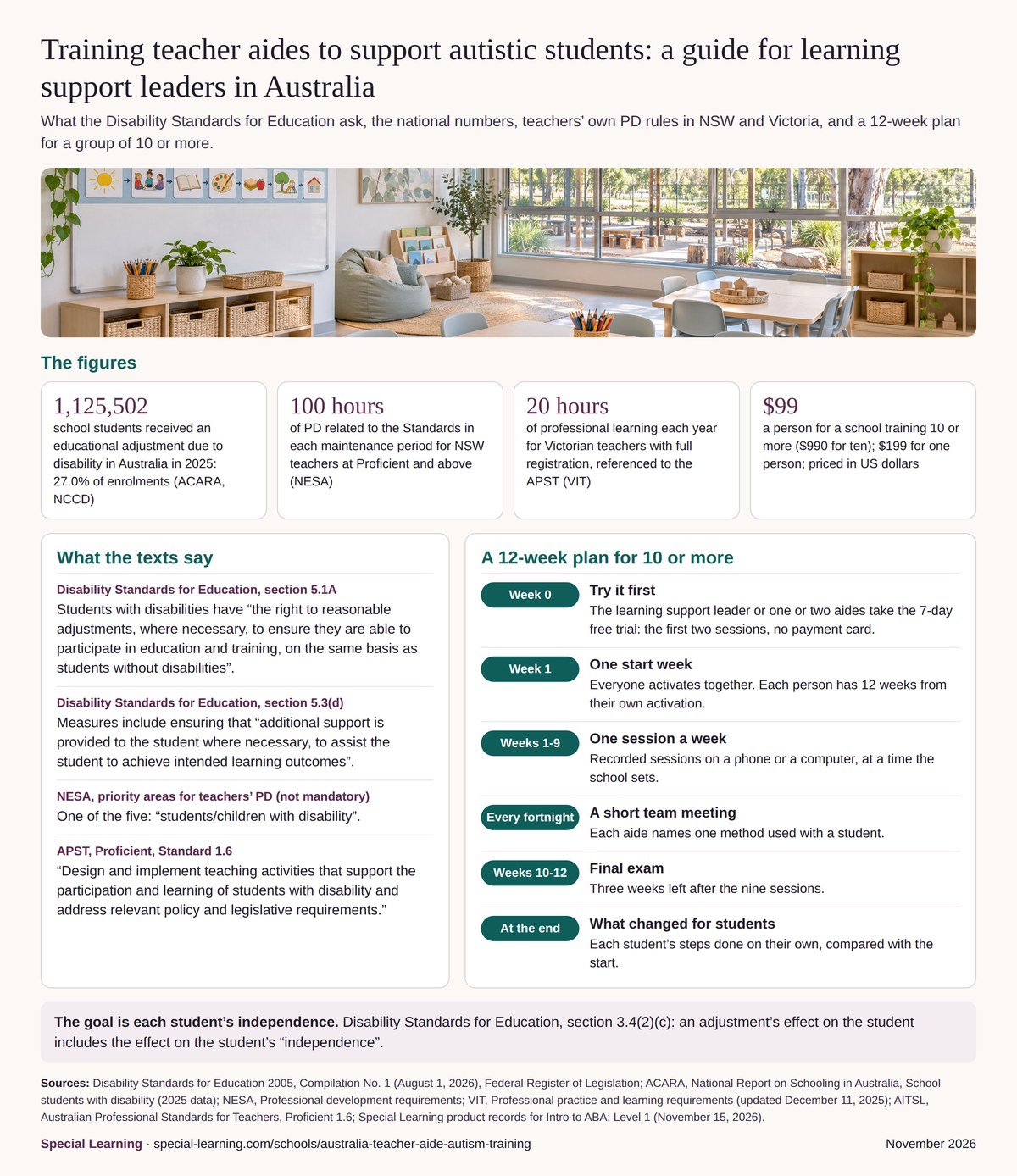
| Section 3.4(2)(c) | In assessing whether an adjustment is reasonable, regard should be had to “the effect of the adjustment on the student, including the effect on the student’s: (i) ability to achieve learning outcomes; and (ii) ability to participate in courses or programs; and (iii) independence”. | The student’s independence is one of the tests named in the law. |
| Section 5.3(d) | Measures a provider may use include ensuring that “additional support is provided to the student where necessary, to assist the student to achieve intended learning outcomes”. | Aides often give that additional support. |
Before making an adjustment, section 3.5 says “the education provider must consult the student, or an associate of the student”, including about “whether there is any other reasonable adjustment that would be less disruptive and intrusive and no less beneficial for the student.” Section 3.7 adds that “The education provider must take reasonable steps to ensure that any adjustment required to be made is made within a reasonable time.”
Sources: Disability Standards for Education 2005, Compilation No. 1, August 1, 2026, Federal Register of Legislation; Disability Standards for Education Amendment Standards 2025 (F2025L01390).

The 2025 Review. Section 11.1 asks for reviews “at intervals of not more than 5 years”. The Australian Government’s consultation for the 2025 Review of the Disability Standards for Education opened on September 26, 2025 and closed on November 21, 2025. In the Department of Education’s words, “The 2025 Review is considering three topics: How well the Standards are being implemented, What more can be done to support inclusive decision-making and complaints handling, and Whether responsibilities for assessment authorities and course developers are clear.” (Department of Education, page last modified December 8, 2025.)
National data
02The NCCD, briefly
The Nationally Consistent Collection of Data on School Students with Disability (NCCD) is the yearly count that follows from these adjustments. ACARA describes it this way: the NCCD “collects data about Australian school students with disability who are receiving adjustments in a consistent, reliable and systematic way. It enables schools, education authorities and governments to better understand the needs of students with disability and how they can be best supported at school; and allocate resources efficiently.”
Teachers “use their professional judgement based on evidence” to record the level of adjustment each student is given, one of four: support within quality differentiated teaching practice, supplementary, substantial and extensive, and the broad category of disability. The collection “is based on the broad definition of disability used in the Disability Discrimination Act 1992 (DDA) and the Disability Standards for Education 2005.”
- 1,125,502 school students “received an educational adjustment due to disability” in Australia in 2025, which “represents 27.0% of total enrolments, up from 25.7% in 2023 and 18.0% in 2015.”
- The levels in 2025: “2.8% of all school students were provided with extensive adjustments to enable them to participate in education on the same basis as other students. A further 5.2% were provided with substantial support, 11.7% were provided with supplementary support and 7.4% were supported through quality differentiated teaching practices.”
Tasmania’s Department for Education, Children and Young People puts the evidence plainly: “School records about the educational adjustments being made for students with disability are key pieces of evidence.” (Nationally Consistent Collection of Data on students with disabilities, published August 29, 2024.) The methods aides use, and the simple records they keep, are part of those school records.
Source: ACARA, National Report on Schooling in Australia, School students with disability, read November 15, 2026.
Teacher aides, SLSOs and paraprofessionals
03What aides most need to practise, and a 12-week plan
A teacher aide or SLSO in Australia does the work a US school calls a paraprofessional. States and sectors use different titles: teacher aide, school learning support officer, education support staff, learning support assistant. Our page on autism training for paraprofessionals describes the same people and the same course, and our page for shadow teachers sets out the one-to-one role in more detail.
Day to day, an aide working with an autistic student helps them through the routines of the class, breaks a task into smaller steps when that helps, gives the least help that lets the student succeed and then less, uses the student’s visual supports, supports communication in the student’s own way, and keeps short notes the teacher uses to see progress. The class teacher stays in charge of the student’s learning. Classroom practices that support participation and independence:
- Reinforcement: “The application of a consequence following a learner’s use of a response or skills that increases the likelihood that the learner will use the response/skills in the future” (NCAEP, Evidence-Based Practices for Children, Youth, and Young Adults with Autism, 2020).
- Prompting, then fading: a prompt is “Verbal, gestural, or physical assistance given to learners to support them in acquiring or engaging in a targeted behavior or skill” (NCAEP, 2020). The aide gives the help that lets the student succeed, then removes it as the student takes over.
- Visual supports: “A visual display that supports the learner engaging in a desired behavior or skills independent of additional prompts” (NCAEP, 2020): a picture timetable, a first-then card, a choice board.
- Simple data: each step marked as done on their own or with a named prompt, the kind of record AFIRM’s data sheets keep (AFIRM, UNC Chapel Hill, Prompting brief packet).
- Stepping back: the best measure of an aide is how much the student can do without them. Let the student try first, remove help over time, and note the moments the student managed alone.
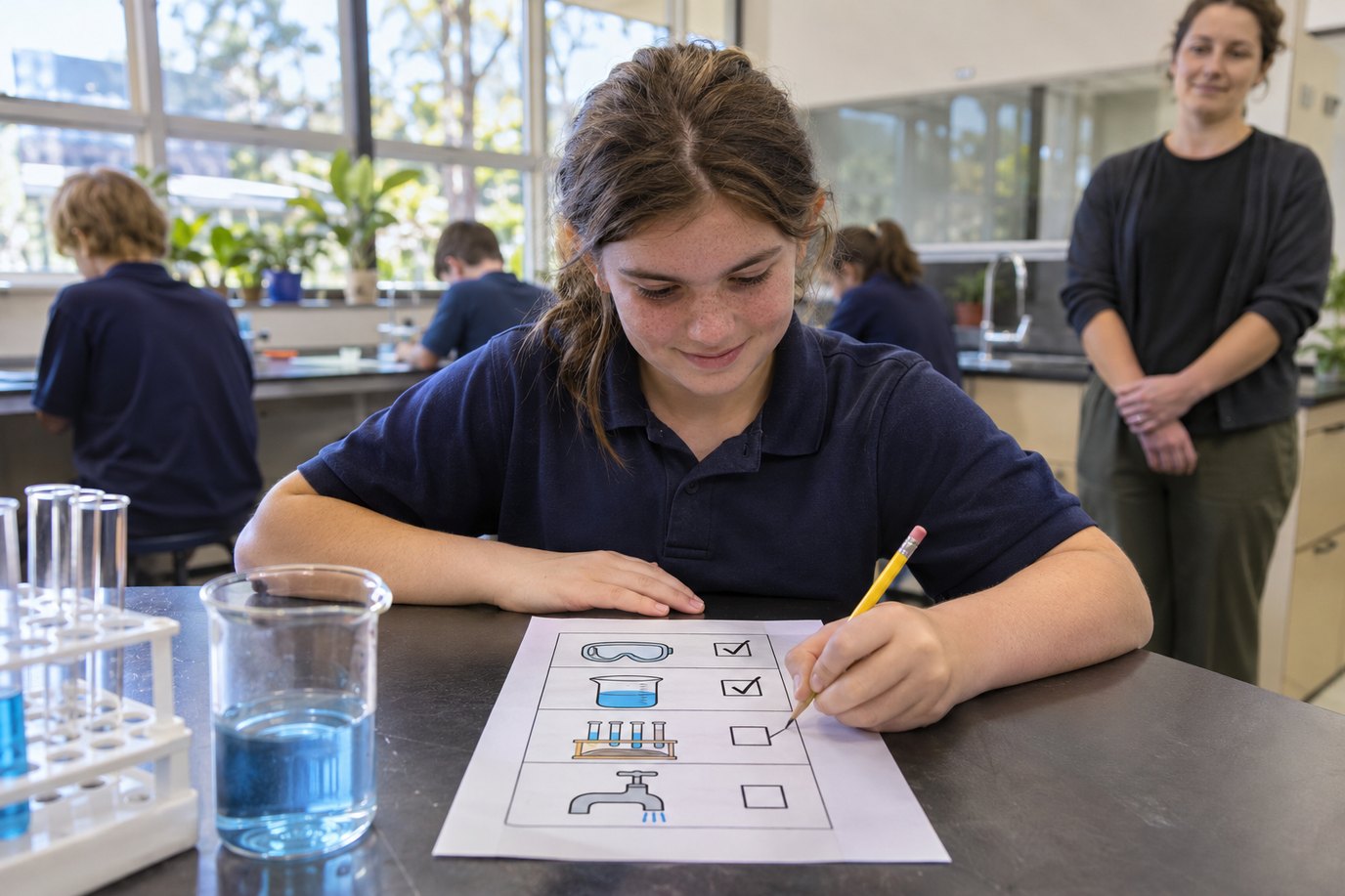
Level 1 includes errorless teaching and prompting, active student responding, beginner classroom participation skills, and an introduction to understanding behaviour through a functional behaviour assessment.
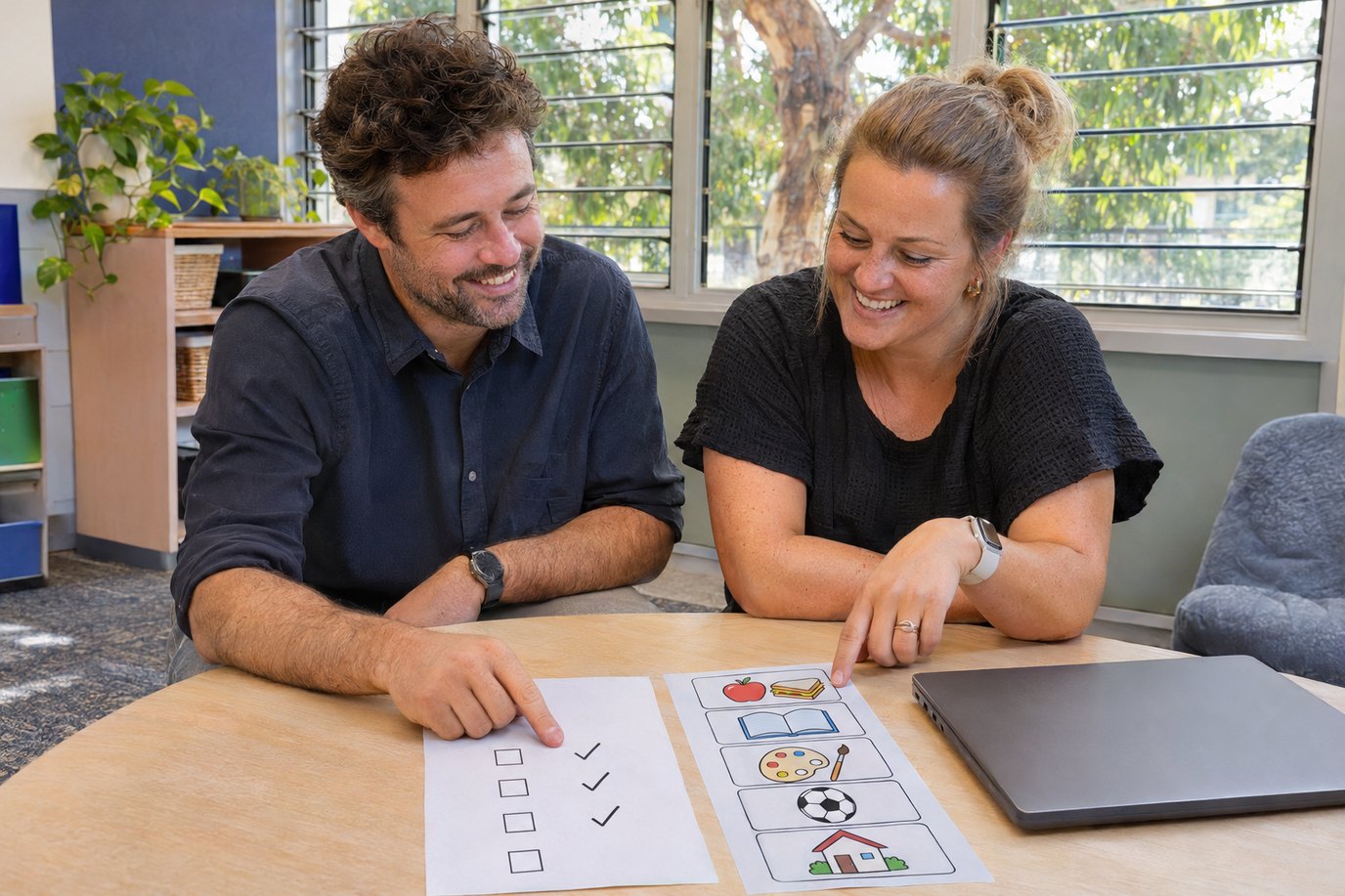
A 12-week plan for a group of 10 or more. Week 0: the learning support leader or one or two aides take the free trial. Week 1: everyone activates in the same week; each person has 12 weeks from their own activation. Weeks 1 to 9: one session a week, in each person’s own time. Every fortnight: a short meeting where each aide names one method they used with a student. Weeks 10 to 12: the final exam. Then compare each student’s record of steps done on their own with the start.
Teachers’ own PD rules, in the authorities’ words
04Teachers’ professional development in NSW and Victoria
Teachers keep their own professional development (PD) records with their state’s authority. Two of the largest states, in their own words:
New South Wales (NESA). “To maintain accreditation, you must take part in ongoing PD related to the Australian Professional Standards for Teachers (the Standards). Teachers accredited at Proficient, Highly Accomplished or Lead Teacher have the same requirements and must complete 100 hours of PD in each maintenance period.” NESA’s official notice of August 16, 2024 removed the Accredited and Elective PD categories, “to give teachers more flexibility to complete their 100 hours of professional development”, and said “the Accreditation of Professional Development Courses Policy is decommissioned effective immediately.” One of NESA’s five priority areas for PD, which it describes as not mandatory, is “students/children with disability”. The teacher records each activity in a PD log, in eTAMS or on NESA’s template, with the date, the activity, the Standard(s) addressed, the duration and the “provider name (if applicable)”.
Sources: NESA, Professional development requirements; NESA, Professional development changes for teachers, official notice, August 16, 2024; NESA, Meet your professional development requirements.
Victoria (VIT). A teacher with full registration must “complete at least 20 hours of professional learning that references the Australian Professional Standards for Teachers (APST)” each year. In the VIT’s words, “The VIT does not have a definitive list of required professional learning activities for renewal of registration”, and “You must be able to relate your professional development to the APST, and ensure that at least one standard in each domain is addressed.” Professional learning may include “short courses, multi-session professional learning and post-graduate study”, and activities “should be recorded, and include a reflection demonstrating how the activity has enhanced the teacher’s professional knowledge and/or teaching practice”, entered in MyPD in the teacher’s MyVIT account. On inclusive education, the VIT says professional learning for teaching learners with special needs “should meet descriptor 1.6” of the APST.
Sources: VIT, Professional practice and learning requirements (last updated December 11, 2025); VIT, Professional learning (last updated December 10, 2025); VIT, Renewal FAQs; VIT, Inclusive education (last updated June 30, 2026).
Standard 1.6. At Proficient level, the Australian Professional Standards for Teachers ask teachers to “Design and implement teaching activities that support the participation and learning of students with disability and address relevant policy and legislative requirements.” (AITSL, Australian Professional Standards for Teachers, Proficient.) A teacher can take Level 1 alongside their aides, so the adults who support the same student learn the same methods.
When the school pays
05How a school buys
Each school, sector and system has its own purchasing rules, and your business manager knows the route that applies. Here is how it works with us.
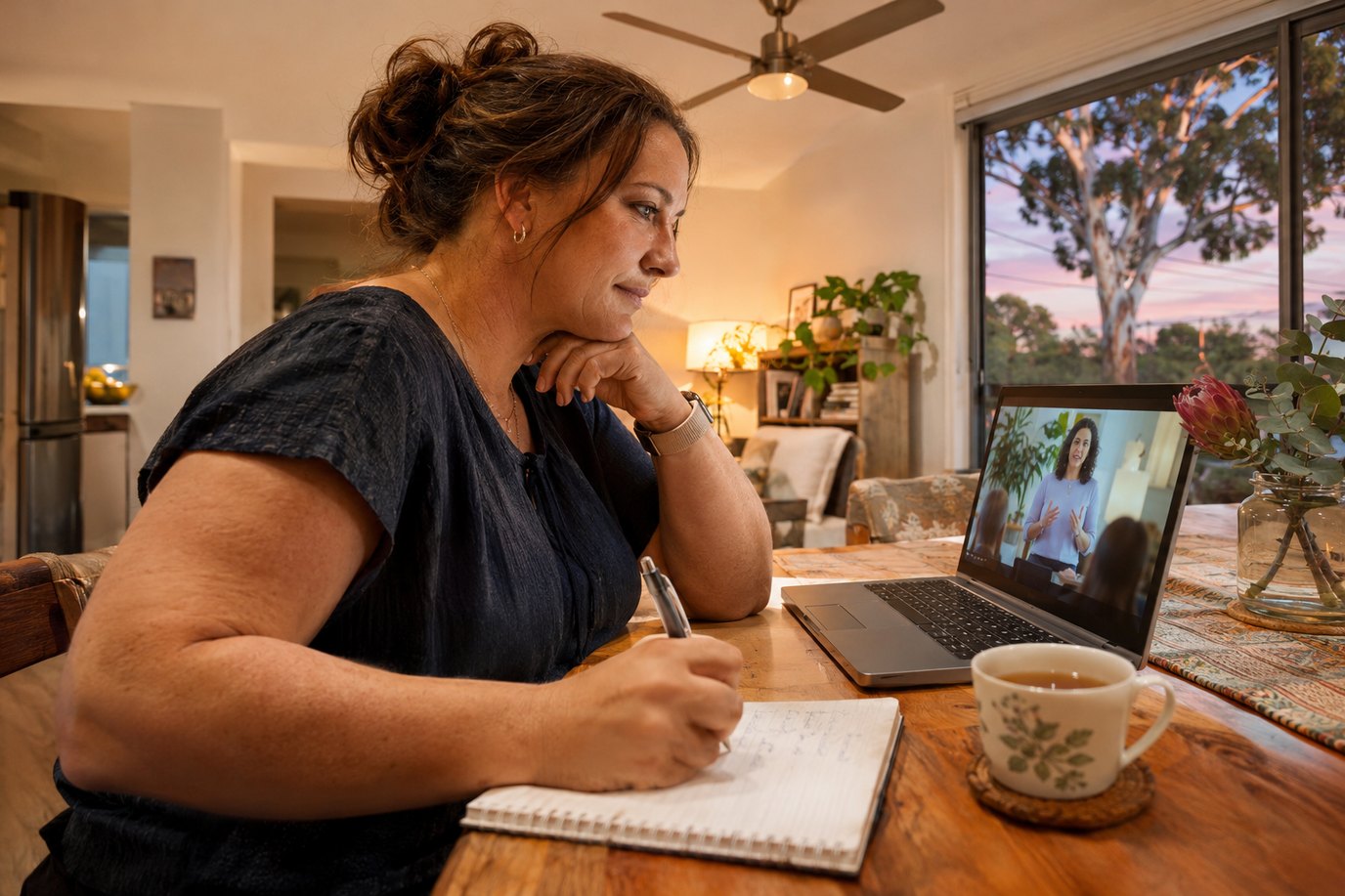
- Try it first. The learning support leader, or one or two aides, take the 7-day free trial: the first two sessions, with no payment card (start the trial).
- Ask for a quote. Tell us your school, how many staff and that you are in Australia; the form lists Australia as a country. In the notes, say what your business manager needs, such as a quote on letterhead, a supplier form or a purchase order number, and we reply with what we can provide.
- Pay. We send the school an invoice from Special Learning, Inc. in US dollars, paid by bank wire. Or pay by card in our store. Access opens once payment clears.
Planning in more detail? Plan your team and see the cost.
From the course records, November 15, 2026
06Options and prices
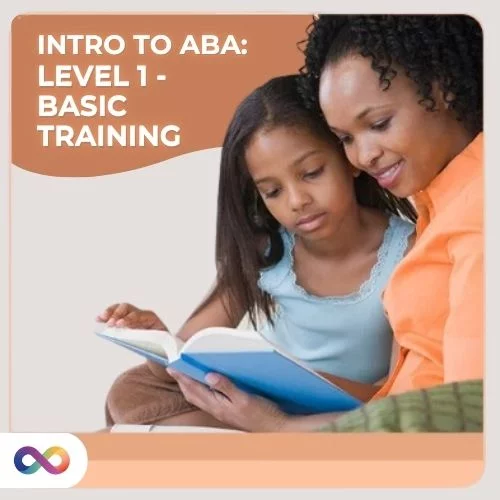
Intro to ABA: Level 1 is a course on the methods and techniques of ABA, built for the people who work with the child every day: parents and caregivers, teachers, paraprofessionals and behaviour technicians. Its nine online sessions run from what autism is to prompting, classroom participation and understanding behaviour (topics covered). A final exam follows, and each session has a short pre-test and post-test.
- One person: $199, paid once, with 11 weeks to complete the course. Australia has no separate country price, so the price is in US dollars (country pricing).
- A school training 10 or more: $99 a person, paid once, with 12 weeks from the day each person activates. Ten staff come to $990, by quote. How a school buys.
- The 7-day free trial: the first two sessions, with no payment card (start the trial).
Completing this course earns a Special Learning certificate of completion.
Buy Level 1 for one personQuestions
07Questions learning support leaders ask
Is a teacher aide or SLSO the same as a paraprofessional?
Yes, for this course. Australian schools say teacher aide, school learning support officer (SLSO), education support staff or learning support assistant, and US schools say paraprofessional; the course is the same (paraprofessional training).
How much does Level 1 cost for a school in Australia?
One person pays $199, paid once. A school training 10 or more pays $99 a person, paid once, so ten staff come to $990, by quote. Prices are in US dollars; Australia is not one of the countries with a separate country price (country pricing).
How do we pay, and can we get the paperwork our business manager needs?
We send the school an invoice from Special Learning, Inc. in US dollars, paid by bank wire. Or pay by card in our store. Access opens once payment clears. In the notes of the quote form, tell us what your business manager needs and we reply with what we can provide.
Can we try the course before we buy for the team?
Yes. The 7-day free trial covers the first two sessions, and starting it asks for your email, a password and your role, with no payment card (start the trial).
What do teacher aides learn in Level 1?
Nine online sessions: what autism is and an overview of ABA, methods of teaching, errorless teaching and prompting, active student responding, teaching methods in application, beginner classroom participation skills, and a first session on decreasing problem behaviour with a functional behaviour assessment. The examples are drawn largely from work with young children in classrooms and homes. A final exam follows, and each session has a short pre-test and post-test.
How long does each person have?
When the school buys for 10 or more, each person has 12 weeks from the day they activate their own access, so staff who join later start their 12 weeks when they begin. One person buying alone has 11 weeks to complete the course.
Do staff receive a certificate?
Completing this course earns a Special Learning certificate of completion.
Can our teachers take it too?
Yes. Level 1 is built for teachers as well as aides, so a class teacher and the aides who support the same student can learn the same methods.
What do teachers’ PD rules say in NSW and Victoria?
In NSW, teachers at Proficient, Highly Accomplished or Lead Teacher “must complete 100 hours of PD in each maintenance period”, related to the Australian Professional Standards for Teachers, and record it in their PD log (NESA, Professional development requirements). In Victoria, a teacher with full registration completes “at least 20 hours of professional learning that references the Australian Professional Standards for Teachers (APST)” each year and records it in MyPD (VIT, Professional practice and learning requirements).
What do the Disability Standards for Education say about adjustments?
Since August 1, 2026, the Standards say students with disabilities have “the right to reasonable adjustments, where necessary, to ensure they are able to participate in education and training, on the same basis as students without disabilities” (Disability Standards for Education 2005, section 5.1A). An adjustment’s effect on the student’s “independence” is one of the things weighed in deciding whether it is reasonable (section 3.4).
Is there a version for Spanish-speaking staff?
Yes, a separate course with English audio and Spanish subtitles on screen: nine recorded sessions and a final exam, $79, paid once, with a 7-day free trial of two sessions (Curso de ABA con subtítulos en español).
Your next step
Watch the first two sessions of Level 1 free for 7 days, then decide with your aides. Starting it asks for no payment card.
Try the first two sessions freeMore for schools: training for schools, autism training for paraprofessionals, training for shadow teachers, training for international schools, teaching assistant training for UK schools and educational assistant training for Canadian schools. For ABA practitioners and certification in Australia: our Australia guide.