
For principals, SPED coordinators and inclusion leads in Philippine schools, and the shadow teachers who work beside learners
Shadow teacher and SPED training: what RA 11650 asks of schools, what a shadow teacher practices, and a way to start this school year
Republic Act No. 11650 says it plainly: “The policy of inclusion is hereby instituted in all early and basic education schools, both public and private.” In many Philippine classrooms, the adult beside a learner with a disability is a shadow teacher, hired by the school or brought in by the family. Special Learning’s Intro to ABA: Level 1 trains shadow teachers, SPED aides and teachers online: nine recorded sessions on the methods of applied behavior analysis (ABA), then a final exam, watched on a phone or a computer in each person’s own time. When you shop from the Philippines, the store shows it at $70, in US dollars. A school training 10 or more can ask us for a quote. Anyone can try the first two sessions free for 7 days, with no payment card.
Start the 7-day free trialTraining 10 or more shadow teachers or aides? Request a quote

The law’s own words, read November 15, 2026
01What RA 11650 asks of schools
Republic Act No. 11650, the “Instituting a Policy of Inclusion and Services for Learners with Disabilities in Support of Inclusive Education Act”, was approved on March 11, 2022. It also creates Inclusive Learning Resource Centers (ILRCs). What it asks, in its own words:
| Section | The Act’s words | For a principal or SPED coordinator |
|---|---|---|
| Section 5 | “The policy of inclusion is hereby instituted in all early and basic education schools, both public and private. All schools, whether public or private, shall ensure equitable access to quality education to every learner with disability, such that no learner shall be denied admission on the basis of disability.” | Public and private schools are both covered. |
| Section 5 | “All learners with disabilities, whether enrolled in public or private schools, shall be accorded services and reasonable accommodation based on the IEP”. | The IEP sets the services; support in the classroom carries them out. |
| Section 3(k) | One objective is “To train and equip all teachers, including child development teachers and workers, principals, administrators, non-teaching staff of the school, sign language interpreters, parents, guardians, and care providers as partners in the care, development, education, and advancement of learners with disabilities”. | Training is named for teachers, non-teaching staff and families alike. |
| Section 4(k) | “Learning Support Aides refer to qualified persons who work together in collaboration with special needs education teachers and para-teachers as defined in this Act, and contribute to the provision of services that promote achievement and progression of learners with disabilities.” | The closest role the Act defines to a shadow teacher. |
| Section 6 | “The DepEd, in collaboration with local government units (LGUs), shall initially establish and maintain at least one (1) ILRC in all cities and municipalities”, and “All existing SPEC Centers shall be converted to and renamed as ‘Inclusive Learning Resource Center’.” | Ask your DepEd division office which ILRC serves your school and what support is available. |
| Section 7(f) | The ILRC shall “provide and facilitate consultative mechanism, counseling, technical assistance, and training to general basic education teachers, administrators, CDC child development workers and teachers, non-teaching personnel, parents, care providers, guardians, or other family members” on the education of learners with disabilities. | Ask the ILRC that serves your school what training it offers. |
| Section 11 | “The DepEd shall also collaborate with relevant partners in the government, the academe, and the private sector to develop and conduct appropriate training programs, advanced seminars, and workshops on disability for all in-service teachers, which may include those in private schools”. | In-service training on disability, which may include teachers in private schools. |
| Section 29 | “All public and private basic educational institutions and the ILRCs shall be given a period of not more than five (5) years from the effectivity of this Act to comply with its provisions and requirements.” | The Act gave schools up to five years. |
Where a shadow teacher fits. The Act does not use the words “shadow teacher”. It defines learning support aides (above) and para-teachers, and it lists “para-teachers, learning support aides, and other persons as may be qualified by the DepEd to teach learners with disabilities” among ILRC personnel (section 4(g)). Schools and families use “shadow teacher” for the adult who supports one learner in class, and what that person may do is set by the school and the learner’s IEP.
The goal is independence. The Act defines the IEP as a plan that “shall likewise aim at developing the learner’s strengths and talents to achieve the greatest possible self-sufficiency and independent living” (section 4(h)), and one of its objectives is “To ensure that learners with disabilities develop their full potential toward self-sufficiency and become fully participative members of society” (section 3(d)).
Source: Republic Act No. 11650, March 11, 2022, full text as published by Lawphil (Arellano Law Foundation), read November 15, 2026.
DepEd’s rules and guidelines
02The IRR and DepEd Order No. 44, s. 2021
The Implementing Rules and Regulations (IRR). DepEd published the IRR of RA 11650 on its website (posted March 3, 2025). In its own words:
- Scope (section 2): “Pursuant to Section 5 of the Act, this IRR shall apply to all early and basic education schools and Community Learning Centers (CLCs), both public and private.”
- Private schools (section 7.2): “Private early or basic education schools may likewise establish additional facilities needed for the education of learners with disabilities in coordination with ILRCs within their cities or municipalities.”
- ILRC minimum standards (section 7.3): including “Availability of services of trained ILRC supervisor, special needs education teacher, para-teacher, and learning support aide”.
- In-service training (section 12): “DepEd, through the NEAP and the Bureau of Human Resource and Organizational Development (BHROD), shall provide in-service training for teaching and non-teaching personnel.”
Source: IRR of RA 11650 (DepEd, scanned PDF, 30 pages), read November 15, 2026.
DepEd Order No. 44, s. 2021. The Policy Guidelines on the Provision of Educational Programs and Services for Learners with Disabilities in the K to 12 Basic Education Program took effect in School Year 2021-2022: “this policy shall be implemented in public and private elementary and secondary schools. However, private schools may contextualize the necessary provisions depending on their needs and contexts.” Its section on teachers begins: “All teachers shall be considered primary implementers of inclusive education.” It adds: “The Department recognizes the PPST as a major reference in designing interventions geared towards the professional development of teachers, including teacher aides and teacher volunteers.” General education teachers shall “Collaborate closely with SPED teachers, non-teaching personnel and/or parents, ILRC Coordinator and/or Resource Room Teacher and other professionals in responding to specific and additional needs of LWDs”.
Source: DepEd Order No. 44, s. 2021, section VII (Teachers), read November 15, 2026.
Shadow teachers, SPED aides and learning support aides
03What a shadow teacher practices, and a 12-week plan
A shadow teacher does the work a US school calls a paraprofessional and a UK school a teaching assistant. Our page on shadow teacher training sets out the role across countries, and our page on autism training for paraprofessionals describes the same course for US schools.
Day to day, a shadow teacher helps the learner follow the lesson the class teacher planned, breaks a task into smaller steps when that helps, gives the least help that lets the learner succeed and then less, uses the learner’s visual supports, supports communication in the learner’s own way, and keeps short notes the teacher and the family can use. The class teacher stays in charge of the learner’s learning. What to practice:
- Reinforcement: “The application of a consequence following a learner’s use of a response or skills that increases the likelihood that the learner will use the response/skills in the future” (NCAEP, Evidence-Based Practices for Children, Youth, and Young Adults with Autism, 2020). In class: specific praise, a turn with a favorite activity, a token toward a choice.
- Prompting, then fading: a prompt is “Verbal, gestural, or physical assistance given to learners to support them in acquiring or engaging in a targeted behavior or skill” (NCAEP, 2020). Give the help that lets the learner succeed, then remove it as the learner takes over.
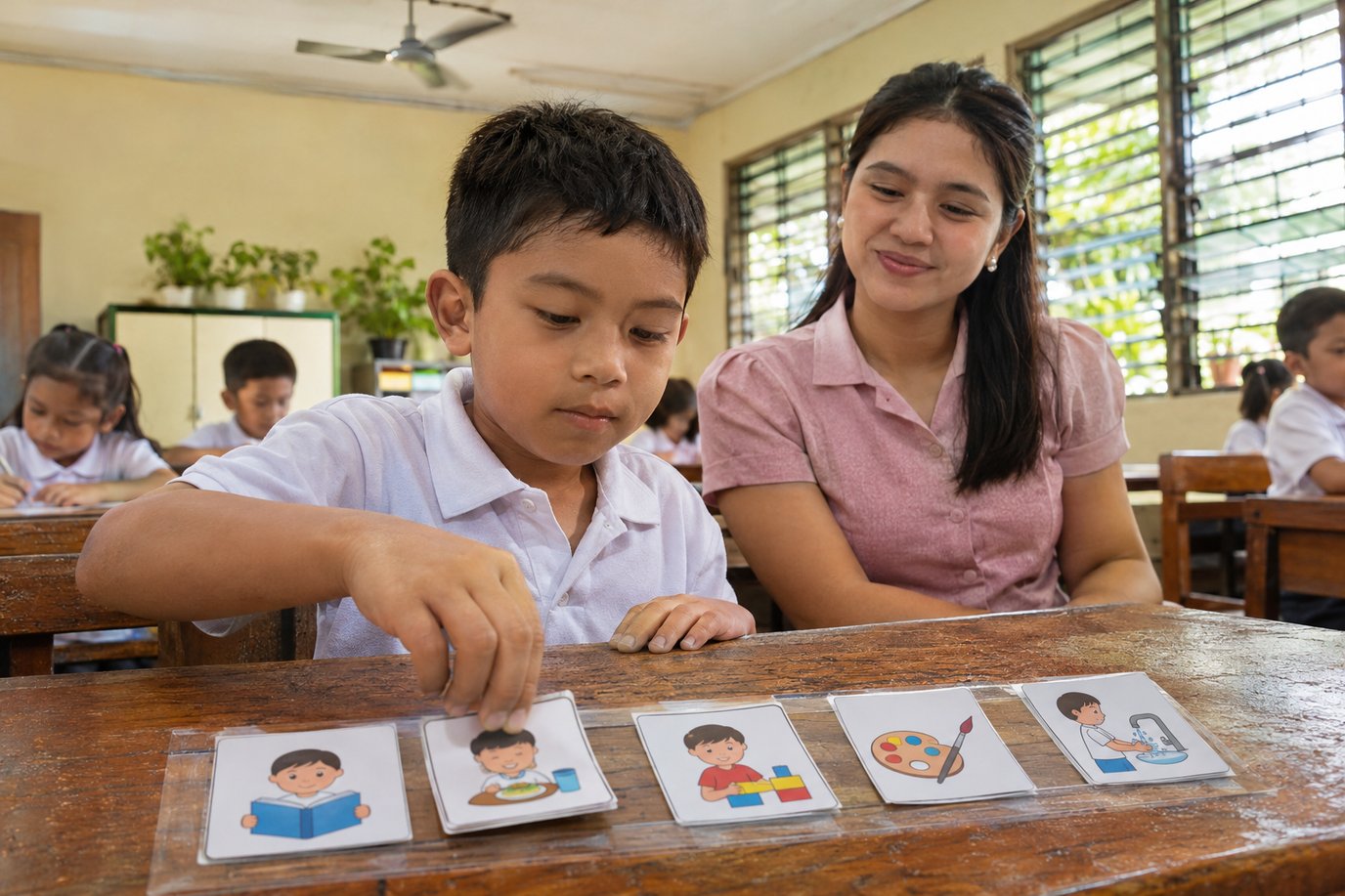
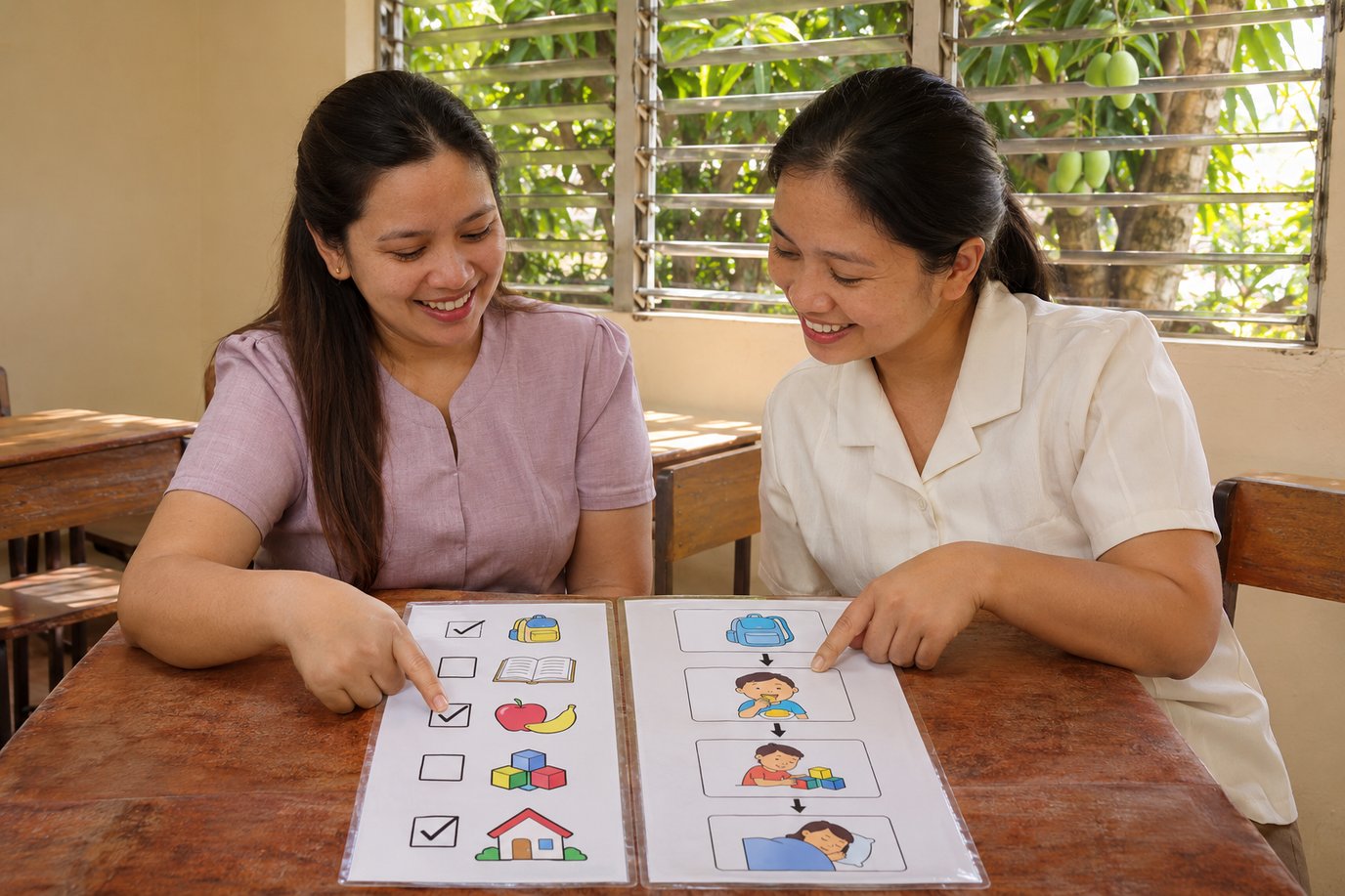
- Visual supports: “A visual display that supports the learner engaging in a desired behavior or skills independent of additional prompts” (NCAEP, 2020): a picture schedule, a first-then card, a choice board.
- Simple data: for each step of a routine, a tick for “did it on their own” or the name of the prompt given. A week of ticks shows the teacher, the SPED coordinator and the family whether help is shrinking.
- Stepping back: the best measure of a shadow teacher is how much the learner can do without them. Let the learner try first, stand a little farther away each week, and note the moments the learner managed alone.
Level 1 includes errorless teaching and prompting, active student responding, beginner classroom participation skills, and an introduction to understanding behavior through a functional behavior assessment.
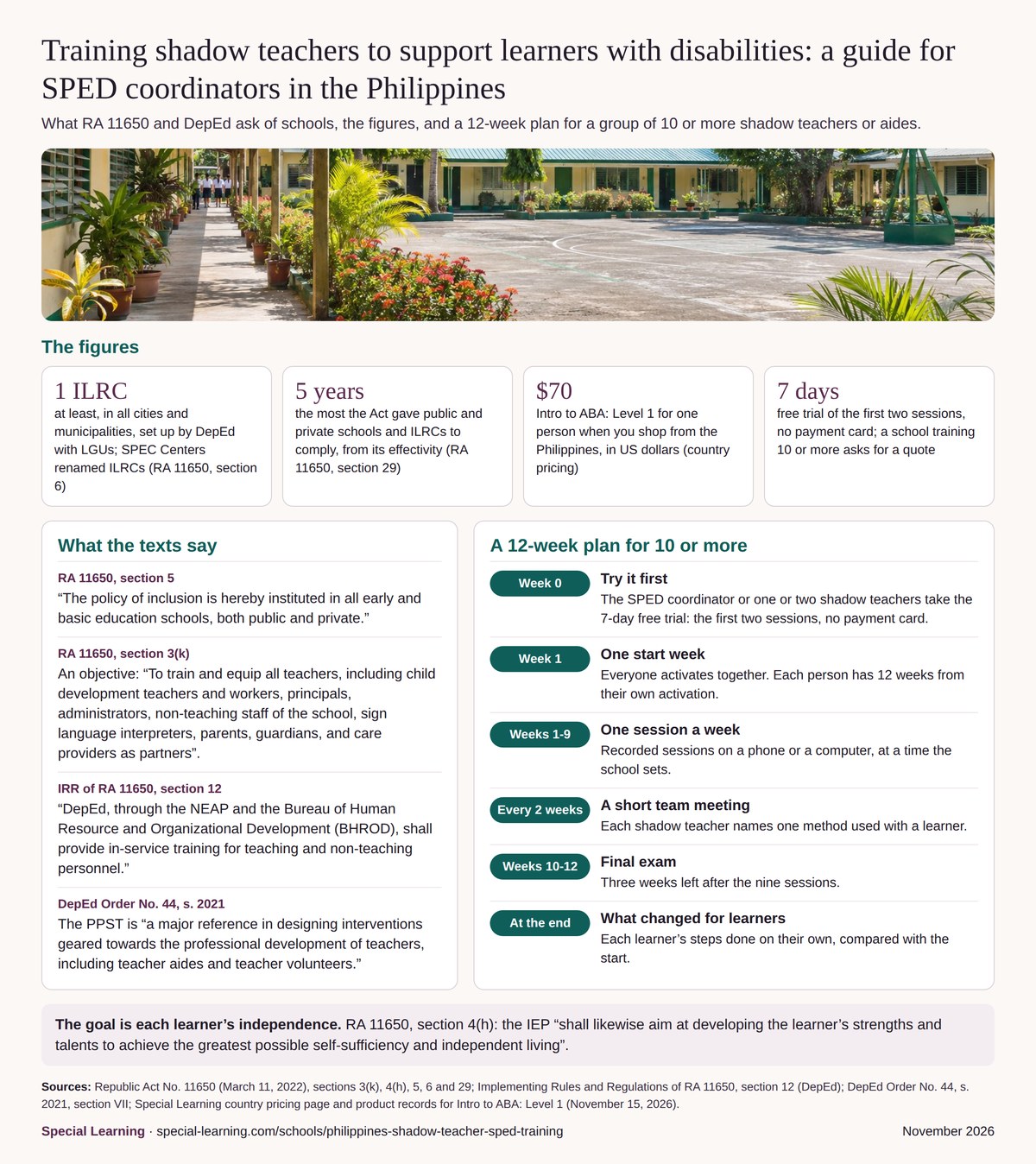
A 12-week plan for a group of 10 or more. Week 0: the SPED coordinator or one or two shadow teachers take the free trial. Week 1: everyone activates in the same week; each person has 12 weeks from their own activation. Weeks 1 to 9: one session a week, in each person’s own time. Every two weeks: a short LAC-style meeting where each shadow teacher names one method they used with a learner. Weeks 10 to 12: the final exam. Then compare each learner’s record of steps done on their own with the start.
DepEd’s memoranda, in their own words
04Teachers’ professional development: the DepEd context
Teachers in DepEd schools and the school heads who plan their training will want the current position on outside providers. Here is what DepEd’s own memoranda say.
NEAP recognition, January 2024. DepEd memorandum DM-OUHROD-2024-0146 of February 1, 2024 says: “With the expiration of DepEd Memorandum No. 050 s. 2020, the field is now advised that the validity of all NEAP-recognized PD programs and courses given by Authorized Learning Service Providers has expired effective January 2024.” It goes on: “PD program service providers external to DepEd may continue to offer PD programs subject to the voluntary participation of teachers and school leaders.”
Source: DM-OUHROD-2024-0146, February 1, 2024, as attached to NCR Regional Memorandum No. 093, s. 2024 and SDO Muntinlupa’s memorandum of February 14, 2024.
DepEd’s own CPD providers, March 2024. A NEAP memorandum of March 7, 2024 says: “As of 04 March 2024, all DepEd ROS, through the Human Resource Development Division (HRDD)/ NEAP in the Regions (NEAP-R), are now PRC-accredited CPD providers”, directs Schools Division Offices to apply as CPD providers, and says that “only quality-assured professional development programs developed by SDOS, quality-assured school-based in-service training (INSET) programs, and learning action cells developed at the school level, shall be processed for PRC accreditation at the division level.”
Source: DepEd, March 7, 2024 – Application of Schools Division Offices as PRC-Accredited CPD Providers (DM-OUHROD-2024-0410).
New guidelines in draft, 2026. On March 23, 2026, DepEd said that NEAP “is currently finalizing the draft DepEd Order titled Revised Guidelines on NEAP Authorization of Learning Service Providers and Recognition of Professional Development Programs for Teachers, School Leaders, and Teaching-Related Personnel.” Its consultation closed on April 1, 2026; check deped.gov.ph for the order itself.
When the school pays
05How a school buys
Public schools, private schools and families each pay in their own way, and your school’s finance office knows the route that applies. Here is how it works with us.

- Try it first. The SPED coordinator, or one or two shadow teachers, take the 7-day free trial: the first two sessions, with no payment card (start the trial).
- Ask for a quote. Tell us your school, how many staff and that you are in the Philippines; the form lists the Philippines as a country. In the notes, say what your finance office needs, such as a quote on letterhead or a supplier form, and we reply with what we can provide.
- Pay. We send the school an invoice from Special Learning, Inc. in US dollars, paid by bank wire. Or pay by card in our store. Access opens once payment clears.
A family that brings in its own shadow teacher can buy Level 1 for that person in the store, and a parent can take it alongside them, so home and school use the same methods.
Request a quote for your schoolFrom the course records, November 15, 2026
06Options and prices
Intro to ABA: Level 1 is a course on the methods and techniques of ABA, built for the people who work with the child every day: parents and caregivers, teachers, paraprofessionals and behavior technicians. Its nine online sessions run from what autism is to prompting, classroom participation and understanding behavior (topics covered). A final exam follows, and each session has a short pre-test and post-test.
- One person shopping from the Philippines: $70, paid once, in US dollars, with 11 weeks to complete the course. There is no code to enter: the store shows the price for the country you shop from (country pricing).
- A school training 10 or more: ask for a quote, and each person has 12 weeks from the day they activate. How a school buys.
- The 7-day free trial: the first two sessions, with no payment card (start the trial).
Completing this course earns a Special Learning certificate of completion.
Buy Level 1 for one personQuestions
07Questions SPED coordinators ask
Is a shadow teacher the same as a learning support aide?
Not exactly. RA 11650 defines learning support aides as “qualified persons who work together in collaboration with special needs education teachers and para-teachers” (section 4(k)) and does not use the words “shadow teacher”. Schools and families use “shadow teacher” for the adult who supports one learner in class. Level 1 is the same course for both.
How much does Level 1 cost in the Philippines?
When you shop from the Philippines, the store shows Intro to ABA: Level 1 at $70, paid once, in US dollars (country pricing). A school training 10 or more can request a quote.
How do we pay, and can we get the papers our finance office needs?
We send the school an invoice from Special Learning, Inc. in US dollars, paid by bank wire. Or pay by card in our store. Access opens once payment clears. In the notes of the quote form, tell us what your finance office needs and we reply with what we can provide.
Can we try the course before we buy for the team?
Yes. The 7-day free trial covers the first two sessions, and starting it asks for your email, a password and your role, with no payment card (start the trial).
What do shadow teachers learn in Level 1?
Nine online sessions: what autism is and an overview of ABA, methods of teaching, errorless teaching and prompting, active student responding, teaching methods in application, beginner classroom participation skills, and a first session on decreasing problem behavior with a functional behavior assessment. The examples are drawn largely from work with young children in classrooms and homes. A final exam follows, and each session has a short pre-test and post-test.
How long does each person have?
When the school buys for 10 or more, each person has 12 weeks from the day they activate their own access, so staff who join later start their 12 weeks when they begin. One person buying alone has 11 weeks to complete the course.
Do staff receive a certificate?
Completing this course earns a Special Learning certificate of completion.
Can a family buy it for the shadow teacher they hired?
Yes. A parent can buy Level 1 for their child’s shadow teacher in the store, and Level 1 is built for parents and caregivers too, so the family and the shadow teacher can learn the same methods (Level 1 in the store).
What does RA 11650 say about training school staff?
One of its objectives is “To train and equip all teachers, including child development teachers and workers, principals, administrators, non-teaching staff of the school, sign language interpreters, parents, guardians, and care providers as partners in the care, development, education, and advancement of learners with disabilities” (section 3(k)). Section 11 has DepEd working with the private sector on training “for all in-service teachers, which may include those in private schools”.
What did DepEd say about outside PD providers in 2024?
DM-OUHROD-2024-0146 of February 1, 2024 says the validity of NEAP-recognized PD programs and courses given by Authorized Learning Service Providers “has expired effective January 2024”, and that “PD program service providers external to DepEd may continue to offer PD programs subject to the voluntary participation of teachers and school leaders” (the memorandum). In March 2026, DepEd said revised NEAP guidelines were being finalized (advisory).
Your next step
Watch the first two sessions of Level 1 free for 7 days, then decide with your shadow teachers. Starting it asks for no payment card.
Try the first two sessions freeMore for schools: training for schools, training for shadow teachers, autism training for paraprofessionals, training for international schools and teacher aide training for Australian schools. For ABA practitioners and certification in the Philippines: our Philippines guide.