
For preschool directors, Head Start and Early Head Start education managers, childcare center directors and pre-K coordinators
Preschool autism training: what early childhood staff practice, and what Head Start asks of training
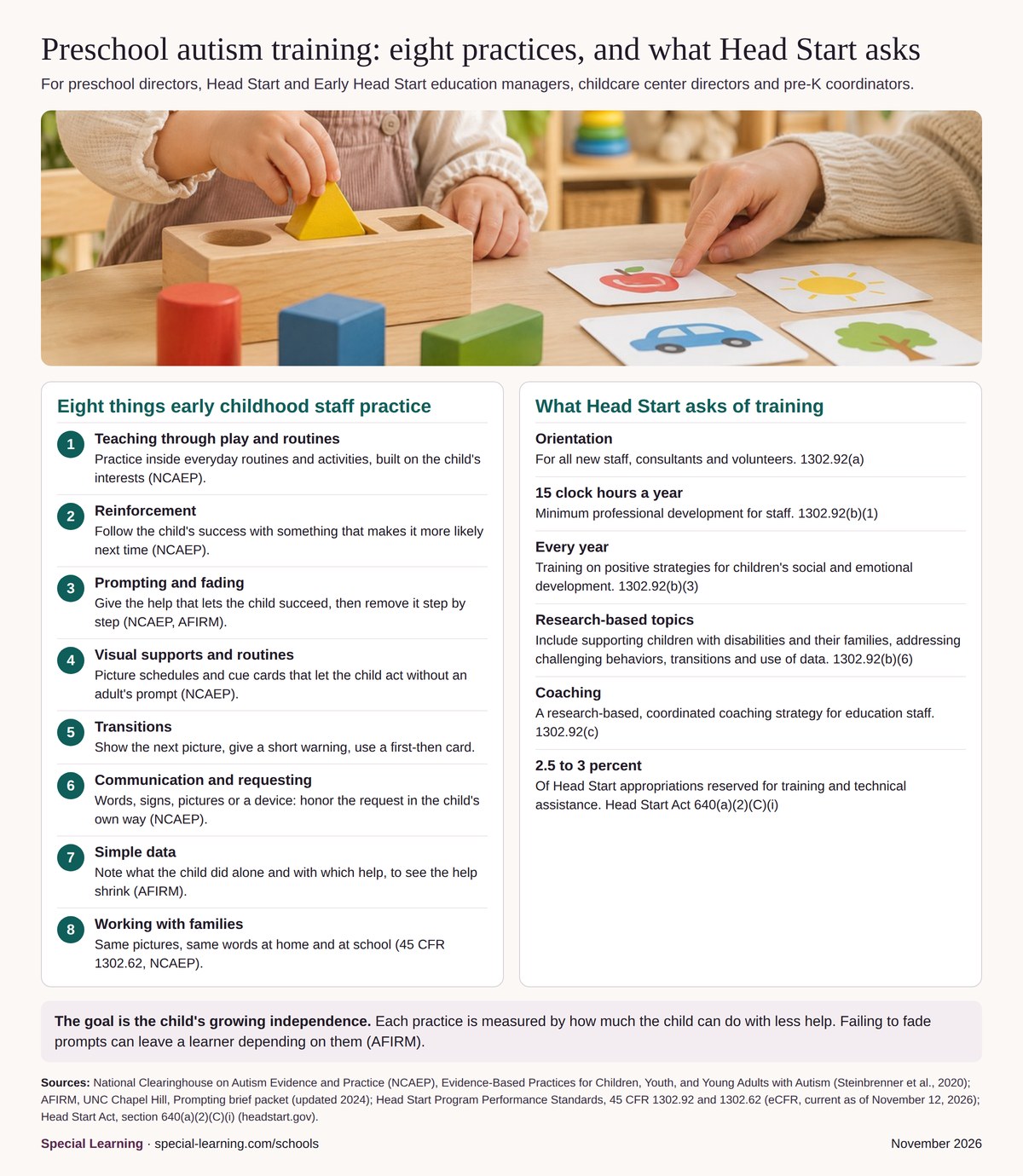
Eight practices matter most for preschool teachers and assistants who support young autistic children: teaching through play and daily routines, reinforcement, prompting and fading, visual supports, transitions, communication and requesting, simple data, and working with families. The goal of each is the same: the child doing more on their own. Head Start's standards call for at least 15 clock hours of professional development a year for staff, and a coaching strategy for education staff (45 CFR 1302.92). Preschool candidates for the Child Development Associate (CDA) credential need 120 hours of formal training, with no fewer than 10 hours in each of eight subject areas. A short online course on ABA methods, such as Special Learning's Intro to ABA: Level 1 ($199, with a 7-day free trial of the first two sessions), can sit beside a program's own coaching.
Start the free trialTraining 10 or more staff? $99 a person: request a quote for your program
From the research and Head Start's own standards, read November 15, 2026
01What early childhood staff most need to practice
Every autistic child is different: how they communicate, what they enjoy and what they are working on. Most of these practices draw on the evidence-based practices identified by the National Clearinghouse on Autism Evidence and Practice (NCAEP), which reviewed intervention research for autistic children, youth and young adults from birth to 22 (NCAEP, Evidence-Based Practices for Children, Youth, and Young Adults with Autism, 2020). Transitions, data and partnering with families also appear in Head Start's list of professional development topics for education staff (45 CFR 1302.92(b)(6)).
1. Teaching through play and routines
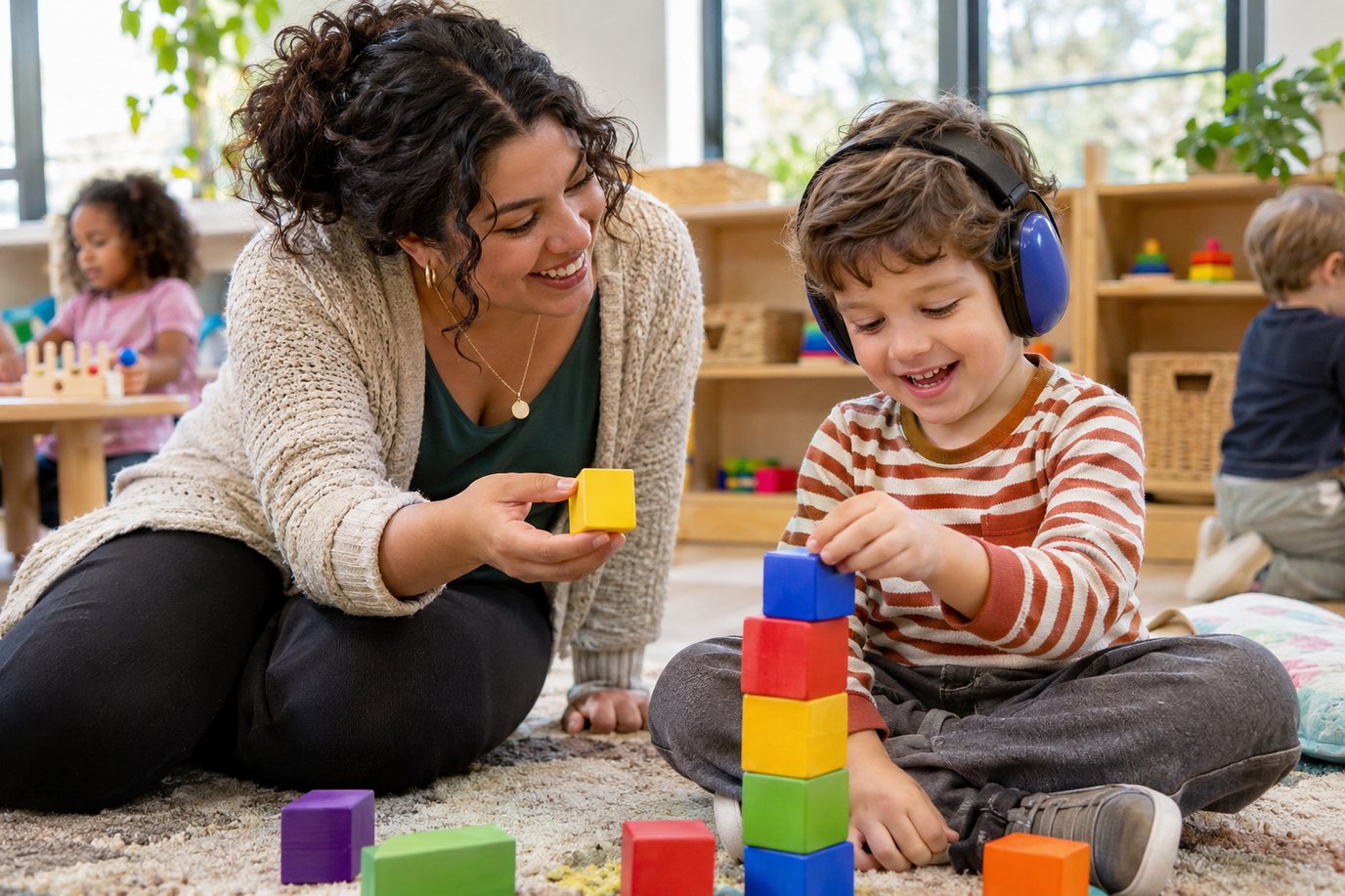
NCAEP describes naturalistic intervention as practices "implemented during everyday routines and activities in the learner's classroom or home environment", "designed to encourage specific target behaviors based on learners' interests" (NCAEP, 2020). In a preschool room that means joining the child's play, following their lead, and offering the next step inside it: holding out the next block, pausing before the last line of a song, waiting for a look or a word.
2. Reinforcement
Reinforcement is "the application of a consequence following a learner's use of a response or skills that increases the likelihood that the learner will use the response/skills in the future" (NCAEP, 2020). For a three-year-old that can be specific praise, another turn with a favorite toy, a tickle or a song, given right after the child does the skill.
3. Prompting and fading
NCAEP defines prompting as "Verbal, gestural, or physical assistance given to learners to support them in acquiring or engaging in a targeted behavior or skill" (NCAEP, 2020). The adult gives the help that lets the child succeed, then removes it step by step. AFIRM warns: "Failure to appropriately fade prompts can cause the learner to become prompt dependent" (AFIRM, UNC Chapel Hill, Prompting brief packet, updated 2024).
4. Visual supports and routines
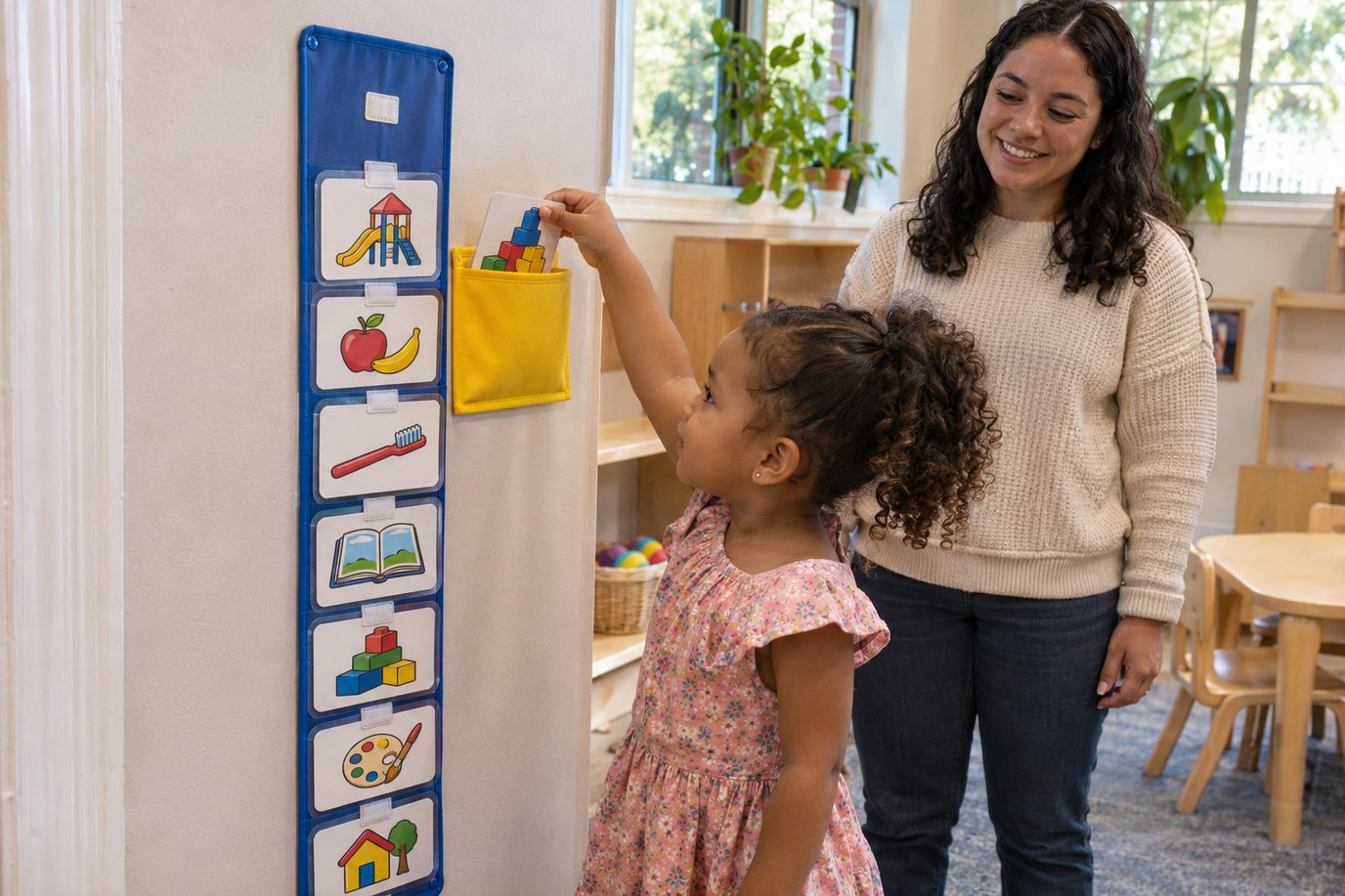
A visual support is "a visual display that supports the learner engaging in a desired behavior or skills independent of additional prompts"; common examples are "visual schedules, activity schedules, work systems, graphic organizers, visual cues, and scripts" (NCAEP, 2020). A picture schedule for the day, a picture of each step of handwashing and a choice board at snack time let a young child follow the routine without waiting for an adult's words.
5. Transitions
Moving from outdoor play to circle time, or from one room to another, is a moment when a predictable routine helps. Staff practice the same steps every time: show the next picture on the schedule, give a short warning, use a first-then card ("first clean up, then snack") and give the child a job to carry, such as the book for circle time. NCAEP notes that visual supports "provide information about an activity, routine, or expectation" (NCAEP, 2020). Head Start also names "preparing children and families for transitions", such as the move to kindergarten, as a professional development focus (45 CFR 1302.92(b)(6)).
6. Communication and requesting
Children communicate in many ways: words, signs, gestures, pictures or a speech device. NCAEP describes augmentative and alternative communication as interventions that "use and/or teach the use of a system of communication that is not verbal/vocal including aided and unaided communication systems", and functional communication training as practices that "replace a challenging behavior that has a communication function with more appropriate and effective communication behaviors or skills" (NCAEP, 2020). Staff create moments to ask, such as a favorite toy in sight but out of reach, and honor the request in whatever form the child uses.
7. Simple data
Head Start lists the "use of data to individualize learning experiences to improve outcomes for all children" among its professional development topics (45 CFR 1302.92(b)(6)). AFIRM's data collection sheets ask staff to "collect data on chained tasks completed correctly without prompts (I), with prompts (V, G, M, P)", so the team can see the help shrinking (AFIRM Prompting brief packet, updated 2024). A few tally marks during snack or circle time are a start.
8. Working with families
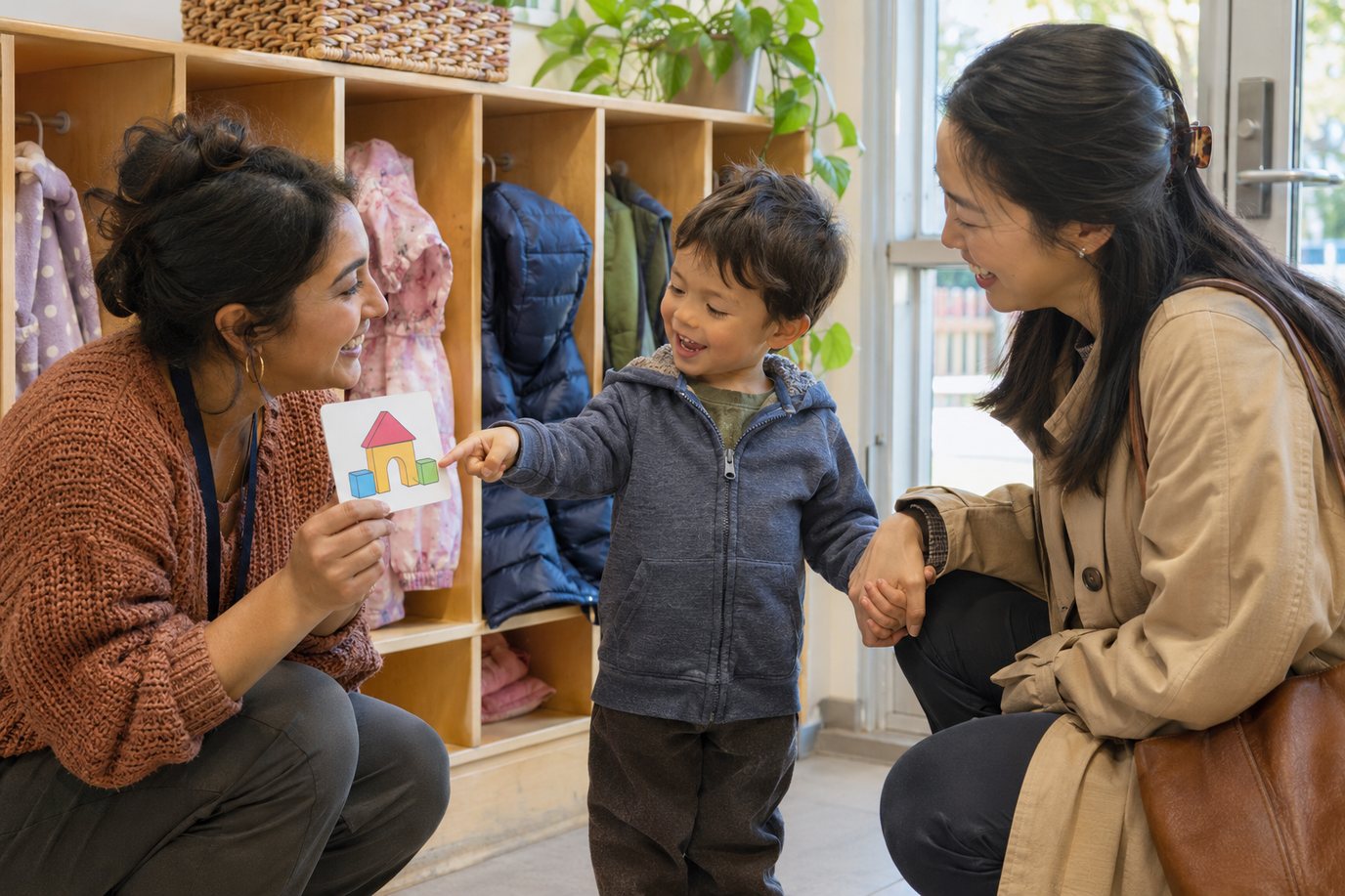
Families know their child best. Head Start programs must collaborate with parents of children with disabilities, including giving "information and skills to help parents understand their child's disability and how to best support the child's development" (45 CFR 1302.62(a)(1)). NCAEP counts parent-implemented intervention among its evidence-based practices: "Parent delivery of an intervention to their child that promotes their social communication or other skills" (NCAEP, 2020). When home and school use the same pictures and the same words, the child practices all day.
The goal is the child's growing independence. Each practice is measured by how much the child can do with less help: asking for a toy, following the schedule, joining the group.
The Head Start Program Performance Standards, quoted from eCFR, current as of November 12, 2026
02What Head Start requires of staff training
Head Start and Early Head Start programs follow the Head Start Program Performance Standards, 45 CFR Part 1302. Section 1302.92 sets the training rule; sections 1302.60 to 1302.63 set the services for children with disabilities that staff carry out. Each line below is the regulation's own words.
| Section | What it says |
|---|---|
| 1302.92(a) | "A program must provide to all new staff, consultants, and volunteers an orientation that focuses on, at a minimum, the goals and underlying philosophy of the program and on the ways they are implemented." |
| 1302.92(b) | "A program must establish and implement a systematic approach to staff training and professional development designed to assist staff in acquiring or increasing the knowledge and skills needed to provide high-quality, comprehensive services within the scope of their job responsibilities". At a minimum it includes "(1) Staff completing a minimum of 15 clock hours of professional development per year" and "(3) Annual training on positive strategies to understand and support children's social and emotional development, such as tools for managing children's behavior". |
| 1302.92(b)(5) | "Training for child and family services staff, including staff that work on family services, health, and disabilities, that builds their knowledge, experience, and competencies to improve child and family outcomes". |
| 1302.92(b)(6) | "Research-based approaches to professional development for education staff, that are focused on effective curricula implementation, knowledge of the content in Head Start Early Learning Outcomes Framework: Ages Birth to Five, partnering with families, supporting children with disabilities and their families, providing effective and nurturing adult-child interactions, supporting dual language learners as appropriate, addressing challenging behaviors, preparing children and families for transitions (as described in subpart G of this part), and use of data to individualize learning experiences to improve outcomes for all children." |
| 1302.92(c) | "A program must implement a research-based, coordinated coaching strategy for education staff", including "opportunities to be observed and receive feedback and modeling of effective teacher practices directly related to program performance goals" for the staff identified for intensive coaching. |
| 1302.60 | Children with disabilities and their families receive "all applicable program services delivered in the least restrictive possible environment" and "fully participate in all program activities." |
| 1302.61(a) | "Programs must provide any necessary modifications to the environment, multiple and varied formats for instruction, and individualized accommodations and supports as necessary to support the full participation of children with disabilities." |
| 1302.61(c)(1) | Programs "Work closely with the local agency responsible for implementing IDEA, the family, and other service partners" so that "Children are working towards the goals in their IFSP or IEP" and "Services are provided in a child's regular Head Start classroom or family child care home to the greatest extent possible." |
| 1302.63(c) | "A program must participate in the development of the IFSP or IEP if requested by the child's parents, and the implementation of the IFSP or IEP." |
The training and technical assistance set-aside
The Head Start Act tells the Secretary to "reserve for each fiscal year an amount that is not less than 2.5 percent and not more than 3 percent of the sums appropriated pursuant to section 639 for that fiscal year, to fund training and technical assistance activities". Of the share for Head Start programs other than Early Head Start, "not less than 50 percent shall be made available to Head Start agencies to use directly" (Head Start Act, section 640(a)(2)(C)(i), on headstart.gov). Section 648(d) lists what agencies use those funds for, including "Activities that ensure that Head Start programs have adequate numbers of trained, qualified staff who have skills in working with children and families, including children and families who are limited English proficient and children with disabilities and their families" (section 648(d)(1)(B)).
From the Council for Professional Recognition, read November 15, 2026
03Childcare centers and the CDA credential
Many childcare and preschool teachers earn the Child Development Associate (CDA) credential from the Council for Professional Recognition. For the preschool setting, the Council asks candidates to "Complete 120 hours of formal early childhood education training, covering the growth and development of children ages 3 to 5 years, with no fewer than 10 training hours in each of the eight CDA® subject areas." (CDA Council, Preschool pathway). The eight subject areas, in the Council's words:
- Planning a safe and healthy learning environment
- Advancing children's physical and intellectual development
- Supporting children's social and emotional development
- Building productive relationships with families
- Managing an effective program operation
- Maintaining a commitment to professionalism
- Observing and recording children's behavior
- Understanding the principles of child development and learning
The Council also runs infant-toddler, family child care and home visitor pathways, each with its own page. Many states keep an early childhood workforce registry with its own training rules; your registry is the place to ask about them.
IDEA Part B, section 619
04Working alongside the school district's team
Under IDEA section 619, the federal government gives states grants to provide special education and related services "to children with disabilities aged 3 through 5, inclusive" (20 U.S.C. 1419(a); 34 CFR 300.800). When a child in your program has an IEP, the district's IEP team includes the parents and "Not less than one regular education teacher of the child (if the child is, or may be, participating in the regular education environment)" (34 CFR 300.321(a)(2)). Preschool staff bring what they see every day, follow the supports written into the plan, and use the same words and pictures as the district's specialists. A Head Start program offers "To provide relevant information from its screenings, assessments, and observations to the team developing a child's IFSP or IEP" (45 CFR 1302.63(c)(1)).
From free to structured
05Training options for a preschool team

- Coaching in the classroom. A coach or education manager watches a teacher during play or circle time, models one practice and gives feedback. Head Start calls for "a research-based, coordinated coaching strategy for education staff" (45 CFR 1302.92(c)).
- Free online modules. AFIRM, from the University of North Carolina at Chapel Hill, publishes free modules on evidence-based practices for autistic learners, including prompting, reinforcement and visual supports (AFIRM modules).
- A short course on ABA methods. A structured course, such as Special Learning's Intro to ABA: Level 1, takes teachers and assistants through these methods in order, so the whole team uses the same words.
- Guidance from the child's specialists. Where a child has a behavior analyst, a speech-language pathologist or an early intervention provider, staff follow that plan and ask them when something changes.
- A request in writing. A teacher or assistant who wants training can fill in the free Staff Training Request (PDF), one page that names who needs training, the children it would support and the skills to practice, and hand it to the director.
The course, for one person
06Intro to ABA: Level 1
Intro to ABA: Level 1 is a course on the methods and techniques of ABA, built for the people who work with the child every day: parents and caregivers, teachers, paraprofessionals and behavior technicians. Its nine online sessions, drawn largely from work with young children in classrooms and homes, include:
- what autism is, and an overview of ABA
- methods of teaching, and errorless teaching and prompting
- active student responding, to raise a learner's motivation
- two sessions on beginner classroom participation skills
- a first session on how to begin a functional behavior assessment
A final exam follows the nine sessions. You watch the sessions online on a phone or a computer, and you have 11 weeks to complete the course. Each session has a pre-test and post-test, and the course comes with downloadable materials, listed beside its sessions.
Completing this course earns a Special Learning certificate of completion.
$199, paid once. The 7-day free trial covers the first two sessions; starting it asks for your email, a password and your role, with no payment card.
Start the free trialWhen the program pays
07For a program training 10 or more

When a preschool, Head Start program or childcare center buys Level 1 for 10 or more staff, it is $99 a person, paid once, and each person has 12 weeks from the day they activate their access. Ten staff come to $990. Teachers, assistants and aides then share the same words and methods.
Tell us your program, your state or country and how many staff, choosing "Preschool / early childhood" as your organization type. We reply with a written quote your office can approve or raise a purchase order against, and we invoice your program from Special Learning, Inc. against your PO or signed quote. We can provide a W-9 on request. Each person gets their own access once payment has cleared.
Request a quote for your programPlanning in more detail? Plan your team and see the cost, or read which funds can pay for staff autism training.
On sale in our store, and free
08More for young children
- Early Social Skills: Toddler to Preschool (Part 1): a recorded training on teaching social skills to toddlers and preschoolers, for early childhood practitioners. $39.
- School Readiness Skills Bundle: five downloadable social stories that get a child ready for school: raising a hand, trying when it's hard, using a tissue, walking down the hallway and waiting a turn. $39.99.
- For your BCBA: CE Bundle 1: Early Childhood, 18 recorded sessions for behavior analysts who work with young learners. $199 for 12 months of access, one payment.
- Free tools for the classroom: the Visual Schedule Maker, the Token Board Maker and the Social Story Creator, with more classroom tools and printables on our page for educators.
Questions
09Questions preschool directors ask
What autism training do preschool teachers and assistants need?
Practice more than theory: teaching inside play and routines, reinforcement, prompting and fading, visual supports, smooth transitions, communication and requesting, simple data and working with families. Several of these are practices the National Clearinghouse on Autism Evidence and Practice identified as evidence-based (NCAEP, 2020). Head Start's own list of professional development topics includes "supporting children with disabilities and their families", "addressing challenging behaviors" and "use of data to individualize learning experiences" (45 CFR 1302.92(b)(6)).
How many hours of professional development does Head Start require?
The Head Start Program Performance Standards require "Staff completing a minimum of 15 clock hours of professional development per year", plus "Annual training on positive strategies to understand and support children's social and emotional development, such as tools for managing children's behavior" (45 CFR 1302.92(b)(1) and (b)(3)).
Can Head Start training and technical assistance money pay for staff autism training?
The Head Start Act reserves "not less than 2.5 percent and not more than 3 percent" of Head Start appropriations for training and technical assistance, and for Head Start programs other than Early Head Start, "not less than 50 percent" of that portion goes to Head Start agencies "to use directly" (section 640(a)(2)(C)(i)). Section 648(d) lists what agencies may use it for, including "Activities that ensure that Head Start programs have adequate numbers of trained, qualified staff who have skills in working with children and families, including children and families who are limited English proficient and children with disabilities and their families" (section 648(d)(1)(B)). Your program's own training and technical assistance plan sets how its share is spent.
How do preschool staff work with the school district's IEP team?
Under IDEA section 619, states receive grants for special education and related services for children with disabilities aged 3 through 5 (34 CFR 300.800). The child's IEP team includes the parents and "Not less than one regular education teacher of the child (if the child is, or may be, participating in the regular education environment)" (34 CFR 300.321(a)(2)). A Head Start program, at a minimum, offers "To provide relevant information from its screenings, assessments, and observations to the team developing a child's IFSP or IEP" (45 CFR 1302.63(c)(1)).
How much does it cost to train a preschool team?
Intro to ABA: Level 1 is $199 for one person, paid once. For 10 or more staff it is $99 a person (ten people come to $990): request a quote and choose "Preschool / early childhood" as your organization type. We reply with a written quote and invoice your program from Special Learning, Inc.
Can a director try the course before buying for the team?
Yes. The 7-day free trial covers the first two sessions of Level 1. Starting it asks for your email, a password and your role, with no payment card (start the free trial).
Your next step
Watch the first two sessions of Level 1 free for 7 days, then decide for your team. Starting it asks for no payment card.
Try the first two sessions freeMore for schools: training for schools, autism training for paraprofessionals, ABA training online for special-education teachers and free tools and guides for educators.